2 Samuel 13:31

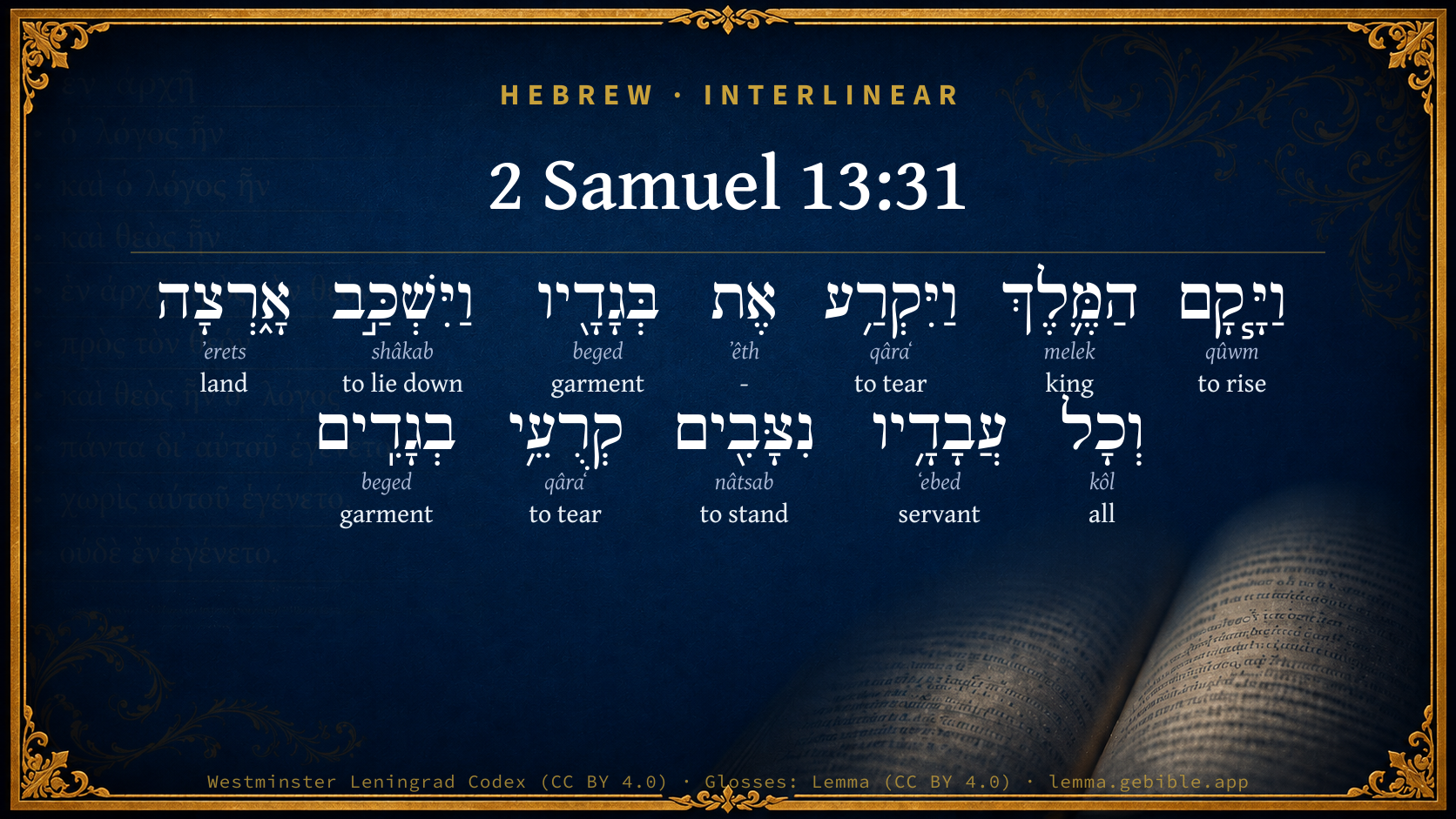
Hebrew (Westminster Leningrad Codex) 2 Samuel 13:31 appears in the Hebrew Old Testament. The text above is from the Westminster Leningrad Codex. Each word links to its Strong’s number, a concise gloss, and parsing drawn from the Open Scriptures Hebrew Bible morphology. Click any word for its full Brown-Driver-Briggs (BDB) entry.
Download image
Cite this verse

2 Samuel 13:31 (World English Bible). Public Domain. Lemma interlinear Bible study tool, https://lemma.gebible.app/v/2-samuel/13/31.

Show BibTeX & RIS
BibTeX
RIS
English Translation
Then the king arose, and tore his garments, and lay on the earth; and all his servants stood by with their clothes torn.
World English Bible · Public Domain
Download a study sheet

One document with this verse’s original text, its word-by-word gloss line, the meaning frame, cross-references with their text, attributed commentary, and full source and license credits — printable, and it pastes into notes with its structure intact.

This verse Autodidact and up

Study sheet (.html) Plain text (.txt)

A passage Seminary Student

Up to 50 verses in one chapter. A passage sheet keeps up to 6 commentary sources and 12 cross-references per verse, in the order this page ranks them, and says so on the sheet whenever that leaves anything out. Ask for a single verse and you get the Autodidact verse sheet above.

Everything on this page stays free to read, with no account — the sheet is a download of what is already on screen, not access to it.

Want to remove ads? Support Godless Engineer
Compare translations 3

The same verse in 3 English versions, stacked beneath the original-language interlinear above. Click any original word for its lexicon entry.

Each is an independent rendering of the whole verse — the interlinear is not word-aligned to these translations.

Highlighted words mark where these versions differ — a whole-verse word diff, not a word-by-word alignment.

  • World English Bible Public Domain
    Then the king arose, and tore his garments, and lay on the earth; and all his servants stood by with their clothes torn.
  • King James Version Public Domain
    Then the king arose, and tare his garments, and lay on the earth; and all his servants stood by with their clothes rent.
  • unfoldingWord Literal Text CC BY-SA 4.0
    And the king arose, and he tore his clothes, and he lay on the ground, and all of his servants were standing, torn of clothes.

unfoldingWord Literal Text — © unfoldingWord, licensed CC BY-SA 4.0. Word-aligned USFM3 via Door43 (git.door43.org/unfoldingWord/en_ult).

Versions to compare (up to 4)

3 of 4 selected

Show all 18 translations

Every available English version of this verse, each an independent rendering of the whole verse.

  • World English Bible Public Domain
    Then the king arose, and tore his garments, and lay on the earth; and all his servants stood by with their clothes torn.
  • Berean Standard Bible Public Domain
    Then the king stood up, tore his clothes, and lay down on the ground; and all his servants stood by with their clothes torn.
  • Majority Standard Bible Public Domain
    Then the king stood up, tore his clothes, and lay down on the ground. And all his servants stood by with their clothes torn.
  • King James Version Public Domain
    Then the king arose, and tare his garments, and lay on the earth; and all his servants stood by with their clothes rent.
  • American Standard Version (1901) Public Domain
    Then the king arose, and rent his garments, and lay on the earth; and all his servants stood by with their clothes rent.
  • Revised Version (1885) Public Domain
    Then the king arose, and rent his garments, and lay on the earth; and all his servants stood by with their clothes rent.
  • Geneva Bible (1599) Public Domain
    Then the King arose, and tare his garments, and lay on the ground, and all his seruants stoode by with their clothes rent.
  • Douay-Rheims (1899) Public Domain
    Then the king rose up, and rent his garments: and fell upon the ground, and all his servants, that stood about him, rent their garments.
  • Young's Literal Translation Public Domain
    and the king riseth, and rendeth his garments, and lieth on the earth, and all his servants are standing by `with' rent garments.
  • Literal Standard Version CC BY-SA 4.0
    and the king rises, and tears his garments, and lies on the earth, and all his servants are standing by [with] torn garments.
  • Unlocked Literal Bible CC BY-SA 4.0
    Then the king arose and tore his clothes, and lay on the floor; all his servants stood by with their clothes torn.
  • unfoldingWord Literal Text CC BY-SA 4.0
    And the king arose, and he tore his clothes, and he lay on the ground, and all of his servants were standing, torn of clothes.
  • Darby Bible Public Domain
    Then the king arose, and rent his garments, and lay on the earth; and all his servants stood by with their garments rent.
  • World Messianic Bible Public Domain
    Then the king arose, and tore his garments, and lay on the earth; and all his servants stood by with their clothes torn.
  • Webster's Bible Public Domain
    Then the king arose, and tore his garments, and lay on the earth; and all his servants stood by with their clothes rent.
  • Free Bible Version CC BY-SA 4.0
    The king stood up, tore his clothes, and lay down on the ground. All his officials stood beside him with their clothes torn.
  • Bible in Basic English Public Domain
    Then the king got up in great grief, stretching himself out on the earth: and all his servants were by his side, with their clothing parted.
  • JPS Tanakh (1917) Public Domain
    Then the king arose, and rent his garments, and lay on the earth; and all his servants stood by with their clothes rent.

Literal Standard Version (2020), Covenant Press — licensed CC BY-SA 4.0. Text via the HelloAO Bible API (eBible.org). Unlocked Literal Bible (unfoldingWord) — licensed CC BY-SA 4.0. Text via the HelloAO Bible API (eBible.org). unfoldingWord Literal Text — © unfoldingWord, licensed CC BY-SA 4.0. Word-aligned USFM3 via Door43 (git.door43.org/unfoldingWord/en_ult). Free Bible Version, Dr. Jonathan Gallagher — licensed CC BY-SA 4.0. Text via the HelloAO Bible API (eBible.org).

Word by word

More ways to search: Search by grammar → Find every occurrence → Compare this word →

Practice this passage: Drill this verse → Learn its vocabulary →

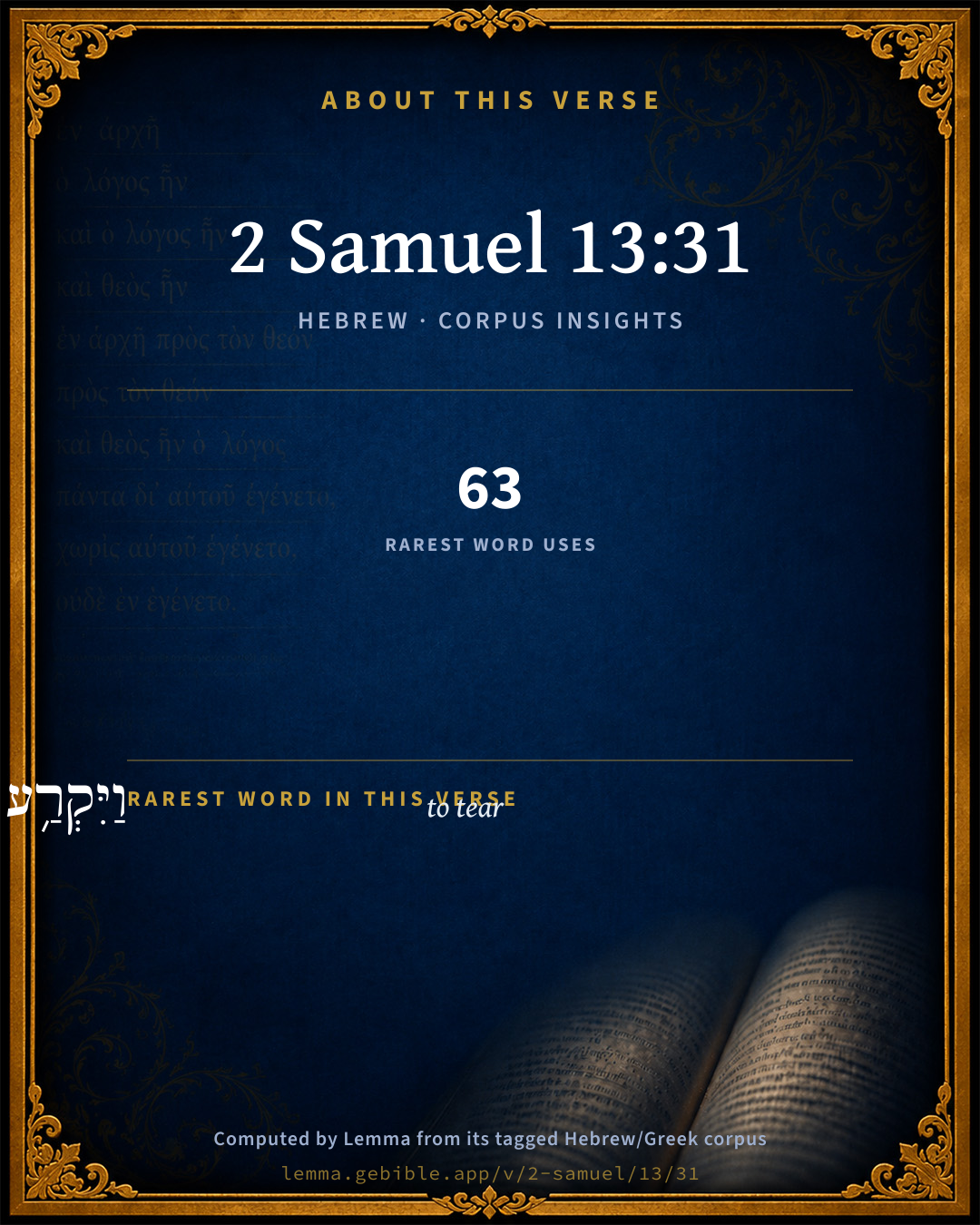
וַיִּקְרַ֥ע
qâraʻ
H7167
“and · to tear”
Conjunction + Verb, Qal, Sequential Imperfect, 3rd Person, Masculine, Singular
Part of Speech
Conjunction + Verb
Stem
Qal
Form
Sequential Imperfect
Person
3rd Person
Gender
Masculine
Number
Singular
Full BDB Definition

Origin: a primitive root

TWOT: 2074

to tear, tear in pieces - (Qal) - to tear, rend - to tear away or out - to tear, rend asunder - to make wide or large (of eyes) - to rend open (of heavens) - to tear, rend (of wild beasts) - (Niphal) to be rent, be split asunder
  1. וַיָּ֧קָם qûwm H6965 “and · to rise” Conjunction + Verb, Qal, Sequential Imperfect, 3rd Person, Masculine, Singular
  2. הַמֶּ֛לֶךְ melek H4428 “the · king” Particle, Definite Article + Noun, Common, Masculine, Singular, Absolute
  3. אֶת ʼêth H853 “-” Particle, Direct Object
  4. בְּגָדָ֖יו beged H899 “garments · his” Noun, Common, Masculine, Plural, Construct + Suffix, Personal, 3rd Person, Masculine, Singular
  5. וַיִּשְׁכַּ֣ב shâkab H7901 “and · to lie down” Conjunction + Verb, Qal, Sequential Imperfect, 3rd Person, Masculine, Singular
  6. אָ֑רְצָה ʼerets H776 “land · toward” Noun, Common, Both, Singular, Absolute + Suffix, Demonstrative
  7. וְכָל kôl H3605 “and · all of” Conjunction + Noun, Common, Masculine, Singular, Construct
  8. עֲבָדָ֥יו ʻebed H5650 “servants · his” Noun, Common, Masculine, Plural, Construct + Suffix, Personal, 3rd Person, Masculine, Singular
  9. נִצָּבִ֖ים nâtsab H5324 “standing” Verb, Niphal, Participle Active, Masculine, Plural, Absolute
  10. קְרֻעֵ֥י qâraʻ H7167 “torn” Verb, Qal, Participle Passive, Masculine, Plural, Construct
  11. בְגָדִֽים beged H899 “garments” Noun, Common, Masculine, Plural, Absolute

About this verse

These counts appear in no published source. They are computed here, from the morphology-tagged text and Lemma’s own curated glosses. What Lemma adds →

12
words
10
distinct lemmas
Historical
section

Grammatical profile

  • 5 verbs
  • 6 nouns
  • 1 particle

Verb forms

  • וַיָּ֧קָם Qal · Sequential Imperfect
  • וַיִּקְרַ֥ע Qal · Sequential Imperfect
  • וַיִּשְׁכַּ֣ב Qal · Sequential Imperfect
  • נִצָּבִ֖ים Niphal · Participle Active
  • קְרֻעֵ֥י Qal · Participle Passive

Repetition

Words recur within this verse — often emphatic in Hebrew:

  • וַיִּקְרַ֥ע to tear H7167 ×2
  • בְּגָדָ֖יו garment H899 ×2

Hebrew & Septuagint length

In English translation the verse runs 23 words from the Hebrew and 25 from the Septuagint (LXX English) — closely comparable.

A rough comparison of the two English renderings, which tokenize alike — not a word-level alignment.

Word counts can differ between the Hebrew and the Greek without any difference in meaning — e.g. the Hebrew direct-object marker אֵת has no separate Greek word, and Greek often adds the article ὁ.

Cross-references

7

Topical passages linked to 2 Samuel 13:31 in the Treasury of Scripture Knowledge — connected by theme and wording, ordered by reader-vote popularity; previews shown in the World English Bible.

  • 2 Samuel 1:11 Then David took hold on his clothes, and tore them; and likewise all the men who were with him:
  • 2 Samuel 12:16 David therefore begged God for the child; and David fasted, and went in, and lay all night on the earth.
  • Genesis 37:29 Reuben returned to the pit; and saw that Joseph wasn't in the pit; and he tore his clothes.
  • Genesis 37:34 Jacob tore his clothes, and put sackcloth on his loins, and mourned for his son many days.
  • Joshua 7:6 Joshua tore his clothes, and fell to the earth on his face before the ark of Yahweh until the evening, he and the elders of Israel; and they put dust on their heads.
  • 2 Samuel 3:31 David said to Joab, and to all the people who were with him, Tear your clothes, and gird you with sackcloth, and mourn before Abner. King David followed the bier.
  • Job 1:20 Then Job arose, and tore his robe, and shaved his head, and fell down on the ground, and worshiped.

Cross-references courtesy of OpenBible.info (CC BY 4.0).

Hebrew and Greek witnesses Masoretic Hebrew ↔ Greek Septuagint

The same verse in the two great witnesses to the Old Testament, shown verse-for-verse.

These are two independent witnesses, not word-aligned to each other, and the Septuagint is shown in lemma (dictionary) form.

Hebrew 2 Samuel 13:31 Masoretic · Westminster Leningrad Codex

וַיָּ֧קָם הַמֶּ֛לֶךְ וַיִּקְרַ֥ע אֶת בְּגָדָ֖יו וַיִּשְׁכַּ֣ב אָ֑רְצָה וְכָל עֲבָדָ֥יו נִצָּבִ֖ים קְרֻעֵ֥י בְגָדִֽים

Then the king arose, and tore his garments, and lay on the earth; and all his servants stood by with their clothes torn.

World English Bible · Public Domain

Greek LXX 2 Samuel 13:31 Septuagint · lemma form

καί ἀναἵστημι ὁ βασιλεύς καί διαῥήγνυμι ὁ ἱμάτιον αὐτός καί κοιμάω ἐπί ὁ γῆ καί πᾶς ὁ παῖς αὐτός ὁ περιἵστημι αὐτός διαῥήγνυμι ὁ ἱμάτιον αὐτός

Then the king arose, and tore his garments, and lay upon the ground: and all his servants that were standing round him tore their garments.

LXX2012 (modern English Septuagint) · Public Domain

Hebrew: Westminster Leningrad Codex (CC BY 4.0). Greek: Septuagint (public domain); English from LXX2012 (modern English Septuagint) (Public Domain). How the Septuagint differs from the Hebrew →

Targum (Aramaic paraphrase)

1

The Targum is the ancient Jewish Aramaic paraphrase of the Hebrew Scriptures — an interpretive translation, not the Hebrew text itself. Onkelos (literal) and Pseudo-Jonathan (expansive) render the Torah, and Jonathan the Prophets. Coverage is partial: where no permissively-licensed English translation exists for a verse, only the Aramaic is shown. This is verse-level text, not a word-by-word alignment to the Hebrew.

  1. Targum Jonathan Prophets (Joshua–Malachi)
    וְקָם מַלְכָּא וּבְזַע יַת לְבוּשׁוֹהִי וּשְׁכִיב עַל אַרְעָא וְכָל עַבְדוֹהִי מְעַתְּדִין כַּד מְבַזְעִין לְבוּשֵׁיהוֹן:

    (no public-domain English translation for this verse)

    Targum Jonathan — Aramaic: “Mikraot Gedolot” (public domain). English: “Sefaria Community Translation” (CC0 1.0 (public-domain dedication)); “London "Chaldee Paraphrase," 1871” (public domain). Text via Sefaria.

Commentary

Notes on 2 Samuel 13:31 from classic Christian and Jewish commentators (each source and its license shown beneath its notes). The classic Christian expositions comment on the surrounding passage and are grouped to its opening verse, so a note may address several verses; the Jewish commentaries on the Tanakh (Rashi and others) are per-verse, so they appear only where the commentator wrote on this verse.

Lemma curates 59 commentaries, every one of them public domain or Creative Commons licensed, each selected and text-cleaned for this edition rather than reprinted as found. About our sources →

Trapp's Complete Commentary

John Trapp

2Sa 13:31 Then the king arose, and tare his garments, and lay on the earth; and all his servants stood by with their clothes rent.

Ver. 31. Then the king arose, and tare his garments.] To show that his heart was torn with extreme sorrow for so sad a disaster. It was the time when he took delight to hear of Uriah’s death: now he smarts for it.

And lay on the earth.] As not able to stand under so importable an affliction.

John Trapp, A Commentary or Exposition upon All the Books of the Old and New Testament (1647–1656) — public domain. Text from a community e-Sword module.

Joseph Benson's Commentary

2Sa 13:31-32. Then the king arose — He was thrown by this news, as we may well imagine, into the utmost consternation, and almost driven even to despair. He tore his clothes, and laid himself down upon the earth, like a person frantic with grief, and abandoned to distress; and his servants stood disconsolate around him with their garments torn also. And Jonadab answered, &c. — Recollecting himself in his subtlety, and running over the train of his own thoughts, he easily concluded that Amnon only was killed; and immediately took upon him to assure the king it must be so. Amnon only is dead; for by the appointment of Absalom, &c. — It is probable Absalom had talked among his familiar friends, that he would take an opportunity to revenge the injury done his sister, although, for the present, he took no notice of it, which Jonadab had some way or other discovered. But “what unparalleled impudence and effrontery,” says Delaney, “was this, to speak with such calmness and unconcern of a horrid villany, which he himself had contrived, and of which he now saw the dreadful consequences! What a miscreant minister was this, and how much fitter to be admitted into the councils of hell than into those of David! This hath been determined from the day that he forced his sister — And did Jonadab know all this? or had he any cause to suspect it? Then what a wicked wretch was he, that he did not make David acquainted with it sooner, in order that means might have been used to make up the quarrel, or, at least, that David might not have thrown Amnon into the mouth of danger, by letting him go to Absalom’s house. For, if we do not do our utmost to prevent mischief, we make ourselves accessory to it. It is well if Jonadab was not as guilty of Amnon’s death as he was of his sin. Such friends do they prove who are hearkened to when they counsel us to do wickedly.

Joseph Benson's Commentary on the Old and New Testaments (1811–1818) — public domain. Text from a community e-Sword module.

Tyndale Open Study Notes

Tyndale Open Resources

13:31 David tore his robe, as Tamar had done after being violated (13:19)—a sign of great distress or remorse (see also Gen 37:34).

Tyndale Open Study Notes — © Tyndale Open Resources, licensed CC BY-SA 4.0. Text via the HelloAO Bible API.

Geneva Bible (1599)

Geneva Bible translators

Lamenting, as he that felt the wrath of God upon his house, 2 Sam. 12:10.

Geneva Bible (1599) marginal notes — public domain. Text via Bolls.life.

Ellicott's Commentary for English Readers

(31) Tare his garments.—Rather, rent his clothes, the words being the same as in the last clause of the verse.

A Bible Commentary for English Readers, edited by Charles John Ellicott (1878–1897) — public domain. Text from a community e-Sword module.

John Gill's Exposition

Then the king arose, and tore his garments,.... In token of extreme grief and sorrow, as Jacob did when he was shown the coat of Joseph, supposing him to have been slain, as David thought all his sons were, Gen 37:34,

and lay on the earth; on the bare ground, another token of mourning; so Job did on hearing the death of his sons, Job 1:20,

and all his servants stood by with their clothes rent: did as David did, in imitation of him, joining with him in expressions of sorrow; these were his courtiers, ministers of state, and principal officers in his household.

John Gill's Exposition of the Whole Bible (1746–1763) — public domain (CC PDM 1.0). Text via the HelloAO Bible API.

Haydock's Catholic Bible Commentary

CHAPTER XIII.

George Leo Haydock (1774–1849), Haydock's Catholic Family Bible and Commentary, 1859 edition — public domain. Excludes Psalms (Douay-Rheims chapter numbering differs from Protestant) and Deuterocanonical books (Catholic canon only).

Keil & Delitzsch

C. F. Keil & F. Delitzsch

The king rent his clothes with horror at such a deed, and sat down upon the ground, and all his servants (courtiers) stood motionless by, with their clothes rent as well. This is the rendering adopted by Bttcher, as נצּב has frequently the idea of standing perfectly motionless (e.g., Num 22:23-24; Exo 5:20, etc.).

Keil & Delitzsch — Biblical Commentary on the Old Testament (1861–1891) — public domain (CC PDM 1.0). Text via the HelloAO Bible API. (Old Testament only.)

Lesson kit

Teaching starters — assembled from the data on this page, not authored interpretation. Every prompt links to the verse data it draws on. Edit before teaching.

2 Samuel, in the Historical, opens this verse with 12 words (10 distinct Hebrew lemmas). Its most distinctive word is qâraʻ (“to tear”). A historical commentator’s framing appears above. Read the whole chapter for the surrounding context.

Discussion questions

  1. The word qâraʻ carries the sense “to tear.” How does it shape the verse?
  2. How does 2 Samuel 1:11, which shares this passage’s theme, read alongside this verse?
  3. What does the repetition of “to tear” (2× in this one verse) do in this verse?
  4. These translations render this verse differently. What is at stake in choosing one wording over another?
  5. «וַיָּ֧קָם» is a Qal Sequential Imperfect verb. How does that grammatical form shape the action described?
  6. Compare how Trapp's Complete Commentary and Joseph Benson's Commentary read this verse. Where do they agree or differ?

Things to notice

Reading settings

Reading text

Shown beneath each verse's original-language words.

Old Testament
Old Testament edition

Read the OT as the Masoretic Hebrew (MT) or the Greek Septuagint (LXX).

English shown for the Greek Septuagint (in the Hebrew ↔ Greek comparison).

Comparing translations? Open the Compare panel on any verse page to stack up to four side by side.