
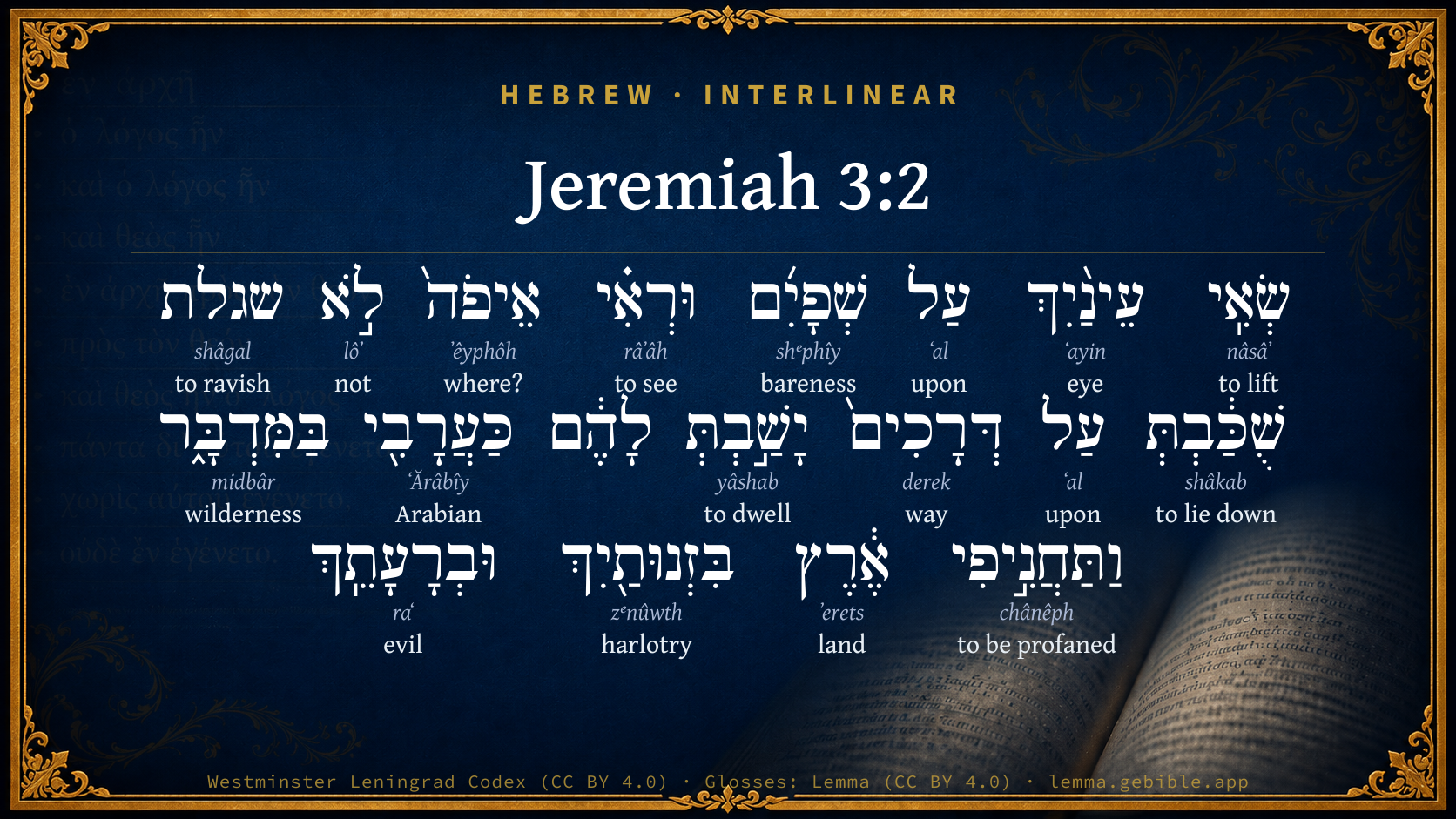
Jeremiah 3:2

Hebrew (Westminster Leningrad Codex) Jeremiah 3:2 appears in the Hebrew Old Testament. The text above is from the Westminster Leningrad Codex. Each word links to its Strong’s number, a concise gloss, and parsing drawn from the Open Scriptures Hebrew Bible morphology. Click any word for its full Brown-Driver-Briggs (BDB) entry.
Download image
Cite this verse

Jeremiah 3:2 (World English Bible). Public Domain. Lemma interlinear Bible study tool, https://lemma.gebible.app/v/jeremiah/3/2.

Show BibTeX & RIS
BibTeX
RIS
English Translation
Lift up your eyes to the bare heights, and see; where have you not been lain with? By the ways have you sat for them, as an Arabian in the wilderness; and you have polluted the land with your prostitution and with your wickedness.
World English Bible · Public Domain
Download a study sheet

One document with this verse’s original text, its word-by-word gloss line, the meaning frame, cross-references with their text, attributed commentary, and full source and license credits — printable, and it pastes into notes with its structure intact.

This verse Autodidact and up

Study sheet (.html) Plain text (.txt)

A passage Seminary Student

Up to 50 verses in one chapter. A passage sheet keeps up to 6 commentary sources and 12 cross-references per verse, in the order this page ranks them, and says so on the sheet whenever that leaves anything out. Ask for a single verse and you get the Autodidact verse sheet above.

Everything on this page stays free to read, with no account — the sheet is a download of what is already on screen, not access to it.

Want to remove ads? Support Godless Engineer
Compare translations 3

The same verse in 3 English versions, stacked beneath the original-language interlinear above. Click any original word for its lexicon entry.

Each is an independent rendering of the whole verse — the interlinear is not word-aligned to these translations.

Highlighted words mark where these versions differ — a whole-verse word diff, not a word-by-word alignment.

  • World English Bible Public Domain
    Lift up your eyes to the bare heights, and see; where have you not been lain with? By the ways have you sat for them, as an Arabian in the wilderness; and you have polluted the land with your prostitution and with your wickedness.
  • King James Version Public Domain
    Lift up thine eyes unto the high places, and see where thou hast not been lien with. In the ways hast thou sat for them, as the Arabian in the wilderness; and thou hast polluted the land with thy whoredoms and with thy wickedness.
  • unfoldingWord Literal Text CC BY-SA 4.0
    Lift up your eyes to the barren heights and see! Where have you not been ravished? By the roads you sat for them, as an Arab in the wilderness. And you have polluted the land with your prostitution and with your evil.

unfoldingWord Literal Text — © unfoldingWord, licensed CC BY-SA 4.0. Word-aligned USFM3 via Door43 (git.door43.org/unfoldingWord/en_ult).

Versions to compare (up to 4)

3 of 4 selected

Show all 18 translations

Every available English version of this verse, each an independent rendering of the whole verse.

  • World English Bible Public Domain
    Lift up your eyes to the bare heights, and see; where have you not been lain with? By the ways have you sat for them, as an Arabian in the wilderness; and you have polluted the land with your prostitution and with your wickedness.
  • Berean Standard Bible Public Domain
    “Lift up your eyes to the barren heights and see. Is there any place where you have not been violated? You sat beside the highways waiting for your lovers, like a nomad in the desert. You have defiled the land with your prostitution and wickedness.
  • Majority Standard Bible Public Domain
    “Lift up your eyes to the barren heights and see. Is there any place where you have not been violated? You sat beside the highways waiting for your lovers, like a nomad in the desert. You have defiled the land with your prostitution and wickedness.
  • King James Version Public Domain
    Lift up thine eyes unto the high places, and see where thou hast not been lien with. In the ways hast thou sat for them, as the Arabian in the wilderness; and thou hast polluted the land with thy whoredoms and with thy wickedness.
  • American Standard Version (1901) Public Domain
    Lift up thine eyes unto the bare heights, and see; where hast thou not been lain with? By the ways hast thou sat for them, as an Arabian in the wilderness; and thou hast polluted the land with thy whoredoms and with thy wickedness.
  • Revised Version (1885) Public Domain
    Lift up thine eyes unto the bare heights, and see; where hast thou not been lain with? By the ways hast thou sat for them, as an Arabian in the wilderness; and thou hast polluted the land with thy whoredoms and with thy wickedness.
  • Geneva Bible (1599) Public Domain
    Lift vp thine eyes vnto the hie places, and beholde, where thou hast not plaied the harlot: thou hast sit waiting for them in the waies, as the Arabian in the wildernesse: and thou hast polluted the lande with thy whoredomes, and with thy malice.
  • Douay-Rheims (1899) Public Domain
    Lift up thy eyes on high: and see where thou hast not prostuted thyself: Thou didst sit in the ways, waiting for them as a robber in the wilderness: and thou hast polluted the land with thy fornications, and with thy wickedness.
  • Young's Literal Translation Public Domain
    Lift thine eyes to the high places, and see, Where hast thou not been lain with? On the ways thou hast sat for them, As an Arab in a wilderness, And thou defilest the land, By thy fornications, and by thy wickedness.
  • Literal Standard Version CC BY-SA 4.0
    “Lift your eyes to the high places, and see, || Where have you not been lain with? You have sat for them on the ways, || As an Arab in a wilderness, || And you defile the land, || By your fornications, and by your wickedness.
  • Unlocked Literal Bible CC BY-SA 4.0
    Lift up your eyes to the barren heights and look! Is there any place where you have not had illicit sex? By the roadsides you sat waiting for your lovers, as an Arab in the wilderness. You have polluted the land with your prostitution and wickedness.
  • unfoldingWord Literal Text CC BY-SA 4.0
    Lift up your eyes to the barren heights and see! Where have you not been ravished? By the roads you sat for them, as an Arab in the wilderness. And you have polluted the land with your prostitution and with your evil.
  • Darby Bible Public Domain
    Lift up thine eyes unto the heights and see, where hast thou not been lain with? In the ways hast thou sat for them, as an Arab in the wilderness; and thou hast polluted the land with thy fornications and with thy wickedness.
  • World Messianic Bible Public Domain
    “Lift up your eyes to the bare heights, and see! Where have you not been lain with? You have sat waiting for them by the road, as an Arabian in the wilderness. You have polluted the land with your prostitution and with your wickedness.
  • Webster's Bible Public Domain
    Lift up thy eyes to the high places, and see where thou hast not been lain with. In the ways hast thou sat for them, as the Arabian in the wilderness; and thou hast polluted the land with thy acts of lewdness, and with thy wickedness.
  • Free Bible Version CC BY-SA 4.0
    Look up at the bare hilltops. Is there anywhere that you haven't had sex? You sat at the roadside like someone from the desert waiting for your lovers to pass by. You have made the land unclean with your prostitution and evil.
  • Bible in Basic English Public Domain
    Let your eyes be lifted up to the open hilltops, and see; where have you not been taken by your lovers? You have been seated waiting for them by the wayside like an Arabian in the waste land; you have made the land unclean with your loose ways and your evil-doing.
  • JPS Tanakh (1917) Public Domain
    Lift up thine eyes unto the high hills, and see: Where hast thou not been lain with? By the ways hast thou sat for them, as an Arabian in the wilderness; and thou hast polluted the land with thy harlotries and with thy wickedness.

Literal Standard Version (2020), Covenant Press — licensed CC BY-SA 4.0. Text via the HelloAO Bible API (eBible.org). Unlocked Literal Bible (unfoldingWord) — licensed CC BY-SA 4.0. Text via the HelloAO Bible API (eBible.org). unfoldingWord Literal Text — © unfoldingWord, licensed CC BY-SA 4.0. Word-aligned USFM3 via Door43 (git.door43.org/unfoldingWord/en_ult). Free Bible Version, Dr. Jonathan Gallagher — licensed CC BY-SA 4.0. Text via the HelloAO Bible API (eBible.org).

Word by word

More ways to search: Search by grammar → Find every occurrence → Compare this word →

Practice this passage: Drill this verse → Learn its vocabulary →

שגלת
shâgal
H7693
“to ravish”
Verb, Pual, Perfect, 2nd Person, Feminine, Singular
Part of Speech
Verb
Stem
Pual
Form
Perfect
Person
2nd Person
Gender
Feminine
Number
Singular
Full BDB Definition

Origin: a primitive root

TWOT: 2327

to violate, ravish - (Qal) to violate, ravish - (Niphal) to be ravished - (Pual) to be ravished
  1. שְׂאִֽי nâsâʼ H5375 “lift” Verb, Qal, Imperative, 2nd Person, Feminine, Singular
  2. עֵינַ֨יִךְ ʻayin H5869 “eyes · your” Noun, Common, Both, Dual, Construct + Suffix, Personal, 2nd Person, Feminine, Singular
  3. עַל ʻal H5921 “upon” Preposition
  4. שְׁפָיִ֜ם shᵉphîy H8205 “bare heights” Noun, Common, Masculine, Plural, Absolute
  5. וּרְאִ֗י râʼâh H7200 “and · see” Conjunction + Verb, Qal, Imperative, 2nd Person, Feminine, Singular
  6. אֵיפֹה֙ ʼêyphôh H375 “where?” Particle, Interrogative
  7. לֹ֣א lôʼ H3808 “not” Particle, Negative
  8. שֻׁכַּ֔בְתְּ shâkab H7901 “to lie down” Verb, Pual, Perfect, 2nd Person, Feminine, Singular
  9. עַל ʻal H5921 “upon” Preposition
  10. דְּרָכִים֙ derek H1870 “ways” Noun, Common, Both, Plural, Absolute
  11. יָשַׁ֣בְתְּ yâshab H3427 “to dwell” Verb, Qal, Perfect, 2nd Person, Feminine, Singular
  12. כַּעֲרָבִ֖י ʻĂrâbîy H6163 “like/as · Arabian” Preposition + Noun, Gentilic, Masculine, Singular, Absolute
  13. בַּמִּדְבָּ֑ר midbâr H4057 “in/at the · wilderness” Preposition, Determined + Noun, Common, Masculine, Singular, Absolute
  14. וַתַּחֲנִ֣יפִי chânêph H2610 “and · to be profaned” Conjunction + Verb, Hiphil, Sequential Imperfect, 2nd Person, Feminine, Singular
  15. אֶ֔רֶץ ʼerets H776 “land” Noun, Common, Both, Singular, Absolute
  16. בִּזְנוּתַ֖יִךְ zᵉnûwth H2184 “in/at · harlotries · your” Preposition + Noun, Common, Feminine, Plural, Construct + Suffix, Personal, 2nd Person, Feminine, Singular
  17. וּבְרָעָתֵֽךְ raʻ H7451 “and · in/at · evil · your” Conjunction + Preposition + Noun, Common, Feminine, Singular, Construct + Suffix, Personal, 2nd Person, Feminine, Singular

About this verse

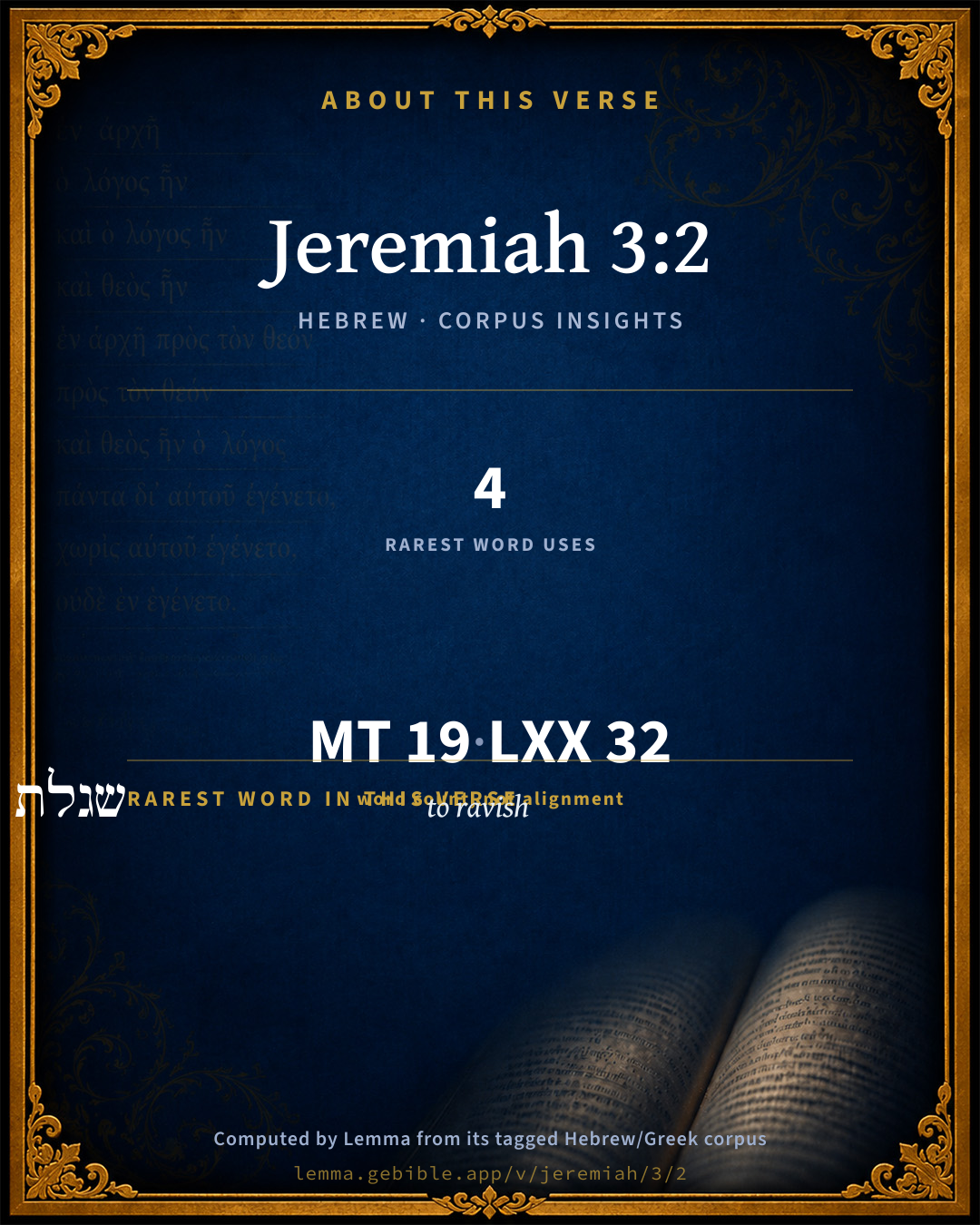
These counts appear in no published source. They are computed here, from the morphology-tagged text and Lemma’s own curated glosses. What Lemma adds →

19
words
17
distinct lemmas
Prophets
section

Notable vocabulary

The rarest word here is שגלת to ravish H7693 — appearing just 4 times in the whole Hebrew Bible.

Shared distinctive vocabulary

שגלת to ravish H7693 occurs in 4 verses of the Hebrew Bible. Also found in:

Grammatical profile

  • 6 verbs
  • 8 nouns
  • 3 prepositions
  • 2 particles

Verb forms

  • שְׂאִֽי Qal · Imperative
  • וּרְאִ֗י Qal · Imperative
  • שגלת Pual · Perfect
  • שֻׁכַּ֔בְתְּ Pual · Perfect
  • יָשַׁ֣בְתְּ Qal · Perfect
  • וַתַּחֲנִ֣יפִי Hiphil · Sequential Imperfect

Repetition

A word recurs within this verse — often emphatic in Hebrew:

Hebrew & Septuagint length

In the original languages it is 19 Hebrew tokens and 32 Greek tokens — but the two are counted differently (Hebrew bundles its prefixes and suffixes into one token; the Greek is in lemma form), so that isn’t a like-for-like length.

Cross-references

18

Topical passages linked to Jeremiah 3:2 in the Treasury of Scripture Knowledge — connected by theme and wording, ordered by reader-vote popularity; previews shown in the World English Bible.

  • Genesis 38:14 She took off of her the garments of her widowhood, and covered herself with her veil, and wrapped herself, and sat in the gate of Enaim, which is by the way to Timnah; for she saw that Shelah was grown up, and she wasn't given to him as a wife.
  • Jeremiah 2:7 I brought you into a plentiful land, to eat the fruit of it and the goodness of it; but when you entered, you defiled my land, and made my heritage an abomination.
  • Jeremiah 2:20 For of old time I have broken your yoke, and burst your bonds; and you said, I will not serve; for on every high hill and under every green tree you did bow yourself, playing the prostitute.
  • Ezekiel 8:4–6 Behold, the glory of the God of Israel was there, according to the appearance that I saw in the plain.
  • Ezekiel 16:24–25 that you have built to you a vaulted place, and have made you a lofty place in every street.
  • Deuteronomy 12:2 You shall surely destroy all the places in which the nations that you shall dispossess served their gods, on the high mountains, and on the hills, and under every green tree:
  • Jeremiah 3:1 They say, If a man put away his wife, and she go from him, and become another man's, will he return to her again? Won't that land be greatly polluted? But you have played the prostitute with many lovers; yet return again to me, says Yahweh.
  • 1 Kings 11:3 He had seven hundred wives, princesses, and three hundred concubines; and his wives turned away his heart.
  • 2 Kings 23:13 The high places that were before Jerusalem, which were on the right hand of the mountain of corruption, which Solomon the king of Israel had built for Ashtoreth the abomination of the Sidonians, and for Chemosh the abomination of Moab, and for Milcom the abomination of the children of Ammon, did the king defile.
  • Proverbs 7:11 She is loud and defiant. Her feet don't stay in her house.
  • Proverbs 23:28 Yes, she lies in wait like a robber, And increases the unfaithful among men.
  • Jeremiah 2:23 How can you say, I am not defiled, I have not gone after the Baals? see your way in the valley, know what you have done: [you are] a swift dromedary traversing her ways;
  • Jeremiah 3:9 It happened through the lightness of her prostitution, that the land was polluted, and she committed adultery with stones and with stocks.
  • Jeremiah 3:21 A voice is heard on the bare heights, the weeping [and] the petitions of the children of Israel; because they have perverted their way, they have forgotten Yahweh their God.
  • Jeremiah 7:29 Cut off your hair, [Jerusalem], and cast it away, and take up a lamentation on the bare heights; for Yahweh has rejected and forsaken the generation of his wrath.
  • Ezekiel 16:16 You took of your garments, and made for yourselves high places decked with various colors, and played the prostitute on them: [the like things] shall not come, neither shall it be [so].
  • Luke 16:23 In Hades, he lifted up his eyes, being in torment, and saw Abraham far off, and Lazarus at his bosom.
  • Ezekiel 20:28 For when I had brought them into the land, which I swore to give to them, then they saw every high hill, and every thick tree, and they offered there their sacrifices, and there they presented the provocation of their offering; there also they made their sweet savor, and they poured out there their drink-offerings.

Cross-references courtesy of OpenBible.info (CC BY 4.0).

Hebrew and Greek witnesses Masoretic Hebrew ↔ Greek Septuagint

The same verse in the two great witnesses to the Old Testament, shown verse-for-verse.

These are two independent witnesses, not word-aligned to each other, and the Septuagint is shown in lemma (dictionary) form.

Hebrew Jeremiah 3:2 Masoretic · Westminster Leningrad Codex

שְׂאִֽי עֵינַ֨יִךְ עַל שְׁפָיִ֜ם וּרְאִ֗י אֵיפֹה֙ לֹ֣א שגלת שֻׁכַּ֔בְתְּ עַל דְּרָכִים֙ יָשַׁ֣בְתְּ לָהֶ֔ם כַּעֲרָבִ֖י בַּמִּדְבָּ֑ר וַתַּחֲנִ֣יפִי אֶ֔רֶץ בִּזְנוּתַ֖יִךְ וּבְרָעָתֵֽךְ

Lift up your eyes to the bare heights, and see; where have you not been lain with? By the ways have you sat for them, as an Arabian in the wilderness; and you have polluted the land with your prostitution and with your wickedness.

World English Bible · Public Domain

Greek LXX Structure differs

In the Septuagint, Jeremiah is about an eighth shorter than the Hebrew and arranges its material differently — the Oracles Against the Nations (Hebrew chapters 46–51) appear in the middle of the Greek book, after 25:13. Because the chapter and verse boundaries do not line up, a verse-for-verse comparison with the Hebrew is not shown.

A verse-for-verse comparison isn’t shown here because the chapters and verses don’t line up. Switch to the LXX edition with the MT / LXX toggle above to read the Greek directly.

On this verse, John Gill's Exposition discusses the Septuagint’s reading. Read the note in Commentary ↓

Hebrew: Westminster Leningrad Codex (CC BY 4.0). Greek: Septuagint (public domain); English from a public-domain English Septuagint. How the Septuagint differs from the Hebrew →

Targum (Aramaic paraphrase)

1

The Targum is the ancient Jewish Aramaic paraphrase of the Hebrew Scriptures — an interpretive translation, not the Hebrew text itself. Onkelos (literal) and Pseudo-Jonathan (expansive) render the Torah, and Jonathan the Prophets. Coverage is partial: where no permissively-licensed English translation exists for a verse, only the Aramaic is shown. This is verse-level text, not a word-by-word alignment to the Hebrew.

  1. Targum Jonathan Prophets (Joshua–Malachi)
    זְקוּפִי עֵינָךְ עַל נָגְדִין וַחֲזָא הֵיכָא לָא אִתְחַבַּרְתְּ לִיךְ לְמִפְלַח לְטַעֲוָתָא עַל אוֹרְחַת בֵּית מֵישָׁרֵיהוֹן אוֹרְכַּת לְהוֹן כַּעֲרָבָאֵי דְשָׁרָן בִשְׁכוּנִין בְּמַדְבְּרָא וְחַיֵבְתְּ אַרְעָא בְּטַעֲוָתִיךְ וּבְבִישְׁתִּיךְ:

    (no public-domain English translation for this verse)

    Targum Jonathan — Aramaic: “Mikraot Gedolot” (public domain). English: “Sefaria Community Translation” (CC0 1.0 (public-domain dedication)); “London "Chaldee Paraphrase," 1871” (public domain). Text via Sefaria.

Commentary

Notes on Jeremiah 3:2 from classic Christian and Jewish commentators (each source and its license shown beneath its notes). The classic Christian expositions comment on the surrounding passage and are grouped to its opening verse, so a note may address several verses; the Jewish commentaries on the Tanakh (Rashi and others) are per-verse, so they appear only where the commentator wrote on this verse.

Lemma curates 59 commentaries, every one of them public domain or Creative Commons licensed, each selected and text-cleaned for this edition rather than reprinted as found. About our sources →

Trapp's Complete Commentary

John Trapp

Jer 3:2 Lift up thine eyes unto the high places, and see where thou hast not been lien with. In the ways hast thou sat for them, as the Arabian in the wilderness; and thou hast polluted the land with thy whoredoms and with thy wickedness.

Ver. 2. And see where thou hast not been lien with.] Pouring out thy spiritual whoredoms, as Papists now do with their crosses, chapels, pictures, set up in all places.

In the ways thou hast sat for them.] For thy customers and copse mates, like a common strumpet. See Gen 38:19 Eze 16:24-25; Eze 16:31.

As the Arabian in the wilderness.] As highway robbers wait for and waylay passengers, making it thy trade.

John Trapp, A Commentary or Exposition upon All the Books of the Old and New Testament (1647–1656) — public domain. Text from a community e-Sword module.

Joseph Benson's Commentary

Jer 3:2. Lift up thine eyes — Do but look and consider whether I charge thee wrongfully or not; unto the high places — The places of thy spiritual whoredoms or idolatries, their false gods being generally worshipped upon the hills and mountains, 2Ki 21:3. Thy idolatries have been so frequent that thou canst scarcely show a place where some false god has not been worshipped. In the ways hast thou sat for them — To allure passengers. Thus the fondness of the people for idolatry is compared to the wantonness of a harlot, who lies in wait for men as for her prey; or, as the Arabian hides himself in the desert, to rob and spoil the unwary traveller. “The Arabs,” says Sir John Chardin, in a manuscript quoted by Harmer, “wait for caravans with the most violent avidity, looking about them on all sides, raising themselves upon their horses, running hither and thither, to see if they can perceive any smoke, or dust, or tracks on the ground, or any other marks of people passing along.” And with thy wickedness — Not only with thy idolatries hast thou polluted the land, but with all thy other wicked courses.

Joseph Benson's Commentary on the Old and New Testaments (1811–1818) — public domain. Text from a community e-Sword module.

Tyndale Open Study Notes

Tyndale Open Resources

3:2 As the Lord’s bride (see 2:2), Israel was not supposed to commit adultery with other gods.

Tyndale Open Study Notes — © Tyndale Open Resources, licensed CC BY-SA 4.0. Text via the HelloAO Bible API.

Geneva Bible (1599)

Geneva Bible translators

Which dwelleth in tents and waiteth for them that pass by to spoil them.

Geneva Bible (1599) marginal notes — public domain. Text via Bolls.life.

Jamieson, Fausset & Brown

Robert Jamieson, A. R. Fausset & David Brown

high places--the scene of idolatries which were spiritual adulteries.

In . . . ways . . . sat for them--watching for lovers like a prostitute (Gen 38:14, Gen 38:21; Pro 7:12; Pro 23:28; Eze 16:24-25), and like an Arab who lies in wait for travellers. The Arabs of the desert, east and south of Palestine, are still notorious as robbers.

Jamieson, Fausset & Brown — Commentary Critical and Explanatory on the Whole Bible (1871) — public domain (CC PDM 1.0). Text via the HelloAO Bible API.

Adam Clarke's Commentary

Verse 2. As the Arabian in the wilderness] They were as fully intent on the practice of their idolatry as the Arab in the desert is in lying in wait to plunder the caravans. Where they have not cover to lie in ambush, they scatter themselves about, and run hither and thither, raising themselves up on their saddles to see if they can discover, by smoke, dust, or other token, the approach of any travellers.

Adam Clarke's Commentary on the Bible (1810–1826) — public domain. Text from a community e-Sword/MySword module.

John Calvin's Commentaries

As the Prophet had charged the Jews with being wanton in a loose and promiscuous manner, as it is the case with abandoned women, after having cast away all shame, that they might not evade the charge and object, that they were not conscious of any crime, he makes them in a manner the judges themselves, Raise up, he says, thine eyes to the high places and see; that is, “I bring forward witnesses sufficiently known to thee; there is no hill in the land where thou hast not been connected with idols.” We have already said, and we shall find the same thing often mentioned by this Prophet, — that superstitions are deemed idolatries by God. But it was a customary thing with the Jews to ascend high places, as though they were there nearer to God. This is the reason why the Prophet bids them to turn their eyes to all the hills: See, he says, whether is there any hill free from thy fornications. For as strumpets seek hiding — places to perpetrate their obscenities, so the Jews sought hills as their brothels. And thus their impiety was the more execrable as they went forth openly, and especially as they wished their flagitious acts to be seen at a distance, ascending, as they did, elevated places; but strumpets, having found adulterers or paramours, are wont to seek some secret retreats. The Prophet then cuts off from the Jews every occasion for evading the charge, when he bids them to raise up their eyes to the high places; for when they prostrated themselves before their idols, it was the same as when strumpets commit acts of adultery.

And he adds, that they sat by the ways, as the Arabian in the desert He again repeats what we have before observed, — that the Jews were not led away by the enticement of others to violate the conjugal pledge which they had given to God, but were, on the contrary, moved by their own wantonness, so that they of themselves sought base and filthy gratifications, he had before said, “Thou hast corrupted others by thy wickedness;” and now he confirms the same, “Thou hast sat, he says, “by all the ways.” This also is what is done by vile strumpets, who, as it has been said, have lost all shame. But the Prophet enhances this crime by another comparison, As an Arabian in the desert, who lies in wait for travelers, that he may rob and kill them: thus hast thou sat by the ways

We then see here a double comparison; one taken from strumpets, who having in time past made gain, when they find themselves neglected, besiege the ways, and offer themselves to any they may meet with. This is the first comparison; the other is, that they were like robbers, who lie in wait for travelers; as though he had said, that the Chaldeans and Egyptians were excusable when compared with the Jews, because they had been drawn by their wicked arts into illicit treaties, like a traveler who passing by is enticed by a robber, — “What art thou but a helpless man; but if thou joinest me, and engagest to be my companion, there is the best prospect of gain, and new spoils will fall into our hands daily.” Such a robber is twice and three times more wicked than the other. So also, the Prophet says of the Jews, that they were like old robbers, who had become hardened in intrigues, in plunders, and in every kind of wickedness, and had enticed to themselves both the Egyptians and the Assyrians. It afterwards follows —

John Calvin's Commentaries (1540-1563) — public domain. Text from the Calvin Translation Society English edition (1840s-50s) via the Christian Classics Ethereal Library (ccel.org). Calvin's coverage is partial (roughly two-thirds of the Bible); uncommented books and verses are honest gaps, never fabricated. The 19th-century editor's footnotes and remarks are omitted so the notes are faithfully Calvin's own voice.

Ellicott's Commentary for English Readers

(2) Lift up thine eyes.—The consciousness of guilt was, however, the only foundation of repentance, and the prophet’s work, therefore, in very tenderness, is to paint that guilt in the darkest colours possible. Still keeping to the parable of the faithless wife, he bids Israel, as such, to look to the “high places” that have witnessed her adulteries with those other lords for whom she had forsaken Jehovah. Like the harlots of the east, she had sat by the wayside, as Tamar had done (Gen_38:14; comp. also Pro_7:12; Eze_16:31), not so much courted by her paramours as courting them.

As the Arabian in the wilderness.—The Arabian is chosen as the representative of the lawless predatory tribes of the desert. As they, like the modern Bedouins, lay in ambush, waiting eagerly for their victims, so had the harlot Israel laid wait for her lovers, and so the land had been polluted.

A Bible Commentary for English Readers, edited by Charles John Ellicott (1878–1897) — public domain. Text from a community e-Sword module.

The Cambridge Bible for Schools and Colleges

gen. ed. J. J. S. Perowne

2. Israel is shameless and wholly given up to idolatrous excesses.

bare heights] a favourite word in this Book (Jer_3:21, Jer_4:11 etc.).

an Arabian in the wilderness] lit. steppe-dwellers (of N. Arabia). See on Jer_25:24. As they lie in wait for companies of travellers passing, so does Israel seek eagerly its unholy rites.

The Cambridge Bible for Schools and Colleges (gen. ed. J. J. S. Perowne; Cambridge University Press, 1878–1918) — public domain. Text from a community e-Sword module.

John Gill's Exposition

Lift up thine eyes unto the high places,.... Where idols were set and worshipped; either places naturally high, as hills and mountains, which were chosen for this service; or high places, artificially made and thrown up for this purpose; see Kg2 17:9, Jarchi interprets the word of "rivulets of water"; and so the Targum, where also idolatry was committed:

and see where thou hast not been lien with; see if there is a hill or mountain, or any high place, where thou hast not committed idolatry; the thing was so notorious, and the facts and instances so many, there was no denying it; every hill and mountain witnessed to their idolatry; to which agrees the Targum,

"see where thou hast not joined thyself to worship idols:''

in the ways hast thou sat for them; for the idolaters, waiting for them, to join with them in their idolatries; as harlots used to sit by the wayside to meet with their lovers, to be picked up by them, or to offer themselves to them as prostitutes, Gen 38:14 which shows that these people were not drawn into idolatry by the temptations and solicitations of others: but they put themselves in the way of it, and solicited it, and others to join with them in it:

as the Arabian in the wilderness; who dwelt in tents in the wilderness, and sat by the wayside to trade with those that passed by; or else lay in wait in desert and by places to rob all that passed by them; and so the Vulgate Latin version renders it,

in the ways thou didst sit, expecting them as a thief in the wilderness; the Arabians being noted for thieves and robbers. The Septuagint, Syriac, and Arabic versions, render it,

as a crow, or raven, of the desert; the same word signifying a "raven" and an "Arabian": see Kg1 17:4,

and thou hast polluted the land with thy whoredoms and with thy wickedness; the land of Judea, where idolatry was so openly and frequently committed, which brought a load of guilt upon it, and exposed it to the wrath and judgments of God; so the Targum,

"thou hast made the land guilty with thine idols and with thy wickedness.''

John Gill's Exposition of the Whole Bible (1746–1763) — public domain (CC PDM 1.0). Text via the HelloAO Bible API.

Albert Barnes' Notes on the Bible

These words are not the language of consolation to the conscience-stricken, but of vehement expostulation with hardened sinners. They prove, therefore, the truth of the interpretation put upon the preceding verse.

As the Arabian ... - The freebooting propensities of the Bedouin had passed in ancient times into a proverb. As eager as the desert-tribes were for plunder, so was Israel for idolatry.

Albert Barnes' Notes on the Bible (1834–1885) — public domain. Text from a community e-Sword/MySword module.

Haydock's Catholic Bible Commentary

High. Literally, "straight forward." (Haydock) --- On the hills, idolatry and immorality prevailed. --- Ways, where harlots used to sit, Genesis xxxviii. 14., and Proverbs vii. 9., and xxxiii. 27. --- Robber; "Arab," (Chaldean, &c.) or "crow." (Septuagint) (Calmet) --- No sin is so great as to be irremissible to the true penitent. (Worthington)

George Leo Haydock (1774–1849), Haydock's Catholic Family Bible and Commentary, 1859 edition — public domain. Excludes Psalms (Douay-Rheims chapter numbering differs from Protestant) and Deuterocanonical books (Catholic canon only).

Matthew Poole's English Annotations

Lift up thine eyes; do but look, and consider whether I do charge thee wrongfully or no.

Unto the high places: he directs her to the places of her whoredoms and idolatries, called

high places, being principally upon hills, 2Ki 21:3, and divers other places, though sometimes in valleys, Jer 2:23; which notes also her impudence, that whereas other whores affected privacy, she should be filthy in the open view.

And see where thou hast not been lien with; thy filthiness has been every where so frequent, that thou canst scarce show a place that hath been free from thy pollutions, Jer 3:6,13, where there are not the footsteps of thy fornications and idolatries.

In the ways, viz. to allure passengers, see Eze 16:24,25 and waiting for them, viz. thy associates; not being drawn by others’ allurements, but thine own lasciviousness.

As the Arabian; an allusion to the manner and custom of that people, either lying in wait by the way for passengers, as robbers use to do, Hos 6:9, they being noted for robbers. Or rather, in way of traffic, that were wont to pitch their tents by the way-sides, that they might meet with their customers to trade, as they passed along; very properly pointing out the practice of harlots. See Pro 7:11,12. Thy wickedness; not only thy idolatries, but all other thy wicked courses.

Matthew Poole's English Annotations on the Holy Bible (1683–1685) — public domain. Text from a community e-Sword/MySword module.

Whedon's Commentary on the Bible

Daniel D. Whedon

2. High places — More exactly, bare-topped hills; the places selected for idolatrous worship, which is here and elsewhere denominated spiritual adultery. Compare Hos_4:13; Num_23:3. As the Arabian, etc. — An allusion to the freebooting propensities of the Bedouins. Eager as they were for plunder, so eager was Israel for idolatry.

Daniel D. Whedon (gen. ed.), Commentary on the Old and New Testaments (1874–1909) — public domain. Text from a community e-Sword module.

The Pulpit Commentary

Lift up thine eyes, etc. No superficial reformation can be called "returning to Jehovah." The prophet, therefore, holds up the mirror to the sinful practices which a sincere repentance must extinguish. The high places; rather, the bare hills. (comp. on Jer_2:20) In the ways hast thou sat for them. By the roadside. (comp. Gen_38:14 Pro_7:12) As the Arabian in the wilderness. So early was the reputation of the Bedouin already won. (comp. Jud_1:6) Jerome ad loc. remarks, "Quae gens latrociniis dedita usque hodie incursat terminos Palaestinae."

The Pulpit Commentary (1880–1919), ed. H.D.M. Spence-Jones & Joseph S. Exell — public domain. Text from a community e-Sword module.

John Wesley's Explanatory Notes

Lien with - Where there are not the footsteps of thy idolaters. Sat - To assure passengers. As the Arabian - An allusion to the custom of that people, who were wont to pitch their tents by the way-sides, that they might meet with their customers to trade, as they passed along. Wickedness - Not only thy idolatries, but other wicked courses.

John Wesley, Explanatory Notes Upon the Whole Bible (1754–1765) — public domain. Text via the GEBible commentary corpus.

Rashi

Rabbi Shlomo Yitzchaki (Rashi)

rivulets rivulets of water.

you were not lain with Heb. שלגת, an expression of a פילגש a concubine.

you sat for them to be prepared to greet them.

like an Arab A tent dweller, who is always found outside in the deserts, and because of this, he is called ערבי since he dwells in the ערבה, the plain.

Rashi on the Tanakh — English translations: “The Judaica Press complete Tanach with Rashi, translated by A. J. Rosenberg” (CC BY 4.0); “Pentateuch with Rashi's commentary by M. Rosenbaum and A.M. Silbermann, 1929-1934” (public domain); “The Metsudah Tanach series, Lakewood, N.J” (CC BY 4.0); and “The Book of Joshua, Metsudah Publications, 1997” (CC BY 4.0). Text via Sefaria.

Lesson kit

Teaching starters — assembled from the data on this page, not authored interpretation. Every prompt links to the verse data it draws on. Edit before teaching.

Jeremiah, in the Prophets, opens this verse with 19 words (17 distinct Hebrew lemmas). Its most distinctive word is shâgal (“to ravish”). A historical commentator’s framing appears above. Read the whole chapter for the surrounding context.

Discussion questions

  1. What does “to ravish” (shâgal) contribute to the verse as a whole?
  2. Deuteronomy 28:30 shares the word «to ravish» with this verse. How do the two illuminate each other?
  3. “upon” occurs 2× in this one verse. What is the effect of the repetition?
  4. These translations render this verse differently; the difference is in the English rendering, not the original. What questions does that raise?
  5. The verb «שְׂאִֽי» is Qal Imperative. How does its form color the action?
  6. Reading how Trapp's Complete Commentary and Joseph Benson's Commentary read this verse, where do the two commentators agree and where do they part?

Things to notice

Reading settings

Reading text

Shown beneath each verse's original-language words.

Old Testament
Old Testament edition

Read the OT as the Masoretic Hebrew (MT) or the Greek Septuagint (LXX).

English shown for the Greek Septuagint (in the Hebrew ↔ Greek comparison).

Comparing translations? Open the Compare panel on any verse page to stack up to four side by side.