1 Kings 16:28

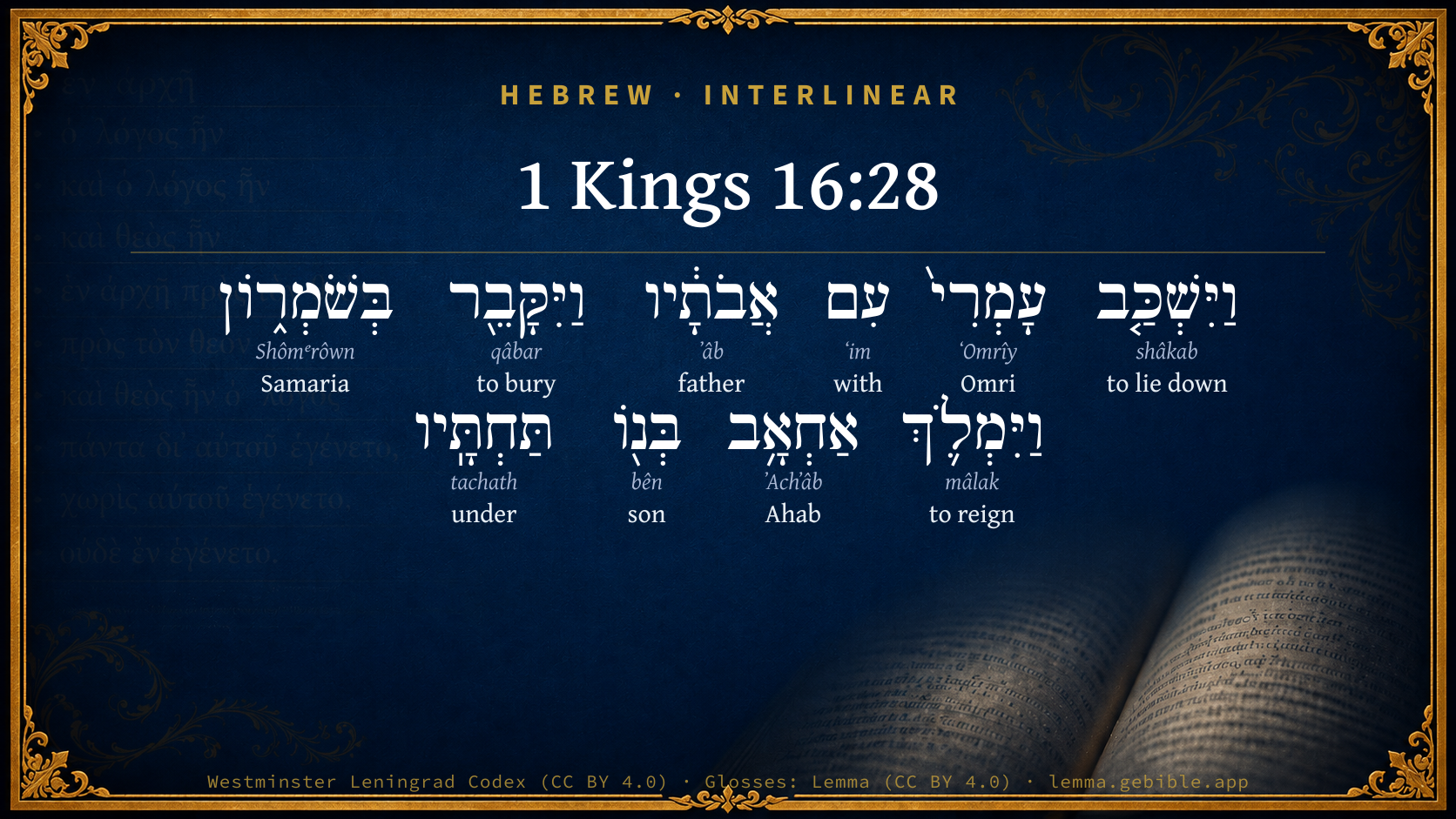
Hebrew (Westminster Leningrad Codex) 1 Kings 16:28 appears in the Hebrew Old Testament. The text above is from the Westminster Leningrad Codex. Each word links to its Strong’s number, a concise gloss, and parsing drawn from the Open Scriptures Hebrew Bible morphology. Click any word for its full Brown-Driver-Briggs (BDB) entry.
Download image
Cite this verse

1 Kings 16:28 (World English Bible). Public Domain. Lemma interlinear Bible study tool, https://lemma.gebible.app/v/1-kings/16/28.

Show BibTeX & RIS
BibTeX
RIS
English Translation
So Omri slept with his fathers, and was buried in Samaria; and Ahab his son reigned in his place.
World English Bible · Public Domain
Highlights Full analysis ↓
Download a study sheet

One document with this verse’s original text, its word-by-word gloss line, the meaning frame, cross-references with their text, attributed commentary, and full source and license credits — printable, and it pastes into notes with its structure intact.

This verse Autodidact and up

Study sheet (.html) Plain text (.txt)

A passage Seminary Student

Up to 50 verses in one chapter. A passage sheet keeps up to 6 commentary sources and 12 cross-references per verse, in the order this page ranks them, and says so on the sheet whenever that leaves anything out. Ask for a single verse and you get the Autodidact verse sheet above.

Everything on this page stays free to read, with no account — the sheet is a download of what is already on screen, not access to it.

Want to remove ads? Support Godless Engineer
Compare translations 3

The same verse in 3 English versions, stacked beneath the original-language interlinear above. Click any original word for its lexicon entry.

Each is an independent rendering of the whole verse — the interlinear is not word-aligned to these translations.

Highlighted words mark where these versions differ — a whole-verse word diff, not a word-by-word alignment.

  • World English Bible Public Domain
    So Omri slept with his fathers, and was buried in Samaria; and Ahab his son reigned in his place.
  • King James Version Public Domain
    So Omri slept with his fathers, and was buried in Samaria: and Ahab his son reigned in his stead.
  • unfoldingWord Literal Text CC BY-SA 4.0
    And Omri lay down with his fathers, and he was buried in Samaria. And Ahab his son reigned in his place.

unfoldingWord Literal Text — © unfoldingWord, licensed CC BY-SA 4.0. Word-aligned USFM3 via Door43 (git.door43.org/unfoldingWord/en_ult).

Versions to compare (up to 4)

3 of 4 selected

Show all 18 translations

Every available English version of this verse, each an independent rendering of the whole verse.

  • World English Bible Public Domain
    So Omri slept with his fathers, and was buried in Samaria; and Ahab his son reigned in his place.
  • Berean Standard Bible Public Domain
    And Omri rested with his fathers and was buried in Samaria, and his son Ahab reigned in his place.
  • Majority Standard Bible Public Domain
    And Omri rested with his fathers and was buried in Samaria, and his son Ahab reigned in his place.
  • King James Version Public Domain
    So Omri slept with his fathers, and was buried in Samaria: and Ahab his son reigned in his stead.
  • American Standard Version (1901) Public Domain
    So Omri slept with his fathers, and was buried in Samaria; and Ahab his son reigned in his stead.
  • Revised Version (1885) Public Domain
    So Omri slept with his fathers, and was buried in Samaria: and Ahab his son reigned in his stead.
  • Geneva Bible (1599) Public Domain
    And Omri slept with his fathers, and was buryed in Samaria: and Ahab his sonne reigned in his stead.
  • Douay-Rheims (1899) Public Domain
    And d Amri slept with his fathers, and was buried in Samaria, and Achab his son reigned in his stead.
  • Young's Literal Translation Public Domain
    And Omri lieth with his fathers, and is buried in Samaria, and Ahab his son reigneth in his stead.
  • Literal Standard Version CC BY-SA 4.0
    And Omri lies with his fathers, and is buried in Samaria, and his son Ahab reigns in his stead.
  • Unlocked Literal Bible CC BY-SA 4.0
    So Omri slept with his ancestors and was buried in Samaria and Ahab his son became king in his place.
  • unfoldingWord Literal Text CC BY-SA 4.0
    And Omri lay down with his fathers, and he was buried in Samaria. And Ahab his son reigned in his place.
  • Darby Bible Public Domain
    And Omri slept with his fathers, and was buried in Samaria; and Ahab his son reigned in his stead.
  • World Messianic Bible Public Domain
    So Omri slept with his fathers, and was buried in Samaria; and Ahab his son reigned in his place.
  • Webster's Bible Public Domain
    So Omri slept with his fathers, and was buried in Samaria: and Ahab his son reigned in his stead.
  • Free Bible Version CC BY-SA 4.0
    Omri died and was buried in Samaria. His son Ahab succeeded him as king.
  • Bible in Basic English Public Domain
    So Omri went to rest with his fathers, and was put into the earth in Samaria; and Ahab his son became king in his place.
  • JPS Tanakh (1917) Public Domain
    And Omri slept with his fathers, and was buried in Samaria; and Ahab his son reigned in his stead.

Literal Standard Version (2020), Covenant Press — licensed CC BY-SA 4.0. Text via the HelloAO Bible API (eBible.org). Unlocked Literal Bible (unfoldingWord) — licensed CC BY-SA 4.0. Text via the HelloAO Bible API (eBible.org). unfoldingWord Literal Text — © unfoldingWord, licensed CC BY-SA 4.0. Word-aligned USFM3 via Door43 (git.door43.org/unfoldingWord/en_ult). Free Bible Version, Dr. Jonathan Gallagher — licensed CC BY-SA 4.0. Text via the HelloAO Bible API (eBible.org).

Word by word

More ways to search: Search by grammar → Find every occurrence → Compare this word →

Practice this passage: Drill this verse → Learn its vocabulary →

עָמְרִי֙
ʻOmrîy
H6018
“Omri”
Noun, Proper
Part of Speech
Noun
Type
Proper
Full BDB Definition

Origin: from H6014

TWOT: None

Omri = "pupil of Jehovah" - king of the northern kingdom of Israel, successor to king Elah for whom he was the captain of the army; ruled for 12 years and succeeded by his infamous son Ahab - one of the sons of Becher the son of Benjamin - a descendant of Pharez the son of Judah - son of Michael and chief of the tribe of Issachar in the time of David
  1. וַיִּשְׁכַּ֤ב shâkab H7901 “and · to lie down” Conjunction + Verb, Qal, Sequential Imperfect, 3rd Person, Masculine, Singular
  2. עִם ʻim H5973 “with” Preposition
  3. אֲבֹתָ֔יו ʼâb H1 “fathers · his” Noun, Common, Masculine, Plural, Construct + Suffix, Personal, 3rd Person, Masculine, Singular
  4. וַיִּקָּבֵ֖ר qâbar H6912 “and · to bury” Conjunction + Verb, Niphal, Sequential Imperfect, 3rd Person, Masculine, Singular
  5. בְּשֹׁמְר֑וֹן Shômᵉrôwn H8111 “in/at · Samaria” Preposition + Noun, Proper
  6. וַיִּמְלֹ֛ךְ mâlak H4427 “and · to reign” Conjunction + Verb, Qal, Sequential Imperfect, 3rd Person, Masculine, Singular
  7. אַחְאָ֥ב ʼAchʼâb H256 “Ahab” Noun, Proper
  8. בְּנ֖וֹ bên H1121 “son · his” Noun, Common, Masculine, Singular, Construct + Suffix, Personal, 3rd Person, Masculine, Singular
  9. תַּחְתָּֽיו tachath H8478 “under · him” Preposition + Suffix, Personal, 3rd Person, Masculine, Singular

About this verse

These counts appear in no published source. They are computed here, from the morphology-tagged text and Lemma’s own curated glosses. What Lemma adds →

10
words
10
distinct lemmas
Historical
section

Notable vocabulary

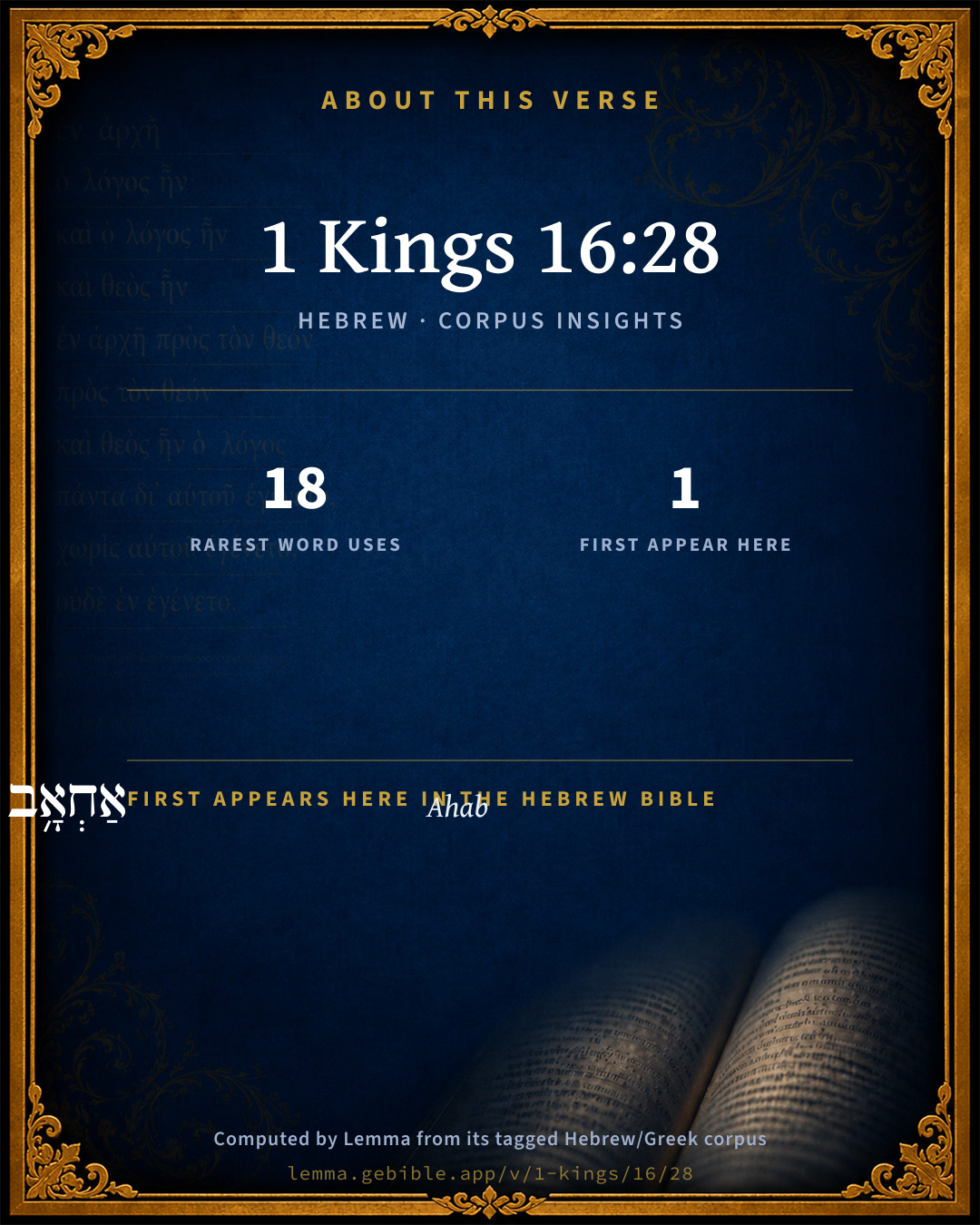
The rarest word here is עָמְרִי֙ Omri H6018 — appearing just 18 times in the whole Hebrew Bible.

First appearance in Scripture

This word makes its first canonical appearance in the Hebrew Bible here:

  • אַחְאָ֥ב Ahab H256

Shared distinctive vocabulary

עָמְרִי֙ Omri H6018 occurs in 16 verses of the Hebrew Bible. Also found in:

Grammatical profile

  • 3 verbs
  • 5 nouns
  • 2 prepositions

Verb forms

  • וַיִּשְׁכַּ֤ב Qal · Sequential Imperfect
  • וַיִּקָּבֵ֖ר Niphal · Sequential Imperfect
  • וַיִּמְלֹ֛ךְ Qal · Sequential Imperfect

Hebrew & Septuagint length

In English translation the verse runs 19 words from the Hebrew and 250 from the Septuagint (LXX English) — the Septuagint runs noticeably longer here. See the side-by-side →

A rough comparison of the two English renderings, which tokenize alike — not a word-level alignment.

Word counts can differ between the Hebrew and the Greek without any difference in meaning — e.g. the Hebrew direct-object marker אֵת has no separate Greek word, and Greek often adds the article ὁ.

Hebrew and Greek witnesses Masoretic Hebrew ↔ Greek Septuagint

The same verse in the two great witnesses to the Old Testament, shown verse-for-verse.

Here the Septuagint runs noticeably longer than the Hebrew — LXX2012 (modern English Septuagint) 250 words vs World English Bible 19. A rough length comparison of the two English translations, not a word-level alignment — read both below.

These are two independent witnesses, not word-aligned to each other, and the Septuagint is shown in lemma (dictionary) form.

Hebrew 1 Kings 16:28 Masoretic · Westminster Leningrad Codex

וַיִּשְׁכַּ֤ב עָמְרִי֙ עִם אֲבֹתָ֔יו וַיִּקָּבֵ֖ר בְּשֹׁמְר֑וֹן וַיִּמְלֹ֛ךְ אַחְאָ֥ב בְּנ֖וֹ תַּחְתָּֽיו

So Omri slept with his fathers, and was buried in Samaria; and Ahab his son reigned in his place.

World English Bible · Public Domain

Greek LXX 1 Kings 16:28 Septuagint · lemma form

καί κοιμάω αμβρι μετά ὁ πατήρ αὐτός καί θάπτω ἐν σαμαρεία καί βασιλεύω αχααβ υἱός αὐτός ἀντί αὐτός καί ἐν ὁ ἐνιαυτός ὁ ἑνδέκατος ὁ αμβρι βασιλεύω ιωσαφατ υἱός ασα ἔτος τριάκοντα καί πέντε ἐν ὁ βασιλεία αὐτός καί εἴκοσι πέντε ἔτος βασιλεύω ἐν ἰερουσαλήμ καί ὄνομα ὁ μήτηρ αὐτός γαζουβα θυγάτηρ σελεϊ καί πορεύομαι ἐν ὁ ὁδός ασα ὁ πατήρ αὐτός καί οὐ ἐκκλίνω ἀπό αὐτός ὁ ποιέω ὁ εὐθής ἐνώπιον κύριος πλήν ὁ ὑψηλός οὐ ξηρός θύω ἐν ὁ ὑψηλός καί θυμιάζω καί ὅς συντίθημι ιωσαφατ καί πᾶς ὁ δυναστεία ὅς ποιέω καί ὅς πολεμέω οὐ ἰδού οὗτος γράφω ἐν βιβλίον λόγος ὁ ἡμέρα ὁ βασιλεύς ιουδα καί ὁ λοιπός ὁ συμπλοκῶν ὅς ἐπιτίθημι ἐν ὁ ἡμέρα ασα ὁ πατήρ αὐτός ἐκαἴρω ἀπό ὁ γῆ καί βασιλεύς οὐ εἰμί ἐν συρία νασιβ καί ὁ βασιλεύς ιωσαφατ ποιέω ναῦς εἰς θαρσις πορεύομαι εἰς σωφιρ ἐπί ὁ χρυσίον καί οὐ πορεύομαι ὅτι συντρίβω ὁ ναῦς ἐν γασιωνγαβερ τότε εἶπον ὁ βασιλεύς ἰσραήλ πρός ιωσαφατ ἐκ ἀποστέλλω ὁ παῖς σύ καί ὁ παιδάριον ἐγώ ἐν ὁ ναῦς καί οὐ βούλομαι ιωσαφατ καί κοιμάω ιωσαφατ μετά ὁ πατήρ αὐτός καί θάπτω μετά ὁ πατήρ αὐτός ἐν πόλις δαυίδ καί βασιλεύω ιωραμ υἱός αὐτός ἀντί αὐτός

And Ambri slept with his fathers, and is buried in Samaria; and Achaab his son reigns in his stead. And in the eleventh year of Ambri Josaphat the son of Asa reigns, being thirty-five years old in the beginning of his reign, and he reigned twenty-five years in Jerusalem: and his mother's name was Gazuba, daughter of Seli. And he walked in the way of Asa his father, and turned not from it, even from doing right in the eyes of the Lord: only they removed not any of the high places; they sacrificed and burnt incense on the high places. Now the engagements which Josaphat made with the king of Israel, and all his mighty deeds which he performed, and the enemies whom he fought against, behold, are not these written in the book of the chronicles of the kings of Juda? and the remains of the prostitution which they practiced in the days of Asa his father, he removed out of the land: and there was no king in Syria, but a deputy. And king Josaphat made a ship at Tharsis to go to Sophir for gold: but it went not, for the ship was broken at Gasion Gaber. Then the king of Israel said to Josaphat, I will send forth your servants and my servants in the ship: but Josaphat would not. And Josaphat slept with his fathers, and is buried with his fathers in the city of David: and Joram his son reigned in his stead.

LXX2012 (modern English Septuagint) · Public Domain

On this verse, The Cambridge Bible for Schools and Colleges discusses the Septuagint’s reading. Read the note in Commentary ↓

Hebrew: Westminster Leningrad Codex (CC BY 4.0). Greek: Septuagint (public domain); English from LXX2012 (modern English Septuagint) (Public Domain). How the Septuagint differs from the Hebrew →

Targum (Aramaic paraphrase)

1

The Targum is the ancient Jewish Aramaic paraphrase of the Hebrew Scriptures — an interpretive translation, not the Hebrew text itself. Onkelos (literal) and Pseudo-Jonathan (expansive) render the Torah, and Jonathan the Prophets. Coverage is partial: where no permissively-licensed English translation exists for a verse, only the Aramaic is shown. This is verse-level text, not a word-by-word alignment to the Hebrew.

  1. Targum Jonathan Prophets (Joshua–Malachi)
    וּשְׁכִיב עָמְרִי עִם אֲבָהָתוֹהִי וְאִתְקְבַר בְּשׁוֹמְרוֹן וּמְלַךְ אַחְאָב בְּרֵיהּ תְּחוֹתֵיהּ:

    (no public-domain English translation for this verse)

    Targum Jonathan — Aramaic: “Mikraot Gedolot” (public domain). English: “Sefaria Community Translation” (CC0 1.0 (public-domain dedication)); “London "Chaldee Paraphrase," 1871” (public domain). Text via Sefaria.

Commentary

Notes on 1 Kings 16:28 from classic Christian and Jewish commentators (each source and its license shown beneath its notes). The classic Christian expositions comment on the surrounding passage and are grouped to its opening verse, so a note may address several verses; the Jewish commentaries on the Tanakh (Rashi and others) are per-verse, so they appear only where the commentator wrote on this verse.

Lemma curates 59 commentaries, every one of them public domain or Creative Commons licensed, each selected and text-cleaned for this edition rather than reprinted as found. About our sources →

Trapp's Complete Commentary

John Trapp

1Ki 16:28 So Omri slept with his fathers, and was buried in Samaria: and Ahab his son reigned in his stead.

Ver. 28. And was buried in Samaria.] Herein he sped better than his betters. It is well observed by Augustine, {a} that God punisheth some wicked ones here, lest his providence - and not all, lest his patience and promise of judgment - should be called into question.

{a} In Ps. xxx.

John Trapp, A Commentary or Exposition upon All the Books of the Old and New Testament (1647–1656) — public domain. Text from a community e-Sword module.

The Biblical Illustrator

Joseph S. Exell

1Ki_16:28

Omri slept with his fathers . . . Ahab his son reigned in his stead.

Omri and Ahab

A careful study of the two kingdoms, Israel and Judah, compels one to feel that communities do the best when they most honour God, and that forgetfulness of Him, and especially revolt from Him, brings disturbance and destruction. It is true these events transpired more than two thousand five hundred years ago, but they are written for our learning. Why should they be if there is nothing that we need to learn from them?

1. We need not trouble ourselves with the settling of the periods making up the dozen years of Omris reign, which had its opening portion in Tirzah, the royal seat (1Ki_16:17). Omri had ability of a certain sort, and hence, probably, was able to secure the adhesion of so many of the people and the conquest of his two rivals. He showed it in the selection of a new capital. Shemer owned a tract of land with a hill of great strategic value. With an opening out into the wider distant plain through the level grounds which divided it elsewhere, all around, from the mountains, it had on one side a gentle slope, and on all the others it was easily made strong against an enemy, when bows and arrows and spears constituted the common weapons of assault. The town got its name from him who owned the hill, and most fitly, for it was the synonym of watch-tower, the very thing at which Omri aimed, having in mind through the slaughter of how many enemies he had to wade to the throne, and how necessary it was to be strong against any future assaults. They who part with Jehovah as Guide and Protector, and trust to human resources, need to multiply these to the utmost. Jeroboam had not flung off God formally. He had only modified the way of serving Him. He had set up the calves. This was politic, expedient, necessary. It was in harmony too with the ways of the nations. This was the Way of Jeroboam the son of Nebat (1Ki_16:26). It was not the way of loyalty to Jehovah; it was not the way of truth. It was the way of disobedience under the inspiration of policy. Between this sin and the others that followed it was only a question of degree, not of kind. Set up taste, usage, popular craving, fashion, artistic completeness, or anything else as changing, modifying the method of Divine appointment, and you enter on the inclined plane. How far down and how fast you will go is determined by circumstances. So Omris working evil in the eyes of the Lord, and doing worse than all that were before him (1Ki_16:25), is only walking in all the way of Jeroboam the son of Nebat, and in his corrupting and contaminating sin. So it is ever. Given the supremacy of Peter, then his control of all things, secular and sacred; then his infallibility! What was the effect of all these modifications? Toward man, to keep Israel together and from union with Judah. But in the other and higher direction--toward God--the effect was to provoke (1Ki_16:26) the Lord God of Israel to anger with their vanities. (See, for the statutes of Omri, Mic_6:16.) When Omri died, the chronicles of the kings of Israel (1Ki_16:27) containing the record of his deeds, they buried him in his capital, Samaria, and the throne fell to his son Ahab in the thirty-eighth year of Asa of Judah (1Ki_16:29), and about nine hundred and eighteen years before the coming of our Lord. His career is as full of darkness and weakness as a kings life could well be. His reign of twenty-two years was a continued curse to the people. He held on the way of his father, but, according to the common rule in such cases, descending lower and lower. Moral rottenness, like material putrefaction, must increase. Evil men and seducers wax worse and worse, deceiving and being deceived. He married Jezebel, the daughter of Ethbaal, King of the Zidonians. We are not surprised at the character of the daughter when we know the career of her father as it is learned from outside history. Among the innovations of Ahab our version mentions a grove, a misleading word into which the translators were led from its being really an idolatrous image or group of images, including the sacred symbolic tree so frequently seen in Assyrian monuments. That it could not be a grove, a wood, is clear from 2Ki_22:4, where Josiah brought out the grove--asherah in Hebrew--from the house of the Lord. It was doubtless a new and imposing idol, in keeping with the luxurious life now being lived by the Israelites as wealth grew through commerce.

(1) There is a real connection between the moral and religious condition of a nation and its temporal affairs. If we as a people defy God or disregard His, laws, He in His government of the world may be expected to show that He is contrary to us.

(2) The temptation is always great to Gods people to be like their neighbours; and if these neighbours be cultivated, be deemed standards of excellence in arts, in manners, or in arms; if they be wealthy; if their trade is of importance to us; if they be powerful and it is our interest to stand well with them--the inducements to conformity are all the greater. The distinctive elements of our religion are set aside. Why thrust our Bibles, our family worship, our Sabbaths, on them? True, God says of us that we are to be holding forth the Word of life. Ah, yes, but that was in other circumstances.

(3) The next step is to take up the ways of our friends. Much in their methods can be described as nice, impressive, beautiful--especially if we have taken their standard of loveliness; and, having done this, there is a stage of attempted combination. But it is awkward, difficult--in the end possible. One or other must go. And when man is choosing between his own products and Gods orders, he prefers his own. So the light is superseded by the darkness; spiritual religion gives place to impressive forms, which put no check on tastes or lusts or passions, and make no conscience uncomfortable, while sin is swallowed as a sweet morsel. (J. Hall, D. D.)

.

The Biblical Illustrator, edited by Joseph S. Exell (c. 1880s–1900s) — public domain. Text from a community e-Sword module.

Joseph Benson's Commentary

1Ki 16:28. So Omri slept with his fathers — He died in his bed, as Jeroboam and Baasha had done; but like them, left it to his posterity to fill up the measure, and then pay off the scores of his iniquity.

Joseph Benson's Commentary on the Old and New Testaments (1811–1818) — public domain. Text from a community e-Sword module.

Geneva Bible (1599)

Geneva Bible translators

He was the first king that was buried in Samaria, after that the kings house was burnt in Tirzah.

Geneva Bible (1599) marginal notes — public domain. Text via Bolls.life.

The Cambridge Bible for Schools and Colleges

gen. ed. J. J. S. Perowne

28. At the close of this verse the LXX. inserts words almost identical with chap. 1Ki_22:41-50, about the accession and the acts of Jehoshaphat. The only variation worth noting is that it is said that Jehoshaphat began to reign in the eleventh year of Omri, whereas in 1Ki_22:41, the date of his accession is given as the fourth year of Ahab. And this latter date the LXX. gives in 22, where, with this change, the passage is inserted once more.

The Cambridge Bible for Schools and Colleges (gen. ed. J. J. S. Perowne; Cambridge University Press, 1878–1918) — public domain. Text from a community e-Sword module.

The Pulpit Commentary

So Omri slept with his fathers, and was buried in Samaria After the example of earlier kings, he found a grave in his capital city; (cf. 1Ki_2:10 1Ki_11:43 1Ki_14:31 1Ki_16:16) and Ahab his son reigned In his stead.

The Pulpit Commentary (1880–1919), ed. H.D.M. Spence-Jones & Joseph S. Exell — public domain. Text from a community e-Sword module.

Lesson kit

Teaching starters — assembled from the data on this page, not authored interpretation. Every prompt links to the verse data it draws on. Edit before teaching.

1 Kings, in the Historical, opens this verse with 10 words (10 distinct Hebrew lemmas). Its most distinctive word is ʻOmrîy (“Omri”). The Greek Septuagint runs longer here. A historical commentator’s framing appears above. Read the whole chapter for the surrounding context.

Discussion questions

  1. How does “Omri” (ʻOmrîy) shape what this verse is saying?
  2. The word “Ahab” first appears here in Scripture. What is being introduced at this debut?
  3. 1 Kings 16:16 shares the word «Omri» with this verse. How do the two illuminate each other?
  4. Compared with the Hebrew, the Septuagint runs longer here. What questions does that raise?
  5. These translations render this verse differently. What is at stake in choosing one wording over another?
  6. The verb «וַיִּשְׁכַּ֤ב» is Qal Sequential Imperfect. How does its form color the action?
  7. Reading how Trapp's Complete Commentary and The Biblical Illustrator read this verse, where do the two commentators agree and where do they part?

Things to notice

  • 1 word makes its first canonical appearance in Scripture here.
  • These translations choose different wording for 5 words in this verse.
  • 10 distinct Hebrew lemmas span 10 words in this verse.

Reading settings

Reading text

Shown beneath each verse's original-language words.

Old Testament
Old Testament edition

Read the OT as the Masoretic Hebrew (MT) or the Greek Septuagint (LXX).

English shown for the Greek Septuagint (in the Hebrew ↔ Greek comparison).

Comparing translations? Open the Compare panel on any verse page to stack up to four side by side.