2 Samuel 11:9

Hebrew (Westminster Leningrad Codex) 2 Samuel 11:9 appears in the Hebrew Old Testament. The text above is from the Westminster Leningrad Codex. Each word links to its Strong’s number, a concise gloss, and parsing drawn from the Open Scriptures Hebrew Bible morphology. Click any word for its full Brown-Driver-Briggs (BDB) entry.
Download image
Cite this verse

2 Samuel 11:9 (World English Bible). Public Domain. Lemma interlinear Bible study tool, https://lemma.gebible.app/v/2-samuel/11/9.

Show BibTeX & RIS
BibTeX
RIS
English Translation
But Uriah slept at the door of the king's house with all the servants of his lord, and didn't go down to his house.
World English Bible · Public Domain
Download a study sheet

One document with this verse’s original text, its word-by-word gloss line, the meaning frame, cross-references with their text, attributed commentary, and full source and license credits — printable, and it pastes into notes with its structure intact.

This verse Autodidact and up

Study sheet (.html) Plain text (.txt)

A passage Seminary Student

Up to 50 verses in one chapter. A passage sheet keeps up to 6 commentary sources and 12 cross-references per verse, in the order this page ranks them, and says so on the sheet whenever that leaves anything out. Ask for a single verse and you get the Autodidact verse sheet above.

Everything on this page stays free to read, with no account — the sheet is a download of what is already on screen, not access to it.

Want to remove ads? Support Godless Engineer
Compare translations 3

The same verse in 3 English versions, stacked beneath the original-language interlinear above. Click any original word for its lexicon entry.

Each is an independent rendering of the whole verse — the interlinear is not word-aligned to these translations.

Highlighted words mark where these versions differ — a whole-verse word diff, not a word-by-word alignment.

  • World English Bible Public Domain
    But Uriah slept at the door of the king's house with all the servants of his lord, and didn't go down to his house.
  • King James Version Public Domain
    But Uriah slept at the door of the king's house with all the servants of his lord, and went not down to his house.
  • unfoldingWord Literal Text CC BY-SA 4.0
    But Uriah lay down the entrance of the house of the king with all of the servants of his master, and he did not go down to his house.

unfoldingWord Literal Text — © unfoldingWord, licensed CC BY-SA 4.0. Word-aligned USFM3 via Door43 (git.door43.org/unfoldingWord/en_ult).

Versions to compare (up to 4)

3 of 4 selected

Show all 18 translations

Every available English version of this verse, each an independent rendering of the whole verse.

  • World English Bible Public Domain
    But Uriah slept at the door of the king's house with all the servants of his lord, and didn't go down to his house.
  • Berean Standard Bible Public Domain
    But Uriah slept at the door of the palace with all his master’s servants; he did not go down to his house.
  • Majority Standard Bible Public Domain
    But Uriah slept at the door of the palace with all his master’s servants; he did not go down to his house.
  • King James Version Public Domain
    But Uriah slept at the door of the king's house with all the servants of his lord, and went not down to his house.
  • American Standard Version (1901) Public Domain
    But Uriah slept at the door of the king's house with all the servants of his lord, and went not down to his house.
  • Revised Version (1885) Public Domain
    But Uriah slept at the door of the king’s house with all the servants of his lord, and went not down to his house.
  • Geneva Bible (1599) Public Domain
    But Vriah slept at the doore of the Kings palace with all the seruants of his lord, and went not downe to his house.
  • Douay-Rheims (1899) Public Domain
    But Urias slept before the gate of the king's house, with the other servants of his lord, and went not down to his own house.
  • Young's Literal Translation Public Domain
    and Uriah lieth down at the opening of the king's house, with all the servants of his lord, and hath not gone down unto his house.
  • Literal Standard Version CC BY-SA 4.0
    and Uriah lies down at the opening of the king’s house, with all the servants of his lord, and has not gone down to his house.
  • Unlocked Literal Bible CC BY-SA 4.0
    But Uriah slept at the door of the king's palace with all the servants of his master, and he did not go down to his house.
  • unfoldingWord Literal Text CC BY-SA 4.0
    But Uriah lay down the entrance of the house of the king with all of the servants of his master, and he did not go down to his house.
  • Darby Bible Public Domain
    And Urijah slept at the entrance of the king's house with all the servants of his lord, and went not down to his house.
  • World Messianic Bible Public Domain
    But Uriah slept at the door of the king’s house with all the servants of his lord, and didn’t go down to his house.
  • Webster's Bible Public Domain
    But Uriah slept at the door of the king's house with all the servants of his lord, and went not down to his house.
  • Free Bible Version CC BY-SA 4.0
    But Uriah didn't go home. He slept in the guardroom at the palace entrance with all the king's guards.
  • Bible in Basic English Public Domain
    But Uriah took his rest at the door of the king's house, with all the servants of his lord, and did not go down to his house.
  • JPS Tanakh (1917) Public Domain
    But Uriah slept at the door of the king's house with all the servants of his lord, and went not down to his house.

Literal Standard Version (2020), Covenant Press — licensed CC BY-SA 4.0. Text via the HelloAO Bible API (eBible.org). Unlocked Literal Bible (unfoldingWord) — licensed CC BY-SA 4.0. Text via the HelloAO Bible API (eBible.org). unfoldingWord Literal Text — © unfoldingWord, licensed CC BY-SA 4.0. Word-aligned USFM3 via Door43 (git.door43.org/unfoldingWord/en_ult). Free Bible Version, Dr. Jonathan Gallagher — licensed CC BY-SA 4.0. Text via the HelloAO Bible API (eBible.org).

Word by word

More ways to search: Search by grammar → Find every occurrence → Compare this word →

Practice this passage: Drill this verse → Learn its vocabulary →

אוּרִיָּ֗ה
ʼÛwrîyâh
H223
“Uriah”
Noun, Proper
Part of Speech
Noun
Type
Proper
Full BDB Definition

Origin: from H217 and H3050

TWOT: None

Uriah or Urijah = "Jehovah (Yahweh) is my light (flame)" - Hittite husband of Bathsheba - a priest who built king Ahaz' heathen altar - a priest who rebuilt Jerusalem's wall - a prophet slain by Jehoiakim
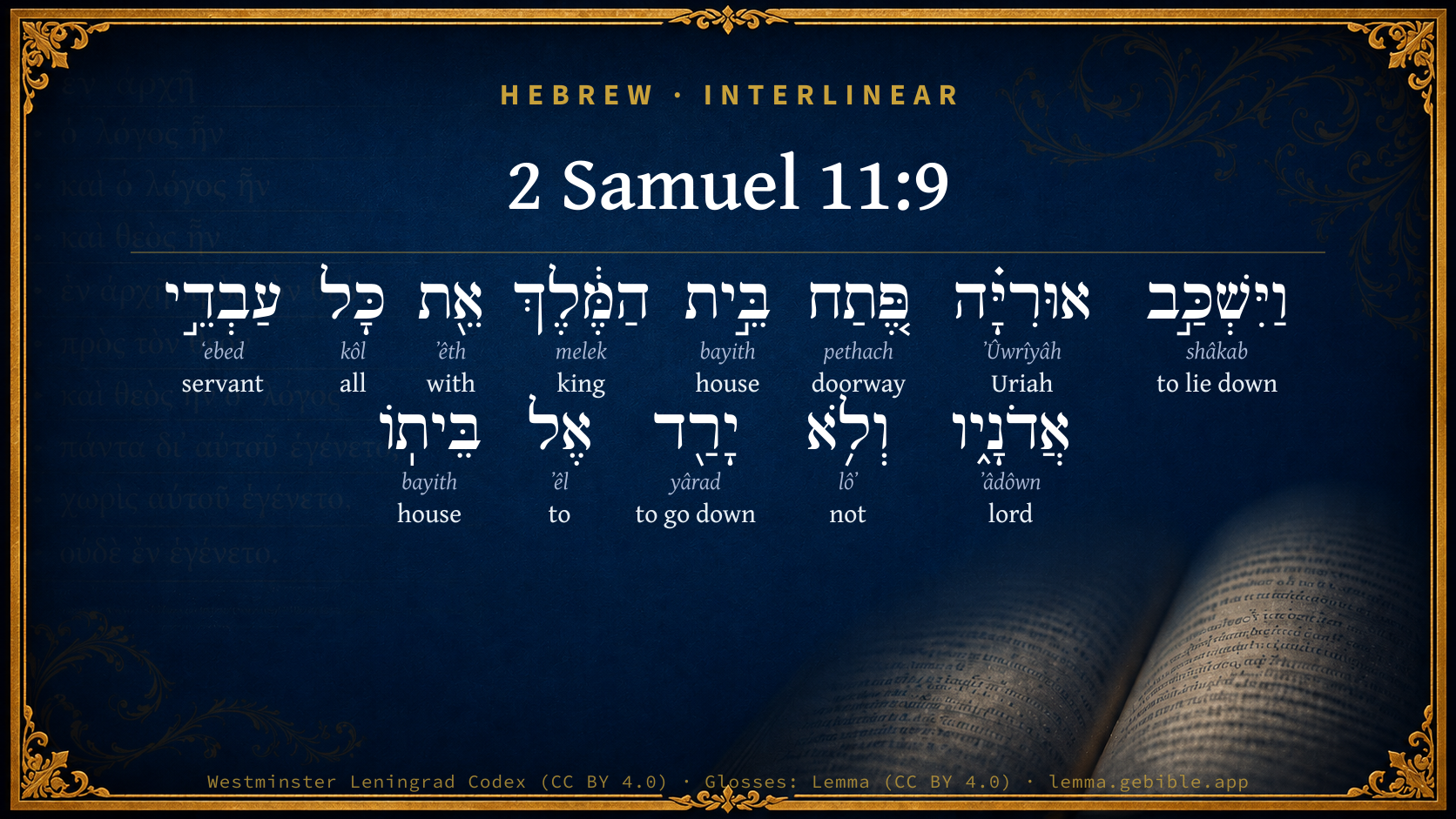
  1. וַיִּשְׁכַּ֣ב shâkab H7901 “and · to lie down” Conjunction + Verb, Qal, Sequential Imperfect, 3rd Person, Masculine, Singular
  2. פֶּ֚תַח pethach H6607 “doorway of” Noun, Common, Masculine, Singular, Construct
  3. בֵּ֣ית bayith H1004 “house of” Noun, Common, Masculine, Singular, Construct
  4. הַמֶּ֔לֶךְ melek H4428 “the · king” Particle, Definite Article + Noun, Common, Masculine, Singular, Absolute
  5. אֵ֖ת ʼêth H854 “with” Preposition
  6. כָּל kôl H3605 “all of” Noun, Common, Masculine, Singular, Construct
  7. עַבְדֵ֣י ʻebed H5650 “servants of” Noun, Common, Masculine, Plural, Construct
  8. אֲדֹנָ֑יו ʼâdôwn H113 “lords · his” Noun, Common, Masculine, Plural, Construct + Suffix, Personal, 3rd Person, Masculine, Singular
  9. וְלֹ֥א lôʼ H3808 “and · not” Conjunction + Particle, Negative
  10. יָרַ֖ד yârad H3381 “to go down” Verb, Qal, Perfect, 3rd Person, Masculine, Singular
  11. אֶל ʼêl H413 “to” Preposition
  12. בֵּיתֽוֹ bayith H1004 “house · his” Noun, Common, Masculine, Singular, Construct + Suffix, Personal, 3rd Person, Masculine, Singular

About this verse

These counts appear in no published source. They are computed here, from the morphology-tagged text and Lemma’s own curated glosses. What Lemma adds →

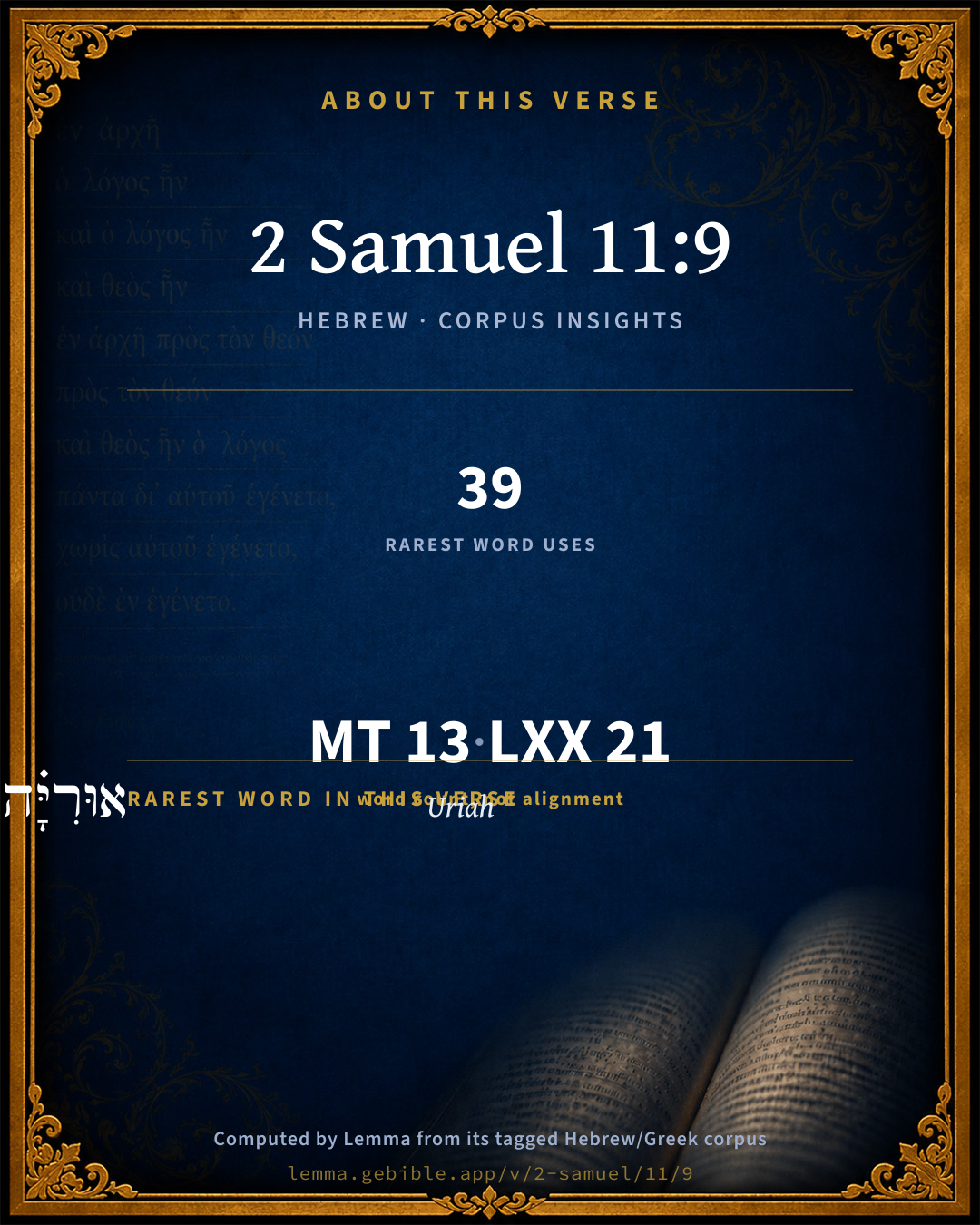
13
words
12
distinct lemmas
Historical
section

Shared distinctive vocabulary

אוּרִיָּ֗ה Uriah H223 occurs in 33 verses of the Hebrew Bible. Also found in:

Grammatical profile

  • 2 verbs
  • 8 nouns
  • 2 prepositions
  • 1 particle

Verb forms

  • וַיִּשְׁכַּ֣ב Qal · Sequential Imperfect
  • יָרַ֖ד Qal · Perfect

Repetition

A word recurs within this verse — often emphatic in Hebrew:

  • בֵּ֣ית house H1004 ×2

Hebrew & Septuagint length

In English translation the verse runs 24 words from the Hebrew and 22 from the Septuagint (LXX English) — closely comparable.

A rough comparison of the two English renderings, which tokenize alike — not a word-level alignment.

Word counts can differ between the Hebrew and the Greek without any difference in meaning — e.g. the Hebrew direct-object marker אֵת has no separate Greek word, and Greek often adds the article ὁ.

In the original languages it is 13 Hebrew tokens and 21 Greek tokens — but the two are counted differently (Hebrew bundles its prefixes and suffixes into one token; the Greek is in lemma form), so that isn’t a like-for-like length.

Cross-references

2

Topical passages linked to 2 Samuel 11:9 in the Treasury of Scripture Knowledge — connected by theme and wording, ordered by reader-vote popularity; previews shown in the World English Bible.

  • Job 5:12–14 He frustrates the devices of the crafty, So that their hands can't perform their enterprise.
  • Proverbs 21:30 There is no wisdom nor understanding Nor counsel against Yahweh.

Cross-references courtesy of OpenBible.info (CC BY 4.0).

Hebrew and Greek witnesses Masoretic Hebrew ↔ Greek Septuagint

The same verse in the two great witnesses to the Old Testament, shown verse-for-verse.

These are two independent witnesses, not word-aligned to each other, and the Septuagint is shown in lemma (dictionary) form.

Hebrew 2 Samuel 11:9 Masoretic · Westminster Leningrad Codex

וַיִּשְׁכַּ֣ב אוּרִיָּ֗ה פֶּ֚תַח בֵּ֣ית הַמֶּ֔לֶךְ אֵ֖ת כָּל עַבְדֵ֣י אֲדֹנָ֑יו וְלֹ֥א יָרַ֖ד אֶל בֵּיתֽוֹ

But Uriah slept at the door of the king's house with all the servants of his lord, and didn't go down to his house.

World English Bible · Public Domain

Greek LXX 2 Samuel 11:9 Septuagint · lemma form

καί κοιμάω ουριας παρά ὁ θύρα ὁ βασιλεύς μετά ὁ δοῦλος ὁ κύριος αὐτός καί οὐ καταβαίνω εἰς ὁ οἶκος αὐτός

And Urias slept at the door of the king with the servants of his lord, and went not down to his house.

LXX2012 (modern English Septuagint) · Public Domain

Hebrew: Westminster Leningrad Codex (CC BY 4.0). Greek: Septuagint (public domain); English from LXX2012 (modern English Septuagint) (Public Domain). How the Septuagint differs from the Hebrew →

Targum (Aramaic paraphrase)

1

The Targum is the ancient Jewish Aramaic paraphrase of the Hebrew Scriptures — an interpretive translation, not the Hebrew text itself. Onkelos (literal) and Pseudo-Jonathan (expansive) render the Torah, and Jonathan the Prophets. Coverage is partial: where no permissively-licensed English translation exists for a verse, only the Aramaic is shown. This is verse-level text, not a word-by-word alignment to the Hebrew.

  1. Targum Jonathan Prophets (Joshua–Malachi)
    וּשְׁכַב אוּרִיָה בִּתְרַע בֵּית מַלְכָּא עִם כָּל עַבְדֵי רִבּוֹנֵיהּ וְלָא נְחַת לְבֵיתֵיהּ:

    (no public-domain English translation for this verse)

    Targum Jonathan — Aramaic: “Mikraot Gedolot” (public domain). English: “Sefaria Community Translation” (CC0 1.0 (public-domain dedication)); “London "Chaldee Paraphrase," 1871” (public domain). Text via Sefaria.

Commentary

Notes on 2 Samuel 11:9 from classic Christian and Jewish commentators (each source and its license shown beneath its notes). The classic Christian expositions comment on the surrounding passage and are grouped to its opening verse, so a note may address several verses; the Jewish commentaries on the Tanakh (Rashi and others) are per-verse, so they appear only where the commentator wrote on this verse.

Lemma curates 59 commentaries, every one of them public domain or Creative Commons licensed, each selected and text-cleaned for this edition rather than reprinted as found. About our sources →

Trapp's Complete Commentary

John Trapp

2Sa 11:9 But Uriah slept at the door of the king’s house with all the servants of his lord, and went not down to his house.

Ver. 9. But Uriah slept at the door, &c.] This was much; but it is like he smelt something: and God had a hand in it.

And went not down to his house.] Though much urged thereunto by his fair but false wife, very likely.

“ Lis est cum forma magna pudicitiae. ”

And some think that there might be some discord betwixt Uriah and his wife before for her seeming levity, he feared she was sick of a pleurisy.

John Trapp, A Commentary or Exposition upon All the Books of the Old and New Testament (1647–1656) — public domain. Text from a community e-Sword module.

Jamieson, Fausset & Brown

Robert Jamieson, A. R. Fausset & David Brown

But Uriah slept at the door of the king's house--It is customary for servants to sleep in the porch or long gallery; and the guards of the Hebrew king did the same. Whatever his secret suspicions might have been, Uriah's refusal to indulge in the enjoyment of domestic pleasure, and his determination to sleep "at the door of the king's house," arose from a high and honorable sense of military duty and propriety (Sa2 11:11). But, doubtless, the resolution of Uriah was overruled by that Providence which brings good out of evil, and which has recorded this sad episode for the warning of the church.

Jamieson, Fausset & Brown — Commentary Critical and Explanatory on the Whole Bible (1871) — public domain (CC PDM 1.0). Text via the HelloAO Bible API.

Adam Clarke's Commentary

Verse 9. Slept at the door] That is, in one of the apartments or niches in the court of the king's house. But in Bengal servants and others generally sleep on the verandahs or porches in face of their master's house.

Adam Clarke's Commentary on the Bible (1810–1826) — public domain. Text from a community e-Sword/MySword module.

Ellicott's Commentary for English Readers

(9) At the door of the king’s house.—Probably in the guard chamber at the entrance of the palace. (Comp. 1Ki_14:27-28.) It is quite unnecessary to suppose that Uriah had any suspicion of what had been done. His conduct and language is simply that of a brave, frank, generous-hearted soldier.

A Bible Commentary for English Readers, edited by Charles John Ellicott (1878–1897) — public domain. Text from a community e-Sword module.

The Cambridge Bible for Schools and Colleges

gen. ed. J. J. S. Perowne

9. Uriah slept at the door of the king’s house] Probably in the guard chamber in the outer court. Cp. 1Ki_14:27-28.

The Cambridge Bible for Schools and Colleges (gen. ed. J. J. S. Perowne; Cambridge University Press, 1878–1918) — public domain. Text from a community e-Sword module.

John Gill's Exposition

But Uriah slept at the door of the king's house, with all the servants of his lord,.... The bodyguards, which were placed there to watch the palace in the night season; Uriah first fell into a conversation with these as is highly probable, to whom he was well known, and who might inquire of one and another of their friends in the army; and he being weary, laid himself down among there, and slept:

and went not down to his house; whether the trifling questions David asked him, or the information the guards might give him of his wife being sent for to court; made him suspect something, and so had no inclination to go to this own house; or however so it was ordered by the providence of God, which directed him to act in this manner, that the sin of David and Bathsheba they studied to hide might be discovered.

John Gill's Exposition of the Whole Bible (1746–1763) — public domain (CC PDM 1.0). Text via the HelloAO Bible API.

Haydock's Catholic Bible Commentary

House, in the court, for the guards. See Atheneus v. 2., &c.

George Leo Haydock (1774–1849), Haydock's Catholic Family Bible and Commentary, 1859 edition — public domain. Excludes Psalms (Douay-Rheims chapter numbering differs from Protestant) and Deuterocanonical books (Catholic canon only).

Matthew Poole's English Annotations

With all the servants of his lord; with the king’s guard. This he did, either upon some suspicion of the matter; see 2Sa 11:7 or by the secret direction of God’s wise and irresistible providence, who would bring David’s sin to light.

Matthew Poole's English Annotations on the Holy Bible (1683–1685) — public domain. Text from a community e-Sword/MySword module.

John Wesley's Explanatory Notes

The servants - With the king's guard. This he did, by the secret direction of God's wise providence, who would bring David's sin to light.

John Wesley, Explanatory Notes Upon the Whole Bible (1754–1765) — public domain. Text via the GEBible commentary corpus.

unfoldingWord translationNotes

Door43 World Missions Community

his master

The word "his" refers to Uriah and the word "master" refers to David.

Have you not come from a journey? Why did you not go down to your house?

This rhetorical question is used to show David's surprise that Uriah did not visit his wife. This can be written as a statement. AT: "After coming from such a long journey, you should have gone down to your house." (See: Rhetorical Question)

Israel and Judah

This refers to their armies. AT: "the armies of Israel and Judah" (See: Synecdoche)

How then can I go into my house ... with my wife?

This rhetorical question is used to emphasize Uriah's refusal to visit his wife and can be translated as a statement. AT: "It would be wrong for me to go into my house ... with my wife while the other soldiers in my army are in danger." (See: Rhetorical Question and Assumed Knowledge and Implicit Information)

As sure as you are alive, I will not do this

Uriah swears a strong promise that he will not go home to his wife as long as the rest of the soldiers are at war. He makes this promise by comparing the truth of his promise to the certainty that the king was alive. AT: "I solemnly promise that I will not do this" (See: Simile)

translationWords

lord

ark of the covenant

Israel

Judah

tent

Joab

life

unfoldingWord translationNotes — © Distant Shores Media and the Door43 World Missions Community, licensed CC BY-SA 4.0. Source: git.door43.org/Door43/en_tn.

Lesson kit

Teaching starters — assembled from the data on this page, not authored interpretation. Every prompt links to the verse data it draws on. Edit before teaching.

2 Samuel, in the Historical, opens this verse with 13 words (12 distinct Hebrew lemmas). Its most distinctive word is ʼÛwrîyâh (“Uriah”). A historical commentator’s framing appears above. Read the whole chapter for the surrounding context.

Discussion questions

  1. How does “Uriah” (ʼÛwrîyâh) shape what this verse is saying?
  2. 2 Samuel 11:3 shares the word «Uriah» with this verse. How do the two illuminate each other?
  3. “house” occurs 2× in this one verse. What is the effect of the repetition?
  4. These translations render this verse differently. What is at stake in choosing one wording over another?
  5. The verb «וַיִּשְׁכַּ֣ב» is Qal Sequential Imperfect. How does its form color the action?
  6. Reading how Trapp's Complete Commentary and Jamieson, Fausset & Brown read this verse, where do the two commentators agree and where do they part?

Things to notice

Reading settings

Reading text

Shown beneath each verse's original-language words.

Old Testament
Old Testament edition

Read the OT as the Masoretic Hebrew (MT) or the Greek Septuagint (LXX).

English shown for the Greek Septuagint (in the Hebrew ↔ Greek comparison).

Comparing translations? Open the Compare panel on any verse page to stack up to four side by side.