Job 7:4

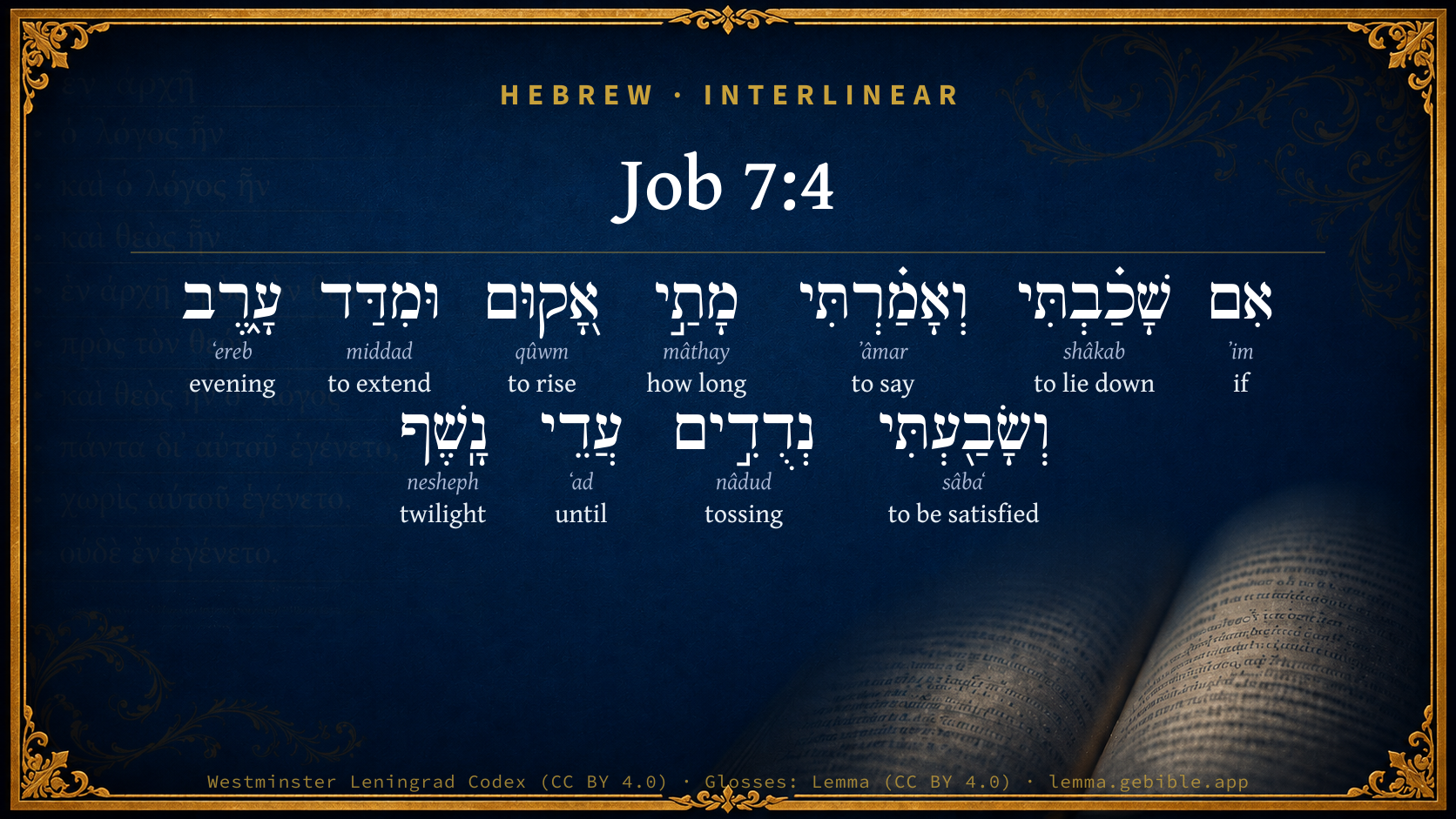
Hebrew (Westminster Leningrad Codex) Job 7:4 appears in the Hebrew Old Testament. The text above is from the Westminster Leningrad Codex. Each word links to its Strong’s number, a concise gloss, and parsing drawn from the Open Scriptures Hebrew Bible morphology. Click any word for its full Brown-Driver-Briggs (BDB) entry.
Download image
Cite this verse

Job 7:4 (World English Bible). Public Domain. Lemma interlinear Bible study tool, https://lemma.gebible.app/v/job/7/4.

Show BibTeX & RIS
BibTeX
RIS
English Translation
When I lie down, I say, 'When shall I arise, and the night be gone?' I toss and turn until the dawning of the day.
World English Bible · Public Domain
Highlights
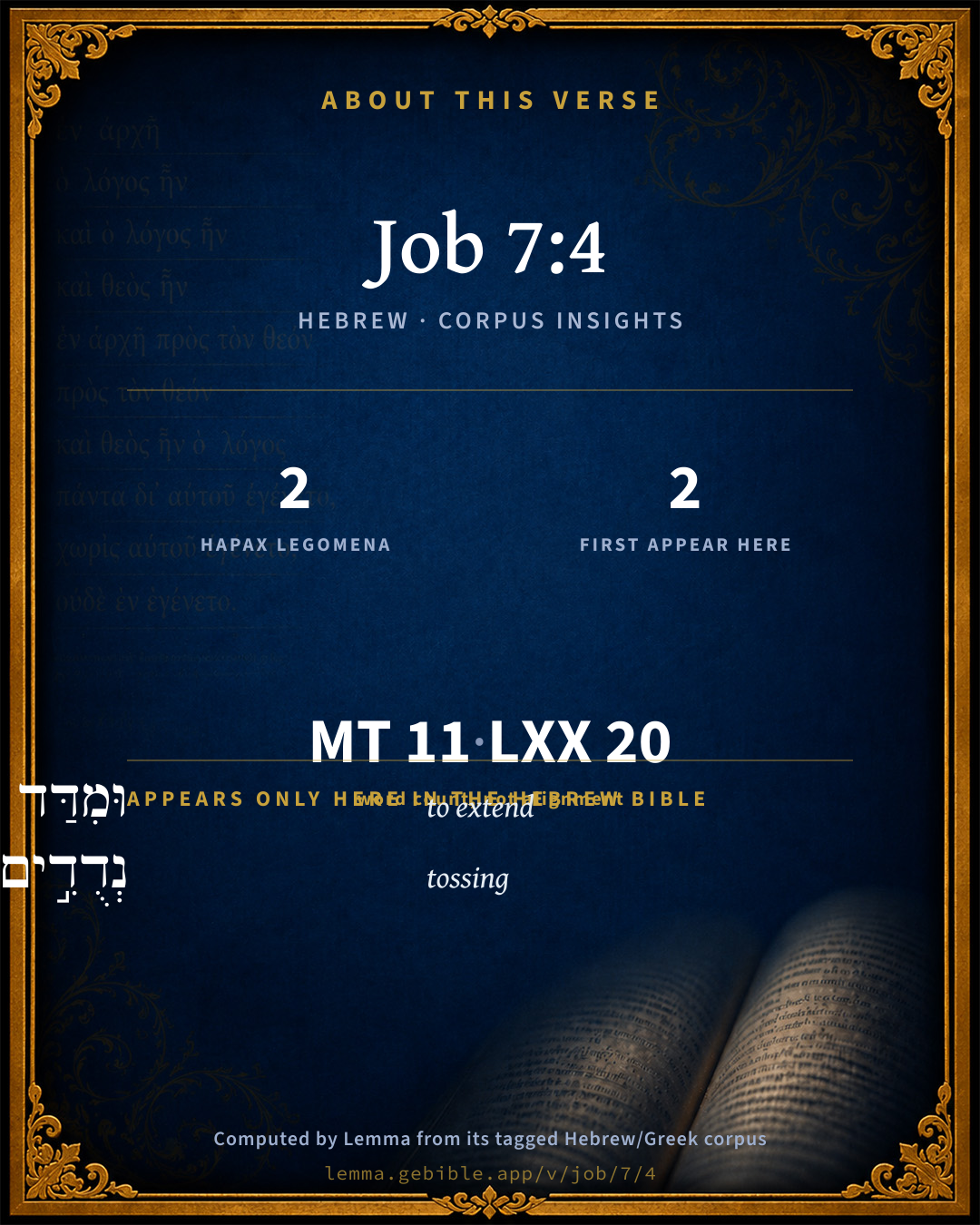
  • 2 hapax legomena — only here in the Hebrew Bible
  • 2 first appearances in the Hebrew Bible
Full analysis ↓
Download a study sheet

One document with this verse’s original text, its word-by-word gloss line, the meaning frame, cross-references with their text, attributed commentary, and full source and license credits — printable, and it pastes into notes with its structure intact.

This verse Autodidact and up

Study sheet (.html) Plain text (.txt)

A passage Seminary Student

Up to 50 verses in one chapter. A passage sheet keeps up to 6 commentary sources and 12 cross-references per verse, in the order this page ranks them, and says so on the sheet whenever that leaves anything out. Ask for a single verse and you get the Autodidact verse sheet above.

Everything on this page stays free to read, with no account — the sheet is a download of what is already on screen, not access to it.

Want to remove ads? Support Godless Engineer
Compare translations 3

The same verse in 3 English versions, stacked beneath the original-language interlinear above. Click any original word for its lexicon entry.

Each is an independent rendering of the whole verse — the interlinear is not word-aligned to these translations.

Highlighted words mark where these versions differ — a whole-verse word diff, not a word-by-word alignment.

  • World English Bible Public Domain
    When I lie down, I say, 'When shall I arise, and the night be gone?' I toss and turn until the dawning of the day.
  • King James Version Public Domain
    When I lie down, I say, When shall I arise, and the night be gone? and I am full of tossings to and fro unto the dawning of the day.
  • unfoldingWord Literal Text CC BY-SA 4.0
    When I lie down, I say, ‘When will I get up?’ But the night extends, and I am full of tossings until dawn.

unfoldingWord Literal Text — © unfoldingWord, licensed CC BY-SA 4.0. Word-aligned USFM3 via Door43 (git.door43.org/unfoldingWord/en_ult).

Versions to compare (up to 4)

3 of 4 selected

Show all 18 translations

Every available English version of this verse, each an independent rendering of the whole verse.

  • World English Bible Public Domain
    When I lie down, I say, 'When shall I arise, and the night be gone?' I toss and turn until the dawning of the day.
  • Berean Standard Bible Public Domain
    When I lie down I think: ‘When will I get up?’ But the night drags on, and I toss and turn until dawn.
  • Majority Standard Bible Public Domain
    When I lie down I think: ‘When will I get up?’ But the night drags on, and I toss and turn until dawn.
  • King James Version Public Domain
    When I lie down, I say, When shall I arise, and the night be gone? and I am full of tossings to and fro unto the dawning of the day.
  • American Standard Version (1901) Public Domain
    When I lie down, I say, When shall I arise, and the night be gone? And I am full of tossings to and fro unto the dawning of the day.
  • Revised Version (1885) Public Domain
    When I lie down, I say, When shall I arise? but the night is long; and I am full of tossings to and fro unto the dawning of the day.
  • Geneva Bible (1599) Public Domain
    If I layed me downe, I sayde, When shall I arise? and measuring the euening I am euen full with tossing to and from vnto the dawning of the day.
  • Douay-Rheims (1899) Public Domain
    If I lie down to sleep, I shall say: When shall arise? and again I shall look for the evening, and shall be filled with sorrows even till darkness.
  • Young's Literal Translation Public Domain
    If I lay down then I said, `When do I rise!' And evening hath been measured, And I have been full of tossings till dawn.
  • Literal Standard Version CC BY-SA 4.0
    If I lay down, then I have said, When do I rise, || And evening has been measured? And I have been full of tossings until dawn.
  • Unlocked Literal Bible CC BY-SA 4.0
    When I lie down, I say to myself, 'When will I get up and when will the night be gone?' I am full of tossing to and fro until the day's dawning.
  • unfoldingWord Literal Text CC BY-SA 4.0
    When I lie down, I say, ‘When will I get up?’ But the night extends, and I am full of tossings until dawn.
  • Darby Bible Public Domain
    If I lie down, I say, When shall I rise up, and the darkness be gone? and I am full of tossings until the dawn.
  • World Messianic Bible Public Domain
    When I lie down, I say, ‘When will I arise, and the night be gone?’ I toss and turn until the dawning of the day.
  • Webster's Bible Public Domain
    When I lie down, I say, When shall I arise, and the night be gone? and I am full of tossings to and fro to the dawning of the day.
  • Free Bible Version CC BY-SA 4.0
    When I go to bed I ask, ‘When shall I get up?’ But the night goes on and on, and I toss and turn until dawn.
  • Bible in Basic English Public Domain
    When I go to my bed, I say, When will it be time to get up? but the night is long, and I am turning from side to side till morning light.
  • JPS Tanakh (1917) Public Domain
    When I lie down, I say: 'When shall I arise?' But the night is long, and I am full of tossings to and fro unto the dawning of the day.

Literal Standard Version (2020), Covenant Press — licensed CC BY-SA 4.0. Text via the HelloAO Bible API (eBible.org). Unlocked Literal Bible (unfoldingWord) — licensed CC BY-SA 4.0. Text via the HelloAO Bible API (eBible.org). unfoldingWord Literal Text — © unfoldingWord, licensed CC BY-SA 4.0. Word-aligned USFM3 via Door43 (git.door43.org/unfoldingWord/en_ult). Free Bible Version, Dr. Jonathan Gallagher — licensed CC BY-SA 4.0. Text via the HelloAO Bible API (eBible.org).

Word by word

More ways to search: Search by grammar → Find every occurrence → Compare this word →

Practice this passage: Drill this verse → Learn its vocabulary →

וּמִדַּד
middad
H4059
“and · to extend”
Conjunction + Verb, Piel, Sequential Perfect, 3rd Person, Masculine, Singular
Part of Speech
Conjunction + Verb
Stem
Piel
Form
Sequential Perfect
Person
3rd Person
Gender
Masculine
Number
Singular
Full BDB Definition

Origin: from H5074

TWOT: 1146

(Piel) to make extension, continue
  1. אִם ʼim H518 “if” Conjunction
  2. שָׁכַ֗בְתִּי shâkab H7901 “to lie down” Verb, Qal, Perfect, 1st Person, Common, Singular
  3. וְאָמַ֗רְתִּי ʼâmar H559 “and · to say” Conjunction + Verb, Qal, Sequential Perfect, 1st Person, Common, Singular
  4. מָתַ֣י mâthay H4970 “how long” Particle, Interrogative
  5. אָ֭קוּם qûwm H6965 “to rise” Verb, Qal, Imperfect, 1st Person, Common, Singular
  6. עָ֑רֶב ʻereb H6153 “evening” Noun, Common, Masculine, Singular, Absolute
  7. וְשָׂבַ֖עְתִּי sâbaʻ H7646 “and · to be satisfied” Conjunction + Verb, Qal, Sequential Perfect, 1st Person, Common, Singular
  8. נְדֻדִ֣ים nâdud H5076 “tossings” Noun, Common, Masculine, Plural, Absolute
  9. עֲדֵי ʻad H5704 “until” Preposition
  10. נָֽשֶׁף nesheph H5399 “twilight” Noun, Common, Masculine, Singular, Absolute

About this verse

These counts appear in no published source. They are computed here, from the morphology-tagged text and Lemma’s own curated glosses. What Lemma adds →

11
words
11
distinct lemmas
Wisdom
section

Notable vocabulary

2 hapax legomena — words that appear only here in the entire Hebrew Bible:

  • וּמִדַּד to extend H4059
  • נְדֻדִ֣ים tossing H5076

First appearance in Scripture

These words make their first canonical appearance in the Hebrew Bible here:

  • וּמִדַּד to extend H4059
  • נְדֻדִ֣ים tossing H5076

Shared distinctive vocabulary

נָֽשֶׁף twilight H5399 occurs in 12 verses of the Hebrew Bible. Also found in:

Grammatical profile

  • 5 verbs
  • 3 nouns
  • 1 preposition
  • 1 conjunction
  • 1 particle

Verb forms

  • שָׁכַ֗בְתִּי Qal · Perfect
  • וְאָמַ֗רְתִּי Qal · Sequential Perfect
  • אָ֭קוּם Qal · Imperfect
  • וּמִדַּד Piel · Sequential Perfect
  • וְשָׂבַ֖עְתִּי Qal · Sequential Perfect

Hebrew & Septuagint length

In English translation the verse runs 25 words from the Hebrew and 34 from the Septuagint (LXX English) — closely comparable.

A rough comparison of the two English renderings, which tokenize alike — not a word-level alignment.

Word counts can differ between the Hebrew and the Greek without any difference in meaning — e.g. the Hebrew direct-object marker אֵת has no separate Greek word, and Greek often adds the article ὁ.

In the original languages it is 11 Hebrew tokens and 20 Greek tokens — but the two are counted differently (Hebrew bundles its prefixes and suffixes into one token; the Greek is in lemma form), so that isn’t a like-for-like length.

Cross-references

9

Topical passages linked to Job 7:4 in the Treasury of Scripture Knowledge — connected by theme and wording, ordered by reader-vote popularity; previews shown in the World English Bible.

  • Deuteronomy 28:67 In the morning you shall say, Would it were even! and at even you shall say, Would it were morning! for the fear of your heart which you shall fear, and for the sight of your eyes which you shall see.
  • Job 7:13–14 When I say, 'My bed shall comfort me, My couch shall ease my complaint;'
  • Psalms 77:4 You hold my eyelids open. I am so troubled that I can't speak.
  • Job 30:17 In the night season my bones are pierced in me, And the pains that gnaw me take no rest.
  • Psalms 6:6 I am weary with my groaning; Every night I flood my bed; I drench my couch with my tears.
  • Psalms 130:6 My soul longs for the Lord more than watchmen long for the morning; More than watchmen for the morning.
  • Job 17:12 They change the night into day, Saying 'The light is near' in the presence of darkness.
  • Psalms 109:23 I fade away like an evening shadow. I am shaken off like a locust.
  • Isaiah 54:11 you afflicted, tossed with tempest, and not comforted, behold, I will set your stones in beautiful colors, and lay your foundations with sapphires.

Cross-references courtesy of OpenBible.info (CC BY 4.0).

Hebrew and Greek witnesses Masoretic Hebrew ↔ Greek Septuagint

The same verse in the two great witnesses to the Old Testament, shown verse-for-verse.

These are two independent witnesses, not word-aligned to each other, and the Septuagint is shown in lemma (dictionary) form.

Hebrew Job 7:4 Masoretic · Westminster Leningrad Codex

אִם שָׁכַ֗בְתִּי וְאָמַ֗רְתִּי מָתַ֣י אָ֭קוּם וּמִדַּד עָ֑רֶב וְשָׂבַ֖עְתִּי נְדֻדִ֣ים עֲדֵי נָֽשֶׁף

When I lie down, I say, 'When shall I arise, and the night be gone?' I toss and turn until the dawning of the day.

World English Bible · Public Domain

Greek LXX Job 7:4 Septuagint · lemma form

ἐάν κοιμάω λέγω πότε ἡμέρα ὡς δέ ἄν ἀναἵστημι πάλιν πότε ἑσπέρα πλήρης δέ γίγνομαι ὀδύνη ἀπό ἑσπέρα ἕως πρωΐ

Whenever I lie down, I say, When will it be day? and whenever I rise up, again I say when will it be evening? and I am full of pains from evening to morning.

LXX2012 (modern English Septuagint) · Public Domain

Hebrew: Westminster Leningrad Codex (CC BY 4.0). Greek: Septuagint (public domain); English from LXX2012 (modern English Septuagint) (Public Domain). How the Septuagint differs from the Hebrew →

Commentary

Notes on Job 7:4 from classic Christian and Jewish commentators (each source and its license shown beneath its notes). The classic Christian expositions comment on the surrounding passage and are grouped to its opening verse, so a note may address several verses; the Jewish commentaries on the Tanakh (Rashi and others) are per-verse, so they appear only where the commentator wrote on this verse.

Lemma curates 59 commentaries, every one of them public domain or Creative Commons licensed, each selected and text-cleaned for this edition rather than reprinted as found. About our sources →

The Cambridge Bible for Schools and Colleges

gen. ed. J. J. S. Perowne

4, 5. A graphic account of his condition under his malady. Job_7:4 should probably be rendered,

When I lie down I say, When shall I arise?

And the night stretches out, and I am full of tossings, &c.

At evening he longs for morning (Deu_28:67), but the night seems to him to prolong itself, and he tosses restlessly till the daybreak.

The Cambridge Bible for Schools and Colleges (gen. ed. J. J. S. Perowne; Cambridge University Press, 1878–1918) — public domain. Text from a community e-Sword module.

Trapp's Complete Commentary

John Trapp

Job 7:4 When I lie down, I say, When shall I arise, and the night be gone? and I am full of tossings to and fro unto the dawning of the day.

Ver. 4. When I lie down, I say, When shall I arise? &c.] Here is a graphic description of a wearisome night. The night is most laborious and irksome to sick people: then they revolve their troubles, and being free from visits of friends, they visit their own afflictions, and study their own distempers freely; then they lie all night wishing for day, telling the clock, hearkening for the cock (that natural clock), tossing to and fro unto the dawning of the day, not able to get the least wink of sleep, that nurse of nature, and sweet parenthesis of men’s griefs and cares. Oh present the condition of a restless sick man to your thoughts (saith an interpreter here), praise God for quiet nights, and pity those to whom wearisome nights are appointed.

John Trapp, A Commentary or Exposition upon All the Books of the Old and New Testament (1647–1656) — public domain. Text from a community e-Sword module.

Jamieson, Fausset & Brown

Robert Jamieson, A. R. Fausset & David Brown

Literally, "When shall be the flight of the night?" [GESENIUS]. UMBREIT, not so well, "The night is long extended"; literally, "measured out" (so Margin).

Jamieson, Fausset & Brown — Commentary Critical and Explanatory on the Whole Bible (1871) — public domain (CC PDM 1.0). Text via the HelloAO Bible API.

Adam Clarke's Commentary

Verse 4. When I lie down] I have so little rest, that when I do lie down I long for the return of the light, that I may rise. Nothing can better depict the state of a man under continual afflictions, which afford him no respite, his days and his nights being spent in constant anguish, utterly unable to be in any one posture, so that he is continually changing his position in his bed, finding ease nowhere: thus, as himself expresses it, he is full of tossings.

Adam Clarke's Commentary on the Bible (1810–1826) — public domain. Text from a community e-Sword/MySword module.

Ellicott's Commentary for English Readers

(4) When I lie down, I say.—Or, When I lie down, then I say, When shall I arise? But the night is long, and I am filled with tossings to and fro till the morning twilight.

A Bible Commentary for English Readers, edited by Charles John Ellicott (1878–1897) — public domain. Text from a community e-Sword module.

John Gill's Exposition

When I lie down, I say, when shall I arise,.... Or, "then I say", &c. (t); that is, as soon as he laid himself down in his bed, and endeavoured to compose himself to sleep, in order to get rest and refreshment; then he said within himself, or with an articulate voice, to those about him, that sat up with him; oh that it was time to rise; when will it be morning, that I may rise from my bed, which is of no manner of service to me, but rather increases weariness?

and the night be gone? and the day dawn and break; or "night" or "evening be measured", as in the margin, or "measures itself" (u); or that "he", that is, God, or "it", my heart, "measures the evening" (w), or "night"; lengthens it out to its full time: to a discomposed person, that cannot sleep, the night seems long; such count every hour, tell every clock that strikes, and long to see peep of day; these are they that watch for the morning, Psa 130:6,

and I am full of tossings to and fro unto the dawning of the day; or, "unto the twilight"; the morning twilight; though some understand it of the twilight or evening of the next day, see Sa1 30:17; and interpret "the tossings to and fro" of the toils and labours of the day, and of the sorrows and miseries of it, lengthened out to the eve of the following day; but rather they are to be understood either of the tosses of his mind, his distressed and perplexed thoughts within him he was full of; or of the tosses of his body, his frequent turning himself upon his bed, from side to side, to ease him; and with these he was "filled", or "satiated" (x); he had enough and too much of them; he was glutted and sated with them, as a man is with overmuch eating, as the word signifies.

(t) "tum dixi", Beza, Piscator, Mercerus. (u) So Saadiah Gaon. (w) "tum admensus est versperam", Schmidt; "extendit", Schultens; "et cor", Mercerus; so Aben Ezra, Ben Gersom, and Bar Tzemach. (x) "satior", Junius & Tremellius, Piscator, Cocceius, Schultens.

John Gill's Exposition of the Whole Bible (1746–1763) — public domain (CC PDM 1.0). Text via the HelloAO Bible API.

Albert Barnes' Notes on the Bible

When I lie down - I find no comfort and no rest on my bed. My nights are long, and I am impatient to have them passed, and equally so is it with the day. This is a description which all can understand who have been laid on a bed of pain.

And the night be gone - Margin, evening be measured. Herder renders this, “the night is irksome to me.” The word rendered night (ערב ‛ereb) properly means the early part of the night, until it is succeeded by the dawn. Thus, in Gen 1:5,” And the evening (ערב ‛ereb) and the morning were the first day.” Here it means the portion of the night which is before the dawning of the aurora - the night. The word rendered “be gone” and in the margin “be measured” ( מדּד mı̂ddad), has been variously rendered. The verb מדד mâdad means to stretch, to extend, to measure; and, according to Gesenius, the form of the word used here is a noun meaning flight, and the sense is, “when shall be the flight of the night?” He derives it from נדד nâdad to move, to flee, to flee away. So Rosenmuller explains it. The expression is poetic, meaning, when shall the night be gone?

I am full of tossings to and fro - (נדדים nâdûdı̂ym). A word from the same root. It means uneasy motions, restlessness. He found no quiet repose on his bed.

Unto the dawning - נשׁף nesheph, from נשׁף nâshaph, to breathe; hence, the evening twilight because the breezes blow, or seem to breathe, and then it means also the morning twilight, the dawn. Dr. Stock renders it, “until the morning breeze.”

Albert Barnes' Notes on the Bible (1834–1885) — public domain. Text from a community e-Sword/MySword module.

Haydock's Catholic Bible Commentary

And again. Hebrew, "and the night be completed, I toss to and fro," (Haydock) or "I am disturbed with dreams, (Calmet) till day break." Vulgate insinuates that night and day are equally restless to a man in extreme pain. (Haydock) --- As I find no comfort, why may I not desire to die? (Menochius) --- I desire to be dissolved, as being much better, said St. Paul. [Philippians i. 23.]

George Leo Haydock (1774–1849), Haydock's Catholic Family Bible and Commentary, 1859 edition — public domain. Excludes Psalms (Douay-Rheims chapter numbering differs from Protestant) and Deuterocanonical books (Catholic canon only).

Matthew Poole's English Annotations

When I lie down, to get some rest and sleep. The night, Heb. the evening; the part put for the whole, as it is Gen 1:5.

To and fro; from side to side in the bed, as men in grievous pains of body or anxiety of mind use to be.

Unto the dawning of the day; so this Hebrew word is used also 1Sa 30:17; Psa 119:147.

Matthew Poole's English Annotations on the Holy Bible (1683–1685) — public domain. Text from a community e-Sword/MySword module.

Whedon's Commentary on the Bible

Daniel D. Whedon

4. When I lie down — “This is a fine touch. The longing for morn does not come, as to the Prometheus of AEschylus, after a night of suffering, but anticipates it. Job’s one thought, as he lies down hopeless of rest or respite, is, when will the light return, bringing with it, at least, more of consciousness and power to endure the agony.” — Canon Cook.

The night be gone — מדד, is rendered by some, is long. Thus Dillmann, Hitzig, and Renan, “When shall I arise? and the night is prolonged.” Many others make middadh the construct state of a verbal noun, and read, “and the flight of the evening be” — evening being equivalent to night of the preceding verse. The accents favour this reading, which is substantially that of the Authorized Version. The use of the word evening heightens the beauty of the thought. If the evening twilight be so hard to bear in anticipation, what must the whole night be?

Daniel D. Whedon (gen. ed.), Commentary on the Old and New Testaments (1874–1909) — public domain. Text from a community e-Sword module.

The Pulpit Commentary

When I lie down, I say, When shall I arise, and the night be gone? So Gesenius, Rosenmuller, and Delitzsch. Others translate, "the night is long" (Dillmann, Renan), or "the night seems endless" (Merx); Deu_28:67, "At evening thou shalt say, Would God it were morning!" And I am full of tossings to and fro. Professor Lee understands "tossings of the mind," or "distracting thoughts;" but it is more probable that tossings of the body are meant. These are familiar to every bad sleeper. Unto the dawning of the day. A little rest sometimes visits the tired eyelids after a long, sleepless night. Job may refer to this, or he may simply mean that he lay tossing on his bed all through the night, till morning came, when he arose.

The Pulpit Commentary (1880–1919), ed. H.D.M. Spence-Jones & Joseph S. Exell — public domain. Text from a community e-Sword module.

Keil & Delitzsch

C. F. Keil & F. Delitzsch

4 If I lie down, I think:

When shall I arise and the evening break away?

And I become weary with tossing to and fro unto the morning dawn.

5 My flesh is clothed with worms and clods of earth;

My skin heals up to fester again.

6 My days are swifter than a weaver's shuttle,

And vanish without hope.

Most modern commentators take מדּד as Piel from מדד: the night is extended (Renan: la nuit se prolonge), which is possible; comp. Ges. 52, 2. But the metre suggests another rendering: מדּד constr. of מדּד from נדד, to flee away: and when fleeing away of the evening. The night is described by its commencement, the late evening, to make the long interval of the sleeplessness and restlessness of the invalid prominent. In נדדים and מדד there is a play of words (Ebrard). רמּה, worms, in reference to the putrifying ulcers; and גּוּשׁ (with זעירא )ג, clod of earth, from the cracked, scaly, earth-coloured skin of one suffering with elephantiasis. The praett. are used of that which is past and still always present, the futt. consec. of that which follows in and with the other. The skin heals, רגע (which we render with Ges., Ew., contrahere se); the result is that it becomes moist again. ימּאס, according to Ges. 67, rem. 4 = ימּס, Psa 58:8. His days pass swiftly away; the result is that they come to an end without any hope whatever. ארג is like κερκίς, radius, a weaver's shuttle, by means of which the weft is shot between the threads of the warp as they are drawn up and down. His days pass as swiftly by as the little shuttle passes backwards and forwards in the warp.

Next follows a prayer to God for the termination of his pain, since there is no second life after the present, and consequently also the possibility of requital ceases with death.

Keil & Delitzsch — Biblical Commentary on the Old Testament (1861–1891) — public domain (CC PDM 1.0). Text via the HelloAO Bible API. (Old Testament only.)

unfoldingWord translationNotes

Door43 World Missions Community

When I lie down

The implied information is that this is when Job would lie down to sleep at night. AT: "When I lie down to sleep" (See: Assumed Knowledge and Implicit Information)

I say to myself

Job poses a question to no one else in particular. AT: "I ask" or "I wonder" (See: Reflexive Pronouns)

When will I get up and when will the night be gone?

Job poses this question to emphasize his intense suffering during the hours he should be sleeping. AT: "I wish I could get up, but night continues." (See: Rhetorical Question)

tossing to and fro

"turning back and forth." This indicates that Job has moved on his bed all night without any rest.

My flesh is clothed with worms and clods of dust

The worms and clods of dust are pictured as covering Job as if they were clothing. AT: "My flesh is covered with worms and clods of dust" (See: Metaphor)

My flesh

This represents his whole body. AT: "My body" (See: Synecdoche)

clods of dust

Possible meanings are 1) lumps or crusts of dirt or 2) scabs on the skin.

dissolve and run afresh

"break out again"

translationWords

flesh

unfoldingWord translationNotes — © Distant Shores Media and the Door43 World Missions Community, licensed CC BY-SA 4.0. Source: git.door43.org/Door43/en_tn.

Rashi

Rabbi Shlomo Yitzchaki (Rashi)

If I would lie down at night, I would hope and say, etc.

and the evening depart When will it become light and when will the time of arising come, and when will the evening depart? [The word מדד ] is an expression of (Gen. 31:40) “and sleep was banished (ותדד).” The “mem” is a defective radical, as in מאמר, statement; משמר, watch.

And I was sated with restlessness I was sated with restlessness on my bed by day until twilight, because, due to the torments I could not sleep until the twilight of day, since my flesh was clothed with worms.

Rashi on the Tanakh — English translations: “The Judaica Press complete Tanach with Rashi, translated by A. J. Rosenberg” (CC BY 4.0); “Pentateuch with Rashi's commentary by M. Rosenbaum and A.M. Silbermann, 1929-1934” (public domain); “The Metsudah Tanach series, Lakewood, N.J” (CC BY 4.0); and “The Book of Joshua, Metsudah Publications, 1997” (CC BY 4.0). Text via Sefaria.

Lesson kit

Teaching starters — assembled from the data on this page, not authored interpretation. Every prompt links to the verse data it draws on. Edit before teaching.

Job, in the Wisdom, opens this verse with 11 words (11 distinct Hebrew lemmas). Its most distinctive word is middad (“to extend”). A historical commentator’s framing appears above. Read the whole chapter for the surrounding context.

Discussion questions

  1. How does “to extend” (middad) shape what this verse is saying?
  2. This verse holds 2 words here found nowhere else in the Hebrew Bible. What might the rare words draw attention to?
  3. 2 words here appear for the first time in Scripture. What is being introduced at this debut?
  4. 1 Samuel 30:17 shares the word «twilight» with this verse. How do the two illuminate each other?
  5. These translations render this verse differently. What is at stake in choosing one wording over another?
  6. The verb «שָׁכַ֗בְתִּי» is Qal Perfect. How does its form color the action?
  7. Reading how The Cambridge Bible for Schools and Colleges and Trapp's Complete Commentary read this verse, where do the two commentators agree and where do they part?

Things to notice

Reading settings

Reading text

Shown beneath each verse's original-language words.

Old Testament
Old Testament edition

Read the OT as the Masoretic Hebrew (MT) or the Greek Septuagint (LXX).

English shown for the Greek Septuagint (in the Hebrew ↔ Greek comparison).

Comparing translations? Open the Compare panel on any verse page to stack up to four side by side.