
Ezekiel 32:21

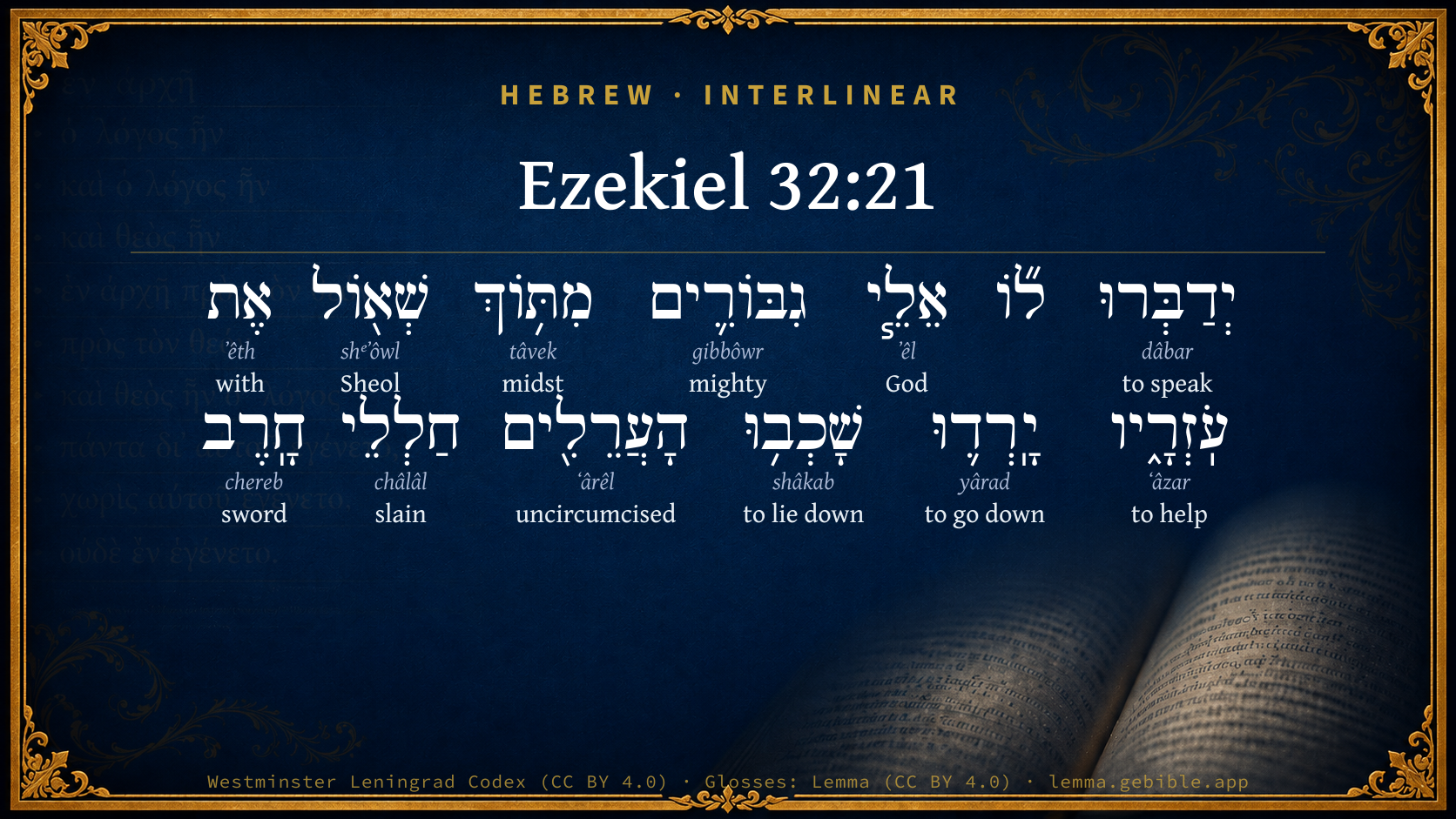
Hebrew (Westminster Leningrad Codex) Ezekiel 32:21 appears in the Hebrew Old Testament. The text above is from the Westminster Leningrad Codex. Each word links to its Strong’s number, a concise gloss, and parsing drawn from the Open Scriptures Hebrew Bible morphology. Click any word for its full Brown-Driver-Briggs (BDB) entry.
Download image
Cite this verse

Ezekiel 32:21 (World English Bible). Public Domain. Lemma interlinear Bible study tool, https://lemma.gebible.app/v/ezekiel/32/21.

Show BibTeX & RIS
BibTeX
RIS
English Translation
The strong among the mighty shall speak to him out of the midst of Sheol with those who help him: they are gone down, they lie still, even the uncircumcised, slain by the sword.
World English Bible · Public Domain
Download a study sheet

One document with this verse’s original text, its word-by-word gloss line, the meaning frame, cross-references with their text, attributed commentary, and full source and license credits — printable, and it pastes into notes with its structure intact.

This verse Autodidact and up

Study sheet (.html) Plain text (.txt)

A passage Seminary Student

Up to 50 verses in one chapter. A passage sheet keeps up to 6 commentary sources and 12 cross-references per verse, in the order this page ranks them, and says so on the sheet whenever that leaves anything out. Ask for a single verse and you get the Autodidact verse sheet above.

Everything on this page stays free to read, with no account — the sheet is a download of what is already on screen, not access to it.

Want to remove ads? Support Godless Engineer
Compare translations 3

The same verse in 3 English versions, stacked beneath the original-language interlinear above. Click any original word for its lexicon entry.

Each is an independent rendering of the whole verse — the interlinear is not word-aligned to these translations.

Highlighted words mark where these versions differ — a whole-verse word diff, not a word-by-word alignment.

  • World English Bible Public Domain
    The strong among the mighty shall speak to him out of the midst of Sheol with those who help him: they are gone down, they lie still, even the uncircumcised, slain by the sword.
  • King James Version Public Domain
    The strong among the mighty shall speak to him out of the midst of hell with them that help him: they are gone down, they lie uncircumcised, slain by the sword.
  • unfoldingWord Literal Text CC BY-SA 4.0
    The strongest of the warriors in Sheol will declare about Egypt and her allies, ‘They have come down here! They will lie with the uncircumcised, with those who were killed by the sword.’

unfoldingWord Literal Text — © unfoldingWord, licensed CC BY-SA 4.0. Word-aligned USFM3 via Door43 (git.door43.org/unfoldingWord/en_ult).

Versions to compare (up to 4)

3 of 4 selected

Show all 18 translations

Every available English version of this verse, each an independent rendering of the whole verse.

  • World English Bible Public Domain
    The strong among the mighty shall speak to him out of the midst of Sheol with those who help him: they are gone down, they lie still, even the uncircumcised, slain by the sword.
  • Berean Standard Bible Public Domain
    Mighty chiefs will speak from the midst of Sheol about Egypt and her allies: ‘They have come down and lie with the uncircumcised, with those slain by the sword.’
  • Majority Standard Bible Public Domain
    Mighty chiefs will speak from the midst of Sheol about Egypt and her allies: ‘They have come down and lie with the uncircumcised, with those slain by the sword.’
  • King James Version Public Domain
    The strong among the mighty shall speak to him out of the midst of hell with them that help him: they are gone down, they lie uncircumcised, slain by the sword.
  • American Standard Version (1901) Public Domain
    The strong among the mighty shall speak to him out of the midst of Sheol with them that help him: they are gone down, they lie still, even the uncircumcised, slain by the sword.
  • Revised Version (1885) Public Domain
    The strong among the mighty shall speak to him out of the midst of hell with them that help him: they are gone down, they lie still, even the uncircumcised, slain by the sword.
  • Geneva Bible (1599) Public Domain
    The most mighty and strong shall speake to him out of the mids of hell with them that helpe her: they are gone downe and sleepe with the vncircumcised that be slaine by the sworde.
  • Douay-Rheims (1899) Public Domain
    The most mighty among the strong ones shall speak to him from the midst of hell, they that went down with his helpers, and slept uncircumcised, slain by the sword.
  • Young's Literal Translation Public Domain
    Speak to him do the gods of the mighty out of the midst of sheol, With his helpers -- they have gone down, They have lain with the uncircumcised, The pierced of the sword.
  • Literal Standard Version CC BY-SA 4.0
    The gods of the mighty speak to him out of the midst of Sheol, || With his helpers—they have gone down, || They have lain with the uncircumcised, || The pierced of the sword.
  • Unlocked Literal Bible CC BY-SA 4.0
    The strongest of the warriors in Sheol will declare about Egypt and her allies, 'They have come down here! They will lie with the uncircumcised, with those who were killed by the sword.'
  • unfoldingWord Literal Text CC BY-SA 4.0
    The strongest of the warriors in Sheol will declare about Egypt and her allies, ‘They have come down here! They will lie with the uncircumcised, with those who were killed by the sword.’
  • Darby Bible Public Domain
    The strong among the mighty, with them that helped him, shall speak to him out of the midst of Sheol: they are gone down, they lie still, the uncircumcised, slain by the sword.
  • World Messianic Bible Public Domain
    The strong among the mighty will speak to him out of the middle of Sheol with those who help him. They have gone down. The uncircumcised lie still, slain by the sword.
  • Webster's Bible Public Domain
    The strong among the mighty shall speak to him out of the midst of the grave with them that help him: they are gone down, they lie uncircumcised, slain by the sword.
  • Free Bible Version CC BY-SA 4.0
    Powerful chiefs will speak from Sheol about Egypt and its allies: ‘They have come down here and lie with the heathen, with those killed by the sword.’
  • Bible in Basic English Public Domain
    The strong among the great ones will say to him from the underworld, Are you more beautiful than any? go down, you and your helpers, and take your rest among those without circumcision, and those who have been put to the sword.
  • JPS Tanakh (1917) Public Domain
    The strong among the mighty shall speak of him out of the midst of the nether-world with them that helped him; they are gone down, they lie still, even the uncircumcised, slain by the sword.

Literal Standard Version (2020), Covenant Press — licensed CC BY-SA 4.0. Text via the HelloAO Bible API (eBible.org). Unlocked Literal Bible (unfoldingWord) — licensed CC BY-SA 4.0. Text via the HelloAO Bible API (eBible.org). unfoldingWord Literal Text — © unfoldingWord, licensed CC BY-SA 4.0. Word-aligned USFM3 via Door43 (git.door43.org/unfoldingWord/en_ult). Free Bible Version, Dr. Jonathan Gallagher — licensed CC BY-SA 4.0. Text via the HelloAO Bible API (eBible.org).

Word by word

More ways to search: Search by grammar → Find every occurrence → Compare this word →

Practice this passage: Drill this verse → Learn its vocabulary →

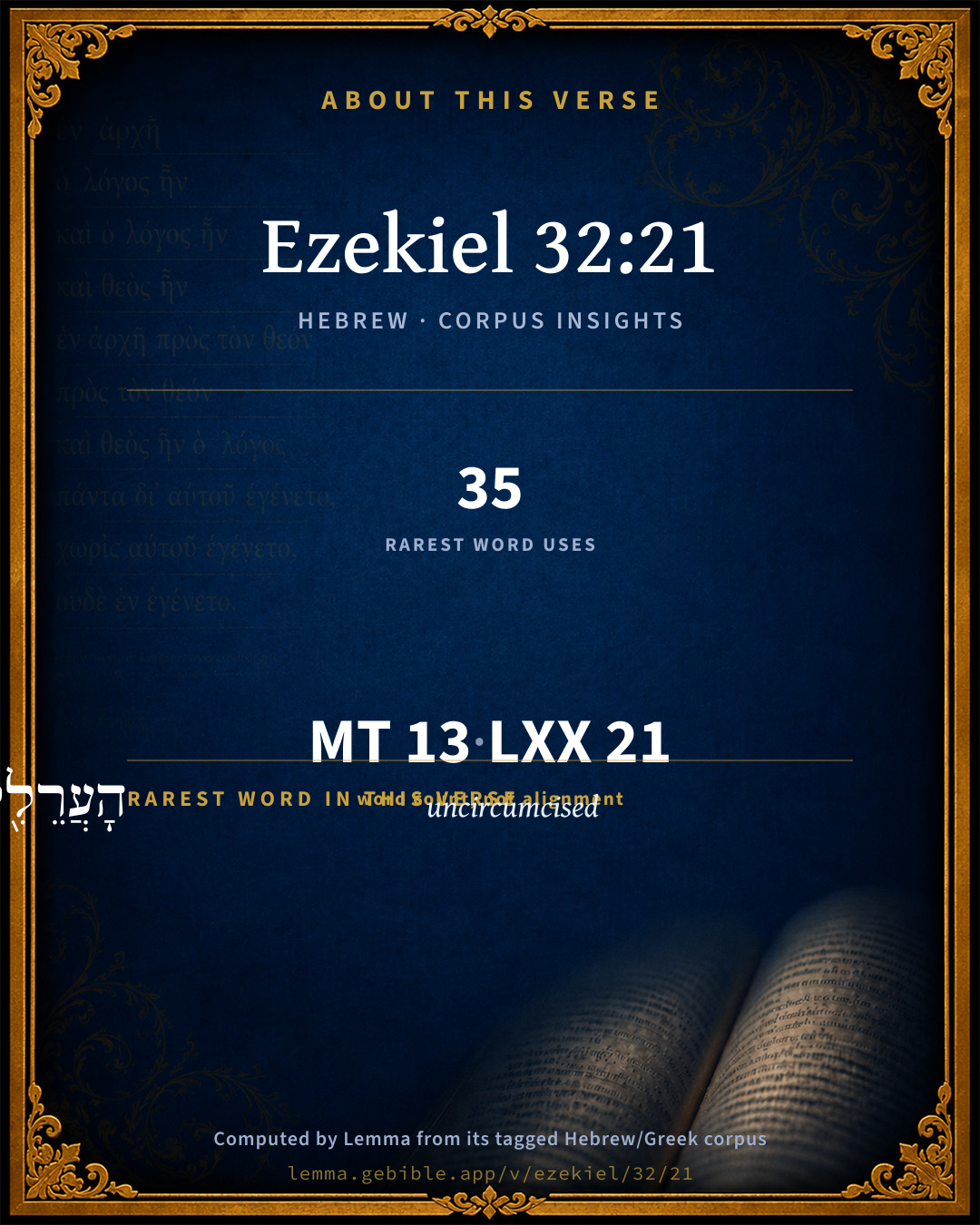
הָעֲרֵלִ֖ים
ʻârêl
H6189
“the · uncircumcised”
Particle, Definite Article + Adjective, Adjective, Masculine, Plural, Absolute
Part of Speech
Particle + Adjective
Type
Adjective
Gender
Masculine
Number
Plural
State
Absolute
Full BDB Definition

Origin: from H6188

TWOT: 1695b

uncircumcised, having foreskin
  1. יְדַבְּרוּ dâbar H1696 “to speak” Verb, Piel, Imperfect, 3rd Person, Masculine, Plural
  2. אֵלֵ֧י ʼêl H410 “gods of” Noun, Common, Masculine, Plural, Construct
  3. גִבּוֹרִ֛ים gibbôwr H1368 “mighty” Adjective, Adjective, Masculine, Plural, Absolute
  4. מִתּ֥וֹךְ tâvek H8432 “from · midst of” Preposition + Noun, Common, Masculine, Singular, Construct
  5. שְׁא֖וֹל shᵉʼôwl H7585 “Sheol” Noun, Proper
  6. אֶת ʼêth H854 “with” Preposition
  7. עֹֽזְרָ֑יו ʻâzar H5826 “helping · him” Verb, Qal, Participle Active, Masculine, Plural, Construct + Suffix, Personal, 3rd Person, Masculine, Singular
  8. יָֽרְד֛וּ yârad H3381 “to go down” Verb, Qal, Perfect, 3rd Person, Common, Plural
  9. שָׁכְב֥וּ shâkab H7901 “to lie down” Verb, Qal, Perfect, 3rd Person, Common, Plural
  10. חַלְלֵי châlâl H2491 “slain of” Adjective, Adjective, Masculine, Plural, Construct
  11. חָֽרֶב chereb H2719 “sword” Noun, Common, Feminine, Singular, Absolute

About this verse

These counts appear in no published source. They are computed here, from the morphology-tagged text and Lemma’s own curated glosses. What Lemma adds →

13
words
12
distinct lemmas
Prophets
section

Shared distinctive vocabulary

הָעֲרֵלִ֖ים uncircumcised H6189 occurs in 32 verses of the Hebrew Bible. Also found in:

Grammatical profile

  • 4 verbs
  • 4 nouns
  • 3 adjectives
  • 2 prepositions

Verb forms

  • יְדַבְּרוּ Piel · Imperfect
  • עֹֽזְרָ֑יו Qal · Participle Active
  • יָֽרְד֛וּ Qal · Perfect
  • שָׁכְב֥וּ Qal · Perfect

Hebrew & Septuagint length

In English translation the verse runs 34 words from the Hebrew and 32 from the Septuagint (LXX English) — closely comparable.

A rough comparison of the two English renderings, which tokenize alike — not a word-level alignment.

Word counts can differ between the Hebrew and the Greek without any difference in meaning — e.g. the Hebrew direct-object marker אֵת has no separate Greek word, and Greek often adds the article ὁ.

In the original languages it is 13 Hebrew tokens and 21 Greek tokens — but the two are counted differently (Hebrew bundles its prefixes and suffixes into one token; the Greek is in lemma form), so that isn’t a like-for-like length.

Cross-references

10

Topical passages linked to Ezekiel 32:21 in the Treasury of Scripture Knowledge — connected by theme and wording, ordered by reader-vote popularity; previews shown in the World English Bible.

  • Isaiah 14:9–10 Sheol from beneath is moved for you to meet you at your coming; it stirs up the dead for you, even all the chief ones of the earth; it has raised up from their thrones all the kings of the nations.
  • Ezekiel 32:27 They shall not lie with the mighty who are fallen of the uncircumcised, who are gone down to Sheol with their weapons of war, and have laid their swords under their heads, and their iniquities are on their bones; for [they were] the terror of the mighty in the land of the living.
  • Numbers 16:30–34 But if Yahweh make a new thing, and the ground open its mouth, and swallow them up, with all that appertain to them, and they go down alive into Sheol; then you shall understand that these men have despised Yahweh.
  • Psalms 9:17 The wicked shall be turned back to Sheol, Even all the nations that forget God.
  • Psalms 55:15 Let death come suddenly on them. Let them go down alive into Sheol. For wickedness is in their dwelling, in the midst of them.
  • Proverbs 14:32 The wicked is brought down in his calamity, But in death, the righteous has a refuge.
  • Isaiah 1:31 The strong will be like tinder, And his work like a spark. They will both burn together, And no one will quench them."
  • Ezekiel 32:19 Whom do you pass in beauty? Go down, and be laid with the uncircumcised.
  • Ezekiel 32:24–25 There is Elam and all her multitude round about her grave; all of them slain, fallen by the sword, who are gone down uncircumcised into the lower parts of the earth, who caused their terror in the land of the living, and have borne their shame with those who go down to the pit.
  • Luke 16:23–24 In Hades, he lifted up his eyes, being in torment, and saw Abraham far off, and Lazarus at his bosom.

Cross-references courtesy of OpenBible.info (CC BY 4.0).

Hebrew and Greek witnesses Masoretic Hebrew ↔ Greek Septuagint

The same verse in the two great witnesses to the Old Testament, shown verse-for-verse.

These are two independent witnesses, not word-aligned to each other, and the Septuagint is shown in lemma (dictionary) form.

Hebrew Ezekiel 32:21 Masoretic · Westminster Leningrad Codex

יְדַבְּרוּ ל֞וֹ אֵלֵ֧י גִבּוֹרִ֛ים מִתּ֥וֹךְ שְׁא֖וֹל אֶת עֹֽזְרָ֑יו יָֽרְד֛וּ שָׁכְב֥וּ הָעֲרֵלִ֖ים חַלְלֵי חָֽרֶב

The strong among the mighty shall speak to him out of the midst of Sheol with those who help him: they are gone down, they lie still, even the uncircumcised, slain by the sword.

World English Bible · Public Domain

Greek LXX Ezekiel 32:21 Septuagint · lemma form

καί εἶπον σύ ὁ γίγας ἐν βαθύς βόθρος γίγνομαι τίς κρείσσων εἰμί καταβαίνω καί κοιμάω μετά ἀπερίτμητος ἐν μέσος τραυματίας μάχαιρα

Be you in the depth of the pit: to whom are you superior? yes, go down, and lie with the uncircumcised, in the midst of them that are slain with the sword.

LXX2012 (modern English Septuagint) · Public Domain

On this verse, The Cambridge Bible for Schools and Colleges discusses the Septuagint’s reading. Read the note in Commentary ↓

Hebrew: Westminster Leningrad Codex (CC BY 4.0). Greek: Septuagint (public domain); English from LXX2012 (modern English Septuagint) (Public Domain). How the Septuagint differs from the Hebrew →

Targum (Aramaic paraphrase)

1

The Targum is the ancient Jewish Aramaic paraphrase of the Hebrew Scriptures — an interpretive translation, not the Hebrew text itself. Onkelos (literal) and Pseudo-Jonathan (expansive) render the Torah, and Jonathan the Prophets. Coverage is partial: where no permissively-licensed English translation exists for a verse, only the Aramaic is shown. This is verse-level text, not a word-by-word alignment to the Hebrew.

  1. Targum Jonathan Prophets (Joshua–Malachi)
    יְמַלְלוּן עִמֵיהּ תַּקִיפֵּי גִבָּרַיָא מִגוֹ שְׁאוֹל עִם סַעֲדוֹהִי נְחִיתוּ שְׁכִיבוּ חַיָבַיָא קְטִילֵי חַרְבָּא:

    (no public-domain English translation for this verse)

    Targum Jonathan — Aramaic: “Mikraot Gedolot” (public domain). English: “Sefaria Community Translation” (CC0 1.0 (public-domain dedication)); “London "Chaldee Paraphrase," 1871” (public domain). Text via Sefaria.

Commentary

Notes on Ezekiel 32:21 from classic Christian and Jewish commentators (each source and its license shown beneath its notes). The classic Christian expositions comment on the surrounding passage and are grouped to its opening verse, so a note may address several verses; the Jewish commentaries on the Tanakh (Rashi and others) are per-verse, so they appear only where the commentator wrote on this verse.

Lemma curates 59 commentaries, every one of them public domain or Creative Commons licensed, each selected and text-cleaned for this edition rather than reprinted as found. About our sources →

Trapp's Complete Commentary

John Trapp

Eze 32:21 The strong among the mighty shall speak to him out of the midst of hell with them that help him: they are gone down, they lie uncircumcised, slain by the sword.

Ver. 21. The strong among the mighty.] Who might have seen many fair summers, had they not been cut off by Pharaoh’s sword.

Shall speak to him out of the midst of hell.] What they say to him, see Isa 14:10, where we have the like personification in poetry.

John Trapp, A Commentary or Exposition upon All the Books of the Old and New Testament (1647–1656) — public domain. Text from a community e-Sword module.

Joseph Benson's Commentary

Eze 32:21. The strong among the mighty shall speak to him — Namely, to the king of Egypt; out of the midst of hell — Or, the pit, as Bishop Newcome renders the word: see Eze 32:23. The passage is “a poetical description of the regions of the dead; where the ghosts of deceased tyrants, with their subjects, are represented as coming to meet the king of Egypt and his auxiliaries, upon their arrival at the same place. Hell signifies here the state of the dead.” — Lowth. See note on Isa 14:9. They are gone down — The warriors, famous in their time for their exploits, have undergone the same fate with other men of blood, and are gone down to the grave by violent deaths.

Joseph Benson's Commentary on the Old and New Testaments (1811–1818) — public domain. Text from a community e-Sword module.

Tyndale Open Study Notes

Tyndale Open Resources

32:21-30 Assyria . . . Elam . . . Meshech and Tubal . . . Edom . . . the princes of the north and the Sidonians: These nations that once struck terror in the hearts of people everywhere were now shadowy figures, spent forces in a world without meaning or joy. Assyria had been conquered by the Babylonians and Medes between 627 and 609 BC and had been removed from its previous status as a superpower.

Tyndale Open Study Notes — © Tyndale Open Resources, licensed CC BY-SA 4.0. Text via the HelloAO Bible API.

Geneva Bible (1599)

Geneva Bible translators

To make the matter more sensible, he bringeth in Pharaoh whom the dead shall meet and marvel at him, read Isa. 14:9.

Geneva Bible (1599) marginal notes — public domain. Text via Bolls.life.

Jamieson, Fausset & Brown

Robert Jamieson, A. R. Fausset & David Brown

(Eze 31:16). Ezekiel has before his eyes Isa 14:9, &c.

shall speak to him--with "him" join "with them that help him"; shall speak to him and his helpers with a taunting welcome, as now one of themselves.

Jamieson, Fausset & Brown — Commentary Critical and Explanatory on the Whole Bible (1871) — public domain (CC PDM 1.0). Text via the HelloAO Bible API.

Adam Clarke's Commentary

Verse 21. Out of the midst of hell] שאול sheol, the catacombs, the place of burial. There is something here similar to Isa 14:9, where the descent of the king of Babylon to the state of the dead is described.

Adam Clarke's Commentary on the Bible (1810–1826) — public domain. Text from a community e-Sword/MySword module.

Ellicott's Commentary for English Readers

(21) Speak to him.—The pronoun oscillates between the masculine and the feminine, because the thought is partly of the king and partly of the kingdom. The pronoun is determined by whichever is for the moment uppermost in the prophet’s mind. On Hell, see Note on Eze_31:16-17. It occurs also at Eze_32:27.

A Bible Commentary for English Readers, edited by Charles John Ellicott (1878–1897) — public domain. Text from a community e-Sword module.

The Cambridge Bible for Schools and Colleges

gen. ed. J. J. S. Perowne

21. The Pharaoh and his multitude are supposed here to have descended into Sheòl, and the “mighty ones” already there address them (Isa_14:8; Isa_14:10) or speak of them.

The strong among the mighty] lit. the strong of the mighty, where “strong” is not a class among the mighty, but identical with them—the strong mighty ones (gen. of appos.). In LXX. “strong” is wanting as in Eze_32:27. The word “strong” is that rendered mighty one of the nations, Eze_31:11. It is probably entirely different (though the same in spelling) from the word God, Eze_28:2, and from the phrase “mighty God,” Isa_9:6; Isa_10:21.

speak to him] Or, of him. The words that follow seem spoken in regard to Pharaoh—though such a meaning is rather flat.

that help him] his helpers, auxiliary nations. The meaning must be that the mighty speak to (of) Pharaoh and his helpers, hardly that Pharaoh’s helpers already gone down join the mighty in mocking Pharaoh.

In LXX. these three verses stand in a different order, viz. Eze_32:20 a, 20 b (read differently), 21 a, 19, and the first three words of Eze_32:20 again, “They shall fall with him in the midst of them that are slain with the sword, and all his multitude (strength) shall lie down. And the mighty (lit. giants, Eze_32:27) shall say unto thee: Be thou in the depth of the pit; to whom art thou superior? go down, and lie with the uncircumcised, in the midst of them that are slain with the sword.” Probably neither text presents the original, though the general meaning of both is the same. It is in favour of Heb. that it begins with the interrogation, and rather against the LXX. that it makes the address rather prolix. The “mighty” who speak are in any case those already in Sheòl, and not persons upon the earth such as the Babylonians (Hitz.).

The Cambridge Bible for Schools and Colleges (gen. ed. J. J. S. Perowne; Cambridge University Press, 1878–1918) — public domain. Text from a community e-Sword module.

John Gill's Exposition

The strong among the mighty shall speak to him,.... The strongest of them, such who have excelled others in strength and courage, famous for military exploits, who have been generals of armies, great warriors, and conquerors; and yet with all their might and strength could not withstand death, but were subdued by it, and brought down to the grave; these are, by a poetical figure, represented as meeting Pharaoh king of Egypt, when he came to his grave, saluting and welcoming him to the state of the dead in which they were; taking a sort of comfort in it, and insulting him as being as weak as they; see Isa 14:9, which they should do

out of the midst of hell, or the grave, "Hades", the state of the dead:

with them that help him; the associates, allies, and friends of Pharaoh, his auxiliaries that fell with him, and were brought to the grave at the same time with him; these should be greeted, saluted, and welcomed in like manner:

they are gone down; to the grave; those mighty ones that are represented as speaking, and the Egyptians and their helpers who are spoken to:

they lie uncircumcised; among them that are so, Eze 32:19,

slain by the sword; of their enemies, who got the victory over them.

John Gill's Exposition of the Whole Bible (1746–1763) — public domain (CC PDM 1.0). Text via the HelloAO Bible API.

Albert Barnes' Notes on the Bible

The uncircumcised - throughout this dirge is equivalent to pagan viewed as impure (Eze 31:18 note).

Albert Barnes' Notes on the Bible (1834–1885) — public domain. Text from a community e-Sword/MySword module.

Haydock's Catholic Bible Commentary

Most. Septuagint, "giants shall say to thee: Remain in the depth of the pit. Whom dost thou excel? descend," &c. (Haydock) --- They vary much in this chapter from the Hebrew. (St. Jerome) --- Helpers; Lybians, &c., chap. xxx. 5. These shall come to compliment the king. (Calmet) --- After a battle, those of the same nation were buried together, ver. 22. (Theodoret) --- The Egyptians had tombs like houses, in which there were separate holes or apartments (Calmet) as in large vaults. (Haydock)

George Leo Haydock (1774–1849), Haydock's Catholic Family Bible and Commentary, 1859 edition — public domain. Excludes Psalms (Douay-Rheims chapter numbering differs from Protestant) and Deuterocanonical books (Catholic canon only).

Matthew Poole's English Annotations

The prophet seems in this verse to introduce the next speakers in this parley, and bringing them in, gives their character.

The strong; the powerful, the valiant, whose natural strength of body was great, and their courage greater, those that were strongest.

Among the mighty; for feats they did, by which it appeared they might compared with others, pass for giants, mighty warriors. conquerors, and riders.

Shall speak to him, the king of Egypt.

Hell; or rather, the grave, where they lie without strength, as dead mortals, though while they lived they bore themselves as if gods and immortal.

Them that help him; either these great ones shall speak to Hophra’s helpers, or else these his friends, slain in his quarrel and dead before him, shall speak to him.

Gone down to the grave: see Eze 32:18. Uncircumcised; neglected and forgotten, or remembered with contempt: see Eze 32:19.

Matthew Poole's English Annotations on the Holy Bible (1683–1685) — public domain. Text from a community e-Sword/MySword module.

Whedon's Commentary on the Bible

Daniel D. Whedon

21. The strong among the mighty — The strong mighty ones (Davidson). The residents of Sheol greet these incoming nations — who in life considered themselves infinitely their superiors — with belittling comments. They have not entered Sheol with dignity, after the sacred rites of a religious burial, but have been hurried thither from the battlefield where their bones may yet be left uncovered. (Compare Eze_31:18.) The entire passage compels a sharp distinction between those who were buried in state with their weapons about them (Eze_32:27), and those who, like the uncircumcised barbarians, lay buried where they fell, without the funeral rites which prepared them for a favorable entrance into Sheol. (See Appendix.)

Daniel D. Whedon (gen. ed.), Commentary on the Old and New Testaments (1874–1909) — public domain. Text from a community e-Sword module.

The Pulpit Commentary

The strong among the mighty. Those already in Sheol watch the new arrival, and make their scornful comments, (comp. Isa_14:9, Isa_14:18) at once classing them with the uncircumcised. Had they heard, we ask, of the downfall of Egypt?

The Pulpit Commentary (1880–1919), ed. H.D.M. Spence-Jones & Joseph S. Exell — public domain. Text from a community e-Sword module.

John Wesley's Explanatory Notes

Him - The king of Egypt. The grave - Where they lie without strength, as dead mortals, tho' while they lived, they bore themselves, as gods. That help - His helpers, dead before him, shall speak to him. Gone down - To the grave. They lie - Neglected, and forgotten.

John Wesley, Explanatory Notes Upon the Whole Bible (1754–1765) — public domain. Text via the GEBible commentary corpus.

Scofield Reference Notes

C. I. Scofield

hell

Eze 32:27, Heb. "Sheol," (See Scofield "Hab 2:5").

The Scofield Reference Bible (1917 edition), notes by C. I. Scofield — public domain. Text from a community e-Sword module.

Rashi

Rabbi Shlomo Yitzchaki (Rashi)

shall speak of him [Heb. יְדַבְּרוּ לוֹ] shall speak of him and of his helpers.

the strongest of the mighty men...from the midst of the Grave Transpose the verse and interpret it: They shall speak of him אֶתעֹזרָיו, with his helpers; i.e., concerning all his helpers with him, too, shall the strongest of the mighty men, who are in the Grave, speak, and they will say about them thus: the uncircumcised... descended, etc. Every לָהֶם, לִי, לוֹ, and לְךָ written next to דִבּוּר, speech, means nothing but “about.”

Rashi on the Tanakh — English translations: “The Judaica Press complete Tanach with Rashi, translated by A. J. Rosenberg” (CC BY 4.0); “Pentateuch with Rashi's commentary by M. Rosenbaum and A.M. Silbermann, 1929-1934” (public domain); “The Metsudah Tanach series, Lakewood, N.J” (CC BY 4.0); and “The Book of Joshua, Metsudah Publications, 1997” (CC BY 4.0). Text via Sefaria.

Lesson kit

Teaching starters — assembled from the data on this page, not authored interpretation. Every prompt links to the verse data it draws on. Edit before teaching.

Ezekiel, in the Prophets, opens this verse with 13 words (12 distinct Hebrew lemmas). Its most distinctive word is ʻârêl (“uncircumcised”). A historical commentator’s framing appears above. Read the whole chapter for the surrounding context.

Discussion questions

  1. The word ʻârêl carries the sense “uncircumcised.” How does it shape the verse?
  2. How does Genesis 17:14, which shares the word «uncircumcised», read alongside this verse?
  3. These translations render this verse differently. What is at stake in choosing one wording over another?
  4. «יְדַבְּרוּ» is a Piel Imperfect verb. How does that grammatical form shape the action described?
  5. Compare how Trapp's Complete Commentary and Joseph Benson's Commentary read this verse. Where do they agree or differ?

Things to notice

Reading settings

Reading text

Shown beneath each verse's original-language words.

Old Testament
Old Testament edition

Read the OT as the Masoretic Hebrew (MT) or the Greek Septuagint (LXX).

English shown for the Greek Septuagint (in the Hebrew ↔ Greek comparison).

Comparing translations? Open the Compare panel on any verse page to stack up to four side by side.