
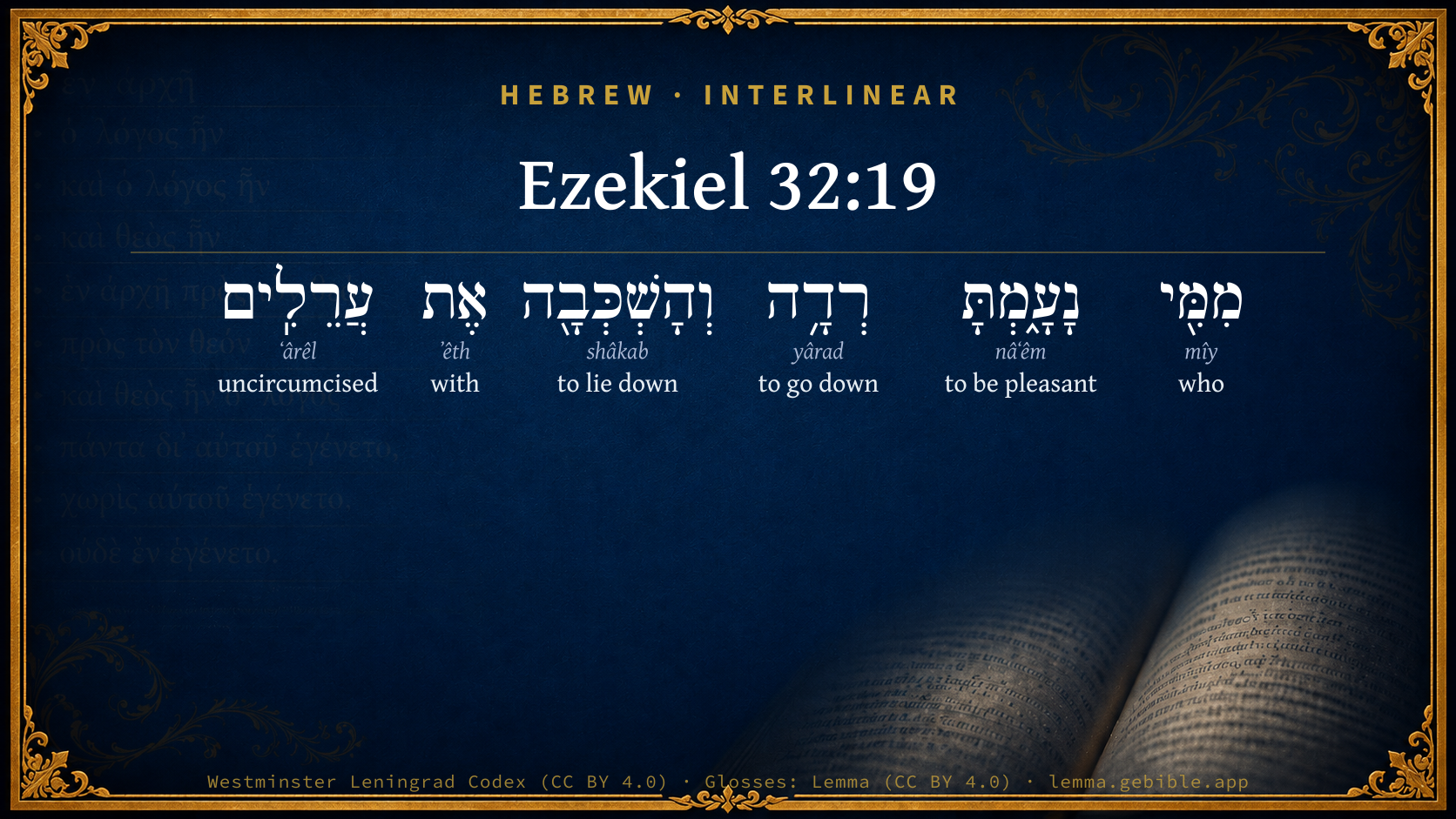
Ezekiel 32:19

Hebrew (Westminster Leningrad Codex) Ezekiel 32:19 appears in the Hebrew Old Testament. The text above is from the Westminster Leningrad Codex. Each word links to its Strong’s number, a concise gloss, and parsing drawn from the Open Scriptures Hebrew Bible morphology. Click any word for its full Brown-Driver-Briggs (BDB) entry.
Download image
Cite this verse

Ezekiel 32:19 (World English Bible). Public Domain. Lemma interlinear Bible study tool, https://lemma.gebible.app/v/ezekiel/32/19.

Show BibTeX & RIS
BibTeX
RIS
English Translation
Whom do you pass in beauty? Go down, and be laid with the uncircumcised.
World English Bible · Public Domain
Download a study sheet

One document with this verse’s original text, its word-by-word gloss line, the meaning frame, cross-references with their text, attributed commentary, and full source and license credits — printable, and it pastes into notes with its structure intact.

This verse Autodidact and up

Study sheet (.html) Plain text (.txt)

A passage Seminary Student

Up to 50 verses in one chapter. A passage sheet keeps up to 6 commentary sources and 12 cross-references per verse, in the order this page ranks them, and says so on the sheet whenever that leaves anything out. Ask for a single verse and you get the Autodidact verse sheet above.

Everything on this page stays free to read, with no account — the sheet is a download of what is already on screen, not access to it.

Want to remove ads? Support Godless Engineer
Compare translations 3

The same verse in 3 English versions, stacked beneath the original-language interlinear above. Click any original word for its lexicon entry.

Each is an independent rendering of the whole verse — the interlinear is not word-aligned to these translations.

Highlighted words mark where these versions differ — a whole-verse word diff, not a word-by-word alignment.

  • World English Bible Public Domain
    Whom do you pass in beauty? Go down, and be laid with the uncircumcised.
  • King James Version Public Domain
    Whom dost thou pass in beauty? go down, and be thou laid with the uncircumcised.
  • unfoldingWord Literal Text CC BY-SA 4.0
    ‘Are you really more beautiful than anyone else? Go down and lie down with the uncircumcised.’

unfoldingWord Literal Text — © unfoldingWord, licensed CC BY-SA 4.0. Word-aligned USFM3 via Door43 (git.door43.org/unfoldingWord/en_ult).

Versions to compare (up to 4)

3 of 4 selected

Show all 18 translations

Every available English version of this verse, each an independent rendering of the whole verse.

  • World English Bible Public Domain
    Whom do you pass in beauty? Go down, and be laid with the uncircumcised.
  • Berean Standard Bible Public Domain
    Whom do you surpass in beauty? Go down and be placed with the uncircumcised!
  • Majority Standard Bible Public Domain
    Whom do you surpass in beauty? Go down and be placed with the uncircumcised!
  • King James Version Public Domain
    Whom dost thou pass in beauty? go down, and be thou laid with the uncircumcised.
  • American Standard Version (1901) Public Domain
    Whom dost thou pass in beauty? go down, and be thou laid with the uncircumcised.
  • Revised Version (1885) Public Domain
    Whom dost thou pass in beauty? go down, and be thou laid with the uncircumcised.
  • Geneva Bible (1599) Public Domain
    Whome doest thou passe in beautie? goe downe and sleepe with the vncircumcised.
  • Douay-Rheims (1899) Public Domain
    Whom dost thou excel in beauty? go down and sleep with the uncircumcised.
  • Young's Literal Translation Public Domain
    Than whom hast thou been more pleasant? Go down, and be laid with the uncircumcised.
  • Literal Standard Version CC BY-SA 4.0
    Whom have you surpassed in beauty? Go down, and be laid with [the] uncircumcised.
  • Unlocked Literal Bible CC BY-SA 4.0
    'Are you really more beautiful than anyone else? Go down and lie down with the uncircumcised.'
  • unfoldingWord Literal Text CC BY-SA 4.0
    ‘Are you really more beautiful than anyone else? Go down and lie down with the uncircumcised.’
  • Darby Bible Public Domain
    Whom dost thou surpass in beauty? Go down, and be thou laid with the uncircumcised.
  • World Messianic Bible Public Domain
    Whom do you pass in beauty? Go down, and be laid with the uncircumcised.
  • Webster's Bible Public Domain
    Whom dost thou pass in beauty? go down, and be thou laid with the uncircumcised.
  • Free Bible Version CC BY-SA 4.0
    Do you think you're more beautiful than anyone else? Go down and take your place in the grave with the heathen!
  • Bible in Basic English Public Domain
    Are you more beautiful than any? go down, and take your rest among those without circumcision,
  • JPS Tanakh (1917) Public Domain
    Whom dost thou pass in beauty? Go down, and be thou laid with the uncircumcised.

Literal Standard Version (2020), Covenant Press — licensed CC BY-SA 4.0. Text via the HelloAO Bible API (eBible.org). Unlocked Literal Bible (unfoldingWord) — licensed CC BY-SA 4.0. Text via the HelloAO Bible API (eBible.org). unfoldingWord Literal Text — © unfoldingWord, licensed CC BY-SA 4.0. Word-aligned USFM3 via Door43 (git.door43.org/unfoldingWord/en_ult). Free Bible Version, Dr. Jonathan Gallagher — licensed CC BY-SA 4.0. Text via the HelloAO Bible API (eBible.org).

Word by word

More ways to search: Search by grammar → Find every occurrence → Compare this word →

Practice this passage: Drill this verse → Learn its vocabulary →

About this verse

These counts appear in no published source. They are computed here, from the morphology-tagged text and Lemma’s own curated glosses. What Lemma adds →

6
words
6
distinct lemmas
Prophets
section

Notable vocabulary

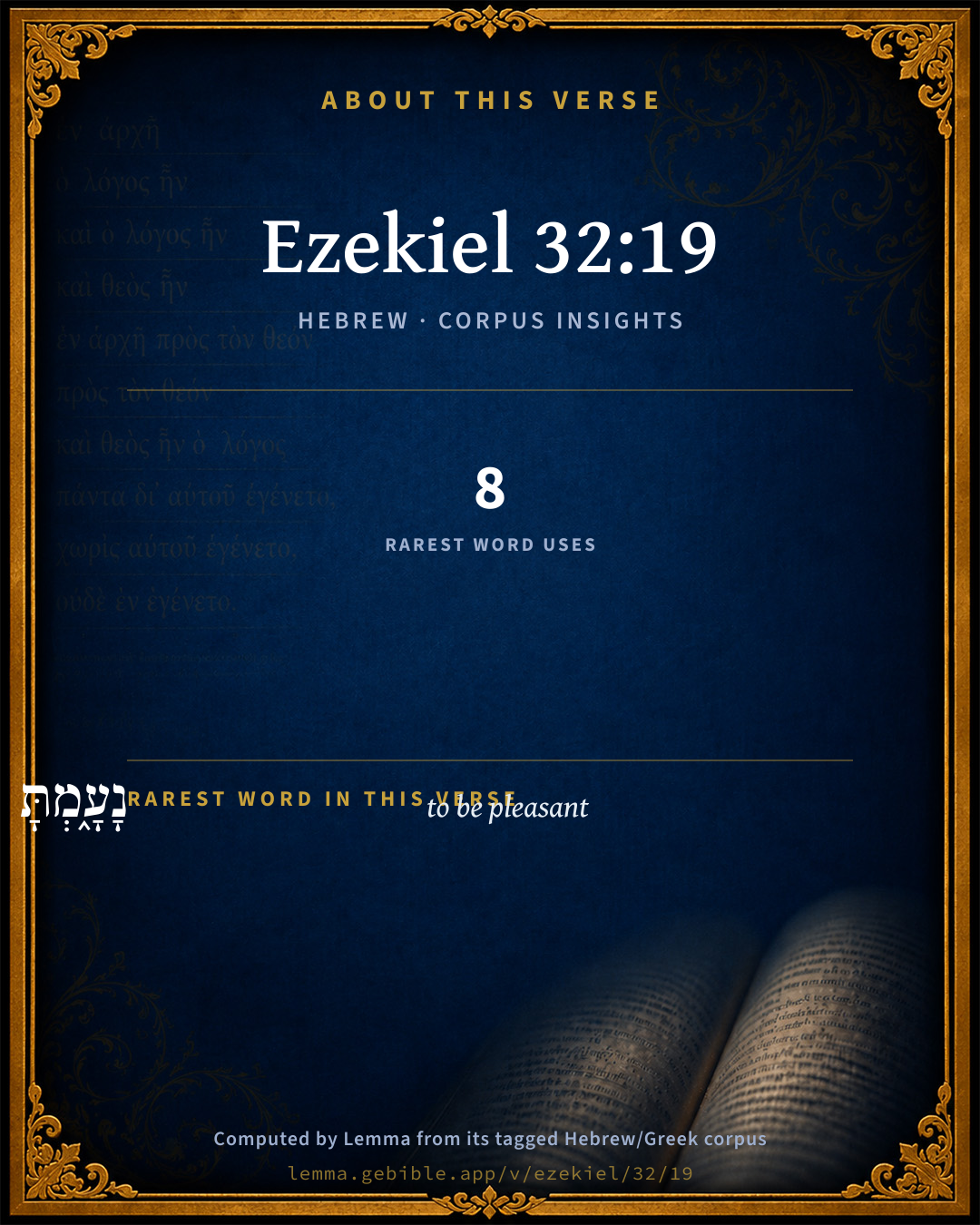
The rarest word here is נָעָ֑מְתָּ to be pleasant H5276 — appearing just 8 times in the whole Hebrew Bible.

Shared distinctive vocabulary

נָעָ֑מְתָּ to be pleasant H5276 occurs in 8 verses of the Hebrew Bible. Also found in:

Grammatical profile

  • 3 verbs
  • 1 adjective
  • 1 preposition
  • 1 particle

Verb forms

  • נָעָ֑מְתָּ Qal · Perfect
  • רְדָ֥ה Qal · Imperative
  • וְהָשְׁכְּבָ֖ה Hophal · Imperative

Cross-references

12

Topical passages linked to Ezekiel 32:19 in the Treasury of Scripture Knowledge — connected by theme and wording, ordered by reader-vote popularity; previews shown in the World English Bible.

  • Ezekiel 31:18 To whom are you thus like in glory and in greatness among the trees of Eden? yet shall you be brought down with the trees of Eden to the lower parts of the earth: you shall lie in the midst of the uncircumcised, with those who are slain by the sword. This is Pharaoh and all his multitude, says the Lord Yahweh.
  • Ezekiel 32:29–30 There is Edom, her kings and all her princes, who in their might are laid with those who are slain by the sword: they shall lie with the uncircumcised, and with those who go down to the pit.
  • Jeremiah 9:25–26 Behold, the days come, says Yahweh, that I will punish all those who are circumcised in [their] uncircumcision:
  • Ezekiel 28:10 You shall die the death of the uncircumcised by the hand of strangers: for I have spoken it, says the Lord Yahweh.
  • Ezekiel 31:2 Son of man, tell Pharaoh king of Egypt, and to his multitude: Whom are you like in your greatness?
  • Ezekiel 32:21 The strong among the mighty shall speak to him out of the midst of Sheol with those who help him: they are gone down, they lie still, even the uncircumcised, slain by the sword.
  • Ezekiel 32:24 There is Elam and all her multitude round about her grave; all of them slain, fallen by the sword, who are gone down uncircumcised into the lower parts of the earth, who caused their terror in the land of the living, and have borne their shame with those who go down to the pit.
  • 1 Samuel 17:26 David spoke to the men who stood by him, saying, What shall be done to the man who kills this Philistine, and takes away the reproach from Israel? for who is this uncircumcised Philistine, that he should defy the armies of the living God?
  • 1 Samuel 17:36 Your servant struck both the lion and the bear: and this uncircumcised Philistine shall be as one of them, seeing he has defied the armies of the living God.
  • Isaiah 14:9–15 Sheol from beneath is moved for you to meet you at your coming; it stirs up the dead for you, even all the chief ones of the earth; it has raised up from their thrones all the kings of the nations.
  • Ezekiel 27:3–4 and tell Tyre, you who dwell at the entry of the sea, who are the merchant of the peoples to many isles, thus says the Lord Yahweh: You, Tyre, have said, I am perfect in beauty.
  • Ezekiel 28:12–17 Son of man, take up a lamentation over the king of Tyre, and tell him, Thus says the Lord Yahweh: You seal up the sum, full of wisdom, and perfect in beauty.

Cross-references courtesy of OpenBible.info (CC BY 4.0).

Hebrew and Greek witnesses Masoretic Hebrew ↔ Greek Septuagint

The same verse in the two great witnesses to the Old Testament, shown verse-for-verse.

These are two independent witnesses, not word-aligned to each other, and the Septuagint is shown in lemma (dictionary) form.

Hebrew Ezekiel 32:19 Masoretic · Westminster Leningrad Codex

מִמִּ֖י נָעָ֑מְתָּ רְדָ֥ה וְהָשְׁכְּבָ֖ה אֶת עֲרֵלִֽים

Whom do you pass in beauty? Go down, and be laid with the uncircumcised.

World English Bible · Public Domain

Hebrew: Westminster Leningrad Codex (CC BY 4.0). Greek: Septuagint (public domain); English from a public-domain English Septuagint. How the Septuagint differs from the Hebrew →

Targum (Aramaic paraphrase)

1

The Targum is the ancient Jewish Aramaic paraphrase of the Hebrew Scriptures — an interpretive translation, not the Hebrew text itself. Onkelos (literal) and Pseudo-Jonathan (expansive) render the Torah, and Jonathan the Prophets. Coverage is partial: where no permissively-licensed English translation exists for a verse, only the Aramaic is shown. This is verse-level text, not a word-by-word alignment to the Hebrew.

  1. Targum Jonathan Prophets (Joshua–Malachi)
    מִמַן אַתְּ גִבַּר חוּת וּשְׁכִיב עִם חַיָבַיָא:

    (no public-domain English translation for this verse)

    Targum Jonathan — Aramaic: “Mikraot Gedolot” (public domain). English: “Sefaria Community Translation” (CC0 1.0 (public-domain dedication)); “London "Chaldee Paraphrase," 1871” (public domain). Text via Sefaria.

Commentary

Notes on Ezekiel 32:19 from classic Christian and Jewish commentators (each source and its license shown beneath its notes). The classic Christian expositions comment on the surrounding passage and are grouped to its opening verse, so a note may address several verses; the Jewish commentaries on the Tanakh (Rashi and others) are per-verse, so they appear only where the commentator wrote on this verse.

Lemma curates 59 commentaries, every one of them public domain or Creative Commons licensed, each selected and text-cleaned for this edition rather than reprinted as found. About our sources →

Trapp's Complete Commentary

John Trapp

Eze 32:19 Whom dost thou pass in beauty? go down, and be thou laid with the uncircumcised.

Ver. 19. Whom dost thou pass in beauty?] What art thou better than other thy compeers and complices in sin? Thou must also dance down to hell down to hell, with the rest.

Be thou laid with the uncircumcised.] Strangers to the covenant, whereof circumcision was a seal Sinners the Chaldee here calleth them, such as the devil sweeps. They are his birds, saith Mr Bradford, martyr, {a} whom, when he hath well fed, he will broach them and eat them, chew them and champ them, world without end, in eternal woe and misery.

{a} Serm. of Repent., p. 70.

John Trapp, A Commentary or Exposition upon All the Books of the Old and New Testament (1647–1656) — public domain. Text from a community e-Sword module.

Joseph Benson's Commentary

Eze 32:19-20. Whom dost thou pass in beauty? — What reason hast thou to prefer thyself before others? Art thou better than they, that thou shouldest not die and be laid in the dust as well as they? Go down — Namely, to the regions of the dead; and be laid with the uncircumcised — Among profane and loathed carcasses, such as the bodies of the uncircumcised were in the opinion of the circumcised: see notes on Eze 28:8-10; Eze 31:18. The circumcised, in Scripture, being put for those for whom God had a peculiar regard, and this being one of the distinguishing characteristics of his peculiar people, therefore the term uncircumcised seems to be used for those whom God had rejected, that is, for the wicked and profane. They shall fall in the midst of them that are slain by the sword — Thy people shall not die the common death of all men, but shall be cut off by an extraordinary judgment from the hand of God himself: they shall be slain by the sword. Draw her and all her multitude — Carry her and her people away to the grave, like so many carcasses, which are buried without any solemnity. The words seem to be spoken to the Babylonians, the executioners of God’s judgments upon Egypt.

Joseph Benson's Commentary on the Old and New Testaments (1811–1818) — public domain. Text from a community e-Sword module.

Geneva Bible (1599)

Geneva Bible translators

Have not other kingdoms, more beautiful than thou, perished?

Geneva Bible (1599) marginal notes — public domain. Text via Bolls.life.

Jamieson, Fausset & Brown

Robert Jamieson, A. R. Fausset & David Brown

Whom dost thou pass in beauty?--Beautiful as thou art, thou art not more so than other nations, which nevertheless have perished.

go down, &c.--to the nether world, where all "beauty" is speedily marred.

Jamieson, Fausset & Brown — Commentary Critical and Explanatory on the Whole Bible (1871) — public domain (CC PDM 1.0). Text via the HelloAO Bible API.

Adam Clarke's Commentary

Verse 19. Whom dost thou pass in beauty?] How little does it signify, whether a mummy be well embalmed, wrapped round with rich stuff, and beautifully painted on the outside, or not. Go down into the tombs, examine the niches, and see whether one dead carcass be preferable to another.

Adam Clarke's Commentary on the Bible (1810–1826) — public domain. Text from a community e-Sword/MySword module.

Ellicott's Commentary for English Readers

(19) With the uncircumcised.—See Note on Eze_28:10. All question as to the use of circumcision among the Egyptians is out of place; the word is simply used as the ordinary phrase for the heathen.

A Bible Commentary for English Readers, edited by Charles John Ellicott (1878–1897) — public domain. Text from a community e-Sword module.

The Cambridge Bible for Schools and Colleges

gen. ed. J. J. S. Perowne

19. Whom … pass in beauty] i.e. surpass; Ew., pass in fortune. Probably the meaning is very much, To whom art (wast) thou superior? The multitude of Egypt or the Pharaoh as the genius of the nation is addressed, hardly his dead body (Sm.).

go down] i.e. to the grave, or pit. “Uncircumcised” has in all the passage the sense of dishonoured, profaned in death, and differs little from slain with the sword, Eze_32:21; Eze_32:24. The pass. imper. “be thou laid” is very rare, Jer_49:8.

The Cambridge Bible for Schools and Colleges (gen. ed. J. J. S. Perowne; Cambridge University Press, 1878–1918) — public domain. Text from a community e-Sword module.

John Gill's Exposition

Whom dost thou pass in beauty?.... This question the prophet is bid to put to Egypt; what nation is there, or has been, that thou excellest in wisdom, in riches, or in strength, in the multitude of subjects, or extent of dominions, that thou thinkest thyself secure from destruction? look over other kingdoms and states mightier than thou, or at least equal to thee, and see how they are brought to ruin, and expect that this will quickly be thy case:

go down, and be thou laid with the uncircumcised; go down to the grave, and take thy place, and lie there among the wicked and most profligate of mankind, and such as might be most despised by the Egyptians, since they used circumcision. The Targum is,

"go down and sleep with sinners.''

John Gill's Exposition of the Whole Bible (1746–1763) — public domain (CC PDM 1.0). Text via the HelloAO Bible API.

Albert Barnes' Notes on the Bible

whom dost thou pass in beauty? - Thou art not more beautiful than other nations: thou shalt not escape their fate.

Albert Barnes' Notes on the Bible (1834–1885) — public domain. Text from a community e-Sword/MySword module.

Matthew Poole's English Annotations

The whole, from this verse, is a most elegant personating of the dead, as if sensible, and acquainted, and discoursing with, and rejoicing at the fall of proud tyrants, who took not warning by their fall. Such a prosopopoeia you have Isa 14. In this chapter the actors are the prophet, the king of Egypt and his people, and their auxiliaries.

Whom dost thou pass in beauty? the prophet begins with this question dialogue-wise, Art thou better than others, that thou shouldst not die and be laid in dust, as well as all others? speak, Hophra, if thou hast any privilege to plead, what hast thou to say why thou shouldst not go down to the pit as a despised mortal?

Go down: the prophet, hearing no plea of privilege, adjudgeth him to the grave, or lays him own with somewhat a sarcasm, Go down like others.

Be thou laid; take up thy lodging, thy long, dark, and dismal recess, where thy dust and bones shall never be known by any royal figure.

With the uncircumcised; among profane and loathed carcasses; such the uncircumcised were in the opinion of the circumcised, and Herodotus in Euterpe saith the Egyptians were circumcised. However, in Scripture, a burial with the uncircumcised is a note of dishonour and contempt; thus for the king and princes.

Matthew Poole's English Annotations on the Holy Bible (1683–1685) — public domain. Text from a community e-Sword/MySword module.

Whedon's Commentary on the Bible

Daniel D. Whedon

19. Pass in — Surpass in (Kautzsch). Egypt, who has been brightest among the nations, must now fall to the level of the shadowy inhabitants of Sheol.

Daniel D. Whedon (gen. ed.), Commentary on the Old and New Testaments (1874–1909) — public domain. Text from a community e-Sword module.

The Pulpit Commentary

Whom dost thou pass in beauty? The lamentation, as might be expected from Ezekiel"s standpoint, is an illustration of irony and triumph rather than of sorrow. The question implies a negative answer. Glorious as Egypt had been, other nations had equaled her. They had passed away, and so should she. With the uncircumcised. The words, as Eze_31:18, suggest the thought that Israel, so far as it was faithful to its calling, circumcised in heart as well as flesh, (Jer_9:26) had a higher and happier dwelling in Hades than the uncircumcised heathen. As the Egyptians practiced circumcision, the language of the prophet had a special significance. Their place in Hades was among the heathen to whom that hereto was unknown.

The Pulpit Commentary (1880–1919), ed. H.D.M. Spence-Jones & Joseph S. Exell — public domain. Text from a community e-Sword module.

John Wesley's Explanatory Notes

Whom - Art thou better than others that thou shouldest not die, and be laid in the dust, as well as they. Go - Go down like others. With the uncircumcised - Among profane and loathed carcasses, such the uncircumcised were in the opinion of the circumcised, as were the Egyptians.

John Wesley, Explanatory Notes Upon the Whole Bible (1754–1765) — public domain. Text via the GEBible commentary corpus.

unfoldingWord translationNotes

Door43 World Missions Community

General Information:

Yahweh continues speaking to Ezekiel. He speaks of the people of Egypt as if they were a woman. (See: Metaphor)

Are you really more beautiful than anyone else? Go down and lie down with the uncircumcised.

This is a question and command that the prophet is to ask the Egyptians. AT: "Go down and lie down with the uncircumcised. Ask them all: 'Are you really more beautiful than anyone else?'" (See: Assumed Knowledge and Implicit Information)

Go down

It is implied that they must go down to Sheol. AT: "Go down to Sheol" (See: Assumed Knowledge and Implicit Information)

lie down

as in death. If your language has a word for dead people lying down that is different from the word for live people lying down to sleep, use it here.

Are you really more beautiful than anyone else?

This question really makes a statement. AT: "You are not more beautiful than anyone else." (See: Rhetorical Question)

They will fall

"Egypt and her people will fall"

who were killed by the sword

The word "sword" is a metonym for a soldier who kills people with a sword.This can be put into active form. AT: "whom enemy soldiers killed with swords" or "who died in battle" (See: Active or Passive and Metonymy)

The sword has been drawn!

The word "sword" here is a metonym for war that people fight with swords. This can be translated in active form. AT: "War has begun" (See: Metonymy and Active or Passive)

She has been given to the sword

This can be put in active form. AT: "I have given Egypt to the sword" (See: Active or Passive)

they will seize her and her multitudes

"her enemies will seize Egypt and her people"

about Egypt and her allies

"about the Egyptians and those who join them"

translationWords

circumcise

sword

Egypt

adversary

Hades

declare

unfoldingWord translationNotes — © Distant Shores Media and the Door43 World Missions Community, licensed CC BY-SA 4.0. Source: git.door43.org/Door43/en_tn.

Rashi

Rabbi Shlomo Yitzchaki (Rashi)

Whom have you surpassed in pleasantness Are you any better than the other uncircumcised ones? You too will descend into the Pit and lie with them.

Rashi on the Tanakh — English translations: “The Judaica Press complete Tanach with Rashi, translated by A. J. Rosenberg” (CC BY 4.0); “Pentateuch with Rashi's commentary by M. Rosenbaum and A.M. Silbermann, 1929-1934” (public domain); “The Metsudah Tanach series, Lakewood, N.J” (CC BY 4.0); and “The Book of Joshua, Metsudah Publications, 1997” (CC BY 4.0). Text via Sefaria.

Lesson kit

Teaching starters — assembled from the data on this page, not authored interpretation. Every prompt links to the verse data it draws on. Edit before teaching.

Ezekiel, in the Prophets, opens this verse with 6 words (6 distinct Hebrew lemmas). Its most distinctive word is nâʻêm (“to be pleasant”). A historical commentator’s framing appears above. Read the whole chapter for the surrounding context.

Discussion questions

  1. The word nâʻêm carries the sense “to be pleasant.” How does it shape the verse?
  2. Genesis 49:15 shares the word «to be pleasant» with this verse. How do the two illuminate each other?
  3. These translations render this verse differently; the difference is in the English rendering, not the original. What questions does that raise?
  4. The verb «נָעָ֑מְתָּ» is Qal Perfect. How does its form color the action?
  5. Reading how Trapp's Complete Commentary and Joseph Benson's Commentary read this verse, where do the two commentators agree and where do they part?

Things to notice

Reading settings

Reading text

Shown beneath each verse's original-language words.

Old Testament
Old Testament edition

Read the OT as the Masoretic Hebrew (MT) or the Greek Septuagint (LXX).

English shown for the Greek Septuagint (in the Hebrew ↔ Greek comparison).

Comparing translations? Open the Compare panel on any verse page to stack up to four side by side.