Genesis 34:2

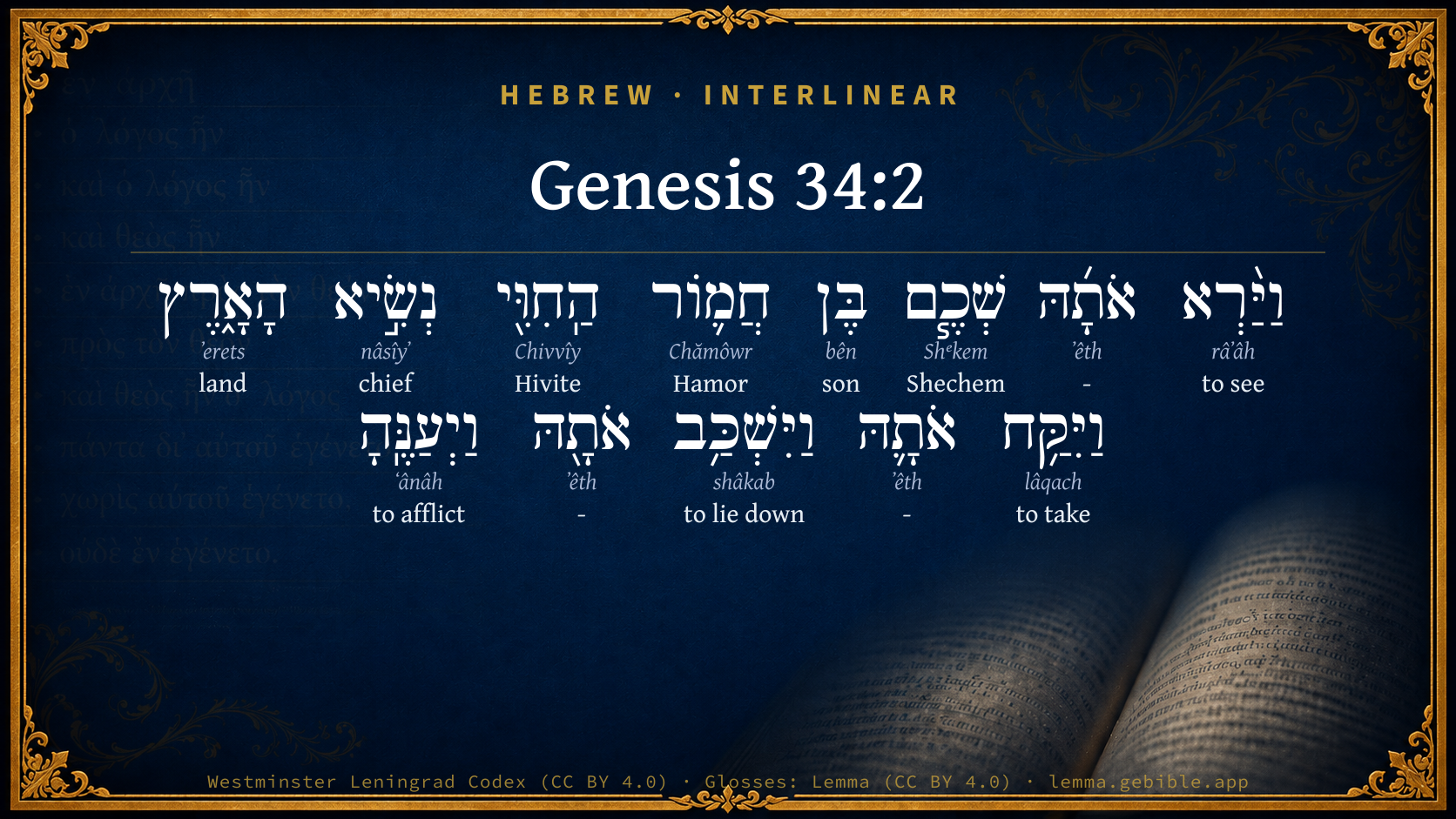
Hebrew (Westminster Leningrad Codex) Genesis 34:2 appears in the Hebrew Old Testament. The text above is from the Westminster Leningrad Codex. Each word links to its Strong’s number, a concise gloss, and parsing drawn from the Open Scriptures Hebrew Bible morphology. Click any word for its full Brown-Driver-Briggs (BDB) entry.
Download image
Cite this verse

Genesis 34:2 (World English Bible). Public Domain. Lemma interlinear Bible study tool, https://lemma.gebible.app/v/genesis/34/2.

Show BibTeX & RIS
BibTeX
RIS
English Translation
Shechem the son of Hamor the Hivite, the prince of the land, saw her. He took her, lay with her, and humbled her.
World English Bible · Public Domain
Download a study sheet

One document with this verse’s original text, its word-by-word gloss line, the meaning frame, cross-references with their text, attributed commentary, and full source and license credits — printable, and it pastes into notes with its structure intact.

This verse Autodidact and up

Study sheet (.html) Plain text (.txt)

A passage Seminary Student

Up to 50 verses in one chapter. A passage sheet keeps up to 6 commentary sources and 12 cross-references per verse, in the order this page ranks them, and says so on the sheet whenever that leaves anything out. Ask for a single verse and you get the Autodidact verse sheet above.

Everything on this page stays free to read, with no account — the sheet is a download of what is already on screen, not access to it.

Want to remove ads? Support Godless Engineer
Compare translations 3

The same verse in 3 English versions, stacked beneath the original-language interlinear above. Click any original word for its lexicon entry.

Each is an independent rendering of the whole verse — the interlinear is not word-aligned to these translations.

Highlighted words mark where these versions differ — a whole-verse word diff, not a word-by-word alignment.

  • World English Bible Public Domain
    Shechem the son of Hamor the Hivite, the prince of the land, saw her. He took her, lay with her, and humbled her.
  • King James Version Public Domain
    And when Shechem the son of Hamor the Hivite, prince of the country, saw her, he took her, and lay with her, and defiled her.
  • unfoldingWord Literal Text CC BY-SA 4.0
    And Shechem, the son of Hamor the Hivite, the ruler of the land, saw her, and he took her and lay with her and violated her.

unfoldingWord Literal Text — © unfoldingWord, licensed CC BY-SA 4.0. Word-aligned USFM3 via Door43 (git.door43.org/unfoldingWord/en_ult).

Versions to compare (up to 4)

3 of 4 selected

Show all 18 translations

Every available English version of this verse, each an independent rendering of the whole verse.

  • World English Bible Public Domain
    Shechem the son of Hamor the Hivite, the prince of the land, saw her. He took her, lay with her, and humbled her.
  • Berean Standard Bible Public Domain
    When Shechem son of Hamor the Hivite, the prince of the region, saw her, he took her and lay with her by force.
  • Majority Standard Bible Public Domain
    When Shechem son of Hamor the Hivite, the prince of the region, saw her, he took her and lay with her by force.
  • King James Version Public Domain
    And when Shechem the son of Hamor the Hivite, prince of the country, saw her, he took her, and lay with her, and defiled her.
  • American Standard Version (1901) Public Domain
    And Shechem the son of Hamor the Hivite, the prince of the land, saw her; And he took her, and lay with her, and humbled her.
  • Revised Version (1885) Public Domain
    And Shechem the son of Hamor the Hivite, the prince of the land, saw her; and he took her, and lay with her, and humbled her.
  • Geneva Bible (1599) Public Domain
    Whome when Shechem the sonne of Hamor the Hiuite lorde of that countrey sawe, hee tooke her, and lay with her, and defiled her.
  • Douay-Rheims (1899) Public Domain
    And when Sichem the son of Hemor the Hevite, the prince of that land, saw her, he was in love with her: and took her away, and lay with her, ravishing the virgin.
  • Young's Literal Translation Public Domain
    and Shechem, son of Hamor the Hivite, a prince of the land, seeth her, and taketh her, and lieth with her, and humbleth her;
  • Literal Standard Version CC BY-SA 4.0
    and Shechem, son of Hamor the Hivite, a prince of the land, sees her, and takes her, and lies with her, and humbles her;
  • Unlocked Literal Bible CC BY-SA 4.0
    Shechem son of Hamor the Hivite, the prince of the land, saw her and he grabbed her, assaulted her, and slept with her.
  • unfoldingWord Literal Text CC BY-SA 4.0
    And Shechem, the son of Hamor the Hivite, the ruler of the land, saw her, and he took her and lay with her and violated her.
  • Darby Bible Public Domain
    And when Shechem, the son of Hamor the Hivite, the prince of the country, saw her, he took her, and lay with her, and humbled her.
  • World Messianic Bible Public Domain
    Shechem the son of Hamor the Hivite, the prince of the land, saw her. He took her, lay with her, and humbled her.
  • Webster's Bible Public Domain
    And when Shechem, the son of Hamor the Hivite, prince of the country, saw her, he took her, and lay with her, and defiled her.
  • Free Bible Version CC BY-SA 4.0
    Shechem, son of Hamor the Hivite, the ruler of that area, saw her. He grabbed hold of her and raped her.
  • Bible in Basic English Public Domain
    And when Shechem, the son of Hamor the Hivite who was the chief of that land, saw her, he took her by force and had connection with her.
  • JPS Tanakh (1917) Public Domain
    And Shechem the son of Hamor the Hivite, the prince of the land, saw her; and he took her, and lay with her, and humbled her.

Literal Standard Version (2020), Covenant Press — licensed CC BY-SA 4.0. Text via the HelloAO Bible API (eBible.org). Unlocked Literal Bible (unfoldingWord) — licensed CC BY-SA 4.0. Text via the HelloAO Bible API (eBible.org). unfoldingWord Literal Text — © unfoldingWord, licensed CC BY-SA 4.0. Word-aligned USFM3 via Door43 (git.door43.org/unfoldingWord/en_ult). Free Bible Version, Dr. Jonathan Gallagher — licensed CC BY-SA 4.0. Text via the HelloAO Bible API (eBible.org).

Word by word

More ways to search: Search by grammar → Find every occurrence → Compare this word →

Practice this passage: Drill this verse → Learn its vocabulary →

חֲמ֛וֹר
Chămôwr
H2544
“Hamor”
Noun, Proper
Part of Speech
Noun
Type
Proper
Full BDB Definition

Origin: the same as H2543

TWOT: None

Hamor = "he-ass" - the Hivite prince of the city of Shechem when Jacob entered Palestine
  1. וַיַּ֨רְא râʼâh H7200 “and · to see” Conjunction + Verb, Qal, Sequential Imperfect, 3rd Person, Masculine, Singular
  2. אֹתָ֜הּ ʼêth H853 “- · her” Particle, Direct Object + Suffix, Personal, 3rd Person, Feminine, Singular
  3. שְׁכֶ֧ם Shᵉkem H7927 “Shechem” Noun, Proper
  4. בֶּן bên H1121 “son of” Noun, Common, Masculine, Singular, Construct
  5. הַֽחִוִּ֖י Chivvîy H2340 “the · Hivite” Particle, Definite Article + Noun, Gentilic, Masculine, Singular, Absolute
  6. נְשִׂ֣יא nâsîyʼ H5387 “chief of” Noun, Common, Masculine, Singular, Construct
  7. הָאָ֑רֶץ ʼerets H776 “the · land” Particle, Definite Article + Noun, Common, Both, Singular, Absolute
  8. וַיִּקַּ֥ח lâqach H3947 “and · to take” Conjunction + Verb, Qal, Sequential Imperfect, 3rd Person, Masculine, Singular
  9. אֹתָ֛הּ ʼêth H853 “- · her” Particle, Direct Object + Suffix, Personal, 3rd Person, Feminine, Singular
  10. וַיִּשְׁכַּ֥ב shâkab H7901 “and · to lie down” Conjunction + Verb, Qal, Sequential Imperfect, 3rd Person, Masculine, Singular
  11. אֹתָ֖הּ ʼêth H853 “- · her” Particle, Direct Object + Suffix, Personal, 3rd Person, Feminine, Singular
  12. וַיְעַנֶּֽהָ ʻânâh H6031 “and · to afflict · her” Conjunction + Verb, Piel, Sequential Imperfect, 3rd Person, Masculine, Singular + Suffix, Personal, 3rd Person, Feminine, Singular

About this verse

These counts appear in no published source. They are computed here, from the morphology-tagged text and Lemma’s own curated glosses. What Lemma adds →

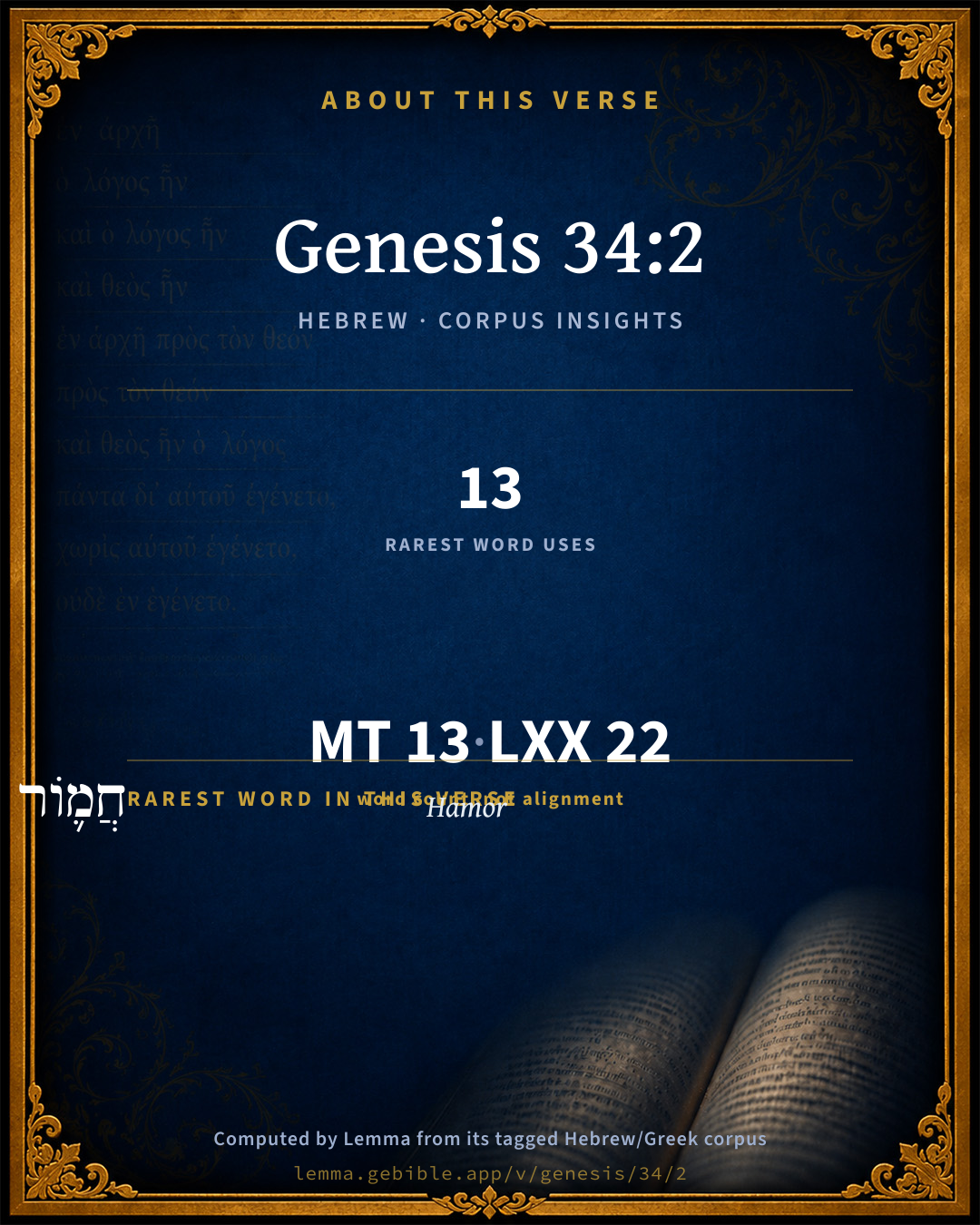
13
words
11
distinct lemmas
Pentateuch
section

Notable vocabulary

The rarest word here is חֲמ֛וֹר Hamor H2544 — appearing just 13 times in the whole Hebrew Bible.

Shared distinctive vocabulary

חֲמ֛וֹר Hamor H2544 occurs in 12 verses of the Hebrew Bible. Also found in:

Grammatical profile

  • 4 verbs
  • 6 nouns
  • 3 particles

Verb forms

  • וַיַּ֨רְא Qal · Sequential Imperfect
  • וַיִּקַּ֥ח Qal · Sequential Imperfect
  • וַיִּשְׁכַּ֥ב Qal · Sequential Imperfect
  • וַיְעַנֶּֽהָ Piel · Sequential Imperfect

Hebrew & Septuagint length

In English translation the verse runs 23 words from the Hebrew and 25 from the Septuagint (LXX English) — closely comparable.

A rough comparison of the two English renderings, which tokenize alike — not a word-level alignment.

Word counts can differ between the Hebrew and the Greek without any difference in meaning — e.g. the Hebrew direct-object marker אֵת has no separate Greek word, and Greek often adds the article ὁ.

In the original languages it is 13 Hebrew tokens and 22 Greek tokens — but the two are counted differently (Hebrew bundles its prefixes and suffixes into one token; the Greek is in lemma form), so that isn’t a like-for-like length.

Cross-references

16

Topical passages linked to Genesis 34:2 in the Treasury of Scripture Knowledge — connected by theme and wording, ordered by reader-vote popularity; previews shown in the World English Bible.

  • Matthew 5:28 but I tell you that everyone who gazes at a woman to lust after her has committed adultery with her already in his heart.
  • Judges 14:1 Samson went down to Timnah, and saw a woman in Timnah of the daughters of the Philistines.
  • Job 31:1 "I made a covenant with my eyes, How then should I look lustfully at a young woman?
  • Job 31:9 "If my heart has been enticed to a woman, And I have laid wait at my neighbor's door;
  • Proverbs 13:20 One who walks with wise men grows wise, But a companion of fools suffers harm.
  • Genesis 6:2 that God's sons saw that men's daughters were beautiful, and they took for themselves wives of all that they chose.
  • Genesis 10:17 the Hivite, the Arkite, the Sinite,
  • Genesis 20:2 Abraham said about Sarah his wife, "She is my sister." Abimelech king of Gerar sent, and took Sarah.
  • Genesis 33:19 He bought the parcel of ground, where he had spread his tent, at the hand of the children of Hamor, Shechem's father, for one hundred pieces of money.
  • Genesis 39:6–7 He left all that he had in Joseph's hand. He didn't concern himself with anything, except for the food which he ate. Joseph was well-built and handsome.
  • Deuteronomy 21:14 It shall be, if you have no delight in her, then you shall let her go where she will; but you shall not sell her at all for money, you shall not deal with her as a slave, because you have humbled her.
  • Deuteronomy 22:24 then you shall bring them both out to the gate of that city, and you shall stone them to death with stones; the lady, because she didn't cry, being in the city; and the man, because he has humbled his neighbor's wife: so you shall put away the evil from the midst of you.
  • Deuteronomy 22:29 then the man who lay with her shall give to the lady's father fifty [shekels] of silver, and she shall be his wife, because he has humbled her; he may not put her away all his days.
  • Judges 19:24–25 Behold, here is my daughter a virgin, and his concubine; them I will bring out now, and humble you them, and do with them what seems good to you: but to this man don't do any such folly.
  • 2 Samuel 11:2 It happened at evening, that David arose from off his bed, and walked on the roof of the king's house: and from the roof he saw a woman bathing; and the woman was very beautiful to look on.
  • Ezekiel 22:10–11 In you have they uncovered their fathers' nakedness; in you have they humbled her who was unclean in her impurity.

Cross-references courtesy of OpenBible.info (CC BY 4.0).

Hebrew and Greek witnesses Masoretic Hebrew ↔ Greek Septuagint

The same verse in the two great witnesses to the Old Testament, shown verse-for-verse.

These are two independent witnesses, not word-aligned to each other, and the Septuagint is shown in lemma (dictionary) form.

Hebrew Genesis 34:2 Masoretic · Westminster Leningrad Codex

וַיַּ֨רְא אֹתָ֜הּ שְׁכֶ֧ם בֶּן חֲמ֛וֹר הַֽחִוִּ֖י נְשִׂ֣יא הָאָ֑רֶץ וַיִּקַּ֥ח אֹתָ֛הּ וַיִּשְׁכַּ֥ב אֹתָ֖הּ וַיְעַנֶּֽהָ

Shechem the son of Hamor the Hivite, the prince of the land, saw her. He took her, lay with her, and humbled her.

World English Bible · Public Domain

Greek LXX Genesis 34:2 Septuagint · lemma form

καί ὁράω αὐτός συχεμ ὁ υἱός εμμωρ ὁ χορραῖος ὁ ἄρχων ὁ γῆ καί λαμβάνω αὐτός κοιμάω μετά αὐτός καί ταπεινόω αὐτός

And Sychem the son of Emmor the Evite, the ruler of the land, saw her, and took her and lay with her, and humbled her.

LXX2012 (modern English Septuagint) · Public Domain

On this verse, The Cambridge Bible for Schools and Colleges discusses the Septuagint’s reading. Read the note in Commentary ↓

Hebrew: Westminster Leningrad Codex (CC BY 4.0). Greek: Septuagint (public domain); English from LXX2012 (modern English Septuagint) (Public Domain). How the Septuagint differs from the Hebrew →

Targum (Aramaic paraphrase)

2

The Targum is the ancient Jewish Aramaic paraphrase of the Hebrew Scriptures — an interpretive translation, not the Hebrew text itself. Onkelos (literal) and Pseudo-Jonathan (expansive) render the Torah, and Jonathan the Prophets. Coverage is partial: where no permissively-licensed English translation exists for a verse, only the Aramaic is shown. This is verse-level text, not a word-by-word alignment to the Hebrew.

  1. Targum Onkelos Torah (Genesis–Deuteronomy)
    וַחֲזָא יָתַהּ שְׁכֶם בַּר חֲמוֹר חִוָאָה רַבָּא דְאַרְעָא וּדְבַר יָתַהּ וּשְׁכִיב יָתַהּ וְעַנְיַהּ

    (no public-domain English translation for this verse)

    Targum Onkelos — Aramaic: “Onkelos Genesis” (public domain); “Onkelos Exodus” (public domain); “Onkelos Leviticus” (public domain); “Onkelos Numbers” (public domain); “Onkelos Deuteronomy” (public domain). English: “Sefaria Community Translation” (CC0 1.0 (public-domain dedication)); “J.W. Etheridge. The Targums of Onkelos and Jonathan Ben Uzziel on the Pentateuch. London: Longmans, Green, 1862” (public domain). Text via Sefaria.

  2. Targum Pseudo-Jonathan Torah (Genesis–Deuteronomy)
    וַחֲמָא יָתָהּ שְׁכֶם בַּר חֲמוֹר חִיוָאָה רַבָּא דְאַרְעָא וּדְבַר יָתָהּ בְּאָנוּסָה וּשְׁכִיב עִמָהּ וְסַגְפָהּ

    And Shekem, the son of Hamor the Hivite, prince of the land, saw her, and took her by force, and lay with her and afflicted her.

    Targum Pseudo-Jonathan — Aramaic: “Targum Jonathan on Genesis” (public domain); “Targum Jonathan on Exodus” (public domain); “Targum Jonathan on Leviticus” (public domain); “Targum Jonathan on Numbers” (public domain); “Targum Jonathan on Deuteronomy” (public domain). English: “The Targum of Jonathan ben Uzziel, trans. J. W. Etheridge, London, 1862” (public domain). Text via Sefaria.

Commentary

Notes on Genesis 34:2 from classic Christian and Jewish commentators (each source and its license shown beneath its notes). The classic Christian expositions comment on the surrounding passage and are grouped to its opening verse, so a note may address several verses; the Jewish commentaries on the Tanakh (Rashi and others) are per-verse, so they appear only where the commentator wrote on this verse.

Lemma curates 59 commentaries, every one of them public domain or Creative Commons licensed, each selected and text-cleaned for this edition rather than reprinted as found. About our sources →

Trapp's Complete Commentary

John Trapp

Gen 34:2 And when Shechem the son of Hamor the Hivite, prince of the country, saw her, he took her, and lay with her, and defiled her.

Ver. 2. Saw her, he look her, and lay with her.] Ut vidit, periit. By those windows of the eyes and ears, sin and death often enter: through them the devil throws balls of wild fire into the soul, and sets all into a combustion. Visus, colloquium, contactus, osculum, concubitus, do too oft one succeed another. {a} See to the five senses, if ye would keep out the enemy. Shut up the five windows, if ye would have the house, the heart, full of light, saith the Arabian proverb. Joseph’s mistress cast her eyes upon him; but when she laid hands on him, she was the more inflamed, and set agog, as it were. The viewing, touching, or familiar talking with a woman, either without necessary occasion, or then, without prayer for holy affection, is dangerous, saith a grave divine. {b} Thou mayest not look intently upon what thou mayest not love. Democritus the philosopher pulled out his eyes, that he might not look upon forbidden beauties. This was no part of his wisdom: but it shall be ours, by mortification, to pluck the wanton eye out of old Adam, and to set it sober into the new man: to get that occulum irretortum, that well-ordered eye, that Job had; {Job 31:1} that Joseph had; that Gregory Nazianzen had, who could σοφρονιζειν τους οφθαλμους, tutor his eyes; that Charles V, Emperor of Germany, had, who would shut the casements, when at any time he saw fair women afar off, or heard that such were to pass by his window {c} It is not safe to pry into the beauty of a fair woman. Circe {d} often used allusively. may enchant us, the cockatrice slay us with her sight. "Let her not take thee with her eyelids," saith Solomon; {Pro 6:25} as larks, while they gaze in a glass, are taken in a hunter’s net. {See Trapp on "Gen 6:2"} {See Trapp on "Gen 26:7"}

{a} Mars videt hanc, visamque cupit, potiturque cupita. - Ovid.

{b} Time Well Spent, by Ezek. Culverwel, p. 53.

{c} Saepe clausit fenestram, ne inspiceret formosiores foeminas, &c. - Par., Hist. Profan., p. 908.

{d} In Greek and Latin mythology the name of an enchantress who dwelt in the island of Aea, and transformed all who drank of her cup into swine.

John Trapp, A Commentary or Exposition upon All the Books of the Old and New Testament (1647–1656) — public domain. Text from a community e-Sword module.

Joseph Benson's Commentary

Gen 34:2. Shechem took her, and defiled her — Hebrew, humbled her. “The word,” says Bishop Kidder, “intimates his violence, as well as her dissent.” Young women may learn from this to be “chaste, keepers at home,” (Tit 2:5,) which qualities have a closer connection than many are willing to believe. They that are fond of going abroad, and intermixing in company with persons of whose piety and good conduct they have no proof, often expose their virtue to a snare. From what happened to Dinah, all may learn to avoid all occasions of falling into temptation, or leading others into it.

Joseph Benson's Commentary on the Old and New Testaments (1811–1818) — public domain. Text from a community e-Sword module.

Geneva Bible (1599)

Geneva Bible translators

Hebrew, humbled her.

Geneva Bible (1599) marginal notes — public domain. Text via Bolls.life.

Adam Clarke's Commentary

Verse 2. Prince of the country] i.e., Hamor was prince; Shechem was the son of the prince or chief. Our version appears to represent Shechem as prince, but his father was the chief of the country. See Ge 34:6; Ge 34:8, &c.

Adam Clarke's Commentary on the Bible (1810–1826) — public domain. Text from a community e-Sword/MySword module.

The Cambridge Bible for Schools and Colleges

gen. ed. J. J. S. Perowne

2. Hivite] See Gen_10:17. The name of a Canaanite tribe. In Jos_9:7 the Hivites are found in Gibeon; but, from Jdg_3:3 and Jos_11:3, their dwelling-place was traditionally connected with Lebanon.

LXX has “Horite,” as in Jos_9:7.

“Hamor,” as the name of an animal, means “he-ass.”

the prince] This word, in Heb. nasi, is used frequently by P, Gen_17:20, Gen_23:6, Gen_25:16. Lat. princeps.

The Cambridge Bible for Schools and Colleges (gen. ed. J. J. S. Perowne; Cambridge University Press, 1878–1918) — public domain. Text from a community e-Sword module.

John Gill's Exposition

And when Shechem the son of Hamor,.... From whom the city had its name, near which Jacob and his family now were:

the Hivite, prince of the country; Hamor was an Hivite, which was one of the nations of the land of Canaan, and this man was the prince or a principal man of that nation, as well as of Shechem. Josephus (c) calls him a king: when the son of this man

saw her; that is, Dinah, what a beautiful person she was, and was enamoured with her:

he took her: by force, as the Targum of Jonathan:

and lay with her, and defiled her; or "humbled" or "afflicted her" (d); and it is a rule with the Jews, that every such act, which is done by force, is called an humiliation and affliction (e): the child begotten in this act of fornication is said (f) by them to be Asenath, who was had into Egypt, and brought up by Potipherah's wife as her daughter, and afterwards married to Joseph, Gen 41:45.

(c) Ut supra. (Antiqu. l. 1. c. 21. sect. 1.) (d) , Sept. & afflixit eam, Pagninus, Montanus. (e) Gerundensis apud Munster, & Drusium in loc. (f) Pirke Eliezer, ut supra. (c. 33. fol. 42. 2.)

John Gill's Exposition of the Whole Bible (1746–1763) — public domain (CC PDM 1.0). Text via the HelloAO Bible API.

Haydock's Catholic Bible Commentary

Virgin. Hebrew and Septuagint, "He humbled or afflicted the virgin." It is well if she made all the resistance she was able, and resented the indignity; as she seems to have done, though Sichem tried all means to comfort her. (Haydock)

George Leo Haydock (1774–1849), Haydock's Catholic Family Bible and Commentary, 1859 edition — public domain. Excludes Psalms (Douay-Rheims chapter numbering differs from Protestant) and Deuterocanonical books (Catholic canon only).

The Pulpit Commentary

And when Shechem the son of Hamor the Hivite, the prince of the country, saw her (literally, and Shechem... saw her, and) he took her. "Dinah paid the full penalty of her carelessness. She suffered the fate which Sarah and Rebekah encountered in the land of Pharaoh and Abimelech; she was seen and taken by the son of the prince" (Kalisch); forcibly, i.e. against her will in the first instance, though not, it is apparent, without the blandishments of a lover. And lay with her, and defiled her literally, oppressed her, offered violence to her, whence humbled her ejtapeinwsen (LXX), vi opprimens (Vulgate).

The Pulpit Commentary (1880–1919), ed. H.D.M. Spence-Jones & Joseph S. Exell — public domain. Text from a community e-Sword module.

Ramban (Nachmanides)

Rabbi Moshe ben Nachman (Ramban / Nachmanides)

AND HE LAY WITH HER, AND HE AFFLICTED HER. He lay with her in natural gratification; and he afflicted her unnaturally. This is Rashi’s language. But Rabbi Abraham ibn Ezra said: And he afflicted her naturally because she was a maiden.” But there is no need for this for all forced sexual connection is called “affliction.” Likewise, Thou shalt not deal with her as a slave, because thou hast afflicted her. And so also: And my concubine they afflicted, and she is dead. Scripture thus tells — in Dinah’s praise — that she was forced, and she did not consent to the prince of the country.

Ramban (Nachmanides) on the Tanakh — English translation: “Commentary on the Torah by Ramban (Nachmanides). Translated and annotated by Charles B. Chavel. New York, Shilo Pub. House, 1971-1976” (CC BY 4.0). Text via Sefaria.

Radak

Rabbi David Kimhi (Radak)

וירא, the reason why the Torah uses the word ויעניה when what Shechem had done was more in the nature of a seduction that a violent rape, is that this term is used in connection with a virgin having intercourse, something usually very painful for her. The term is also used on account of this reason in Deuteronomy 22,29.

Radak on the Tanakh — English translations: “Sefaria Community Translation” (CC0 1.0 (public-domain dedication)); “Eliyahu Munk, HaChut Hameshulash” (CC BY 4.0); “Rabbi Mike Feuer, Jerusalem Anthology” (CC BY 4.0); and “R. David Kimhi on the first book of Psalms, Translated by R.G. Finch, London, 1919” (public domain). Text via Sefaria.

Lesson kit

Teaching starters — assembled from the data on this page, not authored interpretation. Every prompt links to the verse data it draws on. Edit before teaching.

Genesis, in the Pentateuch, opens this verse with 13 words (11 distinct Hebrew lemmas). Its most distinctive word is Chămôwr (“Hamor”). A historical commentator’s framing appears above. Read the whole chapter for the surrounding context.

Discussion questions

  1. How does “Hamor” (Chămôwr) shape what this verse is saying?
  2. How does Genesis 33:19, which shares the word «Hamor», read alongside this verse?
  3. These translations render this verse differently. What is at stake in choosing one wording over another?
  4. «וַיַּ֨רְא» is a Qal Sequential Imperfect verb. How does that grammatical form shape the action described?
  5. Compare how Trapp's Complete Commentary and Joseph Benson's Commentary read this verse. Where do they agree or differ?

Things to notice

Reading settings

Reading text

Shown beneath each verse's original-language words.

Old Testament
Old Testament edition

Read the OT as the Masoretic Hebrew (MT) or the Greek Septuagint (LXX).

English shown for the Greek Septuagint (in the Hebrew ↔ Greek comparison).

Comparing translations? Open the Compare panel on any verse page to stack up to four side by side.