
Proverbs 23:34

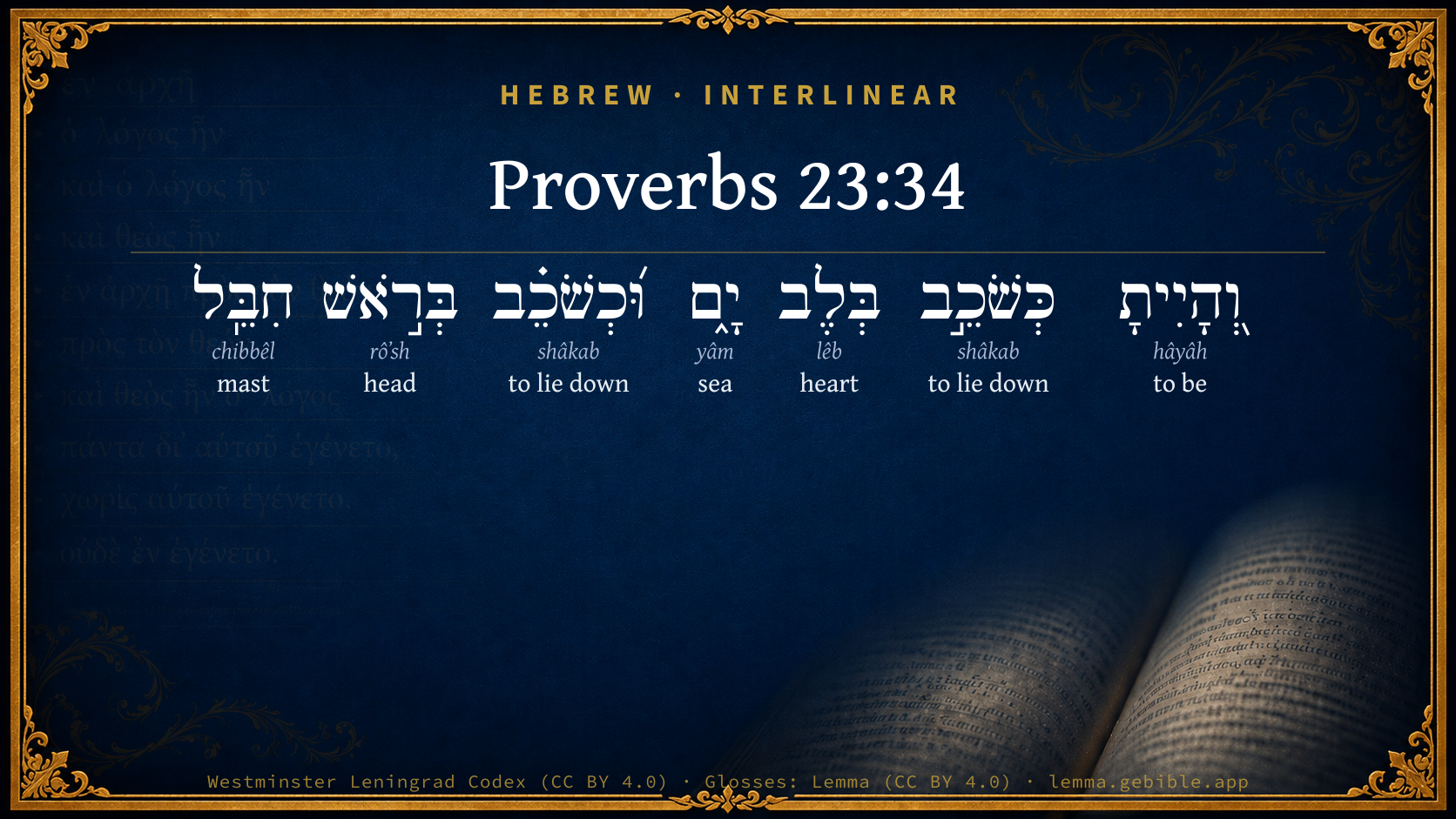
Hebrew (Westminster Leningrad Codex) Proverbs 23:34 appears in the Hebrew Old Testament. The text above is from the Westminster Leningrad Codex. Each word links to its Strong’s number, a concise gloss, and parsing drawn from the Open Scriptures Hebrew Bible morphology. Click any word for its full Brown-Driver-Briggs (BDB) entry.
Download image
Cite this verse

Proverbs 23:34 (World English Bible). Public Domain. Lemma interlinear Bible study tool, https://lemma.gebible.app/v/proverbs/23/34.

Show BibTeX & RIS
BibTeX
RIS
English Translation
Yes, you will be as he who lies down in the midst of the sea, Or as he who lies on top of the rigging:
World English Bible · Public Domain
Highlights
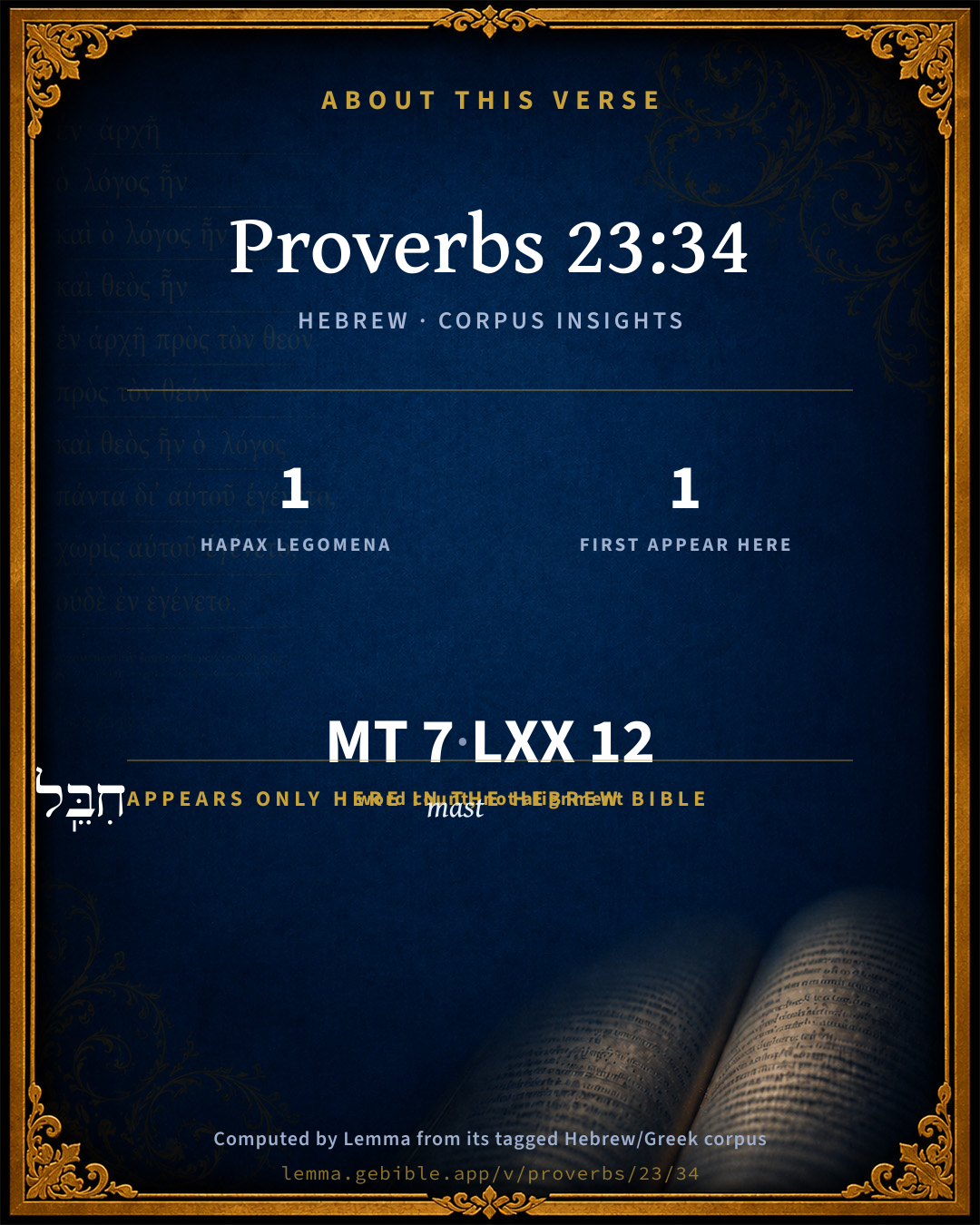
  • 1 hapax legomenon — only here in the Hebrew Bible
  • 1 first appearance in the Hebrew Bible
Full analysis ↓
Download a study sheet

One document with this verse’s original text, its word-by-word gloss line, the meaning frame, cross-references with their text, attributed commentary, and full source and license credits — printable, and it pastes into notes with its structure intact.

This verse Autodidact and up

Study sheet (.html) Plain text (.txt)

A passage Seminary Student

Up to 50 verses in one chapter. A passage sheet keeps up to 6 commentary sources and 12 cross-references per verse, in the order this page ranks them, and says so on the sheet whenever that leaves anything out. Ask for a single verse and you get the Autodidact verse sheet above.

Everything on this page stays free to read, with no account — the sheet is a download of what is already on screen, not access to it.

Want to remove ads? Support Godless Engineer
Compare translations 3

The same verse in 3 English versions, stacked beneath the original-language interlinear above. Click any original word for its lexicon entry.

Each is an independent rendering of the whole verse — the interlinear is not word-aligned to these translations.

Highlighted words mark where these versions differ — a whole-verse word diff, not a word-by-word alignment.

  • World English Bible Public Domain
    Yes, you will be as he who lies down in the midst of the sea, Or as he who lies on top of the rigging:
  • King James Version Public Domain
    Yea, thou shalt be as he that lieth down in the midst of the sea, or as he that lieth upon the top of a mast.
  • unfoldingWord Literal Text CC BY-SA 4.0
    And you will be like one who lies down in the heart of the sea and like one who lies down at the head of a mast.

unfoldingWord Literal Text — © unfoldingWord, licensed CC BY-SA 4.0. Word-aligned USFM3 via Door43 (git.door43.org/unfoldingWord/en_ult).

Versions to compare (up to 4)

3 of 4 selected

Show all 18 translations

Every available English version of this verse, each an independent rendering of the whole verse.

  • World English Bible Public Domain
    Yes, you will be as he who lies down in the midst of the sea, Or as he who lies on top of the rigging:
  • Berean Standard Bible Public Domain
    You will be like one sleeping on the high seas or lying on the top of a mast:
  • Majority Standard Bible Public Domain
    You will be like one sleeping on the high seas or lying on the top of a mast:
  • King James Version Public Domain
    Yea, thou shalt be as he that lieth down in the midst of the sea, or as he that lieth upon the top of a mast.
  • American Standard Version (1901) Public Domain
    Yea, thou shalt be as he that lieth down in the midst of the sea, Or as he that lieth upon the top of a mast.
  • Revised Version (1885) Public Domain
    Yea, thou shalt be as he that lieth down in the midst of the sea, or as he that lieth upon the top of a mast.
  • Geneva Bible (1599) Public Domain
    And thou shalt bee as one that sleepeth in the middes of the sea, and as hee that sleepeth in the toppe of the maste.
  • Douay-Rheims (1899) Public Domain
    And thou shalt be as one sleeping in the midst of the sea, and as a pilot fast asleep, when the stern is lost.
  • Young's Literal Translation Public Domain
    And thou hast been as one lying down in the heart of the sea, And as one lying down on the top of a mast.
  • Literal Standard Version CC BY-SA 4.0
    And you have been as one lying down in the heart of the sea, || And as one lying down on the top of a mast.
  • Unlocked Literal Bible CC BY-SA 4.0
    You will be as one who sleeps on the high seas or lies on the top of a mast.
  • unfoldingWord Literal Text CC BY-SA 4.0
    And you will be like one who lies down in the heart of the sea and like one who lies down at the head of a mast.
  • Darby Bible Public Domain
    and thou shalt be as he that lieth down in the midst of the sea, and as he that lieth down upon the top of a mast:
  • World Messianic Bible Public Domain
    Yes, you will be as he who lies down in the middle of the sea, or as he who lies on top of the rigging:
  • Webster's Bible Public Domain
    And thou shalt be as he that lieth down in the midst of the sea, or as he that lieth upon the top of a mast.
  • Free Bible Version CC BY-SA 4.0
    You'll stumble around like you're on the rolling ocean, you'll be tossed about like someone lying down at the top of a ship's mast, saying,
  • Bible in Basic English Public Domain
    Yes, you will be like him who takes his rest on the sea, or on the top of a sail-support.
  • JPS Tanakh (1917) Public Domain
    Yea, thou shalt be as he that lieth down in the midst of the sea, or as he that lieth upon the top of a mast.

Literal Standard Version (2020), Covenant Press — licensed CC BY-SA 4.0. Text via the HelloAO Bible API (eBible.org). Unlocked Literal Bible (unfoldingWord) — licensed CC BY-SA 4.0. Text via the HelloAO Bible API (eBible.org). unfoldingWord Literal Text — © unfoldingWord, licensed CC BY-SA 4.0. Word-aligned USFM3 via Door43 (git.door43.org/unfoldingWord/en_ult). Free Bible Version, Dr. Jonathan Gallagher — licensed CC BY-SA 4.0. Text via the HelloAO Bible API (eBible.org).

Word by word

More ways to search: Search by grammar → Find every occurrence → Compare this word →

Practice this passage: Drill this verse → Learn its vocabulary →

About this verse

These counts appear in no published source. They are computed here, from the morphology-tagged text and Lemma’s own curated glosses. What Lemma adds →

7
words
6
distinct lemmas
Wisdom
section

Notable vocabulary

1 hapax legomenon — a word that appears only here in the entire Hebrew Bible:

  • חִבֵּֽל mast H2260

First appearance in Scripture

This word makes its first canonical appearance in the Hebrew Bible here:

  • חִבֵּֽל mast H2260

Grammatical profile

  • 3 verbs
  • 4 nouns

Verb forms

  • וְ֭הָיִיתָ Qal · Sequential Perfect
  • כְּשֹׁכֵ֣ב Qal · Participle Active
  • וּ֝כְשֹׁכֵ֗ב Qal · Participle Active

Repetition

A word recurs within this verse — often emphatic in Hebrew:

  • כְּשֹׁכֵ֣ב to lie down H7901 ×2

Hebrew & Septuagint length

In English translation the verse runs 25 words from the Hebrew and 19 from the Septuagint (LXX English) — closely comparable.

A rough comparison of the two English renderings, which tokenize alike — not a word-level alignment.

Word counts can differ between the Hebrew and the Greek without any difference in meaning — e.g. the Hebrew direct-object marker אֵת has no separate Greek word, and Greek often adds the article ὁ.

In the original languages it is 7 Hebrew tokens and 12 Greek tokens — but the two are counted differently (Hebrew bundles its prefixes and suffixes into one token; the Greek is in lemma form), so that isn’t a like-for-like length.

Cross-references

11

Topical passages linked to Proverbs 23:34 in the Treasury of Scripture Knowledge — connected by theme and wording, ordered by reader-vote popularity; previews shown in the World English Bible.

  • 1 Thessalonians 5:2–7 For you yourselves know well that the day of the Lord comes like a thief in the night.
  • 1 Samuel 30:16–17 When he had brought him down, behold, they were spread abroad over all the ground, eating and drinking, and dancing, because of all the great spoil that they had taken out of the land of the Philistines, and out of the land of Judah.
  • 2 Samuel 13:28 Absalom commanded his servants, saying, Mark you now, when Amnon's heart is merry with wine; and when I tell you, Smite Amnon, then kill him; don't be afraid; haven't I commanded you? be courageous, and be valiant.
  • 1 Kings 16:9 His servant Zimri, captain of half his chariots, conspired against him. Now he was in Tirzah, drinking himself drunk in the house of Arza, who was over the household in Tirzah:
  • Matthew 24:38 For as in those days which were before the flood they were eating and drinking, marrying and giving in marriage, until the day that Noah entered into the ark,
  • Luke 17:27–29 They ate, they drank, they married, they were given in marriage, until the day that Noah entered into the ark, and the flood came, and destroyed them all.
  • Luke 21:34 "So be careful, or your hearts will be loaded down with carousing, drunkenness, and cares of this life, and that day will come on you suddenly.
  • Exodus 15:8 With the blast of your nostrils the waters were piled up. The floods stood upright as a heap. The deeps were congealed in the heart of the sea.
  • 1 Samuel 25:33–38 and blessed be your discretion, and blessed be you, that have kept me this day from blood guiltiness, and from avenging myself with my own hand.
  • Joel 1:5 Wake up, you drunkards, and weep! Wail, all you drinkers of wine, because of the sweet wine; For it is cut off from your mouth.
  • 1 Kings 20:16–22 They went out at noon. But Ben Hadad was drinking himself drunk in the pavilions, he and the kings, the thirty-two kings who helped him.

Cross-references courtesy of OpenBible.info (CC BY 4.0).

Hebrew and Greek witnesses Masoretic Hebrew ↔ Greek Septuagint

The same verse in the two great witnesses to the Old Testament, shown verse-for-verse.

These are two independent witnesses, not word-aligned to each other, and the Septuagint is shown in lemma (dictionary) form.

Hebrew Proverbs 23:34 Masoretic · Westminster Leningrad Codex

וְ֭הָיִיתָ כְּשֹׁכֵ֣ב בְּלֶב יָ֑ם וּ֝כְשֹׁכֵ֗ב בְּרֹ֣אשׁ חִבֵּֽל

Yes, you will be as he who lies down in the midst of the sea, Or as he who lies on top of the rigging:

World English Bible · Public Domain

Greek LXX Proverbs 23:34 Septuagint · lemma form

καί κατακεῖμαι ὥσπερ ἐν καρδία θάλασσα καί ὥσπερ κυβερνήτης ἐν πολύς κλύδων

And you shall lie as in the midst of the sea, and as a pilot in a great storm.

LXX2012 (modern English Septuagint) · Public Domain

On this verse, Haydock's Catholic Bible Commentary discusses the Septuagint’s reading. Read the note in Commentary ↓

Hebrew: Westminster Leningrad Codex (CC BY 4.0). Greek: Septuagint (public domain); English from LXX2012 (modern English Septuagint) (Public Domain). How the Septuagint differs from the Hebrew →

Commentary

Notes on Proverbs 23:34 from classic Christian and Jewish commentators (each source and its license shown beneath its notes). The classic Christian expositions comment on the surrounding passage and are grouped to its opening verse, so a note may address several verses; the Jewish commentaries on the Tanakh (Rashi and others) are per-verse, so they appear only where the commentator wrote on this verse.

Lemma curates 59 commentaries, every one of them public domain or Creative Commons licensed, each selected and text-cleaned for this edition rather than reprinted as found. About our sources →

Trapp's Complete Commentary

John Trapp

Pro 23:34 Yea, thou shalt be as he that lieth down in the midst of the sea, or as he that lieth upon the top of a mast.

Ver. 34. Yea, thou shalt be as he, &c.] Thy brains shall crow, and thou shalt be of Copernicus his opinion, that the earth turns round. Thou shalt also be fearless of the greatest danger, and not refuse to sleep upon a mast pole, dance upon a weather cock, &c.

John Trapp, A Commentary or Exposition upon All the Books of the Old and New Testament (1647–1656) — public domain. Text from a community e-Sword module.

Geneva Bible (1599)

Geneva Bible translators

In such great danger shalt thou be.

Geneva Bible (1599) marginal notes — public domain. Text via Bolls.life.

Adam Clarke's Commentary

Verse 34. Lieth down in the midst of the sea] He is utterly regardless of life; which is expressed very forcibly by one in a state of intoxication ascending the shrouds, clasping the mast-head, and there falling asleep; whence, in a few moments, he must either fall down upon the deck and be dashed to pieces, or fall into the sea and be drowned. Reader, if thou be a man given to this appetite, put a knife to thy throat.

Adam Clarke's Commentary on the Bible (1810–1826) — public domain. Text from a community e-Sword/MySword module.

Ellicott's Commentary for English Readers

(34) As he that lieth down in the midst of the sea.—And so would inevitably be drowned if he trusted to its smooth, glassy appearance.

As he that lieth upon the top of a mast.—Whom every roll of the ship might hurl into the waves. The absolute insensibility of the drunkard to danger is here described. Or it may mean that everything round the drunkard and the ground on which he lies, seem to rock like the waves of the sea, or the masthead of a ship.

A Bible Commentary for English Readers, edited by Charles John Ellicott (1878–1897) — public domain. Text from a community e-Sword module.

The Cambridge Bible for Schools and Colleges

gen. ed. J. J. S. Perowne

34. in the midst of the sea] as if it were a safe resting-place. A strong figure to denote the utter recklessness of danger which excess of drink induces.

upon the top of a mast] It only weakens the figure to supply here in the cradle, or the like; just as it does in the former clause to introduce on the deck of a ship. “The rig of an ancient ship was more simple and clumsy than that employed in modern times. Its great feature was one large mast, with one large square sail fastened to a yard of great length,” Smith’s Dict. of Bible, Art. Ship. The drunkard is as foolhardy as one who should lie down to sleep there.

It is difficult to understand how Dean Stanley finds here “a notice rare in any ancient writings, unique in the Hebrew Scriptures, of the well-known signs of sea-sickness” (Jewish Church, ii. 186).

The Cambridge Bible for Schools and Colleges (gen. ed. J. J. S. Perowne; Cambridge University Press, 1878–1918) — public domain. Text from a community e-Sword module.

John Gill's Exposition

Yea, thou shall be as he that lieth down in the midst of the sea,.... Not in the open sea, and the waves of it, there fluctuating and tossed about; nor in an island encompassed by sea; but in a ship at sea, a drunken man reels and tumbles about, just as a ship does at sea; hence the motions and agitations of it, and of the men in it, are compared to the reeling and staggering of a drunken man, Psa 107:26;

or as he that lieth upon the top of a mast: where the motion is the greatest. Or all this may be expressive of the dangers which a drunkard is exposed unto, and of his stupidity and insensibility; for though he is in as great danger as one in the circumstances described, in a storm at sea, yet is not sensible of it; which agrees with what follows.

John Gill's Exposition of the Whole Bible (1746–1763) — public domain (CC PDM 1.0). Text via the HelloAO Bible API.

Haydock's Catholic Bible Commentary

When. Septuagint, "in a great wave." Never is reason more wanted, nor less able to perform her duty.

George Leo Haydock (1774–1849), Haydock's Catholic Family Bible and Commentary, 1859 edition — public domain. Excludes Psalms (Douay-Rheims chapter numbering differs from Protestant) and Deuterocanonical books (Catholic canon only).

Matthew Poole's English Annotations

That lieth down to sleep, of which that word is frequently used,

in the midst of the sea; in a ship in the midst of the sea. This phrase notes the temper and condition of the drunkard, the giddiness of his brain, the unquietness of his mind, and especially his extreme danger joined with great security.

The top of a mast; the worst part of the ship, both for its perpetual tossings, and for the hazard of him that sleeps on it.

Matthew Poole's English Annotations on the Holy Bible (1683–1685) — public domain. Text from a community e-Sword/MySword module.

The Pulpit Commentary

As he that lieth down in the midst of the sea. The dazed and unconscious condition of a drunkard is described by one familiar with sea life, as in Psa_104:25, etc.; Psa_107:23, etc. The Hebrew has "in the heart of the sea", (Jon_2:4) i.e. the depth. Many understand the idea to be that the drunkard is compared to a man asleep in a frail boat, or to one slumbering on board a ship sunk in the trough of the sea. But the "lying" here does not imply sleep, but rather immersion. The inebriated person is assimilated to one who is drowned or drowning, who is cut off from all his former pursuits and interests in life, and has become unconscious of surrounding circumstances. This much more exactly represents the case than any notion of sloping amid danger. Septuagint, "Thou shalt lie as in the heart of the sea." Or as he that lieth upon the top of a mast; the extreme point of the sailyard, where no one could lie without the greatest peril of falling off. The drunkard is exposed to dangers of all kinds from being unable to take care of himself, and yet is all the time unconscious of his critical situation. Corn. a Lapide, followed by Plumptre, considers that the cradle, or look out, on the top of the mast is meant, where, if the watchman slept, he would be certain to endanger his life. Vulgate, "like a pilot fallen asleep, who has dropped the tiller," and is therefore on the way to shipwreck. Septuagint, "as a pilot in a great storm."

The Pulpit Commentary (1880–1919), ed. H.D.M. Spence-Jones & Joseph S. Exell — public domain. Text from a community e-Sword module.

John Wesley's Explanatory Notes

Lieth down - To sleep. Sea - In a ship in the midst of the sea.

John Wesley, Explanatory Notes Upon the Whole Bible (1754–1765) — public domain. Text via the GEBible commentary corpus.

Kretzmann's Popular Commentary

Paul E. Kretzmann

v. 34. Yea, thou shalt be as he that lieth down in the midst of the sea, down in its depths, unconscious of his surroundings, or as he that lieth upon the top of a mast, asleep in a most perilous position, reeling, staggering to and fro, in momentary danger of being hurled into the waves.

Paul E. Kretzmann, Popular Commentary of the Bible (1921–1924) — public domain. Text from a community e-Sword module.

unfoldingWord translationNotes

Door43 World Missions Community

General Information:

These verses continue the "thirty sayings" (Proverbs 22:20). It is the continuation of the description of a drunk person.

lies on the top of a mast

The place on the mast where the person lies can be made explicit. AT: "lies in the basket near the top of a mast" (See: Idiom and Assumed Knowledge and Implicit Information)

mast

the long wooden pole to which are attached the sails of a sailing ship

They hit me, ... but I was not hurt. They beat me, but I did not feel it.

Because the drunk person is not thinking clearly, he is imagining that people are hitting and beating him, yet he feels no pain and cannot remember anything.

When will I wake up?

The drunk person is wondering when he will be sober again; when the effect of the wine will stop.

unfoldingWord translationNotes — © Distant Shores Media and the Door43 World Missions Community, licensed CC BY-SA 4.0. Source: git.door43.org/Door43/en_tn.

Rashi

Rabbi Shlomo Yitzchaki (Rashi)

And you shall be mad like one lying in the midst of the sea.

and like one lying at the top of a mast The mast of a ship sways to fall from it.

Rashi on the Tanakh — English translations: “The Judaica Press complete Tanach with Rashi, translated by A. J. Rosenberg” (CC BY 4.0); “Pentateuch with Rashi's commentary by M. Rosenbaum and A.M. Silbermann, 1929-1934” (public domain); “The Metsudah Tanach series, Lakewood, N.J” (CC BY 4.0); and “The Book of Joshua, Metsudah Publications, 1997” (CC BY 4.0). Text via Sefaria.

Lesson kit

Teaching starters — assembled from the data on this page, not authored interpretation. Every prompt links to the verse data it draws on. Edit before teaching.

Proverbs, in the Wisdom, opens this verse with 7 words (6 distinct Hebrew lemmas). Its most distinctive word is chibbêl (“mast”). A historical commentator’s framing appears above. Read the whole chapter for the surrounding context.

Discussion questions

  1. What does “mast” (chibbêl) contribute to the verse as a whole?
  2. 1 word here appears nowhere else in the Hebrew Bible. Why might the author reach for such rare wording?
  3. This is the first place “mast” appears in Scripture (first appears here). What does its debut here establish?
  4. How does 1 Thessalonians 5:2–7, which shares this passage’s theme, read alongside this verse?
  5. What does the repetition of “to lie down” (2× in this one verse) do in this verse?
  6. These translations render this verse differently; the difference is in the English rendering, not the original. What questions does that raise?
  7. «וְ֭הָיִיתָ» is a Qal Sequential Perfect verb. How does that grammatical form shape the action described?
  8. Compare how Trapp's Complete Commentary and Geneva Bible (1599) read this verse. Where do they agree or differ?

Things to notice

  • 1 word in this verse appears nowhere else in the Hebrew Bible.
  • 1 word makes its first canonical appearance in Scripture here.
  • This verse counts 7 Hebrew ↔ 12 Greek words.
  • These translations choose different wording for 16 words in this verse.
  • “to lie down” occurs 2× in this single verse.

Reading settings

Reading text

Shown beneath each verse's original-language words.

Old Testament
Old Testament edition

Read the OT as the Masoretic Hebrew (MT) or the Greek Septuagint (LXX).

English shown for the Greek Septuagint (in the Hebrew ↔ Greek comparison).

Comparing translations? Open the Compare panel on any verse page to stack up to four side by side.