Micah 7:5

Hebrew (Westminster Leningrad Codex) Micah 7:5 appears in the Hebrew Old Testament. The text above is from the Westminster Leningrad Codex. Each word links to its Strong’s number, a concise gloss, and parsing drawn from the Open Scriptures Hebrew Bible morphology. Click any word for its full Brown-Driver-Briggs (BDB) entry.
Download image
Cite this verse

Micah 7:5 (World English Bible). Public Domain. Lemma interlinear Bible study tool, https://lemma.gebible.app/v/micah/7/5.

Show BibTeX & RIS
BibTeX
RIS
English Translation
Don't trust in a neighbor. Don't put confidence in a friend. With the woman lying in your embrace, Be careful of the words of your mouth!
World English Bible · Public Domain
Download a study sheet

One document with this verse’s original text, its word-by-word gloss line, the meaning frame, cross-references with their text, attributed commentary, and full source and license credits — printable, and it pastes into notes with its structure intact.

This verse Autodidact and up

Study sheet (.html) Plain text (.txt)

A passage Seminary Student

Up to 50 verses in one chapter. A passage sheet keeps up to 6 commentary sources and 12 cross-references per verse, in the order this page ranks them, and says so on the sheet whenever that leaves anything out. Ask for a single verse and you get the Autodidact verse sheet above.

Everything on this page stays free to read, with no account — the sheet is a download of what is already on screen, not access to it.

Want to remove ads? Support Godless Engineer
Compare translations 3

The same verse in 3 English versions, stacked beneath the original-language interlinear above. Click any original word for its lexicon entry.

Each is an independent rendering of the whole verse — the interlinear is not word-aligned to these translations.

Highlighted words mark where these versions differ — a whole-verse word diff, not a word-by-word alignment.

  • World English Bible Public Domain
    Don't trust in a neighbor. Don't put confidence in a friend. With the woman lying in your embrace, Be careful of the words of your mouth!
  • King James Version Public Domain
    Trust ye not in a friend, put ye not confidence in a guide: keep the doors of thy mouth from her that lieth in thy bosom.
  • unfoldingWord Literal Text CC BY-SA 4.0
    Do not trust any neighbor; put no confidence in any friend. Be careful about what you say even to the woman who lies in your arms.

unfoldingWord Literal Text — © unfoldingWord, licensed CC BY-SA 4.0. Word-aligned USFM3 via Door43 (git.door43.org/unfoldingWord/en_ult).

Versions to compare (up to 4)

3 of 4 selected

Show all 18 translations

Every available English version of this verse, each an independent rendering of the whole verse.

  • World English Bible Public Domain
    Don't trust in a neighbor. Don't put confidence in a friend. With the woman lying in your embrace, Be careful of the words of your mouth!
  • Berean Standard Bible Public Domain
    Do not rely on a friend; do not trust in a companion. Seal the doors of your mouth from her who lies in your arms.
  • Majority Standard Bible Public Domain
    Do not rely on a friend; do not trust in a companion. Seal the doors of your mouth from her who lies in your arms.
  • King James Version Public Domain
    Trust ye not in a friend, put ye not confidence in a guide: keep the doors of thy mouth from her that lieth in thy bosom.
  • American Standard Version (1901) Public Domain
    Trust ye not in a neighbor; put ye not confidence in a friend; keep the doors of thy mouth from her that lieth in thy bosom.
  • Revised Version (1885) Public Domain
    Trust ye not in a friend, put ye not confidence in a guide: keep the doors of thy mouth from her that lieth in thy bosom.
  • Geneva Bible (1599) Public Domain
    Trust ye not in a friend, neither put ye confidence in a counseller: keepe the doores of thy mouth from her that lyeth in thy bosome.
  • Douay-Rheims (1899) Public Domain
    Believe not a friend, and trust not in a prince: keep the doors of thy mouth from her that sleepeth in thy bosom.
  • Young's Literal Translation Public Domain
    Believe not in a friend, trust not in a leader, From her who is lying in thy bosom keep the openings of thy mouth.
  • Literal Standard Version CC BY-SA 4.0
    Do not believe in a friend, || Do not trust in a leader, || From her who is lying in your bosom keep the openings of your mouth.
  • Unlocked Literal Bible CC BY-SA 4.0
    Do not trust any neighbor; put no confidence in any friend. Be careful about what you say even to the woman who lies in your arms.
  • unfoldingWord Literal Text CC BY-SA 4.0
    Do not trust any neighbor; put no confidence in any friend. Be careful about what you say even to the woman who lies in your arms.
  • Darby Bible Public Domain
    Believe ye not in a companion, put not confidence in a familiar friend: keep the doors of thy mouth from her that lieth in thy bosom.
  • World Messianic Bible Public Domain
    Don’t trust in a neighbor. Don’t put confidence in a friend. With the woman lying in your embrace, be careful of the words of your mouth!
  • Webster's Bible Public Domain
    Trust ye not in a friend, put ye not confidence in a guide: keep the doors of thy mouth from her that lieth in thy bosom.
  • Free Bible Version CC BY-SA 4.0
    Don't trust a neighbor, don't rely on a friend. Watch what you say even to the one who lies in your arms.
  • Bible in Basic English Public Domain
    Put no faith in a friend, do not let your hope be placed in a relation: keep watch on the doors of your mouth against her who is resting on your breast.
  • JPS Tanakh (1917) Public Domain
    Trust ye not in a friend, put ye not confidence in a familiar friend; keep the doors of thy mouth from her that lieth in thy bosom.

Literal Standard Version (2020), Covenant Press — licensed CC BY-SA 4.0. Text via the HelloAO Bible API (eBible.org). Unlocked Literal Bible (unfoldingWord) — licensed CC BY-SA 4.0. Text via the HelloAO Bible API (eBible.org). unfoldingWord Literal Text — © unfoldingWord, licensed CC BY-SA 4.0. Word-aligned USFM3 via Door43 (git.door43.org/unfoldingWord/en_ult). Free Bible Version, Dr. Jonathan Gallagher — licensed CC BY-SA 4.0. Text via the HelloAO Bible API (eBible.org).

Word by word

More ways to search: Search by grammar → Find every occurrence → Compare this word →

Practice this passage: Drill this verse → Learn its vocabulary →

חֵיקֶ֔ךָ
chêyq
H2436
“bosom · your”
Noun, Common, Masculine, Singular, Construct + Suffix, Personal, 2nd Person, Masculine, Singular
Part of Speech
Noun
Type
Common
Gender
Masculine
Number
Singular
State
Construct
Full BDB Definition

Origin: from an unused root, apparently meaning to inclose

TWOT: 629a

bosom, hollow, bottom, midst
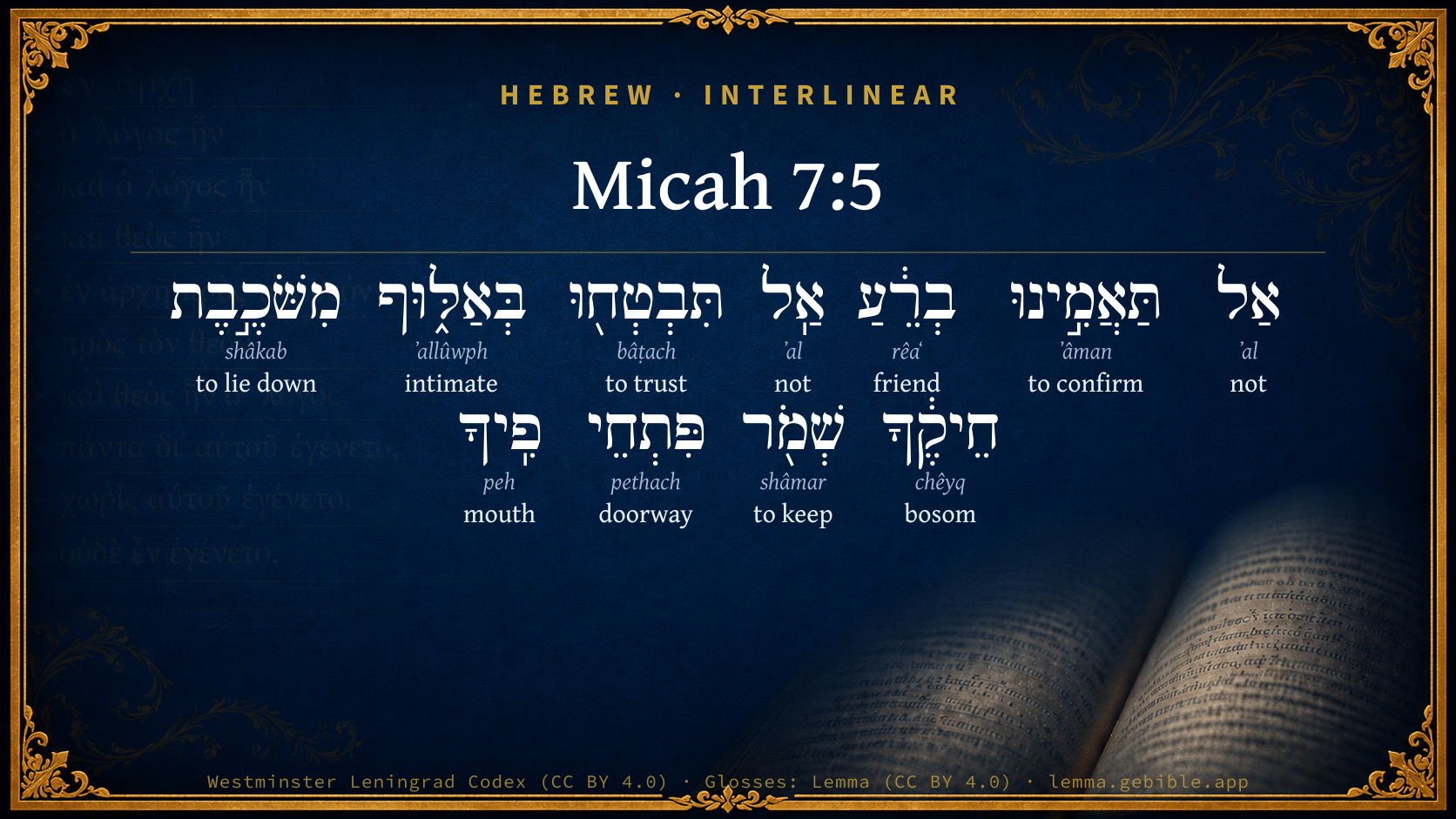
  1. אַל ʼal H408 “not” Particle, Negative
  2. תַּאֲמִ֣ינוּ ʼâman H539 “to confirm” Verb, Hiphil, Jussive, 2nd Person, Masculine, Plural
  3. בְרֵ֔עַ rêaʻ H7453 “in/at · friend” Preposition + Noun, Common, Masculine, Singular, Absolute
  4. אַֽל ʼal H408 “not” Particle, Negative
  5. תִּבְטְח֖וּ bâṭach H982 “to trust” Verb, Qal, Jussive, 2nd Person, Masculine, Plural
  6. בְּאַלּ֑וּף ʼallûwph H441 “in/at · intimate” Preposition + Adjective, Adjective, Masculine, Singular, Absolute
  7. מִשֹּׁכֶ֣בֶת shâkab H7901 “from · lying down” Preposition + Verb, Qal, Participle Active, Feminine, Singular, Construct
  8. שְׁמֹ֖ר shâmar H8104 “keep” Verb, Qal, Imperative, 2nd Person, Masculine, Singular
  9. פִּתְחֵי pethach H6607 “doorways of” Noun, Common, Masculine, Plural, Construct
  10. פִֽיךָ peh H6310 “mouth · your” Noun, Common, Masculine, Singular, Construct + Suffix, Personal, 2nd Person, Masculine, Singular

About this verse

These counts appear in no published source. They are computed here, from the morphology-tagged text and Lemma’s own curated glosses. What Lemma adds →

11
words
10
distinct lemmas
Prophets
section

Shared distinctive vocabulary

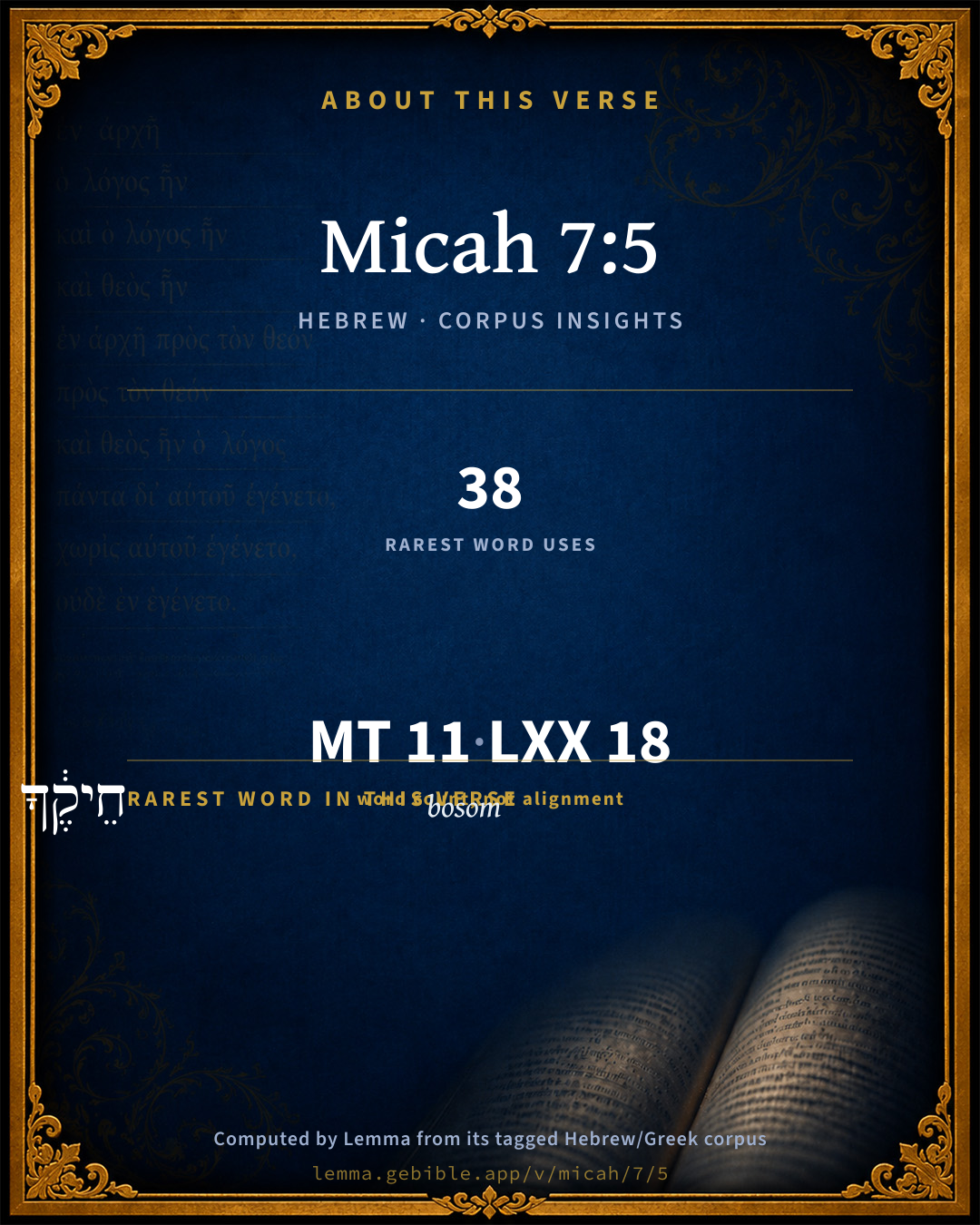
חֵיקֶ֔ךָ bosom H2436 occurs in 34 verses of the Hebrew Bible. Also found in:

Grammatical profile

  • 4 verbs
  • 4 nouns
  • 1 adjective
  • 2 particles

Verb forms

  • תַּאֲמִ֣ינוּ Hiphil · Jussive
  • תִּבְטְח֖וּ Qal · Jussive
  • מִשֹּׁכֶ֣בֶת Qal · Participle Active
  • שְׁמֹ֖ר Qal · Imperative

Repetition

A word recurs within this verse — often emphatic in Hebrew:

  • אַל not H408 ×2

Hebrew & Septuagint length

In English translation the verse runs 26 words from the Hebrew and 21 from the Septuagint (LXX English) — closely comparable.

A rough comparison of the two English renderings, which tokenize alike — not a word-level alignment.

Word counts can differ between the Hebrew and the Greek without any difference in meaning — e.g. the Hebrew direct-object marker אֵת has no separate Greek word, and Greek often adds the article ὁ.

In the original languages it is 11 Hebrew tokens and 18 Greek tokens — but the two are counted differently (Hebrew bundles its prefixes and suffixes into one token; the Greek is in lemma form), so that isn’t a like-for-like length.

Cross-references

5

Topical passages linked to Micah 7:5 in the Treasury of Scripture Knowledge — connected by theme and wording, ordered by reader-vote popularity; previews shown in the World English Bible.

  • Jeremiah 9:4 Take you heed everyone of his neighbor, and don't you trust in any brother; for every brother will utterly supplant, and every neighbor will go about with slanders.
  • Psalms 118:8–9 It is better to take refuge in Yahweh, Than to put confidence in man.
  • Matthew 10:16 "Behold, I send you out as sheep in the midst of wolves. Therefore be wise as serpents, and harmless as doves.
  • Job 6:14–15 "To him who is ready to faint, kindness should be shown from his friend; Even to him who forsakes the fear of the Almighty.
  • Judges 16:5–20 The lords of the Philistines came up to her, and said to her, Entice him, and see in which his great strength lies, and by what means we may prevail against him, that we may bind him to afflict him: and we will each give you of us eleven hundred [pieces] of silver.

Cross-references courtesy of OpenBible.info (CC BY 4.0).

Hebrew and Greek witnesses Masoretic Hebrew ↔ Greek Septuagint

The same verse in the two great witnesses to the Old Testament, shown verse-for-verse.

These are two independent witnesses, not word-aligned to each other, and the Septuagint is shown in lemma (dictionary) form.

Hebrew Micah 7:5 Masoretic · Westminster Leningrad Codex

אַל תַּאֲמִ֣ינוּ בְרֵ֔עַ אַֽל תִּבְטְח֖וּ בְּאַלּ֑וּף מִשֹּׁכֶ֣בֶת חֵיקֶ֔ךָ שְׁמֹ֖ר פִּתְחֵי פִֽיךָ

Don't trust in a neighbor. Don't put confidence in a friend. With the woman lying in your embrace, Be careful of the words of your mouth!

World English Bible · Public Domain

Greek LXX Micah 7:5 Septuagint · lemma form

μή καταπιστεύω ἐν φίλος καί μή ἐλπίζω ἐπί ἡγέομαι ἀπό ὁ συγκοίτος σύ φυλάσσω ὁ ἀνατίθημι τις αὐτός

Trust not in friends, and confide not in guides: beware of your wife, so as not to commit anything to her.

LXX2012 (modern English Septuagint) · Public Domain

On this verse, The Pulpit Commentary discusses the Septuagint’s reading. Read the note in Commentary ↓

Hebrew: Westminster Leningrad Codex (CC BY 4.0). Greek: Septuagint (public domain); English from LXX2012 (modern English Septuagint) (Public Domain). How the Septuagint differs from the Hebrew →

Targum (Aramaic paraphrase)

1

The Targum is the ancient Jewish Aramaic paraphrase of the Hebrew Scriptures — an interpretive translation, not the Hebrew text itself. Onkelos (literal) and Pseudo-Jonathan (expansive) render the Torah, and Jonathan the Prophets. Coverage is partial: where no permissively-licensed English translation exists for a verse, only the Aramaic is shown. This is verse-level text, not a word-by-word alignment to the Hebrew.

  1. Targum Jonathan Prophets (Joshua–Malachi)
    לָא תְהֵימְנוּן בִּרְחֵים וְלָא תִתְרַחֲצוּן בְּקָרִיב מֵאִתַּת קְיָמָךְ טַר מְלֵי פוּמָךְ:

    (no public-domain English translation for this verse)

    Targum Jonathan — Aramaic: “Mikraot Gedolot” (public domain). English: “Sefaria Community Translation” (CC0 1.0 (public-domain dedication)); “London "Chaldee Paraphrase," 1871” (public domain). Text via Sefaria.

Commentary

Notes on Micah 7:5 from classic Christian and Jewish commentators (each source and its license shown beneath its notes). The classic Christian expositions comment on the surrounding passage and are grouped to its opening verse, so a note may address several verses; the Jewish commentaries on the Tanakh (Rashi and others) are per-verse, so they appear only where the commentator wrote on this verse.

Lemma curates 59 commentaries, every one of them public domain or Creative Commons licensed, each selected and text-cleaned for this edition rather than reprinted as found. About our sources →

Trapp's Complete Commentary

John Trapp

Mic 7:5 Trust ye not in a friend, put ye not confidence in a guide: keep the doors of thy mouth from her that lieth in thy bosom.

Ver. 5. Trust ye not in a friend] Friends (said Socrates), there is no friend: and a friend is a changeable creature, saith another (ζωον ευμεταβλητον); all in changeable colours as the peacock, as often changed as moved. Besides, many friends are not more fickle than false, like deep ponds, clear at the top, and all muddy at the bottom. Fide ergo: sed cui vide. Try before you trust; and when you have tried your utmost, trust not overly far, lest you cry out at length, as Queen Elizabeth did, In trust I have found treason; or as Julius Caesar, when stabbed by Brutus among others, What thou, my son Brutus? He was slain in the senate house, with 23 wounds, given, in the most part, by those whose lives he had preserved.

Put ye not confidence in a guide] Potenti et pollenti consilio et auxilio. Be he never so potent or politic, beyond thousand others, as the word importeth: and as the people said to David, "But now thou art worth ten thousand of us," 2Sa 18:3, thou art the light of Israel, thou art the breath of our nostrils; so that if thou miscarry, we shall all breathe out our last. All which notwithstanding, princes are not to be trusted, Psa 62:7; Psa 118:8-9; Psa 146:3, for either they may die, or their affections may die; all their golden thoughts may perish. Great men’s words, saith one, are like dead men’s shoes; he may go barefoot that waiteth for them.

Keep the doors of thy mouth from her that lieth in thy bosom] From thy wife, thine ακοιτις, called the wife of thy bosom, because she should be as dear unto thee as the heart in thy bosom. Be not too open hearted to her, lest she tell all, as Samson’s wife; or as Fulvia, in Sallust, who declared all the secrets of Cneius, a noble Roman, her foolish lover. A fool telleth all, saith Solomon, Pro 29:11, he is as little able to keep as to give counsel. He is full of chinks, and leaks every way; the doors of his mouth are seldom kept shut; you may know him by his gaping: fools are called by Aristophanes and Lucian, κεχηνοτες; gapers. "But a wise man keepeth it in till afterwards," Pro 29:11; Tacitus he holds to be the best historian; and keeps his mouth with a bridle, as David did, Psa 39:1, and as the poets feign of Pegasus, that he had a golden bridle put upon him by Minerva, their goddess of wisdom. God and nature have taught us by the site of the tongue in a man’s mouth, to take heed to it, and to keep the doors of it; and when all is done, to pray God to keep that door, Psa 141:3. The tongue is ever in udo, in a moisture; but yet tied by the roots, that it may not stir out of place; it is also guarded with a percullis of teeth and a two-leaved gate of lips, which we must carefully keep, and hold that for an oracle,

“ Si sapis, arcano vina reconde cado. ”

“If you have sense, hide your personal wine in a jar”

John Trapp, A Commentary or Exposition upon All the Books of the Old and New Testament (1647–1656) — public domain. Text from a community e-Sword module.

Joseph Benson's Commentary

Mic 7:5-7. Trust ye not in a friend — This and the next verse are descriptive of a general corruption of manners; so that all ties and duties of consanguinity were trampled upon, or paid no regard to. The friend proved treacherous to his friend, the wife to her husband: children set at naught their parents, and a man’s own family, or domestics, plotted his injury, or destruction, or acted as enemies toward him. Therefore will I look unto the Lord — The church here expresses her confidence in God alone, since no trust could be placed in man. Or, they may be considered as the words of the prophet, and of those who feared God in Israel.

Joseph Benson's Commentary on the Old and New Testaments (1811–1818) — public domain. Text from a community e-Sword module.

Tyndale Open Study Notes

Tyndale Open Resources

7:5-6 Don’t trust anyone: Bitterness, corruption, and treachery had poisoned the community of the Lord’s people (cp. Matt 10:34-36; Luke 12:52-53).

Tyndale Open Study Notes — © Tyndale Open Resources, licensed CC BY-SA 4.0. Text via the HelloAO Bible API.

Jamieson, Fausset & Brown

Robert Jamieson, A. R. Fausset & David Brown

Trust ye not in a friend--Faith is kept nowhere: all to a man are treacherous (Jer 9:2-6). When justice is perverted by the great, faith nowhere is safe. So, in gospel times of persecution, "a man's foes are they of his own household" (Mat 10:35-36; Luk 12:53).

guide--a counsellor [CALVIN] able to help and advise (compare Psa 118:8-9; Psa 146:3). The head of your family, to whom all the members of the family would naturally repair in emergencies. Similarly the Hebrew is translated in Jos 22:14 and "chief friends" in Pro 16:28 [GROTIUS].

her that lieth in thy bosom--thy wife (Deu 13:6).

Jamieson, Fausset & Brown — Commentary Critical and Explanatory on the Whole Bible (1871) — public domain (CC PDM 1.0). Text via the HelloAO Bible API.

Adam Clarke's Commentary

Verse 5. Trust ye not in a friend] These times will be so evil, and the people so wicked, that all bonds will be dissolved; and even the most intimate will betray each other, when they can hope to serve themselves by it.

On this passage, in the year 1798, I find I have written as follows: -

"Trust ye not in a friend. - Several of those whom I have delighted to call by that name have deceived me.

"Put ye not confidence in a guide. - Had I followed some of these I should have gone to perdition.

"Keep the door of thy mouth from her that lieth in thy bosom. - My wife alone never deceived me."

It is now twenty-seven years since, and I find no cause to alter what I then wrote.

Adam Clarke's Commentary on the Bible (1810–1826) — public domain. Text from a community e-Sword/MySword module.

John Calvin's Commentaries

The Prophet pursues the subject we discussed yesterday, — that liberty, in iniquity, bad arrived to its highest point, for no faithfulness remained among men; nay, there was no more any humanity; for the son performed not his duty towards his father, nor the daughter-in-law towards her mother-in-law; in short, there was then no mutual love and concord. He does not here speak of that false confidence, by which many deceive themselves, who rely on mortals, and transfer to them the glory which belongs to God. Those therefore without any reason, philosophize here, who say, that we ought not to trust in men; for this was not the design of the Prophet. But our Prophet complains of his times according to the tenor of Ovid’s description of the iron age, who says -

“—A guest is not safe from his host; Nor a brother-in-law from a son-in-law; and brotherly love is rare: A husband seeks the death of his wife, and she, of her husband; Cruel stepmothers mingle the lurid poison; The son, before the day, inquires into the years of his father.”

So also our Prophet says, that there was no regard to humanity among men; for the wife was ready to betray her husband, the son treated his father with reproach; in short, they had all forgotten humanity or natural affection. We now then understand what the Prophet means by saying, Trust not a friend; that is, if any one hopes for any thing from a friend, he will be deceived; for nothing can be found among men but perfidy.

Put no faith in a counselor So I render the word אלוף, aluph; some translate it, an elder brother; but there is no necessity to constrain us to depart from the proper and true meaning of the word. As then the Prophet had spoken of an associate or a friend, so he now adds a counselor. And it proves what he had in view, when he says in the next clause, that no enemies are worse than domestics. We hence see that the Prophet simply means, that the men of his age were not only avaricious and cruel to one another, but that without any regard to human feelings the son rebelled against his father, and thus subverted the whole order of nature; So that they had none of those affections, which seem at the same time to be incapable of being extinguished in men. Let us now proceed —

John Calvin's Commentaries (1540-1563) — public domain. Text from the Calvin Translation Society English edition (1840s-50s) via the Christian Classics Ethereal Library (ccel.org). Calvin's coverage is partial (roughly two-thirds of the Bible); uncommented books and verses are honest gaps, never fabricated. The 19th-century editor's footnotes and remarks are omitted so the notes are faithfully Calvin's own voice.

Ellicott's Commentary for English Readers

(5, 6) Trust ye not . . .—All is now distrust and suspicion. The households are divided each against itself, and the relationships which should mean mutual confidence and support have become the occasion of the most bitter hostility. Our Lord adopts these words to express the strife and division which, He foresaw, would defile Christianity. (Comp. Mat_10:35; Mar_13:12; Luk_12:53.)

A Bible Commentary for English Readers, edited by Charles John Ellicott (1878–1897) — public domain. Text from a community e-Sword module.

The Cambridge Bible for Schools and Colleges

gen. ed. J. J. S. Perowne

5. guide] Rather, familiar friend. The same mistake occurs in A. V. of Psa_55:13 (14 in the Hebrew).

5, 6. Here the prophet addresses the better disposed of his people. Friendship and wedded love can no longer be trusted; natural affection passes into its opposite. Comp. Mat_10:21; Mat_10:35-36 (a reminiscence of a clause in our passage), Luk_12:53; Luk_21:16.

The Cambridge Bible for Schools and Colleges (gen. ed. J. J. S. Perowne; Cambridge University Press, 1878–1918) — public domain. Text from a community e-Sword module.

John Gill's Exposition

Trust ye not in a friend,.... This is not said to lessen the value of friendship; or to discourage the cultivation of it with agreeable persons; or to dissuade from a confidence in a real friend; or in the least to weaken it, and damp the pleasure of true friendship, which is one of the great blessings of life; but to set forth the sad degeneracy of the then present age, that men, who pretended to be friends, were so universally false and faithless, that there was no dependence to be had on them:

put ye not confidence in a guide; in political matters, in civil affairs, as civil magistrates, judges, counsellors; or in domestic matters. The Targum renders it, in one near akin. Kimchi interprets it of an elder brother; and Aben Ezra of a husband, who is to his wife the guide of her youth; and in religious matters as prophets, priests who were false and deceitful. It may design a very intimate friend, a familiar acquaintance, who might of all men be thought to be confided in; of whom the word is used, Psa 55:13;

keep the doors of thy mouth from her that lieth in thy bosom; from a wife, and much more from a concubine or harlot. The Targum is,

"from the wife of thy covenant keep the words of thy mouth;''

divulge not the thoughts of thine heart, or disclose the secrets of it, to one so near; take care of speaking treason against the prince, or ill of a neighbour; it may be got out of such an one, and who may be so base as to betray it: or utter not anything whatever that is secret, the divulging of which may be detrimental; for, in such an age as this was, one in so near a relation might be wicked enough to discover it; see Ecc 10:20.

John Gill's Exposition of the Whole Bible (1746–1763) — public domain (CC PDM 1.0). Text via the HelloAO Bible API.

Albert Barnes' Notes on the Bible

Trust ye not in a friend - It is part of the perplexity of crooked ways, that all relationships are put out of joint. Selfishness rends each from the other, and disjoints the whole frame of society. Passions and sin break every band of friendship, kindred, gratitude, nature. “Everyone ‘seeketh his own’.” Times of trial and of outward harass increase this; so that God’s visitations are seasons of the most frightful recklessness as to everything but sell: So had God foretold Deu 28:53; so it was in the siege of Samaria 2Ki 6:28, and in that of Jerusalem both by the Chaldeans Lam 4:3-16 and by the Romans . When the soul has lost the love of God, all other is but sceming love, since “natural affection” is from Him, and it too dies out, as God gives the soul over to itself Rom 1:28. The words describe partly the inward corruption, partly the outward causes which shall call it forth.

There is no real trust in any, where all are eorrupt. The outward straitness and perplexity, in which they shall be, makes that to crumble and fall to pieces, which was inwardly decayed and severed before. The words deepen, as they go on. First, “the friend”, or neighbor, the common band of man and man; then “the guide”, (or, as the word also means, one “familiar”, united by intimacy, to whom, by continual intercourse, the soul was “used”;) then the wife who lay in the bosom, nearest to the secrets of the heart; then those to whom all reverence is due, “father” and “mother”. Our Lord said that this should be fulfilled in the hatred of His Gospel. He begins His warning as to it, with a caution like that of the prophet; “Be ye wise as serpents” Mat 10:16-17, and “beware of men”. Then He says, how these words should still be true Mat 10:21, Mat 10:35-36. There never were wanting pleas of earthly interest against the truth.

He Himself was “cut off” lest “the Romans should take away their place and nation” Joh 11:48. The Apostles were accused, that they meant to “bring this Man’s Blood upon” the chief priests Act 5:28; or as “ringleaders of the sect of the Nazarenes, pestilant fallows and movers of sedition, turning the world upside down, setters up of another king; troublers of the city; comanding things unlawful for Romans to practice; setters forth of strange gods; turning away much people” Act 24:5; Act 16:20-21; Act 17:6-7, Act 17:18; 1Pe 2:12; endangering not men’s craft only, but the honor of their gods; “evil doers”. Truth is against the world’s ways, so the world is against it. Holy zeal hates sin, so sinners hate it. It troubles them, so they count it, “one which troubleth Israel” 1Ki 18:17. Tertullian, in a public defense of Christians in the second century, writes, , “Truth set out with being herself hated; as soon as she appeared, she is an enemy. As many as are strangers to it, so many are its foes; and the Jews indeed appropriately from their rivalry, the soldiers from their violence, even they of our own household from nature. Each flay are we beset, each day betrayed; in our very meetings and assemblies are we mostly surprised.”

There was no lack of pleas. : “A Christian thou deemest a man guilty of every crime, an encmy of the goals, of the Emperors, of law, of morals, of all nature;” “factious,” “authors of all public calamities through the anger of the pagan gods,” “impious,” “atheists,” “disloyal,” “public enemies.” The Jews, in the largest sense of the word “they of their own household”, were ever the deadliest enemies of Christians, the inventors of calumnies, the authors of persecutions. “What other race,” says , Tertullian, “is the seed-plot of our calumnies?”

Then the Acts of the Martyrs tell, how Christians were betrayed by near kinsfolk for private interest, or for revenge, because they would not join in things unlawful. Jerome: “So many are the instances in daily life, (of the daughter rising against the mother) that we should rather mourn that they are so many, than seek them out.” - “I seek no examples, (of those of a man’s own househould being his foes) they are too many, that we should have any need of witness.” Dionysius: “Yet ought we not, on account of these and like words of Holy Scripture, to be mistrustful or suspicious, or always to presume the worst, but to be cautious and prudent. For Holy Scripture speaketh with reference to times, causes, persons, places.” So John saith, “Believe not every spirit, but try the spirits, whether they are of God” 1Jo 4:1.

Albert Barnes' Notes on the Bible (1834–1885) — public domain. Text from a community e-Sword/MySword module.

Haydock's Catholic Bible Commentary

Bosom. In times of general distress, even domestics are not trusted; because all are solicitous for themselves, even to the prejudice of others. (Worthington) --- Before the ruin of Israel civil wars raged, 4 Kings xv. Our Saviour alludes to this passage, Matthew x. 35., Luke xii. 52., and xxi. 16. People will rise up to oppress true believers; and these must abandon their nearest relations, when they prove an obstacle to salvation. Thus is the moral, and the other the literal sense. (Calmet)

George Leo Haydock (1774–1849), Haydock's Catholic Family Bible and Commentary, 1859 edition — public domain. Excludes Psalms (Douay-Rheims chapter numbering differs from Protestant) and Deuterocanonical books (Catholic canon only).

Matthew Poole's English Annotations

Trust ye not in a friend: most prodigiously treacherous were the people of that age, and since none upright, all lay in wait for blood, and were turned hunters of brethren, it is but necessary caution that they trust no friendship.

A guide; either a governor, who ought to guide; or equal, who being of intimate familiarity usually do guide; or a husband, as the word imports.

Keep the doors of thy mouth; watch thy words, let not thy tongue discover any secret or utter any words which may be danger to thyself, or give an advantage to thine enemy.

From her that lieth in thy bosom; a periphrasis of a wife in honest times; but whether in debauched times, as these are of which the prophet did speak, it may not import somewhat like that Pro 5:20, I will not say: a wife, one may rationally suppose, will never disclose a husband’s secrets to ruin him; yet such were the treacheries of that corrupt age, that it would be imprudence to trust a with.

Matthew Poole's English Annotations on the Holy Bible (1683–1685) — public domain. Text from a community e-Sword/MySword module.

The Pulpit Commentary

Such is the moral corruption that the nearest relations cannot be trusted: selfishness reigns everywhere The prophet emphasizes this universal evil by warning the better portion of the people. Friend... guide. There is a gradation here, beginning with "neighbour," or "common acquaintance," and ending with "wife." The word rendered "guide" means "closest, most familiar friend, as in Psa_55:13. Our version is sanctioned by the Septuagint, hgoumenoiv , "leaders;" and the Vulgate, duce; but the context confirms the other translation. (comp. Pro_16:28 Pro_17:9) Our Lord has used some of the expressions in the next verso in describing the miseries of the latter day. (Mat_10:21, Mat_10:35, 36 24:12; comp. Luk_12:53 Luk_21:16 2Ti_3:2) Keep the doors of thy mouth. Guard thy secrets. (For the phrase, comp. Psa_141:3) Her that lieth in thy bosom. Thy wife. (Deu_13:6 Deu_28:54)

The Pulpit Commentary (1880–1919), ed. H.D.M. Spence-Jones & Joseph S. Exell — public domain. Text from a community e-Sword module.

Scofield Reference Notes

C. I. Scofield

trust

(See Scofield "Psa 2:12").

The Scofield Reference Bible (1917 edition), notes by C. I. Scofield — public domain. Text from a community e-Sword module.

unfoldingWord translationNotes

Door43 World Missions Community

General Information:

Micah continues speaking to the people of Israel.

Do not trust any neighbor ... people of his own house

Micah continues to show that there is no longer anyone good, honest, and loyal to God among God's people. Here he emphasizes that they cannot even trust friends or family.

a daughter-in-law against her mother-in-law

The words "rises up" are understood from the previous phrase. They can be repeated here. AT: "a daughter-in-law rises up against her mother-in-law" (See: Ellipsis)

his own house

The word "house" is a metonym for the family that lives in the house. AT: "his own family" (See: Metonymy)

translationWords

trust

neighbor

dishonor

adversary

unfoldingWord translationNotes — © Distant Shores Media and the Door43 World Missions Community, licensed CC BY-SA 4.0. Source: git.door43.org/Door43/en_tn.

Rashi

Rabbi Shlomo Yitzchaki (Rashi)

Believe not a friend [This is to be understood] according to its apparent meaning. But our Sages explained it as referring to the Most High. Do not sin and say that the Holy One, blessed be He, is our Friend, and He will forgive us. [from Hagiga 16a]

from her who lies in your bosom—Your soul will testify against you.

the openings of your mouth Heb. פִּתְחֵי. The words of your mouth, the openings of your mouth.

Rashi on the Tanakh — English translations: “The Judaica Press complete Tanach with Rashi, translated by A. J. Rosenberg” (CC BY 4.0); “Pentateuch with Rashi's commentary by M. Rosenbaum and A.M. Silbermann, 1929-1934” (public domain); “The Metsudah Tanach series, Lakewood, N.J” (CC BY 4.0); and “The Book of Joshua, Metsudah Publications, 1997” (CC BY 4.0). Text via Sefaria.

Lesson kit

Teaching starters — assembled from the data on this page, not authored interpretation. Every prompt links to the verse data it draws on. Edit before teaching.

Micah, in the Prophets, opens this verse with 11 words (10 distinct Hebrew lemmas). Its most distinctive word is chêyq (“bosom”). A historical commentator’s framing appears above. Read the whole chapter for the surrounding context.

Discussion questions

  1. What does “bosom” (chêyq) contribute to the verse as a whole?
  2. Genesis 16:5 shares the word «bosom» with this verse. How do the two illuminate each other?
  3. “not” occurs 2× in this one verse. What is the effect of the repetition?
  4. The translations on this page render this verse differently — a whole-verse word diff, not a word-by-word alignment. What might account for the different wordings?
  5. The verb «תַּאֲמִ֣ינוּ» is Hiphil Jussive. How does its form color the action?
  6. Reading how Trapp's Complete Commentary and Joseph Benson's Commentary read this verse, where do the two commentators agree and where do they part?

Things to notice

Reading settings

Reading text

Shown beneath each verse's original-language words.

Old Testament
Old Testament edition

Read the OT as the Masoretic Hebrew (MT) or the Greek Septuagint (LXX).

English shown for the Greek Septuagint (in the Hebrew ↔ Greek comparison).

Comparing translations? Open the Compare panel on any verse page to stack up to four side by side.