
1 Kings 14:31

Hebrew (Westminster Leningrad Codex) 1 Kings 14:31 appears in the Hebrew Old Testament. The text above is from the Westminster Leningrad Codex. Each word links to its Strong’s number, a concise gloss, and parsing drawn from the Open Scriptures Hebrew Bible morphology. Click any word for its full Brown-Driver-Briggs (BDB) entry.
Download image
Cite this verse

1 Kings 14:31 (World English Bible). Public Domain. Lemma interlinear Bible study tool, https://lemma.gebible.app/v/1-kings/14/31.

Show BibTeX & RIS
BibTeX
RIS
English Translation
Rehoboam slept with his fathers, and was buried with his fathers in the city of David: and his mother's name was Naamah the Ammonitess. Abijam his son reigned in his place.
World English Bible · Public Domain
Highlights
  • 1 first appearance in the Hebrew Bible
Full analysis ↓
Download a study sheet

One document with this verse’s original text, its word-by-word gloss line, the meaning frame, cross-references with their text, attributed commentary, and full source and license credits — printable, and it pastes into notes with its structure intact.

This verse Autodidact and up

Study sheet (.html) Plain text (.txt)

A passage Seminary Student

Up to 50 verses in one chapter. A passage sheet keeps up to 6 commentary sources and 12 cross-references per verse, in the order this page ranks them, and says so on the sheet whenever that leaves anything out. Ask for a single verse and you get the Autodidact verse sheet above.

Everything on this page stays free to read, with no account — the sheet is a download of what is already on screen, not access to it.

Want to remove ads? Support Godless Engineer
Compare translations 3

The same verse in 3 English versions, stacked beneath the original-language interlinear above. Click any original word for its lexicon entry.

Each is an independent rendering of the whole verse — the interlinear is not word-aligned to these translations.

Highlighted words mark where these versions differ — a whole-verse word diff, not a word-by-word alignment.

  • World English Bible Public Domain
    Rehoboam slept with his fathers, and was buried with his fathers in the city of David: and his mother's name was Naamah the Ammonitess. Abijam his son reigned in his place.
  • King James Version Public Domain
    And Rehoboam slept with his fathers, and was buried with his fathers in the city of David. And his mother's name was Naamah an Ammonitess. And Abijam his son reigned in his stead.
  • unfoldingWord Literal Text CC BY-SA 4.0
    And Rehoboam lay down with his fathers, and he was buried with his fathers in the City of David. And the name of his mother was Naamah the Ammonitess. And Abijam his son reigned in his place.

unfoldingWord Literal Text — © unfoldingWord, licensed CC BY-SA 4.0. Word-aligned USFM3 via Door43 (git.door43.org/unfoldingWord/en_ult).

Versions to compare (up to 4)

3 of 4 selected

Show all 18 translations

Every available English version of this verse, each an independent rendering of the whole verse.

  • World English Bible Public Domain
    Rehoboam slept with his fathers, and was buried with his fathers in the city of David: and his mother's name was Naamah the Ammonitess. Abijam his son reigned in his place.
  • Berean Standard Bible Public Domain
    And Rehoboam rested with his fathers and was buried with them in the City of David; his mother’s name was Naamah the Ammonite. And his son Abijam reigned in his place.
  • Majority Standard Bible Public Domain
    And Rehoboam rested with his fathers and was buried with them in the City of David; his mother’s name was Naamah the Ammonite. And his son Abijam reigned in his place.
  • King James Version Public Domain
    And Rehoboam slept with his fathers, and was buried with his fathers in the city of David. And his mother's name was Naamah an Ammonitess. And Abijam his son reigned in his stead.
  • American Standard Version (1901) Public Domain
    And Rehoboam slept with his fathers, and was buried with his fathers in the city of David: and his mother's name was Naamah the Ammonitess. And Abijam his son reigned in his stead.
  • Revised Version (1885) Public Domain
    And Rehoboam slept with his fathers, and was buried with his fathers in the city of David: and his mother’s name was Naamah the Ammonitess. And Abijam his son reigned in his stead.
  • Geneva Bible (1599) Public Domain
    And Rehoboam slept with his fathers, and was buried with his fathers in the citie of Dauid: his mothers name was Naamah an Ammonite. And Abiiam his sonne reigned in his stead.
  • Douay-Rheims (1899) Public Domain
    And Roboam slept with his fathers, and was buried with them in the city of David: and his mother's name was Naama an Ammonitess: and Abiam his son reigned in his stead.
  • Young's Literal Translation Public Domain
    and Rehoboam lieth with his fathers, and is buried with his fathers, in the city of David, and the name of his mother `is' Naamah the Ammonitess, and reign doth Abijam his son in his stead.
  • Literal Standard Version CC BY-SA 4.0
    and Rehoboam lies with his fathers, and is buried with his fathers in the City of David, and the name of his mother [is] Naamah the Ammonitess, and his son Abijam reigns in his stead.
  • Unlocked Literal Bible CC BY-SA 4.0
    So Rehoboam slept with his ancestors and was buried with them in the city of David. His mother's name was Naamah the Ammonite woman. Abijah his son became king in his place.
  • unfoldingWord Literal Text CC BY-SA 4.0
    And Rehoboam lay down with his fathers, and he was buried with his fathers in the City of David. And the name of his mother was Naamah the Ammonitess. And Abijam his son reigned in his place.
  • Darby Bible Public Domain
    And Rehoboam slept with his fathers, and was buried with his fathers in the city of David. And his mother's name was Naamah, an Ammonitess. And Abijam his son reigned in his stead.
  • World Messianic Bible Public Domain
    Rehoboam slept with his fathers, and was buried with his fathers in David’s city. His mother’s name was Naamah the Ammonitess. Abijam his son reigned in his place.
  • Webster's Bible Public Domain
    And Rehoboam slept with his fathers, and was buried with his fathers in the city of David. And his mother's name was Naamah an Ammonitess. And Abijam his son reigned in his stead.
  • Free Bible Version CC BY-SA 4.0
    Rehoboam died and was buried with his ancestors in the City of David. The name of his mother was Naamah the Ammonite. His son Abijam succeeded him as king.
  • Bible in Basic English Public Domain
    And Rehoboam went to rest with his fathers, and was put into the earth with his fathers in the town of David; his mother's name was Naamah, an Ammonite woman. And Abijam his son became king in his place.
  • JPS Tanakh (1917) Public Domain
    And Rehoboam slept with his fathers, and was buried with his fathers in the city of David; and his mother's name was Naamah the Ammonitess. And Abijam his son reigned in his stead.

Literal Standard Version (2020), Covenant Press — licensed CC BY-SA 4.0. Text via the HelloAO Bible API (eBible.org). Unlocked Literal Bible (unfoldingWord) — licensed CC BY-SA 4.0. Text via the HelloAO Bible API (eBible.org). unfoldingWord Literal Text — © unfoldingWord, licensed CC BY-SA 4.0. Word-aligned USFM3 via Door43 (git.door43.org/unfoldingWord/en_ult). Free Bible Version, Dr. Jonathan Gallagher — licensed CC BY-SA 4.0. Text via the HelloAO Bible API (eBible.org).

Word by word

More ways to search: Search by grammar → Find every occurrence → Compare this word →

Practice this passage: Drill this verse → Learn its vocabulary →

הָעַמֹּנִ֑ית
ʻAmmôwnîyth
H5985
“the · Ammonitess”
Particle, Definite Article + Noun, Gentilic, Feminine, Singular, Absolute
Part of Speech
Particle + Noun
Type
Gentilic
Gender
Feminine
Number
Singular
State
Absolute
Full BDB Definition

Origin: fem of H5984

TWOT: None

Ammonitess = see Ammon " tribal" - a woman of Ammon
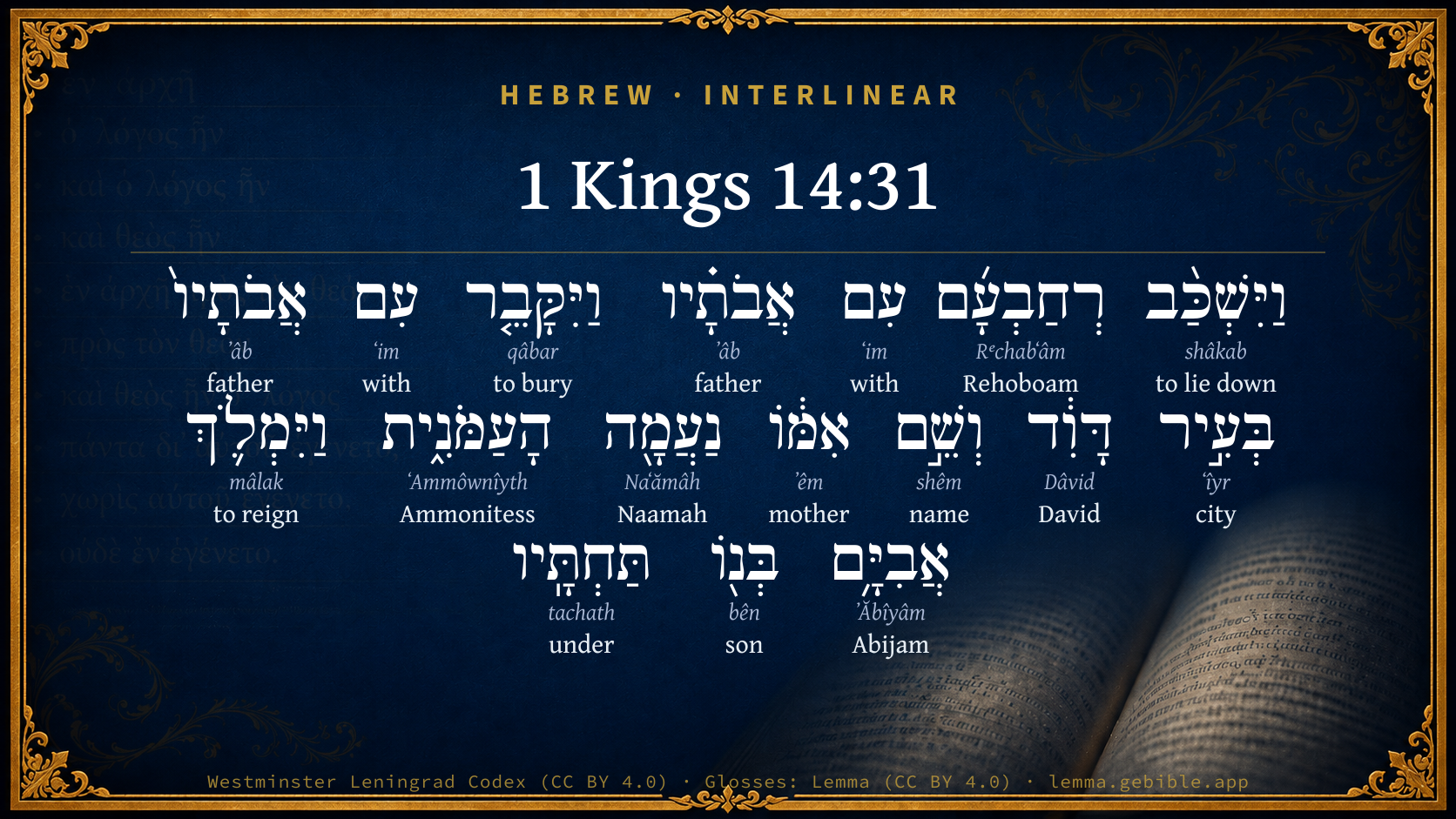
  1. וַיִּשְׁכַּ֨ב shâkab H7901 “and · to lie down” Conjunction + Verb, Qal, Sequential Imperfect, 3rd Person, Masculine, Singular
  2. רְחַבְעָ֜ם Rᵉchabʻâm H7346 “Rehoboam” Noun, Proper
  3. עִם ʻim H5973 “with” Preposition
  4. אֲבֹתָ֗יו ʼâb H1 “fathers · his” Noun, Common, Masculine, Plural, Construct + Suffix, Personal, 3rd Person, Masculine, Singular
  5. וַיִּקָּבֵ֤ר qâbar H6912 “and · to bury” Conjunction + Verb, Niphal, Sequential Imperfect, 3rd Person, Masculine, Singular
  6. עִם ʻim H5973 “with” Preposition
  7. אֲבֹתָיו֙ ʼâb H1 “fathers · his” Noun, Common, Masculine, Plural, Construct + Suffix, Personal, 3rd Person, Masculine, Singular
  8. בְּעִ֣יר ʻîyr H5892 “in/at · city of” Preposition + Noun, Common, Feminine, Singular, Construct
  9. דָּוִ֔ד Dâvid H1732 “David” Noun, Proper
  10. וְשֵׁ֣ם shêm H8034 “and · name of” Conjunction + Noun, Common, Masculine, Singular, Construct
  11. אִמּ֔וֹ ʼêm H517 “mother · his” Noun, Common, Feminine, Singular, Construct + Suffix, Personal, 3rd Person, Masculine, Singular
  12. נַעֲמָ֖ה Naʻămâh H5279 “Naamah” Noun, Proper
  13. וַיִּמְלֹ֛ךְ mâlak H4427 “and · to reign” Conjunction + Verb, Qal, Sequential Imperfect, 3rd Person, Masculine, Singular
  14. אֲבִיָּ֥ם ʼĂbîyâm H38 “Abijam” Noun, Proper
  15. בְּנ֖וֹ bên H1121 “son · his” Noun, Common, Masculine, Singular, Construct + Suffix, Personal, 3rd Person, Masculine, Singular
  16. תַּחְתָּֽיו tachath H8478 “under · him” Preposition + Suffix, Personal, 3rd Person, Masculine, Singular

About this verse

These counts appear in no published source. They are computed here, from the morphology-tagged text and Lemma’s own curated glosses. What Lemma adds →

17
words
15
distinct lemmas
Historical
section

Notable vocabulary

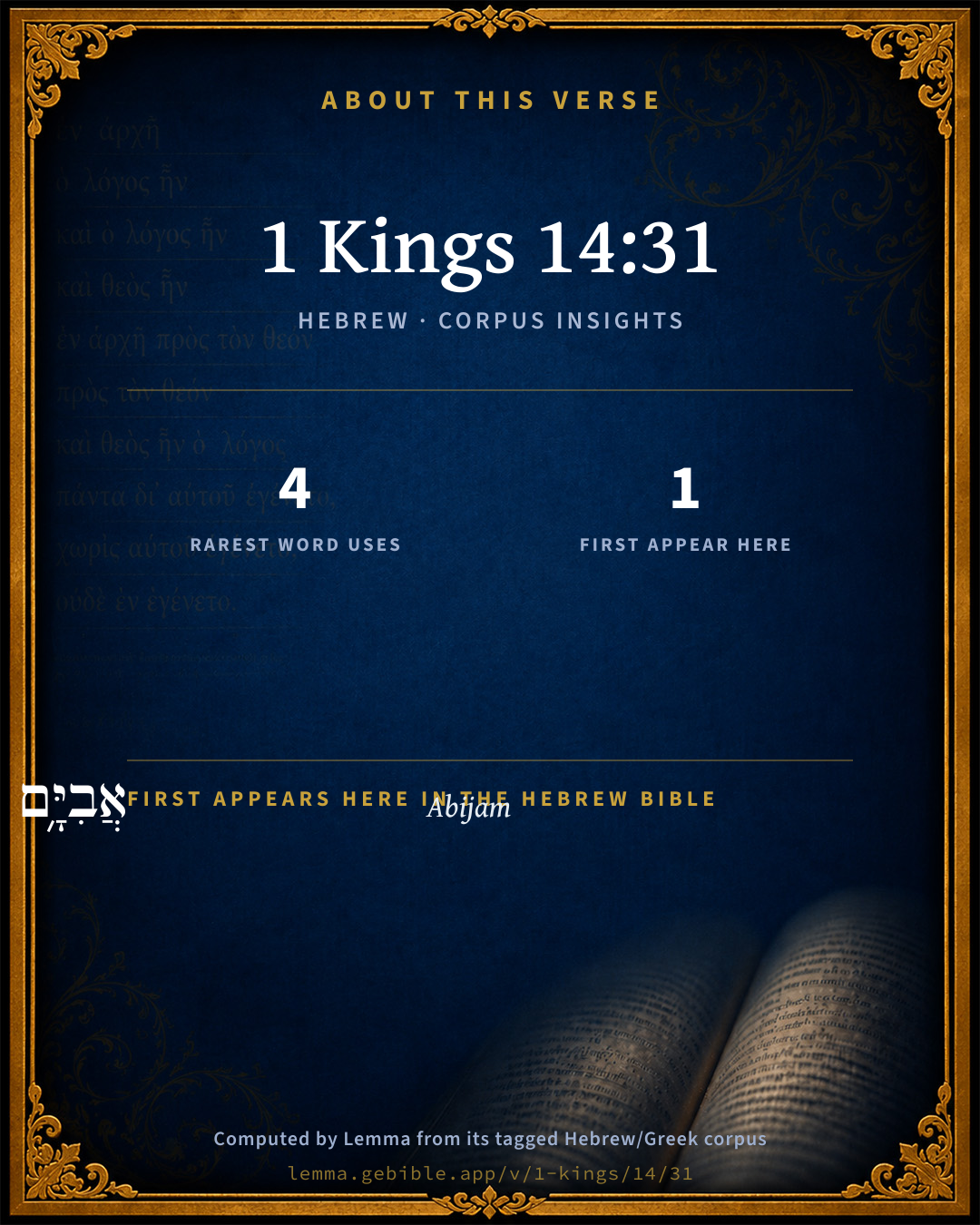
The rarest word here is הָעַמֹּנִ֑ית Ammonitess H5985 — appearing just 4 times in the whole Hebrew Bible.

First appearance in Scripture

This word makes its first canonical appearance in the Hebrew Bible here:

  • אֲבִיָּ֥ם Abijam H38

Shared distinctive vocabulary

הָעַמֹּנִ֑ית Ammonitess H5985 occurs in 4 verses of the Hebrew Bible. Also found in:

Grammatical profile

  • 3 verbs
  • 11 nouns
  • 3 prepositions

Verb forms

  • וַיִּשְׁכַּ֨ב Qal · Sequential Imperfect
  • וַיִּקָּבֵ֤ר Niphal · Sequential Imperfect
  • וַיִּמְלֹ֛ךְ Qal · Sequential Imperfect

Repetition

Words recur within this verse — often emphatic in Hebrew:

  • אֲבֹתָ֗יו father H1 ×2
  • עִם with H5973 ×2

Hebrew & Septuagint length

In English translation the verse runs 31 words from the Hebrew and 25 from the Septuagint (LXX English) — closely comparable.

A rough comparison of the two English renderings, which tokenize alike — not a word-level alignment.

Word counts can differ between the Hebrew and the Greek without any difference in meaning — e.g. the Hebrew direct-object marker אֵת has no separate Greek word, and Greek often adds the article ὁ.

Cross-references

8

Topical passages linked to 1 Kings 14:31 in the Treasury of Scripture Knowledge — connected by theme and wording, ordered by reader-vote popularity; previews shown in the World English Bible.

  • 2 Chronicles 12:16 Rehoboam slept with his fathers, and was buried in the city of David: and Abijah his son reigned in his place.
  • Matthew 1:7 Solomon became the father of Rehoboam. Rehoboam became the father of Abijah. Abijah became the father of Asa.
  • 1 Kings 11:43 Solomon slept with his fathers, and was buried in the city of David his father: and Rehoboam his son reigned in his place.
  • 1 Kings 14:20–21 The days which Jeroboam reigned were two and twenty years: and he slept with his fathers, and Nadab his son reigned in his place.
  • 1 Kings 15:3 He walked in all the sins of his father, which he had done before him; and his heart was not perfect with Yahweh his God, as the heart of David his father.
  • 1 Kings 15:24 Asa slept with his fathers, and was buried with his fathers in the city of David his father; and Jehoshaphat his son reigned in his place.
  • 1 Kings 22:50 Jehoshaphat slept with his fathers, and was buried with his fathers in the city of David his father; Jehoram his son reigned in his place.
  • 1 Chronicles 3:10 Solomon's son was Rehoboam, Abijah his son, Asa his son, Jehoshaphat his son,

Cross-references courtesy of OpenBible.info (CC BY 4.0).

Hebrew and Greek witnesses Masoretic Hebrew ↔ Greek Septuagint

The same verse in the two great witnesses to the Old Testament, shown verse-for-verse.

These are two independent witnesses, not word-aligned to each other, and the Septuagint is shown in lemma (dictionary) form.

Hebrew 1 Kings 14:31 Masoretic · Westminster Leningrad Codex

וַיִּשְׁכַּ֨ב רְחַבְעָ֜ם עִם אֲבֹתָ֗יו וַיִּקָּבֵ֤ר עִם אֲבֹתָיו֙ בְּעִ֣יר דָּוִ֔ד וְשֵׁ֣ם אִמּ֔וֹ נַעֲמָ֖ה הָעַמֹּנִ֑ית וַיִּמְלֹ֛ךְ אֲבִיָּ֥ם בְּנ֖וֹ תַּחְתָּֽיו

Rehoboam slept with his fathers, and was buried with his fathers in the city of David: and his mother's name was Naamah the Ammonitess. Abijam his son reigned in his place.

World English Bible · Public Domain

Greek LXX 1 Kings 14:31 Septuagint · lemma form
And Roboam slept with his fathers, and was buried with his fathers in the city of David: and Abiu his son reigned in his stead.

LXX2012 (modern English Septuagint) · Public Domain

On this verse, Adam Clarke's Commentary discusses the Septuagint’s reading. Read the note in Commentary ↓

Hebrew: Westminster Leningrad Codex (CC BY 4.0). Greek: Septuagint (public domain); English from LXX2012 (modern English Septuagint) (Public Domain). How the Septuagint differs from the Hebrew →

Targum (Aramaic paraphrase)

1

The Targum is the ancient Jewish Aramaic paraphrase of the Hebrew Scriptures — an interpretive translation, not the Hebrew text itself. Onkelos (literal) and Pseudo-Jonathan (expansive) render the Torah, and Jonathan the Prophets. Coverage is partial: where no permissively-licensed English translation exists for a verse, only the Aramaic is shown. This is verse-level text, not a word-by-word alignment to the Hebrew.

  1. Targum Jonathan Prophets (Joshua–Malachi)
    וּשְׁכִיב רְחַבְעָם עִם אֲבָהָתוֹהִי וְאִתְקְבַר עִם אֲבָהָתוֹהִי בְּקַרְתָּא דְדָוִד וְשׁוּם אִמֵיהּ נַעֲמָה דְמִבְנֵי עַמוֹן וּמְלַךְ אֲבִיָם בְּרֵיהּ תְּחוֹתוֹהִי:

    (no public-domain English translation for this verse)

    Targum Jonathan — Aramaic: “Mikraot Gedolot” (public domain). English: “Sefaria Community Translation” (CC0 1.0 (public-domain dedication)); “London "Chaldee Paraphrase," 1871” (public domain). Text via Sefaria.

Commentary

Notes on 1 Kings 14:31 from classic Christian and Jewish commentators (each source and its license shown beneath its notes). The classic Christian expositions comment on the surrounding passage and are grouped to its opening verse, so a note may address several verses; the Jewish commentaries on the Tanakh (Rashi and others) are per-verse, so they appear only where the commentator wrote on this verse.

Lemma curates 59 commentaries, every one of them public domain or Creative Commons licensed, each selected and text-cleaned for this edition rather than reprinted as found. About our sources →

Trapp's Complete Commentary

John Trapp

1Ki 14:31 And Rehoboam slept with his fathers, and was buried with his fathers in the city of David. And his mother’s name [was] Naamah an Ammonitess. And Abijam his son reigned in his stead.

Ver. 31. And Rehoboam slept.] Jeroboam lived to see three successions in the throne of Judah. Thus the ivy liveth where the oak is dead.

John Trapp, A Commentary or Exposition upon All the Books of the Old and New Testament (1647–1656) — public domain. Text from a community e-Sword module.

Geneva Bible (1599)

Geneva Bible translators

Whose idolatry Rehoboam her son followed.

Geneva Bible (1599) marginal notes — public domain. Text via Bolls.life.

Adam Clarke's Commentary

Verse 31. Naamah an Ammonitess.] He was born of a heathen mother, and begotten of an apostate father. From such an impure fountain could sweet water possibly spring?

Abijam his son reigned in his stead.] Though righteousness cannot be propagated, because it is supernatural, yet unrighteousness may, for that is a genuine offspring of nature. Abijam was the wicked son of an apostate father and heathenish mother. Grace may be grafted on a crab stock; but let none do evil that good may come of it. A bad stock will produce bad fruit.

Dr. Kennicott observes that the name of this king of Judah is now expressed three ways: here and in four other places it is Abijam or Abim; in two others it is Abihu, but in eleven other places it is Abiah, as it is expressed by St. Matthew, Mt 1:7, ροβοαμεγεννησετον αβια; and this is the reading of thirteen of Kennicott's and De Rossi's MSS., and of thirteen respectable editions of the Hebrew Bible. The Syriac is the same. The Septuagint in the London Polyglot has αβιου, Abihu; but in the Complutensian and Antwerp Polyglots, it is αβια, Abiah. Though the common printed Vulgate has Abiam, yet the Editio Princeps of the Vulgate, some MSS., and the text in the Complutensian and Antwerp Polyglots, have Abia; which without doubt is the reading that should in all cases be followed.

The rabbins say, and particularly Rab. Sol. Jarchi, that the Shishak mentioned in this chapter is Pharaoh Necho, and that he invaded Israel in order to get the ivory throne of his son-in-law Solomon, which he had always coveted; and this throne he carried away. It appears however that he spoiled the temple, the king's palace, c., and in short took every thing away without resistance which he chose to carry off. It is very likely that this had a good effect on Rehoboam it probably caused him to frequent the temple, 1Kg 14:28, which it is likely he had before neglected. This history is more particularly told in 2 Chron. 12, to which the reader will do well to refer; and as to Rehoboam, though so much positive iniquity is not laid to his charge as to his father, yet little can be said for his piety; the idolatry introduced by Solomon does not appear to have been lessened in the days of Rehoboam.

Adam Clarke's Commentary on the Bible (1810–1826) — public domain. Text from a community e-Sword/MySword module.

The Cambridge Bible for Schools and Colleges

gen. ed. J. J. S. Perowne

31. and his mother’s name—Ammonitess] These words, which are identical with the closing paragraph of 1Ki_14:21 are omitted, by the LXX. (Vat.). Their occurrence twice so close together seems to shew that the compiler of 1 Kings was drawing from several sources, and that he copied 1Ki_14:21-24 from one narrative just as they stood, and 1Ki_14:25-31 from another, which both contained the same piece of information about Rehoboam’s mother. Here as in 1Ki_14:21 we should render ‘the Ammonitess.’ In the long passage which the LXX. inserts after 1Ki_14:24 of chap. 12. (see additional note thereon) she is called Ναανὰν θυγάτηρ Ἄνα υἱοῦ Ναὰς βασιλέως υἱῶν Ἀμμών. The king intended by these words is probably Hanun, the son of Nahash, of whom we hear something in 2 Samuel 10. If Hanun became reconciled to David after the events there related, the marriage of Solomon with his daughter might have been one item in their treaty of friendship. But the authority of the addition in the LXX. is not very great.

Abijam his son] Called in 2Ch_12:16, and elsewhere, Abijah.

The Cambridge Bible for Schools and Colleges (gen. ed. J. J. S. Perowne; Cambridge University Press, 1878–1918) — public domain. Text from a community e-Sword module.

Albert Barnes' Notes on the Bible

Slept with his fathers and was buried ... - Compare 1Ki 11:43. The expression is a sort of formula, and is used with respect to all the kings of Judah, except two or three. The writer probably regards the fact, which he records so carefully, as a continuation of God’s mercy to David.

His mother’s name ... - The mention of the queen-mother so regularly in the account of the kings of Judah is thought to indicate that she had an important position in the state. There are, however, only two instances where such a person seems to have exercised any power 1Ki 15:13; 2 Kings 11:1-20.

Abijam - Abijah (see the marginal reference) was probably his real name, while Abijam is a form due to the religious feeling of the Jews, who would not allow the word JAH to be retained as an element in the name of so bad a king. Instances of a similar feeling are the change of Bethel” into Beth-aven in Hosea 1Ki 4:15, and perhaps of Jehoahaz into Ahaz (2Ki 15:38 note).

Albert Barnes' Notes on the Bible (1834–1885) — public domain. Text from a community e-Sword/MySword module.

Haydock's Catholic Bible Commentary

Roboam. He deserved some commendation for procuring provisions, and fortifying his dominion; (2 Paralipomenon xi. 5, 12.) but was a prince devoid of wisdom and religion. He married 18 wives and 60 concubines. The son of Maacha, his most favourite queen, succeeded him, after he had reigned seventeen years, and lived fifty-eight. (Calmet) --- Semeias and Addo wrote his history, 2 Paralipomenon xii. 15.

George Leo Haydock (1774–1849), Haydock's Catholic Family Bible and Commentary, 1859 edition — public domain. Excludes Psalms (Douay-Rheims chapter numbering differs from Protestant) and Deuterocanonical books (Catholic canon only).

Matthew Poole's English Annotations

His mother’s name was Naamah, an Ammonitess; this is repeated as a thing very observable. See Poole "1Ki 14:21".

Matthew Poole's English Annotations on the Holy Bible (1683–1685) — public domain. Text from a community e-Sword/MySword module.

Whedon's Commentary on the Bible

Daniel D. Whedon

31. Abijam — Called Abijah in the Chronicles.

Daniel D. Whedon (gen. ed.), Commentary on the Old and New Testaments (1874–1909) — public domain. Text from a community e-Sword module.

The Pulpit Commentary

And Rehoboam slept with his fathers The same formula as, 1Ki_2:10 1Ki_11:43 1Ki_15:8, 1Ki_15:24, etc. It is used of nearly all the kings of Judah and was buried with his fathers These words go to prove, against Gesenius, that the phrase "slept (lit. lay down) with his fathers" is not to be interpreted of Sheol, but of the grave; (see on 1Ki_2:10) in the city of David. And his mother"s name was Naamah, an Ammonitess. Same words as in ver. 21. The repetition can hardly be, as Bahr, Wordsworth, al., imagine, designed, in order to show that the worship of Moloch was brought by her to Jerusalem, (1Ki_11:7) and that she exercised a sinister influence upon her son. As she is twice called "the Ammonitess" it can hardly be doubted that she was one of the "Ammonitesses", (1Ki_11:1 Hebrews) who turned away Solomon"s heart; and it is also certain that Rehoboam did not inherit his folly from his father. At the same time these words are more easily accounted for on the supposition that the historian found them in this position in one or more of the documents from which he compiled his history. It is also to be remembered that some of these chronological statements are manifestly by a later hand, and have been transferred from the margin to the text. (See on 1Ki_6:1) And Abijam elsewhere called Abijah, (2Ch_12:16 2Ch_13:1) or Abijahu, (2Ch_13:21 Hebrews) Some MSS. have Abijah here. The variation is not easily accounted for except as a clerical error. The supposition of Lightfoot that the name was designedly altered by the historian to avoid the incorporation of the sacred JAH into the name of a bad man is too fanciful, the more so as Abijam was by no means an exceptionally bad king. It is, however, approved by Bahr and Rawlinson. But it is as little probable that Abijam is the original form of the name (Keil). The form Abijahu, the LXX jAbiou, and the analogy of Abiel (1Sa_9:1) all make against this idea. On the whole, it is more likely that Abijam results from an error of transcription, h and the final being easily confounded his son reigned in his stead.

The Pulpit Commentary (1880–1919), ed. H.D.M. Spence-Jones & Joseph S. Exell — public domain. Text from a community e-Sword module.

John Wesley's Explanatory Notes

An Ammonitess - This is repeated as a thing very observable.

John Wesley, Explanatory Notes Upon the Whole Bible (1754–1765) — public domain. Text via the GEBible commentary corpus.

Lesson kit

Teaching starters — assembled from the data on this page, not authored interpretation. Every prompt links to the verse data it draws on. Edit before teaching.

1 Kings, in the Historical, opens this verse with 17 words (15 distinct Hebrew lemmas). Its most distinctive word is ʻAmmôwnîyth (“Ammonitess”). A historical commentator’s framing appears above. Read the whole chapter for the surrounding context.

Discussion questions

  1. The word ʻAmmôwnîyth carries the sense “Ammonitess.” How does it shape the verse?
  2. The word “Abijam” first appears here in Scripture. What is being introduced at this debut?
  3. 1 Kings 14:21 shares the word «Ammonitess» with this verse. How do the two illuminate each other?
  4. “father” occurs 2× in this one verse. What is the effect of the repetition?
  5. These translations render this verse differently. What is at stake in choosing one wording over another?
  6. The verb «וַיִּשְׁכַּ֨ב» is Qal Sequential Imperfect. How does its form color the action?
  7. Reading how Trapp's Complete Commentary and Geneva Bible (1599) read this verse, where do the two commentators agree and where do they part?

Things to notice

  • 1 word makes its first canonical appearance in Scripture here.
  • These translations choose different wording for 7 words in this verse.
  • “father” occurs 2× in this single verse.
  • 15 distinct Hebrew lemmas span 17 words in this verse.

Reading settings

Reading text

Shown beneath each verse's original-language words.

Old Testament
Old Testament edition

Read the OT as the Masoretic Hebrew (MT) or the Greek Septuagint (LXX).

English shown for the Greek Septuagint (in the Hebrew ↔ Greek comparison).

Comparing translations? Open the Compare panel on any verse page to stack up to four side by side.