Leviticus 15:18

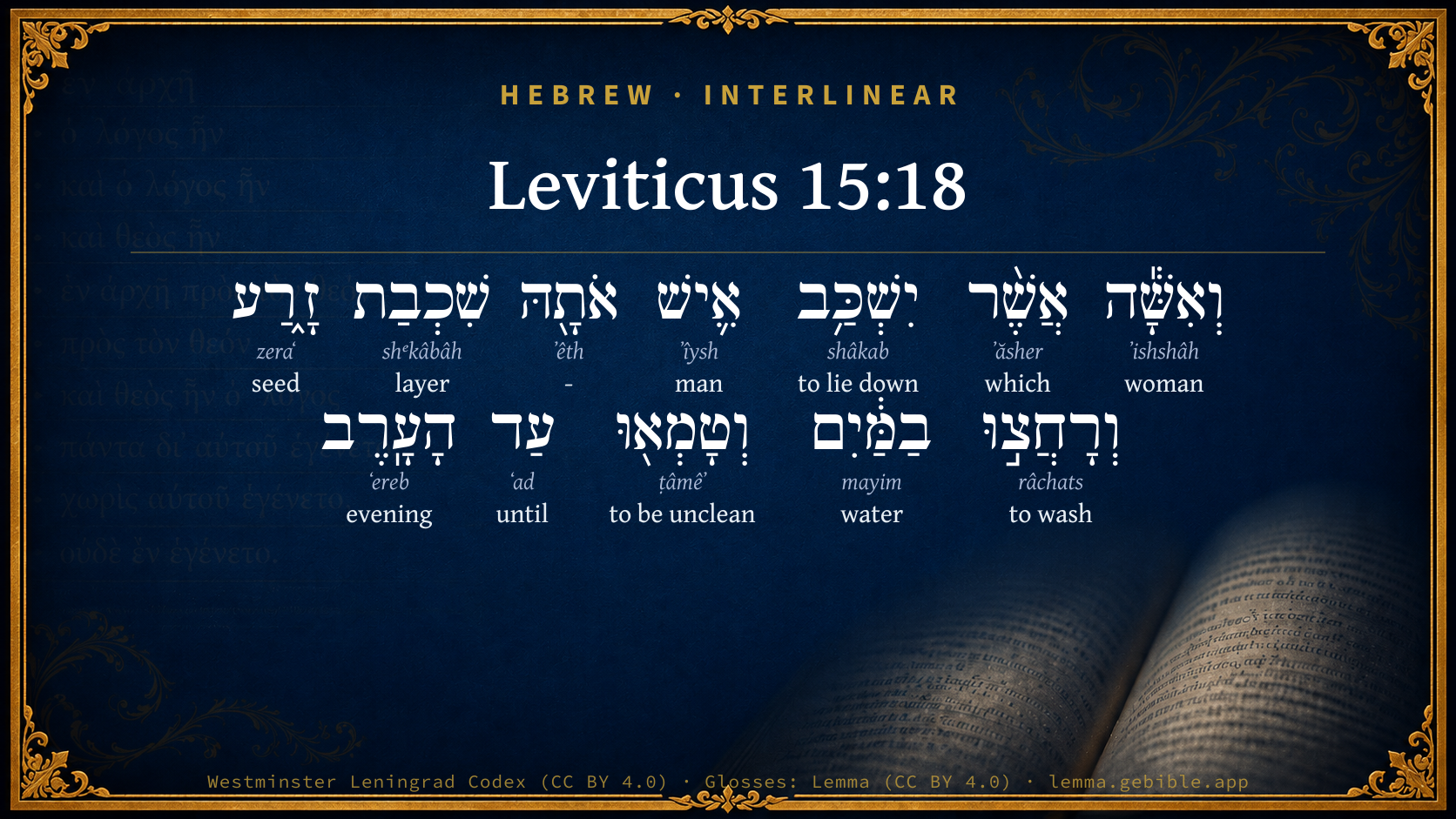
Hebrew (Westminster Leningrad Codex) Leviticus 15:18 appears in the Hebrew Old Testament. The text above is from the Westminster Leningrad Codex. Each word links to its Strong’s number, a concise gloss, and parsing drawn from the Open Scriptures Hebrew Bible morphology. Click any word for its full Brown-Driver-Briggs (BDB) entry.
Download image
Cite this verse

Leviticus 15:18 (World English Bible). Public Domain. Lemma interlinear Bible study tool, https://lemma.gebible.app/v/leviticus/15/18.

Show BibTeX & RIS
BibTeX
RIS
English Translation
If a man lies with a woman and there is an emission of semen, they shall both bathe themselves in water, and be unclean until the evening.
World English Bible · Public Domain
Download a study sheet

One document with this verse’s original text, its word-by-word gloss line, the meaning frame, cross-references with their text, attributed commentary, and full source and license credits — printable, and it pastes into notes with its structure intact.

This verse Autodidact and up

Study sheet (.html) Plain text (.txt)

A passage Seminary Student

Up to 50 verses in one chapter. A passage sheet keeps up to 6 commentary sources and 12 cross-references per verse, in the order this page ranks them, and says so on the sheet whenever that leaves anything out. Ask for a single verse and you get the Autodidact verse sheet above.

Everything on this page stays free to read, with no account — the sheet is a download of what is already on screen, not access to it.

Want to remove ads? Support Godless Engineer
Compare translations 3

The same verse in 3 English versions, stacked beneath the original-language interlinear above. Click any original word for its lexicon entry.

Each is an independent rendering of the whole verse — the interlinear is not word-aligned to these translations.

Highlighted words mark where these versions differ — a whole-verse word diff, not a word-by-word alignment.

  • World English Bible Public Domain
    If a man lies with a woman and there is an emission of semen, they shall both bathe themselves in water, and be unclean until the evening.
  • King James Version Public Domain
    The woman also with whom man shall lie with seed of copulation, they shall both bathe themselves in water, and be unclean until the even.
  • unfoldingWord Literal Text CC BY-SA 4.0
    And a woman, when a man lies with her, a lying down of seed, then they shall bathe with water, and they shall be unclean until the evening.

unfoldingWord Literal Text — © unfoldingWord, licensed CC BY-SA 4.0. Word-aligned USFM3 via Door43 (git.door43.org/unfoldingWord/en_ult).

Versions to compare (up to 4)

3 of 4 selected

Show all 18 translations

Every available English version of this verse, each an independent rendering of the whole verse.

  • World English Bible Public Domain
    If a man lies with a woman and there is an emission of semen, they shall both bathe themselves in water, and be unclean until the evening.
  • Berean Standard Bible Public Domain
    If a man lies with a woman and there is an emission of semen, both must bathe with water, and they will remain unclean until evening.
  • Majority Standard Bible Public Domain
    If a man lies with a woman and there is an emission of semen, both must bathe with water, and they will remain unclean until evening.
  • King James Version Public Domain
    The woman also with whom man shall lie with seed of copulation, they shall both bathe themselves in water, and be unclean until the even.
  • American Standard Version (1901) Public Domain
    The woman also with whom a man shall lie with seed of copulation, they shall both bathe themselves in water, and be unclean until the even.
  • Revised Version (1885) Public Domain
    The woman also with whom a man shall lie with seed of copulation, they shall both bathe themselves in water, and be unclean until the even.
  • Geneva Bible (1599) Public Domain
    If he that hath an issue of seede, do lie with a woman, they shall both wash themselues with water, and be vncleane vntill the euen.
  • Douay-Rheims (1899) Public Domain
    The woman, with whom he copulateth, shall be washed with water, and shall be unclean until the evening.
  • Young's Literal Translation Public Domain
    `And a woman with whom a man lieth with seed of copulation, they also have bathed with water, and been unclean till the evening.
  • Literal Standard Version CC BY-SA 4.0
    And a woman with whom a man lies with seed [from] intercourse, they also have bathed with water, and been unclean until the evening.
  • Unlocked Literal Bible CC BY-SA 4.0
    If a woman and a man sleep together and there is a transfer of semen to her, they must both bathe themselves in water; they will be unclean until evening.
  • unfoldingWord Literal Text CC BY-SA 4.0
    And a woman, when a man lies with her, a lying down of seed, then they shall bathe with water, and they shall be unclean until the evening.
  • Darby Bible Public Domain
    And a woman with whom a man lieth with seed of copulation -- they shall bathe in water, and be unclean until the even.
  • World Messianic Bible Public Domain
    If a man lies with a woman and there is an emission of semen, they shall both bathe themselves in water, and be unclean until the evening.
  • Webster's Bible Public Domain
    The woman also with whom man shall lie with seed of copulation, they shall both bathe themselves in water, and be unclean until the evening.
  • Free Bible Version CC BY-SA 4.0
    If a man sleeps with a woman and there is a release of semen, both of them must wash with water, and they will remain unclean until the evening.
  • Bible in Basic English Public Domain
    And if a man has sex relations with a woman and his seed goes out from him, the two of them will have to be bathed in water and will be unclean till evening.
  • JPS Tanakh (1917) Public Domain
    The woman also with whom a man shall lie carnally, they shall both bathe themselves in water, and be unclean until the even.

Literal Standard Version (2020), Covenant Press — licensed CC BY-SA 4.0. Text via the HelloAO Bible API (eBible.org). Unlocked Literal Bible (unfoldingWord) — licensed CC BY-SA 4.0. Text via the HelloAO Bible API (eBible.org). unfoldingWord Literal Text — © unfoldingWord, licensed CC BY-SA 4.0. Word-aligned USFM3 via Door43 (git.door43.org/unfoldingWord/en_ult). Free Bible Version, Dr. Jonathan Gallagher — licensed CC BY-SA 4.0. Text via the HelloAO Bible API (eBible.org).

Word by word

More ways to search: Search by grammar → Find every occurrence → Compare this word →

Practice this passage: Drill this verse → Learn its vocabulary →

שִׁכְבַת
shᵉkâbâh
H7902
“layer of”
Noun, Common, Feminine, Singular, Construct
Part of Speech
Noun
Type
Common
Gender
Feminine
Number
Singular
State
Construct
Full BDB Definition

Origin: from H7901

TWOT: 2381a

act of lying, layer, coating - act of lying (of sexual relations) - layer
  1. וְאִשָּׁ֕ה ʼishshâh H802 “and · woman” Conjunction + Noun, Common, Feminine, Singular, Absolute
  2. אֲשֶׁ֨ר ʼăsher H834 “which” Particle, Relative
  3. יִשְׁכַּ֥ב shâkab H7901 “to lie down” Verb, Qal, Imperfect, 3rd Person, Masculine, Singular
  4. אִ֛ישׁ ʼîysh H376 “man” Noun, Common, Masculine, Singular, Absolute
  5. אֹתָ֖הּ ʼêth H853 “- · her” Particle, Direct Object + Suffix, Personal, 3rd Person, Feminine, Singular
  6. זָ֑רַע zeraʻ H2233 “seed” Noun, Common, Masculine, Singular, Absolute
  7. וְרָחֲצ֣וּ râchats H7364 “and · to wash” Conjunction + Verb, Qal, Sequential Perfect, 3rd Person, Common, Plural
  8. בַמַּ֔יִם mayim H4325 “in/at the · water(s)” Preposition, Determined + Noun, Common, Masculine, Plural, Absolute
  9. וְטָמְא֖וּ ṭâmêʼ H2930 “and · to be unclean” Conjunction + Verb, Qal, Sequential Perfect, 3rd Person, Common, Plural
  10. עַד ʻad H5704 “until” Preposition
  11. הָעָֽרֶב ʻereb H6153 “the · evening” Particle, Definite Article + Noun, Common, Masculine, Singular, Absolute

About this verse

These counts appear in no published source. They are computed here, from the morphology-tagged text and Lemma’s own curated glosses. What Lemma adds →

12
words
12
distinct lemmas
Pentateuch
section

Notable vocabulary

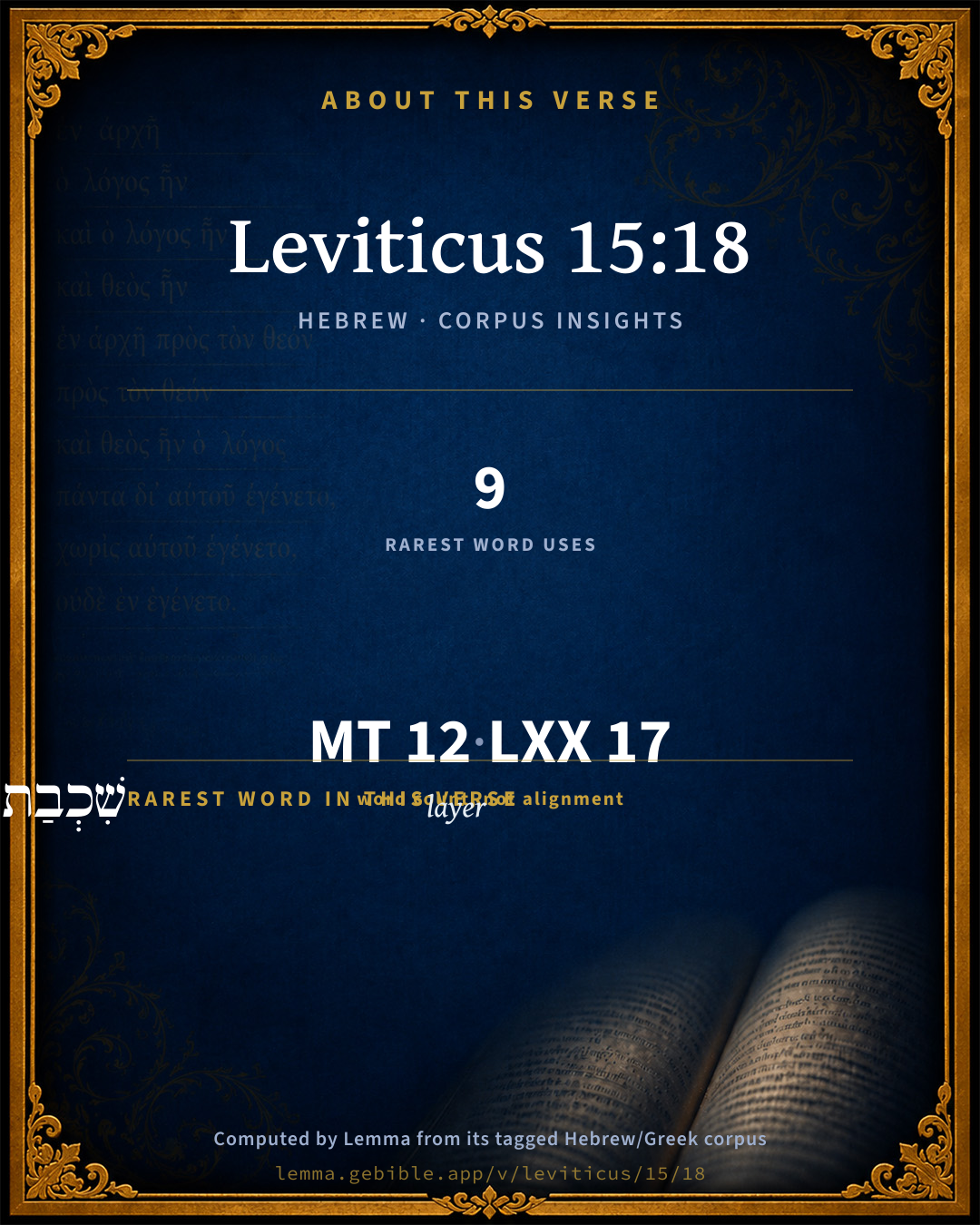
The rarest word here is שִׁכְבַת layer H7902 — appearing just 9 times in the whole Hebrew Bible.

Shared distinctive vocabulary

שִׁכְבַת layer H7902 occurs in 9 verses of the Hebrew Bible. Also found in:

Grammatical profile

  • 3 verbs
  • 6 nouns
  • 1 preposition
  • 2 particles

Verb forms

  • יִשְׁכַּ֥ב Qal · Imperfect
  • וְרָחֲצ֣וּ Qal · Sequential Perfect
  • וְטָמְא֖וּ Qal · Sequential Perfect

Hebrew & Septuagint length

In English translation the verse runs 27 words from the Hebrew and 26 from the Septuagint (LXX English) — closely comparable.

A rough comparison of the two English renderings, which tokenize alike — not a word-level alignment.

Word counts can differ between the Hebrew and the Greek without any difference in meaning — e.g. the Hebrew direct-object marker אֵת has no separate Greek word, and Greek often adds the article ὁ.

In the original languages it is 12 Hebrew tokens and 17 Greek tokens — but the two are counted differently (Hebrew bundles its prefixes and suffixes into one token; the Greek is in lemma form), so that isn’t a like-for-like length.

Cross-references

12

Topical passages linked to Leviticus 15:18 in the Treasury of Scripture Knowledge — connected by theme and wording, ordered by reader-vote popularity; previews shown in the World English Bible.

  • Exodus 19:15 He said to the people, "Be ready by the third day. Don't have sexual relations with a woman."
  • Leviticus 15:5 Whoever touches his bed shall wash his clothes, and bathe himself in water, and be unclean until the evening.
  • 1 Samuel 21:4–5 The priest answered David, and said, There is no common bread under my hand, but there is holy bread; if only the young men have kept themselves from women.
  • Psalms 51:5 Behold, I was brought forth in iniquity. In sin my mother conceived me.
  • 1 Corinthians 6:12 "All things are lawful for me," but not all things are expedient. "All things are lawful for me," but I will not be brought under the power of anything.
  • 1 Corinthians 6:18 Flee sexual immorality! "Every sin that a man does is outside the body," but he who commits sexual immorality sins against his own body.
  • Ephesians 4:17–19 This I say therefore, and testify in the Lord, that you no longer walk as the rest of the Gentiles also walk, in the futility of their mind,
  • Ephesians 5:3–11 But sexual immorality, and all uncleanness, or covetousness, let it not even be mentioned among you, as becomes saints;
  • 1 Thessalonians 4:3–5 For this is the will of God: your sanctification, that you abstain from sexual immorality,
  • 2 Timothy 2:22 Flee from youthful lusts; but pursue righteousness, faith, love, and peace with those who call on the Lord out of a pure heart.
  • Hebrews 13:4 Let marriage be held in honor among all, and let the bed be undefiled: but God will judge the sexually immoral and adulterers.
  • 1 Peter 2:11 Beloved, I beg you as foreigners and pilgrims, to abstain from fleshly lusts, which war against the soul;

Cross-references courtesy of OpenBible.info (CC BY 4.0).

Hebrew and Greek witnesses Masoretic Hebrew ↔ Greek Septuagint

The same verse in the two great witnesses to the Old Testament, shown verse-for-verse.

These are two independent witnesses, not word-aligned to each other, and the Septuagint is shown in lemma (dictionary) form.

Hebrew Leviticus 15:18 Masoretic · Westminster Leningrad Codex

וְאִשָּׁ֕ה אֲשֶׁ֨ר יִשְׁכַּ֥ב אִ֛ישׁ אֹתָ֖הּ שִׁכְבַת זָ֑רַע וְרָחֲצ֣וּ בַמַּ֔יִם וְטָמְא֖וּ עַד הָעָֽרֶב

If a man lies with a woman and there is an emission of semen, they shall both bathe themselves in water, and be unclean until the evening.

World English Bible · Public Domain

Greek LXX Leviticus 15:18 Septuagint · lemma form

καί γυνή ἐάν κοιμάω ἀνήρ μετά αὐτός κοίτη σπέρμα καί λούω ὕδωρ καί ἀκάθαρτος εἰμί ἕως ἑσπέρα

And a woman, if a man shall lie with her with seed of copulation—they shall both bathe themselves in water and shall be unclean until evening.

LXX2012 (modern English Septuagint) · Public Domain

Hebrew: Westminster Leningrad Codex (CC BY 4.0). Greek: Septuagint (public domain); English from LXX2012 (modern English Septuagint) (Public Domain). How the Septuagint differs from the Hebrew →

Targum (Aramaic paraphrase)

2

The Targum is the ancient Jewish Aramaic paraphrase of the Hebrew Scriptures — an interpretive translation, not the Hebrew text itself. Onkelos (literal) and Pseudo-Jonathan (expansive) render the Torah, and Jonathan the Prophets. Coverage is partial: where no permissively-licensed English translation exists for a verse, only the Aramaic is shown. This is verse-level text, not a word-by-word alignment to the Hebrew.

  1. Targum Onkelos Torah (Genesis–Deuteronomy)
    וְאִתְּתָא דִי יִשְׁכּוּב גְבַר יָתָהּ שִׁכְבַת זַרְעָא וְיַסְחוּן בְּמַיָא וְיִסְאֲבוּן עַד רַמְשָׁא

    (no public-domain English translation for this verse)

    Targum Onkelos — Aramaic: “Onkelos Genesis” (public domain); “Onkelos Exodus” (public domain); “Onkelos Leviticus” (public domain); “Onkelos Numbers” (public domain); “Onkelos Deuteronomy” (public domain). English: “Sefaria Community Translation” (CC0 1.0 (public-domain dedication)); “J.W. Etheridge. The Targums of Onkelos and Jonathan Ben Uzziel on the Pentateuch. London: Longmans, Green, 1862” (public domain). Text via Sefaria.

  2. Targum Pseudo-Jonathan Torah (Genesis–Deuteronomy)
    וְאִתְּתָא תִּנְיָיתָא דִי יְשַׁמֵשׁ גְבַר עִמָהּ שִׁכְבַת זַרְעָא וְיִסְחוֹן בְּאַרְבְּעִין סָאוִוין דְמוֹי וִיהוֹן מְסָאֲבִין עַד רַמְשָׁא

    and secondly, a woman with whom a man lieth shall wash in forty seahs of water, and be unclean until evening.

    Targum Pseudo-Jonathan — Aramaic: “Targum Jonathan on Genesis” (public domain); “Targum Jonathan on Exodus” (public domain); “Targum Jonathan on Leviticus” (public domain); “Targum Jonathan on Numbers” (public domain); “Targum Jonathan on Deuteronomy” (public domain). English: “The Targum of Jonathan ben Uzziel, trans. J. W. Etheridge, London, 1862” (public domain). Text via Sefaria.

Commentary

Notes on Leviticus 15:18 from classic Christian and Jewish commentators (each source and its license shown beneath its notes). The classic Christian expositions comment on the surrounding passage and are grouped to its opening verse, so a note may address several verses; the Jewish commentaries on the Tanakh (Rashi and others) are per-verse, so they appear only where the commentator wrote on this verse.

Lemma curates 59 commentaries, every one of them public domain or Creative Commons licensed, each selected and text-cleaned for this edition rather than reprinted as found. About our sources →

Trapp's Complete Commentary

John Trapp

Lev 15:18 The woman also with whom man shall lie [with] seed of copulation, they shall [both] bathe [themselves] in water, and be unclean until the even.

Ver. 18. With seed of copulation.] Though lawful in itself, as being the ordinance of God. {Gen 2:24} Sin is like copperas, {a} which will turn wine or milk into ink; or leaven, which turns a very passover into pollution.

{a} A name given from early times to the protosulphates of copper, iron, and zinc (distinguished as blue, green, and white copperas respectively); etymologically it belonged properly to the copper salt; but in English use, when undistinguished by attribute or context, it has always been most commonly, and is now exclusively, applied to green copperas, the proto-sulphate of iron or ferrous sulphate (Fe Son 4:1-16), also called green vitriol, used in dyeing, tanning, and making ink.

John Trapp, A Commentary or Exposition upon All the Books of the Old and New Testament (1647–1656) — public domain. Text from a community e-Sword module.

Tyndale Open Study Notes

Tyndale Open Resources

15:18 If the seminal emission involved sexual intercourse, both the man and the woman became unclean and had to wash and remain unclean until the next evening. Although it involved a bodily emission, sexual intercourse was not an infection or abnormality, and it required no sacrifices.

Tyndale Open Study Notes — © Tyndale Open Resources, licensed CC BY-SA 4.0. Text via the HelloAO Bible API.

Adam Clarke's Commentary

Verse 18. They shall both bathe themselves] What a wonderful tendency had these ordinances to prevent all excesses! The pains which such persons must take, the separations which they must observe, and the privations which, in consequence, they must be exposed to in the way of commerce, traffic, &c., would prevent them from making an unlawful use of lawful things.

Adam Clarke's Commentary on the Bible (1810–1826) — public domain. Text from a community e-Sword/MySword module.

Ellicott's Commentary for English Readers

(18) The woman also with whom man shall lie.—Better, And if a man lie with a woman, that is, even when what is specified in Lev_15:16 takes place in intercourse between man and woman lawfully married, it pollutes both the husband and the wife. They have accordingly both to immerse their whole bodies, and remain unclean till sundown, and were debarred from the privileges of the sanctuary during that day. Hence abstinence from conjugal intercourse was regarded as a necessary preparation for the performance of sacred duties. He who had approached his wife could not draw nigh to God (Exo_19:15), and was not allowed to partake of sacred meals. (Comp. 1Sa_21:5-6.) The law of pollution was not designed to put a check upon marriage, since matrimony is a Divine institution (Gen_1:27-28; Gen_2:21-25), but it is intended to prevent husband and wife from making an immoderate use of their conjugal life, and thus to preserve them in health and vigour by prescribing such constant purifications after it. This is probably the reason why other nations of antiquity enacted similar laws. Thus the Hindoos and the Babylonians bathed after conjugal intercourse. The Egyptian priests abstained from it when they had to perform sacred duties, and the laity were not allowed to enter the precincts of the Temple unless they submitted to ablutions. Mahommed, for the same reason, enjoins lustrations upon all the faithful before reciting their prayers.

A Bible Commentary for English Readers, edited by Charles John Ellicott (1878–1897) — public domain. Text from a community e-Sword module.

The Cambridge Bible for Schools and Colleges

gen. ed. J. J. S. Perowne

18. As unclean they could not take part in the service of the sanctuary. Similar limitations are found Exo_19:15; 1Sa_21:5 f.

The Cambridge Bible for Schools and Colleges (gen. ed. J. J. S. Perowne; Cambridge University Press, 1878–1918) — public domain. Text from a community e-Sword module.

John Gill's Exposition

The woman also with whom man shall lie with seed of copulation,.... It seems to respect any congress of a man and woman, whether in fornication or adultery, or lawful marriage, and particularly the latter; for though marriage is honourable and holy, and carnal copulation in itself lawful, yet such is the sinfulness of nature, that as no act is performed without pollution, so neither that of generation, and by which the corruption of nature is propagated, and therefore required a ceremonial cleansing:

they shall both bathe themselves in water, and be unclean until the even; so Herodotus (f) reports, that as often as a Babylonian man lay with his wife, he had used to sit by consecrated incense, and the woman did the same: and in the morning they were both washed, and did not touch any vessel before they had washed themselves; and he says the Arabians did the like: and the same historian relates (g) of the Egyptians, that they never go into their temples from their wives unwashed; see Exo 19:15.

(f) Clio, sive, l. 1. c. 198. (g) Euterpe, sive, l. 2. c. 64.

John Gill's Exposition of the Whole Bible (1746–1763) — public domain (CC PDM 1.0). Text via the HelloAO Bible API.

Matthew Poole's English Annotations

Man, or, the man, to wit, that had such an issue, which is plainly to be understood out, of the whole context. For though in some special cases, relating to the worship of God, men were to forbear the use of the marriage-bed, as Exo 19:15; 1Sa 21:4; yet to affirm that the use of it in other cases did generally defile the persons, and make them unclean till even, is contrary to the whole current of Scripture, which affirms the marriage-bed to be undefiled, Heb 13:4, to the practice of the Jews, which is a good comment upon their own laws, and to the light of nature and reason.

Matthew Poole's English Annotations on the Holy Bible (1683–1685) — public domain. Text from a community e-Sword/MySword module.

Whedon's Commentary on the Bible

Daniel D. Whedon

18. They shall both bathe — There are two opinions respecting this verse. The first is, that it relates to the same pollution as Lev_15:16; the second, that it ascribes ceremonial impurity to the most intimate association of matrimony. Keil dissents from the latter opinion on grounds which seem to us insufficient. The design of this statute is doubtless not only to deter from polygamy and unlawful sexual intercourse, but also to set up a safeguard against conjugal excess, which is a sin against the law of the Creator written on the human body and mind. This verse intimates that David, in Psa_51:5, did not use an Oriental exaggeration. Pravity attaches to man from his conception to his death, unless he be sanctified throughout his “whole spirit and soul and body,” (1Th_5:23,) through faith in Christ. Every outflow of nature, even under the holiest sanctions, is not only defiled but defiling. From an impure fountain all the streams are polluting. Circumcision seems to imply that the moral impurity with which the fall of Adam had stained humanity, had concentrated itself in the sexual organs.

Daniel D. Whedon (gen. ed.), Commentary on the Old and New Testaments (1874–1909) — public domain. Text from a community e-Sword module.

The Pulpit Commentary

The third case of an issue. (cf. Exo_19:15 1Sa_21:5 1Co_7:5)

The Pulpit Commentary (1880–1919), ed. H.D.M. Spence-Jones & Joseph S. Exell — public domain. Text from a community e-Sword module.

John Wesley's Explanatory Notes

A man - Or, The man, that had such an issue, which is plainly to be understood out of the whole context. For though in some special cases relating to the worship of God, men were to forbear the use of the marriage-bed, yet to affirm that the use of it in other cases did generally defile the persons, and make them unclean till even, is contrary to the whole current of scripture, which affirms the marriage-bed to be undefiled, Heb. xiii, 4, to the practice of the Jews, which is a good comment upon their own laws, and to the light of nature and reason.

John Wesley, Explanatory Notes Upon the Whole Bible (1754–1765) — public domain. Text via the GEBible commentary corpus.

Keil & Delitzsch

C. F. Keil & F. Delitzsch

Sexual connection. "If a man lie with a woman with the emission of seed, both shall be unclean till the evening, and bathe themselves in water." Consequently it was not the concubitus as such which defiled, as many erroneously suppose, but the emission of seed in the coitus. This explains the law and custom, of abstaining from conjugal intercourse during the preparation for acts of divine worship, or the performance of the same (Exo 19:5; Sa1 21:5-6; Sa2 11:4), in which many other nations resembled the Israelites. (For proofs see Leyrer's article in Herzog's Cyclopaedia, and Knobel in loco, though the latter is wrong in supposing that conjugal intercourse itself defiled.)

Keil & Delitzsch — Biblical Commentary on the Old Testament (1861–1891) — public domain (CC PDM 1.0). Text via the HelloAO Bible API. (Old Testament only.)

Rashi

Rabbi Shlomo Yitzchaki (Rashi)

ורחצו במים THEY SHALL BOTH LAVE THEMSELVES IN WATER — It is a decree of the King that a woman should become unclean through sexual intercourse. The reason is not because of the law of “one who touches שכבת זרע” (who, according to Leviticus 22:7 is unclean; cf. Sifra on that verse) for in her case it is מגע בית הסתרים and this does not render her unclean (Niddah 41b).

Rashi on the Tanakh — English translations: “The Judaica Press complete Tanach with Rashi, translated by A. J. Rosenberg” (CC BY 4.0); “Pentateuch with Rashi's commentary by M. Rosenbaum and A.M. Silbermann, 1929-1934” (public domain); “The Metsudah Tanach series, Lakewood, N.J” (CC BY 4.0); and “The Book of Joshua, Metsudah Publications, 1997” (CC BY 4.0). Text via Sefaria.

Lesson kit

Teaching starters — assembled from the data on this page, not authored interpretation. Every prompt links to the verse data it draws on. Edit before teaching.

Leviticus, in the Pentateuch, opens this verse with 12 words (12 distinct Hebrew lemmas). Its most distinctive word is shᵉkâbâh (“layer”). A historical commentator’s framing appears above. Read the whole chapter for the surrounding context.

Discussion questions

  1. What does “layer” (shᵉkâbâh) contribute to the verse as a whole?
  2. How does Exodus 16:13, which shares the word «layer», read alongside this verse?
  3. These translations render this verse differently. What is at stake in choosing one wording over another?
  4. «יִשְׁכַּ֥ב» is a Qal Imperfect verb. How does that grammatical form shape the action described?
  5. Compare how Trapp's Complete Commentary and Tyndale Open Study Notes read this verse. Where do they agree or differ?

Things to notice

Reading settings

Reading text

Shown beneath each verse's original-language words.

Old Testament
Old Testament edition

Read the OT as the Masoretic Hebrew (MT) or the Greek Septuagint (LXX).

English shown for the Greek Septuagint (in the Hebrew ↔ Greek comparison).

Comparing translations? Open the Compare panel on any verse page to stack up to four side by side.