
Proverbs 6:9

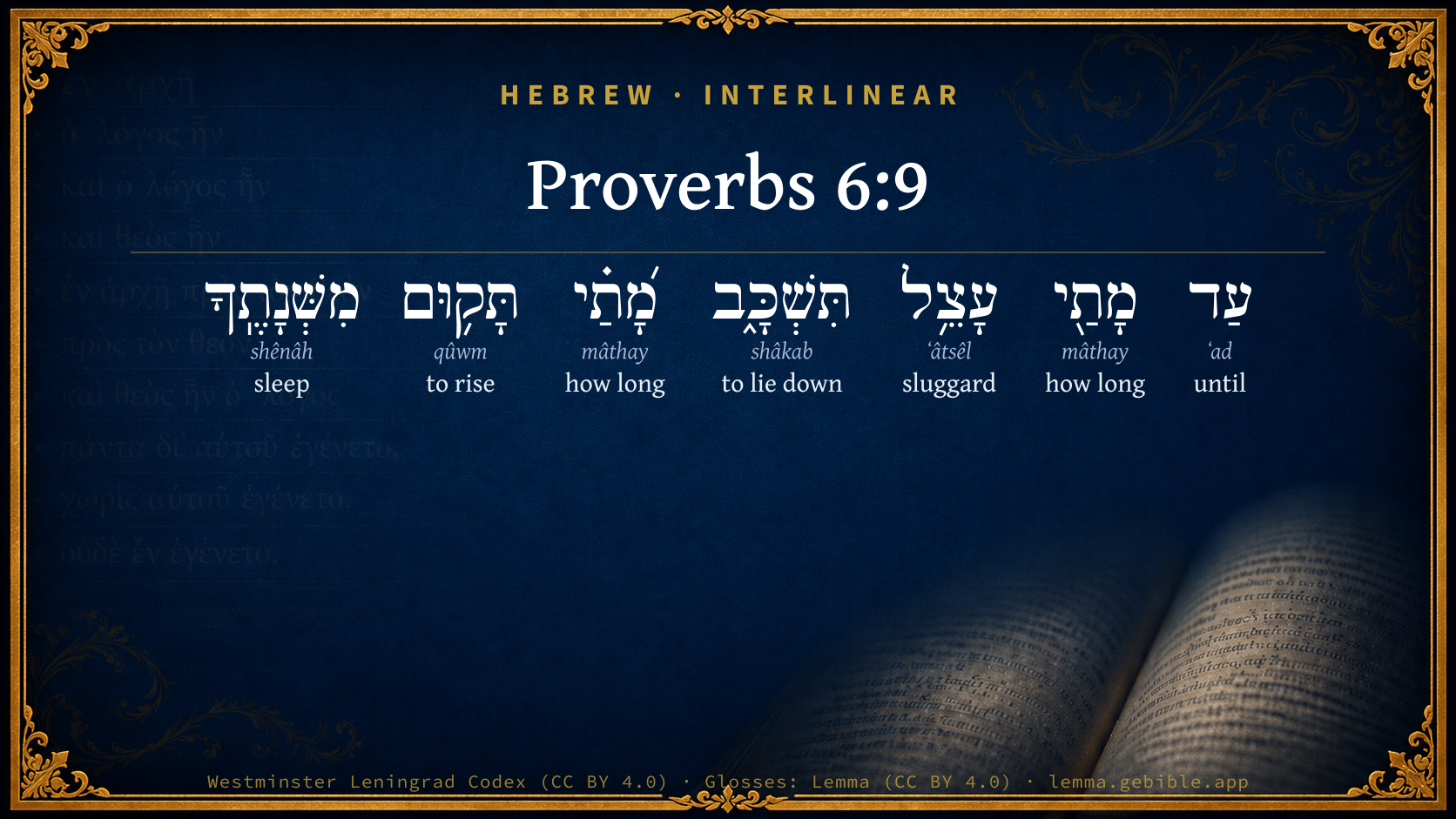
Hebrew (Westminster Leningrad Codex) Proverbs 6:9 appears in the Hebrew Old Testament. The text above is from the Westminster Leningrad Codex. Each word links to its Strong’s number, a concise gloss, and parsing drawn from the Open Scriptures Hebrew Bible morphology. Click any word for its full Brown-Driver-Briggs (BDB) entry.
Download image
Cite this verse

Proverbs 6:9 (World English Bible). Public Domain. Lemma interlinear Bible study tool, https://lemma.gebible.app/v/proverbs/6/9.

Show BibTeX & RIS
BibTeX
RIS
English Translation
How long will you sleep, sluggard? When will you arise out of your sleep?
World English Bible · Public Domain
Download a study sheet

One document with this verse’s original text, its word-by-word gloss line, the meaning frame, cross-references with their text, attributed commentary, and full source and license credits — printable, and it pastes into notes with its structure intact.

This verse Autodidact and up

Study sheet (.html) Plain text (.txt)

A passage Seminary Student

Up to 50 verses in one chapter. A passage sheet keeps up to 6 commentary sources and 12 cross-references per verse, in the order this page ranks them, and says so on the sheet whenever that leaves anything out. Ask for a single verse and you get the Autodidact verse sheet above.

Everything on this page stays free to read, with no account — the sheet is a download of what is already on screen, not access to it.

Want to remove ads? Support Godless Engineer
Compare translations 3

The same verse in 3 English versions, stacked beneath the original-language interlinear above. Click any original word for its lexicon entry.

Each is an independent rendering of the whole verse — the interlinear is not word-aligned to these translations.

Highlighted words mark where these versions differ — a whole-verse word diff, not a word-by-word alignment.

  • World English Bible Public Domain
    How long will you sleep, sluggard? When will you arise out of your sleep?
  • King James Version Public Domain
    How long wilt thou sleep, O sluggard? when wilt thou arise out of thy sleep?
  • unfoldingWord Literal Text CC BY-SA 4.0
    Until when, lazy one, will you lie down? When will you rise from your sleep?

unfoldingWord Literal Text — © unfoldingWord, licensed CC BY-SA 4.0. Word-aligned USFM3 via Door43 (git.door43.org/unfoldingWord/en_ult).

Versions to compare (up to 4)

3 of 4 selected

Show all 18 translations

Every available English version of this verse, each an independent rendering of the whole verse.

  • World English Bible Public Domain
    How long will you sleep, sluggard? When will you arise out of your sleep?
  • Berean Standard Bible Public Domain
    How long will you lie there, O slacker? When will you get up from your sleep?
  • Majority Standard Bible Public Domain
    How long will you lie there, O slacker? When will you get up from your sleep?
  • King James Version Public Domain
    How long wilt thou sleep, O sluggard? when wilt thou arise out of thy sleep?
  • American Standard Version (1901) Public Domain
    How long wilt thou sleep, O sluggard? When wilt thou arise out of thy sleep?
  • Revised Version (1885) Public Domain
    How long wilt thou sleep, O sluggard? when wilt thou arise out of thy sleep?
  • Geneva Bible (1599) Public Domain
    Howe long wilt thou sleepe, O sluggarde? when wilt thou arise out of thy sleepe?
  • Douay-Rheims (1899) Public Domain
    How long wilt thou sleep, O sluggard? when wilt thou rise out of thy sleep?
  • Young's Literal Translation Public Domain
    Till when, O slothful one, dost thou lie? When dost thou arise from thy sleep?
  • Literal Standard Version CC BY-SA 4.0
    Until when, O slothful one, do you lie? When do you arise from your sleep?
  • Unlocked Literal Bible CC BY-SA 4.0
    How long will you sleep, you lazy person? When will you rise from your sleep?
  • unfoldingWord Literal Text CC BY-SA 4.0
    Until when, lazy one, will you lie down? When will you rise from your sleep?
  • Darby Bible Public Domain
    How long, sluggard, wilt thou lie down? When wilt thou arise out of thy sleep?
  • World Messianic Bible Public Domain
    How long will you sleep, sluggard? When will you arise out of your sleep?
  • Webster's Bible Public Domain
    How long wilt thou sleep, O sluggard? when wilt thou arise out of thy sleep?
  • Free Bible Version CC BY-SA 4.0
    So how long are you going to lie there, you slacker? When are you going to get up from your sleep?
  • Bible in Basic English Public Domain
    How long will you be sleeping, O hater of work? when will you get up from your sleep?
  • JPS Tanakh (1917) Public Domain
    How long wilt thou sleep, O sluggard? When wilt thou arise out of thy sleep?

Literal Standard Version (2020), Covenant Press — licensed CC BY-SA 4.0. Text via the HelloAO Bible API (eBible.org). Unlocked Literal Bible (unfoldingWord) — licensed CC BY-SA 4.0. Text via the HelloAO Bible API (eBible.org). unfoldingWord Literal Text — © unfoldingWord, licensed CC BY-SA 4.0. Word-aligned USFM3 via Door43 (git.door43.org/unfoldingWord/en_ult). Free Bible Version, Dr. Jonathan Gallagher — licensed CC BY-SA 4.0. Text via the HelloAO Bible API (eBible.org).

Word by word

More ways to search: Search by grammar → Find every occurrence → Compare this word →

Practice this passage: Drill this verse → Learn its vocabulary →

About this verse

These counts appear in no published source. They are computed here, from the morphology-tagged text and Lemma’s own curated glosses. What Lemma adds →

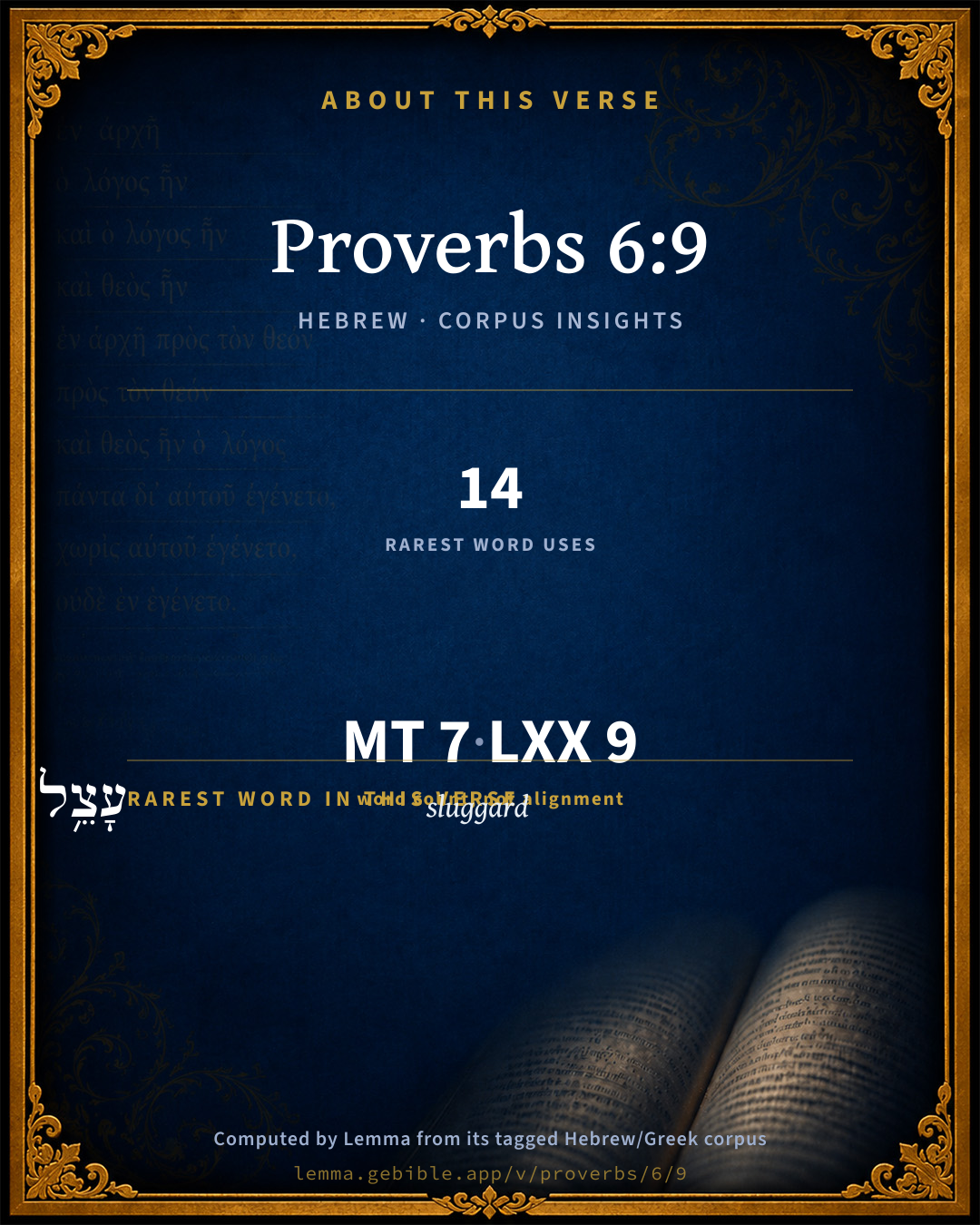
7
words
6
distinct lemmas
Wisdom
section

Notable vocabulary

The rarest word here is עָצֵ֥ל sluggard H6102 — appearing just 14 times in the whole Hebrew Bible.

Shared distinctive vocabulary

עָצֵ֥ל sluggard H6102 occurs in 14 verses of the Hebrew Bible. Also found in:

Grammatical profile

  • 2 verbs
  • 1 noun
  • 1 adjective
  • 1 preposition
  • 2 particles

Verb forms

  • תִּשְׁכָּ֑ב Qal · Imperfect
  • תָּק֥וּם Qal · Imperfect

Repetition

A word recurs within this verse — often emphatic in Hebrew:

  • מָתַ֖י how long H4970 ×2

Hebrew & Septuagint length

In English translation the verse runs 14 words from the Hebrew and 15 from the Septuagint (LXX English) — closely comparable.

A rough comparison of the two English renderings, which tokenize alike — not a word-level alignment.

Word counts can differ between the Hebrew and the Greek without any difference in meaning — e.g. the Hebrew direct-object marker אֵת has no separate Greek word, and Greek often adds the article ὁ.

In the original languages it is 7 Hebrew tokens and 9 Greek tokens — but the two are counted differently (Hebrew bundles its prefixes and suffixes into one token; the Greek is in lemma form), so that isn’t a like-for-like length.

Cross-references

7

Topical passages linked to Proverbs 6:9 in the Treasury of Scripture Knowledge — connected by theme and wording, ordered by reader-vote popularity; previews shown in the World English Bible.

  • Proverbs 24:33–34 A little sleep, a little slumber, A little folding of the hands to sleep;
  • Psalms 94:8 Consider, you senseless among the people; You fools, when will you be wise?
  • Jeremiah 4:14 Jerusalem, wash your heart from wickedness, that you may be saved. How long shall your evil thoughts lodge within you?
  • Ephesians 5:14 Therefore he says, "Awake, you who sleep, and arise from the dead, and Christ will shine on you."
  • Proverbs 1:22 "How long, you simple ones, will you love simplicity? How long will mockers delight themselves in mockery, And fools hate knowledge?
  • Romans 13:11 Do this, knowing the time, that it is already time for you to awaken out of sleep, for salvation is now nearer to us than when we first believed.
  • 1 Thessalonians 5:2–7 For you yourselves know well that the day of the Lord comes like a thief in the night.

Cross-references courtesy of OpenBible.info (CC BY 4.0).

Hebrew and Greek witnesses Masoretic Hebrew ↔ Greek Septuagint

The same verse in the two great witnesses to the Old Testament, shown verse-for-verse.

These are two independent witnesses, not word-aligned to each other, and the Septuagint is shown in lemma (dictionary) form.

Hebrew Proverbs 6:9 Masoretic · Westminster Leningrad Codex

עַד מָתַ֖י עָצֵ֥ל תִּשְׁכָּ֑ב מָ֝תַ֗י תָּק֥וּם מִשְּׁנָתֶֽךָ

How long will you sleep, sluggard? When will you arise out of your sleep?

World English Bible · Public Domain

Greek LXX Proverbs 6:9 Septuagint · lemma form

ἕως τίς ὀκνηρός κατακεῖμαι πότε δέ ἐκ ὕπνος ἐγείρω

How long will you lie, O sluggard? and when will you awake out of sleep?

LXX2012 (modern English Septuagint) · Public Domain

On this verse, Keil & Delitzsch discusses the Septuagint’s reading. Read the note in Commentary ↓

Hebrew: Westminster Leningrad Codex (CC BY 4.0). Greek: Septuagint (public domain); English from LXX2012 (modern English Septuagint) (Public Domain). How the Septuagint differs from the Hebrew →

Commentary

Notes on Proverbs 6:9 from classic Christian and Jewish commentators (each source and its license shown beneath its notes). The classic Christian expositions comment on the surrounding passage and are grouped to its opening verse, so a note may address several verses; the Jewish commentaries on the Tanakh (Rashi and others) are per-verse, so they appear only where the commentator wrote on this verse.

Lemma curates 59 commentaries, every one of them public domain or Creative Commons licensed, each selected and text-cleaned for this edition rather than reprinted as found. About our sources →

Trapp's Complete Commentary

John Trapp

Pro 6:9 How long wilt thou sleep, O sluggard? when wilt thou arise out of thy sleep?

Ver. 9. How long wilt thou sleep, O sluggard?] The ear, we say, is first up in a morning: call a sleeping man by his name, and he will sooner awake and answer to it than to anything else. The wise man therefore thus deals with the sluggard, that he may go forth and shake him, as Samson, not giving way to excessive sleep, which comes as a publican, saith Plutarch, and takes away a third part of our lives at least. Pliny {a} said to his nephew, when he saw him walk out some hours without studying, Poteras has horas non perdere, you might have put these hours to better uses. May not the same be said to the sleepy sluggard? While the crocodile sleeps with open mouth, the Indian rat shoots himself into his body, and eats up his entrails. While Ishbosheth slept upon his bed at noon, Baanah and Rechab took away his head. Epaminondas, a renowned captain, finding one of his sentinels asleep, thrust him through with his sword: and being chided for so great severity, replied, Talem eum reliqui qualem inveni, I left him but as I found him. It must be our care that death serve us not in like sort, that we be not taken napping, and so "killed with death." {Rev 2:23} The bird Onocrotalus is so well practised to expect the hawk to grapple with her, that even when she shutteth her eyes she sleepeth with her beak exalted, as if she would contend with her adversary, to teach us continual vigilance, resembling those who were wont to sleep with brazen balls in their hands, which falling on vessels purposely set on their bedsides, the noise did dissuade immoderate sleep, Nullus mihi per otium exit dies, partem etiam noctium studiis vindico, saith Seneca, {b} I let no day pass me idly, some part of the night also I spend in study. Our King Alfred, 872 AD, cast the natural day into three parts: eight hours he spent in prayer, study, and writing, eight in the service of his body, and eight in the affairs of his state; which space, having then no other divice for it, he measured by a great wax light divided into so many parts, receiving notice by the keeper thereof, as the several hours passed in the burning. {c} The Jews divided likewise the day into three parts, the first, ad Tephilla, for prayer; the second, ad Torah, for reading the law; the third, ad Malachah, for work; no talk of sleep. Their work would, likely, keep them waking. As for the law, what Servilius Scevola said of the civil law, holds more true of the divine, Ius civile scriptum est vigilantibus non dormitantibus, the law was not written for sleepers, but wakers. Jerome exhorted some godly women to whom he wrote, not to lay the Bible out of their hands, until being overcome with sleep, and not able any longer to hold up their heads, they bowed them down, as it were, to greet the leaves below them, with a kiss. {d} And for prayer, David would not fall asleep at it, but break his sleep for it. {Psa 119:62; Psa 119:147} He was at it at midnight, at day dawn, and "In the morning will I direct my prayer unto thee, and will look up." {Psa 5:3} Two military words {e} he there makes use of, to shew his wakefulness at his work soldiers are not the greatest sleepers: Caesar was no less vigilant, than valiant: Scanderbeg from his first coming to Epirus never slept more than two hours in a night; - he would not only pray, but marshal up his prayers, put them in good array; and when he had so done, he would be as a spy upon a tower, to see whether he prevailed, whether he got the day. {f} The spouse slept, but her heart waked; and, as repenting of that half-sleep also, which yet the night and foul weather persuaded, she promiseth to get up early. {Son 5:2; Son 7:12} Our Saviour was up and at prayer "a great while before day." {Mar 1:35} The holy angels are styled "Watchers," Eγρηγοροι. {Dan 4:10} And they are three times pronounced happy that watch. {Luk 12:37-38; Luk 12:43} "Watch therefore."

{a} Lib. iii. cap. 5.

{b} Sen., Epist.

{c} Daniel’s Chro. 13.

{d} Tenenti codicem somnus obrepat, et cadentem faciem pagina sacra suscipiat. - Hier, ad Eust.

{e} Egneroch, ex radice gnarach, ordinavit, aciem disposuit: sappel, ex radice tsaphah, speculando expectavit. Hinc tsopheh, speculator.

{f} Turk. Hist., fol. 297.

John Trapp, A Commentary or Exposition upon All the Books of the Old and New Testament (1647–1656) — public domain. Text from a community e-Sword module.

The Biblical Illustrator

Joseph S. Exell

Pro_6:9

How long wilt thou sleep, O sluggard?

when wilt thou arise out of thy sleep?

The sleeper aroused

The various authors of Scripture are accurately acquainted with the human character. Among numerous defective habits and characteristics of our nature, which Solomon points out and condemns, is that of indolence; excessive fondness for ease and personal indulgence. The language of the text may be used in connection with the affairs of religion and of the soul.

I. The state which is deprecated. It is a state of sleep--a moral condition of which corporeal sleep furnishes the most apt representation.

1. Notice its moral characteristics. The state of sleep is a state of forgetfulness, a state of ignorance, and a state of insensibility. What man is to the material world in a state of corporeal sleep, that he is to the spiritual world when he is influenced by his original and his natural passions. The spiritual characteristics of mans condition, illustrated by the metaphor of the text, will be found to be borne out by the entire and uniform testimony of the Word of God. That testimony is, from the commencement to the close, a record of human depravity, operating in connection with forgetfulness, with ignorance, and with insensibility, and hence deriving, and hence preserving over the species its empire of corruption and of abominable foulness.

2. Notice its penal evils. Sleep is a state of privation and insecurity. The characteristics we have noticed are not involuntary, they are wilful. They are not unfortunate, they are guilty. They are heinous and flagrant transgressions against the law, and against the authority, of God. And hence it is, they expose the persons indulging them to a dispensation of displeasure and of wrath.

II. The change which is desired. There should be an awaking and arising out of sleep.

1. In what does this change consist? The spiritual awakening which is desired constitutes a condition precisely the reverse of that which already has been defined. It consists in s state in which man exchanges forgetfulness for remembrances, ignorance for illumination, and insensibility for sensitiveness and tenderness. Spiritual truth is now discerned, contemplated, believed, and felt; and it produces in the mind all the affections, and in the life all the habits, for which it was designed: repentance, prayerfulness, love to God, zeal for God, obedience to God, diligence in working out the salvation of the soul, and intense and constant aspirings after a state of salvation in the glory of another world. The penal evils, which formerly dwelt over the horizon of the spirit as with the darkness of midnight, are dispelled, and are made to disappear.

2. How is this change produced? There is one Agent, by whose power it must exclusively and efficaciously be performed--the agency of the Holy Spirit of God. The Divine Spirit is the one efficacious source of all that is holy and redeeming in the character and circumstances of man. But there are certain means, appointed by the authority of God, to be addressed by those who have been changed to those who have not, and in connection with them it is that the Spirit produces the desired and happy result. Illustration of the use of means is found in the parable of the valley of dry bones. The system of means exists with remarkable plenitude and sufficiency in the dispensation of the gospel.

III. The appeal which is enforced. The challenge implies that there ought to be no procrastination or delay in the change which is desired and pleaded for. Pleading with sinners, I would say--

1. Consider the protracted period of time during which you have indulged in slumber already.

2. Consider the increased difficulty of awakening the longer the slumber is indulged.

3. Consider the rapidly approaching termination of life, and arrival of judgment and eternity. (James Parson.)

Too much sleep

As waking idleness was condemned before, so sleepy idleness is condemned here. Sloth begets sleep.

I. God will call men to a reckoning for their time.

1. God gives us time as a talent in trust.

2. God looks for some good from men in their time.

II. Too much sleep is as bad as waking idleness.

1. Overmuch sleep is the fruit of idleness. Men that have much to do have little mind or time for sleep.

2. As little good is done in sleep as in waking idleness. Moderate your sleep. Too much sleep makes a man heavy and dull-witted. (Francis Taylor, B. D.)

The danger of delaying repentance

We have the sluggards picture drawn in reference to his eternal concerns. He is one that puts off his great work from time to time. Here is something supposed. The sleeper convinced that he has slept and neglected his work. The sleeper convinced that he must awake and set to his work. The sleeper resolved to awake and mind his business. Something expressed. A delay craved. The quantity of this delay: it is but a little in the sluggards conceit. The mighty concern he is in for this delay. We have the fatal issue of the course. Delays are dangerous. Consider what ruin comes upon him; how this ruin comes upon him--swiftly, silently and surprisingly, irresistibly. This is all owing to the cursed love of ease. The delay and putting off repentance or salvation-work is a soul-ruining course among gospel-hearers.

I. Why is it that gospel-hearers delay and put off repentance?

1. Satan has a great hand in this. He is always urging either that it is too soon or else that it is too long a doing.

2. The cares and business of the world contribute much to this.

3. The predominant love of carnal ease.

4. The predominant love of sin.

5. A natural aversion and backwardness to holiness. When light is let into the mind, but the aversion still remains in the will, what can be expected but that the business of repentance, which they dare not absolutely refuse, will be delayed?

6. The hope of finding the work easier afterwards.

7. A large reckoning on the head of time that is to come.

8. A fond conceit of the easiness of salvation-work.

9. A conceit of sufficient ability in ourselves to turn ourselves from sin unto God.

II. This delaying is a soul-ruining course.

1. It is directly opposite to the gospel call, which is for to-day, not for tomorrow. All the calls of the gospel require present compliance.

2. It is threatened with ruin. And this threatening has been accomplished in many whom their slothful days have caused to perish.

3. Whenever grace touches the heart men see that it is so.

4. It has a native tendency to soul-ruin. The state of sin is a state of wrath, where ruin must needs compass a man about on every hand. The longer men continue in sin, spiritual death advanceth the more upon them. While they remain in this state there is but a step betwixt them and death, which you may be carried over by a delay of ever so short a time.

Use 1. For information: That delayers of repentance are self-destroyers, self-murderers. By delays the interest of hell is advanced. Satan is most busy to ply the engine of delays. They are sinners best friends that give them least rest in a sinful course.

Use 2. Of lamentation: Thou knowest not the worth of a precious soul, which thou are throwing away for what will not profit. Thou knowest not the excellency of the precious Christ. Thou knowest not the worth of precious time. Thou knowest not the weight of the wrath of God. Thou dost not observe what speed thy ruin is making while thou liest at ease. Thou dost not observe how near thy destruction may be. Thou dost not observe how utterly unable thou art to ward off the blow when it comes.

Use 3. Of reproof to delayers of salvation-work: To delaying saints. A delay of righting their case when matters are wrong, by receiving their repentance and the actings of faith. The delaying to give up some bosom-idol that mars their communion with God. The delaying to clear their state before the Lord. The delaying of some particular duty, or piece of generation-work, which they are convinced God calls them to. The delaying of actual preparation for eternity. To delaying sinners: Is the debt of sin so small upon thy head that thou must run thyself deeper in the debt of Gods justice? Is not the holy law binding on thee? Who has assured thee that ever thou shalt see the age thou speakest of? Who has the best right to thy youth and strength? Ye middle-age people, why do ye delay repentance? I exhort you all to delay repentance and salvation-work no longer. (T. Boston, D. D.)

The Biblical Illustrator, edited by Joseph S. Exell (c. 1880s–1900s) — public domain. Text from a community e-Sword module.

Joseph Benson's Commentary

Pro 6:9-11. How long, &c. — O the strange idleness of mankind! who have so many monitors and governors, that call upon them again and again, to excite them to diligence, but in vain! Wilt thou sleep, O sluggard — When the ants are so watchful, and labour not only in the day-time, but even by night, when the moon shines. Yet a little sleep, &c. — This he speaks in the person of the sluggard, refusing to arise and requiring more sleep, that so he might express the disposition and common practice of such persons. So shall thy poverty come as one that travelleth — Swiftly and unexpectedly; and thy wants as an armed man — Irresistibly.

Joseph Benson's Commentary on the Old and New Testaments (1811–1818) — public domain. Text from a community e-Sword module.

Keil & Delitzsch

C. F. Keil & F. Delitzsch

After the poet has admonished the sluggard to take the ant as an example, he seeks also to rouse him out of his sleepiness and indolence:

9 How long, O sluggard, wilt thou lie?

When wilt thou rise up from thy sleep?

10 "A little sleep, a little slumber,

A little folding of the hands to rest!"

11 So comes like a strong robber thy poverty,

And thy want as an armed man.

Pro 6:9-10

The awakening cry, Pro 6:9, is not of the kind that Paul could have it in his mind, Eph 5:14. עצל has, as the vocative, Pasek after it, and is, on account of the Pasek, in correct editions accentuated not with Munach, but Mercha. The words, Pro 6:10, are not an ironical call (sleep only yet a little while, but in truth a long while), but per mimesin the reply of the sluggard with which he turns away the unwelcome disturber. The plurals with מעט sound like self-delusion: yet a little, but a sufficient! To fold the hands, i.e., to cross them over the breast, or put them into the bosom, denotes also, Ecc 4:5, the idler. חבּוּק, complicatio (cf. in Livy, compressis quod aiunt manibus sidere; and Lucan, 2:292, compressas tenuisse manus), for formed like שׁקּוּי, Pro 3:8, and the inf. שׁכב like חסר, Pro 10:21, and שׁפל, Pro 16:19. The perf. consec. connects itself with the words heard from the mouth of the sluggard, which are as a hypothetical antecedent thereto: if thou so sayest, and always again sayest, then this is the consequence, that suddenly and inevitably poverty and want come upon thee. That מהלּך denotes the grassator, i.e., vagabond (Arab. dawwar, one who wanders much about), or the robber or foe (like the Arab. 'aduww, properly transgressor finium), is not justified by the usage of the language; הלך signifies, Sa2 12:4, the traveller, and מהלּך is one who rides quickly forward, not directly a κακὸς ὁδοιπόρος (lxx).

Pro 6:11

The point of comparison, 11a, is the unforeseen, as in quick march or assault (Bttcher), and 11b the hostile and irretrievable surprise; for a man in armour, as Hitzig remarks, brings no good in his armour: he assails the opponent, and he who is without defence yields to him without the possibility of withstanding him. The lxx translate כאישׁ מגן by ὥσπερ ἀγαθὸς δρομεύς (cf. δρομεύς = מני־ארג, Job 7:6, lxx, Aq.), for what reason we know not. After Pro 6:11 they interpose two other lines: "but if thou art assiduous, thy harvest will come to thee as a fountain, but want will go away ὥσπερ κακὸς δρομεύς." Also this "bad runner" we must let go; for Lagarde's retranslation, ומחסרך כחשׁ בּאישׁ נמג, no one can understand. The four lines, Pro 6:10, Pro 6:11 are repeated in the appendix of Words of the Wise, Pro 24:33.; and if this appendix originated in the time of Hezekiah, they may have been taken therefrom by the poet, the editor of the older Book of Proverbs. Instead of כמהלּך, מתהלך is there used (so comes forward thy poverty, i.e., again and again, but certainly moving forward); and instead of מחסרך, מחסריך is written, as also here, Pro 6:6, for משׁנתך is found the variant משׁנתיך with Jod as mater lectionis of the pausal Segol.

Keil & Delitzsch — Biblical Commentary on the Old Testament (1861–1891) — public domain (CC PDM 1.0). Text via the HelloAO Bible API. (Old Testament only.)

Jamieson, Fausset & Brown

Robert Jamieson, A. R. Fausset & David Brown

Their conduct graphically described;

Jamieson, Fausset & Brown — Commentary Critical and Explanatory on the Whole Bible (1871) — public domain (CC PDM 1.0). Text via the HelloAO Bible API.

John Gill's Exposition

Yet a little sleep, a little slumber,.... Or, "little sleeps, little slumbers" (s). These are the words of the sluggard, in answer to the call of him to awake and arise, desiring he might not be disturbed, but be suffered to sleep on longer: there is a very beautiful climax or gradation in the words, aptly expressing the disposition and actions of a sluggard; he first desires a "few sleeps" more, some sound sleeps one after another; which is quite agreeable to his character: and if he cannot be allowed them, then he requests a "few slumbers" at least, some dozings, till he can get himself thoroughly awake; and if these cannot be granted, yet he prays however that this might be admitted,

a little folding of the hands to sleep; or, "to lie down" (t); a few tossings and tumblings upon the bed more, with his hands folded about his breast; a sleeping gesture, and the posture of sluggards. The Septuagint and Arabic versions render it, "a little thou wilt embrace the breast with the hands"; and the Syriac version, "and a little thou wilt put thine hand upon thy breast". The Jewish commentators understand this as a direction and command to sleep and slumber but little, since a little sleep is sufficient for nature; or otherwise poverty will come, &c. but the former sense is best.

(s) "parvis somnis, parvis dormitationibus", Pagninus; "pauculis somnis, pauculis dormitationibus", Junius & Tremellius, Piscator. (t) "cubando", Junius & Tremellius; "cubare", Piscator; "ad cubandum", Cocceius.

John Gill's Exposition of the Whole Bible (1746–1763) — public domain (CC PDM 1.0). Text via the HelloAO Bible API.

Matthew Poole's English Annotations

How long wilt thou sleep? when the ants are watchful and labour, not only in the day time, but even by night, when the moon shineth.

Matthew Poole's English Annotations on the Holy Bible (1683–1685) — public domain. Text from a community e-Sword/MySword module.

Whedon's Commentary on the Bible

Daniel D. Whedon

9-11. How long wilt thou sleep — As in Pro_6:6-8 the instructor had sought to incite his pupil to wise forethought and providence by the example of the ant, so here he seeks to guard him against the love of ease by the ruinous effects of slothfulness.

Sleep… slumber… folding of the hands — These three synonymes for sleep are not to be understood too literally and narrowly, as if this was the only way in which indolence is indulged; though it is one of the most common. The words are to be taken more broadly and generally, as applicable to all kinds of inactivity. Tropically, a man is said to be asleep when he is not awake or alive to his own interests. So the words are to be understood here, and the ordinary consequences are vividly exhibited.

Shall thy poverty come — As a traveller. The word rendered poverty seems to imply that kind of poverty which comes by the loss of possessions, which loss is occasioned by the slothfulness sought to be guarded against. The word rendered one that travelleth is intensive, and is construed to mean a courier, runner, or swift messenger.

Armed man — Literally, man of the shield. There may be an allusion to the “messengers of death,” or executioners which were sent by Eastern monarchs to take off a man’s head, without note or warning, in his own house, or in the way, or wherever they met him. Comp. 1Ki_2:25; 1Ki_2:29; 1Ki_2:34; 1Ki_2:46.

Daniel D. Whedon (gen. ed.), Commentary on the Old and New Testaments (1874–1909) — public domain. Text from a community e-Sword module.

The Pulpit Commentary

Vers. 9-11 contain a call to the sluggard to rouse himself from his lethargy, and the warning of the evil consequences if he remains heedless of the reproof. How long wilt thou sleep, O sluggard? It is the same as if it were said, "What infatuation is this which makes you lie and sleep as if you had nothing else to do?" The double question stigmatizes the sluggard"s utter indolence, and suggests the picture of his prolonging his stay in bed long after every one else is abroad and about his business. How long (Hebrew, ad-matha; Vulgate, usquequo); literally, till when? When; Hebrew, matha; Vulgate, quando. The came words are used in the same order in introducing a question in Neh_2:6, "For how long will the journey be? and when wilt thou return?" Wilt thou... sleep. The Hebrew tish"kar is literally "wilt thou lie," but the verb easily passes to the secondary meaning of "to sleep." The delineation of the sluggard is again drawn in Pro_24:30-34 in almost identical language, but with some additions.

The Pulpit Commentary (1880–1919), ed. H.D.M. Spence-Jones & Joseph S. Exell — public domain. Text from a community e-Sword module.

unfoldingWord translationNotes

Door43 World Missions Community

How long will you sleep ... When will you rise from your sleep?

The teacher uses these questions to scold the lazy person for sleeping too much. AT: "Wake up, you lazy person! Get out of your bed!" (See: Parallelism and Rhetorical Question)

A little sleep ... of the hands to rest

These are the kinds of things that lazy people say.

A little sleep, a little slumber

Both of these statements mean the same thing. They can be stated as complete sentences. AT: "I will just sleep a little longer. Let me sleep lightly a little longer" (See: Parallelism and Ellipsis)

folding of the hands to rest

People often fold their hands while reclining in order to rest more comfortably. AT: "I will just cross my arms comfortably and rest a little" (See: Metonymy)

and your poverty will come

This can be stated as a new sentence to make clear that this is a result of being lazy. AT: "If you continue to be lazy, your poverty will come" or "While you sleep, poverty will come" (See: Assumed Knowledge and Implicit Information)

your poverty will come like a robber

The sudden way a lazy person becomes poor is like the sudden way a robber comes and steals things. AT: "you will suddenly become poor, just as if a robber came and stole everything you have" (See: Simile)

and your needs like an armed soldier

The sudden way a lazy person becomes in need of things is like the sudden way an armed soldier takes things from a person. This can be stated as a complete sentence. AT: "and your needs will come to you like an armed soldier" or "and you will become needy just as if an armed soldier stole all your things" (See: Simile and Ellipsis)

an armed soldier

"a soldier who is holding a weapon" or "a man with a weapon"

unfoldingWord translationNotes — © Distant Shores Media and the Door43 World Missions Community, licensed CC BY-SA 4.0. Source: git.door43.org/Door43/en_tn.

Lesson kit

Teaching starters — assembled from the data on this page, not authored interpretation. Every prompt links to the verse data it draws on. Edit before teaching.

Proverbs, in the Wisdom, opens this verse with 7 words (6 distinct Hebrew lemmas). Its most distinctive word is ʻâtsêl (“sluggard”). A historical commentator’s framing appears above. Read the whole chapter for the surrounding context.

Discussion questions

  1. What does “sluggard” (ʻâtsêl) contribute to the verse as a whole?
  2. Proverbs 6:6 shares the word «sluggard» with this verse. How do the two illuminate each other?
  3. “how long” occurs 2× in this one verse. What is the effect of the repetition?
  4. These translations render this verse differently. What is at stake in choosing one wording over another?
  5. The verb «תִּשְׁכָּ֑ב» is Qal Imperfect. How does its form color the action?
  6. Reading how Trapp's Complete Commentary and The Biblical Illustrator read this verse, where do the two commentators agree and where do they part?

Things to notice

Reading settings

Reading text

Shown beneath each verse's original-language words.

Old Testament
Old Testament edition

Read the OT as the Masoretic Hebrew (MT) or the Greek Septuagint (LXX).

English shown for the Greek Septuagint (in the Hebrew ↔ Greek comparison).

Comparing translations? Open the Compare panel on any verse page to stack up to four side by side.