
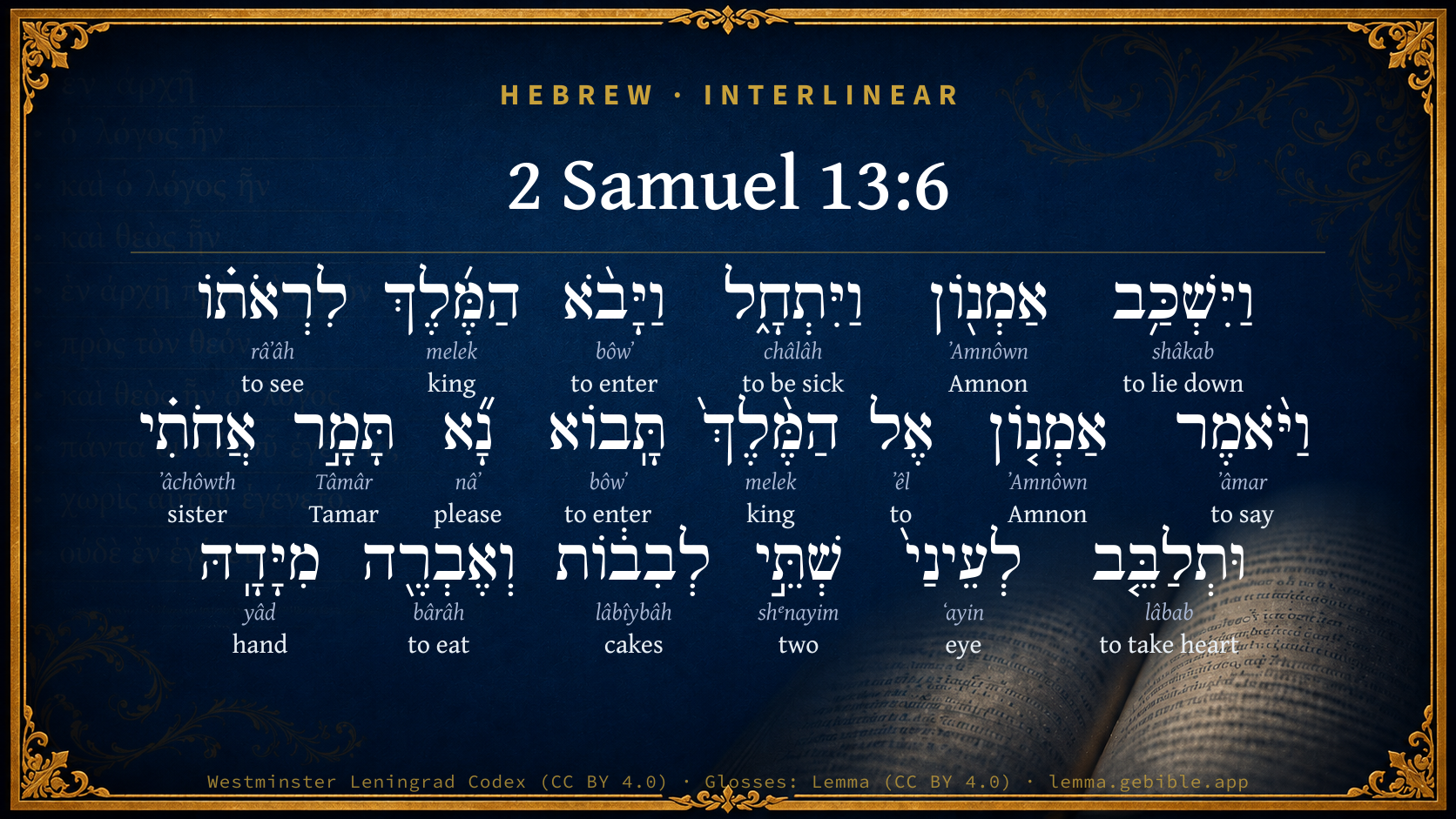
2 Samuel 13:6

Hebrew (Westminster Leningrad Codex) 2 Samuel 13:6 appears in the Hebrew Old Testament. The text above is from the Westminster Leningrad Codex. Each word links to its Strong’s number, a concise gloss, and parsing drawn from the Open Scriptures Hebrew Bible morphology. Click any word for its full Brown-Driver-Briggs (BDB) entry.
Download image
Cite this verse

2 Samuel 13:6 (World English Bible). Public Domain. Lemma interlinear Bible study tool, https://lemma.gebible.app/v/2-samuel/13/6.

Show BibTeX & RIS
BibTeX
RIS
English Translation
So Amnon lay down, and feigned himself sick: and when the king was come to see him, Amnon said to the king, Please let her sister Tamar come, and make me a couple of cakes in my sight, that I may eat from her hand.
World English Bible · Public Domain
Highlights
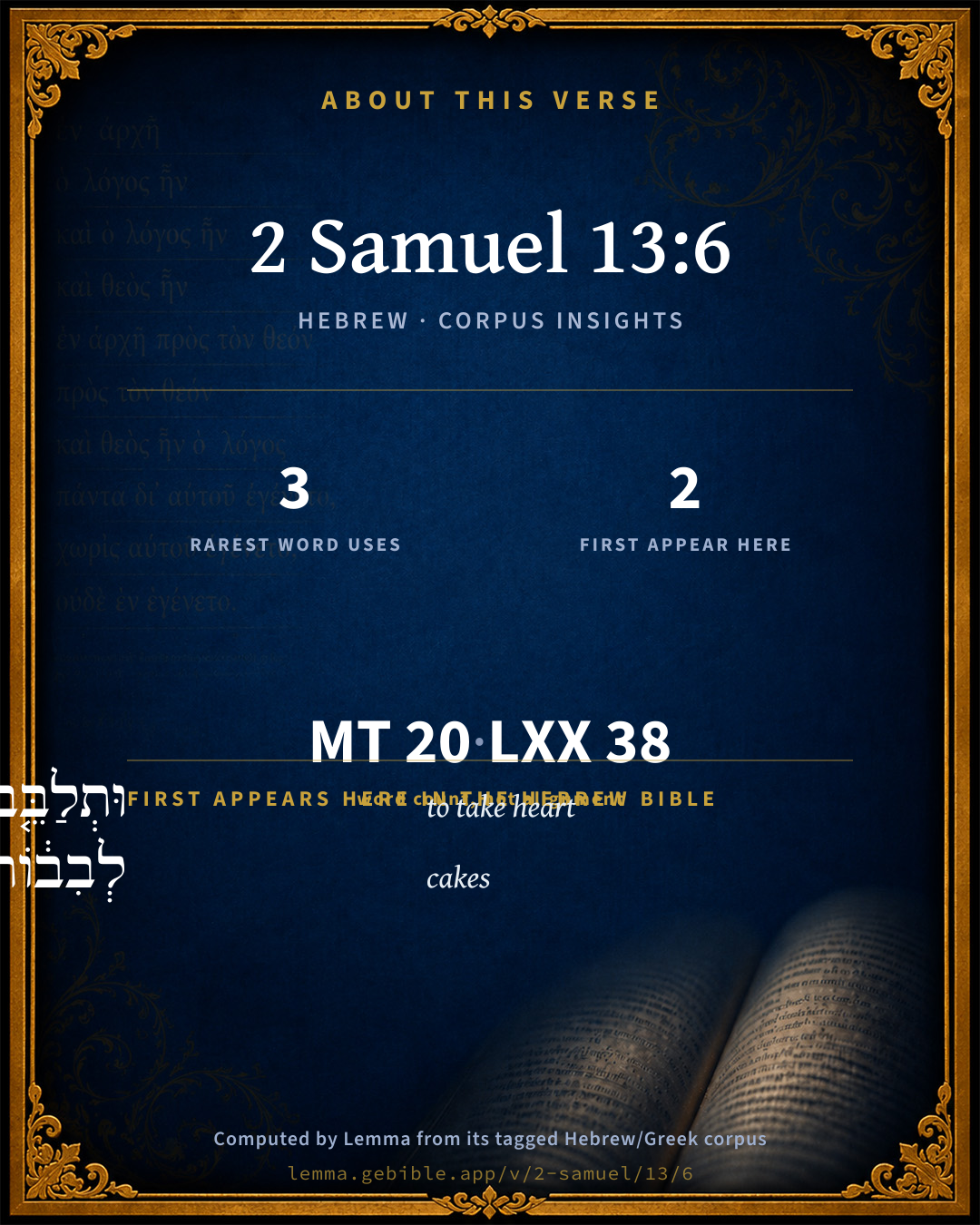
  • 2 first appearances in the Hebrew Bible
Full analysis ↓
Download a study sheet

One document with this verse’s original text, its word-by-word gloss line, the meaning frame, cross-references with their text, attributed commentary, and full source and license credits — printable, and it pastes into notes with its structure intact.

This verse Autodidact and up

Study sheet (.html) Plain text (.txt)

A passage Seminary Student

Up to 50 verses in one chapter. A passage sheet keeps up to 6 commentary sources and 12 cross-references per verse, in the order this page ranks them, and says so on the sheet whenever that leaves anything out. Ask for a single verse and you get the Autodidact verse sheet above.

Everything on this page stays free to read, with no account — the sheet is a download of what is already on screen, not access to it.

Want to remove ads? Support Godless Engineer
Compare translations 3

The same verse in 3 English versions, stacked beneath the original-language interlinear above. Click any original word for its lexicon entry.

Each is an independent rendering of the whole verse — the interlinear is not word-aligned to these translations.

Highlighted words mark where these versions differ — a whole-verse word diff, not a word-by-word alignment.

  • World English Bible Public Domain
    So Amnon lay down, and feigned himself sick: and when the king was come to see him, Amnon said to the king, Please let her sister Tamar come, and make me a couple of cakes in my sight, that I may eat from her hand.
  • King James Version Public Domain
    So Amnon lay down, and made himself sick: and when the king was come to see him, Amnon said unto the king, I pray thee, let Tamar my sister come, and make me a couple of cakes in my sight, that I may eat at her hand.
  • unfoldingWord Literal Text CC BY-SA 4.0
    So Amnon lay down, and he pretended to be sick. And the king came to see him, and Amnon said to the king, “Please let Tamar my sister come, and let her make to my eyes a couple of pancakes, and I will eat from her hand.”

unfoldingWord Literal Text — © unfoldingWord, licensed CC BY-SA 4.0. Word-aligned USFM3 via Door43 (git.door43.org/unfoldingWord/en_ult).

Versions to compare (up to 4)

3 of 4 selected

Show all 18 translations

Every available English version of this verse, each an independent rendering of the whole verse.

  • World English Bible Public Domain
    So Amnon lay down, and feigned himself sick: and when the king was come to see him, Amnon said to the king, Please let her sister Tamar come, and make me a couple of cakes in my sight, that I may eat from her hand.
  • Berean Standard Bible Public Domain
    So Amnon lay down and feigned illness. When the king came to see him, Amnon said, “Please let my sister Tamar come and make a couple of cakes in my sight, so that I may eat from her hand.”
  • Majority Standard Bible Public Domain
    So Amnon lay down and feigned illness. When the king came to see him, Amnon said, “Please let my sister Tamar come and make a couple of cakes in my sight, so that I may eat from her hand.”
  • King James Version Public Domain
    So Amnon lay down, and made himself sick: and when the king was come to see him, Amnon said unto the king, I pray thee, let Tamar my sister come, and make me a couple of cakes in my sight, that I may eat at her hand.
  • American Standard Version (1901) Public Domain
    So Amnon lay down, and feigned himself sick: and when the king was come to see him, Amnon said unto the king, Let her sister Tamar come, I pray thee, and make me a couple of cakes in my sight, that I may eat from her hand.
  • Revised Version (1885) Public Domain
    So Amnon lay down, and feigned himself sick: and when the king was come to see him, Amnon said unto the king, Let my sister Tamar come, I pray thee, and make me a couple of cakes in my sight, that I may eat at her hand.
  • Geneva Bible (1599) Public Domain
    So Amnon lay downe, and made himselfe sicke: and when the King came to see him, Amnon sayde vnto the King, I pray thee, let Tamar my sister come, and make me a couple of cakes in my sight, that I may receiue meate at her hand.
  • Douay-Rheims (1899) Public Domain
    So Amnon lay down, and made as if he were sick: and when the king came to visit him, Amnon said to the king: I pray thee let my sister Thamar come, and make in my sight two little messes, that I may eat at her hand.
  • Young's Literal Translation Public Domain
    And Amnon lieth down, and feigneth himself sick, and the king cometh in to see him, and Amnon saith unto the king, `Let, I pray thee, Tamar my sister come, and she maketh before mine eyes two cakes, and I eat from her hand.'
  • Literal Standard Version CC BY-SA 4.0
    And Amnon lies down, and feigns himself sick, and the king comes in to see him, and Amnon says to the king, “Please let my sister Tamar come, and she makes two cakes before my eyes, and I eat from her hand.”
  • Unlocked Literal Bible CC BY-SA 4.0
    So Amnon lay down and pretended to be sick. When the king came to see him, Amnon said to the king, “Please send my sister Tamar to make some food for my sickness in front of me so that I may eat from her hand.”
  • unfoldingWord Literal Text CC BY-SA 4.0
    So Amnon lay down, and he pretended to be sick. And the king came to see him, and Amnon said to the king, “Please let Tamar my sister come, and let her make to my eyes a couple of pancakes, and I will eat from her hand.”
  • Darby Bible Public Domain
    So Amnon lay down and feigned himself sick; and the king came to see him, and Amnon said to the king, I pray thee, let Tamar my sister come, and make a couple of cakes in my sight, that I may eat from her hand.
  • World Messianic Bible Public Domain
    So Amnon lay down and faked being sick. When the king came to see him, Amnon said to the king, “Please let my sister Tamar come and make me a couple of cakes in my sight, that I may eat from her hand.”
  • Webster's Bible Public Domain
    So Amnon lay down and made himself sick: and when the king came to see him, Amnon said to the king, I pray thee, let Tamar my sister come, and make for me a couple of cakes in my sight, that I may eat at her hand.
  • Free Bible Version CC BY-SA 4.0
    So Amnon lay down and pretended to be sick. When the king came to see him, Amnon asked him, “Please have my sister Tamar come and make a couple of pancakes as I watch, and she can hand them to me to eat.”
  • Bible in Basic English Public Domain
    So Amnon went to bed and made himself seem ill: and when the king came to see him, Amnon said to the king, Please let my sister Tamar come and make me one or two cakes before my eyes, so that I may take food from her hand.
  • JPS Tanakh (1917) Public Domain
    So Amnon lay down, and feigned himself sick; and when the king was come to see him, Amnon said unto the king: 'Let my sister Tamar come, I pray thee, and make me a couple of cakes in my sight, that I may eat at her hand.'

Literal Standard Version (2020), Covenant Press — licensed CC BY-SA 4.0. Text via the HelloAO Bible API (eBible.org). Unlocked Literal Bible (unfoldingWord) — licensed CC BY-SA 4.0. Text via the HelloAO Bible API (eBible.org). unfoldingWord Literal Text — © unfoldingWord, licensed CC BY-SA 4.0. Word-aligned USFM3 via Door43 (git.door43.org/unfoldingWord/en_ult). Free Bible Version, Dr. Jonathan Gallagher — licensed CC BY-SA 4.0. Text via the HelloAO Bible API (eBible.org).

Word by word

More ways to search: Search by grammar → Find every occurrence → Compare this word →

Practice this passage: Drill this verse → Learn its vocabulary →

לְבִב֔וֹת
lâbîybâh
H3834
“cakes”
Noun, Common, Feminine, Plural, Absolute
Part of Speech
Noun
Type
Common
Gender
Feminine
Number
Plural
State
Absolute
Full BDB Definition

Origin: from H3823 in its original sense of fatness (or perhaps of folding) TWOT - H1071 c

TWOT: n f

cakes, bread
  1. וַיִּשְׁכַּ֥ב shâkab H7901 “and · to lie down” Conjunction + Verb, Qal, Sequential Imperfect, 3rd Person, Masculine, Singular
  2. אַמְנ֖וֹן ʼAmnôwn H550 “Amnon” Noun, Proper
  3. וַיִּתְחָ֑ל châlâh H2470 “and · to be sick” Conjunction + Verb, Hithpael, Sequential Imperfect, 3rd Person, Masculine, Singular
  4. וַיָּבֹ֨א bôwʼ H935 “and · to enter” Conjunction + Verb, Qal, Sequential Imperfect, 3rd Person, Masculine, Singular
  5. הַמֶּ֜לֶךְ melek H4428 “the · king” Particle, Definite Article + Noun, Common, Masculine, Singular, Absolute
  6. לִרְאֹת֗וֹ râʼâh H7200 “to see · him” Preposition + Verb, Qal, Infinitive Construct + Suffix, Personal, 3rd Person, Masculine, Singular
  7. וַיֹּ֨אמֶר ʼâmar H559 “and · to say” Conjunction + Verb, Qal, Sequential Imperfect, 3rd Person, Masculine, Singular
  8. אַמְנ֤וֹן ʼAmnôwn H550 “Amnon” Noun, Proper
  9. אֶל ʼêl H413 “to” Preposition
  10. הַמֶּ֨לֶךְ֙ melek H4428 “the · king” Particle, Definite Article + Noun, Common, Masculine, Singular, Absolute
  11. תָּֽבוֹא bôwʼ H935 “to enter” Verb, Qal, Jussive, 3rd Person, Feminine, Singular
  12. נָ֞א nâʼ H4994 “please” Particle, Exhortation
  13. תָּמָ֣ר Tâmâr H8559 “Tamar” Noun, Proper
  14. אֲחֹתִ֗י ʼâchôwth H269 “sister · my” Noun, Common, Feminine, Singular, Construct + Suffix, Personal, 1st Person, Common, Singular
  15. וּתְלַבֵּ֤ב lâbab H3823 “and · to take heart” Conjunction + Verb, Piel, Imperfect, 3rd Person, Feminine, Singular
  16. לְעֵינַי֙ ʻayin H5869 “to/for · eyes · my” Preposition + Noun, Common, Both, Dual, Construct + Suffix, Personal, 1st Person, Common, Singular
  17. שְׁתֵּ֣י shᵉnayim H8147 “two” Adjective, Cardinal number, Feminine, Dual, Construct
  18. וְאֶבְרֶ֖ה bârâh H1262 “and · to eat” Conjunction + Verb, Qal, Imperfect, 1st Person, Common, Singular
  19. מִיָּדָֽהּ yâd H3027 “from · hand · her” Preposition + Noun, Common, Both, Singular, Construct + Suffix, Personal, 3rd Person, Feminine, Singular

About this verse

These counts appear in no published source. They are computed here, from the morphology-tagged text and Lemma’s own curated glosses. What Lemma adds →

20
words
17
distinct lemmas
Historical
section

Notable vocabulary

The rarest word here is לְבִב֔וֹת cakes H3834 — appearing just 3 times in the whole Hebrew Bible.

First appearance in Scripture

These words make their first canonical appearance in the Hebrew Bible here:

  • וּתְלַבֵּ֤ב to take heart H3823
  • לְבִב֔וֹת cakes H3834

Shared distinctive vocabulary

לְבִב֔וֹת cakes H3834 occurs in 3 verses of the Hebrew Bible. Also found in:

Grammatical profile

  • 8 verbs
  • 9 nouns
  • 1 adjective
  • 1 preposition
  • 1 particle

Verb forms

  • וַיִּשְׁכַּ֥ב Qal · Sequential Imperfect
  • וַיִּתְחָ֑ל Hithpael · Sequential Imperfect
  • וַיָּבֹ֨א Qal · Sequential Imperfect
  • לִרְאֹת֗וֹ Qal · Infinitive Construct
  • וַיֹּ֨אמֶר Qal · Sequential Imperfect
  • תָּֽבוֹא Qal · Jussive
  • וּתְלַבֵּ֤ב Piel · Imperfect
  • וְאֶבְרֶ֖ה Qal · Imperfect

Repetition

Words recur within this verse — often emphatic in Hebrew:

  • אַמְנ֖וֹן Amnon H550 ×2
  • וַיָּבֹ֨א to enter H935 ×2
  • הַמֶּ֜לֶךְ king H4428 ×2

Hebrew & Septuagint length

In English translation the verse runs 45 words from the Hebrew and 49 from the Septuagint (LXX English) — closely comparable.

A rough comparison of the two English renderings, which tokenize alike — not a word-level alignment.

Word counts can differ between the Hebrew and the Greek without any difference in meaning — e.g. the Hebrew direct-object marker אֵת has no separate Greek word, and Greek often adds the article ὁ.

In the original languages it is 20 Hebrew tokens and 38 Greek tokens — but the two are counted differently (Hebrew bundles its prefixes and suffixes into one token; the Greek is in lemma form), so that isn’t a like-for-like length.

Cross-references

2

Topical passages linked to 2 Samuel 13:6 in the Treasury of Scripture Knowledge — connected by theme and wording, ordered by reader-vote popularity; previews shown in the World English Bible.

  • Genesis 18:6 Abraham hurried into the tent to Sarah, and said, "Quickly make ready three measures of fine meal, knead it, and make cakes."
  • Matthew 13:33 He spoke another parable to them. "The Kingdom of Heaven is like yeast, which a woman took, and hid in three measures of meal, until it was all leavened."

Cross-references courtesy of OpenBible.info (CC BY 4.0).

Hebrew and Greek witnesses Masoretic Hebrew ↔ Greek Septuagint

The same verse in the two great witnesses to the Old Testament, shown verse-for-verse.

These are two independent witnesses, not word-aligned to each other, and the Septuagint is shown in lemma (dictionary) form.

Hebrew 2 Samuel 13:6 Masoretic · Westminster Leningrad Codex

וַיִּשְׁכַּ֥ב אַמְנ֖וֹן וַיִּתְחָ֑ל וַיָּבֹ֨א הַמֶּ֜לֶךְ לִרְאֹת֗וֹ וַיֹּ֨אמֶר אַמְנ֤וֹן אֶל הַמֶּ֨לֶךְ֙ תָּֽבוֹא נָ֞א תָּמָ֣ר אֲחֹתִ֗י וּתְלַבֵּ֤ב לְעֵינַי֙ שְׁתֵּ֣י לְבִב֔וֹת וְאֶבְרֶ֖ה מִיָּדָֽהּ

So Amnon lay down, and feigned himself sick: and when the king was come to see him, Amnon said to the king, Please let her sister Tamar come, and make me a couple of cakes in my sight, that I may eat from her hand.

World English Bible · Public Domain

Greek LXX 2 Samuel 13:6 Septuagint · lemma form

καί κοιμάω αμνων καί ἀρρωστέω καί εἰςἔρχομαι ὁ βασιλεύς ὁράω αὐτός καί εἶπον αμνων πρός ὁ βασιλεύς ἔρχομαι δή θημαρ ὁ ἀδελφή ἐγώ πρός ἐγώ καί κολλυρίζω ἐν ὀφθαλμός ἐγώ δύο κολλυρίς καί ἐσθίω ἐκ ὁ χείρ αὐτός

So Ammon lay down, and made himself sick; and the king came in to see him: and Amnon said to the king, Let, I pray you, my sister Themar come to me, and make a couple of cakes in my sight, and I will eat them at her hand.

LXX2012 (modern English Septuagint) · Public Domain

Hebrew: Westminster Leningrad Codex (CC BY 4.0). Greek: Septuagint (public domain); English from LXX2012 (modern English Septuagint) (Public Domain). How the Septuagint differs from the Hebrew →

Targum (Aramaic paraphrase)

1

The Targum is the ancient Jewish Aramaic paraphrase of the Hebrew Scriptures — an interpretive translation, not the Hebrew text itself. Onkelos (literal) and Pseudo-Jonathan (expansive) render the Torah, and Jonathan the Prophets. Coverage is partial: where no permissively-licensed English translation exists for a verse, only the Aramaic is shown. This is verse-level text, not a word-by-word alignment to the Hebrew.

  1. Targum Jonathan Prophets (Joshua–Malachi)
    וּשְׁכִיב אַמְנוֹן וְאִתְמְרָע וַאֲתָא מַלְכָּא לְמֶחְזְיֵה וַאֲמַר אַמְנוֹן לְמַלְכָּא תֵּיתֵי כְעַן תָּמָר אֲחָתִי וְתַחֲלוֹט לְעֵינַי תַּרְתֵּין חֲלִיטָתָא וְאֵכּוּל מִן יְדָהּ:

    (no public-domain English translation for this verse)

    Targum Jonathan — Aramaic: “Mikraot Gedolot” (public domain). English: “Sefaria Community Translation” (CC0 1.0 (public-domain dedication)); “London "Chaldee Paraphrase," 1871” (public domain). Text via Sefaria.

Commentary

Notes on 2 Samuel 13:6 from classic Christian and Jewish commentators (each source and its license shown beneath its notes). The classic Christian expositions comment on the surrounding passage and are grouped to its opening verse, so a note may address several verses; the Jewish commentaries on the Tanakh (Rashi and others) are per-verse, so they appear only where the commentator wrote on this verse.

Lemma curates 59 commentaries, every one of them public domain or Creative Commons licensed, each selected and text-cleaned for this edition rather than reprinted as found. About our sources →

Jamieson, Fausset & Brown

Robert Jamieson, A. R. Fausset & David Brown

HE DEFILES HER. (2Sa. 13:6-27)

Amnon lay down, and made himself sick--The Orientals are great adepts in feigning sickness, whenever they have any object to accomplish.

let Tamar my sister come and make me a couple of cakes--To the king Amnon spoke of Tamar as "his sister," a term artfully designed to hoodwink his father; and the request appeared so natural, the delicate appetite of a sick man requiring to be humored, that the king promised to send her. The cakes seem to have been a kind of fancy bread, in the preparation of which Oriental ladies take great delight. Tamar, flattered by the invitation, lost no time in rendering the required service in the house of her sick brother.

Jamieson, Fausset & Brown — Commentary Critical and Explanatory on the Whole Bible (1871) — public domain (CC PDM 1.0). Text via the HelloAO Bible API.

Trapp's Complete Commentary

John Trapp

2Sa 13:6 So Amnon lay down, and made himself sick: and when the king was come to see him, Amnon said unto the king, I pray thee, let Tamar my sister come, and make me a couple of cakes in my sight, that I may eat at her hand.

Ver. 6. So Amnon lay down, and made himself sick.] He was Cereus in vitium flecti, easily drawn to do evil. He answered Jonadab, upon the matter, as Tiberius did Justinus, I am only thy clay and wax. Oh that we could find men so docile and ductile to that which is good! Sed hoc est magis optabile quam opinabile.

And when the king was come to see him.] As fearing to lose him, like as he had lately done the child of his adultery. But could he have foreseen what shortly followed, he would either have wished himself childless with Augustus, or else have said with Moses in another case, Lord, if thou deal thus with me, "kill me, I pray thee, out of hand, if I have found favour in thy sight; and let me not see my wretchedness." {Num 11:15}

And make me a couple of cakes.] Laganet ante oculos meos duo lagana. Let her prepare me two cordial cakes, such as may refresh my heart; so the word signifieth.

John Trapp, A Commentary or Exposition upon All the Books of the Old and New Testament (1647–1656) — public domain. Text from a community e-Sword module.

Geneva Bible (1599)

Geneva Bible translators

Meaning, some delicate and dainty meat.

Geneva Bible (1599) marginal notes — public domain. Text via Bolls.life.

Ellicott's Commentary for English Readers

(6) That I may eat at her hand.—This request from an invalid seemed natural, and was readily granted.

Sent home.—Literally, into the house; i.e., to the private apartments of the women—the harem.

A Bible Commentary for English Readers, edited by Charles John Ellicott (1878–1897) — public domain. Text from a community e-Sword module.

The Cambridge Bible for Schools and Colleges

gen. ed. J. J. S. Perowne

6. cakes] The word occurs here only, and may denote some special delicacy suited for an invalid.

The Cambridge Bible for Schools and Colleges (gen. ed. J. J. S. Perowne; Cambridge University Press, 1878–1918) — public domain. Text from a community e-Sword module.

John Gill's Exposition

So Amnon lay down, and made himself sick,.... Took the advice of his cousin Jonadab, and acted according to it:

and when the king was come to see him; as he quickly did, after he had heard of his illness:

Amnon said unto the king; who perhaps inquired of his appetite, whether he could eat anything, and what:

I pray thee let my sister Tamar come; he calls her sister, as Jonadab had directed, the more to blind his design; though it is much that so sagacious a man as David was had not seen through it; but the notion he had of his being really ill, and the near relation between him and Tamar, forbad his entertaining the least suspicion of that kind:

and make me a couple of cakes in my sight; heart cakes, as the word may be thought to signify; called so either from the form of them, such as We have with us, or from the effect of them, comforting and refreshing the heart:

that I may eat at her hand; both what is made by her hand, and received from it.

John Gill's Exposition of the Whole Bible (1746–1763) — public domain (CC PDM 1.0). Text via the HelloAO Bible API.

Albert Barnes' Notes on the Bible

Make me cakes ... a pan - The words here used occur nowhere else, and the etymology is doubtful. Some particular kind of cake or pudding is meant 2Sa 13:8, called a לביבה lābı̂ybâh; according to some, it was, from its etymology, shaped like a heart.

2Sa 13:9

The dish into which she poured the לביבה lābı̂ybâh was doubtless borne to him by one of the servants into the chamber where he lay, and from which, the doors being open, he could see the outer room where Tamar prepared the meat.

Albert Barnes' Notes on the Bible (1834–1885) — public domain. Text from a community e-Sword/MySword module.

Haydock's Catholic Bible Commentary

Messes. Hebrew, "cakes, or cordials;" what which refresh the heart, and give an appetite. The queen of Perdiccas, of Macedon, baked bread for her servants. (Herodotus viii. 137.) (Genesis xviii. 6.)

George Leo Haydock (1774–1849), Haydock's Catholic Family Bible and Commentary, 1859 edition — public domain. Excludes Psalms (Douay-Rheims chapter numbering differs from Protestant) and Deuterocanonical books (Catholic canon only).

Whedon's Commentary on the Bible

Daniel D. Whedon

6. Cakes — Hebrews, heart cakes; some kind of delicious pastry, perhaps folded and laid together in the shape of a heart.

Daniel D. Whedon (gen. ed.), Commentary on the Old and New Testaments (1874–1909) — public domain. Text from a community e-Sword module.

Lesson kit

Teaching starters — assembled from the data on this page, not authored interpretation. Every prompt links to the verse data it draws on. Edit before teaching.

2 Samuel, in the Historical, opens this verse with 20 words (17 distinct Hebrew lemmas). Its most distinctive word is lâbîybâh (“cakes”). A historical commentator’s framing appears above. Read the whole chapter for the surrounding context.

Discussion questions

  1. How does “cakes” (lâbîybâh) shape what this verse is saying?
  2. 2 words make their first appearance in Scripture here. What does this debut establish?
  3. How does 2 Samuel 13:8, which shares the word «cakes», read alongside this verse?
  4. What does the repetition of “Amnon” (2× in this one verse) do in this verse?
  5. The translations on this page render this verse differently — a whole-verse word diff, not a word-by-word alignment. What might account for the different wordings?
  6. «וַיִּשְׁכַּ֥ב» is a Qal Sequential Imperfect verb. How does that grammatical form shape the action described?
  7. Compare how Jamieson, Fausset & Brown and Trapp's Complete Commentary read this verse. Where do they agree or differ?

Things to notice

Reading settings

Reading text

Shown beneath each verse's original-language words.

Old Testament
Old Testament edition

Read the OT as the Masoretic Hebrew (MT) or the Greek Septuagint (LXX).

English shown for the Greek Septuagint (in the Hebrew ↔ Greek comparison).

Comparing translations? Open the Compare panel on any verse page to stack up to four side by side.