
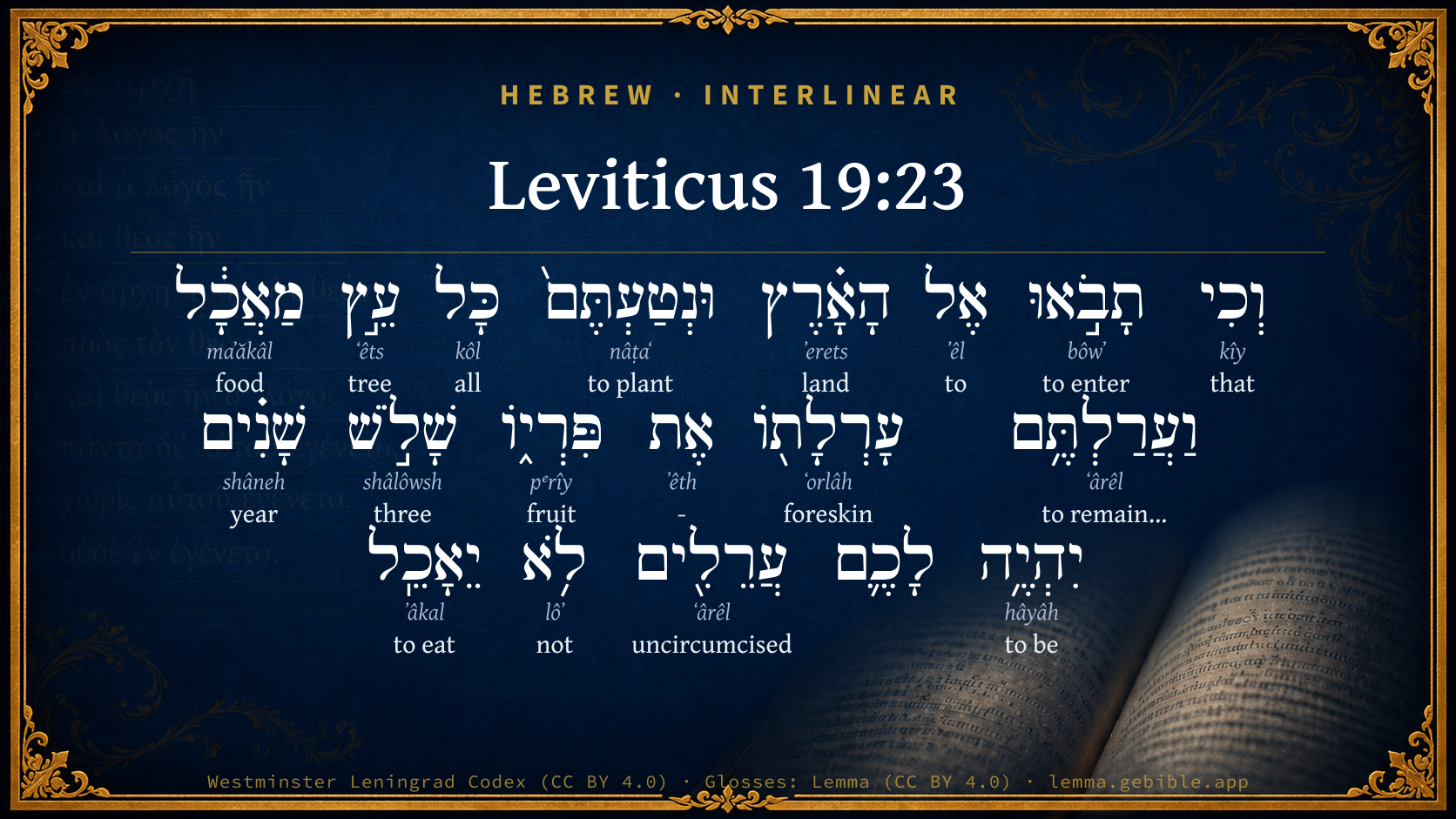
Leviticus 19:23

Hebrew (Westminster Leningrad Codex) Leviticus 19:23 appears in the Hebrew Old Testament. The text above is from the Westminster Leningrad Codex. Each word links to its Strong’s number, a concise gloss, and parsing drawn from the Open Scriptures Hebrew Bible morphology. Click any word for its full Brown-Driver-Briggs (BDB) entry.
Download image
Cite this verse

Leviticus 19:23 (World English Bible). Public Domain. Lemma interlinear Bible study tool, https://lemma.gebible.app/v/leviticus/19/23.

Show BibTeX & RIS
BibTeX
RIS
English Translation
"'When you come into the land, and have planted all kinds of trees for food, then you shall count their fruit as forbidden. Three years shall they be forbidden to you. It shall not be eaten.
World English Bible · Public Domain
Highlights
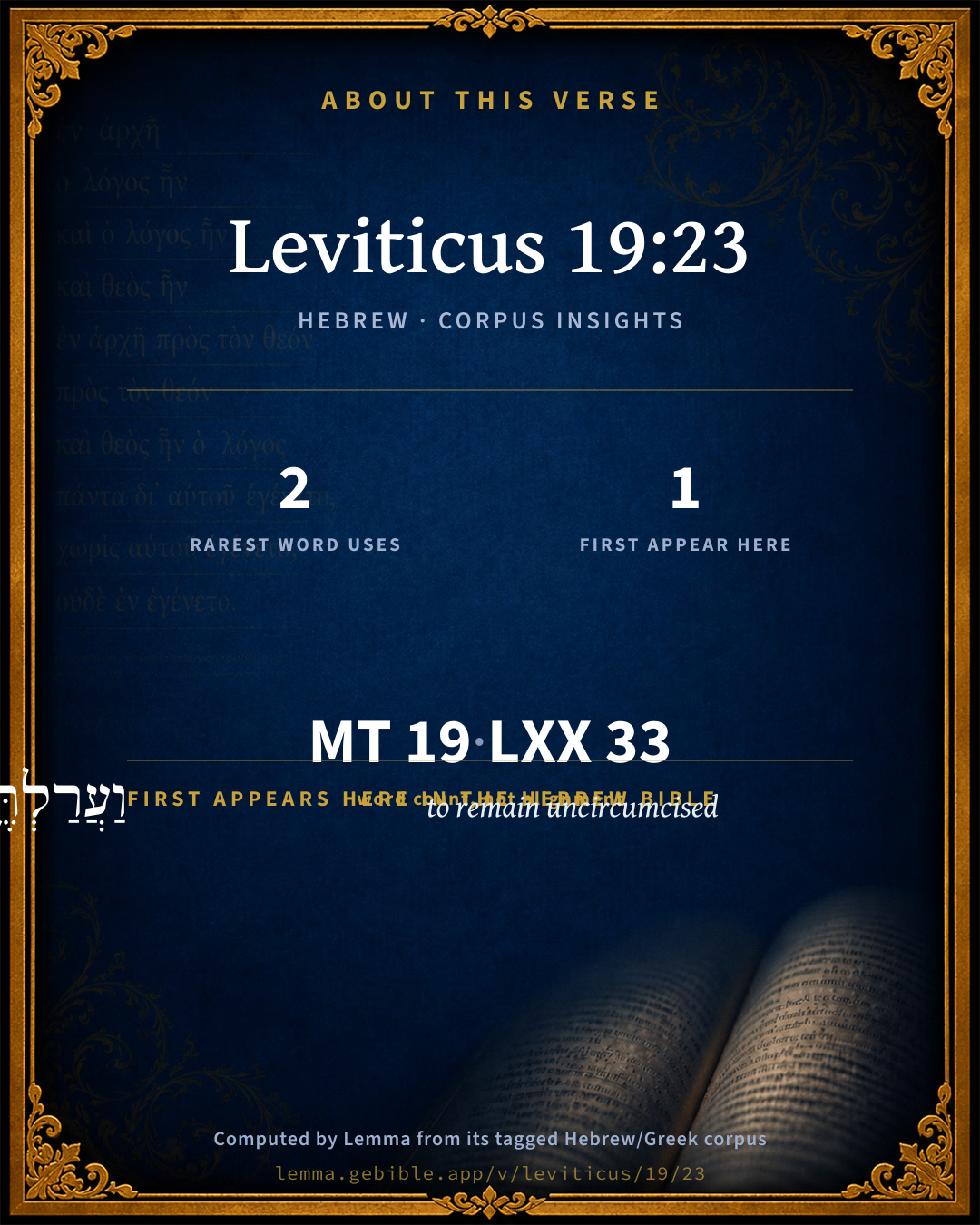
  • 1 first appearance in the Hebrew Bible
Full analysis ↓
Download a study sheet

One document with this verse’s original text, its word-by-word gloss line, the meaning frame, cross-references with their text, attributed commentary, and full source and license credits — printable, and it pastes into notes with its structure intact.

This verse Autodidact and up

Study sheet (.html) Plain text (.txt)

A passage Seminary Student

Up to 50 verses in one chapter. A passage sheet keeps up to 6 commentary sources and 12 cross-references per verse, in the order this page ranks them, and says so on the sheet whenever that leaves anything out. Ask for a single verse and you get the Autodidact verse sheet above.

Everything on this page stays free to read, with no account — the sheet is a download of what is already on screen, not access to it.

Want to remove ads? Support Godless Engineer
Compare translations 3

The same verse in 3 English versions, stacked beneath the original-language interlinear above. Click any original word for its lexicon entry.

Each is an independent rendering of the whole verse — the interlinear is not word-aligned to these translations.

Highlighted words mark where these versions differ — a whole-verse word diff, not a word-by-word alignment.

  • World English Bible Public Domain
    "'When you come into the land, and have planted all kinds of trees for food, then you shall count their fruit as forbidden. Three years shall they be forbidden to you. It shall not be eaten.
  • King James Version Public Domain
    And when ye shall come into the land, and shall have planted all manner of trees for food, then ye shall count the fruit thereof as uncircumcised: three years shall it be as uncircumcised unto you: it shall not be eaten of.
  • unfoldingWord Literal Text CC BY-SA 4.0
    And when you enter into the land, and you plant every tree of food, then you shall leave uncircumcised its foreskin its fruit. Three years it shall be uncircumcised to you. It shall not be eaten.

unfoldingWord Literal Text — © unfoldingWord, licensed CC BY-SA 4.0. Word-aligned USFM3 via Door43 (git.door43.org/unfoldingWord/en_ult).

Versions to compare (up to 4)

3 of 4 selected

Show all 18 translations

Every available English version of this verse, each an independent rendering of the whole verse.

  • World English Bible Public Domain
    "'When you come into the land, and have planted all kinds of trees for food, then you shall count their fruit as forbidden. Three years shall they be forbidden to you. It shall not be eaten.
  • Berean Standard Bible Public Domain
    When you enter the land and plant any kind of tree for food, you shall regard the fruit as forbidden. For three years it will be forbidden to you and must not be eaten.
  • Majority Standard Bible Public Domain
    When you enter the land and plant any kind of tree for food, you shall regard the fruit as forbidden. For three years it will be forbidden to you and must not be eaten.
  • King James Version Public Domain
    And when ye shall come into the land, and shall have planted all manner of trees for food, then ye shall count the fruit thereof as uncircumcised: three years shall it be as uncircumcised unto you: it shall not be eaten of.
  • American Standard Version (1901) Public Domain
    And when ye shall come into the land, and shall have planted all manner of trees for food, then ye shall count the fruit thereof as their uncircumcision: three years shall they be as uncircumcised unto you; it shall not be eaten.
  • Revised Version (1885) Public Domain
    And when ye shall come into the land, and shall have planted all manner of trees for food, then ye shall count the fruit thereof as their uncircumcision: three years shall they be as uncircumcised unto you; it shall not be eaten.
  • Geneva Bible (1599) Public Domain
    Also when ye shall come into the land, and haue planted euery tree for meate, ye shall count the fruite thereof as vncircumcised: three yeere shall it be vncircumcised vnto you, it shall not be eaten:
  • Douay-Rheims (1899) Public Domain
    When you shall be come into the land, and shall have planted in it fruit trees, you shall take away the firstfruits of them: the fruit that comes forth shall be unclean to you, neither shall you eat of them.
  • Young's Literal Translation Public Domain
    `And when ye come in unto the land, and have planted all `kinds' of trees `for' food, then ye have reckoned as uncircumcised its fruit, three years it is to you uncircumcised, it is not eaten,
  • Literal Standard Version CC BY-SA 4.0
    And when you come into the land and have planted all [kinds] of trees [for] food, then you have reckoned its fruit as uncircumcised, it is uncircumcised to you [for] three years, it is not eaten,
  • Unlocked Literal Bible CC BY-SA 4.0
    When you come into the land and have planted all kinds of trees for food, then you must regard the fruit they produce as forbidden to be eaten. The fruit must be forbidden to you for three years. It must not be eaten.
  • unfoldingWord Literal Text CC BY-SA 4.0
    And when you enter into the land, and you plant every tree of food, then you shall leave uncircumcised its foreskin its fruit. Three years it shall be uncircumcised to you. It shall not be eaten.
  • Darby Bible Public Domain
    And when ye come into the land and plant all manner of trees for food, then ye shall count its fruit as uncircumcised, three years shall it be uncircumcised unto you: it shall not be eaten of;
  • World Messianic Bible Public Domain
    “‘When you come into the land, and have planted all kinds of trees for food, then you shall count their fruit as forbidden. For three years it shall be forbidden to you. It shall not be eaten.
  • Webster's Bible Public Domain
    And when ye shall come into the land, and shall have planted all manner of trees for food; then ye shall count its fruit as uncircumcised: three years shall it be as uncircumcised to you: it shall not be eaten of.
  • Free Bible Version CC BY-SA 4.0
    When you enter the land and plant any kind of fruit tree, treat the fruit at first as unclean. For three years you are forbidden to eat it.
  • Bible in Basic English Public Domain
    And when you have come into the land, and have put in all sorts of fruit-trees, their fruit will be as if they had not had circumcision, and for three years their fruit may not be used for food.
  • JPS Tanakh (1917) Public Domain
    And when ye shall come into the land, and shall have planted all manner of trees for food, then ye shall count the fruit thereof as forbidden; three years shall it be as forbidden unto you; it shall not be eaten.

Literal Standard Version (2020), Covenant Press — licensed CC BY-SA 4.0. Text via the HelloAO Bible API (eBible.org). Unlocked Literal Bible (unfoldingWord) — licensed CC BY-SA 4.0. Text via the HelloAO Bible API (eBible.org). unfoldingWord Literal Text — © unfoldingWord, licensed CC BY-SA 4.0. Word-aligned USFM3 via Door43 (git.door43.org/unfoldingWord/en_ult). Free Bible Version, Dr. Jonathan Gallagher — licensed CC BY-SA 4.0. Text via the HelloAO Bible API (eBible.org).

Word by word

More ways to search: Search by grammar → Find every occurrence → Compare this word →

Practice this passage: Drill this verse → Learn its vocabulary →

וַעֲרַלְתֶּ֥ם
ʻârêl
H6188
“and · to remain uncircumcised”
Conjunction + Verb, Qal, Sequential Perfect, 2nd Person, Masculine, Plural
Part of Speech
Conjunction + Verb
Stem
Qal
Form
Sequential Perfect
Person
2nd Person
Gender
Masculine
Number
Plural
Full BDB Definition

Origin: a primitive root

TWOT: 1695

to remain uncircumcised, count uncircumcised, count as foreskin - (Qal) - to regard as uncircumcised - to remain unharvested (figuratively) - (Niphal) to be counted as uncircumcised
  1. וְכִי kîy H3588 “and · that” Conjunction + Conjunction
  2. תָבֹ֣אוּ bôwʼ H935 “to enter” Verb, Qal, Imperfect, 2nd Person, Masculine, Plural
  3. אֶל ʼêl H413 “to” Preposition
  4. הָאָ֗רֶץ ʼerets H776 “the · land” Particle, Definite Article + Noun, Common, Both, Singular, Absolute
  5. וּנְטַעְתֶּם֙ nâṭaʻ H5193 “and · to plant” Conjunction + Verb, Qal, Sequential Perfect, 2nd Person, Masculine, Plural
  6. כָּל kôl H3605 “all of” Noun, Common, Masculine, Singular, Construct
  7. עֵ֣ץ ʻêts H6086 “tree of” Noun, Common, Masculine, Singular, Construct
  8. מַאֲכָ֔ל maʼăkâl H3978 “food” Noun, Common, Masculine, Singular, Absolute
  9. עָרְלָת֖וֹ ʻorlâh H6190 “foreskin · his” Noun, Common, Feminine, Singular, Construct + Suffix, Personal, 3rd Person, Masculine, Singular
  10. אֶת ʼêth H853 “-” Particle, Direct Object
  11. פִּרְי֑וֹ pᵉrîy H6529 “fruit · his” Noun, Common, Masculine, Singular, Construct + Suffix, Personal, 3rd Person, Masculine, Singular
  12. שָׁלֹ֣שׁ shâlôwsh H7969 “three” Adjective, Cardinal number, Feminine, Singular, Absolute
  13. שָׁנִ֗ים shâneh H8141 “years” Noun, Common, Feminine, Plural, Absolute
  14. יִהְיֶ֥ה hâyâh H1961 “to be” Verb, Qal, Imperfect, 3rd Person, Masculine, Singular
  15. עֲרֵלִ֖ים ʻârêl H6189 “uncircumcised” Adjective, Adjective, Masculine, Plural, Absolute
  16. לֹ֥א lôʼ H3808 “not” Particle, Negative
  17. יֵאָכֵֽל ʼâkal H398 “to eat” Verb, Niphal, Imperfect, 3rd Person, Masculine, Singular

About this verse

These counts appear in no published source. They are computed here, from the morphology-tagged text and Lemma’s own curated glosses. What Lemma adds →

19
words
18
distinct lemmas
Pentateuch
section

Notable vocabulary

The rarest word here is וַעֲרַלְתֶּ֥ם to remain uncircumcised H6188 — appearing just 2 times in the whole Hebrew Bible.

First appearance in Scripture

This word makes its first canonical appearance in the Hebrew Bible here:

  • וַעֲרַלְתֶּ֥ם to remain uncircumcised H6188

Shared distinctive vocabulary

וַעֲרַלְתֶּ֥ם to remain uncircumcised H6188 occurs in 2 verses of the Hebrew Bible. Also found in:

Grammatical profile

  • 5 verbs
  • 7 nouns
  • 2 adjectives
  • 2 prepositions
  • 1 conjunction
  • 2 particles

Verb forms

  • תָבֹ֣אוּ Qal · Imperfect
  • וּנְטַעְתֶּם֙ Qal · Sequential Perfect
  • וַעֲרַלְתֶּ֥ם Qal · Sequential Perfect
  • יִהְיֶ֥ה Qal · Imperfect
  • יֵאָכֵֽל Niphal · Imperfect

Hebrew & Septuagint length

In English translation the verse runs 36 words from the Hebrew and 42 from the Septuagint (LXX English) — closely comparable.

A rough comparison of the two English renderings, which tokenize alike — not a word-level alignment.

Word counts can differ between the Hebrew and the Greek without any difference in meaning — e.g. the Hebrew direct-object marker אֵת has no separate Greek word, and Greek often adds the article ὁ.

In the original languages it is 19 Hebrew tokens and 33 Greek tokens — but the two are counted differently (Hebrew bundles its prefixes and suffixes into one token; the Greek is in lemma form), so that isn’t a like-for-like length.

Cross-references

9

Topical passages linked to Leviticus 19:23 in the Treasury of Scripture Knowledge — connected by theme and wording, ordered by reader-vote popularity; previews shown in the World English Bible.

  • Leviticus 22:27 "When a bull, or a sheep, or a goat, is born, then it shall remain seven days with its mother; and from the eighth day and thenceforth it shall be accepted for the offering of an offering made by fire to Yahweh.
  • Acts 7:51 "You stiff-necked and uncircumcised in heart and ears, you always resist the Holy Spirit! As your fathers did, so you do.
  • Jeremiah 9:25–26 Behold, the days come, says Yahweh, that I will punish all those who are circumcised in [their] uncircumcision:
  • Exodus 6:12 Moses spoke before Yahweh, saying, "Behold, the children of Israel haven't listened to me. How then shall Pharaoh listen to me, who am of uncircumcised lips?"
  • Exodus 22:29–30 "You shall not delay to offer from your harvest and from the outflow of your presses. "You shall give the firstborn of your sons to me.
  • Leviticus 12:3 In the eighth day the flesh of his foreskin shall be circumcised.
  • Leviticus 14:34 "When you have come into the land of Canaan, which I give to you for a possession, and I put a spreading mildew in a house in the land of your possession,
  • Jeremiah 6:10 To whom shall I speak and testify, that they may hear? behold, their ear is uncircumcised, and they can't listen: behold, the word of Yahweh is become to them a reproach; they have no delight in it.
  • Exodus 6:30 Moses said before Yahweh, "Behold, I am of uncircumcised lips, and how shall Pharaoh listen to me?"

Cross-references courtesy of OpenBible.info (CC BY 4.0).

Hebrew and Greek witnesses Masoretic Hebrew ↔ Greek Septuagint

The same verse in the two great witnesses to the Old Testament, shown verse-for-verse.

These are two independent witnesses, not word-aligned to each other, and the Septuagint is shown in lemma (dictionary) form.

Hebrew Leviticus 19:23 Masoretic · Westminster Leningrad Codex

וְכִי תָבֹ֣אוּ אֶל הָאָ֗רֶץ וּנְטַעְתֶּם֙ כָּל עֵ֣ץ מַאֲכָ֔ל וַעֲרַלְתֶּ֥ם עָרְלָת֖וֹ אֶת פִּרְי֑וֹ שָׁלֹ֣שׁ שָׁנִ֗ים יִהְיֶ֥ה לָכֶ֛ם עֲרֵלִ֖ים לֹ֥א יֵאָכֵֽל

"'When you come into the land, and have planted all kinds of trees for food, then you shall count their fruit as forbidden. Three years shall they be forbidden to you. It shall not be eaten.

World English Bible · Public Domain

Greek LXX Leviticus 19:23 Septuagint · lemma form

ὅταν δέ εἰςἔρχομαι εἰς ὁ γῆ ὅς κύριος ὁ θεός σύ δίδωμι σύ καί καταφυτεύω πᾶς ξύλον βρώσιμος καί περικαθαρίζω ὁ ἀκαθαρσία αὐτός ὁ καρπός αὐτός τρεῖς ἔτος εἰμί σύ ἀπερικάθαρτος οὐ βιβρώσκω

And whenever you⌃ shall enter into the land which the Lord your God gives you, and shall plant any fruit tree, then shall you⌃ purge away its uncleanness; its fruit shall be three years uncleansed to you, it shall not be eaten.

LXX2012 (modern English Septuagint) · Public Domain

Hebrew: Westminster Leningrad Codex (CC BY 4.0). Greek: Septuagint (public domain); English from LXX2012 (modern English Septuagint) (Public Domain). How the Septuagint differs from the Hebrew →

Targum (Aramaic paraphrase)

2

The Targum is the ancient Jewish Aramaic paraphrase of the Hebrew Scriptures — an interpretive translation, not the Hebrew text itself. Onkelos (literal) and Pseudo-Jonathan (expansive) render the Torah, and Jonathan the Prophets. Coverage is partial: where no permissively-licensed English translation exists for a verse, only the Aramaic is shown. This is verse-level text, not a word-by-word alignment to the Hebrew.

  1. Targum Onkelos Torah (Genesis–Deuteronomy)
    וַאֲרֵי תֵעֲלוּן לְאַרְעָא וְתִצְבוּן כָּל אִלָן דְמֵיכַל וּתְרַחֲקוּן רָחָקָא יַת אִבֵּהּ תְּלַת שְׁנִין יְהֵי לְכוֹן מְרָחָק לַאֲבָדָא לָא יִתְאֲכֵל

    (no public-domain English translation for this verse)

    Targum Onkelos — Aramaic: “Onkelos Genesis” (public domain); “Onkelos Exodus” (public domain); “Onkelos Leviticus” (public domain); “Onkelos Numbers” (public domain); “Onkelos Deuteronomy” (public domain). English: “Sefaria Community Translation” (CC0 1.0 (public-domain dedication)); “J.W. Etheridge. The Targums of Onkelos and Jonathan Ben Uzziel on the Pentateuch. London: Longmans, Green, 1862” (public domain). Text via Sefaria.

  2. Targum Pseudo-Jonathan Torah (Genesis–Deuteronomy)
    וַאֲרוּם תֵּיעָלוּן לְאַרְעָא וְתִינְצְבוּן כָּל אִילַן דְמֵיכְלָא וְתִגְזְרוּן גִזְרָא יַת אִינְבֵּיהּ תְּלַת שְׁנִין יְהֵי לְכוֹן מְרָחַק לְאַבָּדָא לָא יִתְאָכֵל

    And when you have come into the land, and have planted any tree that may be eaten of, you shall verily circumcise the fruit of it; three years shall it be to you for rejection, to be destroyed; it shall not be eaten.

    Targum Pseudo-Jonathan — Aramaic: “Targum Jonathan on Genesis” (public domain); “Targum Jonathan on Exodus” (public domain); “Targum Jonathan on Leviticus” (public domain); “Targum Jonathan on Numbers” (public domain); “Targum Jonathan on Deuteronomy” (public domain). English: “The Targum of Jonathan ben Uzziel, trans. J. W. Etheridge, London, 1862” (public domain). Text via Sefaria.

Commentary

Notes on Leviticus 19:23 from classic Christian and Jewish commentators (each source and its license shown beneath its notes). The classic Christian expositions comment on the surrounding passage and are grouped to its opening verse, so a note may address several verses; the Jewish commentaries on the Tanakh (Rashi and others) are per-verse, so they appear only where the commentator wrote on this verse.

Lemma curates 59 commentaries, every one of them public domain or Creative Commons licensed, each selected and text-cleaned for this edition rather than reprinted as found. About our sources →

Ellicott's Commentary for English Readers

(23) And when ye shall come.—Rather, And when ye be come, as the Authorised Version renders the same phrase in Lev_14:34. This is one of the four instances in Leviticus of a law being given prospectively having no immediate bearing on the condition of the people of Israel (viz., Lev_14:34; Lev_19:23; Lev_23:10; Lev_25:2), and though all the four enactments are introduced by the same phrase, they are translated in three different ways in the Authorised Version:—“When ye be come into the land,” in Lev_14:34; Lev_23:10; “When ye shall come into the land,” in Lev_19:23; and “When ye come into the land,” in Lev_25:2; thus giving the impression as if the phrases in the original were different in the different passages. In legislative formulae it is of importance to exhibit uniformly the same phraseology in a translation.

Shall have planted all manner of trees for food.—From this declaration the administrators of the law during the second Temple inferred that the trees planted by the inhabitants of Canaan before the Israelites took possession of it, were exempt from this law, and that it only applies to fruit-trees intended for food, such as citron-trees, olive-trees, fig-trees, vines, &c. Trees which bore fruit unfit for human food, which grew up by themselves, or which were planted for hedges or timber, did not come under this law.

Then ye shall count the fruit thereof as uncircumcised.—Literally, then shall ye circumcise its uncircumcision, its fruit, that is, cut off or pinch off its uncircumcision, which the text itself explains as “its fruit.” The metaphorical use of circumcision is thus explained by the text itself: it denotes the fruit as disqualified or unfit. In Lev_26:41 the same metaphor is used for the heart which is stubborn or not ripe to listen to the Divine admonitions. And in other passages of Scripture it is used with reference to lips (Exo_6:12; Exo_6:30) and ears (Jer_6:10) which do not perform their proper functions.

Three years shall it be.—The cutting off of the fruit is to be repeated every year during three successive years. As the produce of the earliest year when let to grow upon the trees is both stunted and tasteless, and, moreover, as by plucking off the fruit or pinching off the blossom the trees will thrive better and bear more abundantly afterwards, the Lawgiver enacts here as law that which was in vogue amongst careful husbandmen from time immemorial, thus debarring greedy owners from acting in a way which would ultimately be to their own material injury.

It shall not be eaten.—According to the authorities in the time of Christ, this interdict extended to any and every advantage to be derived from the first three years’ produce. The fruits must not be sold, but must either be burnt, or buried in the ground; and if any one eat as much as an olive he received forty stripes save one.

A Bible Commentary for English Readers, edited by Charles John Ellicott (1878–1897) — public domain. Text from a community e-Sword module.

Trapp's Complete Commentary

John Trapp

Lev 19:23 And when ye shall come into the land, and shall have planted all manner of trees for food, then ye shall count the fruit thereof as uncircumcised: three years shall it be as uncircumcised unto you: it shall not be eaten of.

Ver. 23. Three years shall it be as uncircumcised.] And so to be cast away, as the foreskin of the flesh was. The fourth year it was to be separate, to be offered to the Lord in sign of thanksgiving. And then in the fifth year to be eaten. This was to show that the very fruits of the earth are, after a sort, polluted by man’s sin, till purged by a new kind of blessing. {1Ti 4:5} Hereby also God would separate his own people from other nations: and show that they might with a better conscience feed upon the fruits of the earth than others could. There are that set this mystical sense upon the text. Christ, for three years’ space, planted the gospel in Judea; but the foreskins were cast away for that time - that is, the gospel was not preached yet to the uncircumcised Gentiles. In the fourth year these fruits were consecrated to God - that is, Christ in the fourth year of his ministry died for the sins of the world, rose again, ascended, and sent down the Holy Ghost, whereby the apostles and others were sanctified, being, as it were, the first fruits of the Promised Land. In the fifth year, the fruits of the gospel, planted by Christ, began to be common, preached to the Gentiles, believed in the world. {1Ti 3:16}

John Trapp, A Commentary or Exposition upon All the Books of the Old and New Testament (1647–1656) — public domain. Text from a community e-Sword module.

The Biblical Illustrator

Joseph S. Exell

Lev_19:23-25

In the fourth year all the fruit thereof shall be holy.

The law regarding fruit-trees

The explanation of this peculiar regulation is to be found in a special application of the principle which rules throughout the law--that the firstfruit shall always be consecrated unto God. But in this case the application of the principle is modified by the familiar fact that the fruit of a young tree, for the first few years of its bearing, is apt to be imperfect; it is not yet sufficiently grown to yield its best possible product. Because of this, in those years it could not be given to the Lord, for He must never be served with any but the best of everything; and thus until the fruit should reach its best, so as to be worthy of presentation of the Lord, the Israelite was meanwhile debarred from using it. During these three years the trees are said to be as uncircumcised; i.e., they were to be regarded as in a condition analogous to that of the child who has not yet been consecrated, by the act of circumcision, to the Lord. In the fourth year, however, the trees were regarded as having now so grown as to yield fruit in perfection; hence the principle of the consecration of the firstfruit now applies, and all the fourth years product is given to the Lord, as an offering of thankful praise to Him whose power in nature is the secret of all growth, fruitfulness, and increase. The moral teaching of this law is very plain. It teaches, as in all analogous cases, that God is always to be served before ourselves; and that not grudgingly, as if an irksome tax were to be paid to the Majesty of Heaven, but in the spirit of thanksgiving and praise to Him, as the Giver of every good and perfect gift. It further instructs us, in this particular instance, that the people of God are to recognise this as being true even of all those good things which come to us under the forms of products of nature. (S. H. Kellogg, D. D.)

Early fruits

1. A merciful providence for posterity; for if a tree be suffered to bear too soon, as the first, second, or third year, it doth not usually endure long, but decayeth sooner than otherwise it would, the fruit draweth away the nourishment which should make the root and tree strong.

2. It restrained covetousness in the Jews, and taught them how God hateth scraping all to mans self for his time, and nothing caring for posterity. Such are they that will take the heart out of the land before their term end, cut down the wood, fruit-trees, hedges, destroy the game, and do all the mischief they can and dare do. The Lord seeth them and thinketh of them, though they little think of themselves and of their malicious actions.

3. It shadowed how little worth the fruits of youth usually are, either to the Church or commonwealth, till years have bred strength of judgment, and made them both see and do what is profitable. Even as uncircumcised fruits, so are the actions of youth, and therefore David prayed for pardon in this case. (Bp. Babington.)

The Biblical Illustrator, edited by Joseph S. Exell (c. 1880s–1900s) — public domain. Text from a community e-Sword module.

Joseph Benson's Commentary

Lev 19:23. As uncircumcised — That is, as unclean, not to be eaten, but cast away, because the fruit then was less wholesome, and because hereby men were taught to bridle their appetites; a lesson of great use and absolute necessity in a holy life.

Joseph Benson's Commentary on the Old and New Testaments (1811–1818) — public domain. Text from a community e-Sword module.

Tyndale Open Study Notes

Tyndale Open Resources

19:23-25 For the first three years, a newly planted fruit tree was only to be pruned and cultivated. This allowed all the strength to go back into the tree. In the fourth year, all of the fruit was considered the “first crop” and was given to God (see Exod 23:16). Only in the fifth year could the fruit be eaten.

Tyndale Open Study Notes — © Tyndale Open Resources, licensed CC BY-SA 4.0. Text via the HelloAO Bible API.

Geneva Bible (1599)

Geneva Bible translators

It shall be unclean as that thing, which is not circumcised.

Geneva Bible (1599) marginal notes — public domain. Text via Bolls.life.

Jamieson, Fausset & Brown

Robert Jamieson, A. R. Fausset & David Brown

ye shall count the fruit thereof as uncircumcised; three years . . . it shall not be eaten of--"The wisdom of this law is very striking. Every gardener will teach us not to let fruit trees bear in their earliest years, but to pluck off the blossoms: and for this reason, that they will thus thrive the better, and bear more abundantly afterwards. The very expression, 'to regard them as uncircumcised,' suggests the propriety of pinching them off; I do not say cutting them off, because it is generally the hand, and not a knife, that is employed in this operation" [MICHAELIS].

Jamieson, Fausset & Brown — Commentary Critical and Explanatory on the Whole Bible (1871) — public domain (CC PDM 1.0). Text via the HelloAO Bible API.

Adam Clarke's Commentary

Verse 23. Three years shall it be as uncircumcised] I see no great reason to seek for mystical meanings in this prohibition. The fruit of a young tree cannot be good; for not having arrived at a state of maturity, the juices cannot be sufficiently elaborated to produce fruit excellent in its kind. The Israelites are commanded not to eat of the fruit of a tree till the fifth year after its planting: in the three first years the fruit is unwholesome; in the fourth year the fruit is holy, it belongs to God, and should be consecrated to him, Le 19:24; and in the fifth year and afterward the fruit may be employed for common use, Le 19:25.

Adam Clarke's Commentary on the Bible (1810–1826) — public domain. Text from a community e-Sword/MySword module.

The Cambridge Bible for Schools and Colleges

gen. ed. J. J. S. Perowne

23. The fruit tree in its first three years is to be regarded as a male infant during his first eight days (Dillm.), i.e. as unconsecrated. Probably the object was to allow the tree time to become accustomed to the soil, and so to postpone the enjoyment of the fruit till both quantity and quality had had time to develop. This agrees with the direction in Lev_19:24 that in the fourth year it should be dedicated to the Lord. Of the manner in which this dedication was to be carried out we are ignorant, but the hallowing itself was on the same principle as that of the firstborn of mankind and of cattle (Exo_13:2). For a festive celebration, apparently of the kind contemplated in this v., cp. Jdg_9:27 (with R.V. mg.).

The Cambridge Bible for Schools and Colleges (gen. ed. J. J. S. Perowne; Cambridge University Press, 1878–1918) — public domain. Text from a community e-Sword module.

John Gill's Exposition

And when ye shall come into the land,.... The land of Canaan, whither they were now going:

and shall have planted all manner of trees for food; such that brought forth fruit that was eatable, as figs, grapes, olives, &c. so that all such trees as did not bear fruit fit for man's food came not under the following law; nor such as grew up of themselves and were not planted; nor such as were planted for any other use than for fruit; nor such as were planted by the Canaanites before the Israelites came into their land; for so say the Jews, what were planted for an hedge or for timber are free from the law; and add, at the time our fathers came into the land, what they found planted was free, what they planted, though they had not subdued it (the land), was bound:

then ye shall count the fruit thereof as uncircumcised; not fit to be eaten, but to be taken off and cast away as the foreskin of the flesh:

three years it shall be as uncircumcised unto you, it shall not be eaten of; which was a provision partly for the benefit of fruit trees newly planted, whose fruit, when they first bear, gardeners frequently take off immediately, and do not suffer them to grow to any perfection, by which means a tree will grow stronger, and will bear more and better fruit another year; and partly for the health of man, which physical reason is given by Aben Ezra, who observes that the fruit that comes unto the third year there is no profit by it, but is hurtful; and chiefly because, as it is proper that the first fruits should be given to the Lord before any is eaten, so it is right that it should be given seasonably, and when it is brought to its perfection: three years were to be reckoned, as Jarchi and Ben Gersom say, from the time the tree was planted.

John Gill's Exposition of the Whole Bible (1746–1763) — public domain (CC PDM 1.0). Text via the HelloAO Bible API.

Albert Barnes' Notes on the Bible

Fruit ... uncircumcised - i. e. unfit for presentation to Yahweh. In regard to its spiritual lesson, this law may be compared with the dedication of the first-born of beasts to Yahweh Exo 13:12; Exo 34:19. Its meaning in a moral point of view was plain, and tended to illustrate the spirit of the whole Law.

Albert Barnes' Notes on the Bible (1834–1885) — public domain. Text from a community e-Sword/MySword module.

Haydock's Catholic Bible Commentary

The first-fruits. Præputia, literally their fore-skins: it alludes to circumcision, and signifies that for the first three years the trees were to be as uncircumcised, and their fruit unclean; till the fourth year their increase was sanctified and given to the Lord, that is, to the priests. (Challoner) --- In some countries, people take off the buds to strengthen the tree. (Calmet) --- The fruit, during the three first years, is not esteemed so good or wholesome; and therefore, it could not with propriety be presented to God. (Philo de Creatione.) --- Unclean. Hebrew, "three years shall it be as uncircumcised unto you; it shall not be eaten." (Haydock)

George Leo Haydock (1774–1849), Haydock's Catholic Family Bible and Commentary, 1859 edition — public domain. Excludes Psalms (Douay-Rheims chapter numbering differs from Protestant) and Deuterocanonical books (Catholic canon only).

Matthew Poole's English Annotations

As uncircumcised, i.e. as unclean, not to be eaten, but cast away, and counted abominable, as the foreskins are.

Three years. This precept was serviceable,

1. To the trees themselves, which grew the better and faster, being early stript of those fruits, which otherwise would have derived to themselves and drawn away much more of the strength from the root and tree.

2. To men, both because the fruit then was waterish, undigested, and unwholesome, and because hereby men were taught to bridle their appetites; a lesson of great use and absolute necessity in a godly life.

3. To God, who required and deserved the first-fruits, which must be also of the best, and so they could not be in this time.

Matthew Poole's English Annotations on the Holy Bible (1683–1685) — public domain. Text from a community e-Sword/MySword module.

Whedon's Commentary on the Bible

Daniel D. Whedon

23. Count the fruit… as uncircumcised — The fruit of the first three years was to be thrown away as unclean or uneatable. Some assign as the ground of this law that the fruit of these years was little in quantity and inferior in quality, and that by breaking off the fruit blossoms the growth of the trees and vines was stimulated and the future fruitfulness greatly increased. But it seems more reasonable to suppose that this requirement rests on the same grounds as the command to offer the firstborn of the flocks and the firstfruits of the harvest as a thank offering to Jehovah for his blessing upon the fruit-trees. The trees planted by the Canaanites, before the conquest by Joshua, were treated as exempt from this rule.

Daniel D. Whedon (gen. ed.), Commentary on the Old and New Testaments (1874–1909) — public domain. Text from a community e-Sword module.

The Pulpit Commentary

Vers. 23-25. The eating of the fruit of young trees by their owners for five years is forbidden, on the principle that such fruit is unclean until it has been sanctified by the offering of a crop as firstfruits to the Lord for the use of the servants of the tabernacle, and a full crop is not to be expected until the fourth year from the time that the trees were planted. The fruit is at first to be counted as uncircumcised, being regarded in a position similar to that of the heathen, that is, unclean, from not having been yet sanctified by the offering of the firstfruits. This sanctification takes place in the fourth year.

Vers. 23-25. The range of sin and the rule of God.

There is much uncertainty as to the intention of the Lord in this prohibition. I regard it as a lesson concerning

I THE DEPTH AND BREADTH OF THE TAINT OF SIN. The Israelites were to regard the very soil of Canaan as so polluted by the sins of its former inhabitants that the fruit which came from it must be treated "as uncircumcised" (verse 23). Idolatry and impurity the two flagrant sins of the Canaanites are evils which strike deep and last long in the taint which they confer. Their consequences are penetrating and far-spreading. So, in larger or lesser degree, is all sin. It leaves a taint behind; it pollutes the mind; it mars the life; it makes its fruit, its natural growth and outcome, to be "as uncircumcised," to be unholy and unclean. And this is to an extent beyond our human estimate. If the Israelites had concluded that the iniquities of the Canaanites were to be regarded as polluting the very soil, they would not have reckoned that three years would be required to free the land from the taint of evil. But God made the purifying process extend over this protracted time. He knows that the stain of sin goes deeper and lasts longer than we think it does. What an argument this for expelling the idolatrous and unclean from our heart and life, for cultivating and cherishing the holy and the pure!

II THE RANGE OF GOD"S CLAIMS. (Verse 24) Jehovah claimed the firstfruits of the land when the soil was cleansed: "all the fruit thereof shall be holy to praise the Lord." It was to be given (probably) to the priests. Thus God reasserted and confirmed his claim to all the produce of the land. This law would remind them that the whole soil was his, and that he had sovereign right to dispose of it as lie willed, everything being of him and belonging to him. God claims all as his; and his claim is righteous. For we have nothing but that which we have received from him; we are nothing but that which he has created and preserved. "All our springs are in him," and all that we hold and occupy is his property. When we forget our derivation from him and our dependence upon him, he reminds us, by some providential privation, that we are failing from the spirit of reverence, gratitude, and submission which is the very life of our soul. And it is well for us voluntarily to set aside to his service the firstfruits of our labour, that we may be thus powerfully and practically reminded that we owe our very being and our whole substance to his bounty and his grace.

III THE BENEFICENCE OF THE DIVINE RULE. By this provision God sought, as he is ever seeking,

(1) spiritual well-being and

(2) temporal prosperity.

By teaching them the truths which this abstinence suggested, and by requiring of them the patient waiting and the childlike obedience involved in the fulfillment of his will, he was disciplining and perfecting their spiritual nature. By giving them leave to pluck and partake for themselves after the fourth year, he provided for their bodily wants and appetites. These two ends God has continually in view in all his providential dealing with ourselves. He seeks our present satisfaction, and also and far more our spiritual well-being; our pleasure as children of time and sense, and our perfection as children of the Father of spirits, as followers of the righteous Leader, as temples of the Holy Ghost. C.

The Pulpit Commentary (1880–1919), ed. H.D.M. Spence-Jones & Joseph S. Exell — public domain. Text from a community e-Sword module.

John Wesley's Explanatory Notes

As uncircumcised - That is, As unclean, not to be eaten but cast away. This precept was serviceable,

1. To the trees themselves, which grew the better and faster, being early stript of those fruits, which otherwise would have drawn away much more of the strength from the tree.

2. To men, both because the fruit then was less wholesome, and because hereby men were taught to bridle their appetites; a lesson of great use and absolute necessity in a holy life.

John Wesley, Explanatory Notes Upon the Whole Bible (1754–1765) — public domain. Text via the GEBible commentary corpus.

unfoldingWord translationNotes

Door43 World Missions Community

General Information:

Yahweh continues telling Moses what the people must do.

then you must regard the fruit they produce as forbidden to be eaten ... It must not be eaten

Yahweh repeats the prohibition in order to emphasize it and to clarify that it is in force for the first three years that the tree bears fruit. Translate this to clarify the period of time the trees must be left alone. AT: "then you must not eat the fruit of the trees for the first three years" (See: Parallelism)

you must regard the fruit they produce as forbidden to be eaten

This can be translated in active form. AT: "you must regard the fruit they produce as something that I have forbidden you to eat" (See: Active or Passive)

The fruit must be forbidden to you

This can be translated in active form. AT: "I have forbidden the fruit to you" (See: Active or Passive)

It must not be eaten

This can be translated in active form. AT: "You must not eat it" (See: Active or Passive)

translationWords

fruit

holy

sacrifice

praise

Yahweh

God

unfoldingWord translationNotes — © Distant Shores Media and the Door43 World Missions Community, licensed CC BY-SA 4.0. Source: git.door43.org/Door43/en_tn.

Rashi

Rabbi Shlomo Yitzchaki (Rashi)

וערלתם ערלתו את פריו meant lit., ye shall close its closing (regard it as enclosed): the meaning being that it shall be, as it were, closed up and barred so that no benefit may be derived from it.

שלש שנים יהיה לכם ערלים THREE YEARS IT SHALL BE AS UNCIRCUMCISED UNTO YOU — From when does one count its three years? From the time of its (the tree's) being planted (Sifra, Kedoshim, Section 3 3). One might think that if one has laid it (the fruit) by during these three years it shall become permitted for use after the three years, Scripture therefore states, יהיה which implies it shall remain in its former state of being (forbidden as it was during the entire three years).

Rashi on the Tanakh — English translations: “The Judaica Press complete Tanach with Rashi, translated by A. J. Rosenberg” (CC BY 4.0); “Pentateuch with Rashi's commentary by M. Rosenbaum and A.M. Silbermann, 1929-1934” (public domain); “The Metsudah Tanach series, Lakewood, N.J” (CC BY 4.0); and “The Book of Joshua, Metsudah Publications, 1997” (CC BY 4.0). Text via Sefaria.

Ramban (Nachmanides)

Rabbi Moshe ben Nachman (Ramban / Nachmanides)

VA’ARALTEM ORLATHO’ THE FRUIT THEREOF. “[This means literally]: ‘ye shall close its closing,’ meaning that it shall be closed up and hidden so as not to have any benefit from it.” This is Rashi’s language, and he has explained it well. And if so, ‘erel’ of heart means “closed of heart,”. just as it is said, and I will rend the enclosure of their heart. Similarly, ‘areila’ is their ear means “their ear is closed and dulled so that no sound enters therein.” And ‘aral’ of the lips means “closed of lips,” for defective speech is a result of an impediment and obstruction in the veins of the tongue, or sometimes in those of the lips, which have not been properly opened. Speech is referred to in Scripture by the term “opening,” thus: Open thy mouth for the dumb [which means, “speak up in the cause of the dumb”]; Job opened his mouth; and the opening of my lips shall be right things; keep the doors [literally: “openings”] of thy mouth from her that lieth in thy bosom. Now Scripture uses the expression “closing up” with reference to the fruit of the first three years, so as to prohibit the deriving of any benefit from it, although it does not express it in this way with reference to other things from which we are also forbidden to derive any benefit [e.g., diverse kinds in a vineyard]. This is because the appearance of the fruit in its earliest stage is called “opening,” just as it is said, the vine-blossom has opened. Therefore He said, three years shall it be ‘areilim’ unto you, as if the fruits are closed up in the trees, and have not put forth buds nor opened blossoms.The reason for this commandment is to honor the Eternal with the first of all our produce of the fruits of the tree and the increase of the vineyard, and that we are not to eat of them until we bring all the fruit of one year [i.e., the fourth year after the planting] for giving praise unto the Eternal. Now the fruit of the first three years is not fit to be brought before the Glorious Name because it is small; neither does the tree in its first three years impart good taste or flavor into its fruit. Besides, most trees do not bring forth fruit at all until the fourth year. Therefore we are to wait with all of them [an equal period of time], and are not to taste of their fruit until we have brought of the planting which we have done, all its first good fruit to be holy before G-d, and there [in Jerusalem] we are to eat it and praise the Name of the Eternal. Thus this commandment is like that of the first-fruits., 26:1-11. It is furthermore true that the fruit which comes forth from the tree when it is first planted, contains an abundance of moisture which attaches to and is harmful to the body and it is not good to eat it, just like a fish which has no scales and all food, forbidden by the Torah, which are harmful also to the body.The Rabbi [Moshe ben Maimon] also gave in the Moreh Nebuchim the same type of reason for this commandment as he gave for most of these commandments, namely, that the magicians and sorcerers of those days used to practice certain deeds of witchcraft at the time of the planting of the trees, thinking that by so doing they would accelerate the coming out of the fruits before their natural time, and when the fruits appeared, they would offer them to the idol in the name of which that witchcraft was performed. Therefore the Torah commanded that the fruits which come out before three years [after the planting of the tree] should be forbidden [to derive any benefit from], in order that people should not come to practice these evil deeds, for most trees bring forth fruits in the fourth year, and that we are then to eat them before G-d [in Jerusalem], contrary to their eating of them before the idols.

Ramban (Nachmanides) on the Tanakh — English translation: “Commentary on the Torah by Ramban (Nachmanides). Translated and annotated by Charles B. Chavel. New York, Shilo Pub. House, 1971-1976” (CC BY 4.0). Text via Sefaria.

Lesson kit

Teaching starters — assembled from the data on this page, not authored interpretation. Every prompt links to the verse data it draws on. Edit before teaching.

Leviticus, in the Pentateuch, opens this verse with 19 words (18 distinct Hebrew lemmas). Its most distinctive word is ʻârêl (“to remain uncircumcised”). A historical commentator’s framing appears above. Read the whole chapter for the surrounding context.

Discussion questions

  1. How does “to remain uncircumcised” (ʻârêl) shape what this verse is saying?
  2. This is the first place “to remain uncircumcised” appears in Scripture (first appears here). What does its debut here establish?
  3. How does Habakkuk 2:16, which shares the word «to remain uncircumcised», read alongside this verse?
  4. The translations on this page render this verse differently — a whole-verse word diff, not a word-by-word alignment. What might account for the different wordings?
  5. «תָבֹ֣אוּ» is a Qal Imperfect verb. How does that grammatical form shape the action described?
  6. Compare how Ellicott's Commentary for English Readers and Trapp's Complete Commentary read this verse. Where do they agree or differ?

Things to notice

Reading settings

Reading text

Shown beneath each verse's original-language words.

Old Testament
Old Testament edition

Read the OT as the Masoretic Hebrew (MT) or the Greek Septuagint (LXX).

English shown for the Greek Septuagint (in the Hebrew ↔ Greek comparison).

Comparing translations? Open the Compare panel on any verse page to stack up to four side by side.