
Leviticus 7:30

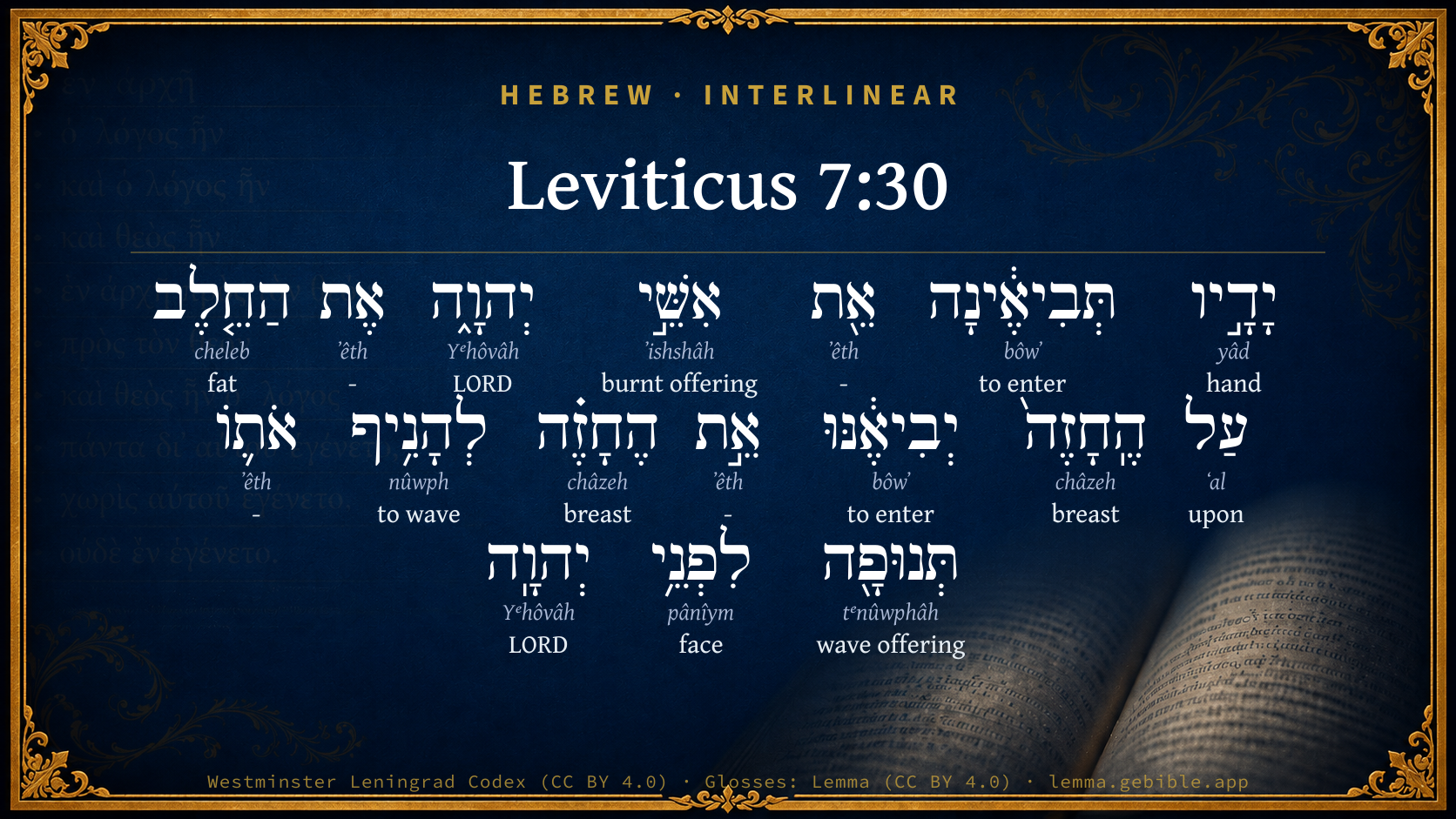
Hebrew (Westminster Leningrad Codex) Leviticus 7:30 appears in the Hebrew Old Testament. The text above is from the Westminster Leningrad Codex. Each word links to its Strong’s number, a concise gloss, and parsing drawn from the Open Scriptures Hebrew Bible morphology. Click any word for its full Brown-Driver-Briggs (BDB) entry.
Download image
Cite this verse

Leviticus 7:30 (World English Bible). Public Domain. Lemma interlinear Bible study tool, https://lemma.gebible.app/v/leviticus/7/30.

Show BibTeX & RIS
BibTeX
RIS
English Translation
With his own hands he shall bring the offerings of Yahweh made by fire. He shall bring the fat with the breast, that the breast may be waved for a wave offering before Yahweh.
World English Bible · Public Domain
Download a study sheet

One document with this verse’s original text, its word-by-word gloss line, the meaning frame, cross-references with their text, attributed commentary, and full source and license credits — printable, and it pastes into notes with its structure intact.

This verse Autodidact and up

Study sheet (.html) Plain text (.txt)

A passage Seminary Student

Up to 50 verses in one chapter. A passage sheet keeps up to 6 commentary sources and 12 cross-references per verse, in the order this page ranks them, and says so on the sheet whenever that leaves anything out. Ask for a single verse and you get the Autodidact verse sheet above.

Everything on this page stays free to read, with no account — the sheet is a download of what is already on screen, not access to it.

Want to remove ads? Support Godless Engineer
Compare translations 3

The same verse in 3 English versions, stacked beneath the original-language interlinear above. Click any original word for its lexicon entry.

Each is an independent rendering of the whole verse — the interlinear is not word-aligned to these translations.

Highlighted words mark where these versions differ — a whole-verse word diff, not a word-by-word alignment.

  • World English Bible Public Domain
    With his own hands he shall bring the offerings of Yahweh made by fire. He shall bring the fat with the breast, that the breast may be waved for a wave offering before Yahweh.
  • King James Version Public Domain
    His own hands shall bring the offerings of the LORD made by fire, the fat with the breast, it shall he bring, that the breast may be waved for a wave offering before the LORD.
  • unfoldingWord Literal Text CC BY-SA 4.0
    His hands shall bring Yahweh’s gift: the fat on the breast. He shall bring the breast to raise it a raised offering to the face of Yahweh.

unfoldingWord Literal Text — © unfoldingWord, licensed CC BY-SA 4.0. Word-aligned USFM3 via Door43 (git.door43.org/unfoldingWord/en_ult).

Versions to compare (up to 4)

3 of 4 selected

Show all 18 translations

Every available English version of this verse, each an independent rendering of the whole verse.

  • World English Bible Public Domain
    With his own hands he shall bring the offerings of Yahweh made by fire. He shall bring the fat with the breast, that the breast may be waved for a wave offering before Yahweh.
  • Berean Standard Bible Public Domain
    With his own hands he is to bring the offerings made by fire to the LORD; he shall bring the fat, together with the breast, and wave the breast as a wave offering before the LORD.
  • Majority Standard Bible Public Domain
    With his own hands he is to bring the food offerings to the LORD; he shall bring the fat, together with the breast, and wave the breast as a wave offering before the LORD.
  • King James Version Public Domain
    His own hands shall bring the offerings of the LORD made by fire, the fat with the breast, it shall he bring, that the breast may be waved for a wave offering before the LORD.
  • American Standard Version (1901) Public Domain
    his own hands shall bring the offerings of Jehovah made by fire; the fat with the breast shall he bring, that the breast may be waved for a wave-offering before Jehovah.
  • Revised Version (1885) Public Domain
    his own hands shall bring the offerings of the LORD made by fire; the fat with the breast shall he bring, that the breast may be waved for a wave offering before the LORD.
  • Geneva Bible (1599) Public Domain
    His handes shall bring the offerings of the Lord made by fire: euen the fatte with the breast shall he bring, that the breast may be shaken to and from before the Lord.
  • Douay-Rheims (1899) Public Domain
    He shall hold in his hands the fat of the victim, and the breast: and when he hath offered and consecrated both to the Lord, he shall deliver them to the priest,
  • Young's Literal Translation Public Domain
    his own hands do bring in the fire-offerings of Jehovah, the fat beside the breast, it he doth bring in with the breast, to wave it -- a wave-offering before Jehovah.
  • Literal Standard Version CC BY-SA 4.0
    his own hands bring in the fire-offerings of YHWH; the fat beside the breast—he brings it in with the breast to wave it [as] a wave-offering before YHWH.
  • Unlocked Literal Bible CC BY-SA 4.0
    The offering for Yahweh to be made by fire, his own hands must bring it. He must bring the fat with the breast, so that the breast may be waved as a wave offering before Yahweh.
  • unfoldingWord Literal Text CC BY-SA 4.0
    His hands shall bring Yahweh’s gift: the fat on the breast. He shall bring the breast to raise it a raised offering to the face of Yahweh.
  • Darby Bible Public Domain
    His own hands shall bring Jehovah's offerings by fire, the fat with the breast shall he bring: the breast, that it may be waved as a wave-offering before Jehovah.
  • World Messianic Bible Public Domain
    With his own hands he shall bring the offerings of the LORD made by fire. He shall bring the fat with the breast, that the breast may be waved for a wave offering before the LORD.
  • Webster's Bible Public Domain
    His own hands shall bring the offerings of the LORD made by fire, the fat with the breast, that shall he bring, that the breast may be waved for a wave-offering before the LORD.
  • Free Bible Version CC BY-SA 4.0
    You must personally bring the food offerings to the Lord; bring the fat as well as the breast, and wave the breast as a wave offering before the Lord.
  • Bible in Basic English Public Domain
    He himself is to take to the Lord the offering made by fire, even the fat with the breast, so that the breast may be waved for a wave offering before the Lord.
  • JPS Tanakh (1917) Public Domain
    His own hands shall bring the offerings of the LORD made by fire: the fat with the breast shall he bring, that the breast may be waved for a wave-offering before the LORD.

Literal Standard Version (2020), Covenant Press — licensed CC BY-SA 4.0. Text via the HelloAO Bible API (eBible.org). Unlocked Literal Bible (unfoldingWord) — licensed CC BY-SA 4.0. Text via the HelloAO Bible API (eBible.org). unfoldingWord Literal Text — © unfoldingWord, licensed CC BY-SA 4.0. Word-aligned USFM3 via Door43 (git.door43.org/unfoldingWord/en_ult). Free Bible Version, Dr. Jonathan Gallagher — licensed CC BY-SA 4.0. Text via the HelloAO Bible API (eBible.org).

Word by word

More ways to search: Search by grammar → Find every occurrence → Compare this word →

Practice this passage: Drill this verse → Learn its vocabulary →

הֶֽחָזֶה֙
châzeh
H2373
“the · breast”
Particle, Definite Article + Noun, Common, Masculine, Singular, Absolute
Part of Speech
Particle + Noun
Type
Common
Gender
Masculine
Number
Singular
State
Absolute
Full BDB Definition

Origin: from H2372

TWOT: 634a

breast (of animals), breast of an animal sacrifice
  1. יָדָ֣יו yâd H3027 “hands · his” Noun, Common, Both, Dual, Construct + Suffix, Personal, 3rd Person, Masculine, Singular
  2. תְּבִיאֶ֔ינָה bôwʼ H935 “to enter” Verb, Hiphil, Imperfect, 3rd Person, Feminine, Plural
  3. אֵ֖ת ʼêth H853 “-” Particle, Direct Object
  4. אִשֵּׁ֣י ʼishshâh H801 “burnt offerings of” Noun, Common, Masculine, Plural, Construct
  5. יְהוָ֑ה Yᵉhôvâh H3068 “LORD” Noun, Proper
  6. אֶת ʼêth H853 “-” Particle, Direct Object
  7. הַחֵ֤לֶב cheleb H2459 “the · fat” Particle, Definite Article + Noun, Common, Masculine, Singular, Absolute
  8. עַל ʻal H5921 “upon” Preposition
  9. יְבִיאֶ֔נּוּ bôwʼ H935 “to enter · him” Verb, Hiphil, Imperfect, 3rd Person, Masculine, Singular + Suffix, Personal, 3rd Person, Masculine, Singular
  10. אֵ֣ת ʼêth H853 “-” Particle, Direct Object
  11. הֶחָזֶ֗ה châzeh H2373 “the · breast” Particle, Definite Article + Noun, Common, Masculine, Singular, Absolute
  12. לְהָנִ֥יף nûwph H5130 “to wave” Preposition + Verb, Hiphil, Infinitive Construct
  13. אֹת֛וֹ ʼêth H853 “- · him” Particle, Direct Object + Suffix, Personal, 3rd Person, Masculine, Singular
  14. תְּנוּפָ֖ה tᵉnûwphâh H8573 “wave offering” Noun, Common, Feminine, Singular, Absolute
  15. לִפְנֵ֥י pânîym H6440 “to/for · face(s) of” Preposition + Noun, Common, Both, Plural, Construct
  16. יְהוָֽה Yᵉhôvâh H3068 “LORD” Noun, Proper

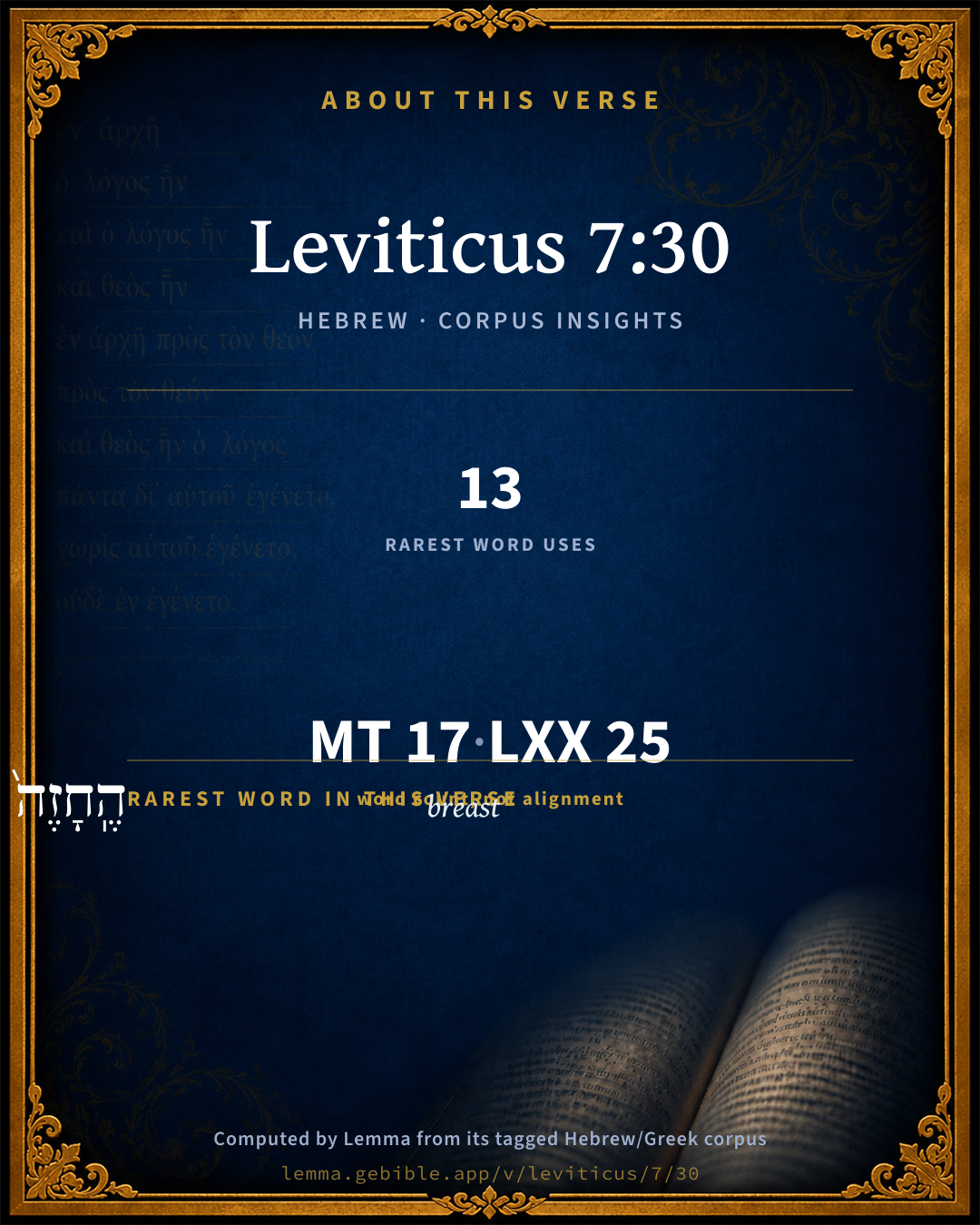
About this verse

These counts appear in no published source. They are computed here, from the morphology-tagged text and Lemma’s own curated glosses. What Lemma adds →

17
words
11
distinct lemmas
Pentateuch
section

Notable vocabulary

The rarest word here is הֶֽחָזֶה֙ breast H2373 — appearing just 13 times in the whole Hebrew Bible.

Shared distinctive vocabulary

הֶֽחָזֶה֙ breast H2373 occurs in 12 verses of the Hebrew Bible. Also found in:

Grammatical profile

  • 3 verbs
  • 9 nouns
  • 1 preposition
  • 4 particles

Verb forms

  • תְּבִיאֶ֔ינָה Hiphil · Imperfect
  • יְבִיאֶ֔נּוּ Hiphil · Imperfect
  • לְהָנִ֥יף Hiphil · Infinitive Construct

Repetition

Words recur within this verse — often emphatic in Hebrew:

  • תְּבִיאֶ֔ינָה to enter H935 ×2
  • יְהוָ֑ה LORD H3068 ×2
  • הֶֽחָזֶה֙ breast H2373 ×2

Hebrew & Septuagint length

In the original languages it is 17 Hebrew tokens and 25 Greek tokens — but the two are counted differently (Hebrew bundles its prefixes and suffixes into one token; the Greek is in lemma form), so that isn’t a like-for-like length.

Cross-references

10

Topical passages linked to Leviticus 7:30 in the Treasury of Scripture Knowledge — connected by theme and wording, ordered by reader-vote popularity; previews shown in the World English Bible.

  • Numbers 6:20 and the priest shall wave them for a wave offering before Yahweh. This is holy for the priest, together with the breast that is waved and the thigh that is offered. After that the Nazirite may drink wine.
  • Leviticus 3:3–4 He shall offer of the sacrifice of peace offerings an offering made by fire to Yahweh; the fat that covers the innards, and all the fat that is on the innards,
  • Leviticus 3:9 He shall offer from the sacrifice of peace offerings an offering made by fire to Yahweh; its fat, the entire tail fat, he shall take away close to the backbone; and the fat that covers the inwards, and all the fat that is on the inwards,
  • Leviticus 3:14 He shall offer from it as his offering, an offering made by fire to Yahweh; the fat that covers the innards, and all the fat that is on the innards,
  • Exodus 29:24–28 You shall put all of this in Aaron's hands, and in his sons' hands, and shall wave them for a wave-offering before Yahweh.
  • Leviticus 8:27 He put all these in Aaron's hands and in his sons' hands, and waved them for a wave offering before Yahweh.
  • Leviticus 9:21 and the breasts and the right thigh Aaron waved for a wave offering before Yahweh, as Moses commanded.
  • Psalms 110:3 Your people offer themselves willingly in the day of your power, in holy array. Out of the womb of the morning, you have the dew of your youth.
  • John 10:18 No one takes it away from me, but I lay it down by myself. I have power to lay it down, and I have power to take it again. I received this commandment from my Father."
  • 2 Corinthians 8:12 For if the readiness is there, it is acceptable according to what you have, not according to what you don't have.

Cross-references courtesy of OpenBible.info (CC BY 4.0).

Hebrew and Greek witnesses Masoretic Hebrew ↔ Greek Septuagint

The same verse in the two great witnesses to the Old Testament, shown verse-for-verse.

These are two independent witnesses, not word-aligned to each other, and the Septuagint is shown in lemma (dictionary) form.

Hebrew Leviticus 7:30 Masoretic · Westminster Leningrad Codex

יָדָ֣יו תְּבִיאֶ֔ינָה אֵ֖ת אִשֵּׁ֣י יְהוָ֑ה אֶת הַחֵ֤לֶב עַל הֶֽחָזֶה֙ יְבִיאֶ֔נּוּ אֵ֣ת הֶחָזֶ֗ה לְהָנִ֥יף אֹת֛וֹ תְּנוּפָ֖ה לִפְנֵ֥י יְהוָֽה

With his own hands he shall bring the offerings of Yahweh made by fire. He shall bring the fat with the breast, that the breast may be waved for a wave offering before Yahweh.

World English Bible · Public Domain

Greek LXX Leviticus 7:30 Septuagint · lemma form

ὁ χείρ αὐτός προςφέρω ὁ κάρπωμα κύριος ὁ στέαρ ὁ ἐπί ὁ στηθύνιον καί ὁ λοβός ὁ ἧπαρ προςφέρω αὐτός ὥστε ἐπιτίθημι δόμα ἔναντι κύριος

No English rendering of this Greek verse — the small residue in the structurally divergent books.

On this verse, Keil & Delitzsch discusses the Septuagint’s reading. Read the note in Commentary ↓

Hebrew: Westminster Leningrad Codex (CC BY 4.0). Greek: Septuagint (public domain); English from a public-domain English Septuagint. How the Septuagint differs from the Hebrew →

Targum (Aramaic paraphrase)

2

The Targum is the ancient Jewish Aramaic paraphrase of the Hebrew Scriptures — an interpretive translation, not the Hebrew text itself. Onkelos (literal) and Pseudo-Jonathan (expansive) render the Torah, and Jonathan the Prophets. Coverage is partial: where no permissively-licensed English translation exists for a verse, only the Aramaic is shown. This is verse-level text, not a word-by-word alignment to the Hebrew.

  1. Targum Onkelos Torah (Genesis–Deuteronomy)
    יְדוֹהִי תַיְתוּן יָת קֻרְבָּנַיָא דַיְיָ יָת תַּרְבָּא עַל חַדְיָא יַיְתִנֵהּ יָת חֶדְיָא לַאֲרָמָא יָתֵהּ אֲרוּמָא קֳדָם יְיָ

    (no public-domain English translation for this verse)

    Targum Onkelos — Aramaic: “Onkelos Genesis” (public domain); “Onkelos Exodus” (public domain); “Onkelos Leviticus” (public domain); “Onkelos Numbers” (public domain); “Onkelos Deuteronomy” (public domain). English: “Sefaria Community Translation” (CC0 1.0 (public-domain dedication)); “J.W. Etheridge. The Targums of Onkelos and Jonathan Ben Uzziel on the Pentateuch. London: Longmans, Green, 1862” (public domain). Text via Sefaria.

  2. Targum Pseudo-Jonathan Torah (Genesis–Deuteronomy)
    יְדוֹי יַיְתִין יַת קוּרְבָּנַיָא דַיְיָ דִי יַפְרֵשׁ מִנִכְסַת קוּדְשֵׁיהּ יַת תַּרְבָּא שׁוּמְנוּנִיתָא דְעַל חַדְיָא וְיַת חַדְיָא כַּד מַחְתָּךְ בִּתְרֵין עִילְעִין מִיכָּא וּתְרֵין עִלְעִין מִיכָּא לִקֳבֵיל אַפְקוֹתָא יַיְתִינֵהּ לַאֲרָמָא יָתֵיהּ אֲרָמָא קֳדָם יְיָ

    His hands shall bring the oblations of the Lord which he would set apart as his hallowed sacrifice, the fat, the fatness that is upon the breast, and the breast cut out with two ribs here and two ribs there at the top, shall be bring to be uplifted, an elevation before the Lord.

    Targum Pseudo-Jonathan — Aramaic: “Targum Jonathan on Genesis” (public domain); “Targum Jonathan on Exodus” (public domain); “Targum Jonathan on Leviticus” (public domain); “Targum Jonathan on Numbers” (public domain); “Targum Jonathan on Deuteronomy” (public domain). English: “The Targum of Jonathan ben Uzziel, trans. J. W. Etheridge, London, 1862” (public domain). Text via Sefaria.

Commentary

Notes on Leviticus 7:30 from classic Christian and Jewish commentators (each source and its license shown beneath its notes). The classic Christian expositions comment on the surrounding passage and are grouped to its opening verse, so a note may address several verses; the Jewish commentaries on the Tanakh (Rashi and others) are per-verse, so they appear only where the commentator wrote on this verse.

Lemma curates 59 commentaries, every one of them public domain or Creative Commons licensed, each selected and text-cleaned for this edition rather than reprinted as found. About our sources →

Trapp's Complete Commentary

John Trapp

Lev 7:30 His own hands shall bring the offerings of the LORD made by fire, the fat with the breast, it shall he bring, that the breast may be waved [for] a wave offering before the LORD.

Ver. 30. His own hands.] Teaching them that they must live by their own faith. {Hab 2:5}

May be waved.] Or, Shaken to and fro; which signified the shaking of our lips in giving thanks to God, {Hos 14:2 Heb 13:15-16} which yet must be fetched lower than the lips, even from the bottom of the heart; the deeper the sweeter. The voice that is made in the mouth is nothing so sweet, as that which comes from the depth of the breast.

John Trapp, A Commentary or Exposition upon All the Books of the Old and New Testament (1647–1656) — public domain. Text from a community e-Sword module.

Geneva Bible (1599)

Geneva Bible translators

And should not send it by another.

Geneva Bible (1599) marginal notes — public domain. Text via Bolls.life.

Adam Clarke's Commentary

Verse 30. Wave-offering] See Clarke on Ex 29:27.

Adam Clarke's Commentary on the Bible (1810–1826) — public domain. Text from a community e-Sword/MySword module.

Ellicott's Commentary for English Readers

(30) His own hands shall bring.—This act the owner himself was to perform, and it was not to be deputed to any one else. The manner in which this rite was performed in the time of Christ was as follows:—The offerer killed the sacrifice, and the priest sprinkled the blood. The victim was then flayed, and the officiating priest took out the inwards, cut the flesh into pieces, and separated the breast and the right shoulder. Whereupon he laid the fat first upon the owner’s hands, then the breast, then the shoulder above it; the two kidneys and the caul of the liver above them again, and the bread above the whole, put his own hand under that of the offerer, and waved it all before the Lord. Hereupon the priest salted the inwards, and burned them upon the altar. The breast and right shoulder, as well as the bread waved before the Lord, were eaten by him and his brother priests, whilst the remainder of the flesh and the rest of the bread were eaten by the owner and his friends. If two persons brought a peace offering in partnership, one of them waved for both; and if a woman brought it, the waving was performed by the officiating priest, since women were not allowed to wave except in the offering of jealousy and of a Nazarite (Num_5:25; Num_6:20).

A Bible Commentary for English Readers, edited by Charles John Ellicott (1878–1897) — public domain. Text from a community e-Sword module.

The Cambridge Bible for Schools and Colleges

gen. ed. J. J. S. Perowne

30. wave offering] The offering was waved towards the altar and back, apparently to express symbolically that it was first given to God and then restored by Him to the priest for his use. See Appendix IV, pp. 183 ff.

The Cambridge Bible for Schools and Colleges (gen. ed. J. J. S. Perowne; Cambridge University Press, 1878–1918) — public domain. Text from a community e-Sword module.

John Gill's Exposition

And the priest shall burn the fat upon the altar,.... Of burnt offering, even the fat upon the inwards, the two kidneys, the flanks, the caul, and liver:

but the breast shall be Aaron's and his sons; which being waved before the Lord for a wave offering, was the Lord's, and so was given to his priests to eat of, for the service done by them, it being but reasonable that they that serve at the altar should live of it; and thus, with other things, a maintenance was provided for the priests and their families, as ought also to be for Gospel ministers under the present dispensation.

John Gill's Exposition of the Whole Bible (1746–1763) — public domain (CC PDM 1.0). Text via the HelloAO Bible API.

Albert Barnes' Notes on the Bible

Wave-offering ... heave-offering - The latter appears to be used (like קרבן qorbân, Lev 1:2) for offerings in general. Waving (a moving to and fro, repeated several times) or heaving (a lifting up once) the offering was a solemn form of dedicating a thing to the use of the sanctuary.

Albert Barnes' Notes on the Bible (1834–1885) — public domain. Text from a community e-Sword/MySword module.

Haydock's Catholic Bible Commentary

CHAPTER VII.

Hands, upon a silver dish. The priest shall direct his hands to form a triple cross. (Cajetan) (Tirinus)

George Leo Haydock (1774–1849), Haydock's Catholic Family Bible and Commentary, 1859 edition — public domain. Excludes Psalms (Douay-Rheims chapter numbering differs from Protestant) and Deuterocanonical books (Catholic canon only).

Matthew Poole's English Annotations

After the beast was killed, and the parts of it divided, the priest was to put the parts mentioned into the hands of the offerer. See Exo 29:22-24.

Made by fire; so called not strictly, as burnt-offerings are, because some parts of these were left for the priest, Lev 7:31; but more largely, because even these peace-offerings were in part, though not wholly, burnt.

The breast may be waved to and fro by his hands, which were supported and directed by the hands of the priest.

Matthew Poole's English Annotations on the Holy Bible (1683–1685) — public domain. Text from a community e-Sword/MySword module.

Whedon's Commentary on the Bible

Daniel D. Whedon

30. A wave offering — The rabbies say that the offering was laid upon the hands of the offerer. The priest, putting his hands beneath, moves the offering to and fro horizontally. But it is not certain from Exo_29:26-27 whether the waving was done by the offerer alone or by the help of the priest. The significance of this peculiar motion is doubtful. The rabbies say that it symbolically teaches that Jehovah is present in every quarter of the earth. The breast thus waved was eaten by the priest and his family.

Daniel D. Whedon (gen. ed.), Commentary on the Old and New Testaments (1874–1909) — public domain. Text from a community e-Sword module.

John Wesley's Explanatory Notes

His own hands - After the beast was killed, and the parts of it divided, the priest was to put the parts mentioned into the hands of the offerer. Offerings made by fire - So called, not strictly, as burnt-offerings are, because some parts of these were left for the priest, but more largely, because even these peace-offerings were in part, tho' not wholly, burnt. Waved - To and fro, by his hands, which were supported and directed by the hands of the priest.

John Wesley, Explanatory Notes Upon the Whole Bible (1754–1765) — public domain. Text via the GEBible commentary corpus.

Keil & Delitzsch

C. F. Keil & F. Delitzsch

His hands were to bring the firings of Jehovah, i.e., the portions to be burned upon the altar (Lev 1:9), viz., "the fat (the fat portions, Lev 3:3-4) with the breast," - the former to be burned upon the altar, the latter "to wave as a wave-offering before Jehovah." חזה, τὸ στηθύνιον (lxx), i.e., according to Pollux, τῶν στηθῶν τὸ μέσον, pectusculum or pectus (Vulg. cf. Lev 9:20-21; Lev 10:15), signifies the breast, the breast-piece of the sacrificial animals,

(Note: The etymology of the word is obscure. According to Winer, Gesenius, and others, it signifies adspectui patens; whilst Meier and Knobel regard it as meaning literally the division, or middle-piece; and Dietrich attributes to it the fundamental signification, "to be moved," viz., the breast, as being the part moved by the heart.)

the brisket, which consists for the most part of cartilaginous fat in the case of oxen, sheep, and goats, and is one of the most savoury parts; so that at the family festivities of the ancients, according to Athen. Deipnos. ii. 70, ix. 10, στηθύνια παχέων ἀρνίων were dainty bits. The breast-piece was presented to the Lord as a wave-offering (tenuphah), and transferred by Him to Aaron and his sons (the priests). תּנוּפה, from נוּף, הניף, to swing, to move to and fro (see Exo 35:22), is the name applied to a ceremony peculiar to the peace-offerings and the consecration-offerings: the priest laid the object to be waved upon the hands of the offerer, and then placed his own hands underneath, and moved the hands of the offerer backwards and forwards in a horizontal direction, to indicate by the movement forwards, i.e., in the direction towards the altar, the presentation of the sacrifice, or the symbolical transference of it to God, and by the movement backwards, the reception of it back again, as a present which God handed over to His servants the priests.

(Note: In the Talmud (cf. Gemar. Kiddush 36, 2, Gem. Succa 37, 2, and Tosaphta Menach. 7, 17), which Maimonides and Rashi follow, tenuphah is correctly interpreted ducebat et reducebat; but some of the later Rabbins (vid., Outram ut sup.) make it out to have been a movement in the direction of the four quarters of the heavens, and Witsius and others find an allusion in this to the omnipresence of God-an allusion which is quite out of character with the occasion.)

In the peace-offerings the waving was performed with the breast-piece, which was called the "wave-breast" in consequence (Lev 7:34; Lev 10:14-15; Num 6:20; Num 18:18; Exo 29:27). At the consecration of the priests it was performed with the fat portions, the right leg, and with some cakes, as well as with the breast of the fill-offering (Lev 8:25-29; Exo 29:22-26). The ceremony of waving was also carried out with the sheaf of first-fruits at the feast of Passover; with the loaves of the first-fruits, and thank-offering lambs, at the feast of Pentecost (Lev 23:11, Lev 23:20); with the shoulder and meat-offering of the Nazarite (Num 6:20); with the trespass-offering of the leper (Lev 14:12, Lev 14:24); with the jealousy-offering (Num 5:25); and lastly with the Levites, at their consecration (Num 8:11.). In the case of all these sacrifices, the object waved, after it had been offered symbolically to the Lord by means of the waving, became the property of the priests. But of the lambs, which were waved at the feast of Pentecost before they were slaughtered, and of the lamb which was brought as a trespass-offering by the leper, the blood and fat were given up to the altar-fire; of the jealousy-offering, only an azcarah; and of the fill-offering, for special reasons, the fat portions and leg, as well as the cakes. Even the Levites were given by Jehovah to the priests to be their own (Num 8:19). The waving, therefore, had nothing in common with the porricere of the Romans, as the portions of the sacrifices which were called porriciae were precisely those which were not only given up to the gods, but burned upon the altars. In addition to the wave-breast, which the Lord gave up to His servants as their share of the peace-offerings, the officiating priest was also to receive for his portion the right leg as a terumah, or heave-offering, or lifting off. שׁוק is the thigh in the case of a man (Isa 47:2; Sol 5:15), and therefore in the case of an animal it is not the fore-leg, or shoulder (βραχηίων, armus), which is called זרע, or the arm (Num 6:19; Deu 18:3), but the hind-leg, or rather the upper part of it or ham, which is mentioned in Sa1 9:24 as a peculiarly choice portion (Knobel). As a portion lifted off from the sacrificial gifts, it is often called "the heave-leg" (v. 34; Lev 10:14-15; Num 6:20; Exo 29:27), because it was lifted or heaved off from the sacrificial animal, as a gift of honour for the officiating priest, but without being waved like the breast-piece-though the more general phrase, "to wave a wave-offering before Jehovah" (Lev 10:15), includes the offering of the heave-leg (see my Archaeologie i. pp. 244-5).

Keil & Delitzsch — Biblical Commentary on the Old Testament (1861–1891) — public domain (CC PDM 1.0). Text via the HelloAO Bible API. (Old Testament only.)

Rashi

Rabbi Shlomo Yitzchaki (Rashi)

'ידיו תביאינה וגו‎ HIS OWN HANDS NAMELY SHALL BRING [THE FIRE OFFERINGS OF THE LORD] — This means that the owner’s hand shall be above and the fat and the breasts shall be lying in it, and the priest’s hand shall be beneath (i. e. beneath the hand of the owner) — and thus does he wave them (Menachot 61b).

‎'את אשי ה‎ THE FIRE OFFERINGS OF THE LORD — and what are these fire-offerings that he shall bring?

‎החזה יביאנו‎ ‎‏ את החלב על‏THE FAT UPON THE BREAST SHALL HE BRING — When he (the first priest; see below) brings it from the slaughtering-place he places the fat upon the breast, and when he afterwards transfers it into the hand of the priest who is to do the waving it follows that the breast is on top and the fat beneath; — that is what Scripture states in another passage, (Leviticus 10:15) “The heave shoulder and the wave breasts shall they bring upon (על) the fire-offerings of the fat, to wave it for a wave offering etc.” (i. e. during the waving the חזה ושוק shall be on top). After the waving he (that priest) transfers it to the priest who is to burn it on the altar, when consequently the breast is again beneath; — that is what Scripture states, (Leviticus 9:20) “And they put the fat upon the breasts, and he burnt the fat at the altar”. Thus we learn that three priests are required for it (for the rite of waving). Thus is it explained in Treatise Menachot 62a.

את החלב על החזה יביאנה THE BREAST WITH THE FAT, IT SHALL HE BRING — And to what end does he bring the breast? This is stated in the words that follow: “[As for the breast], להניף אותו for the purpose of waving it” shall he bring it, and not that it, too, should become part of the fire offerings. But because it states את אשי ה' את החלב על החזה "‎the fire-offerings of the Lord — the fat with the breast”, I might think that the breast also belongs to the fire-offerings, Scripture therefore continues: 'את החזה להניף וגו, “he brings the breast to wave it, etc.”

Rashi on the Tanakh — English translations: “The Judaica Press complete Tanach with Rashi, translated by A. J. Rosenberg” (CC BY 4.0); “Pentateuch with Rashi's commentary by M. Rosenbaum and A.M. Silbermann, 1929-1934” (public domain); “The Metsudah Tanach series, Lakewood, N.J” (CC BY 4.0); and “The Book of Joshua, Metsudah Publications, 1997” (CC BY 4.0). Text via Sefaria.

Ramban (Nachmanides)

Rabbi Moshe ben Nachman (Ramban / Nachmanides)

THE FAT UPON THE BREAST. It appears from this verse according to its plain meaning that the breast was waved with the fat, but not the thigh. Thus the verse which states, And the breasts and the right thigh Aaron waved for a wave-offering, means that afterwards [after he had waved the fats with the breasts], he waved them [i.e., the breasts and the thigh] by themselves. But our Rabbis have said that the priest placed the fats upon the hand of the owner of the offering, with the breast and thigh above them, [and waved them]. According to their opinion, the reason why waving is mentioned only in connection with the breast, is in order to serve the basis for the interpretation which they have said: “If [the parts which are to be waved] became unclean, but one of them was left [which remained clean], whence do we know that it needs waving? Scripture therefore says, that the breast may be waved.”

Ramban (Nachmanides) on the Tanakh — English translation: “Commentary on the Torah by Ramban (Nachmanides). Translated and annotated by Charles B. Chavel. New York, Shilo Pub. House, 1971-1976” (CC BY 4.0). Text via Sefaria.

Lesson kit

Teaching starters — assembled from the data on this page, not authored interpretation. Every prompt links to the verse data it draws on. Edit before teaching.

Leviticus, in the Pentateuch, opens this verse with 17 words (11 distinct Hebrew lemmas). Its most distinctive word is châzeh (“breast”). A historical commentator’s framing appears above. Read the whole chapter for the surrounding context.

Discussion questions

  1. How does “breast” (châzeh) shape what this verse is saying?
  2. Exodus 29:26 shares the word «breast» with this verse. How do the two illuminate each other?
  3. “to enter” occurs 2× in this one verse. What is the effect of the repetition?
  4. These translations render this verse differently. What is at stake in choosing one wording over another?
  5. The verb «תְּבִיאֶ֔ינָה» is Hiphil Imperfect. How does its form color the action?
  6. Reading how Trapp's Complete Commentary and Geneva Bible (1599) read this verse, where do the two commentators agree and where do they part?

Things to notice

Reading settings

Reading text

Shown beneath each verse's original-language words.

Old Testament
Old Testament edition

Read the OT as the Masoretic Hebrew (MT) or the Greek Septuagint (LXX).

English shown for the Greek Septuagint (in the Hebrew ↔ Greek comparison).

Comparing translations? Open the Compare panel on any verse page to stack up to four side by side.