Leviticus 16:26

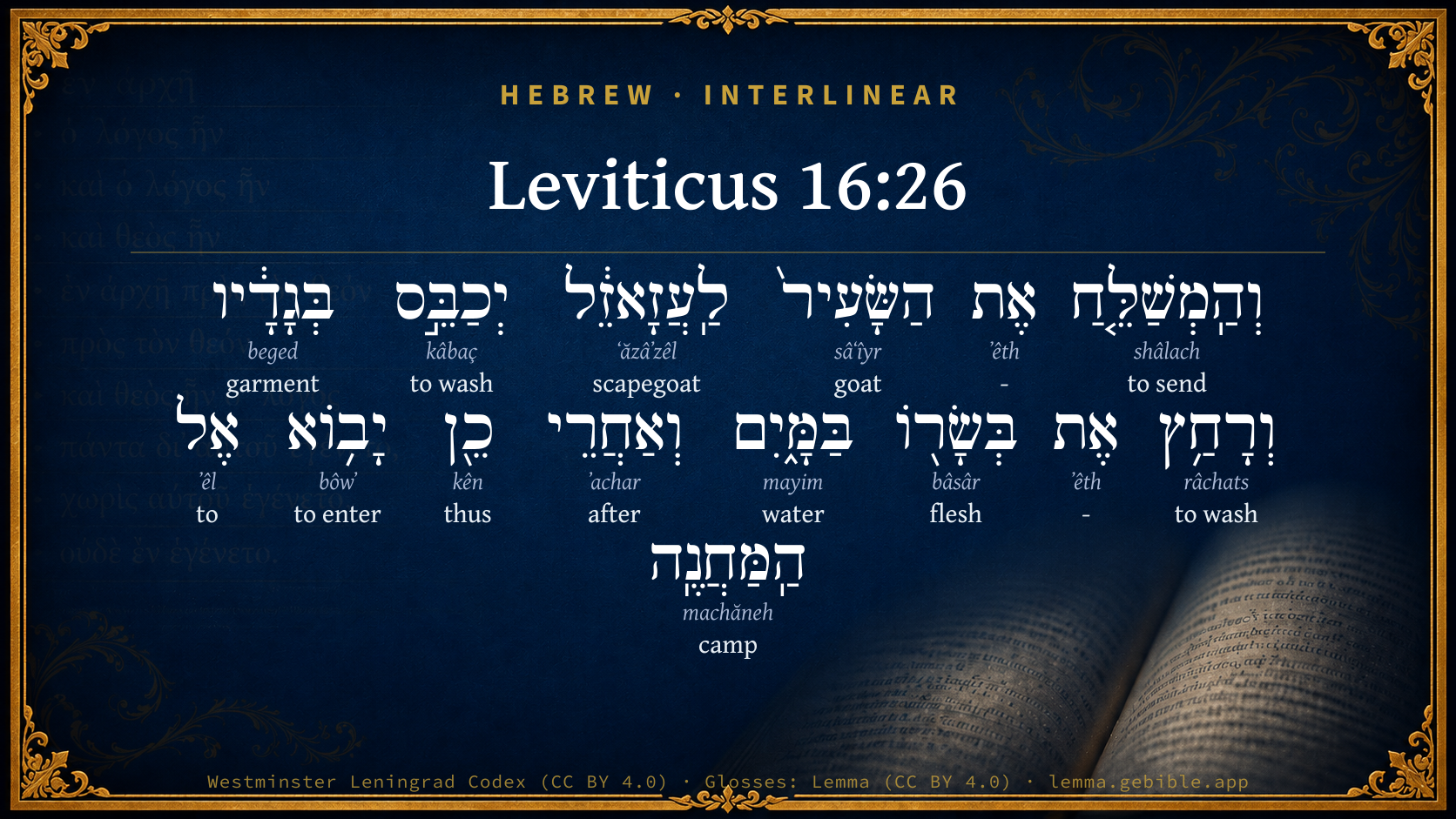
Hebrew (Westminster Leningrad Codex) Leviticus 16:26 appears in the Hebrew Old Testament. The text above is from the Westminster Leningrad Codex. Each word links to its Strong’s number, a concise gloss, and parsing drawn from the Open Scriptures Hebrew Bible morphology. Click any word for its full Brown-Driver-Briggs (BDB) entry.
Download image
Cite this verse

Leviticus 16:26 (World English Bible). Public Domain. Lemma interlinear Bible study tool, https://lemma.gebible.app/v/leviticus/16/26.

Show BibTeX & RIS
BibTeX
RIS
English Translation
"He who lets the goat go for the scapegoat shall wash his clothes, and bathe his flesh in water, and afterward he shall come into the camp.
World English Bible · Public Domain
Download a study sheet

One document with this verse’s original text, its word-by-word gloss line, the meaning frame, cross-references with their text, attributed commentary, and full source and license credits — printable, and it pastes into notes with its structure intact.

This verse Autodidact and up

Study sheet (.html) Plain text (.txt)

A passage Seminary Student

Up to 50 verses in one chapter. A passage sheet keeps up to 6 commentary sources and 12 cross-references per verse, in the order this page ranks them, and says so on the sheet whenever that leaves anything out. Ask for a single verse and you get the Autodidact verse sheet above.

Everything on this page stays free to read, with no account — the sheet is a download of what is already on screen, not access to it.

Want to remove ads? Support Godless Engineer
Compare translations 3

The same verse in 3 English versions, stacked beneath the original-language interlinear above. Click any original word for its lexicon entry.

Each is an independent rendering of the whole verse — the interlinear is not word-aligned to these translations.

Highlighted words mark where these versions differ — a whole-verse word diff, not a word-by-word alignment.

  • World English Bible Public Domain
    "He who lets the goat go for the scapegoat shall wash his clothes, and bathe his flesh in water, and afterward he shall come into the camp.
  • King James Version Public Domain
    And he that let go the goat for the scapegoat shall wash his clothes, and bathe his flesh in water, and afterward come into the camp.
  • unfoldingWord Literal Text CC BY-SA 4.0
    And the person sending away the goat as scapegoat shall wash his clothes, and he shall bathe his flesh in the water. And after thus, he shall enter into the camp.

unfoldingWord Literal Text — © unfoldingWord, licensed CC BY-SA 4.0. Word-aligned USFM3 via Door43 (git.door43.org/unfoldingWord/en_ult).

Versions to compare (up to 4)

3 of 4 selected

Show all 18 translations

Every available English version of this verse, each an independent rendering of the whole verse.

  • World English Bible Public Domain
    "He who lets the goat go for the scapegoat shall wash his clothes, and bathe his flesh in water, and afterward he shall come into the camp.
  • Berean Standard Bible Public Domain
    The man who released the goat as the scapegoat must wash his clothes and bathe himself with water; afterward he may reenter the camp.
  • Majority Standard Bible Public Domain
    The man who released the goat as the scapegoat must wash his clothes and bathe himself with water; afterward he may reenter the camp.
  • King James Version Public Domain
    And he that let go the goat for the scapegoat shall wash his clothes, and bathe his flesh in water, and afterward come into the camp.
  • American Standard Version (1901) Public Domain
    And he that letteth go the goat for Azazel shall wash his clothes, and bathe his flesh in water, and afterward he shall come into the camp.
  • Revised Version (1885) Public Domain
    And he that letteth go the goat for Azazel shall wash his clothes, and bathe his flesh in water, and afterward he shall come into the camp.
  • Geneva Bible (1599) Public Domain
    And he that caried forth the goat, called the Scape goat, shall wash his clothes, and wash his flesh in water, and after that shall come into the hoste.
  • Douay-Rheims (1899) Public Domain
    But he that hath let go the emissary goat, shall wash his clothes, and his body with water, and so shall enter into the camp.
  • Young's Literal Translation Public Domain
    `And he who is sending away the goat for a goat of departure doth wash his garments, and hath bathed his flesh with water, and afterwards he cometh in unto the camp.
  • Literal Standard Version CC BY-SA 4.0
    And he who is sending the goat away for a goat of departure washes his garments, and has bathed his flesh with water, and afterward he comes into the camp.
  • Unlocked Literal Bible CC BY-SA 4.0
    The man who let the scapegoat go free must wash his clothes and bathe his body in water; after that, he may come back into the camp.
  • unfoldingWord Literal Text CC BY-SA 4.0
    And the person sending away the goat as scapegoat shall wash his clothes, and he shall bathe his flesh in the water. And after thus, he shall enter into the camp.
  • Darby Bible Public Domain
    And he that letteth go the goat for Azazel shall wash his clothes, and bathe his flesh in water; and afterwards he may come into the camp.
  • World Messianic Bible Public Domain
    “He who lets the goat go as the scapegoat shall wash his clothes, and bathe his flesh in water, and afterward he shall come into the camp.
  • Webster's Bible Public Domain
    And he that let go the goat for the scape-goat shall wash his clothes, and bathe his flesh in water, and afterward come into the camp.
  • Free Bible Version CC BY-SA 4.0
    The man who went and sent away the scapegoat must wash his clothes and wash himself with water; then he may come back into the camp.
  • Bible in Basic English Public Domain
    And the man who takes away the goat for Azazel is to have his clothing washed and his body bathed in water and then he may come back to the tent-circle.
  • JPS Tanakh (1917) Public Domain
    And he that letteth go the goat for Azazel shall wash his clothes, and bathe his flesh in water, and afterward he may come into the camp.

Literal Standard Version (2020), Covenant Press — licensed CC BY-SA 4.0. Text via the HelloAO Bible API (eBible.org). Unlocked Literal Bible (unfoldingWord) — licensed CC BY-SA 4.0. Text via the HelloAO Bible API (eBible.org). unfoldingWord Literal Text — © unfoldingWord, licensed CC BY-SA 4.0. Word-aligned USFM3 via Door43 (git.door43.org/unfoldingWord/en_ult). Free Bible Version, Dr. Jonathan Gallagher — licensed CC BY-SA 4.0. Text via the HelloAO Bible API (eBible.org).

Word by word

More ways to search: Search by grammar → Find every occurrence → Compare this word →

Practice this passage: Drill this verse → Learn its vocabulary →

לַֽעֲזָאזֵ֔ל
ʻăzâʼzêl
H5799
“to/for · scapegoat”
Preposition + Noun, Proper
Part of Speech
Preposition + Noun
Type
Proper
Full BDB Definition

Origin: from H5795 and H235

TWOT: 1593

entire removal, scapegoat - refers to the goat used for sacrifice for the sins of the people - meaning dubious
  1. וְהַֽמְשַׁלֵּ֤חַ shâlach H7971 “and · the · sending” Conjunction + Particle, Definite Article + Verb, Piel, Participle Active, Masculine, Singular, Absolute
  2. אֶת ʼêth H853 “-” Particle, Direct Object
  3. הַשָּׂעִיר֙ sâʻîyr H8163 “the · goat” Particle, Definite Article + Noun, Common, Masculine, Singular, Absolute
  4. יְכַבֵּ֣ס kâbaç H3526 “to wash” Verb, Piel, Imperfect, 3rd Person, Masculine, Singular
  5. בְּגָדָ֔יו beged H899 “garments · his” Noun, Common, Masculine, Plural, Construct + Suffix, Personal, 3rd Person, Masculine, Singular
  6. וְרָחַ֥ץ râchats H7364 “and · to wash” Conjunction + Verb, Qal, Sequential Perfect, 3rd Person, Masculine, Singular
  7. אֶת ʼêth H853 “-” Particle, Direct Object
  8. בְּשָׂר֖וֹ bâsâr H1320 “flesh · his” Noun, Common, Masculine, Singular, Construct + Suffix, Personal, 3rd Person, Masculine, Singular
  9. בַּמָּ֑יִם mayim H4325 “in/at the · water(s)” Preposition, Determined + Noun, Common, Masculine, Plural, Absolute
  10. וְאַחֲרֵי ʼachar H310 “and · after” Conjunction + Preposition
  11. כֵ֖ן kên H3651 “thus” Adverb
  12. יָב֥וֹא bôwʼ H935 “to enter” Verb, Qal, Imperfect, 3rd Person, Masculine, Singular
  13. אֶל ʼêl H413 “to” Preposition
  14. הַֽמַּחֲנֶֽה machăneh H4264 “the · camp” Particle, Definite Article + Noun, Common, Both, Singular, Absolute

About this verse

These counts appear in no published source. They are computed here, from the morphology-tagged text and Lemma’s own curated glosses. What Lemma adds →

15
words
14
distinct lemmas
Pentateuch
section

Notable vocabulary

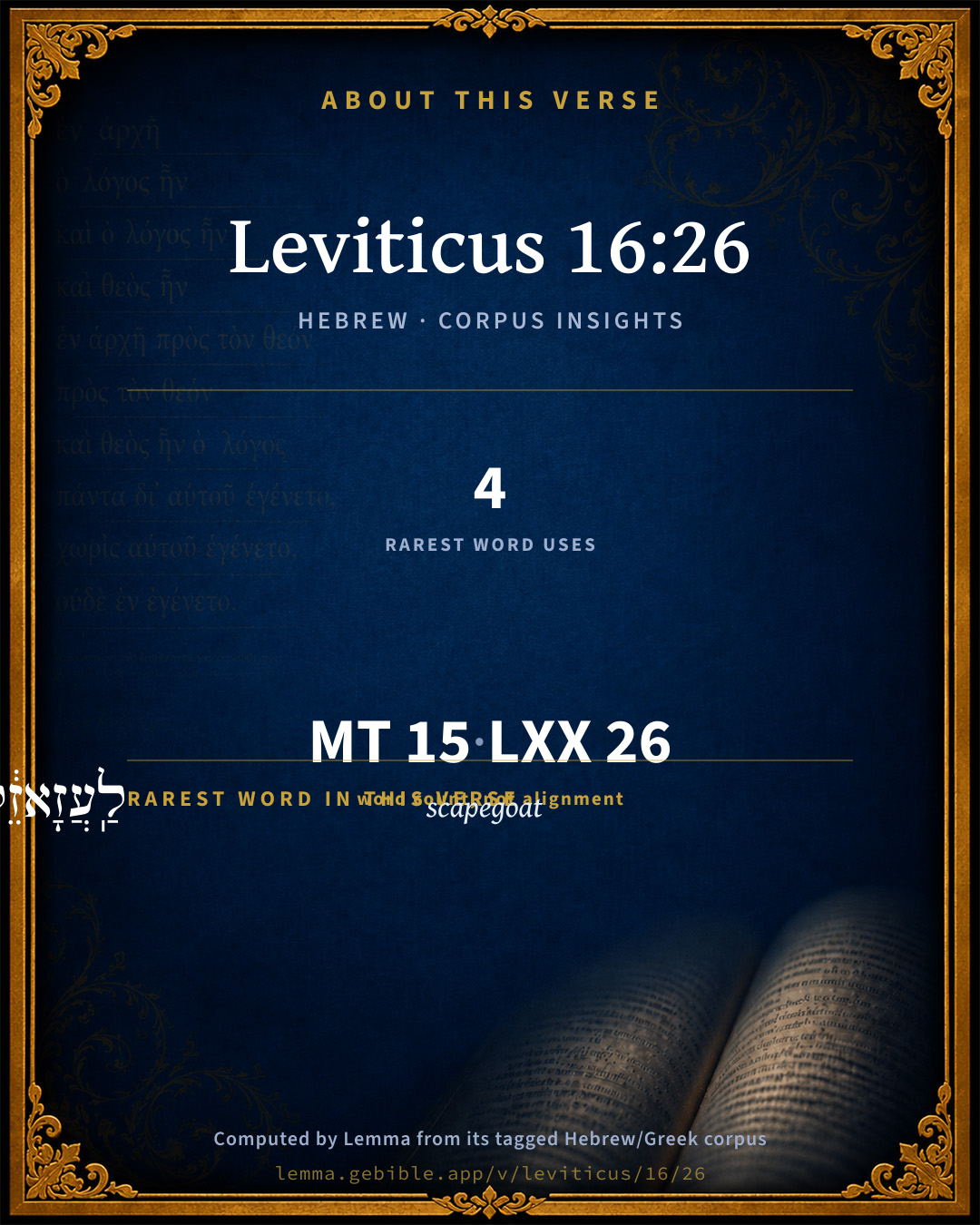
The rarest word here is לַֽעֲזָאזֵ֔ל scapegoat H5799 — appearing just 4 times in the whole Hebrew Bible.

Shared distinctive vocabulary

לַֽעֲזָאזֵ֔ל scapegoat H5799 occurs in 3 verses of the Hebrew Bible. Also found in:

Grammatical profile

  • 4 verbs
  • 6 nouns
  • 2 prepositions
  • 1 adverb
  • 2 particles

Verb forms

  • וְהַֽמְשַׁלֵּ֤חַ Piel · Participle Active
  • יְכַבֵּ֣ס Piel · Imperfect
  • וְרָחַ֥ץ Qal · Sequential Perfect
  • יָב֥וֹא Qal · Imperfect

Hebrew & Septuagint length

In English translation the verse runs 27 words from the Hebrew and 33 from the Septuagint (LXX English) — closely comparable.

A rough comparison of the two English renderings, which tokenize alike — not a word-level alignment.

Word counts can differ between the Hebrew and the Greek without any difference in meaning — e.g. the Hebrew direct-object marker אֵת has no separate Greek word, and Greek often adds the article ὁ.

In the original languages it is 15 Hebrew tokens and 26 Greek tokens — but the two are counted differently (Hebrew bundles its prefixes and suffixes into one token; the Greek is in lemma form), so that isn’t a like-for-like length.

Cross-references

10

Topical passages linked to Leviticus 16:26 in the Treasury of Scripture Knowledge — connected by theme and wording, ordered by reader-vote popularity; previews shown in the World English Bible.

  • Leviticus 16:10 But the goat, on which the lot fell for the scapegoat, shall be presented alive before Yahweh, to make atonement for him, to send him away for the scapegoat into the wilderness.
  • Hebrews 7:19 (for the law made nothing perfect), and a bringing in thereupon of a better hope, through which we draw near to God.
  • Leviticus 11:25 Whoever carries any part of their carcass shall wash his clothes, and be unclean until the evening.
  • Leviticus 14:8 "He who is to be cleansed shall wash his clothes, and shave off all his hair, and bathe himself in water; and he shall be clean. After that he shall come into the camp, but shall dwell outside his tent seven days.
  • Leviticus 15:5–11 Whoever touches his bed shall wash his clothes, and bathe himself in water, and be unclean until the evening.
  • Leviticus 15:27 Whoever touches these things shall be unclean, and shall wash his clothes, and bathe himself in water, and be unclean until the evening.
  • Leviticus 16:21–22 Aaron shall lay both his hands on the head of the live goat, and confess over him all the iniquities of the children of Israel, and all their transgressions, even all their sins; and he shall put them on the head of the goat, and shall send him away into the wilderness by the hand of a man who is in readiness.
  • Leviticus 16:28 He who burns them shall wash his clothes, and bathe his flesh in water, and afterward he shall come into the camp.
  • Numbers 19:7–8 Then the priest shall wash his clothes, and he shall bathe his flesh in water, and afterward he shall come into the camp, and the priest shall be unclean until the even.
  • Numbers 19:21 It shall be a perpetual statute to them: and he who sprinkles the water for impurity shall wash his clothes, and he who touches the water for impurity shall be unclean until even.

Cross-references courtesy of OpenBible.info (CC BY 4.0).

Hebrew and Greek witnesses Masoretic Hebrew ↔ Greek Septuagint

The same verse in the two great witnesses to the Old Testament, shown verse-for-verse.

These are two independent witnesses, not word-aligned to each other, and the Septuagint is shown in lemma (dictionary) form.

Hebrew Leviticus 16:26 Masoretic · Westminster Leningrad Codex

וְהַֽמְשַׁלֵּ֤חַ אֶת הַשָּׂעִיר֙ לַֽעֲזָאזֵ֔ל יְכַבֵּ֣ס בְּגָדָ֔יו וְרָחַ֥ץ אֶת בְּשָׂר֖וֹ בַּמָּ֑יִם וְאַחֲרֵי כֵ֖ן יָב֥וֹא אֶל הַֽמַּחֲנֶֽה

"He who lets the goat go for the scapegoat shall wash his clothes, and bathe his flesh in water, and afterward he shall come into the camp.

World English Bible · Public Domain

Greek LXX Leviticus 16:26 Septuagint · lemma form

καί ὁ ἐκ ἀποστέλλω ὁ χίμαρος ὁ διαστέλλω εἰς ἄφεσις πλύνω ὁ ἱμάτιον καί λούω ὁ σῶμα αὐτός ὕδωρ καί μετά οὗτος εἰςἔρχομαι εἰς ὁ παρεμβολή

And he that sends forth the goat that has been set apart to be let go, shall wash his garments, and bathe his body in water, and afterwards shall enter into the camp.

LXX2012 (modern English Septuagint) · Public Domain

Hebrew: Westminster Leningrad Codex (CC BY 4.0). Greek: Septuagint (public domain); English from LXX2012 (modern English Septuagint) (Public Domain). How the Septuagint differs from the Hebrew →

Targum (Aramaic paraphrase)

2

The Targum is the ancient Jewish Aramaic paraphrase of the Hebrew Scriptures — an interpretive translation, not the Hebrew text itself. Onkelos (literal) and Pseudo-Jonathan (expansive) render the Torah, and Jonathan the Prophets. Coverage is partial: where no permissively-licensed English translation exists for a verse, only the Aramaic is shown. This is verse-level text, not a word-by-word alignment to the Hebrew.

  1. Targum Onkelos Torah (Genesis–Deuteronomy)
    וּדְמוֹבִיל יָת צְפִירָא לַעֲזָאזֵל יְצַבַּע לְבוּשׁוֹהִי וְיַסְחֵי יָת בִּסְרֵהּ בְּמַיָא וּבָתַר כֵּן יֵיעוֹל לְמַשְׁרִיתָא

    (no public-domain English translation for this verse)

    Targum Onkelos — Aramaic: “Onkelos Genesis” (public domain); “Onkelos Exodus” (public domain); “Onkelos Leviticus” (public domain); “Onkelos Numbers” (public domain); “Onkelos Deuteronomy” (public domain). English: “Sefaria Community Translation” (CC0 1.0 (public-domain dedication)); “J.W. Etheridge. The Targums of Onkelos and Jonathan Ben Uzziel on the Pentateuch. London: Longmans, Green, 1862” (public domain). Text via Sefaria.

  2. Targum Pseudo-Jonathan Torah (Genesis–Deuteronomy)
    וּדְיִפְטוֹר צְפִירָא לַעֲזָאזֵל יְצַבַּע יַת לְבוּשׁוֹי וְיַסְחֵי יַת בִּישְרֵיהּ בְּאַרְבְּעִין סָאוִוין דְמוֹי וּמִן בָּתַר כְּדֵין יֵיעוֹל לְמַשְׁרִיתָא

    And he who led away the goat to Azazel shall wash his clothes, and bathe his flesh in forty seahs of water, and afterward he may enter the camp.

    Targum Pseudo-Jonathan — Aramaic: “Targum Jonathan on Genesis” (public domain); “Targum Jonathan on Exodus” (public domain); “Targum Jonathan on Leviticus” (public domain); “Targum Jonathan on Numbers” (public domain); “Targum Jonathan on Deuteronomy” (public domain). English: “The Targum of Jonathan ben Uzziel, trans. J. W. Etheridge, London, 1862” (public domain). Text via Sefaria.

Commentary

Notes on Leviticus 16:26 from classic Christian and Jewish commentators (each source and its license shown beneath its notes). The classic Christian expositions comment on the surrounding passage and are grouped to its opening verse, so a note may address several verses; the Jewish commentaries on the Tanakh (Rashi and others) are per-verse, so they appear only where the commentator wrote on this verse.

Lemma curates 59 commentaries, every one of them public domain or Creative Commons licensed, each selected and text-cleaned for this edition rather than reprinted as found. About our sources →

The Cambridge Bible for Schools and Colleges

gen. ed. J. J. S. Perowne

26–28. The bullock and the goat for the Sin-Offerings were not eaten, as their blood had been brought into the holy place (Lev_6:30). They were carried forth and burnt in the fire. The ordinary Heb. word for ‘burn’ is here used—the burning was not sacrificial. The Sin-Offering was most holy (Lev_6:25). Whatsoever touched the flesh thereof was holy (Lev_6:27), and those who carried them out must remove the contagion of holiness by washing their clothes and bathing. The same ceremony was required of the man that let go the goat for Azazel (Lev_16:26). Whether this goat was regarded as sin-laden and unclean, or whether it shared the holiness of the Sin-Offering (the two goats constitute the Sin-Offering; see Lev_16:5), is not stated. It may be noted that in Lev_4:1-21 those who carried the Sin-Offerings outside are not required to undergo this rite of washing and bathing.

The Cambridge Bible for Schools and Colleges (gen. ed. J. J. S. Perowne; Cambridge University Press, 1878–1918) — public domain. Text from a community e-Sword module.

Trapp's Complete Commentary

John Trapp

Lev 16:26 And he that let go the goat for the scapegoat shall wash his clothes, and bathe his flesh in water, and afterward come into the camp.

Ver. 26. Shall wash his clothes.] To show, (1.) That it was for our sins that Christ suffered; (2.) That all that partake of his benefits must wash their hearts from wickedness. {Jer 4:14; 2Co 5:15; 2Co 7:1}

John Trapp, A Commentary or Exposition upon All the Books of the Old and New Testament (1647–1656) — public domain. Text from a community e-Sword module.

Adam Clarke's Commentary

Verse 26. He that let go the goat - shall wash, &c.] Not only the person who led him away, but the priest who consecrated him, was reputed unclean, because the goat himself was unclean, being considered as bearing the sins of the whole congregation. On this account both the priest and the person who led him to the wilderness were obliged to wash their clothes and bathe themselves, before they could come into the camp.

Adam Clarke's Commentary on the Bible (1810–1826) — public domain. Text from a community e-Sword/MySword module.

Ellicott's Commentary for English Readers

(26) And he that let go the goat for the scapegoat.—Better, And he that leadeth away the goat to Azazel (see Lev_16:10). As the messenger who conducted the sin-laden animal to the author of sin contracted defilement by the impurity which the victim carried away, he had both to wash his clothes and immerse his whole body in water before he was admitted into the camp. During the second Temple he remained in the last booth, which was a mile from Jerusalem, till sundown, when he was re-admitted into the camp.

A Bible Commentary for English Readers, edited by Charles John Ellicott (1878–1897) — public domain. Text from a community e-Sword module.

John Gill's Exposition

And the bullock for the sin offering, and the goat for the sin offering,.... The one for Aaron and his family, the other for the people of Israel, of which see Lev 16:5,

whose blood was brought in to make an atonement in the holy place; the holy of holies, where it was brought and sprinkled, as directed inLev 16:14,

shall one carry forth without the camp; by command, as Aben Ezra observes; by the order of the high priest; and, perhaps, more than one was employed to carry out those carcasses, they being too large for one man, and as it seems from a following clause; and the Targum of Jonathan is,

"they shall be carried out on staves by the hands of the junior priests;

so Jarchi says (r), four men carried two staves, two before and two behind, and they went staff by staff, and the bullock and the goat were upon them, and they carried them one upon another: this was done after the high priest had done to them what was necessary; for so it is said, he went to the bullock and to the goat that were to be burnt; he ripped them up and took out their inwards, and put them in a bowl, and offered them on the top of the altar; and cut them with cuttings (made incisions into the flesh of them, but did not part it), and ordered them to be carried out to the place of burning, which was without the camp of Israel, and afterwards without the city of Jerusalem: the mystery of this, and the application of it to Christ, setting forth the nature and place of Christs sufferings, are fully and largely expressed by the apostle in Heb 13:11,

and they shall burn in the fire their skins, and their flesh, and their dung; the priests, as Aben Ezra; for there were more than one concerned, as in carrying them out, so in the burning of them: the high priest was not concerned in it, for while these were burning he was reading, as observed on Lev 16:24; so that he that saw, the high priest when he was reading, saw not the bullock and the goat when they were burnt; and he that saw the bullock and the goat burnt, saw not the high priest when he read; not because it was not lawful, but because the way was distant, and the business of both was done together (s): this was done in a place called the place of ashes (t), where the ashes of the altar of burnt offering were carried; See Gill on Lev 4:11 andSee Gill on Lev 4:12.

(r) In Misn. Yoma, c. 6. sect. 7. (s) Misn. Yoma, c. 7, sect. 2. (t) Misn. Zebachim, c. 5. sect. 2. & c. 12. sect. 5.

John Gill's Exposition of the Whole Bible (1746–1763) — public domain (CC PDM 1.0). Text via the HelloAO Bible API.

Albert Barnes' Notes on the Bible

Both he who led away the goat, and he who burned the parts of the sin-offerings had to purify themselves. They who went out of the camp during a religious solemnity incurred uncleanness; hence, the need of purification.

Lev 16:27

Shall burn in the fire - i. e., consume in the fire, not burn sacrificially. See Lev 1:9.

Albert Barnes' Notes on the Bible (1834–1885) — public domain. Text from a community e-Sword/MySword module.

Haydock's Catholic Bible Commentary

Camp. This was always required of those who had burnt the bodies of the victims out of the camp, as ver. 28, and Numbers xix. 7. (Outram.) --- In some of the sacrifices for sin, the priests might eat part of the flesh. But here all was consumed, as the victim was offered for the sins of all.

George Leo Haydock (1774–1849), Haydock's Catholic Family Bible and Commentary, 1859 edition — public domain. Excludes Psalms (Douay-Rheims chapter numbering differs from Protestant) and Deuterocanonical books (Catholic canon only).

Matthew Poole's English Annotations

He shall wash his clothes, because he had contracted some degree of ceremonial uncleanness by the touch of the goat.

Matthew Poole's English Annotations on the Holy Bible (1683–1685) — public domain. Text from a community e-Sword/MySword module.

The Pulpit Commentary

The man that let go the goat which served for a remover of sins is to wash his clothes, and bathe his flesh before he comes into the comp. This is not ordered on account of any special defilement attaching to the scapegoat, but only because it had been the symbolical sin-bearer, and therefore conveyed legal uncleanness by its touch. The man who bore the flesh of the ether goat to be burnt had to do exactly the same thing (verse 25).

The Pulpit Commentary (1880–1919), ed. H.D.M. Spence-Jones & Joseph S. Exell — public domain. Text from a community e-Sword module.

Keil & Delitzsch

C. F. Keil & F. Delitzsch

The man who took the goat into the desert, and those who burned the two sin-offerings outside the camp (see at Lev 4:11, Lev 4:21), had also to wash their clothes and bathe their bodies before they returned to the camp, because they had been defiled by the animals laden with sin.

Keil & Delitzsch — Biblical Commentary on the Old Testament (1861–1891) — public domain (CC PDM 1.0). Text via the HelloAO Bible API. (Old Testament only.)

Lesson kit

Teaching starters — assembled from the data on this page, not authored interpretation. Every prompt links to the verse data it draws on. Edit before teaching.

Leviticus, in the Pentateuch, opens this verse with 15 words (14 distinct Hebrew lemmas). Its most distinctive word is ʻăzâʼzêl (“scapegoat”). A historical commentator’s framing appears above. Read the whole chapter for the surrounding context.

Discussion questions

  1. How does “scapegoat” (ʻăzâʼzêl) shape what this verse is saying?
  2. How does Leviticus 16:8, which shares the word «scapegoat», read alongside this verse?
  3. These translations render this verse differently. What is at stake in choosing one wording over another?
  4. «וְהַֽמְשַׁלֵּ֤חַ» is a Piel Participle Active verb. How does that grammatical form shape the action described?
  5. Compare how The Cambridge Bible for Schools and Colleges and Trapp's Complete Commentary read this verse. Where do they agree or differ?

Things to notice

Reading settings

Reading text

Shown beneath each verse's original-language words.

Old Testament
Old Testament edition

Read the OT as the Masoretic Hebrew (MT) or the Greek Septuagint (LXX).

English shown for the Greek Septuagint (in the Hebrew ↔ Greek comparison).

Comparing translations? Open the Compare panel on any verse page to stack up to four side by side.