

Leviticus 13:2

Hebrew (Westminster Leningrad Codex) Leviticus 13:2 appears in the Hebrew Old Testament. The text above is from the Westminster Leningrad Codex. Each word links to its Strong’s number, a concise gloss, and parsing drawn from the Open Scriptures Hebrew Bible morphology. Click any word for its full Brown-Driver-Briggs (BDB) entry.
Download image
Cite this verse

Leviticus 13:2 (World English Bible). Public Domain. Lemma interlinear Bible study tool, https://lemma.gebible.app/v/leviticus/13/2.

Show BibTeX & RIS
BibTeX
RIS
English Translation
"When a man shall have a rising in his body's skin, or a scab, or a bright spot, and it becomes in the skin of his body the plague of leprosy, then he shall be brought to Aaron the priest, or to one of his sons the priests:
World English Bible · Public Domain
Highlights
  • 3 first appearances in the Hebrew Bible
Full analysis ↓
Download a study sheet

One document with this verse’s original text, its word-by-word gloss line, the meaning frame, cross-references with their text, attributed commentary, and full source and license credits — printable, and it pastes into notes with its structure intact.

This verse Autodidact and up

Study sheet (.html) Plain text (.txt)

A passage Seminary Student

Up to 50 verses in one chapter. A passage sheet keeps up to 6 commentary sources and 12 cross-references per verse, in the order this page ranks them, and says so on the sheet whenever that leaves anything out. Ask for a single verse and you get the Autodidact verse sheet above.

Everything on this page stays free to read, with no account — the sheet is a download of what is already on screen, not access to it.

Want to remove ads? Support Godless Engineer
Compare translations 3

The same verse in 3 English versions, stacked beneath the original-language interlinear above. Click any original word for its lexicon entry.

Each is an independent rendering of the whole verse — the interlinear is not word-aligned to these translations.

Highlighted words mark where these versions differ — a whole-verse word diff, not a word-by-word alignment.

  • World English Bible Public Domain
    "When a man shall have a rising in his body's skin, or a scab, or a bright spot, and it becomes in the skin of his body the plague of leprosy, then he shall be brought to Aaron the priest, or to one of his sons the priests:
  • King James Version Public Domain
    When a man shall have in the skin of his flesh a rising, a scab, or bright spot, and it be in the skin of his flesh like the plague of leprosy; then he shall be brought unto Aaron the priest, or unto one of his sons the priests:
  • unfoldingWord Literal Text CC BY-SA 4.0
    “A man, when he has on the skin of his flesh a swelling or a scab or a bright spot, and it becomes on the skin of his flesh an infection of skin disease, then he shall be brought to Aaron the priest or to one from his sons the priests.

unfoldingWord Literal Text — © unfoldingWord, licensed CC BY-SA 4.0. Word-aligned USFM3 via Door43 (git.door43.org/unfoldingWord/en_ult).

Versions to compare (up to 4)

3 of 4 selected

Show all 18 translations

Every available English version of this verse, each an independent rendering of the whole verse.

  • World English Bible Public Domain
    "When a man shall have a rising in his body's skin, or a scab, or a bright spot, and it becomes in the skin of his body the plague of leprosy, then he shall be brought to Aaron the priest, or to one of his sons the priests:
  • Berean Standard Bible Public Domain
    “When someone has a swelling or rash or bright spot on his skin that could become an infectious skin disease, he must be brought to Aaron the priest or to one of his sons who is a priest.
  • Majority Standard Bible Public Domain
    “When someone has a swelling or rash or bright spot on his skin that may be an infectious skin disease, he must be brought to Aaron the priest or to one of his sons who is a priest.
  • King James Version Public Domain
    When a man shall have in the skin of his flesh a rising, a scab, or bright spot, and it be in the skin of his flesh like the plague of leprosy; then he shall be brought unto Aaron the priest, or unto one of his sons the priests:
  • American Standard Version (1901) Public Domain
    When a man shall have in the skin of his flesh a rising, or a scab, or a bright spot, and it become in the skin of his flesh the plague of leprosy, then he shall be brought unto Aaron the priest, or unto one of his sons the priests:
  • Revised Version (1885) Public Domain
    When a man shall have in the skin of his flesh a rising, or a scab, or a bright spot, and it become in the skin of his flesh the plague of leprosy, then he shall be brought unto Aaron the priest, or unto one of his sons the priests:
  • Geneva Bible (1599) Public Domain
    The man that shall haue in the skin of his flesh a swelling or a skab, or a white spot, so that in the skinne of his flesh it be like the plague of leprosie, then he shalbe brought vnto Aaron the Priest, or vnto one of his sonnes the Priestes,
  • Douay-Rheims (1899) Public Domain
    The man in whose skin or flesh shalt arise a different colour or a blister, or as it were something shining, that is, the stroke of the leprosy, shall be brought to Aaron the priest, or any one of his sons.
  • Young's Literal Translation Public Domain
    `When a man hath in the skin of his flesh a rising, or scab, or bright spot, and it hath become in the skin of his flesh a leprous plague, then he hath been brought in unto Aaron the priest, or unto one of his sons the priests;
  • Literal Standard Version CC BY-SA 4.0
    “When a man has a rising, or scab, or bright spot in the skin of his flesh, and it has become a leprous plague in the skin of his flesh, then he has been brought to Aaron the priest, or to one of his sons the priests;
  • Unlocked Literal Bible CC BY-SA 4.0
    “When anyone has on the skin of his body a swelling or scab or a bright spot, and it becomes infected and there is a skin disease in his body, then he must be brought to Aaron the high priest, or to one of his sons the priests.
  • unfoldingWord Literal Text CC BY-SA 4.0
    “A man, when he has on the skin of his flesh a swelling or a scab or a bright spot, and it becomes on the skin of his flesh an infection of skin disease, then he shall be brought to Aaron the priest or to one from his sons the priests.
  • Darby Bible Public Domain
    When a man shall have in the skin of his flesh a rising or a scab, or bright spot, and it become in the skin of his flesh a sore [as] of leprosy, then he shall be brought unto Aaron the priest, or unto one of his sons the priests.
  • World Messianic Bible Public Domain
    “When a man shall have a swelling in his body’s skin, or a scab, or a bright spot, and it becomes in the skin of his body the plague of leprosy, then he shall be brought to Aaron the priest or to one of his sons, the priests.
  • Webster's Bible Public Domain
    When a man shall have in the skin of his flesh a rising, a scab, or bright spot, and it be in the skin of his flesh like the plague of leprosy; then he shall be brought to Aaron the priest, or to one of his sons the priests:
  • Free Bible Version CC BY-SA 4.0
    “Anyone who has a swelling, a rash, or a spot on the skin that may be an infectious skin disease must be taken to Aaron the priest or to one of his descendants.
  • Bible in Basic English Public Domain
    If a man has on his skin a growth or a mark or a white place, and it becomes the disease of a leper, let him be taken to Aaron the priest, or to one of the priests, his sons;
  • JPS Tanakh (1917) Public Domain
    When a man shall have in the skin of his flesh a rising, or a scab, or a bright spot, and it become in the skin of his flesh the plague of leprosy, then he shall be brought unto Aaron the priest, or unto one of his sons the priests.

Literal Standard Version (2020), Covenant Press — licensed CC BY-SA 4.0. Text via the HelloAO Bible API (eBible.org). Unlocked Literal Bible (unfoldingWord) — licensed CC BY-SA 4.0. Text via the HelloAO Bible API (eBible.org). unfoldingWord Literal Text — © unfoldingWord, licensed CC BY-SA 4.0. Word-aligned USFM3 via Door43 (git.door43.org/unfoldingWord/en_ult). Free Bible Version, Dr. Jonathan Gallagher — licensed CC BY-SA 4.0. Text via the HelloAO Bible API (eBible.org).

Word by word

More ways to search: Search by grammar → Find every occurrence → Compare this word →

Practice this passage: Drill this verse → Learn its vocabulary →

סַפַּ֨חַת֙
çappachath
H5597
“scab”
Noun, Common, Feminine, Singular, Absolute
Part of Speech
Noun
Type
Common
Gender
Feminine
Number
Singular
State
Absolute
Full BDB Definition

Origin: from H5596

TWOT: 1534a

eruption, scab, lesion - either malignant or benign
  1. אָדָ֗ם ʼâdâm H120 “man” Noun, Common, Masculine, Singular, Absolute
  2. כִּֽי kîy H3588 “that” Conjunction
  3. יִהְיֶ֤ה hâyâh H1961 “to be” Verb, Qal, Imperfect, 3rd Person, Masculine, Singular
  4. בְעוֹר ʻôwr H5785 “in/at · skin of” Preposition + Noun, Common, Masculine, Singular, Construct
  5. בְּשָׂרוֹ֙ bâsâr H1320 “flesh · his” Noun, Common, Masculine, Singular, Construct + Suffix, Personal, 3rd Person, Masculine, Singular
  6. שְׂאֵ֤ת sᵉʼêth H7613 “exaltation” Noun, Common, Feminine, Singular, Absolute
  7. אֽוֹ ʼôw H176 “or” Conjunction
  8. א֣וֹ ʼôw H176 “or” Conjunction
  9. בַהֶ֔רֶת bôhereth H934 “white patch” Noun, Common, Feminine, Singular, Absolute
  10. וְהָיָ֥ה hâyâh H1961 “and · to be” Conjunction + Verb, Qal, Sequential Perfect, 3rd Person, Masculine, Singular
  11. בְעוֹר ʻôwr H5785 “in/at · skin of” Preposition + Noun, Common, Masculine, Singular, Construct
  12. בְּשָׂר֖וֹ bâsâr H1320 “flesh · his” Noun, Common, Masculine, Singular, Construct + Suffix, Personal, 3rd Person, Masculine, Singular
  13. לְנֶ֣גַע negaʻ H5061 “to/for · plague of” Preposition + Noun, Common, Masculine, Singular, Construct
  14. צָרָ֑עַת tsâraʻath H6883 “leprosy” Noun, Common, Feminine, Singular, Absolute
  15. וְהוּבָא֙ bôwʼ H935 “and · to enter” Conjunction + Verb, Hophal, Sequential Perfect, 3rd Person, Masculine, Singular
  16. אֶל ʼêl H413 “to” Preposition
  17. אַהֲרֹ֣ן ʼAhărôwn H175 “Aaron” Noun, Proper
  18. הַכֹּהֵ֔ן kôhên H3548 “the · priest” Particle, Definite Article + Noun, Common, Masculine, Singular, Absolute
  19. א֛וֹ ʼôw H176 “or” Conjunction
  20. אֶל ʼêl H413 “to” Preposition
  21. אַחַ֥ד ʼechâd H259 “one” Adjective, Cardinal number, Masculine, Singular, Absolute
  22. מִבָּנָ֖יו bên H1121 “from · sons · his” Preposition + Noun, Common, Masculine, Plural, Construct + Suffix, Personal, 3rd Person, Masculine, Singular
  23. הַכֹּהֲנִֽים kôhên H3548 “the · priests” Particle, Definite Article + Noun, Common, Masculine, Plural, Absolute

About this verse

These counts appear in no published source. They are computed here, from the morphology-tagged text and Lemma’s own curated glosses. What Lemma adds →

24
words
17
distinct lemmas
Pentateuch
section

Notable vocabulary

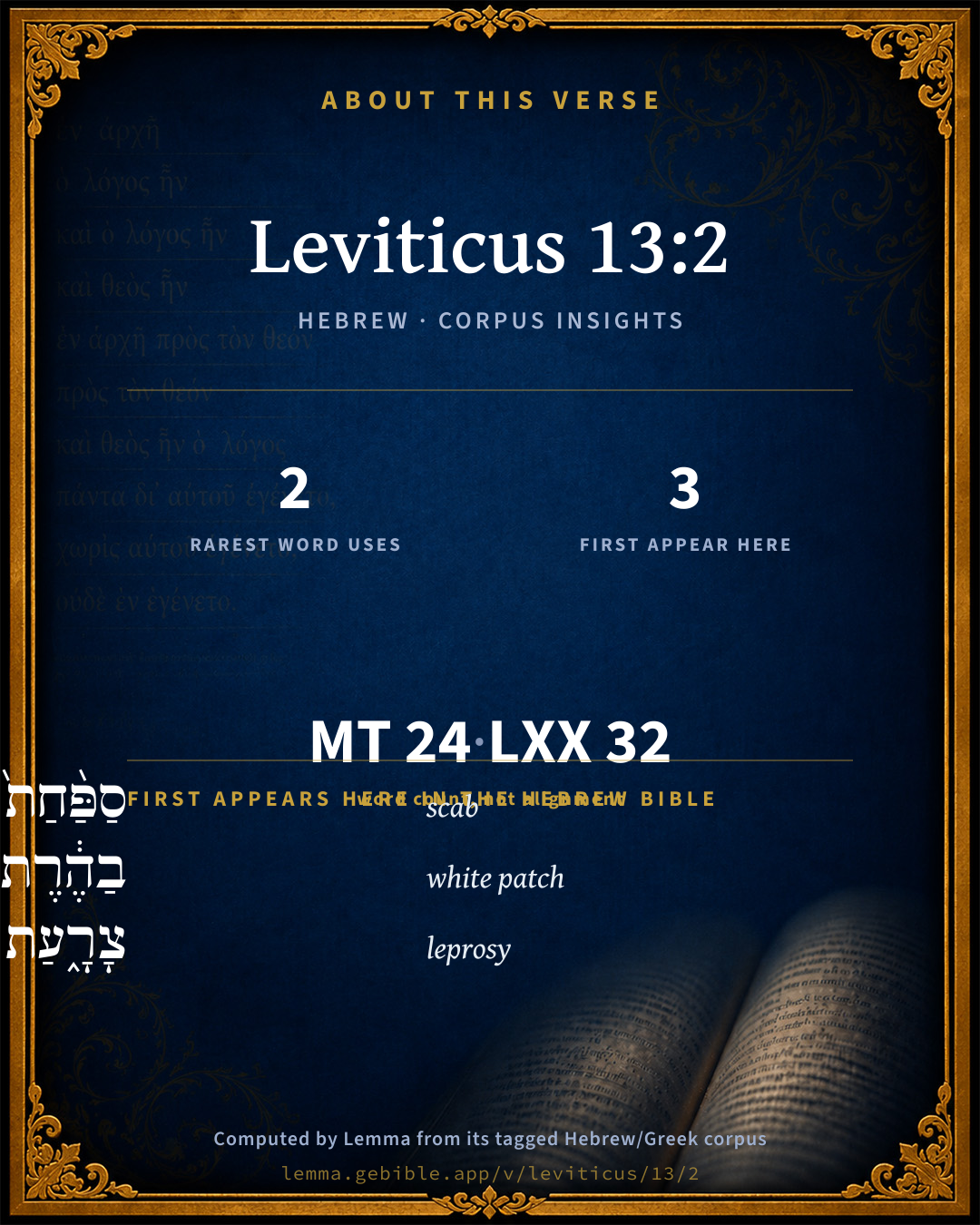
The rarest word here is סַפַּ֨חַת֙ scab H5597 — appearing just 2 times in the whole Hebrew Bible.

First appearance in Scripture

These words make their first canonical appearance in the Hebrew Bible here:

  • סַפַּ֨חַת֙ scab H5597
  • בַהֶ֔רֶת white patch H934
  • צָרָ֑עַת leprosy H6883

Shared distinctive vocabulary

סַפַּ֨חַת֙ scab H5597 occurs in 2 verses of the Hebrew Bible. Also found in:

Grammatical profile

  • 3 verbs
  • 14 nouns
  • 1 adjective
  • 2 prepositions
  • 4 conjunctions

Verb forms

  • יִהְיֶ֤ה Qal · Imperfect
  • וְהָיָ֥ה Qal · Sequential Perfect
  • וְהוּבָא֙ Hophal · Sequential Perfect

Repetition

Words recur within this verse — often emphatic in Hebrew:

  • יִהְיֶ֤ה to be H1961 ×2
  • בְעוֹר skin H5785 ×2
  • בְּשָׂרוֹ֙ flesh H1320 ×2
  • הַכֹּהֵ֔ן priest H3548 ×2
  • אֽוֹ or H176 ×3
  • אֶל to H413 ×2

Hebrew & Septuagint length

In English translation the verse runs 48 words from the Hebrew and 45 from the Septuagint (LXX English) — closely comparable.

A rough comparison of the two English renderings, which tokenize alike — not a word-level alignment.

Word counts can differ between the Hebrew and the Greek without any difference in meaning — e.g. the Hebrew direct-object marker אֵת has no separate Greek word, and Greek often adds the article ὁ.

In the original languages it is 24 Hebrew tokens and 32 Greek tokens — but the two are counted differently (Hebrew bundles its prefixes and suffixes into one token; the Greek is in lemma form), so that isn’t a like-for-like length.

Cross-references

20

Topical passages linked to Leviticus 13:2 in the Treasury of Scripture Knowledge — connected by theme and wording, ordered by reader-vote popularity; previews shown in the World English Bible.

  • Deuteronomy 24:8 Take heed in the plague of leprosy, that you observe diligently, and do according to all that the priests the Levites shall teach you: as I commanded them, so you shall observe to do.
  • Leviticus 14:56 and for a rising, and for a scab, and for a bright spot;
  • Leviticus 14:3 and the priest shall go forth out of the camp. The priest shall examine him, and, behold, if the plague of leprosy is healed in the leper,
  • Exodus 4:6–7 Yahweh said furthermore to him, "Now put your hand inside your cloak." He put his hand inside his cloak, and when he took it out, behold, his hand was leprous, as white as snow.
  • Leviticus 14:35 then he who owns the house shall come and tell the priest, saying, 'There seems to me to be some sort of plague in the house.'
  • Numbers 12:10 The cloud removed from over the Tent; and, behold, Miriam was leprous, as [white as] snow: and Aaron looked at Miriam, and, behold, she was leprous.
  • Deuteronomy 17:8–9 If there arise a matter too hard for you in judgment, between blood and blood, between plea and plea, and between stroke and stroke, being matters of controversy within your gates; then shall you arise, and go up to the place which Yahweh your God shall choose;
  • Deuteronomy 28:27 Yahweh will strike you with the boil of Egypt, and with the tumors, and with the scurvy, and with the itch, of which you can not be healed.
  • 2 Samuel 3:29 let it fall on the head of Joab, and on all his father's house; and let there not fail from the house of Joab one who has an issue, or who is a leper, or who leans on a staff, or who falls by the sword, or who lacks bread.
  • 2 Kings 5:1 Now Naaman, captain of the host of the king of Syria, was a great man with his master, and honorable, because by him Yahweh had given victory to Syria: he was also a mighty man of valor, [but he was] a leper.
  • 2 Kings 5:27 The leprosy therefore of Naaman shall cleave to you, and to your seed forever. He went out from his presence a leper [as white] as snow.
  • 2 Chronicles 26:19–21 Then Uzziah was angry; and he had a censer in his hand to burn incense; and while he was angry with the priests, the leprosy broke forth in his forehead before the priests in the house of Yahweh, beside the altar of incense.
  • Isaiah 1:6 From the sole of the foot even to the head there is no soundness in it: Wounds, welts, and open sores. They haven't been closed, neither bandaged, neither soothed with oil.
  • Isaiah 3:17 Therefore the Lord brings sores on the crown of the head of the women of Zion, And Yahweh will make their scalps bald."
  • Malachi 2:7 For the priest's lips should keep knowledge, and they should seek the law at his mouth; for he is the messenger of Yahweh of Hosts.
  • Matthew 8:4 Jesus said to him, "See that you tell nobody, but go, show yourself to the priest, and offer the gift that Moses commanded, as a testimony to them."
  • Mark 1:44 and said to him, "See you say nothing to anybody, but go show yourself to the priest, and offer for your cleansing the things which Moses commanded, for a testimony to them."
  • Luke 5:14 He charged him to tell no one, "But go your way, and show yourself to the priest, and offer for your cleansing according to what Moses commanded, for a testimony to them."
  • Luke 17:14 When he saw them, he said to them, "Go and show yourselves to the priests." It happened that as they went, they were cleansed.
  • Numbers 12:12 Let her not, I pray, be as one dead, of whom the flesh is half consumed when he comes out of his mother's womb.

Cross-references courtesy of OpenBible.info (CC BY 4.0).

Hebrew and Greek witnesses Masoretic Hebrew ↔ Greek Septuagint

The same verse in the two great witnesses to the Old Testament, shown verse-for-verse.

These are two independent witnesses, not word-aligned to each other, and the Septuagint is shown in lemma (dictionary) form.

Hebrew Leviticus 13:2 Masoretic · Westminster Leningrad Codex

אָדָ֗ם כִּֽי יִהְיֶ֤ה בְעוֹר בְּשָׂרוֹ֙ שְׂאֵ֤ת אֽוֹ סַפַּ֨חַת֙ א֣וֹ בַהֶ֔רֶת וְהָיָ֥ה בְעוֹר בְּשָׂר֖וֹ לְנֶ֣גַע צָרָ֑עַת וְהוּבָא֙ אֶל אַהֲרֹ֣ן הַכֹּהֵ֔ן א֛וֹ אֶל אַחַ֥ד מִבָּנָ֖יו הַכֹּהֲנִֽים

"When a man shall have a rising in his body's skin, or a scab, or a bright spot, and it becomes in the skin of his body the plague of leprosy, then he shall be brought to Aaron the priest, or to one of his sons the priests:

World English Bible · Public Domain

Greek LXX Leviticus 13:2 Septuagint · lemma form

ἄνθρωπος ἐάν τις γίγνομαι ἐν δέρμα χρώς αὐτός οὐλή σημασία τηλαυγής καί γίγνομαι ἐν δέρμα χρώς αὐτός ἁφή λέπρα καί ἄγω πρός ἀαρών ὁ ἱερεύς ἤ εἷς ὁ υἱός αὐτός ὁ ἱερεύς

If any man should have in the skin of his flesh a bright clear spot, and there should be in the skin of his flesh a plague of leprosy, he shall be brought to Aaron the priest, or to one of his sons the priests.

LXX2012 (modern English Septuagint) · Public Domain

Hebrew: Westminster Leningrad Codex (CC BY 4.0). Greek: Septuagint (public domain); English from LXX2012 (modern English Septuagint) (Public Domain). How the Septuagint differs from the Hebrew →

Targum (Aramaic paraphrase)

2

The Targum is the ancient Jewish Aramaic paraphrase of the Hebrew Scriptures — an interpretive translation, not the Hebrew text itself. Onkelos (literal) and Pseudo-Jonathan (expansive) render the Torah, and Jonathan the Prophets. Coverage is partial: where no permissively-licensed English translation exists for a verse, only the Aramaic is shown. This is verse-level text, not a word-by-word alignment to the Hebrew.

  1. Targum Onkelos Torah (Genesis–Deuteronomy)
    אֱנַשׁ אֲרֵי יְהֵי בִמְשַׁךְ בִּסְרֵהּ עַמְקָא אוֹ עַדְיָא אוֹ בַהֲרָא וִיהֵי בִמְשַׁךְ בִּסְרֵהּ לְמַכְתַּשׁ סְגִירוּ וְיִתֵּתֵי לְוַת אַהֲרֹן כַּהֲנָא אוֹ לְוַת חַד מִבְּנוֹהִי כַּהֲנַיָא

    (no public-domain English translation for this verse)

    Targum Onkelos — Aramaic: “Onkelos Genesis” (public domain); “Onkelos Exodus” (public domain); “Onkelos Leviticus” (public domain); “Onkelos Numbers” (public domain); “Onkelos Deuteronomy” (public domain). English: “Sefaria Community Translation” (CC0 1.0 (public-domain dedication)); “J.W. Etheridge. The Targums of Onkelos and Jonathan Ben Uzziel on the Pentateuch. London: Longmans, Green, 1862” (public domain). Text via Sefaria.

  2. Targum Pseudo-Jonathan Torah (Genesis–Deuteronomy)
    בַּר נַשׁ אֲרוּם יְהֵי בִּמְשָׁךְ בִּסְרֵיהּ שׁוּמָא זְקִיפָא אוֹ קְלוֹפֵי אוֹ בַהַקֵי וִיהֵי בִּמְשַׁךְ בִּישְרֵיהּ לְמִיכְתַּשׁ סְגִירוּ וִיתֵיתֵי לְוַת אַהֲרן כַּהֲנָא אוֹ לְוַת חַד מִבְּנוֹי כַּהֲנַיָא

    If a man have in the skin of his flesh a rising tumour or a white spot, and it be in the skin of his flesh (as) the plague of leprosy, let him be brought unto Aharon the priest, or to one of the priests his sons.

    Targum Pseudo-Jonathan — Aramaic: “Targum Jonathan on Genesis” (public domain); “Targum Jonathan on Exodus” (public domain); “Targum Jonathan on Leviticus” (public domain); “Targum Jonathan on Numbers” (public domain); “Targum Jonathan on Deuteronomy” (public domain). English: “The Targum of Jonathan ben Uzziel, trans. J. W. Etheridge, London, 1862” (public domain). Text via Sefaria.

Commentary

Notes on Leviticus 13:2 from classic Christian and Jewish commentators (each source and its license shown beneath its notes). The classic Christian expositions comment on the surrounding passage and are grouped to its opening verse, so a note may address several verses; the Jewish commentaries on the Tanakh (Rashi and others) are per-verse, so they appear only where the commentator wrote on this verse.

Lemma curates 59 commentaries, every one of them public domain or Creative Commons licensed, each selected and text-cleaned for this edition rather than reprinted as found. About our sources →

The Cambridge Bible for Schools and Colleges

gen. ed. J. J. S. Perowne

Leprosy in man (Lev_13:2-46)

Appearances in the skin which should be shewn to the priest (2–8)

2. a rising, or a scab, or a bright spot] Of the three words thus translated, the first is a common Heb. word for ‘lifting up,’ but employed in these chs. only in the sense of a swelling in or under the skin; the second (ṣappaḥath) occurs only here and Lev_14:56, the form miṣpaḥath from the same root only in Lev_13:6-8; the third is from a root signifying ‘to be bright or clear,’ and is used only in these chs. They all seem to denote an appearance like that of an angry-looking boil.

the plague of leprosy] rather a plague.

plague] lit. ‘a stroke’ (plaga; cp. a ‘stroke’ of paralysis), which also represents the sense of the Heb. word nega‘, which gives its name to the treatise Negâim. The leper was rejected as ‘smitten of God.’ See introd. note on ch. 14.

The Cambridge Bible for Schools and Colleges (gen. ed. J. J. S. Perowne; Cambridge University Press, 1878–1918) — public domain. Text from a community e-Sword module.

Trapp's Complete Commentary

John Trapp

Lev 13:2 When a man shall have in the skin of his flesh a rising, a scab, or bright spot, and it be in the skin of his flesh [like] the plague of leprosy; then he shall be brought unto Aaron the priest, or unto one of his sons the priests:

Ver. 2. Like the plague of leprosy.] Leprosy is both an effect and type of sin; which is such a sickness of the soul, as those are of the body, which physicians say are corruptio totius substantiae, universal diseases tending to the issues of death. It dries up and draws out the very vital blood and life of the soul.

John Trapp, A Commentary or Exposition upon All the Books of the Old and New Testament (1647–1656) — public domain. Text from a community e-Sword module.

The Biblical Illustrator

Joseph S. Exell

Lev_13:2-46

The plague of leprosy.

The cleansing of the leper

I. The loathsome and ghastly spectacle of a leper.

1. A leper was extremely loathsome in his person. But let me remind you that this, fearful as it seems to be, is a very poor portrait of the loathsomeness of sin. If we could bear to hear what God could tell us of the exceeding wickedness and uncleanness of sin, I am sure we should die. God hides from all eyes but His own the blackness of sin.

2. The leper was not only loathsome in his person, but was defiled in all his acts. If he drank out of a vessel, the vessel was defiled. If he lay upon a bed, the bed became unclean, and whosoever sat upon the bed afterwards became unclean too. All that he did was full of the same loathsomeness as was himself. Now this may seem to be a very humiliating truth, but faithfulness requires us to say it, all the actions of the natural man are tainted with sin. Whether he eats, or drinks, or whatsoever he does, he continues to sin against his God.

3. Being thus the medium of contagion and defilement wherever he went, the Lord demanded that he should be shut out from the society of Israel. Living apart from their dearest friends, shut out from all the pleasures of society, they were required never to drink of a running stream of water of which others might drink; nor might they sit down on any stone by the roadside upon which it was probable any other person might rest. They were, to all intents and purposes, dead to all the enjoyments of life, dead to all the endearments and society of their friends. Ay, and such is the case with the sinner with regard to the people of God.

4. Once more, the leper was wholly unable to come up to the house of God. Other men might offer sacrifices, but not the leper; others had a share in the high priests great sacrifice, and when he went within the veil he appeared for all others; but the leper had neither part nor lot in this matter. He was shut out from God, as well as shut out from man. He was no partaker of the sacred things of Israel, and all the ordinances of the Tabernacle were as nothing to him. Think of that, sinner! As a sinner full of guilt thou art shut out from all communion with God. True, He gives thee the mercies of this life as the leper had his bread and water, but thou hast none of the spiritual joys which God affords to His people.

II. I shall now bring the leper up to the high priest. Here he stands; the priest has come out to meet him. Mark, whenever a leper was cleansed under the Jewish law--the leper did nothing--the priest did all. My text asserts that if there was found any sound place in him, he was unclean. But when the leprosy had covered him, wheresoever the priest looked, then the man became by sacrificial rights a clean leper. Now, let me bring up the sinner before the great High Priest this morning. How many there are, who, as they come up hither, are ready to confess that they have done many things which are wrong, but they say, Though we have done much which we cannot justify, yet there have been many good actions which might almost counterbalance the sin. Have we not been charitable to the poor, have we not sought to instruct the ignorant, to help those that are out of the way? We have some sins we do confess; but there is much at the bottom which is still right and good, and we therefore hope that we shall be delivered. I put you aside in Gods name as unclean lepers. For you there is no hope, and no promise of salvation whatever. Here comes a second. Sir, a month or two ago I would have claimed a righteousness with the very best of them. I, too, could have boasted of what I have done; but now I see my righteousness to be as filthy rags, and all my goodness is as an unclean thing. As for the future, I can make no promise; I have often promised, and so often lied. Lord, if ever I am made whole, Thy grace must make me so.

III. Having thus brought the man before the priest, we shall now briefly turn our attention to the ceremonies which the priest used in the cleansing of the leper.

1. You will perceive, first, that the priest went to the leper, not the leper to the priest. We go not up to heaven, first, till Christ comes down from His Fathers glory to the place where we as lepers are shut out from God. Thou dost take upon Thyself the form of man. Thou dost not disdain the Virgins womb; Thou comest to sinners; Thou eatest and drinkest with them!

2. But the coming of the priest was not enough, there must be a sacrifice, and on this occasion, in order to set out the two ways by which a sinner is saved, there was sacrifice mingled with resurrection. First, there was sacrifice. One of the birds was taken, and its blood was shed in a vessel which was full, as the Hebrew hath it, of living water--of water which had not been stagnant, but which was clean. Just as when Jesus Christ was put to death, blood and water flowed from His side to be of sin a double cure, so in the earthen vessel there was received, first, the living water and then the blood of the bird which had just been slain. If sin is put away it must be by blood. There is no way of patting sin from before the presence of God except by the streams which flow from the open veins of Christ. The leper was made clean by sacrifice and by resurrection, but he was not clean till the blood was sprinkled on him. Christians, the Cross does not save us till Christs blood is sprinkled on our conscience. Yet the virtual salvation was accomplished for all the elect when Christ died for them upon the tree.

IV. That after the leper was cleansed, there were certain things which he had. To do. Yet, until he is cleansed, he is to do nothing. Tim sinner can do nothing towards his own salvation. His place is the place of death. Christ must be his life. The sinner is so lost that Christ must begin, and carry on, and finish all; but, when the sinner is saved then he begins to work in right good earnest. When once he is no more a leper, but a leper cleansed, then, for the love he bears his Masters name, there is no trial too arduous, no service too hard; but he spends his whole strength in magnifying and glorifying his Lord. I will not detain you further than to notice that this man, before he might further enjoy the privileges of his healed estate, was to bring an offering, and the priest was to take him to the very door of the Tabernacle. He never dare come there before, but he may come now. So the pardoned man may come right up to Gods mercy-seat, and may bring the offering of holiness and good works. He is a pardoned man now. You ask me how? Not by anything he did, but by what the priest did, and that alone. (C. H. Spurgeon.)

Leprosy, a special type of sin

I. In the first place, leprosy is undoubtedly selected to be a special type of sin, on account of its extreme loathsomeness. Beginning, indeed, as an insignificant spot, a bright place, a mere scale on the skin, it goes on progressing ever from worse to worse, till at last limb drops from limb, and only the hideous mutilated remnant of what was once a man is left.

II. But it will be rejoined by some: surely it were gross exaggeration to apply this horrible symbolism to the case of many who, although indeed sinners, unbelievers also in Christ, yet certainly exhibit truly lovely and attractive characters (see Mar_10:21). But this fact only makes leprosy the more fitting symbol of sin. For another characteristic is its insignificant and often imperceptible beginning. We are told that in the case of those who inherit the taint, it frequently remains quite dormant in early life, only gradually appearing in later years. How perfectly the type, in this respect, then, symbolises sin! No comfort can be rightly had from any complacent comparison of our own characters with those of many, perhaps professing more, who are much worse than we. No one who knew that from his parents he had inherited the leprous taint, or in whom the leprosy as yet appeared as only an insignificant bright spot, would comfort himself greatly by the observation that other lepers were much worse; and that he was, as yet, fair and goodly to look upon. Though the leprosy were in him but just begun, that would be enough to fill him with dismay and consternation. So should it be with regard to sin.

III. And it would so affect such a man the more surely, when he knew that the disease, however slight in its beginnings, was certainly progressive. This is one of the unfailing marks of the disease. And so with sin. No man can morally stand still. Sin may not develop in all with equal rapidity, but it does progress in every natural man, outwardly or inwardly, with equal certainty.

IV. It is another mark of leprosy, that sooner or later it affects the whole man; and in this, again, appears the sad fitness of the disease to stand as a symbol of sin. For sin is not a partial disorder, affecting only one class of faculties, or one part of our nature. It disorders the judgment; it obscures the moral perceptions; it either perverts the affections or unduly stimulates them in one direction while it deadens them in another; it hardens and quickens the will for evil, while it paralyses its power for the volition of that which is holy. And not only Scripture, but observation itself, teaches us that sin, in many cases, also affects the body of man, weakening its powers, and bringing in, by an inexorable law, pain, disease, death.

V. It is another remarkable feature of the disease that, as it progresses from bad to worse, the victim becomes more and more insensible. A recent writer says: Though a mass of bodily corruption, at last unable to leave his bed, the leper seems happy and contented with his sad condition. Is anything more characteristic than this of the malady of sin? The sin which, when first committed, costs a keen pang, afterward, when frequently repeated, hurts not the conscience at all. Judgments and mercies, which in earlier life affected one with profound emotion, in later life leave the impenitent sinner as unmoved as they found him.

VI. Another element of the solemn fitness of the type is found in the persistently hereditary nature of leprosy. It may indeed sometimes arise of itself, even as did sin in the case of certain of the holy angels, and with our first parents; but when once it is introduced, in the case of any person, the terrible infection descends with unfailing certainty to all his descendants; and while, by suitable hygiene, it is possible to alleviate its violence, and retard its development, it is not possible to escape the terrible inheritance. Is anything more uniformly characteristic of sin? The most cultivated and the most barbarous alike, come into the world so constituted that, quite antecedent to any act of free choice on their part, we know that it is not more certain that they will eat than that, when they begin to exercise freedom they will, each and every one, use their moral freedom wrongly--in a word will sin.

VII. And again, we find yet another analogy in the fact that, among the ancient Hebrews, the disease was regarded as incurable by human means; and, notwithstanding occasional announcements in our day that a remedy has been discovered for the plague, this seems to be the verdict of the best authorities in medical science still. That in this respect leprosy perfectly represents the sorer malady of the soul, every one is witness. No possible effort of will or fixedness of determination has ever availed to free a man from sin. Neither is culture, whether intellectual or religious, of any more avail.

VIII. Last of all, this law teaches the supreme lesson, that as with the symbolic disease of the body, so with that of the soul--sin shuts out from god and from the fellowship of the holy (see Rev_21:27; Rev_22:15). (S. H. Kellogg, D. D.)

Discipline in the Church

1. Of the necessity and moderation of discipline in the Church.

2. That the discipline of the Church be advisedly exercised, not rashly precipitated.

3. Of the wholesome power left to the Church, of binding and loosing, and of obedience to be given thereunto.

4. The law declares mens sins, but does not heal them.

5. Of the diversity of censures in the Church. (A. Willet, D. D.)

Sin as a disease

1. Sin the cause of diseases.

2. To take heed of the least sins.

3. Ministers to rebuke sin.

4. Not to go forward in sin.

5. Not to sin against the conscience.

6. Not to be swift to judge others.

7. To shun the company of the wicked.

8. Against pride in apparel. (A. Willet, D. D.)

Leprosy

Sin is a corrupting and disorganising disease, as well as a brutal degradation and hereditary uncleanness. It is a loathsome putrescence of the whole nature. It is a sickness of the whole head, and a faintness of the whole heart. Deliverance from it is called a cure and a healing, as well as a pardon. Notice its beginnings. Leprosy was, for the most part, hereditary. After doing its work in the parent it was very apt to break out in the child. Sin began in Adam, and having wrought nine hundred years in him he died; but the taint of it was left in all who sprang from him. But leprosy was not always hereditary. Hence the necessity of a special symbol on the subject of innate depravity, such as we have in the preceding chapter. The germ of all human sin is derived from our connection with a fallen parentage. But leprosy, whether hereditary, or contracted by contagion or otherwise, began far within. Its seat is in the deepest interior of the body. It is often in the system as many as three or a dozen years before it shows itself. How exactly this describes sin l Nero and Caligula were once tender infants, apparently the very personifications of innocence. Who that saw their sweet slumbers upon the bosoms of their mothers would ever have suspected that in those gentle forms were latent seeds which finally developed into bloody butchery, and tyranny, and vice, at which the world for ages has stood amazed! And little do we know of those depths of deceit which we carry in ourselves, or to what enormities of crime we are liable any day to be driven. The taint of leprosy is within, and nothing but watchfulness and grace can keep it from breaking out in all its corrosive and wasting power.

1. The first visible signs of leprosy are often very minute and inconsiderable, and not easily detected. A small pustule or rising of the flesh--a little bright red spot like that made by a puncture from a pin--a very trifling eruption, indentation, or scaliness of the skin--or some other very slight symptom, is usually the first sign which it gives of its presence. And from these small beginnings the whole living death of the leper is developed. How vivid the picture of the fact, that the worst and darkest iniquities may grow out of the smallest beginnings! A look of the eye, a desire of the heart, a thought of the imagination, a touch of the hand, a single word of compliance, is often the door of inlet to Satan and all bells troops.

2. Leprosy is also gradual in its development. It does not break out in its full violence at once. Its first manifestations are so trifling that one who did not understand it would consider it nothing at all. No man is an outbreaking and confirmed villain at once. People are shocked, and hold up their hands in horror at scandalous crimes; but they forget that these are only the easy sequences of little indulgences and sins of which they take no account. They need to be told that there is a close interior brotherhood and cohesion between sins, and that he who takes one to his favour is at once beset with all the rest.

3. Again, leprosy is in itself an exceedingly loathsome and offensive disorder--a kind of perpetual small-pox, only more deeply seated and attended with more inward corruption.

4. Again, leprosy under this law carried with it a most melancholy condemnation of Jewish leper was not only horribly diseased, but also fearfully cursed in consequence of his disease. He was pronounced unclean by the law and by the priests. Such is the type, and it is the same with the antitype. Every sinner is condemned as well as diseased, and condemned for the very reason that he is diseased. There is a sentence of uncleanness and exclusion upon him. He has no fellowship with the saints, and no share in the holy services of Gods people. He is a spiritual outcast--a moral leper--unclean, and ready for the realms of everlasting banishment and death.

5. And yet the picture is not quite complete. It remains to be said that there was no earthly cure for leprosy. The prophet of God, by his miraculous power, could remove it, but no human power or skill could. It was beyond the reach of physician or priest. And so it is with sin. It is a consumption which cannot be cured--a cancer which cannot be extracted--a leprosy which cannot be cleansed--except by the direct power of Divine grace. (J. A. Seiss, D. D.)

The gospel of the leprosy

1. It is a work both difficult and weighty for people to discern and judge aright of their own spiritual condition. This appears by all these rules and directions.

2. It is the priests office to judge of the leprosy. Goal has given His ministers power to retain and remit sins (Joh_20:23).

3. Note the rules of trial, whereby the priest is to judge of the leprosy.

(1) If it be but skindeep, it is not the leprosy, he is clean; but if deeper, he is unclean (Lev_13:3-4; Lev_13:20; Lev_13:25; Lev_13:30). A child of God may have spots in his skin, frailties in his life; but his heart is sound. There are other sins rooted deep in the heart, that affect the vitals.

(2) Does it stand at a stay, or does it spread further and further (Lev_13:5-8; Lev_13:23; Lev_13:27-28; Lev_13:34; Lev_13:36-37)? Evil men grow worse and worse: their corruptions gain ground upon them. But it is a sign there is some beginning of healing if it stand at a stay. If the Lord be healing a sinner, mortifying his lusts, he is clean.

(3) If there be proud raw flesh in the rising, he is not to be shut up in suspense; the thing is evident (Lev_13:9-11; Lev_13:14-15). Pride, presumption, and impatience of reproof, are bad signs.

(4) If all be turned white, a man is clean (Lev_13:12; Lev_13:17; Lev_13:34).

(a) The natural reason. It is a sign of some inward strength of nature, that it expels the disease, and sends it forth to the outward parts.

(b) The spiritual reason. A humble acknowledgment of the overspreading corruption of our nature, and flying to Christ for help under a thorough conviction and sense of our total uncleanness and pollutedness; this is a sign the plague is healed, and the leper made clean.

(5) In ease the leprosy be in the head, he is doubly unclean (Lev_13:44). Where sin has prevailed so far as to blind the very mind and understanding, men are more incapable of conversion than others, because so far from conviction.

4. Note the duties imposed upon the leper (Lev_13:45-47).

(1) Rend clothes. Sign of sorrow and lamentation.

(2) Bare head.

(3) Cover lips to express shame.

(4) Give warning to others to shun him. A scandalous sinner must not charge others with his failings, but load his own conscience, and take his guiltiness home to himself.

(5) Dwell alone. Excommunication. (S. Mather.)

Avoidance of false suspicion

When you read in the fourth verse of shutting up the parties for seven days, and then to look on it again, you may note with yourself, how greatly God hateth hasty, rash, and uncharitable judgment. A thing which many men and women, otherwise honest and good, are carried away withal, to their own great hurt, not only in soul, but in worldly reputation also, and to the bitter and biting discomfort of those whom they ought to love and judge well of. Nay, you may reason further with yourself thus: That if in a matter thus subject to the eye, as these sores were, yet God would have no haste, but a stay for seven days, and longer as occasion served, before any judgment should be given that the party was unclean. Oh, how much more doth He abhor haste and love leisure, in pronouncing of the hearts and thoughts of our friends and neighbours which are not seen, nor subject to an easy censure? (Bp. Babington.)

Sin may be invisible to human eyes

A lady, whose portrait had often been successfully taken before, paid a visit one day to the photographers for the purpose of having a new one taken. After she had sat for it in the usual way, the photographer retired with the plate to examine the picture which the suns light had drawn there, but as the lines gradually developed in the chemical bath a strange sight was revealed. In the portrait the ladys face appeared covered with a number of dark spots; but yet no one looking at her that day was able to detect the slightest trace of them in her face I But the next day the explanation came. The spots had then become distinctly visible. The lady was ill of small-pox, of which she died. The faint yellow of the spots, some time before human eyes could discern it, had been marked by the pure light of the sun, and traced in darkened spots in that inexorably true picture drawn on the photographic plate, revealing the horrible disease that already, though as yet invisible to human eyes, was seated there. (Biblical Treasury.)

The importance of attending to the disease of sin

Sin is an awful disease. I hear people say, with a toss of the head, and with a trivial manner: Oh, yes, Im a sinner. Sin is an awful disease. It is leprosy. It is dropsy. It is consumption. It is all moral disorders in one. Now, you know there is a crisis in a disease. Perhaps you have had some illustration of it in your own family. Sometimes the physician has called, and he has looked at the patient and said: That case was simple enough; but the crisis has passed. If you had called me yesterday, or this morning, I could have cured the patient. It is too late now; the crisis has passed. Just so it is in the spiritual treatment of the soul--there is a crisis. Before that, life. After that, death. Oh, as you love your soul, do not let the crisis pass unattended to. There are some here who can remember instances in life when, if they had bought a certain property, they would have become very rich. A few acres that would have cost them almost nothing were offered them. They refused them. Afterwards a large village or city sprang up on those acres of ground, and they see what a mistake they made in not buying the property. There was an opportunity of getting it. It never came again. And so it is in regard to a mans spiritual and eternal fortune. There is a chance; if you let that go, perhaps it never comes back. Certainly that one never comes back. (H. W. Beecher.)

Leprosy and six hereditary

Never shall I forget a visit which I paid to the leper hospital outside the East Gate of Damascus, which tradition says occupies the site of Naamans house. A woman was crossing the courtyard, whose loathsome features seemed all but eaten away by disease. In her hands--the fingers of which were almost consumed by leprosy--she held a sweet-looking infant, as fair and pretty a child as one could desire to see. The contrast was most painful. Life and health and innocence seemed to sleep in the arms of sin, disease, and death. I said to the missionary who accompanied me, Surely the woman is not the mother Of the child? He said, Yes, she is; the child does not show the leprosy now, but it is in the blood, and before long it will probably appear; and if the infant live long enough she will be as bad as the mother. Who can bring a clean thing out of an unclean? (J. W. Bardsley.)

Ministers must seek to produce conviction of sin

A devoted minister relates the following: A friend of mine was visiting a dying carter, and said to him, My friend, do you feel yourself a sinner? I do not know that I am, was the reply; I suppose I am like other people; I do not feel very bad. We must get that point settled, said my friend. Let me ask you a few questions. Have you ever taken too much to drink? Well, fellows like me, you know, are likely to do that now and then, out as we are in all weathers. I am not asking you about the weathers, my question is, Have you done this? Yes, I have. Have you ever sworn? Well, we carters are a rough lot, and a mans temper sometimes-- Stop! you admit that you have sworn, that you have cursed, and taken Gods name in vain. Did you ever break the Lords day? Well, it would be difficult for us carters, busy as we are with our horses, to keep the Lords day. Stop! here are three things--drunkenness, profane swearing, and Sabbath-breaking-that you admit yourself guilty of. How can you say that you are not a sinner? You must take your place as a sinner, my friend; and the sooner you do it, the better. He did so, and found mercy and pardon through the atoning blood of Christ. It is of no use for men to deny, or try to explain away, the fact of their sinfulness; they will never take their true place until they do so as sinners in the sight of God.

The difficulty of knowing aright ones true spiritual state

A young lady, who was under concern of soul, said to Dr. Nettleton: I certainly do desire to be a Christian. I desire to be holy. I would give all the world for an interest in Christ. What you say will not bear examination, said Dr. Nettleton. If you really desire religion for what it is, there is nothing to hinder you from possessing it. I can make a representation which will show you your heart, if you are willing to see it. I am, she replied. It will look very bad, said Dr. N., but if you are willing to see it, I will make the representation. Suppose you were a young lady of fortune; and suppose a certain young man should desire to possess your fortune, and should, for that reason, conclude to pay his addresses to you. But he does not happen to be pleased with your person. He does not love you, but hates you. And suppose he should come to you, and say, I really wish I could love you, but I do not. I would give all the world if I could love you; but I cannot. What would you think of that young man? We may readily guess the confusion and silence to which she was brought, by this faithful exposure of the deception which she had practised upon herself. (Sword and Trowel.)

Sinners ought to be willing to know their true state

A man once said this to Dr. Nettleton, I sincerely desire to be a Christian. I have often gone to the house of God, hoping that something which should be said might be sent home to my mind by the Spirit of God, and be blessed to my salvation. You are willing, then, are you not, said Dr. N., that I should converse with you, hoping that my conversation may be the means of your conversion? I am, was his reply. If you are willing to be a Christian, added Dr. Nettleton, you are willing to perform the duties of religion; for this is what is implied in being a Christian. Are you willing to perform these duties? I do not know but that I am, was the rather doubtful reply. Well, then, you are the head of a family. One of the duties of religion is family prayer. Are you willing to pray in your family? I should be, he replied, if I were a Christian; but it cannot be the duty of such a man as I am to pray. The prayers of the wicked are an abomination to the Lord. And is it not, said Dr. Nettleton, an abomination unto the Lord to live without prayer? But just let me show you how you deceive yourself. You think you really desire to be converted. But you are not willing to be convicted. Just as soon as I mention a duty which you are neglecting, you begin to excuse and justify yourself, on purpose to keep your sin out of sight. You are not willing to see that it is an heinous sin to live in the neglect of family prayer. How can you expect to be brought to repentance until you are willing to see your sinfulness; and how can you flatter yourself that you really desire to be a Christian while you thus close your eyes against the truth? (Sword and Trowel.)

A diseased nature

It is not necessary to split hairs over the doctrine of original sin, nor to trip against stumblingblocks labelled transmitted iniquity, in order to arrive at the conclusion that man as he is in this world needs moral helps. It was forcibly said, by way of illustration, that a wolf cub has probably never killed a sheep, but it undoubtedly will if it lives and has a chance--because it has the wolf nature. Man does not need to look outside of his own heart, if he be honest, to know that he has in his nature a tendency to sin-that he needs constraints around him and a new spirit within him to keep him true to the higher life. Sin progressive:--Amongst many other diseases that the body is incident unto, there is one that is called by the name of gangrena, which doth altogether affect the joints, against which there is no remedy but to cut off that joint where it settled, otherwise it will pass from joint to joint, till the whole body is endangered. Such is the nature of sin, which unless it be cut off in the first motion, it proceedeth unto action, from action to delectation, from delight unto custom, and from that unto habit, which being as it were, a second nature, is never, or very hardly removed without much prayer and fasting. (J. Spencer.)

The power of one sin

While I was walking in the garden one bright morning, a breeze came through and set all the flowers and leaves a-fluttering. Now, that is the way flowers talk, so I pricked up my ears and listened. Presently an old eldertree said: Flowers, shake off your caterpillars. Why? said a dozen altogether, for they were like some children who always say, Why? when they are told to do anything. Bad children, those! The elder said: If you dont, theyll gobble you up. So the flowers set themselves a-shaking, till the caterpillars were shaken off. In one of the middle beds there was a beautiful rose, which shook off all but one, and she said to herself: Oh, thats a beauty! Ill keep that one. The elder overheard her, and called out: One caterpillar is enough to spoil you. But, said the rose, look at his brown and crimson fur and his beautiful black eyes, and scores of little feet. I want to keep him. Surely one wont hurt me. A few mornings after I passed the rose again. There was not a whole leaf on her; her beauty was gone, she was all but killed, and had only life enough to weep over her folly, while the tear stood like dewdrops on her tattered leaves. Alas! I didnt think one caterpillar would ruin me!

If the plague be turned into white, then the priest shall pronounce him clean

At first sight it seems strange to ordain that the man should be reckoned clean if the leprosy were out upon him and covered him wholly. The reason, however, may be--

1. Natural.

2. Moral.

If natural, then it is either because the leprosy is not so infectious when it has thus come all out on the body, the hard, dry scurf not being likely to spread infection, whereas the ichor of raw flesh would (see Bagster); or, because it really is not a proper leprosy if it so come out--it is a salt humour cast out by the strength of the mans constitution, and is not deep-seated. It is rather a relief to the constitution; as when measles or small-pox come out to the surface of the body, recovery is hopeful. If it was for a moral reason, then it seems meant to teach that the Lord has a deep abhorrence of a corrupt nature--deeper far than merely of corrupt actions. We are ever ready to take home the guilt of evil deeds, but to palliate the evil of a depraved heart. But the Lord reverses the case. His severest judgment is reserved for inward depravity. And yet more. Is it not when a soul is fully sensible of entire corruption (as Isa_1:5) that salvation is nearest? A complete Saviour for a complete sinner? If there appeared any raw flesh, then the man is unclean. For this indicates inward disease--not on the surface only. It is working into the flesh. But if the raw flesh, turn and be changed into white, then it is plain that the disease is not gone inwards; it is playing on the skin only. Let him stand, therefore, as clean. Perhaps the case of a pardoned man may be referred to again in this type. His iniquity comes all out to view, when it is thrown into the fountain opened; and the inner source of it is checked. The seat of corruption has been removed, But if, after the appearance of pardon, the man turn aside to folly (if raw flesh appear), he is to be counted unclean. If, however, this turning aside to folly be checked, if this backsliding be healed, then it is like the raw flesh, turning into white--it evidences that his nature is sound--it has not returned to its state of thorough depravity. (A. A. Bonar.)

Unclean, unclean.

The leper diseased

Leper, canst thou not read thy case here? Afflicted, exercised, tempted, downcast child of God, dost thou not see thy character here described by an inspired pen?

1. The leper in whom the plague is. Is sin your plague? Take all your worldly anxieties, tie them up in one bundle, and put them into the scale; now place in the other scale the plague of sin. Which scale goes down? If you are a spiritual leper, you will say, Oh, it is sin, sin, that I sometimes fear will be a millstone to drown my soul in hell. And canst thou find this mark, the leper in whom the plague is? Is not this a very striking expression, In whom ? I think Paul has hit the matter to a nicety; and well he might, for he wrote as a man who knew what he was writing about; he says, The sin that dwelleth in me. Sin is not like a martin that builds its nest under the eaves, which sticks to the house, but is not in the house. Neither is sin a lodger to whom you can give a weeks or a months notice to quit; nor is it a servant whom you may call up, pay him his months wages, and send him about his business. No, no. Sin is one of the family who dwells in the house, and will not be turned out of the house--haunts every room, nestles in every corner, and like the poor ejected Irish of whom we read, will never leave the tenement while stick or stone hangs together. Is not this the case with you? Does not sin dwell in you, work in you, lust in you, go to bed with you, get up with you, and all the day long, more or less, crave, design, or imagine some evil thing? Do you feel sin to be a plague and a pest, as it must be to every living soul? Then are you not something of a leper if the plague dwell in you?

2. But the lepers clothes were to be rent.

(1) This was a sign of mourning. Grief, sorrow, is their continual portion on account of the leprosy that is in them.

(2) Rending the clothes was also a sign of abhorrence. Thus the high priest rent his clothes, saying, He hath spoken blasphemy, when the Lord Jesus, in answer to his question, affirmed that He was the Son of God.

(3) The rent clothes, therefore, of the leper show his self-abhorrence and self-loathing. Seeing the holiness and purity of God it is with him as with Job. I have heard of Thee by the hearing of the ear; but now mine eye seeth Thee. Wherefore I abhor myself, and repent in dust and ashes.

(4) The rent clothes was also a figure of a rent and contrite heart. Rend your hearts, says the prophet, and not your garments; implying that though the rent garment was a figure of a rent heart, yet the outward mark was nothing without the inward feeling.

3. But the leper was also to have his head bare. No covering from Gods wrath was allowed him; bareheaded he stood exposed to the winds and storms of heaven, bare before the lightnings flash. And does not this represent the poor sinner without a covering before God; sensible that he is amenable to Gods justice and eternal indignation?

4. But he was also to have a covering on his upper lip. And this for the same reason that we cover the mouth of the grave--to present the infection of his breath. If he covered but the lower lip, the breath might come forth. Have you ever thought and felt that there was sin enough in your heart to infect a world? that if every man and woman in the world were perfectly holy, and you were left freely to give vent to every thought and imagination of your carnal mind, there was sin enough there to taint every individual? It is so, felt or not; for sin is of that infectious nature that there is enough in one mans heart to fill all London with horror. Oh, when a man knows this he is glad to have a covering for his upper lip! He cannot boast then of what a good heart he has, nor what good resolutions he has made, or what great performances he means to accomplish. He has at times a very Vesuvius in him, and wants no one to come within the mouth of the crater. If a man has a covering upon the upper lip he will not boast of his goodness.

5. But the leper was to have a cry in his mouth. That cry was Unclean, unclean. It was a warning cry. He was to shout to the passengers, if any were drawing near, Unclean, unclean; come not near me; I am a leper; I shall pollute you; beware of my breath, it carries infection with it; touch me not; if you touch me you will be tainted with the same malady; beware of me; keep your distance; standoff! Yes, but you say, Come; I am not so bad as that; I am religious, and holy, and consistent. I am sure I need not cover my upper lip and cry, Unclean, unclean. Oh, no; certainly not. You are not a leper. You have had years ago a rising, or a boil, and at the priests direction you have washed your clothes and are clean. But if you do not feel to be a leper, there are those who do; and such do cry, and ever must cry, Unclean, unclean. And if they do not uncover all their sores to men, they can do so to God.

6. But all the (lays wherein the plague was in the leper he was to be defiled; he was unclean. Such is a spiritual leper; defiled by sin; polluted from head to foot, as long as the leprosy remains.

7. But what was the necessary consequence of this? He shall dwell alone. A solitary religion is generally a good religion. Gods tried people have not many companions. The exercised cannot walk with the unexercised; the polluted with the unpolluted; the sick with the well; tile leper with the clean; for how can two walk together except they be agreed? (J. C. Philpot.)

Disease and sin

This great fact that a disease in the body was typical of a malady in the soul reminds us at once that there was perfect harmony between the body and the soul, between things spiritual and things temporal, between things heavenly and things earthly. There is enough of the harmony still surviving to show what and how rich it once was. The historical statement in this chapter is, that the leprosy overspread the whole body, till it became, in language used by one of the prophets, white as snow; the whole physical economy was infected with its deadly poison. And, in that respect, it was the type, and is indeed referred to in the New Testament as the type, of that sin which has infected the whole soul and body of mankind. Take any one faculty that is within us, and we shall find on it the great leprosy, or taint, or moral influence of sin. Mans intellect has in it still remaining energies that give token of what it once was; but it has in it also defects, and tremulousness, and weakness, and paralysis, that indicate that it is the subject of some great derangement. I need not attempt to prove that the heart also is defiled. Our blessed Lord gives the heart its faithful character when He says, Out of the heart proceed evil thoughts, murder, adultery, and such like; and these are the things that defile a man. Truly, therefore, and justly did the Psalmist pray, Create in me a clean heart, O God: renew a right spirit within me. But not only are the heart and intellect affected, as I have shown you, but the conscience also has suffered, and is poisoned by the universal disease. It is sometimes overflowed by guilty passions, it is sometimes silent when it ought to rebuke them; sometimes quiescent when it ought to assert its original authority, and sometimes the democracy of the passions rises in fierce array, dethrones the monarch that ought to govern them, and prompts man to pursue the infatuated course that leads to his ruin. And in the worst of cases this power of conscience is often perverted to the wrong side, sanctioning the sins which it ought to abhor. When the intellect that discerns, the heart that loves or hates, and the conscience that testifies what is right or wrong, are thus infected, truly may we say with Isaiah, The whole head is sick, the whole heart is faint, &c. Were the tokens and the evidences of the assertion I have made not so obvious and so numerous as they actually are, you find other proofs in the miser fixing his heart upon gold, in spite of the decisions of intellect, the better impulses of the heart, and the rebukes of conscience. You find the drunkard still indulging in his cups, notwithstanding a thousand testimonies within and without, that he is ruining soul and body. You find the Pharisee robbing widows houses, and making long prayers for a pretence. You find the very religion of love and truth corrupted into the religion of superstition, of hate, and a lie. So depraved and fallen is man that it looks that, if he had the power, he would turn redemption itself into a nullity, or into a curse. There is, then, on all sides the evidence of some great derangement. We never can suppose we were made so. Disease seems to us natural, but it is most unnatural; error, sin, hate, all seem to us normal and ordinary, but they are really altogether the reverse. We find, on tracing the similitude between the disease which is here mentioned, that the leper had to be insulated from the rest of the world, and left by himself to get rid of the disease that thus separated him. So the sinner, in Gods moral government, must be for ever separated from the communion and company of the holy, if he continue the subject of this great moral malady--sin. The lepers disease was so bad that it was incurable by human means. It is so with sin. Like the leprosy, in the next place, sin is contagious. The characteristic disease of the Israelite spread from person to person, from house to house, and throughout the whole land. And who needs to be taught that evil communications corrupt good manners? Who needs to learn that there is in an evil word, in a crooked course, a contagious influence that is distilled upon susceptible and sensitive and living hearts? In the ancient economy, the party to whom the leper presented himself, was not the physician, as in other diseases, but the priest. And this shows that it was a disease in some shape intimately associated with mans guilt, or with sin. A Jew of old, like a Gentile now, if taken ill, applied to the physician; but when infected with this great typical disease, he did not go to the physician, but to the priest. But, more than this, even the priest could not heal him; the priest had no prescription that could heal him, no balm that could remove it. All that he could do was to say, You are healed, or You are not healed, or, You are advancing towards convalescence, or the reverse. The priest was to pronounce him clean, or to pronounce him unclean. But how much better is the economy under which we live! Our High Priest can not only pronounce us clean, but make us clean; He can not only say that we are justified, but He can justify us by His perfect righteousness, forgive us by His atoning blood, by His sanctifying Spirit, through His inspired Word. (J. Cumming, D. D.)

The separating influences of sin

Any one who has visited Jerusalem may have seen the lepers standing day by day near the Jaffa Gate soliciting alms from those passing the threshold of the city which they themselves were not allowed to enter. Most travellers who have either witnessed this painful sight or visited the houses of the lepers at the Zion Gate must have recalled the words, Without the camp shall his habitation be. No type so strikingly brings out the separating influences of sin as that of leprosy; telling the sinner, in no uncertain tones, that unless his sin be pardoned, his leprosy cleansed, he shall never enter the gates of the heavenly city. Howels, in one of his sermons, finely says that when Adam sinned, God, having locked the gate of Paradise to prevent the entrance of men, cast the key into the very depths of hell. There it lay, and man must for ever have been excluded--without the camp, the place of Gods dwelling, whether typified by garden, camp, or city, must his habitation have been--had not the Son of God, with His Fathers will and pleasure, wrought our deliverance. As He stood on the edge of the fiery abyss--the wrath of God due to mans sin--He drew back. Again He looked into the terrible gulf. Then, with a love incomprehensible were it not Divine, He plunged into its depths, found the key, ascended upon high, led captivity captive, opened the gate of Paradise; and now the kingdom of heaven is open to all believers. (J. W. Bardsley, M. A.)

Leprous outcasts in England

A gentleman visiting the venerable church of St. Marys in the village of Minster, near Ramsgate, said to the guide, What means this hole through the wall? That, replied the guide, recalls a fact which is full of interest and pathos. In the twelfth century there were a number of lepers in the neighbourhood. You will understand, of course, that they were obliged to live by themselves, and were supported by charity. Over at the old Abbey you may still see the place where bread and other food was passed out to them. Being unclean, and afflicted with a horrible and incurable disease which was contagious, they were not allowed in church, or to come in contact with healthy persons, so they had no way of taking any direct part in the worship of God. Both as to soul and body they were driven out from all intercourse with the rest of mankind. Yet many of them longed for some sound or sight that might comfort them in their sad, loathsome, and hopeless condition. Taking pity on the poor creatures, the monks made this hole in the wall, so that, one at a time, they could see the priests ministering at the altar, hear the music, and perhaps a few words of the Mass. Then they would go back to their huts and caves, trusting that in heaven, if not on earth, they might be free from the dreadful curse under which they suffered. That is why this hole is called the Lepers Squint. Poor outcasts! my heart aches to think of them, though they are all dead and gone these seven hundred years.

The Biblical Illustrator, edited by Joseph S. Exell (c. 1880s–1900s) — public domain. Text from a community e-Sword module.

Joseph Benson's Commentary

Lev 13:2. A rising, a scab, or bright spot — The leprosy appeared in one of these three forms. Now, as these marks might sometimes be upon the skin when there was no leprosy, rules are here given whereby the priests might discern between a plague of leprosy and the resemblance of it; that accordingly they might pronounce a person clean or unclean. Some of the symptoms of the leprosy here described are of a very extraordinary nature, particularly its infecting houses and garments. This has led several of the learned, Le Clerc in particular, to imagine that Moses’s leprosy was one of those diseases which Providence occasionally inflicts upon mankind in certain ages and countries, as a chastisement for peculiar sins, and to bring them to repentance and reformation. Thus much is certain, that what we now call the leprosy is very different from what went by that name in former times.

Joseph Benson's Commentary on the Old and New Testaments (1811–1818) — public domain. Text from a community e-Sword module.

Keil & Delitzsch

C. F. Keil & F. Delitzsch

The symptoms of leprosy, whether proceeding directly from eruptions in the skin, or caused by a boil or burn. - Lev 13:2-8. The first case: "When a man shall have in the skin of his flesh (body) a raised spot or scab, or a bright spot." שׂאת, a lifting up (Gen 4:7, etc.), signifies here an elevation of the skin in some part of the body, a raised spot like a pimple. ספּחת, an eruption, scurf, or scab, from ספח to pour out, "a pouring out as it were from the flesh or skin" (Knobel). בּהרת .)le, from בּהר, in the Arabic and Chaldee to shine, is a bright swollen spot in the skin. If ether of these signs became "a spot of leprosy," the person affected was to be brought to the priest, that he might examine the complaint. The term zaraath, from an Arabic word signifying to strike down or scourge, is applied to leprosy as a scourge of God, and in the case of men it always denotes the white leprosy, which the Arabs call baras. נגע, a stroke (lit., "stroke of leprosy"), is applied not only to the spot attacked by the leprosy, the leprous mole (Lev 13:3, Lev 13:29-32, Lev 13:42, etc.), but to the persons and even to things affected with leprosy (Lev 13:4, Lev 13:12, Lev 13:13, Lev 13:31, Lev 13:50, Lev 13:55).

Lev 13:3

A person so diseased was to be pronounced unclean, (a) if the hair of his head had turned white on the mole, i.e., if the dark hair which distinguished the Israelites had become white; and (b) if the appearance of the mole was deeper than the skin of the flesh, i.e., if the spot, where the mole was, appeared depressed in comparison with the rest of the skin. In that case it was leprosy. These signs are recognised by modern observers (e.g., Hensler); and among the Arabs leprosy is regarded as curable if the hair remains black upon the white spots, but incurable if it becomes whitish in colour.

Lev 13:4-6

But if the bright spot was white upon the skin, and its appearance was not deeper than the skin, and the place therefore was not sunken, nor the hair turned white, the priest was to shut up the leper, i.e., preclude him from intercourse with other men, for seven days, and on the seventh day examine him again. If he then found that the mole still stood, i.e., remained unaltered, "in his eyes," or in his view, that it had not spread any further, he was to shut him up for seven days more. And if, on further examination upon the seventh day, he found that the mole had become paler, had lost its brilliant whiteness, and had not spread, he was to declare him clean, for it was a scurf, i.e., a mere skin eruption, and not true leprosy. The person who had been pronounced clean, however, was to wash his clothes, to change himself from even the appearance of leprosy, and then to be clean.

Lev 13:7-8

But if the scurf had spread upon the skin "after his (first) appearance before the priest with reference to his cleansing," i.e., to be examined concerning his purification; and if the priest notice this on his second appearance, he was to declare him unclean, for in that case it was leprosy.

Lev 13:9-17

The second case (Lev 13:9-17): if the leprosy broke out without previous eruptions.

Lev 13:9-11

"If a mole of leprosy is in a man, and the priest to whom he is brought sees that there is a white rising in the skin, and this has turned the hair white, and there is raw (proud) flesh upon the elevation, it is an old leprosy." The apodosis to Lev 13:9 and Lev 13:10 commences with Lev 13:11. חי בּשׂר living, i.e., raw, proud flesh. מחיה the preservation of life (Gen 45:5), sustenance (Jdg 6:4); here, in Lev 13:10 and Lev 13:24, it signifies life in the sense of that which shows life, not a blow or spot (נגע, from מחה to strike), as it is only in a geographical sense that the verb has this signification, viz., to strike against, or reach as far as (Num 34:11). If the priest found that the evil was an old, long-standing leprosy, he was to pronounce the man unclean, and not first of all to shut him up, as there was no longer any doubt about the matter.

Lev 13:12-13

If, on the other hand, the leprosy broke out blooming on the skin, and covered the whole of the skin from head to foot "with regard to the whole sight of the eyes of the priest," i.e., as far as his eyes could see, the priest was to pronounce the person clean. "He has turned quite white," i.e., his dark body has all become white. The breaking out of the leprous matter in this complete and rapid way upon the surface of the whole body was the crisis of the disease; the diseased matter turned into a scurf, which died away and then fell off.

Lev 13:14-19

"But in the day when proud flesh appears upon him, he is unclean,...the proud flesh is unclean; it is leprosy." That is to say, if proud flesh appeared after the body had been covered with a white scurf, with which the diseased matter had apparently exhausted itself, the disease was not removed, and the person affected with it was to be pronounced unclean.

The third case: if the leprosy proceeded from an abscess which had been cured. In Lev 13:18 בּשׂר is first of all used absolutely, and then resumed with בּו, and the latter again is more closely defined in בּעורו: "if there arises in the flesh, in him, in his skin, an abscess, and (it) is healed, and there arises in the place of the abscess a white elevation, or a spot of a reddish white, he (the person so affected) shall appear at the priest's."

Lev 13:20

If the priest found the appearance of the diseased spot lower than the surrounding skin, and the hair upon it turned white, he was to pronounce the person unclean. "It is a mole of leprosy: it has broken out upon the abscess."

Lev 13:21-23

But if the hair had not turned white upon the spot, and there was no depression on the skin, and it (the spot) was pale, the priest was to shut him up for seven days. If the mole spread upon the skin during this period, it was leprosy; but if the spot stood in its place, and had not spread, it was השּׁחין צרבת, "the closing of the abscess:" literally "the burning;" here, that part of the skin or flesh which has been burnt up or killed by the inflammation or abscess, and gradually falls off as scurf (Knobel).

Lev 13:24-28

The fourth case (Lev 13:24-28): if there was a burnt place upon the skin of the flesh (מבות־אשׁ, a spot where he had burnt himself with fire, the scar of a burn), and the "life of the scar" - i.e., the skin growing or forming upon the scar (see Lev 13:10), - "becomes a whitish red, or white spot," i.e., if it formed itself into a bright swollen spot. This was to be treated exactly like the previous case. המּכוה שׂאת (Lev 13:28), rising of the scar of the burn, i.e., a rising of the flesh and skin growing out of the scar of the burn.

Keil & Delitzsch — Biblical Commentary on the Old Testament (1861–1891) — public domain (CC PDM 1.0). Text via the HelloAO Bible API. (Old Testament only.)

Tyndale Open Study Notes

Tyndale Open Resources

13:2 Skin disorders that were potentially contagious, such as swelling or a rash or discolored skin, required precautions to arrest their spread. Until a disorder was healed, the person was deemed unclean. The diseases described in this section may range from something as simple as an allergic rash, ringworm, or eczema to something as serious as gangrene. In Old Testament times, skin conditions were diagnosed by observation. The priests not only had a religious function, but they also served as physicians. • one of his sons: These priestly functions were to apply to future generations of priests as well.

Tyndale Open Study Notes — © Tyndale Open Resources, licensed CC BY-SA 4.0. Text via the HelloAO Bible API.

Geneva Bible (1599)

Geneva Bible translators

That it may be suspected to be the leprosy.

Geneva Bible (1599) marginal notes — public domain. Text via Bolls.life.

Adam Clarke's Commentary

Verse 2. The plague of leprosy] This dreadful disorder has its name leprosy, from the Greek λεποα, from λεπις, a scale, because in this disease the body was often covered with thin white scales, so as to give it the appearance of snow. Hence it is said of the hand of Moses, Ex 4:6, that it was leprous as snow; and of Miriam, Nu 12:10, that she became leprous, as white as snow; and of Gehazi, 2Kg 5:27, that, being judicially struck with the disease of Naaman, he went out from Elisha's presence a leper as white as snow. See Clarke on Ex 4:6.

In Hebrew this disease is termed צרעת tsaraath, from צרע tsara, to smite or strike; but the root in Arabic signifies to cast down or prostrate, and in AEthiopic, to cause to cease, because, says Stockius, "it prostrates the strength of man, and obliges him to cease from all work and labour."

There were three signs by which the leprosy was known.

1. A bright spot.

2. A rising (enamelling) of the surface.

3. A scab; the enamelled place producing a variety of layers, or stratum super stratum, of these scales.

The account given by Mr. Maundrell of the appearance of several persons whom he saw infected with this disorder in Palestine, will serve to show, in the clearest light, its horrible nature and tendency.

"When I was in the Holy Land," says he, in his letter to the Rev. Mr. Osborn, Fellow of Exeter College, "I saw several that laboured under Gehazi's distemper; particularly at Sichem, (now Naplosu,) there were no less than ten that came begging to us at one time. Their manner is to come with small buckets in their hands, to receive the alms of the charitable; their touch being still held infectious, or at least unclean. The distemper, as I saw it on them, was quite different from what I have seen it in England; for it not only defiles the whole surface of the body with a foul scurf, but also deforms the joints of the body, particularly those of the wrists and ankles, making them swell with a gouty scrofulous substance, very loathsome to look on. I thought their legs like those of old battered horses, such as are often seen in drays in England. The whole distemper, indeed, as it there appeared, was so noisome, that it might well pass for the utmost corruption of the human body on this side the grave. And certainly the inspired penman could not have found out a fitter emblem, whereby to express the uncleanness and odiousness of vice." - Maundrell's Travels. Letters at the end. The reader will do well to collate this account with that given from Dr. Mead; See Clarke on Ex 4:6.

Adam Clarke's Commentary on the Bible (1810–1826) — public domain. Text from a community e-Sword/MySword module.

John Gill's Exposition

When a man shall have in the skin of his flesh,.... Rules are here given, by which a leprosy might be judged of; which, as a disease, was frequent in Egypt, where the Israelites had dwelt a long time, and from whence they were just come; and is doubtless the reason, as learned men have observed, that several Heathen writers make the cause of their expulsion from Egypt, as they choose to call it, though wrongly, their being infected with this distemper; whereas it was the reverse, not they, but the Egyptians, were incident to it (z). Moreover, the leprosy here spoken of seems not to be the same with that disease, or what we now call so, though some have thought otherwise; it being rather an uncleanness than a disease, and the business of a priest, and not a physician to attend unto; and did not arise from natural causes, but was from the immediate hand of God, and was inflicted on men for their sins, as the cases of Miriam, Gehazi, and Uzziah show; and who by complying with the rites and ceremonies hereafter enjoined, their sins were pardoned, and they were cleansed; so that as their case was extraordinary and supernatural, their cure and cleansing were as remarkable: besides, this impurity being in garments and houses, shows it to be something out of the ordinary way. And this law concerning it did not extend to all men, only to the Israelites, and such as were in connection with them, such as proselytes. It is said (a), all are defiled with the plague (of leprosy) except an idolater and a proselyte of the gate; and the commentators say (b), even servants, and little ones though but a day old; that is, they are polluted with it, and so come under this law. Now the place where this disorder appears is "in the skin of the flesh"; that is, where there is a skin, and that is seen; for there are some places, the Jewish writers (c) say, are not reckoned the skin of the flesh, or where that is not seen, and such places are excepted, and they are these; the inside of the eye, of the ear, and of the nose: wrinkles in the neck, under the pap, and under the arm hole; the sole of the foot, the nail, the head and beard: and this phrase, "in the skin of his flesh", is always particularly mentioned; and when there appeared in it

a rising, scab, or bright spot; the scab that is placed between the rising or swelling, and the bright spot, belongs to them both, and is a kind of an accessory, or second to each of them: hence the Jews distinguish the scab of the swelling, and the scab of the bright spot; so that these make four in all, as they observe (d). And to this agrees what Ben Gersom on this text remarks; the bright spot is, whose whiteness is as the snow; the rising or swelling is what is white, as the pure wool of a lamb of a day old; the scab is what is inferior in whiteness to the rising, and is as in the degree of the whiteness of the shell or film of an egg; and this is the order of these appearances, the most white is the bright spot, after that the rising, and after that the scab of the bright spot, and after that the scab of the rising or swelling; and, lo, what is in whiteness below the whiteness of this (the last) is not the plague of leprosy:

and it be in the skin of his flesh like the plague of leprosy; either of the above appearances in the skin, having somewhat in them similar to the leprosy, or which may justly raise a suspicion of it, though it is not clear and manifest:

then he shall be brought to Aaron the priest, or unto one of his sons the priests; for, as Jarchi notes, there was no pollution nor purification of the leprosy, but by the mouth or determination of a priest. And a good man that was desirous, and made conscience of observing the laws of God, when he observed anything of the above in him, and had any suspicion of his case, would of himself go, and show himself to the priest; but if a man did not do this, and any of his neighbours observed the appearances on him, brought him to the priest whether he would or not, according to the text:

he shall be brought: that is, as Aben Ezra explains it, whether with or without his will; for he that sees in him one of the signs, shall oblige him to come to the priest; and who observes, that by Aaron the priest is meant, the priest anointed in his room; and by his sons the priests, the common priests, who are found without the sanctuary; such as the priests of Anathoth, but who were not of those that were rejected.

(z) Est elephas morbus-----gignitur Aegypto. Lucret. l. 6. ver. 1112. (a) Misn. Negaim, c. 3. sect. 1. (b) Maimon. & Bartenora in ib. (c) Misn. Negaim. c. 6. sect. 8. & Maimon. & Bartenora in ib. (d) Misn. ib. c. 1. sect. 1.

John Gill's Exposition of the Whole Bible (1746–1763) — public domain (CC PDM 1.0). Text via the HelloAO Bible API.

Albert Barnes' Notes on the Bible

The skin of his flesh - An expression found nowhere but in this chapter. It probably denotes the cuticle or scarf skin, as distinguished from the curls or true skin.

Rising ... scab ... bright spot - The Hebrew words are the technical names applied to the common external signs of incipient elephantiasis.

Like the plague of leprosy - Like a stroke of leprosy.

Albert Barnes' Notes on the Bible (1834–1885) — public domain. Text from a community e-Sword/MySword module.

Haydock's Catholic Bible Commentary

Colour, &c. Hebrew, "a tumour, abscess, or white spot," which are the three marks of leprosy. (Calmet) --- Leprosy. The leprosy was a figure of sin: and the observances prescribed in this and the following chapter, intimate what ought spiritually to be done, in order to be delivered from so great an evil, or preserved from it. (Challoner) --- The authority of the priests in the new law to bind or loose sins, was hereby prefigured. (St. Chrysostom, de Sacerd. 3.) (Worthington)

George Leo Haydock (1774–1849), Haydock's Catholic Family Bible and Commentary, 1859 edition — public domain. Excludes Psalms (Douay-Rheims chapter numbering differs from Protestant) and Deuterocanonical books (Catholic canon only).

Matthew Poole's English Annotations

In the skin, for there was the seat of the leprosy.

Bright spot, shining like the scale of a fish, as it is in the beginning of a leprosy.

Leprosy was a distemper most frequent in Egypt and Syria, &c., known also among the Greeks, who note that it was not so properly a disease as a defilement or distemper in the skin, whence Christ is not said to heal, but to cleanse the lepers that came to him. And this distemper is here provided against, not because it was worse than others, but because it was externally and visibly filthy, and because of its infectious nature, that hereby we might be instructed to avoid converse with such vicious persons who were likely to infect us.

He shall be brought unto Aaron the priest, not to the physician, because, as was now said, it needed not so much healing as cleansing, and was rather a ceremonial pollution than a disease; and because it belonged to the priest to cleanse him, and therefore to search and discover whether he was defiled and needed cleansing. The priest also was to admit to, or exclude from, the sanctuary, and therefore to examine who were to be excluded. And the discovery of this distemper was not so difficult that it required the physician’s art, but the priest, by experience, and the observation of those rules, might easily make it.

Matthew Poole's English Annotations on the Holy Bible (1683–1685) — public domain. Text from a community e-Sword/MySword module.

The Pulpit Commentary

The word translated plague of leprosy literally means stroke. It seems to be used in the sense of spot. Then shall he be brought unto Aaron the priest. That the regulations respecting leprosy were not sanitary arrangements, as has been sometimes represented, is indicated by the authority over the leper being vested in the priest rather than in the physician, and the question of whether a man was a leper or no being decided by the former rather than the latter. It is to be noted also that the priest is not made unclean by his contact with the leper, because he is in the performance of his duty. The supposed leper may be brought either to Aaron or unto one of his sons the priests; that is, to the high priest or to the ordinary priest, and those descendants of Aaron who were disqualified by physical infirmities from officiating at the altar were permitted to act as examiners in leprosy.

The Pulpit Commentary (1880–1919), ed. H.D.M. Spence-Jones & Joseph S. Exell — public domain. Text from a community e-Sword module.

John Wesley's Explanatory Notes

In the skin - For there is the first seat of the leprosy, the bright spot shining like the scale of a fish, as it is in the beginning of a leprosy. The priest - The priest was to admit to, or exclude from, the sanctuary, and therefore to examine who were to be excluded.

John Wesley, Explanatory Notes Upon the Whole Bible (1754–1765) — public domain. Text via the GEBible commentary corpus.

Scofield Reference Notes

C. I. Scofield

Leprosy

Leprosy speaks of sin as

(1) in the blood;

(2) becoming overt in loathsome ways;

(3) incurable by human means. The anti-type as applied to the people of God is "sin," demanding self-judgment 1Co 11:31 and "sins," demanding confession and cleansing. 1Jn 1:9.

The Scofield Reference Bible (1917 edition), notes by C. I. Scofield — public domain. Text from a community e-Sword module.

Rashi

Rabbi Shlomo Yitzchaki (Rashi)

'שאת או ספחת וגו‎ — These are the names of leprous plagues — A RISING, A SCAB etc., — and they are the one whiter than the other (cf. Shevuot 5b; Sifra, Tazria Parashat Nega'im, Section 1 4).

בהרת means SPOTS, taie in O. F. — Similar is (Job 37:21) “It is a spot (בהיר) in the skies”.

'אל אהרון וגו‎ [HE SHALL BE BROUGHT] TO AARON etc. — It is an enactment of Scripture that the uncleanness and purification of leprous plagues are pronounced only by the mouth of a priest (Sifra, Tazria Parashat Nega'im, Section 1 9).

Rashi on the Tanakh — English translations: “The Judaica Press complete Tanach with Rashi, translated by A. J. Rosenberg” (CC BY 4.0); “Pentateuch with Rashi's commentary by M. Rosenbaum and A.M. Silbermann, 1929-1934” (public domain); “The Metsudah Tanach series, Lakewood, N.J” (CC BY 4.0); and “The Book of Joshua, Metsudah Publications, 1997” (CC BY 4.0). Text via Sefaria.

Ramban (Nachmanides)

Rabbi Moshe ben Nachman (Ramban / Nachmanides)

SE’EITH O SAPACHATH O BAHERETH’ (A RISING, OR A SCAB, OR A BRIGHT SPOT). “These are the names of the plagues, each one whiter than the other.” This is Rashi’s language. Rabbi Abraham ibn Ezra wrote that “se’eith is a term for ‘burning,’ the word being associated with the expressions: ‘v’hamaseith’ (and the beacon) began to arise up; ‘va’yisa’eim’ (and) David (burned them). It is possible that it is called se’eith [literally: ‘uprising,’ ‘swelling’], because it is in the nature of fire to rise upwards. Sapachath is of the root: ‘sphacheini’ (attach me), I pray; ‘v’nispechu’ (and they shall cleave) to the house of Jacob — signifying a sickness which attaches to one place. Bahereth is of the root, ‘bahir’ (bright) in the skies, becoming a sort of sign or mark.” [Thus far is Ibn Ezra’s interpretation.] If so, the term se’eith is the name of the plague caused by the bitter green burning fluid [in the body], Note 264. and bahereth is caused by the white fluid, and sapachath is brought about by a combination of both of these fluids. Now our Rabbis have said: “The word se’eith is always an expression of ‘rising,’ and so it is stated in Scripture, And upon all the high mountains, and upon all the hills ‘hanisa’oth’ (that are lifted up), and sapachath always means ‘attachment,’ and se’eith. To each of these two colors Scripture has added a sapachath — a second shade of it. Thus the number of colors is four. See further, Notes 105 and 107, for the precise nature of these colors and their gradations. and so it is stated in Scripture, ‘sphacheini’ (attach me), I pray.”

Ramban (Nachmanides) on the Tanakh — English translation: “Commentary on the Torah by Ramban (Nachmanides). Translated and annotated by Charles B. Chavel. New York, Shilo Pub. House, 1971-1976” (CC BY 4.0). Text via Sefaria.

Ibn Ezra

Rabbi Abraham ibn Ezra

A person. It does not state, “Each man from the House of Israel,” because it intends to include converts. We find in the previous verse as well (1:2), “[If] a man among you will bring,” for a born Jew and a convert have the same law with regard to offerings. The convert is included so that he will not make another person ritually unclean, because tzora’as is one of the maladies that are contracted from the afflicted person to the unaffected person.

He shall be brought. Either willingly or unwillingly, because someone who sees that he has one of these signs must force him to come.

To Aharon, the kohein, or to one of his sons, the kohanim. The reason the verse mentions Aharon is to include the anointed kohein who will take his place; it mentions “one of his sons” to include the regular kohanim outside of the Beit HaMikdash such as the kohanim of Anatot;

and “the kohanim” comes to specify that they must not be invalid kohanim.

Ibn Ezra on the Tanakh — English translations: “Sefaria Community Translation” (CC0 1.0 (public-domain dedication)); “Yalkut, Sifsei Chachomim Chumash, Metsudah Publications, 2009” (CC BY 4.0); and “Commentary of Ibn Ezra on Isaiah - trans. by M. Friedlander, 1873” (public domain). Text via Sefaria.

Lesson kit

Teaching starters — assembled from the data on this page, not authored interpretation. Every prompt links to the verse data it draws on. Edit before teaching.

Leviticus, in the Pentateuch, opens this verse with 24 words (17 distinct Hebrew lemmas). Its most distinctive word is çappachath (“scab”). A historical commentator’s framing appears above. Read the whole chapter for the surrounding context.

Discussion questions

  1. The word çappachath carries the sense “scab.” How does it shape the verse?
  2. 3 words here appear for the first time in Scripture. What is being introduced at this debut?
  3. Leviticus 14:56 shares the word «scab» with this verse. How do the two illuminate each other?
  4. “to be” occurs 2× in this one verse. What is the effect of the repetition?
  5. These translations render this verse differently; the difference is in the English rendering, not the original. What questions does that raise?
  6. The verb «יִהְיֶ֤ה» is Qal Imperfect. How does its form color the action?
  7. Reading how The Cambridge Bible for Schools and Colleges and Trapp's Complete Commentary read this verse, where do the two commentators agree and where do they part?

Things to notice

Reading settings

Reading text

Shown beneath each verse's original-language words.

Old Testament
Old Testament edition

Read the OT as the Masoretic Hebrew (MT) or the Greek Septuagint (LXX).

English shown for the Greek Septuagint (in the Hebrew ↔ Greek comparison).

Comparing translations? Open the Compare panel on any verse page to stack up to four side by side.