
Leviticus 10:15

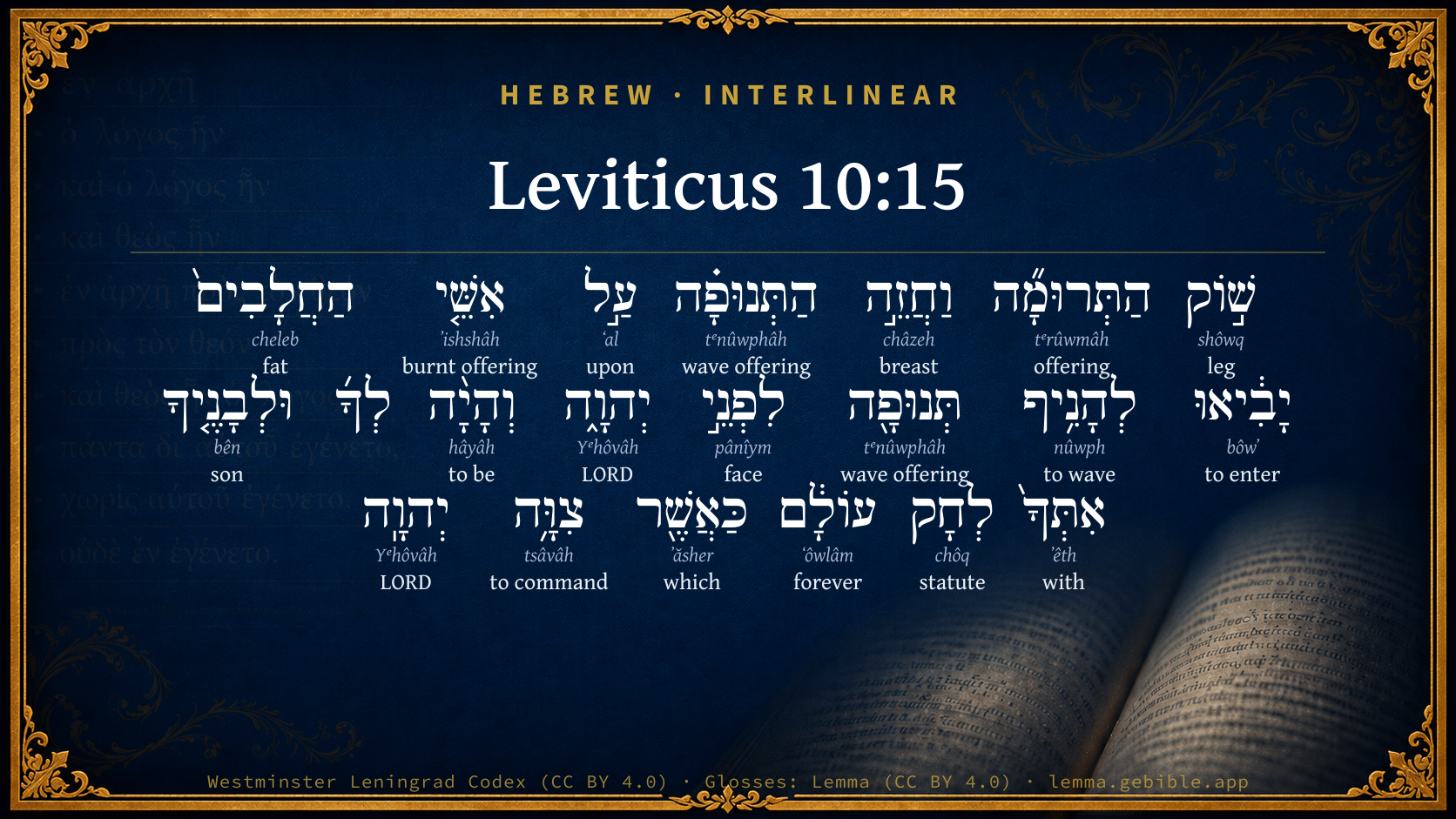
Hebrew (Westminster Leningrad Codex) Leviticus 10:15 appears in the Hebrew Old Testament. The text above is from the Westminster Leningrad Codex. Each word links to its Strong’s number, a concise gloss, and parsing drawn from the Open Scriptures Hebrew Bible morphology. Click any word for its full Brown-Driver-Briggs (BDB) entry.
Download image
Cite this verse

Leviticus 10:15 (World English Bible). Public Domain. Lemma interlinear Bible study tool, https://lemma.gebible.app/v/leviticus/10/15.

Show BibTeX & RIS
BibTeX
RIS
English Translation
The heaved thigh and the waved breast they shall bring with the offerings made by fire of the fat, to wave it for a wave offering before Yahweh: and it shall be yours, and your sons' with you, as a portion forever; as Yahweh has commanded."
World English Bible · Public Domain
Download a study sheet

One document with this verse’s original text, its word-by-word gloss line, the meaning frame, cross-references with their text, attributed commentary, and full source and license credits — printable, and it pastes into notes with its structure intact.

This verse Autodidact and up

Study sheet (.html) Plain text (.txt)

A passage Seminary Student

Up to 50 verses in one chapter. A passage sheet keeps up to 6 commentary sources and 12 cross-references per verse, in the order this page ranks them, and says so on the sheet whenever that leaves anything out. Ask for a single verse and you get the Autodidact verse sheet above.

Everything on this page stays free to read, with no account — the sheet is a download of what is already on screen, not access to it.

Want to remove ads? Support Godless Engineer
Compare translations 3

The same verse in 3 English versions, stacked beneath the original-language interlinear above. Click any original word for its lexicon entry.

Each is an independent rendering of the whole verse — the interlinear is not word-aligned to these translations.

Highlighted words mark where these versions differ — a whole-verse word diff, not a word-by-word alignment.

  • World English Bible Public Domain
    The heaved thigh and the waved breast they shall bring with the offerings made by fire of the fat, to wave it for a wave offering before Yahweh: and it shall be yours, and your sons' with you, as a portion forever; as Yahweh has commanded."
  • King James Version Public Domain
    The heave shoulder and the wave breast shall they bring with the offerings made by fire of the fat, to wave it for a wave offering before the LORD; and it shall be thine, and thy sons' with thee, by a statute for ever; as the LORD hath commanded.
  • unfoldingWord Literal Text CC BY-SA 4.0
    The thigh of the contribution and the breast of the raised offering, in addition to the gifts of the fat portions, they shall bring to raise a raised offering to the face of Yahweh. And it shall be for you and for your sons with you as an enduring portion, just as Yahweh commanded.”

unfoldingWord Literal Text — © unfoldingWord, licensed CC BY-SA 4.0. Word-aligned USFM3 via Door43 (git.door43.org/unfoldingWord/en_ult).

Versions to compare (up to 4)

3 of 4 selected

Show all 18 translations

Every available English version of this verse, each an independent rendering of the whole verse.

  • World English Bible Public Domain
    The heaved thigh and the waved breast they shall bring with the offerings made by fire of the fat, to wave it for a wave offering before Yahweh: and it shall be yours, and your sons' with you, as a portion forever; as Yahweh has commanded."
  • Berean Standard Bible Public Domain
    They are to bring the thigh of the contribution and the breast of the wave offering, together with the fat portions of the offerings made by fire, to wave as a wave offering before the LORD. It will belong permanently to you and your children, as the LORD has commanded.”
  • Majority Standard Bible Public Domain
    They are to bring the thigh of the contribution and the breast of the wave offering, together with the fat portions of the food offerings, to wave as a wave offering before the LORD. It will belong permanently to you and your children, as the LORD has commanded.”
  • King James Version Public Domain
    The heave shoulder and the wave breast shall they bring with the offerings made by fire of the fat, to wave it for a wave offering before the LORD; and it shall be thine, and thy sons' with thee, by a statute for ever; as the LORD hath commanded.
  • American Standard Version (1901) Public Domain
    The heave-thigh and the wave-breast shall they bring with the offerings made by fire of the fat, to wave it for a wave-offering before Jehovah: and it shall be thine, and thy sons' with thee, as a portion for ever; as Jehovah hath commanded.
  • Revised Version (1885) Public Domain
    The heave thigh and the wave breast shall they bring with the offerings made by fire of the fat, to wave it for a wave offering before the LORD: and it shall be thine, and thy sons’ with thee, as a due for ever; as the LORD hath commanded.
  • Geneva Bible (1599) Public Domain
    The heaue shoulder, and the shaken breast shall they bring with the offringes made by fire of the fat, to shake it to and from before the Lord, and it shalbe thine and thy sonnes with thee by a lawe for euer, as the Lord hath commanded.
  • Douay-Rheims (1899) Public Domain
    Because they have elevated before the Lord the shoulder and the breast, and the fat that is burnt on the altar, and they belong to thee and to thy sons by a perpetual law, as the Lord hath commanded.
  • Young's Literal Translation Public Domain
    the leg of the heave-offering, and breast of the wave-offering, besides fire-offerings of the fat, they do bring in to wave a wave-offering before Jehovah, and it hath been to thee, and to thy sons with thee, by a statute age-during, as Jehovah hath commanded.'
  • Literal Standard Version CC BY-SA 4.0
    the leg of the raised-offering, and breast of the wave-offering, besides fire-offerings of the fat, they bring in to wave [as] a wave-offering before YHWH, and it has been to you, and to your sons with you, by a continuous statute, as YHWH has commanded.”
  • Unlocked Literal Bible CC BY-SA 4.0
    The thigh that is presented and the breast that is waved, they must bring with the offerings of fat made by fire, to wave before Yahweh. They will be yours and your sons' with you as a share forever, as Yahweh has commanded.”
  • unfoldingWord Literal Text CC BY-SA 4.0
    The thigh of the contribution and the breast of the raised offering, in addition to the gifts of the fat portions, they shall bring to raise a raised offering to the face of Yahweh. And it shall be for you and for your sons with you as an enduring portion, just as Yahweh commanded.”
  • Darby Bible Public Domain
    The shoulder of the heave-offering and the breast of the wave-offering shall they bring, with the fire-offering of the pieces of fat, to wave [them] as a wave-offering before Jehovah; and they shall be thine, and thy sons' with thee, for an everlasting statute, as Jehovah has commanded.
  • World Messianic Bible Public Domain
    They shall bring the heaved thigh and the waved breast with the offerings made by fire of the fat, to wave it for a wave offering before the LORD. It shall be yours, and your sons’ with you, as a portion forever, as the LORD has commanded.”
  • Webster's Bible Public Domain
    The heave-shoulder and the wave-breast shall they bring, with the offerings made by fire of the fat, to wave it for a wave-offering before the LORD; and it shall be thine, and thy sons' with thee, by a statute for ever; as the LORD hath commanded.
  • Free Bible Version CC BY-SA 4.0
    The thigh contribution and the breast of the wave offering, as well as the fat portions of the food offerings made, they are to bring and wave as a wave offering before the Lord. They belong to you and your children forever as the Lord has ordered.”
  • Bible in Basic English Public Domain
    Let them take the breast which is waved and the leg which is lifted up on high, with the fat of the burned offering, to be waved for a wave offering before the Lord; and this will be for you and for your sons with you, for a right for ever, as the Lord has given orders.
  • JPS Tanakh (1917) Public Domain
    The thigh of heaving and the breast of waving shall they bring with the offerings of the fat made by fire, to wave it for a wave-offering before the LORD; and it shall be thine, and thy sons' with thee, as a due for ever; as the LORD hath commanded.'

Literal Standard Version (2020), Covenant Press — licensed CC BY-SA 4.0. Text via the HelloAO Bible API (eBible.org). Unlocked Literal Bible (unfoldingWord) — licensed CC BY-SA 4.0. Text via the HelloAO Bible API (eBible.org). unfoldingWord Literal Text — © unfoldingWord, licensed CC BY-SA 4.0. Word-aligned USFM3 via Door43 (git.door43.org/unfoldingWord/en_ult). Free Bible Version, Dr. Jonathan Gallagher — licensed CC BY-SA 4.0. Text via the HelloAO Bible API (eBible.org).

Word by word

More ways to search: Search by grammar → Find every occurrence → Compare this word →

Practice this passage: Drill this verse → Learn its vocabulary →

וַחֲזֵ֣ה
châzeh
H2373
“and · breast of”
Conjunction + Noun, Common, Masculine, Singular, Construct
Part of Speech
Conjunction + Noun
Type
Common
Gender
Masculine
Number
Singular
State
Construct
Full BDB Definition

Origin: from H2372

TWOT: 634a

breast (of animals), breast of an animal sacrifice
  1. שׁ֣וֹק shôwq H7785 “leg of” Noun, Common, Feminine, Singular, Construct
  2. הַתְּרוּמָ֞ה tᵉrûwmâh H8641 “the · offering” Particle, Definite Article + Noun, Common, Feminine, Singular, Absolute
  3. הַתְּנוּפָ֗ה tᵉnûwphâh H8573 “the · wave offering” Particle, Definite Article + Noun, Common, Feminine, Singular, Absolute
  4. עַ֣ל ʻal H5921 “upon” Preposition
  5. אִשֵּׁ֤י ʼishshâh H801 “burnt offerings of” Noun, Common, Masculine, Plural, Construct
  6. הַחֲלָבִים֙ cheleb H2459 “the · fat” Particle, Definite Article + Noun, Common, Masculine, Plural, Absolute
  7. יָבִ֔יאוּ bôwʼ H935 “to enter” Verb, Hiphil, Imperfect, 3rd Person, Masculine, Plural
  8. לְהָנִ֥יף nûwph H5130 “to wave” Preposition + Verb, Hiphil, Infinitive Construct
  9. תְּנוּפָ֖ה tᵉnûwphâh H8573 “wave offering” Noun, Common, Feminine, Singular, Absolute
  10. לִפְנֵ֣י pânîym H6440 “to/for · face(s) of” Preposition + Noun, Common, Both, Plural, Construct
  11. יְהוָ֑ה Yᵉhôvâh H3068 “LORD” Noun, Proper
  12. וְהָיָ֨ה hâyâh H1961 “and · to be” Conjunction + Verb, Qal, Sequential Perfect, 3rd Person, Masculine, Singular
  13. וּלְבָנֶ֤יךָ bên H1121 “and · to/for · sons · your” Conjunction + Preposition + Noun, Common, Masculine, Plural, Construct + Suffix, Personal, 2nd Person, Masculine, Singular
  14. אִתְּךָ֙ ʼêth H854 “with · you” Preposition + Suffix, Personal, 2nd Person, Masculine, Singular
  15. לְחָק chôq H2706 “to/for · statute of” Preposition + Noun, Common, Masculine, Singular, Construct
  16. עוֹלָ֔ם ʻôwlâm H5769 “forever” Noun, Common, Masculine, Singular, Absolute
  17. כַּאֲשֶׁ֖ר ʼăsher H834 “like/as · which” Preposition + Particle, Relative
  18. צִוָּ֥ה tsâvâh H6680 “to command” Verb, Piel, Perfect, 3rd Person, Masculine, Singular
  19. יְהוָֽה Yᵉhôvâh H3068 “LORD” Noun, Proper

About this verse

These counts appear in no published source. They are computed here, from the morphology-tagged text and Lemma’s own curated glosses. What Lemma adds →

21
words
18
distinct lemmas
Pentateuch
section

Notable vocabulary

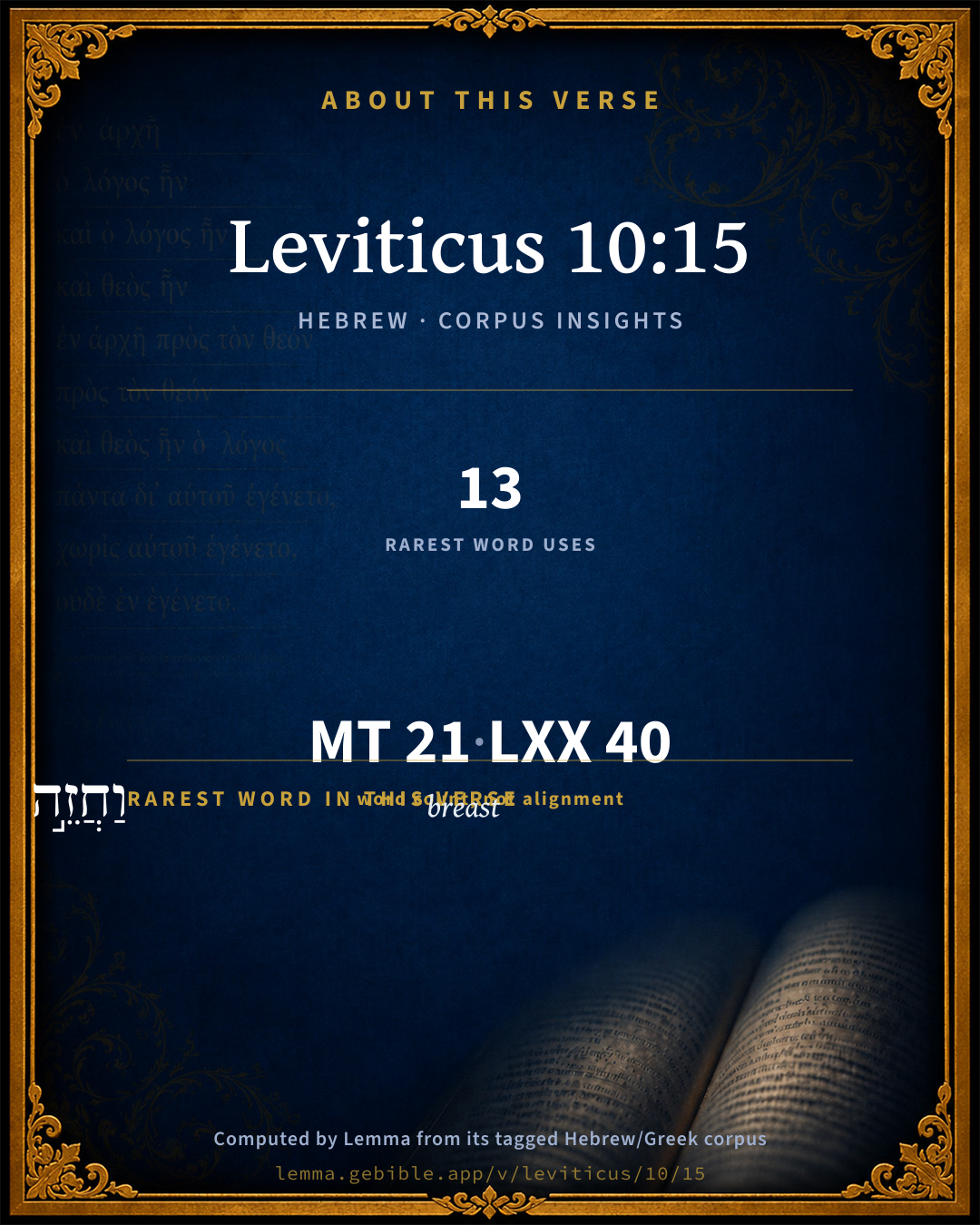
The rarest word here is וַחֲזֵ֣ה breast H2373 — appearing just 13 times in the whole Hebrew Bible.

Shared distinctive vocabulary

וַחֲזֵ֣ה breast H2373 occurs in 12 verses of the Hebrew Bible. Also found in:

Grammatical profile

  • 4 verbs
  • 13 nouns
  • 3 prepositions
  • 1 particle

Verb forms

  • יָבִ֔יאוּ Hiphil · Imperfect
  • לְהָנִ֥יף Hiphil · Infinitive Construct
  • וְהָיָ֨ה Qal · Sequential Perfect
  • צִוָּ֥ה Piel · Perfect

Repetition

Words recur within this verse — often emphatic in Hebrew:

  • הַתְּנוּפָ֗ה wave offering H8573 ×2
  • יְהוָ֑ה LORD H3068 ×2

Hebrew & Septuagint length

In English translation the verse runs 46 words from the Hebrew and 51 from the Septuagint (LXX English) — closely comparable.

A rough comparison of the two English renderings, which tokenize alike — not a word-level alignment.

Word counts can differ between the Hebrew and the Greek without any difference in meaning — e.g. the Hebrew direct-object marker אֵת has no separate Greek word, and Greek often adds the article ὁ.

In the original languages it is 21 Hebrew tokens and 40 Greek tokens — but the two are counted differently (Hebrew bundles its prefixes and suffixes into one token; the Greek is in lemma form), so that isn’t a like-for-like length.

Cross-references

7

Topical passages linked to Leviticus 10:15 in the Treasury of Scripture Knowledge — connected by theme and wording, ordered by reader-vote popularity; previews shown in the World English Bible.

  • Leviticus 7:34 For the waved breast and the heaved thigh I have taken from the children of Israel out of the sacrifices of their peace offerings, and have given them to Aaron the priest and to his sons as their portion forever from the children of Israel.'"
  • Genesis 13:15 for all the land which you see, I will give to you, and to your offspring forever.
  • Genesis 17:8 I will give to you, and to your seed after you, the land where you are traveling, all the land of Canaan, for an everlasting possession. I will be their God."
  • Genesis 17:13 He who is born in your house, and he who is bought with your money, must be circumcised. My covenant will be in your flesh for an everlasting covenant.
  • Genesis 17:17 Then Abraham fell on his face, and laughed, and said in his heart, "Will a child be born to him who is one hundred years old? Will Sarah, who is ninety years old, give birth?"
  • Leviticus 7:29–30 "Speak to the children of Israel, saying, 'He who offers the sacrifice of his peace offerings to Yahweh shall bring his offering to Yahweh out of the sacrifice of his peace offerings.
  • 1 Corinthians 9:13–14 Don't you know that those who serve around sacred things eat from the things of the temple, and those who wait on the altar have their portion with the altar?

Cross-references courtesy of OpenBible.info (CC BY 4.0).

Hebrew and Greek witnesses Masoretic Hebrew ↔ Greek Septuagint

The same verse in the two great witnesses to the Old Testament, shown verse-for-verse.

These are two independent witnesses, not word-aligned to each other, and the Septuagint is shown in lemma (dictionary) form.

Hebrew Leviticus 10:15 Masoretic · Westminster Leningrad Codex

שׁ֣וֹק הַתְּרוּמָ֞ה וַחֲזֵ֣ה הַתְּנוּפָ֗ה עַ֣ל אִשֵּׁ֤י הַחֲלָבִים֙ יָבִ֔יאוּ לְהָנִ֥יף תְּנוּפָ֖ה לִפְנֵ֣י יְהוָ֑ה וְהָיָ֨ה לְךָ֜ וּלְבָנֶ֤יךָ אִתְּךָ֙ לְחָק עוֹלָ֔ם כַּאֲשֶׁ֖ר צִוָּ֥ה יְהוָֽה

The heaved thigh and the waved breast they shall bring with the offerings made by fire of the fat, to wave it for a wave offering before Yahweh: and it shall be yours, and your sons' with you, as a portion forever; as Yahweh has commanded."

World English Bible · Public Domain

Greek LXX Leviticus 10:15 Septuagint · lemma form

ὁ βραχίων ὁ ἀφαίρεμα καί ὁ στηθύνιον ὁ ἀφόρισμα ἐπί ὁ κάρπωμα ὁ στέαρ προςφέρω ἀφόρισμα ἀποὁρίζω ἔναντι κύριος καί εἰμί σύ καί ὁ υἱός σύ καί ὁ θυγάτηρ σύ μετά σύ νόμιμος αἰώνιος ὅς τρόπος συντάσσω κύριος ὁ μωυσῆς

They shall bring the shoulder of the choice-offering, and the breast of the separation upon the burnt offerings of the fat, to separate for a separation before the Lord; and it shall be a perpetual ordinance for you and your sons and your daughters with you, as the Lord commanded Moses.

LXX2012 (modern English Septuagint) · Public Domain

On this verse, Haydock's Catholic Bible Commentary discusses the Septuagint’s reading. Read the note in Commentary ↓

Hebrew: Westminster Leningrad Codex (CC BY 4.0). Greek: Septuagint (public domain); English from LXX2012 (modern English Septuagint) (Public Domain). How the Septuagint differs from the Hebrew →

Targum (Aramaic paraphrase)

2

The Targum is the ancient Jewish Aramaic paraphrase of the Hebrew Scriptures — an interpretive translation, not the Hebrew text itself. Onkelos (literal) and Pseudo-Jonathan (expansive) render the Torah, and Jonathan the Prophets. Coverage is partial: where no permissively-licensed English translation exists for a verse, only the Aramaic is shown. This is verse-level text, not a word-by-word alignment to the Hebrew.

  1. Targum Onkelos Torah (Genesis–Deuteronomy)
    שׁוֹקָא דְאַפְרָשׁוּתָא וְחֶדְיָא דַאֲרָמוּתָא עַל קֻרְבָּנֵי תַרְבַּיָא יַיְתוּן לַאֲרָמָא אֲרָמָא קֳדָם יְיָ וִיהֵי לָךְ וְלִבְנָיךְ עִמָךְ לִקְיַם עָלָם כְּמָא דִי פַקִיד יְיָ

    (no public-domain English translation for this verse)

    Targum Onkelos — Aramaic: “Onkelos Genesis” (public domain); “Onkelos Exodus” (public domain); “Onkelos Leviticus” (public domain); “Onkelos Numbers” (public domain); “Onkelos Deuteronomy” (public domain). English: “Sefaria Community Translation” (CC0 1.0 (public-domain dedication)); “J.W. Etheridge. The Targums of Onkelos and Jonathan Ben Uzziel on the Pentateuch. London: Longmans, Green, 1862” (public domain). Text via Sefaria.

  2. Targum Pseudo-Jonathan Torah (Genesis–Deuteronomy)
    שׁוֹקָא דְאַפְרָשׁוּתָא וְחַדְיָא דַאֲרָמוּתָא עַל קוּרְבָּנֵיהּ תַּרְבַּיָא יַיְתוּן לַאֲרָמָא אֲרָמָא קֳדָם יְיָ וִיהֵי לָךְ וְלִבְנָךְ עִמָךְ לִקְיַים עֳלָם הֵיכְמָא דְפַקֵיד יְיָ

    The shoulder of the separation and the elevated breast with the fats of the oblations they shall bring to be uplifted an elevation before the Lord, and they shall then be thine and thy sons' with thee, by an everlasting statute, as the Lord commanded.

    Targum Pseudo-Jonathan — Aramaic: “Targum Jonathan on Genesis” (public domain); “Targum Jonathan on Exodus” (public domain); “Targum Jonathan on Leviticus” (public domain); “Targum Jonathan on Numbers” (public domain); “Targum Jonathan on Deuteronomy” (public domain). English: “The Targum of Jonathan ben Uzziel, trans. J. W. Etheridge, London, 1862” (public domain). Text via Sefaria.

Commentary

Notes on Leviticus 10:15 from classic Christian and Jewish commentators (each source and its license shown beneath its notes). The classic Christian expositions comment on the surrounding passage and are grouped to its opening verse, so a note may address several verses; the Jewish commentaries on the Tanakh (Rashi and others) are per-verse, so they appear only where the commentator wrote on this verse.

Lemma curates 59 commentaries, every one of them public domain or Creative Commons licensed, each selected and text-cleaned for this edition rather than reprinted as found. About our sources →

Trapp's Complete Commentary

John Trapp

Lev 10:15 The heave shoulder and the wave breast shall they bring with the offerings made by fire of the fat, to wave [it for] a wave offering before the LORD; and it shall be thine, and thy sons’ with thee, by a statute for ever; as the LORD hath commanded.

Ver. 15. The heave shoulder.] See on Exo 29:24.

John Trapp, A Commentary or Exposition upon All the Books of the Old and New Testament (1647–1656) — public domain. Text from a community e-Sword module.

Ellicott's Commentary for English Readers

(15) The heave shoulder and the wave breast shall they bring.—That is, the offerers who devoted these portions of the peace offering to the Lord, are to bring them to the officiating priests. (See Lev_7:29-30.)

A Bible Commentary for English Readers, edited by Charles John Ellicott (1878–1897) — public domain. Text from a community e-Sword module.

John Gill's Exposition

And Moses diligently sought the goat of the sin offering,.... The Targum of Jonathan says,"three goats were offered on that day, the goat of the new moon, of the sin offering for the people, and of the sin offering, which Nahshon the son of Amminadab offered at the dedication of the altar; Aaron and his sons, it adds, went and burnt these three, Moses came and sought, &c.''Jarchi also speaks of three goats offered, but says that only one was burnt, the goat of the new moon; and so Ben Gersom, who gives this reason for the diligent search after it, because it was always to be offered up, and was not a temporary affair, as the others were: but it rather seems to be the goat of the sin offering for the people, for it is not certain that the other goats were offered on this day, but this was, see Lev 9:15 now according to the law, the flesh of this goat was not to be burnt, but to be eaten by the priests in the holy place, see Lev 6:25. Moses now suspecting that Aaron and his sons, through their grief for the death of Nadab and Abihu, had neglected the eating of it, sought diligently after it, and so it proved:

and, behold, it was burnt: as they had no appetite to it themselves, they burnt it, that it might not be eaten by any others, for none but they might eat it, and that it might not corrupt:

and he was angry with Eleazar and Ithamar, the sons of Aaron, which were left alive; when their two elder brothers were killed with lightning for doing what was not commanded, which should have made them more observant of the laws of God, to do that which was commanded them: and though they were spared, and survived their brethren, yet they transgressed, in burning the sin offering of the people, when they should have eaten it. Jarchi observes, that he expressed his anger not to Aaron, but to his sons, which he did for the honour of Aaron, laying the blame not on him, who was overwhelmed with grief, but on his sons:

saying; as follows.

John Gill's Exposition of the Whole Bible (1746–1763) — public domain (CC PDM 1.0). Text via the HelloAO Bible API.

Haydock's Catholic Bible Commentary

Sons. Samaritan and Septuagint add, "and thy daughters." The male children were allowed to partake of the sin-offerings: those of peace, were given also to females.

George Leo Haydock (1774–1849), Haydock's Catholic Family Bible and Commentary, 1859 edition — public domain. Excludes Psalms (Douay-Rheims chapter numbering differs from Protestant) and Deuterocanonical books (Catholic canon only).

Whedon's Commentary on the Bible

Daniel D. Whedon

15. The heave shoulder… wave breast — See Lev_7:14; Lev_7:30, notes. “All the members of the priestly family, daughters, as well as sons — all, whatever the measure of energy or capacity — are to feed upon the breast and the shoulder, the affections and the strength of the true Peace Offering as raised from the dead and presented before God.” — McIntosh.

Daniel D. Whedon (gen. ed.), Commentary on the Old and New Testaments (1874–1909) — public domain. Text from a community e-Sword module.

Rashi

Rabbi Shlomo Yitzchaki (Rashi)

על אשי החלבים WITH THE FIRE OFFERINGS OF THE FAT — From this we may learn that the fat-portions were beneath the others at the time of waving (Sifra, Shemini, Chapter 1 11). And as for the exposition of the texts in such a manner that they shall not contradict each other I have already explained the three of them in the section צו את אהרן (Leviticus 7:30; see Rashi thereon).

Rashi on the Tanakh — English translations: “The Judaica Press complete Tanach with Rashi, translated by A. J. Rosenberg” (CC BY 4.0); “Pentateuch with Rashi's commentary by M. Rosenbaum and A.M. Silbermann, 1929-1934” (public domain); “The Metsudah Tanach series, Lakewood, N.J” (CC BY 4.0); and “The Book of Joshua, Metsudah Publications, 1997” (CC BY 4.0). Text via Sefaria.

Ramban (Nachmanides)

Rabbi Moshe ben Nachman (Ramban / Nachmanides)

THE THIGH OF HEAVING AND THE BREAST OF WAVING. “This expression is similar to the verse, [the breast of the wave-offering, and the thigh of the heave-offering], which is waved, and which is heaved up. ‘Waving’ is an expression for moving to and fro [in a horizontal direction]. ‘Heaving’ is an expression for moving up and down. But why Scripture divided them, mentioning ‘heaving’ in connection with the thigh and ‘waving’ in connection with the breast, I do not know, for both of them [required] waving and heaving.” Thus far is the language of Rashi. It appears to me that the reason for it is that during the [seven days of] consecration, the thigh was a heave-offering to G-d, being burned together with the bread and the fats, and that which is set aside from a peace-offering [to be burnt on the altar] is called “a heave-offering,” just as it is said, And of it he shall offer one out of each offering for a heave-offering unto the Eternal, and [it follows] all the more so that these parts [of the ram of consecration] offered on the altar, were all “a heave-offering unto the Eternal.” [Hence the expression “the thigh of heaving.”] It was not called by the term “waving,” for that movement [to and fro in a horizontal direction] was done to the thigh together with the fats and the bread so as to burn them unto the Eternal. The breast, however, was waved by itself, and was only different from the rest of the meat [which was to be eaten by the priests] in that it was waved, and it was through this waving alone that it became sanctified and that Moses acquired it as his portion. [Moses] shalt take the breast of Aaron’s ram of consecration, and wave it for a wave-offering before the Eternal; and it shall be thy portion. Now since the right of Aaron and his sons to the breast and thigh [of peace-offerings] in future generations was [derived] from the day of their consecration as priests, when they acquired the thigh through its being a heave-offering to G-d and the breast through its being waved, whilst the rest of the meat belonged to the owners, therefore the thigh was forever called [the thigh of] “heaving,” and the breast that of “waving,” as was done to them on the day of [the priests] acquiring their rights to them.

AL ISHEI HACHALAVIM’ (UPON THE FIRE-OFFERINGS OF THE FAT). “This is like: ‘upon the fat of the fire-offerings.’ From here we learn that at the time of waving the fat-portions were beneath.” This is the language of Rashi. But there is no need for it [i.e., to invert the verse, and to derive this law from the verse here]. For the word ishei (“fire-offerings of”) is an adjectival-noun qualifying the word chalavim (fats), just as He said, ‘ishei Hashem’ (the fire-offerings of the Eternal) and His inheritance they [the priests] shall eat. does not have its precise meaning of “the fires of,” since the priests do not eat that which has actually been on the fire upon the altar. The word ishei must therefore be taken as an adjectival-noun for all offerings, since most of them are put upon the fire. Consequently the fats are not called ishei because of the fire, and the expression in the verse need not be inverted. — Ramban now proceeds to comment on the second point that Rashi made, namely that from the verse here we learn that the fat-portions were at the bottom at the time of waving. The explanation of this verse is that it constitutes a reason for that which He said [in the preceding verse], for they [the offerings] are given as thy due, and thy sons’ due, out of the offerings of the peace-offerings of the children of Israel. [With reference to this] He now said, The thigh of heaving and the breast of waving shall they — that is, the children of Israel, mentioned [in the previous verse] — bring upon the fire-offerings of the fat, to wave it for a wave-offering before the Eternal, that they [i.e., the thigh and the breast] be hallowed before Him, and they shall be thine and thy sons’ with thee, as a due forever. For this is not the place of the command concerning the waving, but incidentally we learn that at the time of waving the fats were beneath the others.

Ramban (Nachmanides) on the Tanakh — English translation: “Commentary on the Torah by Ramban (Nachmanides). Translated and annotated by Charles B. Chavel. New York, Shilo Pub. House, 1971-1976” (CC BY 4.0). Text via Sefaria.

Lesson kit

Teaching starters — assembled from the data on this page, not authored interpretation. Every prompt links to the verse data it draws on. Edit before teaching.

Leviticus, in the Pentateuch, opens this verse with 21 words (18 distinct Hebrew lemmas). Its most distinctive word is châzeh (“breast”). A historical commentator’s framing appears above. Read the whole chapter for the surrounding context.

Discussion questions

  1. How does “breast” (châzeh) shape what this verse is saying?
  2. How does Exodus 29:26, which shares the word «breast», read alongside this verse?
  3. What does the repetition of “wave offering” (2× in this one verse) do in this verse?
  4. These translations render this verse differently. What is at stake in choosing one wording over another?
  5. «יָבִ֔יאוּ» is a Hiphil Imperfect verb. How does that grammatical form shape the action described?
  6. Compare how Trapp's Complete Commentary and Ellicott's Commentary for English Readers read this verse. Where do they agree or differ?

Things to notice

Reading settings

Reading text

Shown beneath each verse's original-language words.

Old Testament
Old Testament edition

Read the OT as the Masoretic Hebrew (MT) or the Greek Septuagint (LXX).

English shown for the Greek Septuagint (in the Hebrew ↔ Greek comparison).

Comparing translations? Open the Compare panel on any verse page to stack up to four side by side.