
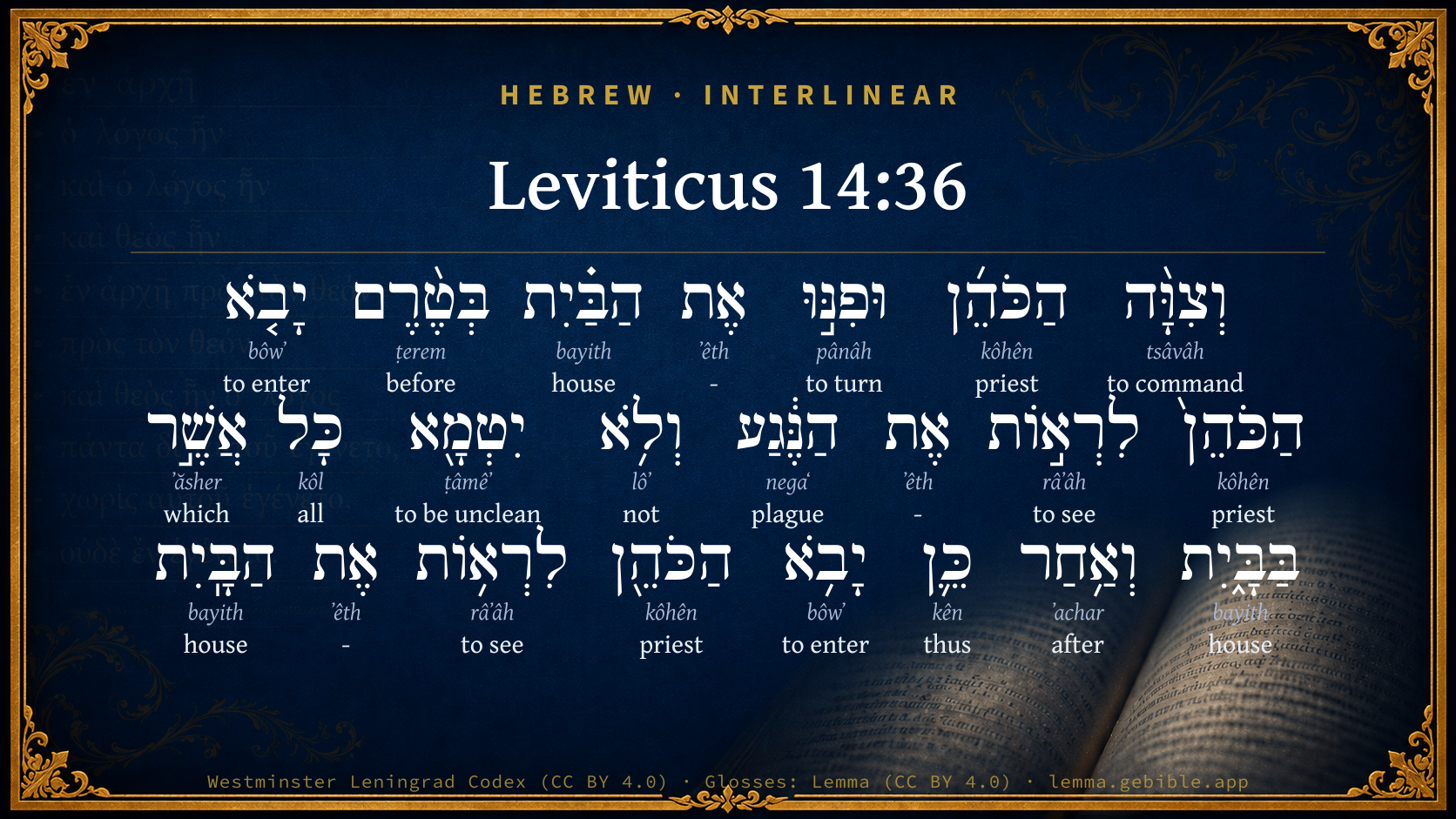
Leviticus 14:36

Hebrew (Westminster Leningrad Codex) Leviticus 14:36 appears in the Hebrew Old Testament. The text above is from the Westminster Leningrad Codex. Each word links to its Strong’s number, a concise gloss, and parsing drawn from the Open Scriptures Hebrew Bible morphology. Click any word for its full Brown-Driver-Briggs (BDB) entry.
Download image
Cite this verse

Leviticus 14:36 (World English Bible). Public Domain. Lemma interlinear Bible study tool, https://lemma.gebible.app/v/leviticus/14/36.

Show BibTeX & RIS
BibTeX
RIS
English Translation
The priest shall command that they empty the house, before the priest goes in to examine the plague, that all that is in the house not be made unclean: and afterward the priest shall go in to inspect the house.
World English Bible · Public Domain
Download a study sheet

One document with this verse’s original text, its word-by-word gloss line, the meaning frame, cross-references with their text, attributed commentary, and full source and license credits — printable, and it pastes into notes with its structure intact.

This verse Autodidact and up

Study sheet (.html) Plain text (.txt)

A passage Seminary Student

Up to 50 verses in one chapter. A passage sheet keeps up to 6 commentary sources and 12 cross-references per verse, in the order this page ranks them, and says so on the sheet whenever that leaves anything out. Ask for a single verse and you get the Autodidact verse sheet above.

Everything on this page stays free to read, with no account — the sheet is a download of what is already on screen, not access to it.

Want to remove ads? Support Godless Engineer
Compare translations 3

The same verse in 3 English versions, stacked beneath the original-language interlinear above. Click any original word for its lexicon entry.

Each is an independent rendering of the whole verse — the interlinear is not word-aligned to these translations.

Highlighted words mark where these versions differ — a whole-verse word diff, not a word-by-word alignment.

  • World English Bible Public Domain
    The priest shall command that they empty the house, before the priest goes in to examine the plague, that all that is in the house not be made unclean: and afterward the priest shall go in to inspect the house.
  • King James Version Public Domain
    Then the priest shall command that they empty the house, before the priest go into it to see the plague, that all that is in the house be not made unclean: and afterward the priest shall go in to see the house:
  • unfoldingWord Literal Text CC BY-SA 4.0
    The priest shall command, and they shall empty the house before the priest comes to see the infection, and everything that in the house will not be pronounced unclean. And after thus, the priest shall come to see the house.

unfoldingWord Literal Text — © unfoldingWord, licensed CC BY-SA 4.0. Word-aligned USFM3 via Door43 (git.door43.org/unfoldingWord/en_ult).

Versions to compare (up to 4)

3 of 4 selected

Show all 18 translations

Every available English version of this verse, each an independent rendering of the whole verse.

  • World English Bible Public Domain
    The priest shall command that they empty the house, before the priest goes in to examine the plague, that all that is in the house not be made unclean: and afterward the priest shall go in to inspect the house.
  • Berean Standard Bible Public Domain
    The priest must order that the house be cleared before he enters it to examine the mildew, so that nothing in the house will become unclean. After this, the priest shall go in to inspect the house.
  • Majority Standard Bible Public Domain
    The priest must order that the house be cleared before he enters it to examine the mildew, so that nothing in the house will become unclean. After this, the priest shall go in to inspect the house.
  • King James Version Public Domain
    Then the priest shall command that they empty the house, before the priest go into it to see the plague, that all that is in the house be not made unclean: and afterward the priest shall go in to see the house:
  • American Standard Version (1901) Public Domain
    And the priest shall command that they empty the house, before the priest goeth in to see the plague, that all that is in the house be not made unclean: and afterward the priest shall go in to see the house:
  • Revised Version (1885) Public Domain
    and the priest shall command that they empty the house, before the priest go in to see the plague, that all that is in the house be not made unclean: and afterward the priest shall go in to see the house:
  • Geneva Bible (1599) Public Domain
    Then the Priest shall commande them to emptie the house before the Priest goe into it to see the plague, that all that is in the house be not made vncleane, and then shall the Priest goe in to see the house,
  • Douay-Rheims (1899) Public Domain
    And he shall command, that they carry forth all things out of the house, before he go into it, and see whether it have the leprosy, lest all things become unclean that are in the house. And after- wards he shall go in to view the leprosy of the house.
  • Young's Literal Translation Public Domain
    and the priest hath commanded, and they have prepared the house before the priest cometh in to see the plague (that all which `is' in the house be not unclean), and afterwards doth the priest come in to see the house;
  • Literal Standard Version CC BY-SA 4.0
    and the priest has commanded, and they have prepared the house before the priest comes in to see the plague (that all which [is] in the house is not unclean), and afterward the priest comes in to see the house;
  • Unlocked Literal Bible CC BY-SA 4.0
    Then the priest will command that they empty the house before he goes in to see the evidence of mildew, so that nothing in the house will be made unclean. Afterward the priest must go in to see the house.
  • unfoldingWord Literal Text CC BY-SA 4.0
    The priest shall command, and they shall empty the house before the priest comes to see the infection, and everything that in the house will not be pronounced unclean. And after thus, the priest shall come to see the house.
  • Darby Bible Public Domain
    and the priest shall command that they empty the house before the priest go into it to see the plague, that all that is in the house be not made unclean; and afterwards the priest shall go in to see the house.
  • World Messianic Bible Public Domain
    The priest shall command that they empty the house, before the priest goes in to examine the plague, that all that is in the house not be made unclean. Afterward the priest shall go in to inspect the house.
  • Webster's Bible Public Domain
    Then the priest shall command that they empty the house, before the priest shall enter to see the plague, that all that is in the house may not be made unclean; and afterward the priest shall go in to see the house:
  • Free Bible Version CC BY-SA 4.0
    The priest must order the house to be emptied before he goes in to inspect the mold, so that nothing in the house will be declared unclean. Once that's done, the priest is to go in and inspect the house.
  • Bible in Basic English Public Domain
    And the priest will give orders for everything to be taken out of the house, before he goes in to see the disease, so that the things in the house may not become unclean; and then the priest is to go in to see the house;
  • JPS Tanakh (1917) Public Domain
    And the priest shall command that they empty the house, before the priest go in to see the plague, that all that is in the house be not made unclean; and afterward the priest shall go in to see the house.

Literal Standard Version (2020), Covenant Press — licensed CC BY-SA 4.0. Text via the HelloAO Bible API (eBible.org). Unlocked Literal Bible (unfoldingWord) — licensed CC BY-SA 4.0. Text via the HelloAO Bible API (eBible.org). unfoldingWord Literal Text — © unfoldingWord, licensed CC BY-SA 4.0. Word-aligned USFM3 via Door43 (git.door43.org/unfoldingWord/en_ult). Free Bible Version, Dr. Jonathan Gallagher — licensed CC BY-SA 4.0. Text via the HelloAO Bible API (eBible.org).

Word by word

More ways to search: Search by grammar → Find every occurrence → Compare this word →

Practice this passage: Drill this verse → Learn its vocabulary →

בְּטֶ֨רֶם
ṭerem
H2962
“in/at · before”
Preposition + Adverb
Part of Speech
Preposition + Adverb
Full BDB Definition

Origin: from an unused root apparently meaning to interrupt or suspend

TWOT: 826

before, not yet, before that
  1. וְצִוָּ֨ה tsâvâh H6680 “and · to command” Conjunction + Verb, Piel, Sequential Perfect, 3rd Person, Masculine, Singular
  2. הַכֹּהֵ֜ן kôhên H3548 “the · priest” Particle, Definite Article + Noun, Common, Masculine, Singular, Absolute
  3. וּפִנּ֣וּ pânâh H6437 “and · to turn” Conjunction + Verb, Piel, Sequential Perfect, 3rd Person, Common, Plural
  4. אֶת ʼêth H853 “-” Particle, Direct Object
  5. הַבַּ֗יִת bayith H1004 “the · house” Particle, Definite Article + Noun, Common, Masculine, Singular, Absolute
  6. יָבֹ֤א bôwʼ H935 “to enter” Verb, Qal, Imperfect, 3rd Person, Masculine, Singular
  7. הַכֹּהֵן֙ kôhên H3548 “the · priest” Particle, Definite Article + Noun, Common, Masculine, Singular, Absolute
  8. לִרְא֣וֹת râʼâh H7200 “to see” Preposition + Verb, Qal, Infinitive Construct
  9. אֶת ʼêth H853 “-” Particle, Direct Object
  10. הַנֶּ֔גַע negaʻ H5061 “the · plague” Particle, Definite Article + Noun, Common, Masculine, Singular, Absolute
  11. וְלֹ֥א lôʼ H3808 “and · not” Conjunction + Particle, Negative
  12. יִטְמָ֖א ṭâmêʼ H2930 “to be unclean” Verb, Qal, Imperfect, 3rd Person, Masculine, Singular
  13. כָּל kôl H3605 “all of” Noun, Common, Masculine, Singular, Construct
  14. אֲשֶׁ֣ר ʼăsher H834 “which” Particle, Relative
  15. בַּבָּ֑יִת bayith H1004 “in/at the · house” Preposition, Determined + Noun, Common, Masculine, Singular, Absolute
  16. וְאַ֥חַר ʼachar H310 “and · after” Conjunction + Adverb
  17. כֵּ֛ן kên H3651 “thus” Particle, Demonstrative
  18. יָבֹ֥א bôwʼ H935 “to enter” Verb, Qal, Imperfect, 3rd Person, Masculine, Singular
  19. הַכֹּהֵ֖ן kôhên H3548 “the · priest” Particle, Definite Article + Noun, Common, Masculine, Singular, Absolute
  20. לִרְא֥וֹת râʼâh H7200 “to see” Preposition + Verb, Qal, Infinitive Construct
  21. אֶת ʼêth H853 “-” Particle, Direct Object
  22. הַבָּֽיִת bayith H1004 “the · house” Particle, Definite Article + Noun, Common, Masculine, Singular, Absolute

About this verse

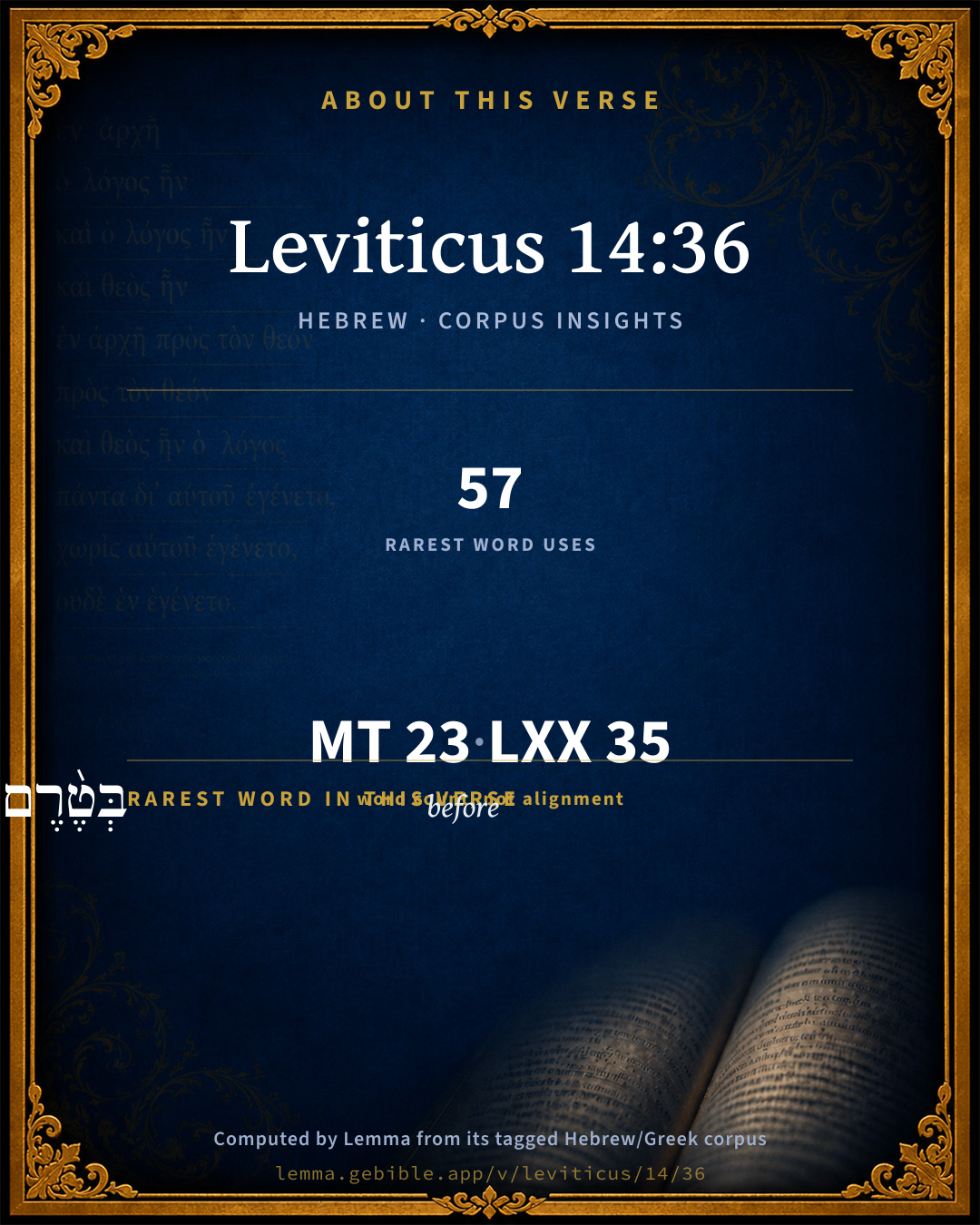
These counts appear in no published source. They are computed here, from the morphology-tagged text and Lemma’s own curated glosses. What Lemma adds →

23
words
15
distinct lemmas
Pentateuch
section

Shared distinctive vocabulary

בְּטֶ֨רֶם before H2962 occurs in 50 verses of the Hebrew Bible. Also found in:

Grammatical profile

  • 7 verbs
  • 8 nouns
  • 2 adverbs
  • 6 particles

Verb forms

  • וְצִוָּ֨ה Piel · Sequential Perfect
  • וּפִנּ֣וּ Piel · Sequential Perfect
  • יָבֹ֤א Qal · Imperfect
  • לִרְא֣וֹת Qal · Infinitive Construct
  • יִטְמָ֖א Qal · Imperfect
  • יָבֹ֥א Qal · Imperfect
  • לִרְא֥וֹת Qal · Infinitive Construct

Repetition

Words recur within this verse — often emphatic in Hebrew:

  • הַכֹּהֵ֜ן priest H3548 ×3
  • הַבַּ֗יִת house H1004 ×3
  • יָבֹ֤א to enter H935 ×2
  • לִרְא֣וֹת to see H7200 ×2

Hebrew & Septuagint length

In English translation the verse runs 40 words from the Hebrew and 45 from the Septuagint (LXX English) — closely comparable.

A rough comparison of the two English renderings, which tokenize alike — not a word-level alignment.

Word counts can differ between the Hebrew and the Greek without any difference in meaning — e.g. the Hebrew direct-object marker אֵת has no separate Greek word, and Greek often adds the article ὁ.

In the original languages it is 23 Hebrew tokens and 35 Greek tokens — but the two are counted differently (Hebrew bundles its prefixes and suffixes into one token; the Greek is in lemma form), so that isn’t a like-for-like length.

Cross-references

4

Topical passages linked to Leviticus 14:36 in the Treasury of Scripture Knowledge — connected by theme and wording, ordered by reader-vote popularity; previews shown in the World English Bible.

  • 1 Corinthians 15:33 Don't be deceived! "Evil companionships corrupt good morals."
  • 2 Timothy 2:17–18 and their word will consume like gangrene, of whom is Hymenaeus and Philetus;
  • Hebrews 12:15 looking carefully lest there be any man who falls short of the grace of God; lest any root of bitterness springing up trouble you, and thereby the many be defiled;
  • Revelation 18:4 I heard another voice from heaven, saying, "Come out of her, my people, that you have no participation in her sins, and that you don't receive of her plagues,

Cross-references courtesy of OpenBible.info (CC BY 4.0).

Hebrew and Greek witnesses Masoretic Hebrew ↔ Greek Septuagint

The same verse in the two great witnesses to the Old Testament, shown verse-for-verse.

These are two independent witnesses, not word-aligned to each other, and the Septuagint is shown in lemma (dictionary) form.

Hebrew Leviticus 14:36 Masoretic · Westminster Leningrad Codex

וְצִוָּ֨ה הַכֹּהֵ֜ן וּפִנּ֣וּ אֶת הַבַּ֗יִת בְּטֶ֨רֶם יָבֹ֤א הַכֹּהֵן֙ לִרְא֣וֹת אֶת הַנֶּ֔גַע וְלֹ֥א יִטְמָ֖א כָּל אֲשֶׁ֣ר בַּבָּ֑יִת וְאַ֥חַר כֵּ֛ן יָבֹ֥א הַכֹּהֵ֖ן לִרְא֥וֹת אֶת הַבָּֽיִת

The priest shall command that they empty the house, before the priest goes in to examine the plague, that all that is in the house not be made unclean: and afterward the priest shall go in to inspect the house.

World English Bible · Public Domain

Greek LXX Leviticus 14:36 Septuagint · lemma form

καί προςτάσσω ὁ ἱερεύς ἀποσκευάζω ὁ οἰκία πρό ὁ εἰςἔρχομαι ὁράω ὁ ἱερεύς ὁ ἁφή καί οὐ μή ἀκάθαρτος γίγνομαι ὅσος ἐάν εἰμί ἐν ὁ οἰκία καί μετά οὗτος εἰςἔρχομαι ὁ ἱερεύς καταμανθάνω ὁ οἰκία

And the priest shall give orders to remove the furniture of the house, before the priest comes in to see the plague, and thus none of the things in the house shall become unclean; and afterwards the priest shall go in to examine the house.

LXX2012 (modern English Septuagint) · Public Domain

Hebrew: Westminster Leningrad Codex (CC BY 4.0). Greek: Septuagint (public domain); English from LXX2012 (modern English Septuagint) (Public Domain). How the Septuagint differs from the Hebrew →

Targum (Aramaic paraphrase)

2

The Targum is the ancient Jewish Aramaic paraphrase of the Hebrew Scriptures — an interpretive translation, not the Hebrew text itself. Onkelos (literal) and Pseudo-Jonathan (expansive) render the Torah, and Jonathan the Prophets. Coverage is partial: where no permissively-licensed English translation exists for a verse, only the Aramaic is shown. This is verse-level text, not a word-by-word alignment to the Hebrew.

  1. Targum Onkelos Torah (Genesis–Deuteronomy)
    וִיפַקֵד כַּהֲנָא וִיפַנוּן יָת בֵּיתָא עַד לָא יֵעוֹל כַּהֲנָא לְמֶחֱזֵי יָת מַכְתָּשָׁא וְלָא יִסְתָּאַב כָּל דִי בְּבֵיתָא וּבָתַר כֵּן יֵיעוֹל כַּהֲנָא לְמֶחֱזֵי יָת בֵּיתָא

    (no public-domain English translation for this verse)

    Targum Onkelos — Aramaic: “Onkelos Genesis” (public domain); “Onkelos Exodus” (public domain); “Onkelos Leviticus” (public domain); “Onkelos Numbers” (public domain); “Onkelos Deuteronomy” (public domain). English: “Sefaria Community Translation” (CC0 1.0 (public-domain dedication)); “J.W. Etheridge. The Targums of Onkelos and Jonathan Ben Uzziel on the Pentateuch. London: Longmans, Green, 1862” (public domain). Text via Sefaria.

  2. Targum Pseudo-Jonathan Torah (Genesis–Deuteronomy)
    וְיַפְקֵיד כַּהֲנָא וִיפַנוּן יַת בֵּיתָא עַד לָא יֵיעוֹל כַּהֲנָא לְמֵיחְמֵי יַת בֵּיתָא מְטוֹל דְלָא יִסְתָּאָב כָּל דִבְבֵיתָא וּמִן בָּתַר כְּדֵין יֵיעוֹל כַּהֲנָא לְמֵיחְמֵי יַת בֵּיתָא

    then the priest shall direct that they make the house empty before the priest cometh to inspect the house, that all that is in the house may not be (condemned as) unclean; and after that the priest shall go in to inspect the house.

    Targum Pseudo-Jonathan — Aramaic: “Targum Jonathan on Genesis” (public domain); “Targum Jonathan on Exodus” (public domain); “Targum Jonathan on Leviticus” (public domain); “Targum Jonathan on Numbers” (public domain); “Targum Jonathan on Deuteronomy” (public domain). English: “The Targum of Jonathan ben Uzziel, trans. J. W. Etheridge, London, 1862” (public domain). Text via Sefaria.

Commentary

Notes on Leviticus 14:36 from classic Christian and Jewish commentators (each source and its license shown beneath its notes). The classic Christian expositions comment on the surrounding passage and are grouped to its opening verse, so a note may address several verses; the Jewish commentaries on the Tanakh (Rashi and others) are per-verse, so they appear only where the commentator wrote on this verse.

Lemma curates 59 commentaries, every one of them public domain or Creative Commons licensed, each selected and text-cleaned for this edition rather than reprinted as found. About our sources →

Trapp's Complete Commentary

John Trapp

Lev 14:36 Then the priest shall command that they empty the house, before the priest go [into it] to see the plague, that all that [is] in the house be not made unclean: and afterward the priest shall go in to see the house:

Ver. 36. That all that is in the house be not made unclean.] As it will be when once the priest hath been there and pronounced it unclean. Learn here, saith a good interpreter, to prevent God’s last judgment, by sequestering ourselves betimes, from the contagion of sinners.

John Trapp, A Commentary or Exposition upon All the Books of the Old and New Testament (1647–1656) — public domain. Text from a community e-Sword module.

Joseph Benson's Commentary

Lev 14:36. That all be not made unclean — It is observable here, that neither the people nor the household stuff were polluted till the leprosy was discovered and declared by the priest, to show what great difference God makes between sins of ignorance, and sins against knowledge.

Joseph Benson's Commentary on the Old and New Testaments (1811–1818) — public domain. Text from a community e-Sword module.

Tyndale Open Study Notes

Tyndale Open Resources

14:36 Having the house emptied indicated that it was not actually unclean until the priest pronounced it so. The owner would remove furnishings so that they would not be included in the quarantine.

Tyndale Open Study Notes — © Tyndale Open Resources, licensed CC BY-SA 4.0. Text via the HelloAO Bible API.

Ellicott's Commentary for English Readers

(36) That they empty the house.—If the examination was made before the removal of the objects in it, and the priest pronounced the house leprous, all the furniture, &c, found therein would be defiled. Hence the benign law that everything should be removed previous to the priest’s inspection, to save the household stuff. This assuredly shows that the law did not regard leprosy as infectious.

A Bible Commentary for English Readers, edited by Charles John Ellicott (1878–1897) — public domain. Text from a community e-Sword module.

John Gill's Exposition

Then the priest shall command that they take away the stones in which the plague is,.... In there appeared any cavities, or the above colours, and these spreading: in order to put a stop thereunto, these stones were to be drawn or pulled out, as the word signifies, in such manner as not to endanger the fall of the house, and two stones at least were to be taken out; for, as Gersom says, a house was not shut up unless the plague appeared on two stones:

and they shall cast them into an unclean place without the city; where dead carcasses were laid, and dung, and filth of every sort; and being laid in such a place, it would be known that they were unclean, as Aben Ezra observes, and so would not be made use of for any purpose.

John Gill's Exposition of the Whole Bible (1746–1763) — public domain (CC PDM 1.0). Text via the HelloAO Bible API.

Haydock's Catholic Bible Commentary

Become. If any thing was left in the house, it was deemed unclean, as soon as the priest had declared that the house was infected; and therefore, all was to be removed before he came, (Calmet) and might be used without scruple, unless some marks of leprosy appeared afterwards on the garments, chap. xiii. 47.

George Leo Haydock (1774–1849), Haydock's Catholic Family Bible and Commentary, 1859 edition — public domain. Excludes Psalms (Douay-Rheims chapter numbering differs from Protestant) and Deuterocanonical books (Catholic canon only).

Matthew Poole's English Annotations

That they empty the house, i.e. the possessors of the house. It is observable here, that neither the people nor the household stuff were polluted till the leprosy was discovered and declared by the priest, to show what great difference God makes between sins of ignorance, and sins against knowledge and conscience.

Matthew Poole's English Annotations on the Holy Bible (1683–1685) — public domain. Text from a community e-Sword/MySword module.

Whedon's Commentary on the Bible

Daniel D. Whedon

36. Empty the house — Literally, prepare the house for inspection, by the removal of its contents, as a safeguard against ceremonial defilement.

Daniel D. Whedon (gen. ed.), Commentary on the Old and New Testaments (1874–1909) — public domain. Text from a community e-Sword module.

John Wesley's Explanatory Notes

That all be not made unclean - It is observable here, that neither the people nor the household stuff were polluted till the leprosy was discovered and declared by the priest, to shew what great difference God makes between sins of ignorance, and sins against knowledge.

John Wesley, Explanatory Notes Upon the Whole Bible (1754–1765) — public domain. Text via the GEBible commentary corpus.

unfoldingWord translationNotes

Door43 World Missions Community

so that nothing in the house will be made unclean

Once the priest declared the house to be unclean, everything in the house became unclean, as well. This can be translated in active form. AT: "so that he does not need to declare anything left in the house to be unclean" (See: Active or Passive)

the house will be made unclean

The house that Yahweh has stated is unfit for people to touch or live in is spoken of as if it were physically unclean. (See: Metaphor)

in the depressions in the wall's surface

This means the priest is to determine whether mildew has gone deeper that just the surface of the walls.

translationWords

command

clean

unfoldingWord translationNotes — © Distant Shores Media and the Door43 World Missions Community, licensed CC BY-SA 4.0. Source: git.door43.org/Door43/en_tn.

Rashi

Rabbi Shlomo Yitzchaki (Rashi)

'בטרם יבא הכהן וגו‎ [THEY SHALL CLEAR THE HOUSE] BEFORE THE PRIEST COME etc. — For so long as the priest has not yet engaged himself with it no law of uncleanness is applicable there.

ולא יטמא כל אשר בבית THAT ALL THAT IS IN THE HOUSE BE NOT MADE UNCLEAN, for if he does not clear it out and the priest comes and examines the plague, it requires shutting up and all that is inside immediately becomes unclean. To what is it that the Torah has regard in ordering these precautions to be taken? If it had in mind wooden or metal vessels that need only be rinsed in order to restore them to cleanness, he can immerse them and they will become clean (and there is no need to remove them from the house for fear that they will become unclean if he does not do so), and if it has in mind food and liquids, he can eat them during the time of his uncleanness (in which case also he suffers no loss since he may consume them at a time when he himself happens to be unclean). Consequently it follows that the Torah must have regard only to earthen vessels for which there is no means of purification by immersion in a ritual bath (cf. Rashi on Leviticus 11:35) and which therefore will remain unusable except in connection with ordinary food (חולין) (Sifra, Metzora, Section 5 12).

Rashi on the Tanakh — English translations: “The Judaica Press complete Tanach with Rashi, translated by A. J. Rosenberg” (CC BY 4.0); “Pentateuch with Rashi's commentary by M. Rosenbaum and A.M. Silbermann, 1929-1934” (public domain); “The Metsudah Tanach series, Lakewood, N.J” (CC BY 4.0); and “The Book of Joshua, Metsudah Publications, 1997” (CC BY 4.0). Text via Sefaria.

Ibn Ezra

Rabbi Abraham ibn Ezra

And they shall empty the house [of its contents]. “They shall empty” refers to the homeowner and all his household members, and the reason it is plural is so they will empty the house quickly.

Before the kohein will come. For in a short while he will confine the house due to its doubtful nature …

Ibn Ezra on the Tanakh — English translations: “Sefaria Community Translation” (CC0 1.0 (public-domain dedication)); “Yalkut, Sifsei Chachomim Chumash, Metsudah Publications, 2009” (CC BY 4.0); and “Commentary of Ibn Ezra on Isaiah - trans. by M. Friedlander, 1873” (public domain). Text via Sefaria.

Lesson kit

Teaching starters — assembled from the data on this page, not authored interpretation. Every prompt links to the verse data it draws on. Edit before teaching.

Leviticus, in the Pentateuch, opens this verse with 23 words (15 distinct Hebrew lemmas). Its most distinctive word is ṭerem (“before”). A historical commentator’s framing appears above. Read the whole chapter for the surrounding context.

Discussion questions

  1. How does “before” (ṭerem) shape what this verse is saying?
  2. Genesis 2:5 shares the word «before» with this verse. How do the two illuminate each other?
  3. “priest” occurs 3× in this one verse. What is the effect of the repetition?
  4. These translations render this verse differently; the difference is in the English rendering, not the original. What questions does that raise?
  5. The verb «וְצִוָּ֨ה» is Piel Sequential Perfect. How does its form color the action?
  6. Reading how Trapp's Complete Commentary and Joseph Benson's Commentary read this verse, where do the two commentators agree and where do they part?

Things to notice

Reading settings

Reading text

Shown beneath each verse's original-language words.

Old Testament
Old Testament edition

Read the OT as the Masoretic Hebrew (MT) or the Greek Septuagint (LXX).

English shown for the Greek Septuagint (in the Hebrew ↔ Greek comparison).

Comparing translations? Open the Compare panel on any verse page to stack up to four side by side.