Leviticus 16:28

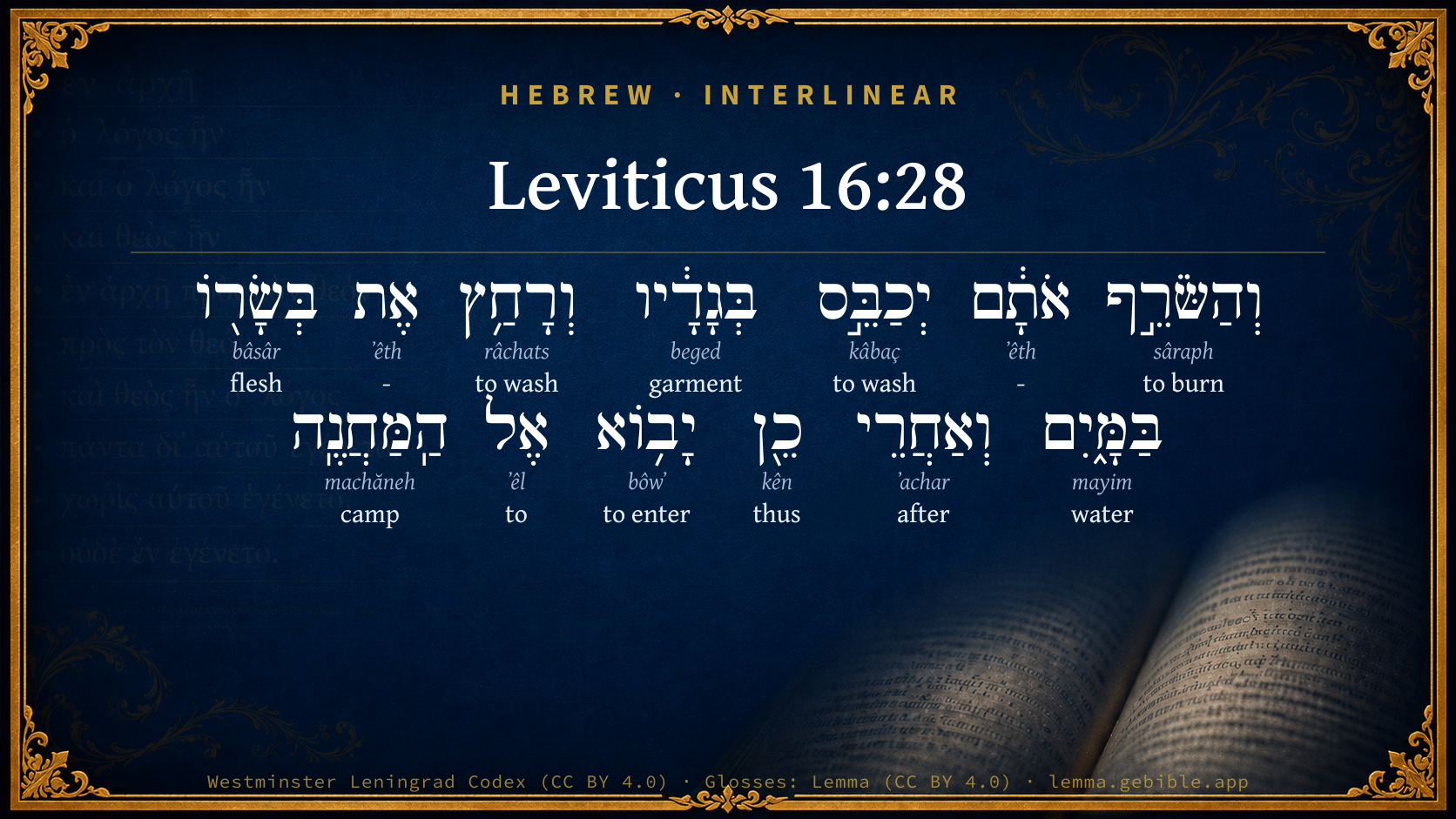
Hebrew (Westminster Leningrad Codex) Leviticus 16:28 appears in the Hebrew Old Testament. The text above is from the Westminster Leningrad Codex. Each word links to its Strong’s number, a concise gloss, and parsing drawn from the Open Scriptures Hebrew Bible morphology. Click any word for its full Brown-Driver-Briggs (BDB) entry.
Download image
Cite this verse

Leviticus 16:28 (World English Bible). Public Domain. Lemma interlinear Bible study tool, https://lemma.gebible.app/v/leviticus/16/28.

Show BibTeX & RIS
BibTeX
RIS
English Translation
He who burns them shall wash his clothes, and bathe his flesh in water, and afterward he shall come into the camp.
World English Bible · Public Domain
Download a study sheet

One document with this verse’s original text, its word-by-word gloss line, the meaning frame, cross-references with their text, attributed commentary, and full source and license credits — printable, and it pastes into notes with its structure intact.

This verse Autodidact and up

Study sheet (.html) Plain text (.txt)

A passage Seminary Student

Up to 50 verses in one chapter. A passage sheet keeps up to 6 commentary sources and 12 cross-references per verse, in the order this page ranks them, and says so on the sheet whenever that leaves anything out. Ask for a single verse and you get the Autodidact verse sheet above.

Everything on this page stays free to read, with no account — the sheet is a download of what is already on screen, not access to it.

Want to remove ads? Support Godless Engineer
Compare translations 3

The same verse in 3 English versions, stacked beneath the original-language interlinear above. Click any original word for its lexicon entry.

Each is an independent rendering of the whole verse — the interlinear is not word-aligned to these translations.

Highlighted words mark where these versions differ — a whole-verse word diff, not a word-by-word alignment.

  • World English Bible Public Domain
    He who burns them shall wash his clothes, and bathe his flesh in water, and afterward he shall come into the camp.
  • King James Version Public Domain
    And he that burneth them shall wash his clothes, and bathe his flesh in water, and afterward he shall come into the camp.
  • unfoldingWord Literal Text CC BY-SA 4.0
    And the person burning them shall wash his clothes, and he shall bathe his flesh in the water. And after thus, he shall enter into the camp.

unfoldingWord Literal Text — © unfoldingWord, licensed CC BY-SA 4.0. Word-aligned USFM3 via Door43 (git.door43.org/unfoldingWord/en_ult).

Versions to compare (up to 4)

3 of 4 selected

Show all 18 translations

Every available English version of this verse, each an independent rendering of the whole verse.

  • World English Bible Public Domain
    He who burns them shall wash his clothes, and bathe his flesh in water, and afterward he shall come into the camp.
  • Berean Standard Bible Public Domain
    The one who burns them must wash his clothes and bathe himself with water, and afterward he may reenter the camp.
  • Majority Standard Bible Public Domain
    The one who burns them must wash his clothes and bathe himself with water, and afterward he may reenter the camp.
  • King James Version Public Domain
    And he that burneth them shall wash his clothes, and bathe his flesh in water, and afterward he shall come into the camp.
  • American Standard Version (1901) Public Domain
    And he that burneth them shall wash his clothes, and bathe his flesh in water, and afterward he shall come into the camp.
  • Revised Version (1885) Public Domain
    And he that burneth them shall wash his clothes, and bathe his flesh in water, and afterward he shall come into the camp.
  • Geneva Bible (1599) Public Domain
    And hee that burneth them shall wash his clothes, and wash his flesh in water, and afterward come into the hoste.
  • Douay-Rheims (1899) Public Domain
    And whosoever burneth them shall wash his clothes, and flesh with water, and so shall enter into the camp.
  • Young's Literal Translation Public Domain
    and he who is burning them doth wash his garments, and hath bathed his flesh with water, and afterwards he cometh in unto the camp.
  • Literal Standard Version CC BY-SA 4.0
    and he who is burning them washes his garments, and has bathed his flesh with water, and afterward he comes into the camp.
  • Unlocked Literal Bible CC BY-SA 4.0
    The man who burns those parts must wash his clothes and bathe his body in water; after that, he may come back into the camp.
  • unfoldingWord Literal Text CC BY-SA 4.0
    And the person burning them shall wash his clothes, and he shall bathe his flesh in the water. And after thus, he shall enter into the camp.
  • Darby Bible Public Domain
    And he that burneth them shall wash his clothes, and bathe his flesh in water; and afterwards he may come into the camp.
  • World Messianic Bible Public Domain
    He who burns them shall wash his clothes, and bathe his flesh in water, and afterward he shall come into the camp.
  • Webster's Bible Public Domain
    And he that burneth them shall wash his clothes, and bathe his flesh in water, and afterward he shall come into the camp.
  • Free Bible Version CC BY-SA 4.0
    The person who burns them must wash his clothes and wash himself with water; then he may come back into the camp.
  • Bible in Basic English Public Domain
    And the man by whom they are burned is to have his clothing washed and his body bathed in water, and then he may come back to the tent-circle.
  • JPS Tanakh (1917) Public Domain
    And he that burneth them shall wash his clothes, and bathe his flesh in water, and afterward he may come into the camp.

Literal Standard Version (2020), Covenant Press — licensed CC BY-SA 4.0. Text via the HelloAO Bible API (eBible.org). Unlocked Literal Bible (unfoldingWord) — licensed CC BY-SA 4.0. Text via the HelloAO Bible API (eBible.org). unfoldingWord Literal Text — © unfoldingWord, licensed CC BY-SA 4.0. Word-aligned USFM3 via Door43 (git.door43.org/unfoldingWord/en_ult). Free Bible Version, Dr. Jonathan Gallagher — licensed CC BY-SA 4.0. Text via the HelloAO Bible API (eBible.org).

Word by word

More ways to search: Search by grammar → Find every occurrence → Compare this word →

Practice this passage: Drill this verse → Learn its vocabulary →

יְכַבֵּ֣ס
kâbaç
H3526
“to wash”
Verb, Piel, Imperfect, 3rd Person, Masculine, Singular
Part of Speech
Verb
Stem
Piel
Form
Imperfect
Person
3rd Person
Gender
Masculine
Number
Singular
Full BDB Definition

Origin: a primitive root

TWOT: 946

to wash (by treading), be washed, perform the work of a fuller - (Qal) washer, fuller, treader (participle) - (Piel) to wash (garments, person) - (Pual) to be washed - (Hothpael) to be washed out
  1. וְהַשֹּׂרֵ֣ף sâraph H8313 “and · the · burning” Conjunction + Particle, Definite Article + Verb, Qal, Participle Active, Masculine, Singular, Absolute
  2. אֹתָ֔ם ʼêth H853 “- · them” Particle, Direct Object + Suffix, Personal, 3rd Person, Masculine, Plural
  3. בְּגָדָ֔יו beged H899 “garments · his” Noun, Common, Masculine, Plural, Construct + Suffix, Personal, 3rd Person, Masculine, Singular
  4. וְרָחַ֥ץ râchats H7364 “and · to wash” Conjunction + Verb, Qal, Sequential Perfect, 3rd Person, Masculine, Singular
  5. אֶת ʼêth H853 “-” Particle, Direct Object
  6. בְּשָׂר֖וֹ bâsâr H1320 “flesh · his” Noun, Common, Masculine, Singular, Construct + Suffix, Personal, 3rd Person, Masculine, Singular
  7. בַּמָּ֑יִם mayim H4325 “in/at the · water(s)” Preposition, Determined + Noun, Common, Masculine, Plural, Absolute
  8. וְאַחֲרֵי ʼachar H310 “and · after” Conjunction + Preposition
  9. כֵ֖ן kên H3651 “thus” Adverb
  10. יָב֥וֹא bôwʼ H935 “to enter” Verb, Qal, Imperfect, 3rd Person, Masculine, Singular
  11. אֶל ʼêl H413 “to” Preposition
  12. הַֽמַּחֲנֶֽה machăneh H4264 “the · camp” Particle, Definite Article + Noun, Common, Both, Singular, Absolute

About this verse

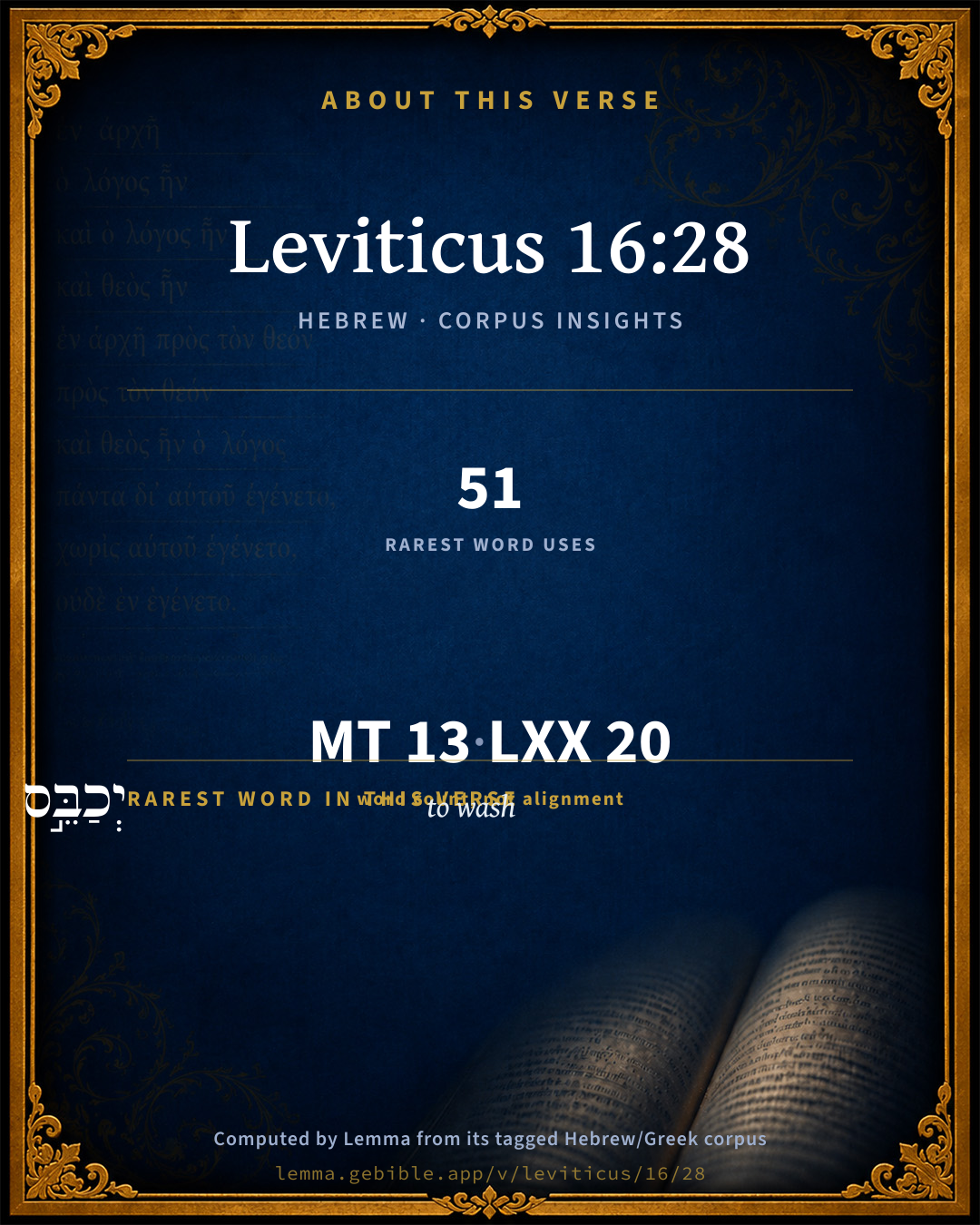
These counts appear in no published source. They are computed here, from the morphology-tagged text and Lemma’s own curated glosses. What Lemma adds →

13
words
12
distinct lemmas
Pentateuch
section

Shared distinctive vocabulary

יְכַבֵּ֣ס to wash H3526 occurs in 48 verses of the Hebrew Bible. Also found in:

Grammatical profile

  • 4 verbs
  • 4 nouns
  • 2 prepositions
  • 1 adverb
  • 2 particles

Verb forms

  • וְהַשֹּׂרֵ֣ף Qal · Participle Active
  • יְכַבֵּ֣ס Piel · Imperfect
  • וְרָחַ֥ץ Qal · Sequential Perfect
  • יָב֥וֹא Qal · Imperfect

Hebrew & Septuagint length

In English translation the verse runs 22 words from the Hebrew and 23 from the Septuagint (LXX English) — closely comparable.

A rough comparison of the two English renderings, which tokenize alike — not a word-level alignment.

Word counts can differ between the Hebrew and the Greek without any difference in meaning — e.g. the Hebrew direct-object marker אֵת has no separate Greek word, and Greek often adds the article ὁ.

In the original languages it is 13 Hebrew tokens and 20 Greek tokens — but the two are counted differently (Hebrew bundles its prefixes and suffixes into one token; the Greek is in lemma form), so that isn’t a like-for-like length.

Hebrew and Greek witnesses Masoretic Hebrew ↔ Greek Septuagint

The same verse in the two great witnesses to the Old Testament, shown verse-for-verse.

These are two independent witnesses, not word-aligned to each other, and the Septuagint is shown in lemma (dictionary) form.

Hebrew Leviticus 16:28 Masoretic · Westminster Leningrad Codex

וְהַשֹּׂרֵ֣ף אֹתָ֔ם יְכַבֵּ֣ס בְּגָדָ֔יו וְרָחַ֥ץ אֶת בְּשָׂר֖וֹ בַּמָּ֑יִם וְאַחֲרֵי כֵ֖ן יָב֥וֹא אֶל הַֽמַּחֲנֶֽה

He who burns them shall wash his clothes, and bathe his flesh in water, and afterward he shall come into the camp.

World English Bible · Public Domain

Greek LXX Leviticus 16:28 Septuagint · lemma form

ὁ δέ κατακαίω αὐτός πλύνω ὁ ἱμάτιον καί λούω ὁ σῶμα αὐτός ὕδωρ καί μετά οὗτος εἰςἔρχομαι εἰς ὁ παρεμβολή

And he that burns them shall wash his garments, and bathe his body in water, and afterwards he shall enter into the camp.

LXX2012 (modern English Septuagint) · Public Domain

Hebrew: Westminster Leningrad Codex (CC BY 4.0). Greek: Septuagint (public domain); English from LXX2012 (modern English Septuagint) (Public Domain). How the Septuagint differs from the Hebrew →

Targum (Aramaic paraphrase)

2

The Targum is the ancient Jewish Aramaic paraphrase of the Hebrew Scriptures — an interpretive translation, not the Hebrew text itself. Onkelos (literal) and Pseudo-Jonathan (expansive) render the Torah, and Jonathan the Prophets. Coverage is partial: where no permissively-licensed English translation exists for a verse, only the Aramaic is shown. This is verse-level text, not a word-by-word alignment to the Hebrew.

  1. Targum Onkelos Torah (Genesis–Deuteronomy)
    וּדְמוֹקִיד יָתְהוֹן יְצַבַּע לְבוּשׁוֹהִי וְיַסְחֵי יָת בִּסְרֵהּ בְּמַיָא וּבָתַר כֵּן יֵיעוֹל למַשְׁרִיתָא

    (no public-domain English translation for this verse)

    Targum Onkelos — Aramaic: “Onkelos Genesis” (public domain); “Onkelos Exodus” (public domain); “Onkelos Leviticus” (public domain); “Onkelos Numbers” (public domain); “Onkelos Deuteronomy” (public domain). English: “Sefaria Community Translation” (CC0 1.0 (public-domain dedication)); “J.W. Etheridge. The Targums of Onkelos and Jonathan Ben Uzziel on the Pentateuch. London: Longmans, Green, 1862” (public domain). Text via Sefaria.

  2. Targum Pseudo-Jonathan Torah (Genesis–Deuteronomy)
    וּדְמוֹקֵיד יַתְהוֹן יְצַבַּע לְבוּשׁוֹי וְיַסְחֵי יַת בִּישְרֵיהּ בְּאַרְבְּעִין סָאוִוין דְמוֹי וּמִן בָּתַר כֵּן יֵיעוֹל לְמַשְׁרִיתָא

    And he who burneth them shall wash his clothes, and bathe his flesh in forty seahs of water, and afterwards he may enter the camp.

    Targum Pseudo-Jonathan — Aramaic: “Targum Jonathan on Genesis” (public domain); “Targum Jonathan on Exodus” (public domain); “Targum Jonathan on Leviticus” (public domain); “Targum Jonathan on Numbers” (public domain); “Targum Jonathan on Deuteronomy” (public domain). English: “The Targum of Jonathan ben Uzziel, trans. J. W. Etheridge, London, 1862” (public domain). Text via Sefaria.

Commentary

Notes on Leviticus 16:28 from classic Christian and Jewish commentators (each source and its license shown beneath its notes). The classic Christian expositions comment on the surrounding passage and are grouped to its opening verse, so a note may address several verses; the Jewish commentaries on the Tanakh (Rashi and others) are per-verse, so they appear only where the commentator wrote on this verse.

Lemma curates 59 commentaries, every one of them public domain or Creative Commons licensed, each selected and text-cleaned for this edition rather than reprinted as found. About our sources →

Trapp's Complete Commentary

John Trapp

Lev 16:28 And he that burneth them shall wash his clothes, and bathe his flesh in water, and afterward he shall come into the camp.

Ver. 28. He that burneth.] Whoever he be whom the priests shall appoint to do it.

John Trapp, A Commentary or Exposition upon All the Books of the Old and New Testament (1647–1656) — public domain. Text from a community e-Sword module.

Ellicott's Commentary for English Readers

(28) And he that burneth.—That is, those who carried the carcases and burned them, like the messenger who conducted the sin-laden goat, contracted defilement from the atoning victims. They had, therefore, to undergo the same ablutions.

A Bible Commentary for English Readers, edited by Charles John Ellicott (1878–1897) — public domain. Text from a community e-Sword module.

John Gill's Exposition

And this shall be a statute for ever unto you,.... As long as the Aaronic priesthood was in being, and the Levitical dispensation lasted, until: the true Messiah came and put an end to all these rites and ceremonies; until that time this service was to be performed by the high priest in succession every year:

that in the seventh month; the month Tisri, as the Targum of Jonathan explains it, which answers to part of our September, and was the seventh month from the month Abib or Nisan, answering to part of our March; which was appointed the first month, upon the Israelites coming out of Egypt in that month, and for that reason; otherwise this seventh month, or Tisri, was the first month of the year before, and, indeed, continued to be so notwithstanding, with respect to things civil:

on the tenth day of the month; on which day, the Jews say (w), Moses descended from the mount the second time, with the tables of the law, and the tidings of forgiveness of the sin of the calf; wherefore this day is thought to be appointed a day of affliction and humiliation for that and all other sins, and for the atonement of them, and on this day the jubilee trumpet was blown, Lev 25:9,

ye shall afflict your souls; not only by humiliation of the heart for sin, and by repentance of it, and by turning from their evil ways, but by corporeal fasting, which is chiefly meant by the affliction of their souls; so the Targum of Jonathan explains it, by abstaining from eating and from drinking, and from the use of baths, and from anointing, and from the use of shoes, and of the marriage bed; and so it is said in the Misnah (x), on the day of atonement, eating and drinking, and washing, and anointing, and putting on of the shoes, and the use of the bed, are forbidden; whoever eats the quantity of a gross date with its kernels, or drinks a mouthful (as much as he can hold in his jaws), is guilty: they do not afflict children on the day of atonement, but they train them up a year or two before, that they may be inured to the command; hence this day, in Act 27:9 is called "the fast":

and do no work at all; no bodily work, for it was in that respect a sabbath, as it is afterwards called; the Jewish canon is, he that ate and did any work was guilty of two sins, or was obliged to two sin offerings (y):

whether it be one of your own country, or a stranger that sojourneth among you; whether a native of the land of Israel, that was born there, and of parents who were Israelites, or one that was a proselyte to the Jewish religion, a proselyte of righteousness, as Ben Gersom interprets it; this law concerning fasting and abstinence from all servile work on the day of atonement was binding on the one as on the other,

(w) Seder Olam Rabba, c. 6. p. 19. (x) Misn. Yoma, c. 8. sect. 1, 2, 4. (y) Ibid. sect. 3.

John Gill's Exposition of the Whole Bible (1746–1763) — public domain (CC PDM 1.0). Text via the HelloAO Bible API.

Lesson kit

Teaching starters — assembled from the data on this page, not authored interpretation. Every prompt links to the verse data it draws on. Edit before teaching.

Leviticus, in the Pentateuch, opens this verse with 13 words (12 distinct Hebrew lemmas). Its most distinctive word is kâbaç (“to wash”). A historical commentator’s framing appears above. Read the whole chapter for the surrounding context.

Discussion questions

  1. What does “to wash” (kâbaç) contribute to the verse as a whole?
  2. How does Genesis 49:11, which shares the word «to wash», read alongside this verse?
  3. These translations render this verse differently. What is at stake in choosing one wording over another?
  4. «וְהַשֹּׂרֵ֣ף» is a Qal Participle Active verb. How does that grammatical form shape the action described?
  5. Compare how Trapp's Complete Commentary and Ellicott's Commentary for English Readers read this verse. Where do they agree or differ?

Things to notice

Reading settings

Reading text

Shown beneath each verse's original-language words.

Old Testament
Old Testament edition

Read the OT as the Masoretic Hebrew (MT) or the Greek Septuagint (LXX).

English shown for the Greek Septuagint (in the Hebrew ↔ Greek comparison).

Comparing translations? Open the Compare panel on any verse page to stack up to four side by side.