

Leviticus 13:9

Hebrew (Westminster Leningrad Codex) Leviticus 13:9 appears in the Hebrew Old Testament. The text above is from the Westminster Leningrad Codex. Each word links to its Strong’s number, a concise gloss, and parsing drawn from the Open Scriptures Hebrew Bible morphology. Click any word for its full Brown-Driver-Briggs (BDB) entry.
Download image
Cite this verse

Leviticus 13:9 (World English Bible). Public Domain. Lemma interlinear Bible study tool, https://lemma.gebible.app/v/leviticus/13/9.

Show BibTeX & RIS
BibTeX
RIS
English Translation
"When the plague of leprosy is in a man, then he shall be brought to the priest;
World English Bible · Public Domain
Download a study sheet

One document with this verse’s original text, its word-by-word gloss line, the meaning frame, cross-references with their text, attributed commentary, and full source and license credits — printable, and it pastes into notes with its structure intact.

This verse Autodidact and up

Study sheet (.html) Plain text (.txt)

A passage Seminary Student

Up to 50 verses in one chapter. A passage sheet keeps up to 6 commentary sources and 12 cross-references per verse, in the order this page ranks them, and says so on the sheet whenever that leaves anything out. Ask for a single verse and you get the Autodidact verse sheet above.

Everything on this page stays free to read, with no account — the sheet is a download of what is already on screen, not access to it.

Want to remove ads? Support Godless Engineer
Compare translations 3

The same verse in 3 English versions, stacked beneath the original-language interlinear above. Click any original word for its lexicon entry.

Each is an independent rendering of the whole verse — the interlinear is not word-aligned to these translations.

Highlighted words mark where these versions differ — a whole-verse word diff, not a word-by-word alignment.

  • World English Bible Public Domain
    "When the plague of leprosy is in a man, then he shall be brought to the priest;
  • King James Version Public Domain
    When the plague of leprosy is in a man, then he shall be brought unto the priest;
  • unfoldingWord Literal Text CC BY-SA 4.0
    An infection of skin disease, when it is on a man, then he shall be brought to the priest.

unfoldingWord Literal Text — © unfoldingWord, licensed CC BY-SA 4.0. Word-aligned USFM3 via Door43 (git.door43.org/unfoldingWord/en_ult).

Versions to compare (up to 4)

3 of 4 selected

Show all 18 translations

Every available English version of this verse, each an independent rendering of the whole verse.

  • World English Bible Public Domain
    "When the plague of leprosy is in a man, then he shall be brought to the priest;
  • Berean Standard Bible Public Domain
    When anyone develops a skin disease, he must be brought to the priest.
  • Majority Standard Bible Public Domain
    When anyone develops a skin disease, he must be brought to the priest.
  • King James Version Public Domain
    When the plague of leprosy is in a man, then he shall be brought unto the priest;
  • American Standard Version (1901) Public Domain
    When the plague of leprosy is in a man, then he shall be brought unto the priest;
  • Revised Version (1885) Public Domain
    When the plague of leprosy is in a man, then he shall be brought unto the priest;
  • Geneva Bible (1599) Public Domain
    When the plague of leprosie is in a man, he shalbe brought vnto the Priest,
  • Douay-Rheims (1899) Public Domain
    If the stroke of the leprosy be in a man, he shall be brought to the priest,
  • Young's Literal Translation Public Domain
    `When a plague of leprosy is in a man, then he hath been brought in unto the priest,
  • Literal Standard Version CC BY-SA 4.0
    When a plague of leprosy is in a man, then he has been brought to the priest,
  • Unlocked Literal Bible CC BY-SA 4.0
    When an infectious skin disease is in someone, then he must be brought to the priest.
  • unfoldingWord Literal Text CC BY-SA 4.0
    An infection of skin disease, when it is on a man, then he shall be brought to the priest.
  • Darby Bible Public Domain
    When a sore [as] of leprosy is in a man, he shall be brought unto the priest;
  • World Messianic Bible Public Domain
    “When the plague of leprosy is in a man, then he shall be brought to the priest;
  • Webster's Bible Public Domain
    When the plague of leprosy is in a man, then he shall be brought to the priest:
  • Free Bible Version CC BY-SA 4.0
    Anyone who develops an infectious skin disease must be taken to the priest.
  • Bible in Basic English Public Domain
    When the disease of a leper is seen on a man, let him be taken to the priest;
  • JPS Tanakh (1917) Public Domain
    When the plague of leprosy is in a man, then he shall be brought unto the priest.

Literal Standard Version (2020), Covenant Press — licensed CC BY-SA 4.0. Text via the HelloAO Bible API (eBible.org). Unlocked Literal Bible (unfoldingWord) — licensed CC BY-SA 4.0. Text via the HelloAO Bible API (eBible.org). unfoldingWord Literal Text — © unfoldingWord, licensed CC BY-SA 4.0. Word-aligned USFM3 via Door43 (git.door43.org/unfoldingWord/en_ult). Free Bible Version, Dr. Jonathan Gallagher — licensed CC BY-SA 4.0. Text via the HelloAO Bible API (eBible.org).

Word by word

More ways to search: Search by grammar → Find every occurrence → Compare this word →

Practice this passage: Drill this verse → Learn its vocabulary →

About this verse

These counts appear in no published source. They are computed here, from the morphology-tagged text and Lemma’s own curated glosses. What Lemma adds →

8
words
8
distinct lemmas
Pentateuch
section

Shared distinctive vocabulary

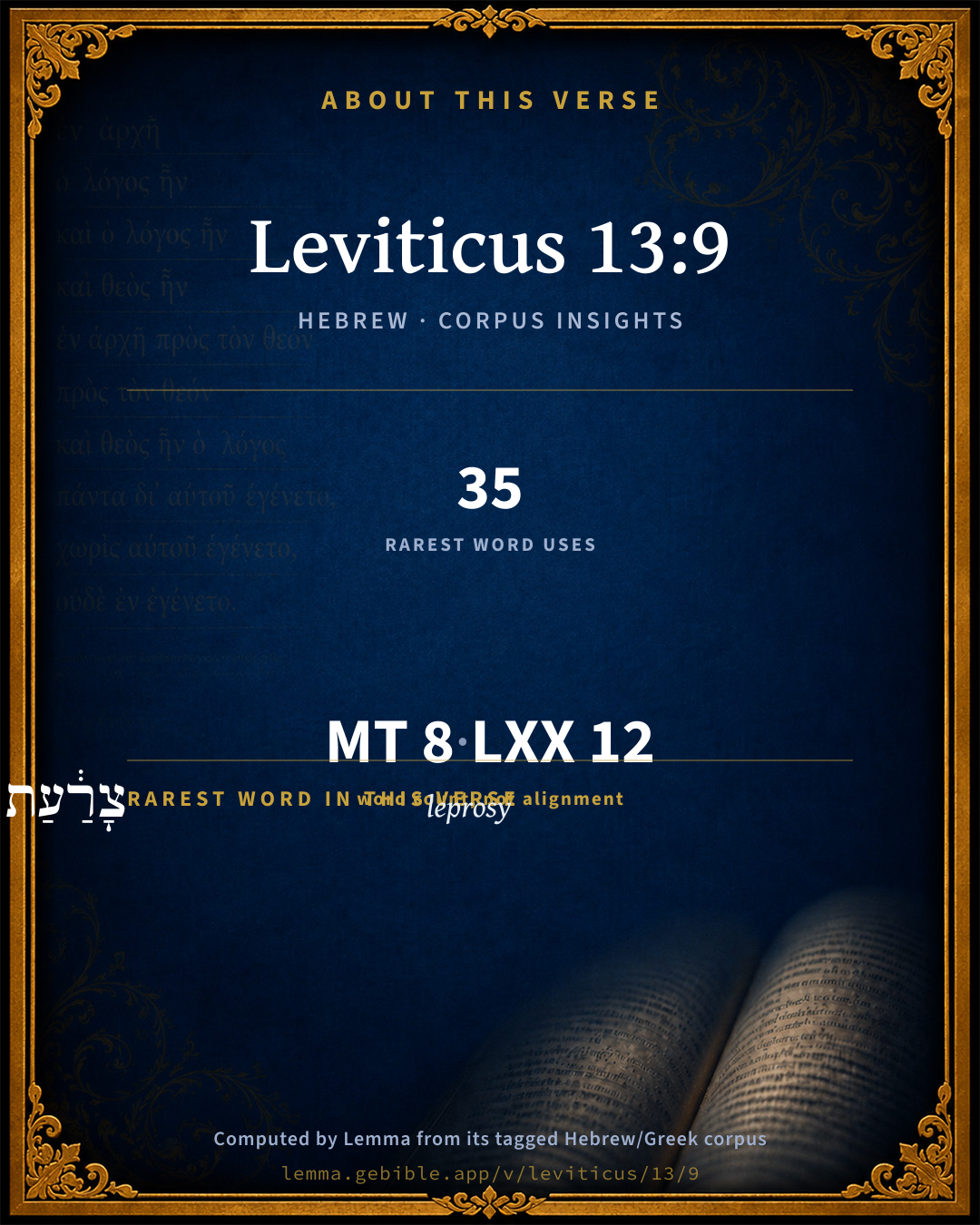
צָרַ֔עַת leprosy H6883 occurs in 33 verses of the Hebrew Bible. Also found in:

Grammatical profile

  • 2 verbs
  • 4 nouns
  • 1 preposition
  • 1 conjunction

Verb forms

  • תִהְיֶ֖ה Qal · Imperfect
  • וְהוּבָ֖א Hophal · Sequential Perfect

Hebrew & Septuagint length

In English translation the verse runs 17 words from the Hebrew and 16 from the Septuagint (LXX English) — closely comparable.

A rough comparison of the two English renderings, which tokenize alike — not a word-level alignment.

Word counts can differ between the Hebrew and the Greek without any difference in meaning — e.g. the Hebrew direct-object marker אֵת has no separate Greek word, and Greek often adds the article ὁ.

In the original languages it is 8 Hebrew tokens and 12 Greek tokens — but the two are counted differently (Hebrew bundles its prefixes and suffixes into one token; the Greek is in lemma form), so that isn’t a like-for-like length.

Hebrew and Greek witnesses Masoretic Hebrew ↔ Greek Septuagint

The same verse in the two great witnesses to the Old Testament, shown verse-for-verse.

These are two independent witnesses, not word-aligned to each other, and the Septuagint is shown in lemma (dictionary) form.

Hebrew Leviticus 13:9 Masoretic · Westminster Leningrad Codex

נֶ֣גַע צָרַ֔עַת כִּ֥י תִהְיֶ֖ה בְּאָדָ֑ם וְהוּבָ֖א אֶל הַכֹּהֵֽן

"When the plague of leprosy is in a man, then he shall be brought to the priest;

World English Bible · Public Domain

Greek LXX Leviticus 13:9 Septuagint · lemma form

καί ἁφή λέπρα ἐάν γίγνομαι ἐν ἄνθρωπος καί ἥκω πρός ὁ ἱερεύς

And if a man have a plague of leprosy, then he shall come to the priest;

LXX2012 (modern English Septuagint) · Public Domain

Hebrew: Westminster Leningrad Codex (CC BY 4.0). Greek: Septuagint (public domain); English from LXX2012 (modern English Septuagint) (Public Domain). How the Septuagint differs from the Hebrew →

Targum (Aramaic paraphrase)

2

The Targum is the ancient Jewish Aramaic paraphrase of the Hebrew Scriptures — an interpretive translation, not the Hebrew text itself. Onkelos (literal) and Pseudo-Jonathan (expansive) render the Torah, and Jonathan the Prophets. Coverage is partial: where no permissively-licensed English translation exists for a verse, only the Aramaic is shown. This is verse-level text, not a word-by-word alignment to the Hebrew.

  1. Targum Onkelos Torah (Genesis–Deuteronomy)
    מַכְתַּשׁ סְגִירוּ אֲרֵי תְהֵי בֶּאֱנָשָׁא ויִתֵּתֵי לְוָת כַּהֲנָא

    (no public-domain English translation for this verse)

    Targum Onkelos — Aramaic: “Onkelos Genesis” (public domain); “Onkelos Exodus” (public domain); “Onkelos Leviticus” (public domain); “Onkelos Numbers” (public domain); “Onkelos Deuteronomy” (public domain). English: “Sefaria Community Translation” (CC0 1.0 (public-domain dedication)); “J.W. Etheridge. The Targums of Onkelos and Jonathan Ben Uzziel on the Pentateuch. London: Longmans, Green, 1862” (public domain). Text via Sefaria.

  2. Targum Pseudo-Jonathan Torah (Genesis–Deuteronomy)
    מַכְתַּשׁ סְגִירוּ אֲרוּם יְהֵי בְּבַר נַשׁ וִיתֵיתֵיהּ לְוַת כַּהֲנָא

    When the plague of leprosy is upon a man, let him be brought to the priest.

    Targum Pseudo-Jonathan — Aramaic: “Targum Jonathan on Genesis” (public domain); “Targum Jonathan on Exodus” (public domain); “Targum Jonathan on Leviticus” (public domain); “Targum Jonathan on Numbers” (public domain); “Targum Jonathan on Deuteronomy” (public domain). English: “The Targum of Jonathan ben Uzziel, trans. J. W. Etheridge, London, 1862” (public domain). Text via Sefaria.

Commentary

Notes on Leviticus 13:9 from classic Christian and Jewish commentators (each source and its license shown beneath its notes). The classic Christian expositions comment on the surrounding passage and are grouped to its opening verse, so a note may address several verses; the Jewish commentaries on the Tanakh (Rashi and others) are per-verse, so they appear only where the commentator wrote on this verse.

Lemma curates 59 commentaries, every one of them public domain or Creative Commons licensed, each selected and text-cleaned for this edition rather than reprinted as found. About our sources →

The Cambridge Bible for Schools and Colleges

gen. ed. J. J. S. Perowne

9–17. The first part of this section is obscure; most modern commentators explain Lev_13:9-11 as referring to another form of leprosy in which the rising described in Lev_13:10 appears without any of the premonitory symptoms of Lev_13:2; if in addition to the white hair (already mentioned in Lev_13:3) there is ‘quick raw flesh’ (Lev_13:10) in the rising, this is a sure sign of leprosy, and the man must be declared unclean at once without waiting for any further examination. By ‘quick raw flesh’ (Heb. ‘the rawness of raw flesh,’ or lit. ‘the quickness of quick flesh’) is understood an appearance like that of raw meat. The Heb. words for ‘raw flesh’ [bâsâr ḥay] are used of raw meat in 1Sa_2:15; Prof. Macalister describes it as ‘red granulation tissue’ (HDB. iii. 96a). The words ‘old leprosy’ must then mean a leprosy of long standing which has not manifested itself in the preliminary stages, but, when first noticed, shews this definite indication of the disease. It is possible that these verses may include the case when the first symptoms described in Lev_13:2 have been either unobserved or concealed.

Another explanation of Lev_13:9-11 is that they describe a fresh outbreak in one who has been pronounced clean, or who has been cured of a previous attack. The traditional interpretation of ‘quick raw flesh’ (the quickening of living flesh, A. V. mg.) is ‘sound flesh.’ The appearance of this sound flesh in a rising was, in the opinion of the rabbis, evidence that an old leprosy had developed fresh activity.

The words of Lev_13:7, ‘after that he hath shewn himself to the priest for his cleansing,’ are by some considered as referring to the third of the inspections prescribed in Lev_13:2-6. It has been observed that the suspected person at the first and second inspection must either be pronounced unclean, or shut up for further enquiry, and he cannot be pronounced clean till the third examination. Then Lev_13:7-8 would refer to the reappearance of leprous symptoms after a man had been pronounced clean by the priest, and Lev_13:9-11 would supply further rules for such cases.

The Cambridge Bible for Schools and Colleges (gen. ed. J. J. S. Perowne; Cambridge University Press, 1878–1918) — public domain. Text from a community e-Sword module.

Trapp's Complete Commentary

John Trapp

Lev 13:9 When the plague of leprosy is in a man, then he shall be brought unto the priest;

Ver. 9. He shall be brought unto the priest.] Who was to discern it by the law of leprosy: so must we find out our sins by the moral law. {Rom 3:20; Rom 7:7} "The works of the flesh are manifest." {Gal 5:19} Neither need we half so much caution or curiosity to be persuaded of our spiritual leprosy, which is too apparent: only those many ceremonies, as one well noteth, may put us in mind how much more exquisite our diligence ought to be in finding and ferreting out our special sins.

John Trapp, A Commentary or Exposition upon All the Books of the Old and New Testament (1647–1656) — public domain. Text from a community e-Sword module.

Joseph Benson's Commentary

Lev 13:9-10. When the plague of leprosy (symptoms thereof) is in a man — If the priest plainly see that it has reached not only the skin, and changed the hair, but eaten into the very flesh, so that he can see the whiteness there, as well as in the skin, he shall look upon it as an evident case, and without shutting him up for further trial, shall judge it a leprosy that has long been breeding, and of the worst kind, and accordingly shall remove the person out of the camp, that he may dwell by himself, Lev 13:46.

Joseph Benson's Commentary on the Old and New Testaments (1811–1818) — public domain. Text from a community e-Sword module.

Jamieson, Fausset & Brown

Robert Jamieson, A. R. Fausset & David Brown

if the rising be white--This BRIGHT WHITE leprosy is the most malignant and inveterate of all the varieties the disease exhibits, and it was marked by the following distinctive signs: A glossy white and spreading scale, upon an elevated base, the elevation depressed in the middle, but without a change of color; the black hair on the patches participating in the whiteness, and the scaly patches themselves perpetually enlarging their boundary. Several of these characteristics, taken separately, belong to other blemishes of the skin as well; so that none of them was to be taken alone, and it was only when the whole of them concurred that the Jewish priest, in his capacity of physician, was to pronounce the disease a malignant leprosy. If it spread over the entire frame without producing any ulceration, it lost its contagious power by degrees; or, in other words, it ran through its course and exhausted itself. In that case, there being no longer any fear of further evil, either to the individual himself or to the community, the patient was declared clean by the priest, while the dry scales were yet upon him, and restored to society. If, on the contrary, the patches ulcerated and quick or fungous flesh sprang up in them, the purulent matter of which, if brought into contact with the skin of other persons, would be taken into the constitution by means of absorbent vessels, the priest was at once to pronounce it an inveterate leprosy. A temporary confinement was them declared to be totally unnecessary, and he was regarded as unclean for life [DR. GOOD]. Other skin affections, which had a tendency to terminate in leprosy, though they were not decided symptoms when alone, were: "a boil" (Lev 13:18-23); "a hot burning,"--that is, a fiery inflammation or carbuncle (Lev 13:24-28); and "a dry scall" (Lev 13:29-37), when the leprosy was distinguished by being deeper than the skin and the hair became thin and yellow.

Jamieson, Fausset & Brown — Commentary Critical and Explanatory on the Whole Bible (1871) — public domain (CC PDM 1.0). Text via the HelloAO Bible API.

Ellicott's Commentary for English Readers

(9) When the plague of leprosy is in a man.—The second case, discussed inverses 9-17, is of leprosy re-appearing after it has been cured, when a somewhat different treatment is enjoined. In its re-appearance, as in its first manifestation, the patient is forthwith to be brought to the priest.

A Bible Commentary for English Readers, edited by Charles John Ellicott (1878–1897) — public domain. Text from a community e-Sword module.

John Gill's Exposition

When the plague of leprosy is in a man,.... He has all the signs of it, and it is pretty manifest both to himself and others that it is upon him:

then he shall be brought unto the priest; by his friends and neighbours, if he is not willing to come of himself: a sinner insensible of the leprosy of sin, and of his unclean and miserable state through it, has no will to come to Christ the great High Priest for cleansing; but one that is sensible of it, and of Christ's ability to help and cleanse him, will come freely and gladly, and importunately seek to him for it; though indeed such an one is brought by powerful and efficacious grace to him, yet not against, but with his full will; see Joh 5:40; compare with this Mat 8:1.

John Gill's Exposition of the Whole Bible (1746–1763) — public domain (CC PDM 1.0). Text via the HelloAO Bible API.

The Pulpit Commentary

Vers. 9-11. The method of procedure in the case of a doubtful leprosy having been laid down in the previous verses, the rule for dealing with an unmistakable case is here given. When the characteristic white spot and white hair are present (if the rising be white in the skin, and it have turned the hair white), and if a third symptom be present if there be quick raw flesh in the rising, that is, if there be an ulcer underneath the white scab, there is to be no delay, as in the previous case, but judgment is to be passed at once. The priest shall pronounce him unclean, and shall not shut him up: for he is manifestly unclean.

The Pulpit Commentary (1880–1919), ed. H.D.M. Spence-Jones & Joseph S. Exell — public domain. Text from a community e-Sword module.

unfoldingWord translationNotes

Door43 World Missions Community

he must be brought to the priest

The priests determined if a disease was spreading. This can be translated in active form. AT: "someone must bring him to the priest" or "he must go to the priest" (See: Active or Passive)

if there is raw flesh in the swelling

Here "raw flesh" could refer to open sores on the skin or it could refer to new skin that has grown, but the area around it is still diseased. Either one indicates that the skin disease is not healing properly.

chronic skin disease

This is a disease that continues or reoccurs over a long period of time.

the priest must pronounce him unclean ... he is already unclean

The man whom other people must not touch is spoken of as if he were physically unclean. (See: Metaphor)

translationWords

priest

flesh

clean

unfoldingWord translationNotes — © Distant Shores Media and the Door43 World Missions Community, licensed CC BY-SA 4.0. Source: git.door43.org/Door43/en_tn.

Lesson kit

Teaching starters — assembled from the data on this page, not authored interpretation. Every prompt links to the verse data it draws on. Edit before teaching.

Leviticus, in the Pentateuch, opens this verse with 8 words (8 distinct Hebrew lemmas). Its most distinctive word is tsâraʻath (“leprosy”). A historical commentator’s framing appears above. Read the whole chapter for the surrounding context.

Discussion questions

  1. The word tsâraʻath carries the sense “leprosy.” How does it shape the verse?
  2. How does Leviticus 13:2, which shares the word «leprosy», read alongside this verse?
  3. The translations on this page render this verse differently — a whole-verse word diff, not a word-by-word alignment. What might account for the different wordings?
  4. «תִהְיֶ֖ה» is a Qal Imperfect verb. How does that grammatical form shape the action described?
  5. Compare how The Cambridge Bible for Schools and Colleges and Trapp's Complete Commentary read this verse. Where do they agree or differ?

Things to notice

Reading settings

Reading text

Shown beneath each verse's original-language words.

Old Testament
Old Testament edition

Read the OT as the Masoretic Hebrew (MT) or the Greek Septuagint (LXX).

English shown for the Greek Septuagint (in the Hebrew ↔ Greek comparison).

Comparing translations? Open the Compare panel on any verse page to stack up to four side by side.