
Leviticus 24:11

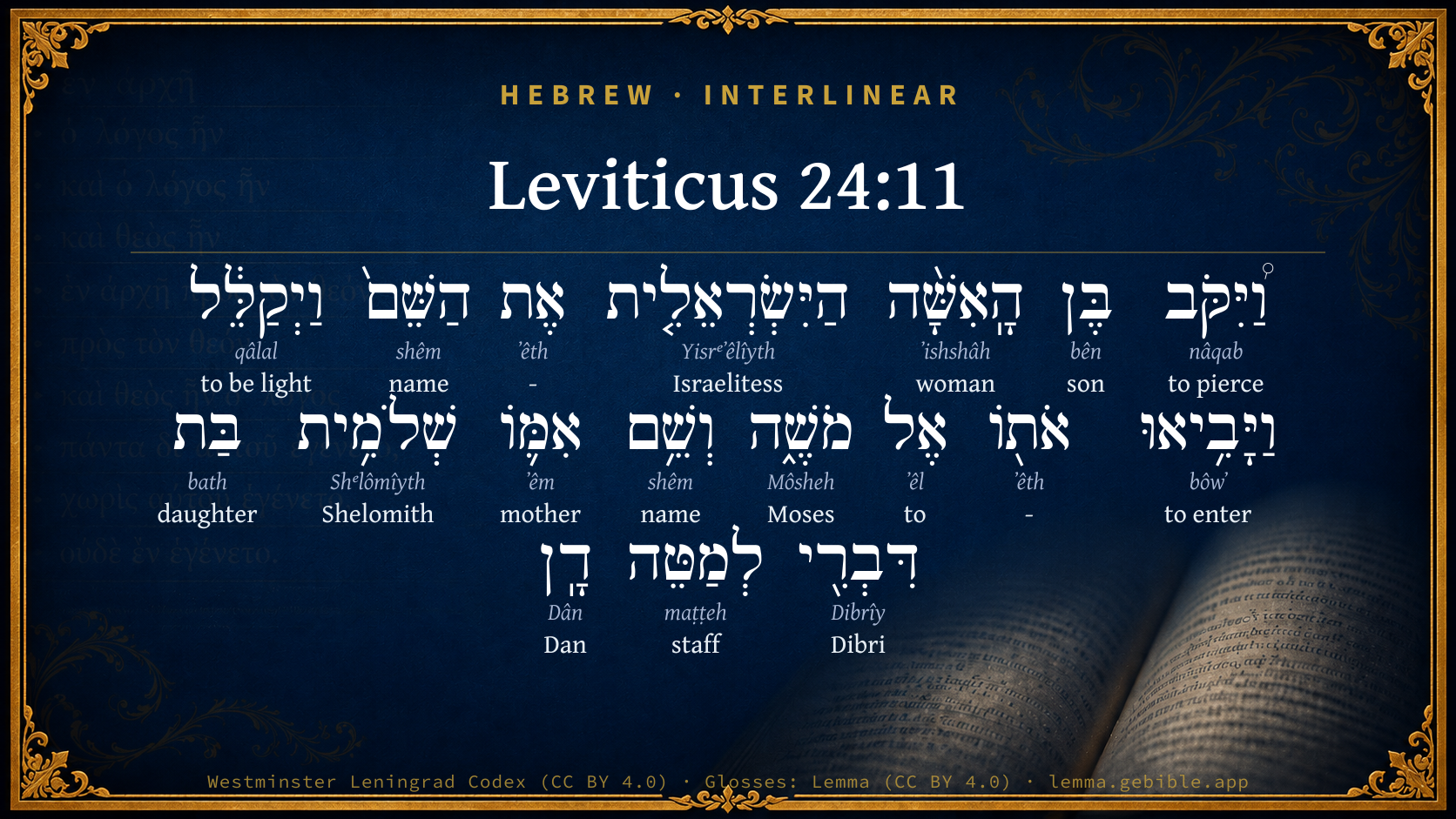
Hebrew (Westminster Leningrad Codex) Leviticus 24:11 appears in the Hebrew Old Testament. The text above is from the Westminster Leningrad Codex. Each word links to its Strong’s number, a concise gloss, and parsing drawn from the Open Scriptures Hebrew Bible morphology. Click any word for its full Brown-Driver-Briggs (BDB) entry.
Download image
Cite this verse

Leviticus 24:11 (World English Bible). Public Domain. Lemma interlinear Bible study tool, https://lemma.gebible.app/v/leviticus/24/11.

Show BibTeX & RIS
BibTeX
RIS
English Translation
The son of the Israelite woman blasphemed the Name, and cursed; and they brought him to Moses. His mother's name was Shelomith, the daughter of Dibri, of the tribe of Dan.
World English Bible · Public Domain
Highlights
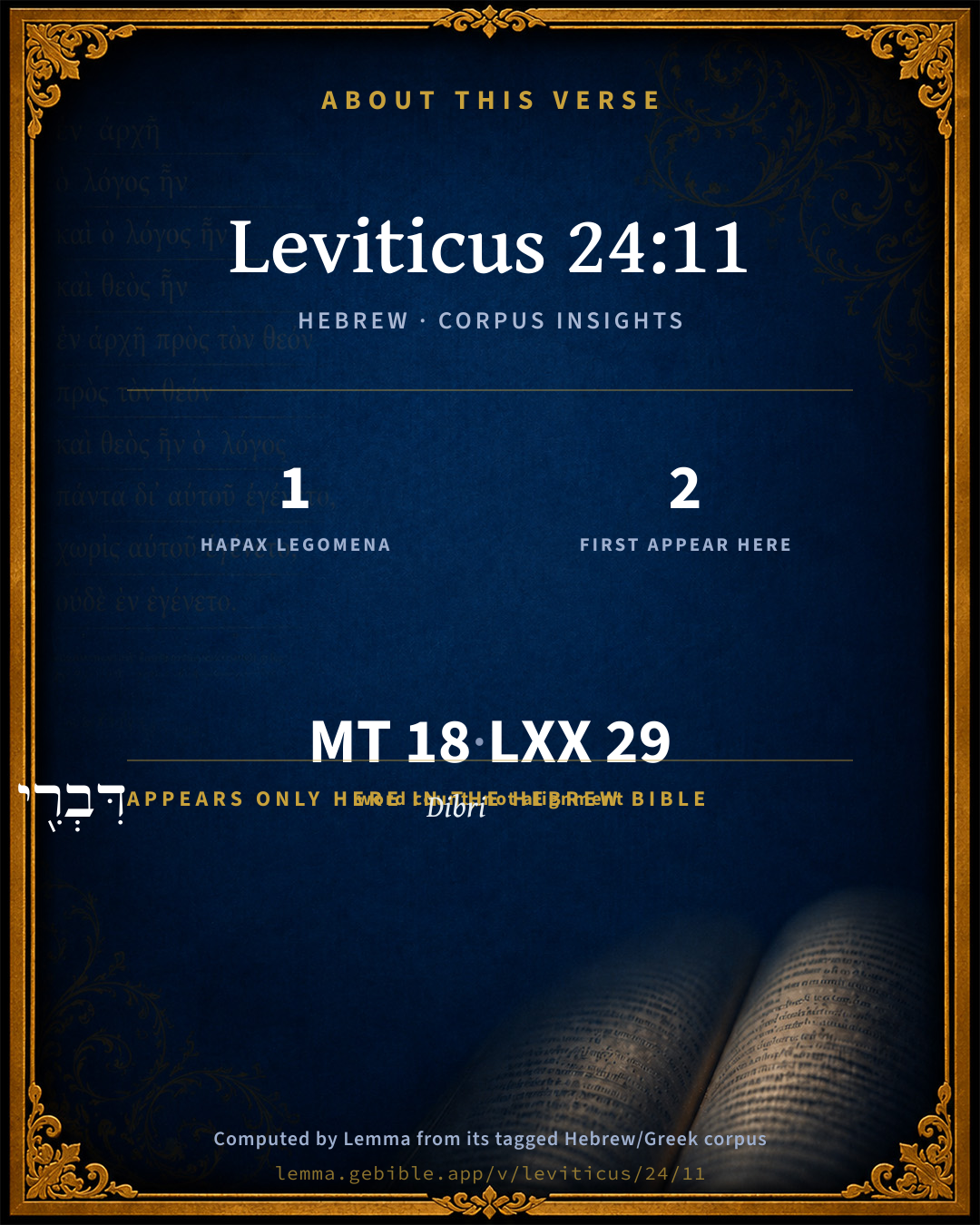
  • 1 hapax legomenon — only here in the Hebrew Bible
  • 2 first appearances in the Hebrew Bible
Full analysis ↓
Download a study sheet

One document with this verse’s original text, its word-by-word gloss line, the meaning frame, cross-references with their text, attributed commentary, and full source and license credits — printable, and it pastes into notes with its structure intact.

This verse Autodidact and up

Study sheet (.html) Plain text (.txt)

A passage Seminary Student

Up to 50 verses in one chapter. A passage sheet keeps up to 6 commentary sources and 12 cross-references per verse, in the order this page ranks them, and says so on the sheet whenever that leaves anything out. Ask for a single verse and you get the Autodidact verse sheet above.

Everything on this page stays free to read, with no account — the sheet is a download of what is already on screen, not access to it.

Want to remove ads? Support Godless Engineer
Compare translations 3

The same verse in 3 English versions, stacked beneath the original-language interlinear above. Click any original word for its lexicon entry.

Each is an independent rendering of the whole verse — the interlinear is not word-aligned to these translations.

Highlighted words mark where these versions differ — a whole-verse word diff, not a word-by-word alignment.

  • World English Bible Public Domain
    The son of the Israelite woman blasphemed the Name, and cursed; and they brought him to Moses. His mother's name was Shelomith, the daughter of Dibri, of the tribe of Dan.
  • King James Version Public Domain
    And the Israelitish woman's son blasphemed the name of the Lord, and cursed. And they brought him unto Moses: (and his mother's name was Shelomith, the daughter of Dibri, of the tribe of Dan:)
  • unfoldingWord Literal Text CC BY-SA 4.0
    And the son of the Israelite woman blasphemed the Name and cursed. And they brought him to Moses. And the name of his mother Shelomith, daughter of Dibri, of the tribe of Dan.

unfoldingWord Literal Text — © unfoldingWord, licensed CC BY-SA 4.0. Word-aligned USFM3 via Door43 (git.door43.org/unfoldingWord/en_ult).

Versions to compare (up to 4)

3 of 4 selected

Show all 18 translations

Every available English version of this verse, each an independent rendering of the whole verse.

  • World English Bible Public Domain
    The son of the Israelite woman blasphemed the Name, and cursed; and they brought him to Moses. His mother's name was Shelomith, the daughter of Dibri, of the tribe of Dan.
  • Berean Standard Bible Public Domain
    The son of the Israelite woman blasphemed the Name with a curse. So they brought him to Moses. (His mother’s name was Shelomith daughter of Dibri, of the tribe of Dan.)
  • Majority Standard Bible Public Domain
    The son of the Israelite woman blasphemed the Name with a curse. So they brought him to Moses. (His mother’s name was Shelomith daughter of Dibri, of the tribe of Dan.)
  • King James Version Public Domain
    And the Israelitish woman's son blasphemed the name of the Lord, and cursed. And they brought him unto Moses: (and his mother's name was Shelomith, the daughter of Dibri, of the tribe of Dan:)
  • American Standard Version (1901) Public Domain
    and the son of the Israelitish woman blasphemed the Name, and cursed; and they brought him unto Moses. And his mother's name was Shelomith, the daughter of Dibri, of the tribe of Dan.
  • Revised Version (1885) Public Domain
    and the son of the Israelitish woman blasphemed the Name, and cursed: and they brought him unto Moses. And his mother’s name was Shelomith, the daughter of Dibri, of the tribe of Dan.
  • Geneva Bible (1599) Public Domain
    So the Israelitish womans sonne blasphemed the name of the Lord, and cursed, and they brought him vnto Moses (his mothers name also was Shelomith, the daughter of Dibri, of the tribe of Dan)
  • Douay-Rheims (1899) Public Domain
    And when he had blasphemed the name, and had cursed it, he was brought to Moses: (now his mother was called Salumith, the daughter of Dabri, of the tribe of Dan:)
  • Young's Literal Translation Public Domain
    and the son of the Israelitish woman execrateth the Name, and revileth; and they bring him in unto Moses; and his mother's name `is' Shelomith daughter of Dibri, of the tribe of Dan;
  • Literal Standard Version CC BY-SA 4.0
    and the son of the Israeli woman execrates the Name and reviles; and they bring him to Moses; and his mother’s name [is] Shelomith daughter of Dibri, of the tribe of Dan;
  • Unlocked Literal Bible CC BY-SA 4.0
    The son of the Israelite woman blasphemed the name of Yahweh and cursed God, so the people brought him to Moses. His mother's name was Shelomith, the daughter of Dibri, from the tribe of Dan.
  • unfoldingWord Literal Text CC BY-SA 4.0
    And the son of the Israelite woman blasphemed the Name and cursed. And they brought him to Moses. And the name of his mother Shelomith, daughter of Dibri, of the tribe of Dan.
  • Darby Bible Public Domain
    and the Israelitish woman's son blasphemed the Name, and cursed; and they brought him to Moses. And his mother's name was Shelomith, the daughter of Dibri, of the tribe of Dan.
  • World Messianic Bible Public Domain
    The son of the Israelite woman blasphemed the Name, and cursed; and they brought him to Moses. His mother’s name was Shelomith, the daughter of Dibri, of the tribe of Dan.
  • Webster's Bible Public Domain
    And the Israelitish woman's son blasphemed the name of the LORD, and cursed: and they brought him to Moses: (and his mother's name was Shelomith, the daughter of Dibri, of the tribe of Dan:)
  • Free Bible Version CC BY-SA 4.0
    The Israelite woman's son cursed the name of the Lord. So they took him before Moses. (His mother's name was Shelomith, daughter of Dibri, from the tribe of Dan.)
  • Bible in Basic English Public Domain
    And the son of the Israelite woman said evil against the holy Name, with curses; and they took him to Moses. His mother's name was Shelomith, the daughter of Dibri, of the tribe of Dan.
  • JPS Tanakh (1917) Public Domain
    And the son of the Israelitish woman blasphemed the Name, and cursed; and they brought him unto Moses. And his mother's name was Shelomith, the daughter of Dibri, of the tribe of Dan.

Literal Standard Version (2020), Covenant Press — licensed CC BY-SA 4.0. Text via the HelloAO Bible API (eBible.org). Unlocked Literal Bible (unfoldingWord) — licensed CC BY-SA 4.0. Text via the HelloAO Bible API (eBible.org). unfoldingWord Literal Text — © unfoldingWord, licensed CC BY-SA 4.0. Word-aligned USFM3 via Door43 (git.door43.org/unfoldingWord/en_ult). Free Bible Version, Dr. Jonathan Gallagher — licensed CC BY-SA 4.0. Text via the HelloAO Bible API (eBible.org).

Word by word

More ways to search: Search by grammar → Find every occurrence → Compare this word →

Practice this passage: Drill this verse → Learn its vocabulary →

דִּבְרִ֖י
Dibrîy
H1704
“Dibri”
Noun, Proper
Part of Speech
Noun
Type
Proper
Full BDB Definition

Origin: from H1697

TWOT: None

Dibri = "my word" - a Danite, father of Shelomith in the time of the exodus
  1. וַ֠יִּקֹּב nâqab H5344 “and · to pierce” Conjunction + Verb, Qal, Sequential Imperfect, 3rd Person, Masculine, Singular
  2. בֶּן bên H1121 “son of” Noun, Common, Masculine, Singular, Construct
  3. הָֽאִשָּׁ֨ה ʼishshâh H802 “the · woman” Particle, Definite Article + Noun, Common, Feminine, Singular, Absolute
  4. הַיִּשְׂרְאֵלִ֤ית Yisrᵉʼêlîyth H3482 “the · Israelitess” Particle, Definite Article + Noun, Gentilic, Feminine, Singular, Absolute
  5. אֶת ʼêth H853 “-” Particle, Direct Object
  6. הַשֵּׁם֙ shêm H8034 “the · name” Particle, Definite Article + Noun, Common, Masculine, Singular, Absolute
  7. וַיְקַלֵּ֔ל qâlal H7043 “and · to be light” Conjunction + Verb, Piel, Sequential Imperfect, 3rd Person, Masculine, Singular
  8. וַיָּבִ֥יאוּ bôwʼ H935 “and · to enter” Conjunction + Verb, Hiphil, Sequential Imperfect, 3rd Person, Masculine, Plural
  9. אֹת֖וֹ ʼêth H853 “- · him” Particle, Direct Object + Suffix, Personal, 3rd Person, Masculine, Singular
  10. אֶל ʼêl H413 “to” Preposition
  11. מֹשֶׁ֑ה Môsheh H4872 “Moses” Noun, Proper
  12. וְשֵׁ֥ם shêm H8034 “and · name of” Conjunction + Noun, Common, Masculine, Singular, Construct
  13. אִמּ֛וֹ ʼêm H517 “mother · his” Noun, Common, Feminine, Singular, Construct + Suffix, Personal, 3rd Person, Masculine, Singular
  14. שְׁלֹמִ֥ית Shᵉlômîyth H8019 “Shelomith” Noun, Proper
  15. בַּת bath H1323 “daughter of” Noun, Common, Feminine, Singular, Construct
  16. לְמַטֵּה maṭṭeh H4294 “to/for · staff of” Preposition + Noun, Common, Masculine, Singular, Construct
  17. דָֽן Dân H1835 “Dan” Noun, Proper

About this verse

These counts appear in no published source. They are computed here, from the morphology-tagged text and Lemma’s own curated glosses. What Lemma adds →

18
words
16
distinct lemmas
Pentateuch
section

Notable vocabulary

1 hapax legomenon — a word that appears only here in the entire Hebrew Bible:

  • דִּבְרִ֖י Dibri H1704

First appearance in Scripture

These words make their first canonical appearance in the Hebrew Bible here:

  • שְׁלֹמִ֥ית Shelomith H8019
  • דִּבְרִ֖י Dibri H1704

Shared distinctive vocabulary

הַיִּשְׂרְאֵלִ֤ית Israelitess H3482 occurs in 2 verses of the Hebrew Bible. Also found in:

Grammatical profile

  • 3 verbs
  • 12 nouns
  • 1 preposition
  • 2 particles

Verb forms

  • וַ֠יִּקֹּב Qal · Sequential Imperfect
  • וַיְקַלֵּ֔ל Piel · Sequential Imperfect
  • וַיָּבִ֥יאוּ Hiphil · Sequential Imperfect

Repetition

A word recurs within this verse — often emphatic in Hebrew:

  • הַשֵּׁם֙ name H8034 ×2

Hebrew & Septuagint length

In English translation the verse runs 31 words from the Hebrew and 32 from the Septuagint (LXX English) — closely comparable.

A rough comparison of the two English renderings, which tokenize alike — not a word-level alignment.

Word counts can differ between the Hebrew and the Greek without any difference in meaning — e.g. the Hebrew direct-object marker אֵת has no separate Greek word, and Greek often adds the article ὁ.

In the original languages it is 18 Hebrew tokens and 29 Greek tokens — but the two are counted differently (Hebrew bundles its prefixes and suffixes into one token; the Greek is in lemma form), so that isn’t a like-for-like length.

Cross-references

30

Topical passages linked to Leviticus 24:11 in the Treasury of Scripture Knowledge — connected by theme and wording, ordered by reader-vote popularity; previews shown in the World English Bible.

  • Exodus 20:7 "You shall not take the name of Yahweh your God in vain, for Yahweh will not hold him guiltless who takes his name in vain.
  • Exodus 3:15 God said moreover to Moses, "You shall tell the children of Israel this, 'Yahweh, the God of your fathers, the God of Abraham, the God of Isaac, and the God of Jacob, has sent me to you.' This is my name forever, and this is my memorial to all generations.
  • Exodus 18:22 Let them judge the people at all times. It shall be that every great matter they shall bring to you, but every small matter they shall judge themselves. So shall it be easier for you, and they shall share the load with you.
  • Exodus 18:26 They judged the people at all times. They brought the hard causes to Moses, but every small matter they judged themselves.
  • Leviticus 24:15–16 You shall speak to the children of Israel, saying, 'Whoever curses his God shall bear his sin.
  • Job 2:5 But put forth your hand now, and touch his bone and his flesh, and he will renounce you to your face."
  • Isaiah 8:21 They shall pass through it, sore distressed and hungry; and it shall happen that when they shall be hungry, they shall fret themselves, and curse by their king and by their God, and turn their faces upward:
  • Matthew 26:65 Then the high priest tore his clothing, saying, "He has spoken blasphemy! Why do we need any more witnesses? Behold, now you have heard his blasphemy.
  • Numbers 15:33–35 Those who found him gathering sticks brought him to Moses and Aaron, and to all the congregation.
  • 1 Kings 21:10 and set two men, base fellows, before him, and let them testify against him, saying, You did curse God and the king. Then carry him out, and stone him to death.
  • 1 Kings 21:13 The two men, the base fellows, came in and sat before him: and the base fellows bore witness against him, even against Naboth, in the presence of the people, saying, Naboth did curse God and the king. Then they carried him forth out of the city, and stoned him to death with stones.
  • 2 Kings 18:30 neither let Hezekiah make you trust in Yahweh, saying, Yahweh will surely deliver us, and this city shall not be given into the hand of the king of Assyria.
  • 2 Kings 18:35 Who are they among all the gods of the countries, that have delivered their country out of my hand, that Yahweh should deliver Jerusalem out of my hand?
  • 2 Kings 18:37–19:3 Then came Eliakim the son of Hilkiah, who was over the household, and Shebna the scribe, and Joah the son of Asaph the recorder, to Hezekiah with their clothes torn, and told him the words of Rabshakeh.
  • 2 Kings 19:6 Isaiah said to them, Thus shall you tell your master, Thus says Yahweh, Don't be afraid of the words that you have heard, with which the servants of the king of Assyria have blasphemed me.
  • 2 Kings 19:10 Thus shall you speak to Hezekiah king of Judah, saying, Don't let your God in whom you trust deceive you, saying, Jerusalem shall not be given into the hand of the king of Assyria.
  • 2 Kings 19:22 Whom have you defied and blasphemed? and against whom have you exalted your voice and lifted up your eyes on high? [even] against the Holy One of Israel.
  • 2 Chronicles 32:14–17 Who was there among all the gods of those nations which my fathers utterly destroyed, that could deliver his people out of my hand, that your God should be able to deliver you out of my hand?
  • Job 1:5 It was so, when the days of their feasting had run their course, that Job sent and sanctified them, and rose up early in the morning, and offered burnt offerings according to the number of them all. For Job said, "It may be that my sons have sinned, and renounced God in their hearts." Thus did Job continually.
  • Job 1:11 But put forth your hand now, and touch all that he has, and he will renounce you to your face."
  • Job 1:22 In all this, Job did not sin, nor charge God with wrongdoing.
  • Job 2:9–10 Then his wife said to him, "Do you still maintain your integrity? Renounce God, and die."
  • Psalms 74:18 Remember this, that the enemy has mocked you, Yahweh. Foolish people have blasphemed your name.
  • Psalms 74:22 Arise, God! Plead your own cause. Remember how the foolish man mocks you all day.
  • Acts 6:11–13 Then they secretly induced men to say, "We have heard him speak blasphemous words against Moses and God."
  • Romans 2:24 For "the name of God is blasphemed among the Gentiles because of you," just as it is written.
  • 1 Timothy 1:13 although I was before a blasphemer, a persecutor, and insolent. However, I obtained mercy, because I did it ignorantly in unbelief.
  • Revelation 16:11 and they blasphemed the God of heaven because of their pains and their sores. They didn't repent of their works.
  • Revelation 16:21 Great hailstones, about the weight of a talent, came down out of the sky on people. People blasphemed God because of the plague of the hail, for this plague is exceedingly severe.
  • 2 Samuel 12:14 However, because by this deed you have given great occasion to Yahweh's enemies to blaspheme, the child also who is born to you shall surely die."

Cross-references courtesy of OpenBible.info (CC BY 4.0).

Hebrew and Greek witnesses Masoretic Hebrew ↔ Greek Septuagint

The same verse in the two great witnesses to the Old Testament, shown verse-for-verse.

These are two independent witnesses, not word-aligned to each other, and the Septuagint is shown in lemma (dictionary) form.

Hebrew Leviticus 24:11 Masoretic · Westminster Leningrad Codex

וַ֠יִּקֹּב בֶּן הָֽאִשָּׁ֨ה הַיִּשְׂרְאֵלִ֤ית אֶת הַשֵּׁם֙ וַיְקַלֵּ֔ל וַיָּבִ֥יאוּ אֹת֖וֹ אֶל מֹשֶׁ֑ה וְשֵׁ֥ם אִמּ֛וֹ שְׁלֹמִ֥ית בַּת דִּבְרִ֖י לְמַטֵּה דָֽן

The son of the Israelite woman blasphemed the Name, and cursed; and they brought him to Moses. His mother's name was Shelomith, the daughter of Dibri, of the tribe of Dan.

World English Bible · Public Domain

Greek LXX Leviticus 24:11 Septuagint · lemma form

καί ἐπιὀνομάζω ὁ υἱός ὁ γυνή ὁ ἰσραηλίτης ὁ ὄνομα καταἀράομαι καί ἄγω αὐτός πρός μωυσῆς καί ὁ ὄνομα ὁ μήτηρ αὐτός σαλωμιθ θυγάτηρ δαβρι ἐκ ὁ φυλή δαν

And the son of the Israelitish woman named THE NAME and curse; and they brought him to Moses: and his mother's name was Salomith, daughter of Dabri of the tribe of Dan.

LXX2012 (modern English Septuagint) · Public Domain

On this verse, The Pulpit Commentary discusses the Septuagint’s reading. Read the note in Commentary ↓

Hebrew: Westminster Leningrad Codex (CC BY 4.0). Greek: Septuagint (public domain); English from LXX2012 (modern English Septuagint) (Public Domain). How the Septuagint differs from the Hebrew →

Targum (Aramaic paraphrase)

2

The Targum is the ancient Jewish Aramaic paraphrase of the Hebrew Scriptures — an interpretive translation, not the Hebrew text itself. Onkelos (literal) and Pseudo-Jonathan (expansive) render the Torah, and Jonathan the Prophets. Coverage is partial: where no permissively-licensed English translation exists for a verse, only the Aramaic is shown. This is verse-level text, not a word-by-word alignment to the Hebrew.

  1. Targum Onkelos Torah (Genesis–Deuteronomy)
    וּפָרֵשׁ בַּר אִתְּתָא בַת יִשְׂרָאֵל יָת שְׁמָא וְאַרְגֵז וְאַיְתִיאוּ יָתֵהּ לְוָת מֹשֶׁה וְשׁוּם אִמֵהּ שְׁלֹמִית בַּת דִבְרִי לְשִׁבְטָא דְדָן

    (no public-domain English translation for this verse)

    Targum Onkelos — Aramaic: “Onkelos Genesis” (public domain); “Onkelos Exodus” (public domain); “Onkelos Leviticus” (public domain); “Onkelos Numbers” (public domain); “Onkelos Deuteronomy” (public domain). English: “Sefaria Community Translation” (CC0 1.0 (public-domain dedication)); “J.W. Etheridge. The Targums of Onkelos and Jonathan Ben Uzziel on the Pentateuch. London: Longmans, Green, 1862” (public domain). Text via Sefaria.

  2. Targum Pseudo-Jonathan Torah (Genesis–Deuteronomy)
    וְכַד נָפַק מִבֵּי דִינָא כַּד מְחַיֵיב פָּרֵישׁ וְחָרִיף בַּר אִתְּתָא בַּת יִשְרָאֵל יַת שְׁמָא רַבָּא וְיַקִירָא דְמִתְפָּרֵשׁ דְשָׁמַע בְּסִינַי וְאָזִיד וְאַרְגִיז וְשׁוּם אִמֵיהּ שְׁלוֹמִית בַּת דִבְרִי לְשִׁבְטָא דְדָן

    and when they had come out from the house of judgment, where he had been condemned, the son of the daughter of Israel expressed and reviled the great and glorious Name of Manifestation which he had heard at Sinai, and defiled and execrated; and the name of his mother was Shelomith, the daughter of Dibree, of the tribe of Dan.

    Targum Pseudo-Jonathan — Aramaic: “Targum Jonathan on Genesis” (public domain); “Targum Jonathan on Exodus” (public domain); “Targum Jonathan on Leviticus” (public domain); “Targum Jonathan on Numbers” (public domain); “Targum Jonathan on Deuteronomy” (public domain). English: “The Targum of Jonathan ben Uzziel, trans. J. W. Etheridge, London, 1862” (public domain). Text via Sefaria.

Commentary

Notes on Leviticus 24:11 from classic Christian and Jewish commentators (each source and its license shown beneath its notes). The classic Christian expositions comment on the surrounding passage and are grouped to its opening verse, so a note may address several verses; the Jewish commentaries on the Tanakh (Rashi and others) are per-verse, so they appear only where the commentator wrote on this verse.

Lemma curates 59 commentaries, every one of them public domain or Creative Commons licensed, each selected and text-cleaned for this edition rather than reprinted as found. About our sources →

Trapp's Complete Commentary

John Trapp

Lev 24:11 And the Israelitish woman’s son blasphemed the name [of the LORD], and cursed. And they brought him unto Moses: (and his mother’s name [was] Shelomith, the daughter of Dibri, of the tribe of Dan:)

Ver. 11. Blasphemed the name, &c.] Heb., Bored it through; gored it; pierced it; as did those Syrians, slain by the fall of the wall of Aphek; Rabshakeh that dead dog; {Isa 36:4-6} Julian the apostate, Chosroes the Persian, the raging Turk at the siege of Scodra; {a} that foul mouthed Papist that dared say, The God of the Protestants is worse than Pan, god of clowns, which can endure no ceremonies nor good manners at all. {b} To these add Paul Best, who hath lately published blasphemous verses against the Trinity. See the "London Ministers’ Testimonial to the Truth of Jesus Christ."

{a} Turk. Hist., 423.

{b} Sheldon’s Mark of the Beast, epis. dedic.

John Trapp, A Commentary or Exposition upon All the Books of the Old and New Testament (1647–1656) — public domain. Text from a community e-Sword module.

Joseph Benson's Commentary

Lev 24:11. The name of the Lord — The words of the Lord, or of Jehovah, are supplied out of Lev 24:16, where they are expressed; here they are omitted, perhaps for the aggravation of his crime. He blasphemed the name — So called by way of eminence; that name which is above every name; that name which a man should in some sort tremble to mention; which is not to be named without cause, or without reverence. And cursed — Not the Israelite only, but his God also, as appears from Lev 24:15-16. And they brought him — Either the people who heard him, or the inferior magistrate, to whom he was first brought.

Joseph Benson's Commentary on the Old and New Testaments (1811–1818) — public domain. Text from a community e-Sword module.

Tyndale Open Study Notes

Tyndale Open Resources

24:11 blasphemed . . . with a curse In biblical times, a name was more than a means of identification; it represented a person’s character, reputation, and origin. God is holy, and he was to be regarded as holy in all of Israel’s life (see 10:3). The Israelites had been instructed to treat God’s name with reverence (Exod 20:7). Using his name in a curse reflected a sinful attitude toward God himself (Lev 24:15), and it deserved death (24:13-16). The wording in the Hebrew text is very strong: Two verbs meaning “curse” are used, one that indicated a more formal type of curse, the other a blasphemous or irreverent expression. The two terms are synonymous in 24:15-16. • the Name of the Lord: The Hebrew text refers simply to “the Name” to reflect care and reverence for God’s name.

Tyndale Open Study Notes — © Tyndale Open Resources, licensed CC BY-SA 4.0. Text via the HelloAO Bible API.

Geneva Bible (1599)

Geneva Bible translators

By swearing or despiting God.

Geneva Bible (1599) marginal notes — public domain. Text via Bolls.life.

Jamieson, Fausset & Brown

Robert Jamieson, A. R. Fausset & David Brown

And the Israelitish woman's son blasphemed the name of the Lord--A youth of this half-blood, having quarrelled with an Israelite [Lev 24:10], vented his rage in some horrid form of impiety. It was a common practice among the Egyptians to curse their idols when disappointed in obtaining the object of their petitions. The Egyptian mind of this youth thought the greatest insult to his opponent was to blaspheme the object of his religious reverence. He spoke disrespectfully of One who sustained the double character of the King as well as the God of the Hebrew people; as the offense was a new one, he was put in ward till the mind of the Lord was ascertained as to his disposal.

Jamieson, Fausset & Brown — Commentary Critical and Explanatory on the Whole Bible (1871) — public domain (CC PDM 1.0). Text via the HelloAO Bible API.

Ellicott's Commentary for English Readers

(11) Blasphemed the name of the Lord, and cursed.—Better, cursed the Name and reviled. In accordance with the above interpretation, this happened after sentence was given against him, and when they had left the court. Being vexed with the Divine enactments which excluded him from encamping in the tribe of his mother, he both cursed God who gave such law, and reviled the judges who pronounced judgment against him. The expression, “the Name,” which in after times was commonly used instead of the Ineffable Jehovah, has been substituted here for the Tetragrammaton by a transcriber who out of reverence would not combine cursing with it. The same shyness on the part of copyists has been the cause of inserting the word Lord (Adonaî) and God (Elohîm) for Jehovah in sundry passages of the Old Testament. During the second Temple, however, this passage was rendered, “he pronounced the Name and cursed.” Hence it was enacted that the simple pronunciation of the Tetragrammaton was criminal. In accordance with the ancient interpretation, the Chaldee version translates this part of the verse, “And when they came out of the house of judgment, having been condemned, the son of the Israelitish woman pronounced and reviled the great and glorious name of manifestation which had been heard on Sinai, and he was defiant and annoying.”

And they brought him unto Moses.—The contention about his right to pitch his tent among the tribe to which his mother belonged being a minor point, came within the jurisdiction of the rulers, according to the advice of Jethro (Exo_18:22); whilst blaspheming God was considered too serious an offence, and hence the criminal was brought to Moses.

And his mother’s name was Shelomith.—Whether we accept the traditional explanation, that Shelomith was no consenting party to her union with the Egyptian, or whether we regard her as having voluntarily married him, the fact that both her personal and tribal names are here so distinctly specified, indicates that the record of this incident is designed to point out the ungodly issue of so unholy an alliance, and to guard the Hebrew women against intermarriage with heathen.

A Bible Commentary for English Readers, edited by Charles John Ellicott (1878–1897) — public domain. Text from a community e-Sword module.

The Cambridge Bible for Schools and Colleges

gen. ed. J. J. S. Perowne

11. blasphemed the Name] The Heb. verb denotes ‘to indicate by name’ either honourably or with reproach. In the latter sense it is used in Num_23:8; Pro_11:26, etc., and obviously must be so interpreted here. But the Jews, taking the word in its more general sense, understood the passage as forbidding the mention of the Sacred Name, and wherever it occurs in the Scriptures they either pronounced it Adônai instead (rendered in English by ‘the Lord’), or, where the word Adônai was itself in immediate juxtaposition with the Sacred Name, they substituted for the latter Elôhîm.

The Cambridge Bible for Schools and Colleges (gen. ed. J. J. S. Perowne; Cambridge University Press, 1878–1918) — public domain. Text from a community e-Sword module.

John Gill's Exposition

And the Israelitish woman's son blasphemed the name of the Lord, and cursed,.... As they were striving together, or when the trial was over, he being cast, fell into outrageous blasphemies against God, who made such laws for the civil polity of Israel, and cursed the judges that had given sentence against him; so the Targum of Jonathan; and so the Jews generally understand by the "name" blasphemed, the name Jehovah, which he spake out plainly, and which, they say, is ineffable, and ought not to be pronounced but by the high priest in the sanctuary; but this man expressed it in its proper sound, and made use of it to curse the man that strove with him, or the judge that judged him; so it is said in the Misnah (d),"a blasphemer is not guilty until he expresses the name;''but it undoubtedly means blaspheming God himself, by whatsoever name:

and they brought him unto Moses; having heard his blasphemy, to charge him with it before him, or in order to have due punishment inflicted on him: as to the matter of contest between him and the Israelite, that had been decided in a lesser court of judicature, such an one as had been set up by the advice of Jethro; but though there was full proof of his blasphemy and cursing, which, perhaps, were expressed in open court; they might not know what punishment to inflict upon him for so horrid a crime, of which, perhaps, they had never had an instance before, and therefore sent him to Moses, to whom the hearing and decision of weighty matters belonged; see Exo 18:22,

and his mother's name was Shelomith, the daughter of Dibri, of the tribe of Dan; which is observed, as it should seem, to show in what tribe this affair happened, and what the quarrel was first about, even a place and rank in this tribe.

(d) Sanhedrin, c. 7. sect. 5.

John Gill's Exposition of the Whole Bible (1746–1763) — public domain (CC PDM 1.0). Text via the HelloAO Bible API.

Haydock's Catholic Bible Commentary

The Name. Some Latin copies add, "of God;" but the best omit it, with the Hebrew, &c. This is, however, the meaning. (Calmet) --- The son of Salumith being in a rage, cursed that sacred name; (ver. 15) and, as he perhaps had attempted to vent his fury upon whatever came in his way, God here reiterates the laws against murder, &c., ver. 17. The Jews are so much afraid of taking the name of God (Yehovah) in vain, that they have for a long time abstained from pronouncing it at all; (Haydock) and here they have probably omitted it on purpose. (Houbigant) But this seems to border upon superstition, is contrary to the design of God, who revealed that august name, and inserted it very frequently in the holy Bible, and in the very prayer, which the senators have to recite; (Deuteronomy xxi. 8,) and, can any one suppose, that he would not have them pronounce it, even in their solemn devotions? Many of the Rabbins suppose, that blasphemy is not to be punished with death, if any other name of God be used: but others are more reasonable. Our Saviour was not accused by the Jews of transgressing, in this respect, when they condemned him as guilty of blasphemy, Matthew xxvi. 64. The name of God, is often used in the same sense as we use the words majesty, lordship, &c., as being more emphatical, and dignified. (Calmet)

George Leo Haydock (1774–1849), Haydock's Catholic Family Bible and Commentary, 1859 edition — public domain. Excludes Psalms (Douay-Rheims chapter numbering differs from Protestant) and Deuterocanonical books (Catholic canon only).

Matthew Poole's English Annotations

The name of the Lord: the words of the Lord, or of Jehovah, are here conveniently supplied out of Lev 24:16, where they are expressed, but here they are omitted for the aggravation of his crime. He

blasphemed the name, so called by way of eminency; that name which is above every name; that name which a man should in some sort tremble to mention; which is not to be named without cause and without reverence. For which reason the godly Jews did many times rather understand than express the name of God, as Mar 14:62, the right hand of power, for of the power of God, as it is Luk 22:69; and the Blessed for the blessed God, Mat 26:63 Mar 14:61. And cursed, not the Israelite only, but his God also, as appears from Lev 24:15,16.

They brought him; either the people who heard him, or the inferior magistrate, to whom he was first brought.

Unto Moses, according to the order settled by Jethro’s advice, Exo 18:26.

Matthew Poole's English Annotations on the Holy Bible (1683–1685) — public domain. Text from a community e-Sword/MySword module.

Whedon's Commentary on the Bible

Daniel D. Whedon

11. Blasphemed — The Seventy and Rashi erroneously render the original accurately pronounced, this being looked upon before God as a reviling of him. From this passage the rabbins, by an untenable exposition, derived their prohibition even to utter the name of Jehovah, called “the sacred tetragrammaton.” The provocation to this vilification of Jehovah is not given. It is probable that the adversary of the half Israelite had taunted him on account of his Egyptian descent as a disgrace, and adding that he had no part in the God of Israel and in his covenant, and that in the heat of passion the half-breed spoke contemptuously of Jehovah, and possibly contrasted him with the gods of his father.

The name — We admit, with the rationalistic critics, that the designation of Jehovah by “the name,” is a practice of a later age. But this practice must have had a beginning, and that beginning may have been in the age of the Pentateuch. This is confirmed by the fact that in Lev_24:16 we have the full expression, “the name of Jehovah,” as evidently explanatory of the recently invented designation, “the name.” Hence no satisfactory proof that this piece of history is the interpolation of a later age can be derived from this phrase. From this passage we see that the Jews of this early period may have pronounced “the name” by substituting the consonants of Adonai for those of Jehovah, so that this practice cannot be regarded as a superstition originating with Jews after the destruction of Jerusalem. “This dread,” says Oehler, “sprang from the efforts of later Judaism to thrust back divinity to an unapproachable distance, and everywhere to put something between divinity and man.” The translation of Jehovah, by Κυριος, Lord, 250 years before Christ, confirms this statement. It is a strong incidental proof of the supreme godhead of Christ that he is called “the Name.” See R.V., Act_5:41; 3Jn_1:7.

Shelomith — A sad misnomer, for it signifies peacefulness. It is quite a common name in the Old Testament. Nothing more is known of this woman, who stands pilloried in history as the mother of a blasphemer.

Daniel D. Whedon (gen. ed.), Commentary on the Old and New Testaments (1874–1909) — public domain. Text from a community e-Sword module.

The Pulpit Commentary

In the course of the straggle the Israelitish woman"s son blasphemed the name of the Lord, and cursed. The word nakav is here rightly translated blasphemeth (cf. verses 14, 16, 23), but the words of the Lord should be omitted, as they are not found in the original, and are not required. The LXX have rendered nakav by a word meaning pronounced, and on this misunderstanding, adopted by the Jews, has been founded the Jewish precept forbidding the utterance of the Divine Name. Owing to that prohibition, the true pronunciation of the word written and called "Jehovah" has been lost. Wherever the Name occurred in Scripture, that of Adoring, meaning Lord, was substituted for it in public reading, the consonants only of the original name, Y H V H, being preserved in the written text, and the vowels of Adonai, namely a o a, being written underneath them in lieu of the original vowels. From the consonants Y H Y H and the vowels a o a would be formed Yahovah or Jahovah, but the laws of the Hebrew language required the first a to be changed into e, and hence the name Jehovah. It is almost certain that the original vowels were a and e, which would form the name Yahveh, the Samaritans having always so pronounced it, according to the testimony of Theodoret. It is said that the high priest continued to utter the very name Yahveh on the Day of Atonement long after it had ceased to be used in the reading of the Scriptures, and that when he did so, those who heard it prostrated themselves, saying, "Blessed be the Name!" After a time, however, he ceased to pronounce it aloud on that day also, lest it should be learnt and used for magical purposes. In consequence, perhaps, of the substitution of Adonai for Yahveh, the Septuagint version always reads for Yahveh, Kuriov : and the English version the LORD. In French and other versions the name is represented by the Eternal, and it has been proposed to substitute the latter rendering for the Loud in our own version. But it is more than doubtful whether we should then come nearer to the true sense of the original Yahveh, although at first sight it appears that this would be the case. For the word Yahveh is part of the causative form of the verb havah, or hayah, to be; but this verb is not used to express unchangeable or absolute existence, but rather an occurrence: its causative form, therefore, would signify that which brings about events; and the substantive derived from that causative form would signify, not one that eternally exists, but one that providentially governs. For an induction of instances for the further proof of the above meaning of the word Yahveh, we refer the reader to Sir William Martin"s essay "On the Divine Name" ("Semitic Languages," part 2), from which we transcribe the concluding paragraph. "This view of the Divine Name, to which we are led by the evidence of the Hebrew language itself, is in full conformity with the general religious teaching of the Old Testament, which is practical and moral; setting forth in form readily intelligible, the character of God in his relations to man. It does not concern itself with those problems which philosophy has ever been seeking to solve. It addresses itself to human needs and human duties, and not to abstract inquiries. Not that the highest abstract truths were unknown or untaught. Lawgiver and prophet and psalmist set before the people the greatness and the eternity of God in language most clear and impressive. Yet the Name whereby he was put before them as the object of their daily worship, was not one which would exalt him to the utmost above the frail and changeful and transitory lives of his worshippers, and thereby remove him far away from them into the height of a Being beyond man"s search or comprehension; but rather a Name which should bring him nigh to them, as One ever mindful of them, ever carrying forward his great purpose for their good, working for their deliverance in every time of need; as One "whose providence ordereth all things in heaven and on earth." If this Name did convey to the mind of a Hebrew hearer the thought above expressed, it follows that the old rendering Adonai, Kuriov , or Lord, is to be preferred to that which has of late been substituted for it." And they brought the blasphemer unto Moses. This was in accordance with the counsel of Jethro, accepted by Moses: (Exo_18:13-26) "Moreover thou shalt provide out of all the people able men, such as fear God, men of truth, hating covetousness; and place such over them, to be rulers of thousands, and rulers of hundreds, rulers of fifties, and rulers of tens: and let them judge the people at all seasons: and it shall be, that every great matter they shall bring unto thee, but every small matter they shall judge:... and they judged the people at all seasons: the hard causes they brought unto Moses, but every small matter they judged themselves.

Vers. 11-16. The Name of the Lord is a revelation of his nature. Names given or taken by man may be imposed from accidental circumstances. A name given by God denotes an essential quality of the thing named. Hence if we can arrive at the true meaning of God"s Name, as revealed by himself, we shall have a manifestation of himself as he chose to reveal his nature to man.

I After the primary Name of Elohim, where we mark the plural form of the noun, the Name by which he revealed himself to the patriarchs was that of El Shaddai, GOD ALMIGHTY. His omnipotence was the part of his nature which he specially manifested to them. (Exo_6:3)

II To Moses he revealed himself under the name of EHYEH, ASHER EHYEH, or I AM THAT I AM. The word Ehyeh is not used for absolute existence in any place where it is found in the Scriptures, but rather for condition or relation. "The meaning to be given to the words, if we guide ourselves by the evidence furnished by the Hebrew books, may be paraphrased in this way, "I show myself from time to time, even as I show myself. I stand from time to time in varying relation to men. This is my Name. Only from my dealings with men is my character to be apprehended by men (Sir W. Martin, "Semitic Languages").

III He also revealed himself to Moses as YAHVEH. Neither is this word used for absolute existence. It means the One who causes things to happen as they do.

IV IN THESE THREE NAMES, THEN, WE FIND THE REVELATION THAT GOD THOUGHT PROPER THEREBY TO GIVE TO HIS ANCIENT PEOPLE. He is the Almighty Spiritual Being, who manifests himself as he wills to his creatures, and governs by his providence the universe and all the events of human life. This is the proclamation of his Name by God himself. "And Yahveh descended in the cloud, and stood with Moses there, and proclaimed the name of Yahveh. And Yahveh passed by before him, and proclaimed, Yahveh, Yahveh Elohim, merciful and gracious, longsuffering, and abundant in goodness and truth, keeping mercy for thousands, forgiving iniquity and transgression and sin, and that will by no means clear the guilty; visiting the iniquity of the fathers upon the children, and upon the children"s children, unto the third and to the fourth generation". (Exo_34:5-7) In the Old Testament, then, God does not, by his Name, reveal his absolute nature, but his relation to man as the Supreme Moral Governor of the world, whose characteristic in that government was omnipotence, uncontrolled by anything but his own will, but guided by mercy and justice.

V IN THE NEW TESTAMENT, NOT ONLY GOD"S RELATION TO MAN, BUT ALSO HIS OWN NATURE, IS REVEALED BY THE NAME OF FATHER, SON, AND HOLY GHOST. These names exhibit to us, so far as human faculties can apprehend them, the very Godhead, not merely as governing man, but in its essential character. "The revealed Name of God, given to the apostles in the tradition of holy baptism, is a revelation of truth. The entire Christian revelation is in the way of a summary contained in it. It is itself a doctrine and the sum of all doctrine. It was originally given in order that the world might be taught it ("make disciples of all nations"), and it contains all that the world, in the way of religion, needs to be taught. The apostles, indeed, by Divine inspiration, developed it into its essential and necessary details, summed into the Apostles" Creed; but in itself, that is, in the doctrine of the Holy Trinity, all was shortly comprised. In like manner, it is a creed and the sum of all creeds; for while we read that it was often used as a creed in early times, the structure of the subsequent authoritative creeds of the Church has been so framed upon it, and their contents so confined to it, that what we chiefly learn in all the articles of our belief, whether contained in the Apostles", the Nicene, or the Athanasian formula, is first, to believe in God the Father, who hath made all the world; secondly, in God the Son, who hath redeemed all mankind; and thirdly, in God the Holy Ghost, who sanctifieth all the elect people of God.... All the great elements and outlines of inspired teaching, as they are gathered into the Apostles" Creed, and all the minute expressions and articulations of truth as given to the Church in writing by the apostles, are to be regarded with deep, true, and habitual reverence for the sake of the Name of God" (Moberly, "The Law of the Love of God").

VI THE NAME JESUS CHRIST INDICATES THE WORK AND THE RELATION TO OURSELVES OF HIM WHO BEING MAN WAS ALSO GOD.

1. Christ is the Anointed One. "God anointed Jesus... with the Holy Ghost and with power". (Act_10:38) "The Word was made flesh, and dwelt among us full of grace and truth"; (Joh_1:14) "for God giveth not the Spirit by measure unto him"; (Joh_3:34) "for it pleased the Father that in him should all fullness dwell". (Col_1:19)

2. Jesus is the Saviour. "Thou shalt call his name Jesus: for he shall save his people from their sins". (Mat_1:21) "Neither is there salvation in any other: for there is none other name under heaven given among men, whereby we must be saved"; (Act_4:12) "a Prince and a Saviour"; (Act_5:31) "a Saviour, Jesus". (Act_13:23) "He was wounded for our transgressions, he was bruised for our iniquities: the chastisement of our peace was upon him; and with his stripes we are healed The Lord hath laid on him the iniquity of us all.... For the transgression of my people was he stricken". (Isa_53:5-8) The Name Jesus Christ, therefore, indicates that he who bore it was the promised Messiah, (Dan_9:25 Joh_1:41) filled to the full with the grace of the Holy Spirit, and the Saviour of those that put their trust in him.

The Pulpit Commentary (1880–1919), ed. H.D.M. Spence-Jones & Joseph S. Exell — public domain. Text from a community e-Sword module.

John Wesley's Explanatory Notes

The name of the Lord - The words of the Lord, or of Jehovah, are supplied out of ver. 16, where they are expressed; here they are omitted perhaps for the aggravation of his crime. He blasphemed the name so called by way of eminency; that name which is above every name; that name which a man should in some sort tremble to mention; which is not to be named without cause or without reverence. And cursed - Not the Israelite only, but his God also, as appears from ver. 15, 16. And they brought him - Either the people who heard him, or the inferior magistrate, to whom he was first brought.

John Wesley, Explanatory Notes Upon the Whole Bible (1754–1765) — public domain. Text via the GEBible commentary corpus.

Rashi

Rabbi Shlomo Yitzchaki (Rashi)

ויקב — Translate this as the Targum does: ופרש “and he pronounced”, thus ויקב … ויקלל means that he uttered the Tetragrammaton and by so doing blasphemed. It was the “Proper Name” which he had heard on Mount Sinai (cf. Sifra, Emor, Section 14 2 and Jeremiah Targ.).

ושם אמו שלמית בת דברי AND HIS MOTHER’S NAME WAS SHELOMITH, THE DAUGHTER OF DIBRI, [THE TRIBE OF DAN] — it is to tell how praiseworthy Israel was that Scripture publicly mentions her name (exposes her), telling us implicitly that of all the women of Israel she alone was a harlot (Leviticus Rabbah 32 5).

שלמית (connected with שלום “peace”) — she was so called because she was always babbling: “Peace be with thee”, “peace be with thee”, “peace be with you” — she used to continually babble with many words (she was a בת דברי) — she enquired after the health of everybody (Leviticus Rabbah 32 5).

בת דברי (from the root דבר “to speak”) — she was talkative — talking with any man, and in consequence of this she got into trouble.

למטה דן OF THE TRIBE OF DAN — This mention also of the parent and tribe of the woman teaches us that the wrong doer brings shame upon himself, shame upon his parent, shame upon his whole tribe. Similarly we find the name of the tribe Dan mentioned to express praise; (Exodus 31:6) “Oholiab, the son of Ahisamach, of the tribe of Dan”, where the details of Oholiab’s descent imply praise for him, praise for his father and praise for his tribe (Sifra, Emor, Section 14 4).

Rashi on the Tanakh — English translations: “The Judaica Press complete Tanach with Rashi, translated by A. J. Rosenberg” (CC BY 4.0); “Pentateuch with Rashi's commentary by M. Rosenbaum and A.M. Silbermann, 1929-1934” (public domain); “The Metsudah Tanach series, Lakewood, N.J” (CC BY 4.0); and “The Book of Joshua, Metsudah Publications, 1997” (CC BY 4.0). Text via Sefaria.

Lesson kit

Teaching starters — assembled from the data on this page, not authored interpretation. Every prompt links to the verse data it draws on. Edit before teaching.

Leviticus, in the Pentateuch, opens this verse with 18 words (16 distinct Hebrew lemmas). Its most distinctive word is Dibrîy (“Dibri”). A historical commentator’s framing appears above. Read the whole chapter for the surrounding context.

Discussion questions

  1. What does “Dibri” (Dibrîy) contribute to the verse as a whole?
  2. This verse holds 1 word here found nowhere else in the Hebrew Bible. What might the rare word draw attention to?
  3. 2 words here appear for the first time in Scripture. What is being introduced at this debut?
  4. Leviticus 24:10 shares the word «Israelitess» with this verse. How do the two illuminate each other?
  5. “name” occurs 2× in this one verse. What is the effect of the repetition?
  6. The translations on this page render this verse differently — a whole-verse word diff, not a word-by-word alignment. What might account for the different wordings?
  7. The verb «וַ֠יִּקֹּב» is Qal Sequential Imperfect. How does its form color the action?
  8. Reading how Trapp's Complete Commentary and Joseph Benson's Commentary read this verse, where do the two commentators agree and where do they part?

Things to notice

  • 1 word in this verse appears nowhere else in the Hebrew Bible.
  • 2 words make their first canonical appearance in Scripture here.
  • This verse counts 18 Hebrew ↔ 29 Greek words.
  • These translations choose different wording for 7 words in this verse.
  • “name” occurs 2× in this single verse.

Reading settings

Reading text

Shown beneath each verse's original-language words.

Old Testament
Old Testament edition

Read the OT as the Masoretic Hebrew (MT) or the Greek Septuagint (LXX).

English shown for the Greek Septuagint (in the Hebrew ↔ Greek comparison).

Comparing translations? Open the Compare panel on any verse page to stack up to four side by side.