Leviticus 14:35

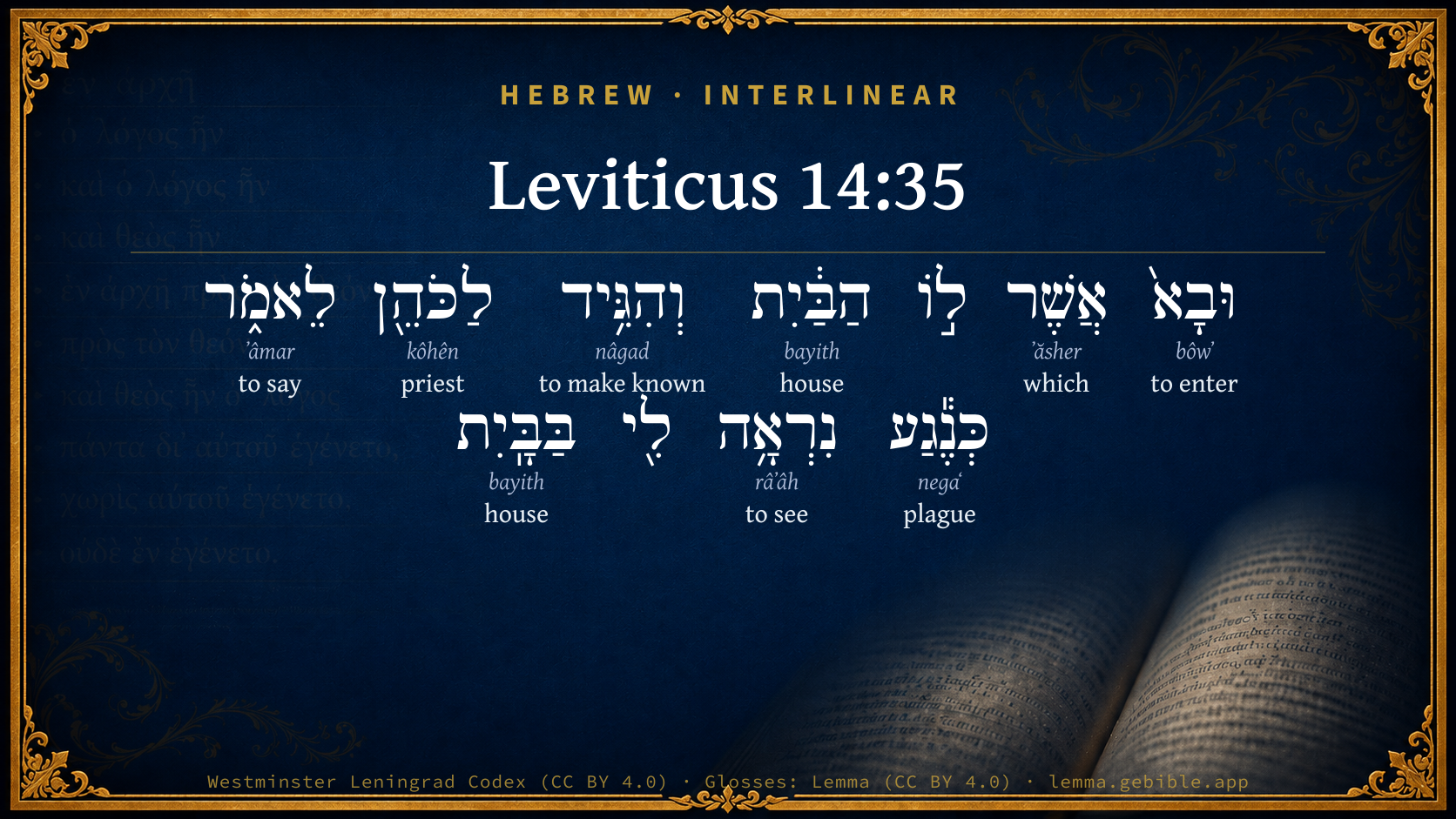
Hebrew (Westminster Leningrad Codex) Leviticus 14:35 appears in the Hebrew Old Testament. The text above is from the Westminster Leningrad Codex. Each word links to its Strong’s number, a concise gloss, and parsing drawn from the Open Scriptures Hebrew Bible morphology. Click any word for its full Brown-Driver-Briggs (BDB) entry.
Download image
Cite this verse

Leviticus 14:35 (World English Bible). Public Domain. Lemma interlinear Bible study tool, https://lemma.gebible.app/v/leviticus/14/35.

Show BibTeX & RIS
BibTeX
RIS
English Translation
then he who owns the house shall come and tell the priest, saying, 'There seems to me to be some sort of plague in the house.'
World English Bible · Public Domain
Download a study sheet

One document with this verse’s original text, its word-by-word gloss line, the meaning frame, cross-references with their text, attributed commentary, and full source and license credits — printable, and it pastes into notes with its structure intact.

This verse Autodidact and up

Study sheet (.html) Plain text (.txt)

A passage Seminary Student

Up to 50 verses in one chapter. A passage sheet keeps up to 6 commentary sources and 12 cross-references per verse, in the order this page ranks them, and says so on the sheet whenever that leaves anything out. Ask for a single verse and you get the Autodidact verse sheet above.

Everything on this page stays free to read, with no account — the sheet is a download of what is already on screen, not access to it.

Want to remove ads? Support Godless Engineer
Compare translations 3

The same verse in 3 English versions, stacked beneath the original-language interlinear above. Click any original word for its lexicon entry.

Each is an independent rendering of the whole verse — the interlinear is not word-aligned to these translations.

Highlighted words mark where these versions differ — a whole-verse word diff, not a word-by-word alignment.

  • World English Bible Public Domain
    then he who owns the house shall come and tell the priest, saying, 'There seems to me to be some sort of plague in the house.'
  • King James Version Public Domain
    And he that owneth the house shall come and tell the priest, saying, It seemeth to me there is as it were a plague in the house:
  • unfoldingWord Literal Text CC BY-SA 4.0
    then he who the house to him shall come, and he shall inform the priest, saying, ‘ like an infection has appeared to me in the house.’

unfoldingWord Literal Text — © unfoldingWord, licensed CC BY-SA 4.0. Word-aligned USFM3 via Door43 (git.door43.org/unfoldingWord/en_ult).

Versions to compare (up to 4)

3 of 4 selected

Show all 18 translations

Every available English version of this verse, each an independent rendering of the whole verse.

  • World English Bible Public Domain
    then he who owns the house shall come and tell the priest, saying, 'There seems to me to be some sort of plague in the house.'
  • Berean Standard Bible Public Domain
    the owner of the house shall come and tell the priest, ‘Something like mildew has appeared in my house.’
  • Majority Standard Bible Public Domain
    the owner of the house shall come and tell the priest, ‘Something like mildew has appeared in my house.’
  • King James Version Public Domain
    And he that owneth the house shall come and tell the priest, saying, It seemeth to me there is as it were a plague in the house:
  • American Standard Version (1901) Public Domain
    then he that owneth the house shall come and tell the priest, saying, There seemeth to me to be as it were a plague in the house.
  • Revised Version (1885) Public Domain
    then he that owneth the house shall come and tell the priest, saying, There seemeth to me to be as it were a plague in the house:
  • Geneva Bible (1599) Public Domain
    Then he that oweth the house, shall come and tell the Priest, saying, Me thinke there is like a plague of leprosie in the house.
  • Douay-Rheims (1899) Public Domain
    He whose house it is, shall go and tell the priest, saying: It seemeth to me, that there is the plague of leprosy in my house,
  • Young's Literal Translation Public Domain
    then hath he whose the house `is' come in and declared to the priest, saying, As a plague hath appeared to me in the house;
  • Literal Standard Version CC BY-SA 4.0
    then he whose the house [is] has come in and declared [it] to the priest, saying, Some plague has appeared to me in the house;
  • Unlocked Literal Bible CC BY-SA 4.0
    then he who owns the house must come and tell the priest. He must say, 'There seems to me to be something like mildew in my house.'
  • unfoldingWord Literal Text CC BY-SA 4.0
    then he who the house to him shall come, and he shall inform the priest, saying, ‘ like an infection has appeared to me in the house.’
  • Darby Bible Public Domain
    then he whose house it is shall come and tell the priest, saying, It seemeth to me like a plague in the house;
  • World Messianic Bible Public Domain
    then he who owns the house shall come and tell the priest, saying, ‘There seems to me to be some sort of plague in the house.’
  • Webster's Bible Public Domain
    And he that owneth the house shall come and tell the priest, saying, it seemeth to me there is as it were a plague in the house:
  • Free Bible Version CC BY-SA 4.0
    the owner of the house must come and tell the priest, ‘It seems my house has something like mold.’
  • Bible in Basic English Public Domain
    Then let the owner of the house come and say to the priest, It seems to me that there is a sort of leper's disease in the house.
  • JPS Tanakh (1917) Public Domain
    then he that owneth the house shall come and tell the priest, saying: 'There seemeth to me to be as it were a plague in the house.'

Literal Standard Version (2020), Covenant Press — licensed CC BY-SA 4.0. Text via the HelloAO Bible API (eBible.org). Unlocked Literal Bible (unfoldingWord) — licensed CC BY-SA 4.0. Text via the HelloAO Bible API (eBible.org). unfoldingWord Literal Text — © unfoldingWord, licensed CC BY-SA 4.0. Word-aligned USFM3 via Door43 (git.door43.org/unfoldingWord/en_ult). Free Bible Version, Dr. Jonathan Gallagher — licensed CC BY-SA 4.0. Text via the HelloAO Bible API (eBible.org).

Word by word

More ways to search: Search by grammar → Find every occurrence → Compare this word →

Practice this passage: Drill this verse → Learn its vocabulary →

כְּנֶ֕גַע
negaʻ
H5061
“like/as · plague”
Preposition + Noun, Common, Masculine, Singular, Absolute
Part of Speech
Preposition + Noun
Type
Common
Gender
Masculine
Number
Singular
State
Absolute
Full BDB Definition

Origin: from H5060

TWOT: 1293a

stroke, plague, disease, mark, plague spot - stroke, wound - stroke (metaphorical of disease) - mark (of leprosy)
  1. וּבָא֙ bôwʼ H935 “and · to enter” Conjunction + Verb, Qal, Sequential Perfect, 3rd Person, Masculine, Singular
  2. אֲשֶׁר ʼăsher H834 “which” Particle, Relative
  3. הַבַּ֔יִת bayith H1004 “the · house” Particle, Definite Article + Noun, Common, Masculine, Singular, Absolute
  4. וְהִגִּ֥יד nâgad H5046 “and · to make known” Conjunction + Verb, Hiphil, Sequential Perfect, 3rd Person, Masculine, Singular
  5. לַכֹּהֵ֖ן kôhên H3548 “to/for the · priest” Preposition, Determined + Noun, Common, Masculine, Singular, Absolute
  6. לֵאמֹ֑ר ʼâmar H559 “to say” Preposition + Verb, Qal, Infinitive Construct
  7. נִרְאָ֥ה râʼâh H7200 “to see” Verb, Niphal, Perfect, 3rd Person, Masculine, Singular
  8. בַּבָּֽיִת bayith H1004 “in/at the · house” Preposition, Determined + Noun, Common, Masculine, Singular, Absolute

About this verse

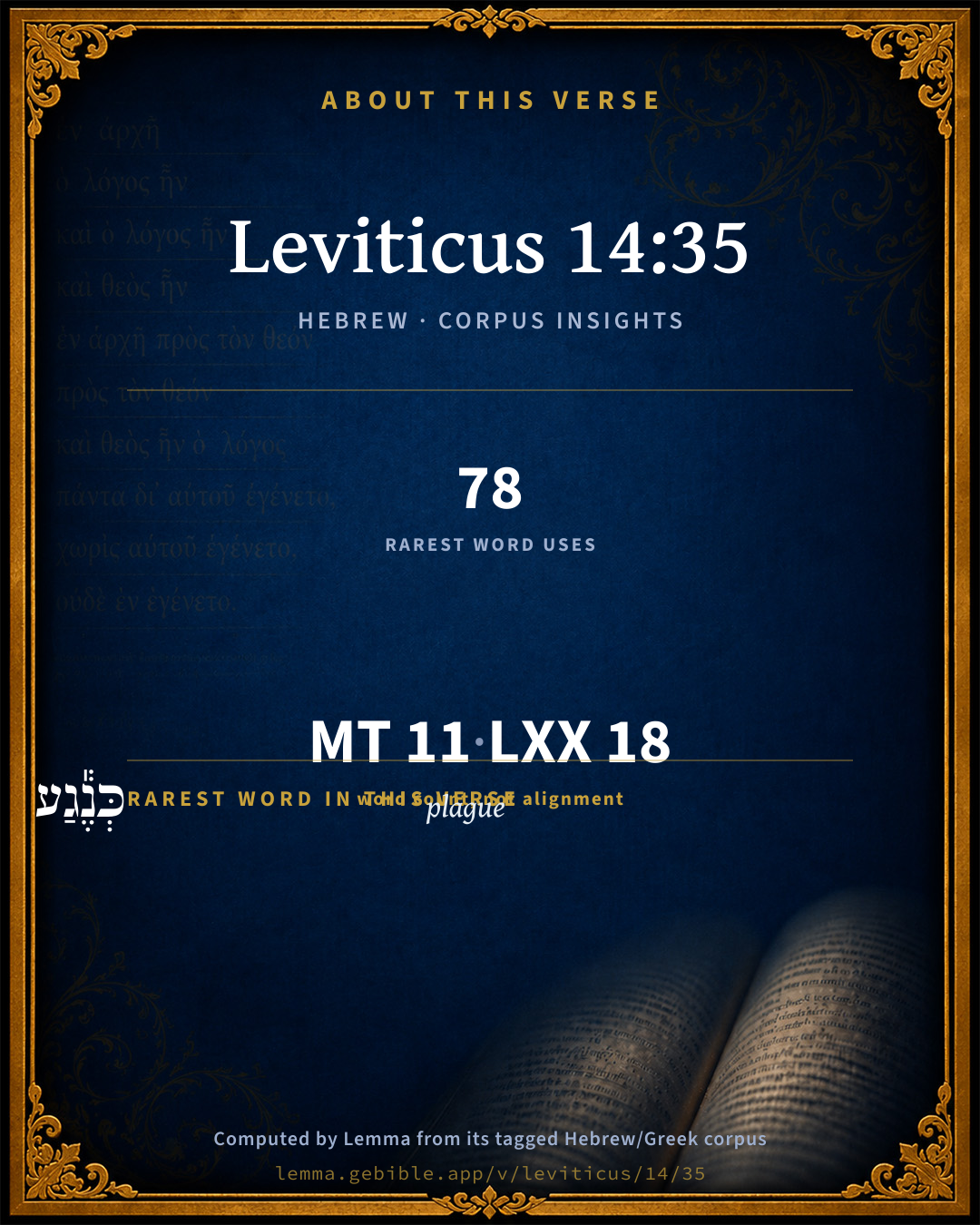
These counts appear in no published source. They are computed here, from the morphology-tagged text and Lemma’s own curated glosses. What Lemma adds →

11
words
8
distinct lemmas
Pentateuch
section

Grammatical profile

  • 4 verbs
  • 4 nouns
  • 2 prepositions
  • 1 particle

Verb forms

  • וּבָא֙ Qal · Sequential Perfect
  • וְהִגִּ֥יד Hiphil · Sequential Perfect
  • לֵאמֹ֑ר Qal · Infinitive Construct
  • נִרְאָ֥ה Niphal · Perfect

Repetition

A word recurs within this verse — often emphatic in Hebrew:

  • הַבַּ֔יִת house H1004 ×2

Hebrew & Septuagint length

In English translation the verse runs 26 words from the Hebrew and 25 from the Septuagint (LXX English) — closely comparable.

A rough comparison of the two English renderings, which tokenize alike — not a word-level alignment.

Word counts can differ between the Hebrew and the Greek without any difference in meaning — e.g. the Hebrew direct-object marker אֵת has no separate Greek word, and Greek often adds the article ὁ.

In the original languages it is 11 Hebrew tokens and 18 Greek tokens — but the two are counted differently (Hebrew bundles its prefixes and suffixes into one token; the Greek is in lemma form), so that isn’t a like-for-like length.

Cross-references

7

Topical passages linked to Leviticus 14:35 in the Treasury of Scripture Knowledge — connected by theme and wording, ordered by reader-vote popularity; previews shown in the World English Bible.

  • Psalms 91:10 No evil shall happen to you, Neither shall any plague come near your dwelling.
  • Deuteronomy 7:26 You shall not bring an abomination into your house, and become a devoted thing like it: you shall utterly detest it, and you shall utterly abhor it; for it is a devoted thing.
  • Zechariah 5:4 I will cause it to go out," says Yahweh of Hosts, "and it will enter into the house of the thief, and into the house of him who swears falsely by my name; and it will remain in the midst of his house, and will destroy it with its timber and its stones."
  • Joshua 7:21 when I saw among the spoil a goodly Babylonian mantle, and two hundred shekels of silver, and a wedge of gold of fifty shekels weight, then I coveted them, and took them; and, behold, they are hid in the earth in the midst of my tent, and the silver under it.
  • 1 Samuel 3:12–14 In that day I will perform against Eli all that I have spoken concerning his house, from the beginning even to the end.
  • 1 Kings 13:34 This thing became sin to the house of Jeroboam, even to cut it off, and to destroy it from off the surface of the earth.
  • Proverbs 3:33 Yahweh's curse is in the house of the wicked, But he blesses the habitation of the righteous.

Cross-references courtesy of OpenBible.info (CC BY 4.0).

Hebrew and Greek witnesses Masoretic Hebrew ↔ Greek Septuagint

The same verse in the two great witnesses to the Old Testament, shown verse-for-verse.

These are two independent witnesses, not word-aligned to each other, and the Septuagint is shown in lemma (dictionary) form.

Hebrew Leviticus 14:35 Masoretic · Westminster Leningrad Codex

וּבָא֙ אֲשֶׁר ל֣וֹ הַבַּ֔יִת וְהִגִּ֥יד לַכֹּהֵ֖ן לֵאמֹ֑ר כְּנֶ֕גַע נִרְאָ֥ה לִ֖י בַּבָּֽיִת

then he who owns the house shall come and tell the priest, saying, 'There seems to me to be some sort of plague in the house.'

World English Bible · Public Domain

Greek LXX Leviticus 14:35 Septuagint · lemma form

καί ἥκω τίς αὐτός ὁ οἰκία καί ἀναἀγγέλλω ὁ ἱερεύς λέγω ὥσπερ ἁφή ὁράω ἐγώ ἐν ὁ οἰκία

then the owner of the house shall come and report to the priest, saying, I have seen as it were a plague in the house.

LXX2012 (modern English Septuagint) · Public Domain

Hebrew: Westminster Leningrad Codex (CC BY 4.0). Greek: Septuagint (public domain); English from LXX2012 (modern English Septuagint) (Public Domain). How the Septuagint differs from the Hebrew →

Targum (Aramaic paraphrase)

2

The Targum is the ancient Jewish Aramaic paraphrase of the Hebrew Scriptures — an interpretive translation, not the Hebrew text itself. Onkelos (literal) and Pseudo-Jonathan (expansive) render the Torah, and Jonathan the Prophets. Coverage is partial: where no permissively-licensed English translation exists for a verse, only the Aramaic is shown. This is verse-level text, not a word-by-word alignment to the Hebrew.

  1. Targum Onkelos Torah (Genesis–Deuteronomy)
    וְיֵיתֵי דִי דִילֵהּ בֵּיתָא וִיחַוִי לְכַהֲנָא לְמֵימָר כְּמַכְתָּשָׁא אִתְחֲזִי לִי בְּבֵיתָא

    (no public-domain English translation for this verse)

    Targum Onkelos — Aramaic: “Onkelos Genesis” (public domain); “Onkelos Exodus” (public domain); “Onkelos Leviticus” (public domain); “Onkelos Numbers” (public domain); “Onkelos Deuteronomy” (public domain). English: “Sefaria Community Translation” (CC0 1.0 (public-domain dedication)); “J.W. Etheridge. The Targums of Onkelos and Jonathan Ben Uzziel on the Pentateuch. London: Longmans, Green, 1862” (public domain). Text via Sefaria.

  2. Targum Pseudo-Jonathan Torah (Genesis–Deuteronomy)
    וְיֵיתֵי דְדִילֵיהּ בֵיתָא וִיתַנֵי לְכַהֲנָא לְמֵימָר הֵי כְמַכְתְּשָׁא אִיתְחֲמֵי לִי בְּבֵיתָא

    and he who owneth the house shall come to the priest, saying, There is a plague, as it appeareth to me, in the house:

    Targum Pseudo-Jonathan — Aramaic: “Targum Jonathan on Genesis” (public domain); “Targum Jonathan on Exodus” (public domain); “Targum Jonathan on Leviticus” (public domain); “Targum Jonathan on Numbers” (public domain); “Targum Jonathan on Deuteronomy” (public domain). English: “The Targum of Jonathan ben Uzziel, trans. J. W. Etheridge, London, 1862” (public domain). Text via Sefaria.

Commentary

Notes on Leviticus 14:35 from classic Christian and Jewish commentators (each source and its license shown beneath its notes). The classic Christian expositions comment on the surrounding passage and are grouped to its opening verse, so a note may address several verses; the Jewish commentaries on the Tanakh (Rashi and others) are per-verse, so they appear only where the commentator wrote on this verse.

Lemma curates 59 commentaries, every one of them public domain or Creative Commons licensed, each selected and text-cleaned for this edition rather than reprinted as found. About our sources →

Trapp's Complete Commentary

John Trapp

Lev 14:35 And he that owneth the house shall come and tell the priest, saying, It seemeth to me [there is] as it were a plague in the house:

Ver. 35. As it were a plague.] He might not flatly say, it was the leprosy, till the priest had so pronounced it.

John Trapp, A Commentary or Exposition upon All the Books of the Old and New Testament (1647–1656) — public domain. Text from a community e-Sword module.

Ellicott's Commentary for English Readers

(35) He that owneth the house.—As in the case of the suspicious symptoms in human beings, the suspected house is forthwith to be examined by the priest.

Saying, It seemeth to me . . . —According to the authorities in the time of Christ, this prescribes the formula which the owner of the house is to use when he communicates the fact to the priest. Hence they enacted that though he be himself an expert in these matters, and know certainly that it is leprosy, he is not to say positively to the priest, “The plague has appeared in my house,” but “It seemeth to me . . . as it were,” &c, because it was the office of the priest to pronounce a positive sentence on the subject.

A Bible Commentary for English Readers, edited by Charles John Ellicott (1878–1897) — public domain. Text from a community e-Sword module.

John Gill's Exposition

And the priest shall come again the seventh day, and shall look,.... On the seventh day from his shutting of it up, he shall open it again, go into it, and observe in what condition it is:

and, behold, if the plague be spread in the walls of the house: the hollow strakes are become deeper, or the coloured spots are become larger: spreading was always a sign of leprosy, both in the bodies of men, and in garments.

John Gill's Exposition of the Whole Bible (1746–1763) — public domain (CC PDM 1.0). Text via the HelloAO Bible API.

Whedon's Commentary on the Bible

Daniel D. Whedon

35. Tell the priest — This obligation, laid upon every householder, would tend to a scrupulous care of the house and be promotive of health. It also tended to magnify the office of the priest.

Daniel D. Whedon (gen. ed.), Commentary on the Old and New Testaments (1874–1909) — public domain. Text from a community e-Sword module.

The Pulpit Commentary

Vers. 35-44. The examination of the suspected house by the priest. First, the house is to be emptied of its furniture, lest the latter should contract a ceremonial uncleanness in case the house were found to be leprous, but not, it will be noted, lest it should convey contagion or infection. Then the priest is to examine the discolouration, and if it bear a suspicious appearance, the house is to be shut up for seven days. It at the end of that time the spot has spread, he is to have the part of the wall in which it shows itself taken down and carried away, and built up again with new stones and mortar and plaster, the parts adjoining to the infected place having been first well scraped. If this treatment does not succeed in getting rid of the mischief, the priest is to determine that it is a fretting leprosy in the house: it is unclean.

The Pulpit Commentary (1880–1919), ed. H.D.M. Spence-Jones & Joseph S. Exell — public domain. Text from a community e-Sword module.

Keil & Delitzsch

C. F. Keil & F. Delitzsch

When the evil showed itself in a house, the owner was to send this message to the priest, "A leprous evil has appeared in my house," and the priest, before entering to examine it, was to have the house cleared, lest everything in it should become unclean. Consequently, as what was in the house became unclean only when the priest had declared the house affected with leprosy, the reason for the defilement is not to be sought for in physical infection, but must have been of an ideal or symbolical kind.

Keil & Delitzsch — Biblical Commentary on the Old Testament (1861–1891) — public domain (CC PDM 1.0). Text via the HelloAO Bible API. (Old Testament only.)

Rashi

Rabbi Shlomo Yitzchaki (Rashi)

כנגע נראה לי בבית SOMETHING LIKE A PLAGUE HATH SHOWN ITSELF TO ME IN THE HOUSE — Even if he (the owner of the house) be a learned man and knows for sure that it is a plague he shall not decide the matter as a certainty saying, "a plague hath shown itself to me" but, “something like a plague hath shown itself to me" (Mishnah Negaim 12:5; Sifra, Metzora, Section 5 10).

Rashi on the Tanakh — English translations: “The Judaica Press complete Tanach with Rashi, translated by A. J. Rosenberg” (CC BY 4.0); “Pentateuch with Rashi's commentary by M. Rosenbaum and A.M. Silbermann, 1929-1934” (public domain); “The Metsudah Tanach series, Lakewood, N.J” (CC BY 4.0); and “The Book of Joshua, Metsudah Publications, 1997” (CC BY 4.0). Text via Sefaria.

Lesson kit

Teaching starters — assembled from the data on this page, not authored interpretation. Every prompt links to the verse data it draws on. Edit before teaching.

Leviticus, in the Pentateuch, opens this verse with 11 words (8 distinct Hebrew lemmas). Its most distinctive word is negaʻ (“plague”). A historical commentator’s framing appears above. Read the whole chapter for the surrounding context.

Discussion questions

  1. How does “plague” (negaʻ) shape what this verse is saying?
  2. How does Psalms 91:10, which shares this passage’s theme, read alongside this verse?
  3. What does the repetition of “house” (2× in this one verse) do in this verse?
  4. The translations on this page render this verse differently — a whole-verse word diff, not a word-by-word alignment. What might account for the different wordings?
  5. «וּבָא֙» is a Qal Sequential Perfect verb. How does that grammatical form shape the action described?
  6. Compare how Trapp's Complete Commentary and Ellicott's Commentary for English Readers read this verse. Where do they agree or differ?

Things to notice

Reading settings

Reading text

Shown beneath each verse's original-language words.

Old Testament
Old Testament edition

Read the OT as the Masoretic Hebrew (MT) or the Greek Septuagint (LXX).

English shown for the Greek Septuagint (in the Hebrew ↔ Greek comparison).

Comparing translations? Open the Compare panel on any verse page to stack up to four side by side.