Leviticus 14:42

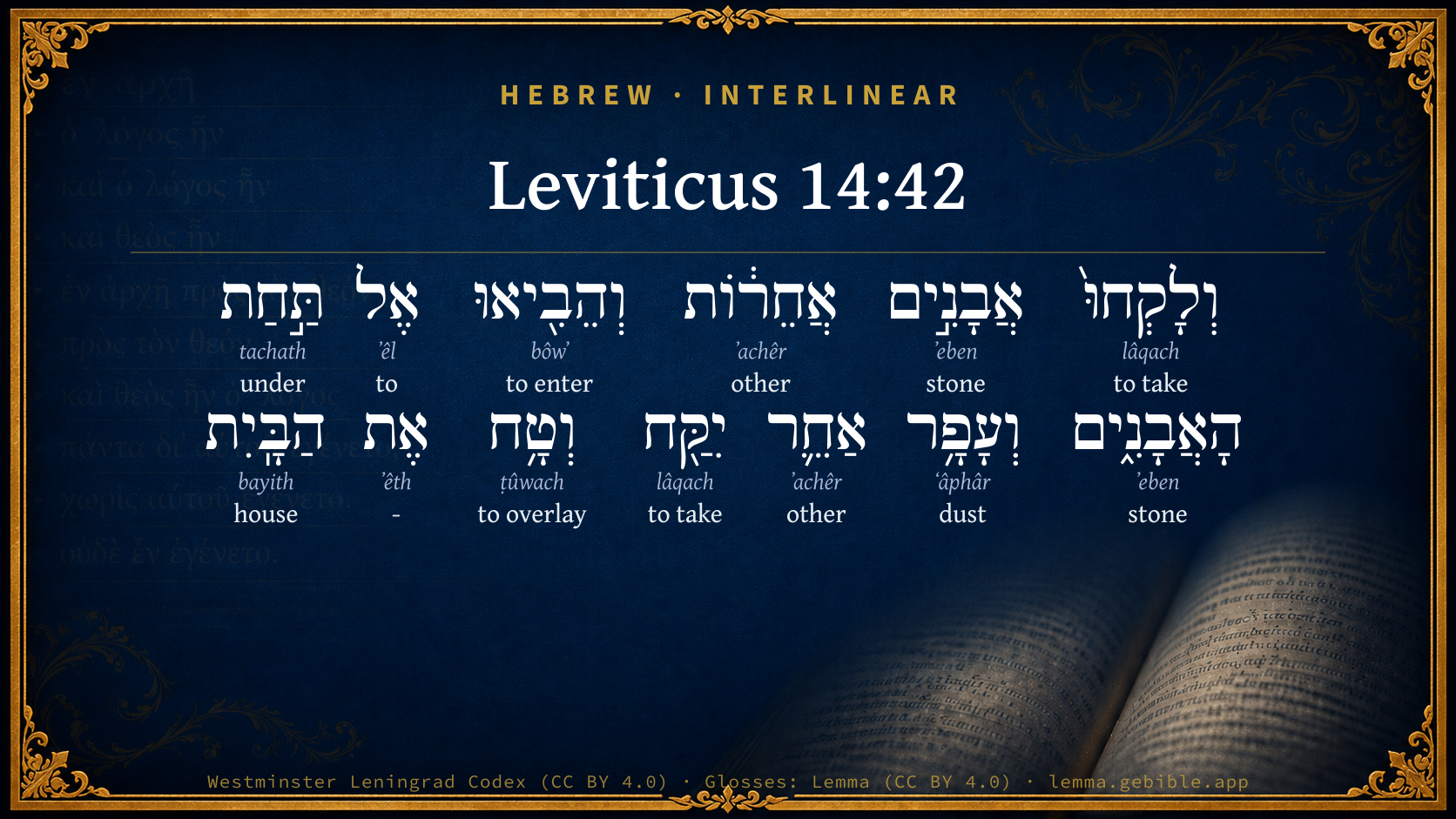
Hebrew (Westminster Leningrad Codex) Leviticus 14:42 appears in the Hebrew Old Testament. The text above is from the Westminster Leningrad Codex. Each word links to its Strong’s number, a concise gloss, and parsing drawn from the Open Scriptures Hebrew Bible morphology. Click any word for its full Brown-Driver-Briggs (BDB) entry.
Download image
Cite this verse

Leviticus 14:42 (World English Bible). Public Domain. Lemma interlinear Bible study tool, https://lemma.gebible.app/v/leviticus/14/42.

Show BibTeX & RIS
BibTeX
RIS
English Translation
They shall take other stones, and put them in the place of those stones; and he shall take other mortar, and shall plaster the house.
World English Bible · Public Domain
Highlights
  • 1 first appearance in the Hebrew Bible
Full analysis ↓
Download a study sheet

One document with this verse’s original text, its word-by-word gloss line, the meaning frame, cross-references with their text, attributed commentary, and full source and license credits — printable, and it pastes into notes with its structure intact.

This verse Autodidact and up

Study sheet (.html) Plain text (.txt)

A passage Seminary Student

Up to 50 verses in one chapter. A passage sheet keeps up to 6 commentary sources and 12 cross-references per verse, in the order this page ranks them, and says so on the sheet whenever that leaves anything out. Ask for a single verse and you get the Autodidact verse sheet above.

Everything on this page stays free to read, with no account — the sheet is a download of what is already on screen, not access to it.

Want to remove ads? Support Godless Engineer
Compare translations 3

The same verse in 3 English versions, stacked beneath the original-language interlinear above. Click any original word for its lexicon entry.

Each is an independent rendering of the whole verse — the interlinear is not word-aligned to these translations.

Highlighted words mark where these versions differ — a whole-verse word diff, not a word-by-word alignment.

  • World English Bible Public Domain
    They shall take other stones, and put them in the place of those stones; and he shall take other mortar, and shall plaster the house.
  • King James Version Public Domain
    And they shall take other stones, and put them in the place of those stones; and he shall take other mortar, and shall plaster the house.
  • unfoldingWord Literal Text CC BY-SA 4.0
    And they shall take other stones and they shall bring in the place of the stones, and he shall take other and he shall plaster the house.

unfoldingWord Literal Text — © unfoldingWord, licensed CC BY-SA 4.0. Word-aligned USFM3 via Door43 (git.door43.org/unfoldingWord/en_ult).

Versions to compare (up to 4)

3 of 4 selected

Show all 18 translations

Every available English version of this verse, each an independent rendering of the whole verse.

  • World English Bible Public Domain
    They shall take other stones, and put them in the place of those stones; and he shall take other mortar, and shall plaster the house.
  • Berean Standard Bible Public Domain
    So different stones must be obtained to replace the contaminated ones, as well as additional mortar to replaster the house.
  • Majority Standard Bible Public Domain
    So different stones must be obtained to replace the contaminated ones, as well as additional mortar to replaster the house.
  • King James Version Public Domain
    And they shall take other stones, and put them in the place of those stones; and he shall take other mortar, and shall plaster the house.
  • American Standard Version (1901) Public Domain
    and they shall take other stones, and put them in the place of those stones; and he shall take other mortar, and shall plaster the house.
  • Revised Version (1885) Public Domain
    and they shall take other stones, and put them in the place of those stones; and he shall take other mortar, and shall plaister the house.
  • Geneva Bible (1599) Public Domain
    And they shall take other stones, and put them in the places of those stones, and shall take other mortar, to plaister the house with.
  • Douay-Rheims (1899) Public Domain
    And that other stones be laid in the place of them that were taken away, and the house be plastered with other mortar.
  • Young's Literal Translation Public Domain
    and they have taken other stones, and brought `them' in unto the place of the stones, and other clay he taketh and hath daubed the house.
  • Literal Standard Version CC BY-SA 4.0
    and they have taken other stones, and brought [them] to the place of the stones, and he takes other clay and has coated the house.
  • Unlocked Literal Bible CC BY-SA 4.0
    They must take other stones and put them in the place of the stones that were removed, and they must use new clay to plaster the house.
  • unfoldingWord Literal Text CC BY-SA 4.0
    And they shall take other stones and they shall bring in the place of the stones, and he shall take other and he shall plaster the house.
  • Darby Bible Public Domain
    And they shall take other stones, and put them in the place of those stones; and they shall take other mortar, and shall plaster the house.
  • World Messianic Bible Public Domain
    They shall take other stones, and put them in the place of those stones; and he shall take other mortar, and shall plaster the house.
  • Webster's Bible Public Domain
    And they shall take other stones, and put them in the place of those stones; and he shall take other mortar, and shall plaster the house.
  • Free Bible Version CC BY-SA 4.0
    Different stones must be used to replace the ones removed, and new plaster will be needed to replaster the house.
  • Bible in Basic English Public Domain
    And they will take other stones and put them in place of those stones, and he will take other paste and put it on the walls of the house.
  • JPS Tanakh (1917) Public Domain
    And they shall take other stones, and put them in the place of those stones; and he shall take other mortar, and shall plaster the house.

Literal Standard Version (2020), Covenant Press — licensed CC BY-SA 4.0. Text via the HelloAO Bible API (eBible.org). Unlocked Literal Bible (unfoldingWord) — licensed CC BY-SA 4.0. Text via the HelloAO Bible API (eBible.org). unfoldingWord Literal Text — © unfoldingWord, licensed CC BY-SA 4.0. Word-aligned USFM3 via Door43 (git.door43.org/unfoldingWord/en_ult). Free Bible Version, Dr. Jonathan Gallagher — licensed CC BY-SA 4.0. Text via the HelloAO Bible API (eBible.org).

Word by word

More ways to search: Search by grammar → Find every occurrence → Compare this word →

Practice this passage: Drill this verse → Learn its vocabulary →

וְטָ֥ח
ṭûwach
H2902
“and · to overlay”
Conjunction + Verb, Qal, Sequential Perfect, 3rd Person, Masculine, Singular
Part of Speech
Conjunction + Verb
Stem
Qal
Form
Sequential Perfect
Person
3rd Person
Gender
Masculine
Number
Singular
Full BDB Definition

Origin: a primitive root

TWOT: 795

to spread over, overlay, plaster, cover over, coat, besmear - (Qal) to overspread, coat, overlay - (Niphal) to be coated, be plastered - (Qal) to be besmeared
  1. וְלָקְחוּ֙ lâqach H3947 “and · to take” Conjunction + Verb, Qal, Sequential Perfect, 3rd Person, Common, Plural
  2. אֲבָנִ֣ים ʼeben H68 “stones” Noun, Common, Feminine, Plural, Absolute
  3. אֲחֵר֔וֹת ʼachêr H312 “other” Adjective, Adjective, Feminine, Plural, Absolute
  4. וְהֵבִ֖יאוּ bôwʼ H935 “and · to enter” Conjunction + Verb, Hiphil, Sequential Perfect, 3rd Person, Common, Plural
  5. אֶל ʼêl H413 “to” Preposition
  6. תַּ֣חַת tachath H8478 “under” Preposition
  7. הָאֲבָנִ֑ים ʼeben H68 “the · stones” Particle, Definite Article + Noun, Common, Feminine, Plural, Absolute
  8. וְעָפָ֥ר ʻâphâr H6083 “and · dust” Conjunction + Noun, Common, Masculine, Singular, Absolute
  9. אַחֵ֛ר ʼachêr H312 “other” Adjective, Adjective, Masculine, Singular, Absolute
  10. יִקַּ֖ח lâqach H3947 “to take” Verb, Qal, Imperfect, 3rd Person, Masculine, Singular
  11. אֶת ʼêth H853 “-” Particle, Direct Object
  12. הַבָּֽיִת bayith H1004 “the · house” Particle, Definite Article + Noun, Common, Masculine, Singular, Absolute

About this verse

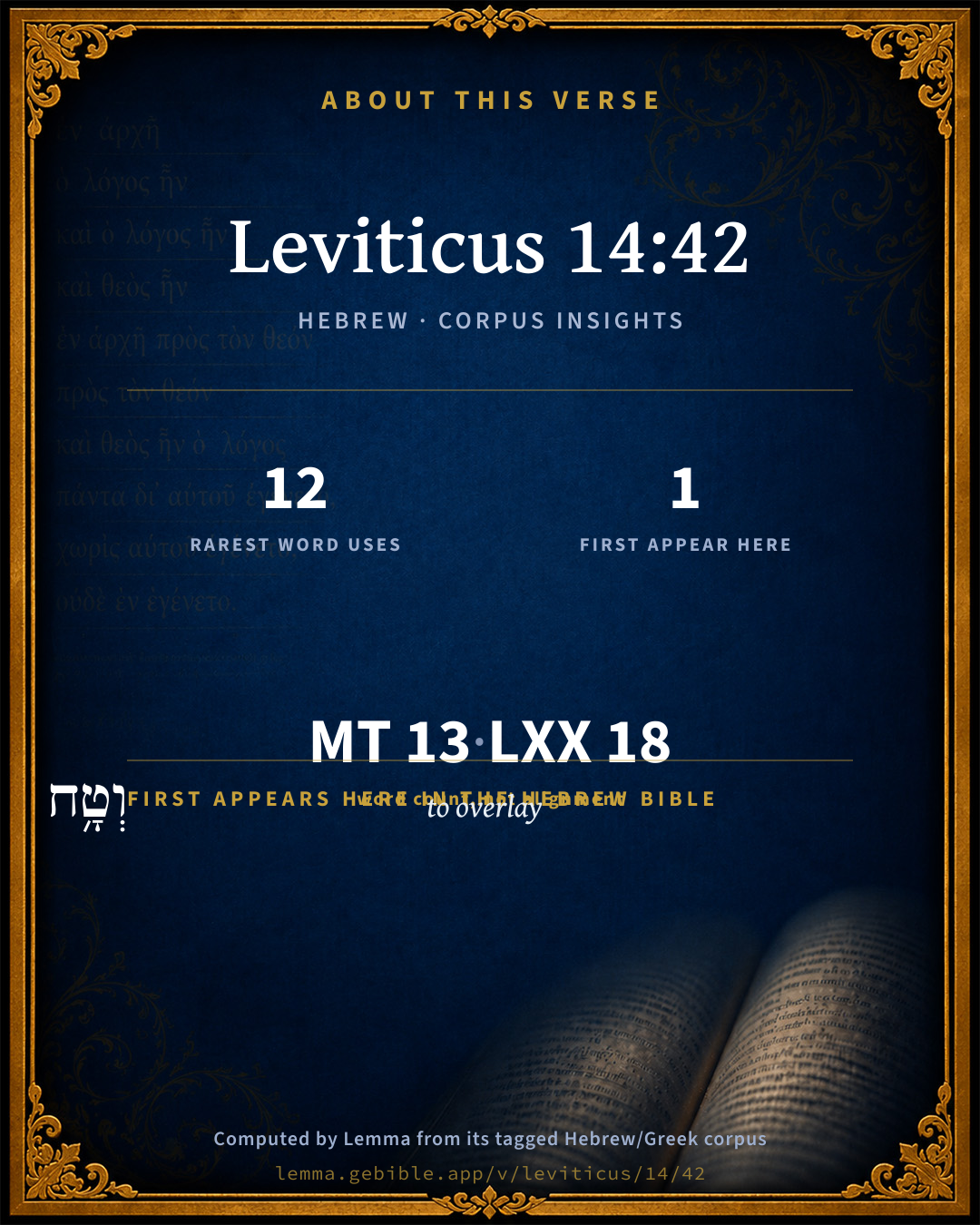
These counts appear in no published source. They are computed here, from the morphology-tagged text and Lemma’s own curated glosses. What Lemma adds →

13
words
10
distinct lemmas
Pentateuch
section

Notable vocabulary

The rarest word here is וְטָ֥ח to overlay H2902 — appearing just 12 times in the whole Hebrew Bible.

First appearance in Scripture

This word makes its first canonical appearance in the Hebrew Bible here:

  • וְטָ֥ח to overlay H2902

Shared distinctive vocabulary

וְטָ֥ח to overlay H2902 occurs in 11 verses of the Hebrew Bible. Also found in:

Grammatical profile

  • 4 verbs
  • 4 nouns
  • 2 adjectives
  • 2 prepositions
  • 1 particle

Verb forms

  • וְלָקְחוּ֙ Qal · Sequential Perfect
  • וְהֵבִ֖יאוּ Hiphil · Sequential Perfect
  • יִקַּ֖ח Qal · Imperfect
  • וְטָ֥ח Qal · Sequential Perfect

Repetition

Words recur within this verse — often emphatic in Hebrew:

  • וְלָקְחוּ֙ to take H3947 ×2
  • אֲבָנִ֣ים stone H68 ×2
  • אֲחֵר֔וֹת other H312 ×2

Hebrew & Septuagint length

In English translation the verse runs 25 words from the Hebrew and 27 from the Septuagint (LXX English) — closely comparable.

A rough comparison of the two English renderings, which tokenize alike — not a word-level alignment.

Word counts can differ between the Hebrew and the Greek without any difference in meaning — e.g. the Hebrew direct-object marker אֵת has no separate Greek word, and Greek often adds the article ὁ.

In the original languages it is 13 Hebrew tokens and 18 Greek tokens — but the two are counted differently (Hebrew bundles its prefixes and suffixes into one token; the Greek is in lemma form), so that isn’t a like-for-like length.

Cross-references

11

Topical passages linked to Leviticus 14:42 in the Treasury of Scripture Knowledge — connected by theme and wording, ordered by reader-vote popularity; previews shown in the World English Bible.

  • Genesis 18:19 For I have known him, to the end that he may command his children and his household after him, that they may keep the way of Yahweh, to do righteousness and justice; to the end that Yahweh may bring on Abraham that which he has spoken of him."
  • Joshua 24:15 If it seem evil to you to serve Yahweh, choose you this day whom you will serve; whether the gods which your fathers served that were beyond the River, or the gods of the Amorites, in whose land you dwell: but as for me and my house, we will serve Yahweh.
  • 2 Chronicles 17:7–9 Also in the third year of his reign he sent his princes, even Ben Hail, and Obadiah, and Zechariah, and Nethanel, and Micaiah, to teach in the cities of Judah;
  • 2 Chronicles 19:5–7 He set judges in the land throughout all the fortified cities of Judah, city by city,
  • 2 Chronicles 29:4–5 He brought in the priests and the Levites, and gathered them together into the broad place on the east,
  • Psalms 101:6 My eyes will be on the faithful of the land, That they may dwell with me. He who walks in a perfect way, He will serve me.
  • Acts 1:20–26 For it is written in the book of Psalms, 'Let his habitation be made desolate, Let no one dwell therein,' and, 'Let another take his office.'
  • 1 Timothy 5:9–10 Let no one be enrolled as a widow under sixty years old, having been the wife of one man,
  • 1 Timothy 5:21–22 I charge you in the sight of God, and Christ Jesus, and the chosen angels, that you observe these things without prejudice, doing nothing by partiality.
  • 2 Timothy 2:2 The things which you have heard from me among many witnesses, commit the same to faithful men, who will be able to teach others also.
  • Titus 1:5–9 I left you in Crete for this reason, that you would set in order the things that were lacking, and appoint elders in every city, as I directed you;

Cross-references courtesy of OpenBible.info (CC BY 4.0).

Hebrew and Greek witnesses Masoretic Hebrew ↔ Greek Septuagint

The same verse in the two great witnesses to the Old Testament, shown verse-for-verse.

These are two independent witnesses, not word-aligned to each other, and the Septuagint is shown in lemma (dictionary) form.

Hebrew Leviticus 14:42 Masoretic · Westminster Leningrad Codex

וְלָקְחוּ֙ אֲבָנִ֣ים אֲחֵר֔וֹת וְהֵבִ֖יאוּ אֶל תַּ֣חַת הָאֲבָנִ֑ים וְעָפָ֥ר אַחֵ֛ר יִקַּ֖ח וְטָ֥ח אֶת הַבָּֽיִת

They shall take other stones, and put them in the place of those stones; and he shall take other mortar, and shall plaster the house.

World English Bible · Public Domain

Greek LXX Leviticus 14:42 Septuagint · lemma form

καί λαμβάνω λίθος ἀποξύω ἕτερος καί ἀντιτίθημι ἀντί ὁ λίθος καί χοῦς ἕτερος λαμβάνω καί ἐκἀλείφω ὁ οἰκία

And they shall take other scraped stones, and put them in the place of the former stones, and they shall take other plaster and plaster the house.

LXX2012 (modern English Septuagint) · Public Domain

Hebrew: Westminster Leningrad Codex (CC BY 4.0). Greek: Septuagint (public domain); English from LXX2012 (modern English Septuagint) (Public Domain). How the Septuagint differs from the Hebrew →

Targum (Aramaic paraphrase)

2

The Targum is the ancient Jewish Aramaic paraphrase of the Hebrew Scriptures — an interpretive translation, not the Hebrew text itself. Onkelos (literal) and Pseudo-Jonathan (expansive) render the Torah, and Jonathan the Prophets. Coverage is partial: where no permissively-licensed English translation exists for a verse, only the Aramaic is shown. This is verse-level text, not a word-by-word alignment to the Hebrew.

  1. Targum Onkelos Torah (Genesis–Deuteronomy)
    וְיִסְבוּן אַבְנַיָא אָחֳרָנִין וְיַיְתוּן בַּאֲתַר אַבְנַיָא וַעֲפַר אָחֳרָן יִסַב וִישׁוּעַ יָת בֵּיתָא

    (no public-domain English translation for this verse)

    Targum Onkelos — Aramaic: “Onkelos Genesis” (public domain); “Onkelos Exodus” (public domain); “Onkelos Leviticus” (public domain); “Onkelos Numbers” (public domain); “Onkelos Deuteronomy” (public domain). English: “Sefaria Community Translation” (CC0 1.0 (public-domain dedication)); “J.W. Etheridge. The Targums of Onkelos and Jonathan Ben Uzziel on the Pentateuch. London: Longmans, Green, 1862” (public domain). Text via Sefaria.

  2. Targum Pseudo-Jonathan Torah (Genesis–Deuteronomy)
    וְיִסְבוּן אַבְנִין חוּרַנְיָין וִיעַלוּן בַּאֲתַר אַבְנַיָא וְעַפְרָא חוּרַן יִסַב וְיִתְטַשׁ יַת בֵּיתָא

    And they shall take other stones, and insert them in the place of the (former) stones, and let other mortar be taken, and the house be replastered.

    Targum Pseudo-Jonathan — Aramaic: “Targum Jonathan on Genesis” (public domain); “Targum Jonathan on Exodus” (public domain); “Targum Jonathan on Leviticus” (public domain); “Targum Jonathan on Numbers” (public domain); “Targum Jonathan on Deuteronomy” (public domain). English: “The Targum of Jonathan ben Uzziel, trans. J. W. Etheridge, London, 1862” (public domain). Text via Sefaria.

Commentary

Notes on Leviticus 14:42 from classic Christian and Jewish commentators (each source and its license shown beneath its notes). The classic Christian expositions comment on the surrounding passage and are grouped to its opening verse, so a note may address several verses; the Jewish commentaries on the Tanakh (Rashi and others) are per-verse, so they appear only where the commentator wrote on this verse.

Lemma curates 59 commentaries, every one of them public domain or Creative Commons licensed, each selected and text-cleaned for this edition rather than reprinted as found. About our sources →

John Gill's Exposition

Moreover, he that goeth into the house all the while it is shut up,.... The utmost of which were three weeks, as Jarchi observes; during the time a house was shut up, no man might enter it: if he did, he

shall be unclean until the evening; might not have any conversation with men until the evening was come, and he had washed himself; nay, according to the Misnah (q), if a clean person thrust in his head, or the greatest part of his body, into an unclean house, he was defiled; and whoever entered into a leprous house, and his clothes are on his shoulder, and his sandals (on his feet), and his rings on his hands, he and they are unclean immediately; and if he has his clothes on, and his sandals on his feet, and his rings on his hands, he is immediately defiled, and they are clean.

(q) Misn. Negaim, c. 12. sect. 8, 9.

John Gill's Exposition of the Whole Bible (1746–1763) — public domain (CC PDM 1.0). Text via the HelloAO Bible API.

Whedon's Commentary on the Bible

Daniel D. Whedon

42. Other mortar — This implies that the scraping removed the entire inner plastering.

Daniel D. Whedon (gen. ed.), Commentary on the Old and New Testaments (1874–1909) — public domain. Text from a community e-Sword module.

Lesson kit

Teaching starters — assembled from the data on this page, not authored interpretation. Every prompt links to the verse data it draws on. Edit before teaching.

Leviticus, in the Pentateuch, opens this verse with 13 words (10 distinct Hebrew lemmas). Its most distinctive word is ṭûwach (“to overlay”). A historical commentator’s framing appears above. Read the whole chapter for the surrounding context.

Discussion questions

  1. The word ṭûwach carries the sense “to overlay.” How does it shape the verse?
  2. This is the first place “to overlay” appears in Scripture (first appears here). What does its debut here establish?
  3. How does Leviticus 14:43, which shares the word «to overlay», read alongside this verse?
  4. What does the repetition of “to take” (2× in this one verse) do in this verse?
  5. These translations render this verse differently; the difference is in the English rendering, not the original. What questions does that raise?
  6. «וְלָקְחוּ֙» is a Qal Sequential Perfect verb. How does that grammatical form shape the action described?
  7. Compare how John Gill's Exposition and Whedon's Commentary on the Bible read this verse. Where do they agree or differ?

Things to notice

Reading settings

Reading text

Shown beneath each verse's original-language words.

Old Testament
Old Testament edition

Read the OT as the Masoretic Hebrew (MT) or the Greek Septuagint (LXX).

English shown for the Greek Septuagint (in the Hebrew ↔ Greek comparison).

Comparing translations? Open the Compare panel on any verse page to stack up to four side by side.