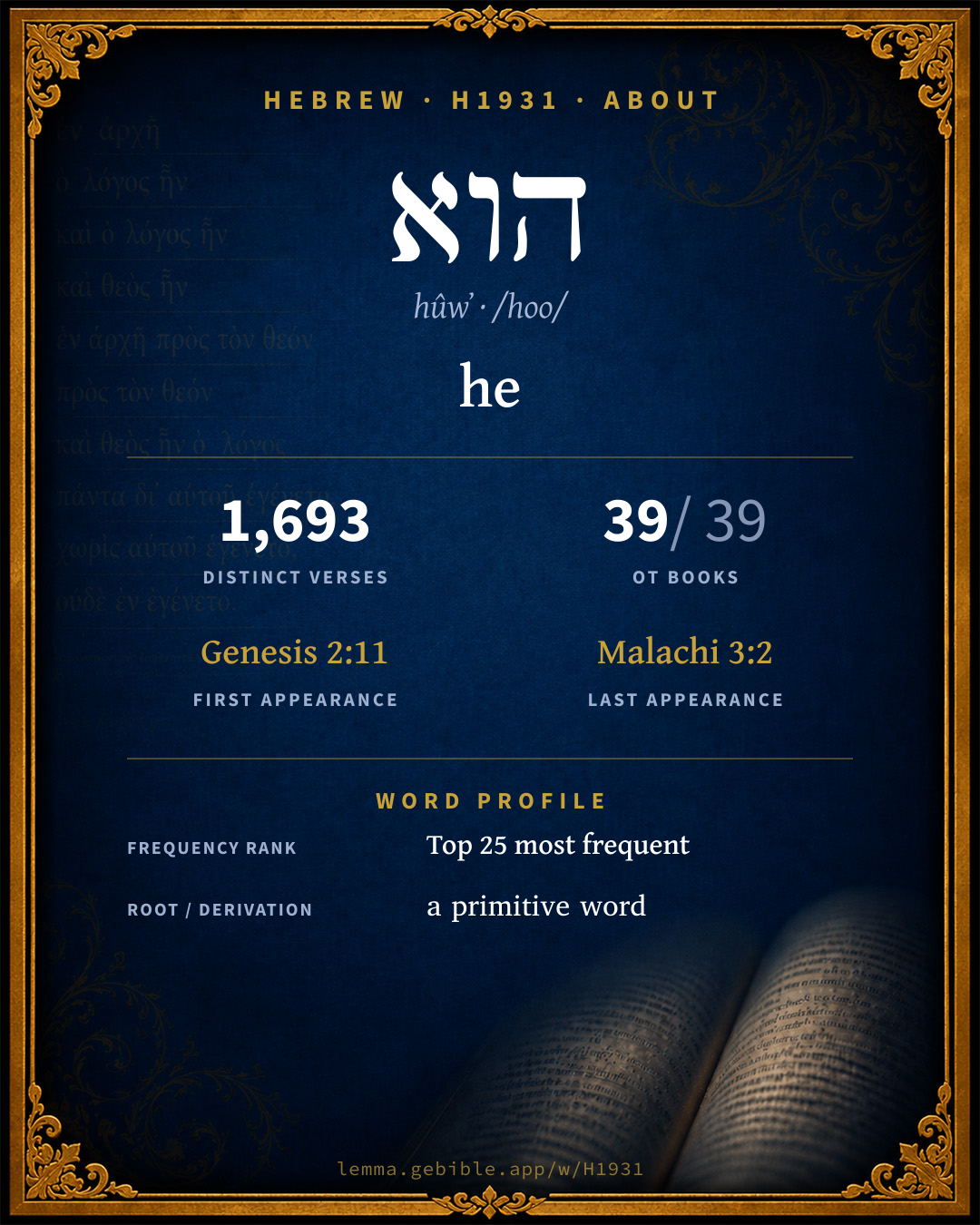
הוּא
he
also: she, it fuller range ↓
Full lexicon entry — Brown-Driver-Briggs (BDB)
From Brown-Driver-Briggs (BDB)
Where this word appears
Grammar key — what these labels mean
Part of speech
- Pronoun
- A word standing in for a noun (“he,” “this,” “who”).
Person
- 3rd Person
- The one spoken about (“he / she / it / they”).
Gender
- Masculine
- Grammatically masculine.
- Feminine
- Grammatically feminine.
Number
- Singular
- One.
Every verse where H1931 appears in the Book of Deuteronomy — 109 distinct verses. Click any verse to open its interlinear word-by-word view. Verse text shown in the World English Bible for context — . Each verse’s Hebrew form is shown with its reference; the English is not keyword-highlighted, since the data carries no word-level English alignment. Use “Compare translations” on any verse to read it across multiple English versions. This concordance covers the Hebrew Bible; Septuagint (Greek Old Testament) occurrences are not indexed here.
Deuteronomy
- Deuteronomy 1:9 הַ/הִ֖וא ptcl def.art + pron pers 3fs I spoke to you at that time, saying, I am not able to bear you myself alone:
- Deuteronomy 1:16 הַ/הִ֖וא ptcl def.art + pron pers 3fs I charged your judges at that time, saying, Hear [the causes] between your brothers, and judge righteously between a man and his brother, and the foreigner who is living with him.
- Deuteronomy 1:17 ה֑וּא pron pers 3ms You shall not show partiality in judgment; you shall hear the small and the great alike; you shall not be afraid of the face of man; for the judgment is God's: and the cause that is too hard for you, you shall bring to me, and I will hear it.
- Deuteronomy 1:18 הַ/הִ֑וא ptcl def.art + pron pers 3fs I commanded you at that time all the things which you should do.
- Deuteronomy 1:19 הַ/ה֜וּא ptcl def.art + pron pers 3ms We traveled from Horeb, and went through all that great and terrible wilderness which you saw, by the way to the hill-country of the Amorites, as Yahweh our God commanded us; and we came to Kadesh-barnea.
- Deuteronomy 1:30 ה֖וּא pron pers 3ms Yahweh your God who goes before you, he will fight for you, according to all that he did for you in Egypt before your eyes,
- Deuteronomy 1:36 ה֣וּא pron pers 3ms save Caleb the son of Jephunneh: he shall see it; and to him will I give the land that he has trodden on, and to his children, because he has wholly followed Yahweh.
- Deuteronomy 1:38 ה֖וּא ה֖וּא pron pers 3ms pron pers 3ms Joshua the son of Nun, who stands before you, he shall go in there: encourage you him; for he shall cause Israel to inherit it.
- Deuteronomy 1:44 הַ/הוּא֙ ptcl def.art + pron pers 3ms The Amorites, who lived in that hill-country, came out against you, and chased you, as bees do, and beat you down in Seir, even to Hormah.
- Deuteronomy 2:20 הִ֑וא pron pers 3fs (That also is accounted a land of Rephaim: Rephaim lived therein before; but the Ammonites call them Zamzummim,
- Deuteronomy 2:32 ה֧וּא pron pers 3ms Then Sihon came out against us, he and all his people, to battle at Jahaz.
- Deuteronomy 2:34 הַ/הִ֔וא ptcl def.art + pron pers 3fs We took all his cities at that time, and utterly destroyed every inhabited city, with the women and the little ones; we left none remaining:
- Deuteronomy 3:1 ה֧וּא pron pers 3ms Then we turned, and went up the way to Bashan: and Og the king of Bashan came out against us, he and all his people, to battle at Edrei.
- Deuteronomy 3:4 הַ/הִ֔וא ptcl def.art + pron pers 3fs We took all his cities at that time; there was not a city which we didn't take from them; sixty cities, all the region of Argob, the kingdom of Og in Bashan.
- Deuteronomy 3:8 הַ/הִוא֙ ptcl def.art + pron pers 3fs We took the land at that time out of the hand of the two kings of the Amorites who were beyond the Jordan, from the valley of the Arnon to Mount Hermon;
- Deuteronomy 3:11 הִ֔וא pron pers 3fs (For only Og king of Bashan remained of the remnant of the Rephaim; behold, his bedstead was a bedstead of iron; isn't it in Rabbah of the children of Ammon? nine cubits was the length of it, and four cubits the breadth of it, after the cubit of a man.)
- Deuteronomy 3:12 הַ/הִ֑וא ptcl def.art + pron pers 3fs This land we took in possession at that time: from Aroer, which is by the valley of the Arnon, and half the hill-country of Gilead, and the cities of it, gave I to the Reubenites and to the Gadites:
- Deuteronomy 3:13 הַ/ה֥וּא ptcl def.art + pron pers 3ms and the rest of Gilead, and all Bashan, the kingdom of Og, gave I to the half-tribe of Manasseh; all the region of Argob, even all Bashan. (The same is called the land of Rephaim.
- Deuteronomy 3:18 הַ/הִ֖וא ptcl def.art + pron pers 3fs I commanded you at that time, saying, Yahweh your God has given you this land to possess it: you shall pass over armed before your brothers the children of Israel, all the men of valor.
- Deuteronomy 3:21 הַ/הִ֖וא ptcl def.art + pron pers 3fs I commanded Joshua at that time, saying, Your eyes have seen all that Yahweh your God has done to these two kings: so shall Yahweh do to all the kingdoms where you go over.
- Deuteronomy 3:22 ה֖וּא pron pers 3ms You shall not fear them; for Yahweh your God, he it is who fights for you.
- Deuteronomy 3:23 הַ/הִ֖וא ptcl def.art + pron pers 3fs I begged Yahweh at that time, saying,
- Deuteronomy 3:28 ה֣וּא וְ/הוּא֙ pron pers 3ms conj + pron pers 3ms But charge Joshua, and encourage him, and strengthen him; for he shall go over before this people, and he shall cause them to inherit the land which you shall see.
- Deuteronomy 4:6 הִ֤וא pron pers 3fs Keep therefore and do them; for this is your wisdom and your understanding in the sight of the peoples, who shall hear all these statutes, and say, Surely this great nation is a wise and understanding people.
- Deuteronomy 4:14 הַ/הִ֔וא ptcl def.art + pron pers 3fs Yahweh commanded me at that time to teach you statutes and ordinances, that you might do them in the land where you go over to possess it.
- Deuteronomy 4:24 ה֑וּא pron pers 3ms For Yahweh your God is a devouring fire, a jealous God.
- Deuteronomy 4:35 ה֣וּא pron pers 3ms To you it was shown, that you might know that Yahweh he is God; there is none else besides him.
- Deuteronomy 4:39 ה֣וּא pron pers 3ms Know therefore this day, and lay it to your heart, that Yahweh he is God in heaven above and on the earth beneath; there is none else.
- Deuteronomy 4:42 וְ/ה֛וּא conj + pron pers 3ms that the manslayer might flee there, who kills his neighbor unawares, and didn't hate him in time past; and that fleeing to one of these cities he might live:
- Deuteronomy 4:48 ה֥וּא pron pers 3ms from Aroer, which is on the edge of the valley of the Arnon, even to Mount Sion (the same is Hermon),
- Deuteronomy 5:5 הַ/הִ֔וא ptcl def.art + pron pers 3fs (I stood between Yahweh and you at that time, to show you the word of Yahweh: for you were afraid because of the fire, and didn't go up onto the mountain;) saying,
- Deuteronomy 7:9 ה֣וּא pron pers 3ms Know therefore that Yahweh your God, he is God, the faithful God, who keeps covenant and loving kindness with them who love him and keep his commandments to a thousand generations,
- Deuteronomy 7:16 ה֖וּא pron pers 3ms You shall consume all the peoples who Yahweh your God shall deliver to you; your eye shall not pity them: neither shall you serve their gods; for that will be a snare to you.
- Deuteronomy 7:25 הֽוּא pron pers 3ms The engraved images of their gods shall you burn with fire: you shall not covet the silver or the gold that is on them, nor take it to you, lest you be snared therein; for it is an abomination to Yahweh your God.
- Deuteronomy 7:26 הֽוּא pron pers 3ms You shall not bring an abomination into your house, and become a devoted thing like it: you shall utterly detest it, and you shall utterly abhor it; for it is a devoted thing.
- Deuteronomy 8:18 ה֗וּא pron pers 3ms But you shall remember Yahweh your God, for it is he who gives you power to get wealth; that he may establish his covenant which he swore to your fathers, as at this day.
- Deuteronomy 9:3 הֽוּא ה֧וּא וְ/ה֥וּא pron pers 3ms pron pers 3ms conj + pron pers 3ms Know therefore this day, that Yahweh your God is he who goes over before you as a devouring fire; he will destroy them, and he will bring them down before you: so shall you drive them out, and make them to perish quickly, as Yahweh has spoken to you.
- Deuteronomy 9:13 הֽוּא pron pers 3ms Furthermore Yahweh spoke to me, saying, I have seen this people, and, behold, it is a stiff-necked people:
- Deuteronomy 9:19 הַ/הִֽוא ptcl def.art + pron pers 3fs For I was afraid of the anger and hot displeasure, with which Yahweh was angry against you to destroy you. But Yahweh listened to me that time also.
- Deuteronomy 9:20 הַ/הִֽוא ptcl def.art + pron pers 3fs Yahweh was very angry with Aaron to destroy him: and I prayed for Aaron also at the same time.
- Deuteronomy 10:1 הַ/הִ֜וא ptcl def.art + pron pers 3fs At that time Yahweh said to me, Hew you two tables of stone like the first, and come up to me onto the mountain, and make an ark of wood.
- Deuteronomy 10:8 הַ/הִ֗וא ptcl def.art + pron pers 3fs At that time Yahweh set apart the tribe of Levi, to bear the ark of the covenant of Yahweh, to stand before Yahweh to minister to him, and to bless in his name, to this day.
- Deuteronomy 10:9 ה֣וּא pron pers 3ms Therefore Levi has no portion nor inheritance with his brothers; Yahweh is his inheritance, according as Yahweh your God spoke to him.)
- Deuteronomy 10:10 הַ/הִ֔וא ptcl def.art + pron pers 3fs I stayed on the mountain, as at the first time, forty days and forty nights: and Yahweh listened to me that time also; Yahweh would not destroy you.
- Deuteronomy 10:17 ה֚וּא pron pers 3ms For Yahweh your God, he is God of gods, and Lord of lords, the great God, the mighty, and the awesome, who doesn't regard persons, nor takes reward.
- Deuteronomy 10:21 ה֥וּא וְ/ה֣וּא pron pers 3ms conj + pron pers 3ms He is your praise, and he is your God, who has done for you these great and awesome things, which your eyes have seen.
- Deuteronomy 11:10 הִ֔וא pron pers 3fs For the land, where you go in to possess it, isn't as the land of Egypt, from whence you came out, where you sowed your seed, and watered it with your foot, as a garden of herbs;
- Deuteronomy 12:3 הַ/הֽוּא ptcl def.art + pron pers 3ms and you shall break down their altars, and dash in pieces their pillars, and burn their Asherim with fire; and you shall cut down the engraved images of their gods; and you shall destroy their name out of that place.
- Deuteronomy 12:23 ה֣וּא pron pers 3ms Only be sure that you don't eat the blood: for the blood is the life; and you shall not eat the life with the flesh.
- Deuteronomy 13:3 הַ/ה֔וּא הַ/ה֑וּא ptcl def.art + pron pers 3ms ptcl def.art + pron pers 3ms you shall not listen to the words of that prophet, or to that dreamer of dreams: for Yahweh your God proves you, to know whether you love Yahweh your God with all your heart and with all your soul.
- Deuteronomy 13:5 הַ/ה֡וּא הַ/ה֜וּא ptcl def.art + pron pers 3ms ptcl def.art + pron pers 3ms That prophet, or that dreamer of dreams, shall be put to death, because he has spoken rebellion against Yahweh your God, who brought you out of the land of Egypt, and redeemed you out of the house of bondage, to draw you aside out of the way which Yahweh your God commanded you to walk in. So shall you put away the evil from the midst of you.
- Deuteronomy 13:15 ה/הוא הַ/הִ֖יא ptcl def.art + pron pers 3ms ptcl def.art + pron pers 3fs you shall surely strike the inhabitants of that city with the edge of the sword, destroying it utterly, and all that is therein and the cattle of it, with the edge of the sword.
- Deuteronomy 14:8 הוּא֙ ה֖וּא pron pers 3ms pron pers 3ms The pig, because it has a split hoof but doesn't chew the cud, is unclean to you: of their flesh you shall not eat, and their carcasses you shall not touch.
- Deuteronomy 14:10 ה֖וּא pron pers 3ms and whatever doesn't have fins and scales you shall not eat; it is unclean to you.
- Deuteronomy 14:19 ה֖וּא pron pers 3ms All winged creeping things are unclean to you: they shall not be eaten.
- Deuteronomy 14:28 הַ/הִ֑וא ptcl def.art + pron pers 3fs At the end of every three years you shall bring forth all the tithe of your increase in the same year, and shall lay it up within your gates:
- Deuteronomy 17:1 הֽוּא pron pers 3ms You shall not sacrifice to Yahweh your God an ox, or a sheep, in which is a blemish, [or] anything evil; for that is an abomination to Yahweh your God.
- Deuteronomy 17:5 הַ/ה֡וּא הַ/הִ֜וא ptcl def.art + pron pers 3ms ptcl def.art + pron pers 3fs then shall you bring forth that man or that woman, who has done this evil thing, to your gates, even the man or the woman; and you shall stone them to death with stones.
- Deuteronomy 17:10 הַ/ה֔וּא ptcl def.art + pron pers 3ms You shall do according to the tenor of the sentence which they shall show you from that place which Yahweh shall choose; and you shall observe to do according to all that they shall teach you:
- Deuteronomy 17:12 הַ/ה֔וּא ptcl def.art + pron pers 3ms The man who does presumptuously, in not listening to the priest who stands to minister there before Yahweh your God, or to the judge, even that man shall die: and you shall put away the evil from Israel.
- Deuteronomy 17:15 הֽוּא pron pers 3ms you shall surely set him king over you, whom Yahweh your God shall choose: one from among your brothers shall you set king over you; you may not put a foreigner over you, who is not your brother.
- Deuteronomy 17:20 ה֥וּא pron pers 3ms that his heart not be lifted up above his brothers, and that he not turn aside from the commandment, to the right hand, or to the left: to the end that he may prolong his days in his kingdom, he and his children, in the midst of Israel.
- Deuteronomy 18:2 ה֣וּא pron pers 3ms They shall have no inheritance among their brothers: Yahweh is their inheritance, as he has spoken to them.
- Deuteronomy 18:5 ה֥וּא pron pers 3ms For Yahweh your God has chosen him out of all your tribes, to stand to minister in the name of Yahweh, him and his sons for ever.
- Deuteronomy 18:6 ה֖וּא pron pers 3ms If a Levite comes from any of your gates out of all Israel, where he lives as a foreigner, and comes with all the desire of his soul to the place which Yahweh shall choose;
- Deuteronomy 18:20 הַ/הֽוּא ptcl def.art + pron pers 3ms But the prophet, who shall speak a word presumptuously in my name, which I have not commanded him to speak, or who shall speak in the name of other gods, that same prophet shall die.
- Deuteronomy 18:22 ה֣וּא pron pers 3ms when a prophet speaks in the name of Yahweh, if the thing doesn't follow, nor happen, that is the thing which Yahweh has not spoken: the prophet has spoken it presumptuously, you shall not be afraid of him.
- Deuteronomy 19:4 וְ/ה֛וּא conj + pron pers 3ms This is the case of the manslayer, that shall flee there and live: whoever kills his neighbor unawares, and didn't hate him in time past;
- Deuteronomy 19:5 ה֗וּא pron pers 3ms as when a man goes into the forest with his neighbor to hew wood, and his hand fetches a stroke with the axe to cut down the tree, and the head slips from the handle, and lights on his neighbor, so that he dies; he shall flee to one of these cities and live:
- Deuteronomy 19:6 ה֛וּא pron pers 3ms lest the avenger of blood pursue the manslayer, while his heart is hot, and overtake him, because the way is long, and strike him mortally; whereas he was not worthy of death, inasmuch as he didn't hate him in time past.
- Deuteronomy 20:20 ה֔וּא הִ֨וא pron pers 3ms pron pers 3fs Only the trees of which you know that they are not trees for food, you shall destroy and cut them down; and you shall build bulwarks against the city that makes war with you, until it fall.
- Deuteronomy 21:3 הַ/הִ֜וא ptcl def.art + pron pers 3fs and it shall be, that the city which is nearest to the slain man, even the elders of that city shall take a heifer of the herd, which hasn't been worked with, and which has not drawn in the yoke;
- Deuteronomy 21:4 הַ/הִ֤וא ptcl def.art + pron pers 3fs and the elders of that city shall bring down the heifer to a valley with running water, which is neither plowed nor sown, and shall break the heifer's neck there in the valley.
- Deuteronomy 21:6 הַ/הִ֔וא ptcl def.art + pron pers 3fs All the elders of that city, who are nearest to the slain man, shall wash their hands over the heifer whose neck was broken in the valley;
- Deuteronomy 21:17 הוּא֙ pron pers 3ms but he shall acknowledge the firstborn, the son of the hated, by giving him a double portion of all that he has; for he is the beginning of his strength; the right of the firstborn is his.
- Deuteronomy 21:23 הַ/ה֔וּא ptcl def.art + pron pers 3ms his body shall not remain all night on the tree, but you shall surely bury him the same day; for he who is hanged is accursed of God; that you don't defile your land which Yahweh your God gives you for an inheritance.
- Deuteronomy 22:17 ה֡וּא pron pers 3ms and, behold, he has laid shameful things [to her charge], saying, I didn't find in your daughter the tokens of virginity; and yet these are the tokens of my daughter's virginity. They shall spread the garment before the elders of the city.
- Deuteronomy 22:18 הַ/הִ֖וא ptcl def.art + pron pers 3fs The elders of that city shall take the man and chastise him;
- Deuteronomy 22:24 הַ/הִ֗וא ptcl def.art + pron pers 3fs then you shall bring them both out to the gate of that city, and you shall stone them to death with stones; the lady, because she didn't cry, being in the city; and the man, because he has humbled his neighbor's wife: so you shall put away the evil from the midst of you.
- Deuteronomy 23:7 ה֑וּא pron pers 3ms You shall not abhor an Edomite; for he is your brother: you shall not abhor an Egyptian, because you lived as a foreigner in his land.
- Deuteronomy 24:4 הִ֖וא pron pers 3fs her former husband, who sent her away, may not take her again to be his wife, after that she is defiled; for that is abomination before Yahweh: and you shall not cause the land to sin, which Yahweh your God gives you for an inheritance.
- Deuteronomy 24:6 ה֥וּא pron pers 3ms No man shall take the mill or the upper millstone to pledge; for he takes [a man's] life to pledge.
- Deuteronomy 24:7 הַ/ה֔וּא ptcl def.art + pron pers 3ms If a man be found stealing any of his brothers of the children of Israel, and he deal with him as a slave, or sell him; then that thief shall die: so shall you put away the evil from the midst of you.
- Deuteronomy 24:12 ה֑וּא pron pers 3ms If he be a poor man, you shall not sleep with his pledge;
- Deuteronomy 24:15 ה֔וּא ה֥וּא pron pers 3ms pron pers 3ms in his day you shall give him his hire, neither shall the sun go down on it; for he is poor, and sets his heart on it: lest he cry against you to Yahweh, and it be sin to you.
- Deuteronomy 27:11 הַ/ה֖וּא ptcl def.art + pron pers 3ms Moses charged the people the same day, saying,
- Deuteronomy 28:44 ה֣וּא ה֚וּא pron pers 3ms pron pers 3ms He shall lend to you, and you shall not lend to him: he shall be the head, and you shall be the tail.
- Deuteronomy 29:13 וְ/ה֤וּא conj + pron pers 3ms that he may establish you this day to himself for a people, and that he may be to you a God, as he spoke to you, and as he swore to your fathers, to Abraham, to Isaac, and to Jacob.
- Deuteronomy 29:20 הַ/ה֔וּא ptcl def.art + pron pers 3ms Yahweh will not pardon him, but then the anger of Yahweh and his jealousy will smoke against that man, and all the curse that is written in this book shall lie on him, and Yahweh will blot out his name from under the sky.
- Deuteronomy 29:22 הַ/הִוא֙ ptcl def.art + pron pers 3fs The generation to come, your children who shall rise up after you, and the foreigner who shall come from a far land, shall say, when they see the plagues of that land, and the sicknesses with which Yahweh has made it sick;
- Deuteronomy 29:27 הַ/הִ֑וא ptcl def.art + pron pers 3fs therefore the anger of Yahweh was kindled against this land, to bring on it all the curse that is written in this book;
- Deuteronomy 30:11 הִוא֙ הִֽוא pron pers 3fs pron pers 3fs For this commandment which I command you this day, it is not too hard for you, neither is it far off.
- Deuteronomy 30:12 הִ֑וא pron pers 3fs It is not in heaven, that you should say, Who shall go up for us to heaven, and bring it to us, and make us to hear it, that we may do it?
- Deuteronomy 30:13 הִ֑וא pron pers 3fs Neither is it beyond the sea, that you should say, Who shall go over the sea for us, and bring it to us, and make us to hear it, that we may do it?
- Deuteronomy 30:20 ה֤וּא pron pers 3ms to love Yahweh your God, to obey his voice, and to cleave to him; for he is your life, and the length of your days; that you may dwell in the land which Yahweh swore to your fathers, to Abraham, to Isaac, and to Jacob, to give them.
- Deuteronomy 31:3 ה֣וּא הֽוּא ה֚וּא pron pers 3ms pron pers 3ms pron pers 3ms Yahweh your God, he will go over before you; he will destroy these nations from before you, and you shall dispossess them: [and] Joshua, he shall go over before you, as Yahweh has spoken.
- Deuteronomy 31:6 ה֚וּא pron pers 3ms Be strong and of good courage, don't be afraid, nor be scared of them: for Yahweh your God, he it is who does go with you; he will not fail you, nor forsake you.
- Deuteronomy 31:8 ה֣וּא ה֚וּא pron pers 3ms pron pers 3ms Yahweh, he it is who does go before you; he will be with you, he will not fail you, neither forsake you: don't be afraid, neither be dismayed.
- Deuteronomy 31:16 ה֤וּא pron pers 3ms Yahweh said to Moses, Behold, you shall sleep with your fathers; and this people will rise up, and play the prostitute after the strange gods of the land, where they go to be among them, and will forsake me, and break my covenant which I have made with them.
- Deuteronomy 31:17 הַ֠/הוּא הַ/ה֔וּא ptcl def.art + pron pers 3ms ptcl def.art + pron pers 3ms Then my anger shall be kindled against them in that day, and I will forsake them, and I will hide my face from them, and they shall be devoured, and many evils and troubles shall come on them; so that they will say in that day, Haven't these evils come on us because our God is not among us?
- Deuteronomy 31:18 הַ/ה֔וּא ptcl def.art + pron pers 3ms I will surely hide my face in that day for all the evil which they shall have worked, in that they are turned to other gods.
- Deuteronomy 31:21 ה֤וּא pron pers 3ms It shall happen, when many evils and troubles are come on them, that this song shall testify before them as a witness; for it shall not be forgotten out of the mouths of their seed: for I know their imagination which they frame this day, before I have brought them into the land which I swore.
- Deuteronomy 31:22 הַ/ה֑וּא ptcl def.art + pron pers 3ms So Moses wrote this song the same day, and taught it the children of Israel.
- Deuteronomy 32:4 הֽוּא pron pers 3ms The Rock, his work is perfect; For all his ways are justice: A God of faithfulness and without iniquity, Just and right is he.
- Deuteronomy 32:6 הוּא֙ ה֥וּא pron pers 3ms pron pers 3ms Do you thus requite Yahweh, Foolish people and unwise? Isn't he your father who has bought you? He has made you, and established you.
- Deuteronomy 32:34 ה֖וּא pron pers 3ms Isn't this laid up in store with me, Sealed up among my treasures?
- Deuteronomy 32:39 ה֔וּא pron pers 3ms See now that I, even I, am he, There is no god with me: I kill, and I make alive; I wound, and I heal; There is none who can deliver out of my hand.
- Deuteronomy 32:44 ה֖וּא pron pers 3ms Moses came and spoke all the words of this song in the ears of the people, he and Joshua the son of Nun.
- Deuteronomy 32:47 הוּא֙ ה֖וּא pron pers 3ms pron pers 3ms For it is no vain thing for you; because it is your life, and through this thing you shall prolong your days in the land, where you go over the Jordan to possess it.
About this entry
At a glance — auto-summarized from this page’s data, not written by a person. Every figure links to its source below. This summary describes the numbers; it doesn’t interpret them.
The Hebrew word הוא centers on the idea of “he.” Translators differ — “that” in the King James Version, then “he” (Berean Standard Bible), as the renderings breakdown shows. It turns up in 1,693 verses across 39 books, one of the most common footprint. First canonically at Genesis 2:11, it enters the text early. Beyond “he” it also covers “she” and “it” — see its full sense range. Dig into 1,693-verse concordance and the renderings breakdown below.
Gloss history
Strong's 1890 vs modern scholarship
About this word
Strong's H1931 catalogs a Hebrew word from the Hebrew Old Testament.
These counts are not copied from any lexicon or concordance. They are computed here, from the morphology-tagged Hebrew Old Testament. What Lemma adds →
- 1,693
- distinct verses
- The word appears in 1,693 distinct verses.
- 39 / 39
- OT books
- The word appears in 39 of 39 Old Testament books.
- #23
- by frequency
- Top 25 most frequent Hebrew words (rank 23 of 8,640 Hebrew words by occurrence).
View all 1,693 occurrences in the concordance →
Most concentrated in
- Genesis 164 verses 10%
- Leviticus 145 verses 9%
- Deuteronomy 109 verses 6%
By section of the Old Testament
By traditional corpus
Conventional, traditional groupings — biblical authorship is debated, so this is a traditional corpus grouping, not an authorship claim. Each share is this word’s portion of its verses in that division of the Hebrew canon. Each figure is a share of the word’s 1,693 distinct verses.
- Prophets (Nevi'im) 777 verses · 46%
- Torah (Pentateuch) 560 verses · 33%
- Writings (Ketuvim) 356 verses · 21%
How translations render this word
Counts come from each version’s own published word-to-Strong’s tagging or interlinear alignment — an approximate guide to how each version renders this word, not a word-level alignment the data otherwise carries. Because each total is that version’s own tagged count, the per-version totals vary from one another and need not match the appearance or distinct-verse counts above. These counts may also differ from a printed concordance because Lemma counts each distinctly tagged rendering and does not collapse phrase taggings into a single head-word total. This is a fixed set of word-tagged versions (KJV, ASV, BSB, ULT) and does not change with the reading translation you choose elsewhere. Each version’s license is shown beside its name below (and on Sources).
- King James Version: That 5×, Same 4×, He 3×
- American Standard Version: Same 6×, That 6×, He 3×
- Berean Standard Bible: He 362×, That 358×, It 167×
- unfoldingWord Literal Text: He 601×, That 425×, It 330×
King James Version Public Domain
Renders H1931 across 36 tagged occurrences — most commonly:
Plus 13 renderings that appear only once — usually multi-word phrases or single function words the recovered tagging swept in, not distinct renderings. Not rendered by a distinct English word in 2 further occurrences.
American Standard Version Public Domain
Renders H1931 across 37 tagged occurrences — most commonly:
Plus 15 renderings that appear only once — usually multi-word phrases or single function words the recovered tagging swept in, not distinct renderings.
Berean Standard Bible Public Domain
Renders H1931 across 1,421 tagged occurrences — most commonly:
Plus other, less common renderings. Plus 110 renderings that appear only once — usually multi-word phrases or single function words the recovered tagging swept in, not distinct renderings. Not rendered by a distinct English word in 449 further occurrences.
unfoldingWord Literal Text CC BY-SA 4.0
Renders H1931 across 1,992 tagged occurrences — most commonly:
Plus other, less common renderings. Plus 38 renderings that appear only once — usually multi-word phrases or single function words the recovered tagging swept in, not distinct renderings.
23 senses and sub-senses in the full BDB
What do BDB’s symbols mean?
BDB uses these scholarly abbreviations:
| Symbol | Meaning |
|---|---|
| 𝔊 | the Septuagint (the ancient Greek translation, LXX) |
| 𝔙 | the Vulgate (the Latin translation) |
| 𝔖 | the Syriac version (the Peshitta) |
| 𝔗 | the Targum (the Aramaic translation) |
| ψ | the Psalms |
| √ | root (the underlying root or stem) |
| ‖ | parallel passage (a synonymous or contrasted parallel) |
| † | the dagger: every passage where the word occurs is cited |
The 23 senses and sub-senses the full Brown-Driver-Briggs lexicon distinguishes for this word, in lexicon order (not ranked by frequency), with BDB’s own verbatim wording and sub-sense lettering. Shown in Hebrew script with BDB’s own scholarly abbreviations. The condensed entry is in the Lexicon Entry tab. See also the Forms in the corpus table below.
- 1. an emph. he (she, it, they), sometimes equivalent to himself (herself, itself, themselves), or (especially with the art.) that (those):
- a. Gn 3:15 הוא ישׁופך ראשׁ he (𝔊 αὐτὸς) shall bruise thee as to the head (opp. to the foll. אתה thou), v 20 for she (and no one else) was the mother of all living (so often in causal sentences, where some emph. on the subject is desirable, as Ju 14:3 ψ 24:2; 25:15; 33:9; 91:3; 103:14; 148:5 Jb 5:18; 11:11; 28:24 Je 5:5; 34:7b Ho 6:1; 11:10: Dr 1 S 14, 18), 4:20 Adah bare Jabal הוא היה אבי ישׁב אהלים he (ἐκεῖνος) was the father of tent-dwellers, v 21; 10:8 he began to be a mighty one in the earth, 20:5 (αὐτός), Ju 13:5 Is 32:7; 33:22 2 K 14:7, 22, 25; Ho 10:2 he—the unseen observer of their thoughts and deeds (Che), 13:15b (he, the foe figured by the E. wind). (For its use thus in circ. clauses v. Dr§ 157, 160, 168, 169.) And where the predic. is a subst. or ptcp., Gn 2:11 הוּא הַסֹּבֵב … that is the one which encompasseth etc., v 13, 14 10:12 that is the great city. So in the explanatory notices, Gn 14:3 הוּא יָם הַמֶּלַח that is the salt sea, v 8 הוּא־צֹעַר that is Zoar, 36:1 + often e.g. Genesis 3:15
- b. pointing back to the subj. and contrasting it with something else: Gn 4:4 הבל גם־הוא Abel, he also … v 26; 10:21; 20:5 וְהִיא־גַם־הִוא and she, herself also said, Ex 1:10 + often e.g. Genesis 4:4
- c. appended alone to a verb (more rarely, but always with intentional emphasis), Ex 4:14 I know כי דבר ידבר הוא that he can speak, v 16 1 S 22:18 ויפגע הוא בכהנים and he (though none else would do it) smote the priests, 23:22 for one hath told me, עָרֹם יַעְרִם הוּא He can deal subtilly, Ez 12:12 (peculiarly), cf. Dr§ 160 n.: very rarely indeed to a noun Nu 18:23 הַלֵּוִי הוּא, Is 7:14 י׳ הוא, Est 9:1 (הֵמָּה) being probably all the exx. in the OT e.g. Exodus 4:14
- d. Gn 13:1 and Abram came up out of Egypt, הוּא וְאִשְׁתּוֹ himself and his wife, and all that he had, 14:15 הוּא וַעֲבָדָיו he and his servants, 19:30; so very often e.g. Genesis 13:1
- e. prefixed to a noun (very rare, and mostly late), Ex 12:42b Ez 3:8 & 33:8 הוּא רָשָׁע: to pr. names Ex 6:27 הוא משׁה ואהרן, 1 Ch 26:26 that Shelomoth, 27:6 2 Ch 28:22; 32:12 (diff. from 2 K 18:22), v 30; 33:23 Ezr 7:6: cf. הֵם Ne 10:38 (comp. in Syriac ܗܽܘ, Nö§ 227): cf. ψ 87:5 1 S 20:29. e.g. Exodus 12:42
- 2. It resumes the subj. with emph.:
- a. when the predic. is a verb (especially if it be separated from its subject by an intervening clause), Gn 15:4 but one that shall come forth out of thine own bowels, הוּא יִירָשֶׁ֑ךָ he shall be thy heir, 3:12 the woman whom thou gavest to be with me, הוא נתנה לי she gave to me, 24:7; 44:17 etc. Ju 7:4 2 S 14:19 (throwing stress on יוֹאָב) 1 Ch 11:20 Is 33:15–16; 34:16; 38:19; 47:10; 59:16; 63:5 Ho 7:8; often in Pr, as 10:18, 22, 24; 11:28; 13:13; 19:21; 22:9; 24:12; 1 S 1:13 (v. Dr), ψ 68:36. e.g. Genesis 15:4
- b. when the predic. is a noun, Gn 2:14 and the fourth river, הוּא פְרָת it was the Euphrates, v 19 9:18; 15:2; 42:6 וְיוֹסֵף הוּא הַשַּׁלִּיט and Joseph, he was the ruler etc.: in sentences of the type י׳ הוּא הָאֱלֹהִים, י׳ הוּא הַנִּלְחָם לָכֶם, י׳ הוּא נַחֲלָתְֽךָ, Dt 3:22; 4:35; 7:9; 10:9 Jos 13:14, 33 Is 9:14; 33:6 Ho 11:5 (in these cases, to avoid stiffness, it is convenient often to drop the pron. in translating, as ‘And the fourth river was the Euphrates:’ the pronoun, however, though it then corresponds to the substantive verb in English, does not really express it, the copula, as the exx. shew, being in fact understood. Sts. in AV the pron. is retained for emphasis, as Dt. ll. cc.) So e.g. Genesis 2:14
- c. after אֲשֶׁר in an affirmative sentence, Gn 9:3 all creeping things אֲשֶׁר הוּא־חַי which are living, Lv 11:39 Nu 9:13; 14:8; 35:31 אֲשֶׁר הוּא רָשָׁע לָמוּת who is guilty of death, Dt 20:20 1 S 10:19 Hg 1:9 Ru 4:15 +. (On 2, cf. Dr§ 199, with Obs.) e.g. Genesis 9:3
- 3. Where, however, the pron. follows the pred., its position gives it the minimum of emphasis, and it expresses (or resumes) the subject as unobtrusively as possible: thus
- a. Gn 12:18 why didst thou not tell me כי אשׁתך הוא that she was thy wife? 20:13; 21:13 כי זרעך הוא for he is thy seed, 31:20 because he told him not כִּי בֹרֵחַ הוּא, 37:3 + often (the opp. order rare and emph.: Gn 24:65 Dt 4:6; 30:20 Jos 10:2 1 K 2:22; 3:4; 21:2 Ho 2:4 ψ 45:12). e.g. Genesis 12:18
- b. resuming the subj., Gn 31:16 all the wealther which God hath taken etc., לנו הוא ולבנינו it is ours and our children’s, v 43 and all that thou seest, לי הוא it is mine (or, omitting the pronoun, as not required in our idiom, simply) is mine, 41:25 חלום פרעה אחד הוא the dream of Pharaoh is one, 48:5 (לי הם), Ex 3:5 for the place whereon thou standest, אַדְמַת קֹדֶשׁ הוּא it is holy ground, Nu 13:22; 21:26; Dt 1:17; Jos 5:15; 6:19; Jb 3:19 + often; Gn 23:15 ארץ … מַה־הִוא, so ψ 39:5 Is 41:22 (הֵנָּה); אַתֶּם … הֵמָּה (unusual) Zp 2:12. (In all such cases the predicate is not referred directly to the subject, but, the subject being made a casus pendens, it is resumed by the pron., and the pred. thus referred to it indirectly. By this means the sentence is lightened and relieved, especially if the subject consist of many words: in Gn 31:16 for instance, the direct form of predicate כִּי לָנוּ וּלְבָנֵינוּ כָּל־הָעֹשֶׁר אֲשֶׁר הִצִּיל אֱלֹהִים מֵאָבִינוּ would have been heavy and inelegant.) So e.g. Genesis 31:16
- c. after אֲשֶׁר in a negative sentence, Gn 7:2; 17:12 אֲשֶׁר לֹא מִוַּרְעֲךָ הוּא which is not of thy seed, Nu 17:5; Dt 17:15; 1 K 8:41 (cf. הֵמָּה 3 c). e.g. Genesis 7:2
- d. peculiarly, as the subject of לֹא, Je 5:12 לוֹא הוּא He is not; and as embracing its predicate in itself, Is 18:2, 7 a nation terrible מִן־הוּא (= מֵאֲשֶׁר הוּא) from (the time that) it was, Na 2:9 מִימֵי הִיא from the days that (st. c. Ges§ 130.4) it was, 2 K 7:7 they left the camp כַּאֲשֶׁר הִיא as it was (cf. כַּאֲשֶׁר הֵמָּה v 10). (On 3, cf. Dr§ 198, with Obs.) e.g. Jeremiah 5:12
- 4. It anticipates (as it seems) the subject viz.
- a. (rare) Ct 6:9 אַחַת הִיא יוֹנָתִי תַמָּתִי one is she, my dove my perfect one, Lv 25:11; Ez 11:15; 21:16, La 1:18 צַדִּיק הוּא י׳ (often so in NH); Ec 6:10 וְנוֹדָע אֲשֶׁר הוּא אָדָם and that which he, even man, is, is known (De Now); cf. 1 S 6:19 מִקְרֶה הוּא הָיָה לָנוּ an accident is it, (that) hath befallen us. (Cf. הֵמָּה 4 a.) e.g. Song of Solomon 6:9
- b. after pronouns—(α) 2 S 7:28 אַתָּה הוּא הָאֱלֹהִים Thou art he—God, ψ 44:5 אתה הוא מלכי thou art he—my king, Is 37:16; 43:25 (אנכי), 51:9, 10, 12; 52:6; Je 14:22; 29:23 Kt +; cf. Je 49:12 וְאַתָּה הוּא נָקֹה תִנָּקֶה and art thou he (that) shall be unpunished? (with change of pers. κατὰ σύνεσιν, cf. Ju 13:11; 1 Ch 21:17; Ez 38:17.) So Ew§ 297 b Müll § 499. But others, as GesThes Roo § 563 De Is 37:16; ψ 44:5, treat הוא as emphasizing the pronoun, ‘Thou, he, art God’ i.e. Thou and none else art God; ‘Thou (emph.) art my king.’ (β) מִי הוּא, sq. a ptcp. or subst. Gn 27:33 ψ 24:10 מִי הוּא זֶה מֶלֶךְ הַכָּבוֹד who is he, then—the king of glory? (according to others, as before, ‘Who (emph.), then, is the king of glory?’); sq. a verb Is 50:9 מִי הוּא יַרְשִׁיעֵנִי who is he (that) will condemn me? (al. ‘Who (emph.) will condemn me?’) Jb 4:7; 13:19; 17:3; 41:2 Je 30:21 (so with הֵנָּה Gn 21:29, הֵמָּה Zc 1:9; 4:5). (γ) זֶה־הוּא †1 Ch 22:1; Ec 1:17 (freq. in NH, where the two words coalesce into one זֶהוּ). On the analogous אֵלֶּה הֵם …, v. הֵמָּה 4 b (γ). (Cf. Dr§ 200, 201.) e.g. 2 Samuel 7:28
- 5. As an emph. predicate, of God, ‘I am He,’ i.e. I am He Who is (opp. to unreal gods, named in context, or to transitory world), the Unseen, yet Omni-present, and Self-consistent, Ruler of the world, †Dt 32:39 אֲנִי אֲנִי הוּא I, I am he, and beside me there is no God, Is 41:4 (v. Che) 43:10, 13 even from to-day I am he, 46:4; 48:12 ψ 102:28 (v. Che) thou art he, and thy years have no end (𝔊 usually ἐγώ εἰμι: in ψ σὺ δὲ ὁ αὐτὸς εἶ). So also, according to many, Jb 3:19, but is הוא a mere predicate of identity? v. rather 3 b. e.g. Deuteronomy 32:39
- 6. In a neuter sense, that, it (of an action, occurrence, matter, etc.)—
- a. Jos 2:21 כְּדִבְרֵיכֶם כֶּן־הוּא according to your words, so be it; Gn 42:14 הוא אשׁר דברתי that is what I said, Ex 16:23; Lv 10:3; 2 K 9:36; Jb 8:19 הן הוא משׂושׂ דרכו lo that (what has just been described) is the joy of his way, 13:16; 15:9; 31:28; Pr 7:23; Ec 2:1; 3:22; 9:9; Est 9:1b; similarly the fem. הִיא, Ju 14:4 they knew not כי מי׳ היא that it was from י׳, Nu 14:41; Jos 10:13; Is 14:24; ψ 77:10 חַלּוֹתִי הִיא it (this perplexity) is my sickness, Jb 9:22; Pr 18:13; Je 22:16; 2 Ch 25:20 Ec 3:13; ref. to זאת Am 7:6; ψ 118:23 Jb 5:27, זֹה Ec 2:24. (Where there is a predicate, the gender of this usually regulates the choice of m. or f.: hence הִוא Gn 34:14; Ex 8:15; Nu 15:25 (Ec 5:5) Dt 4:6 +.) e.g. Joshua 2:21
- b. affirming the presence or existence of something (rare): 2 K 18:36 = Is 36:21 כִּי מִצְוַת הַמֶּלֶךְ הִיא for it was the king’s command, saying etc., 1 S 20:33 (text dub.), Je 50:15, 25; 51:6, 11; Mi 2:3, perhaps Jb 32:8. Cf. Dr§ § 198–201. e.g. 2 Kings 18:36
- 7. With the art. הַהוּא, הַהִיא, הָהֵ֫מָּה, הָהֵם, הָהֵ֫נָּה: so regularly when joined to a subst. defined itself by the art.: Gn 2:12 הָאָרֶץ הַהִוא that land, 19:35 ובלילה ההוא and in that night, 21:22 בָּעֵת הַהִוא at that time, Dt 1:19 המדבר הגדול והנורא ההוא. Only four times does there occur the anomalous construction בַּלַּיְלָה הוּא Gn 19:33; 30:16; 32:23; 1 S 19:10. e.g. Genesis 2:12
Senses from the full Brown-Driver-Briggs lexicon (Brown, Driver, Briggs; Oxford 1906 — public domain), digitized via Sefaria, supplemented by the OpenScriptures HebrewLexicon (CC BY 4.0). Full attribution on Sources.
Word origin
m. הִיא f. (pl. m. הֵ֫מָּה, הֵם; fem. הֵ֫נָּה, הֵן [the latter only with prefixes]; see these words), pron. of the 3rd ps. sing., he, she, used also (in both genders) for the neuter, it, Lat. is, ea, id. (The א is not orthographic merely, but radical, being written on Moab. and Ph. inscriptions, though dropped in some of the later dialects. [In Heb. only Je 29:23 Kt, and in the prn. אֱלִיהוּ.] Moab. (MI 6.27) and Ph. (often) הא; Aramaic of Zinjirli הא, once הו (DHMInschr. von Sendschirli 55); 𝔗 הוּא, הִיא, Syriac ܗܽܘ, ܗܺܝ Arabic هُوَ, هِىَ (for hūʾa, hīʾa, WSG 104); Ethiopic ውእቱ, ይእቲ weʾĕtū, yeʾĕtī; perhaps also Assyrian šû, šî, himself, herself, suff. s̆u, ši, cf. demonstr. šuatu, šiati (v. KraetzschmarBAS i. 383 & reff., WSG 98, 105 Dl§ 55 b, 57). In the Pent., הוא is of common gender, the fem. form הִיא occurring only 11 times, viz. Gn 14:2; 20:5; 38:25 (v. Mass here), Lv 11:39; 13:10, 21; 16:31; 20:17; 21:9 Nu 5:13, 14. The punctuators, however, sought to assimilate the usage of the Pent. to that of the rest of the OT, and accordingly wherever הוא was construed as a fem. pointed it הִוא (as a Qrê perpetuum). Outside the Pent. the same Qrê occurs 1 K 17:15 Is 30:33 Jb 31:11a—prob. for the sake of removing gramm. anomalies: five instances of the converse change, viz. of היא to be read as הוּא, occur for a similar reason, 1 K 17:15 (וַתֹּאכַל הוּא־וָהִיא to be read as וַתֹּאכַל הִיא־וָהוּא, on account of the fem. verb) ψ 73:16 Jb 31:11b (כי הוא זמה והיא עָוֹן פלילים to be read as כי היא זמה והוא עון פלילים), Ec 5:8 1 Ch 29:16. The origin of the peculiarity in the Pent. is uncertain. It can hardly be a real archaism: for the fact that Arabic, Aramaic, & Ethiopic have distinct forms for masc. & fem. shews that both must have formed part of the original Semitic stock, and consequently of Hebrew as well, from its earliest existence as an independent language. Nor is the peculiarity confined to the Pent.: in the ms. of the Later Prophets, of a.d. 916, now at S. Petersburg, published in facsimile by Strack (1876), the fem. occurs written הוא (see the passages cited in the Adnotationes Criticae, p. 026). In Ph. both masc. and fem. ar alike written הא (CIS i. 1:9 מלך צדק הא, 1:13 מלאכת הא, 3:19 אדם הא, l:11 ממלכת הא, 93:2; 94:2), though naturally this would be read as hu’ or hi’ as occasion required. Hence, as 𝔊 shews that in the older Heb. MSS. the scriptio plena was not yet generally introduced, it is prob. that originally הא was written for both genders in Hebrew likewise, and that the epicene הוא in the Pent. originated at a comparatively late epoch in the transmission of the text—perhaps in connexion with the assumption, which is partly borne out by facts (cf. DeZKWL 1880, pp. 393–399), that in the older language fem. forms were more sparingly used than subsequently.)In usage הוּא (f. הִיא; pl. הֵ֫מָּה, הֵם, הֵ֫נָּה: v. הֵ֫מָּה is
— Brown-Driver-Briggs (Oxford 1906, public domain), digitized via Sefaria, supplemented by the OpenScriptures HebrewLexicon (CC BY 4.0). See Sources.
Origin: a primitive word
Jastrow Dictionary
A second Hebrew/Aramaic lexicon for comparison, covering Aramaic and post-biblical (Talmudic, Targumic, Midrashic) usage that the biblical-Hebrew BDB does not. Matched by lemma rather than by Strong’s number, so a lemma may carry more than one Jastrow headword (shown separately below), and the entries cover usage well beyond the Bible.
הוּא
- (b. h.) he, it; she; it is &c. Snh. III, 3 (24ᵇ) if he has no trade אלא הוא (Y. ed., Erub. 82ᵃ היא) except this (gambling &c.); יש לו אומנות שלא הוא (היא) if he has a trade besides this (v. Rabb. D. S. a. l. note 80).—הוא—הוא, היא—היא it is the same, i.e. there is no difference between the two. Y. Ber. I, 3ᵇ היא היא both are equally precious. Gen. R. s. 9, end הוא מאד הוא אדם the word מאד has the same letters as אדם. Ber. 2ᵇ דילמא ביאת אורו הוא perhaps it is (means) the arrival of his day, v. אוֹר II; a. v. fr.—[Shebi. III, 8 עושה הוא; IV, 5 מכסה הוא, Y. ed. עוֹשֵׂהוּ, מְכַסֵּהוּ; ib. X, 6 מזכה הוא; Ms. M., Gitt. 37ᵃ מְזַכֵּהוּ.]—ולא היא but it is not so (it has a different reason &c.). Ber. 57ᵃ; a. fr.—כל שהוא (כל שהיא) a) whosoever, whatsoever (is). Peah II, 4 כל ש׳ אוכל whatever is eatable &c.; a. fr.—b) whatever it may be, a minimum, v. כָּל. Shebi. X, 6 כל שהוא; Gitt. l. c. כל שֶׁהוּ; a. fr.—ספר היא the Book Hi, name of a Pentateuch scroll in the Temple in which היא occurs nine times (for the archaic הִוא), whereas in others it appears eleven times (v. Ab. d’R. N. ch. XXXIV, ed. Schechter). Sifré Deut. 356; Y. Taan. IV, 68ᵃ bot.—הַהוּא, הַהִיא, mostly in Chald. diction, v. next w.—Pl. הֵם m., הֵן c. Ber. 2ᵇ והלא כהנים … הם טובלים but do not priests bathe &c.?—Meg. 14ᵇ רהמניות הן are compassionate. Ḥull. 127ᵇ הרי הן וכ׳ they are to be treated as if &c.; a. v. fr.—הן … הן are the same. Y. Ab. Zar. II, end, 42ᵃ, v. אִסְטַגְיוֹת.—With prep. מֵהֶם, מֵהֶן, לָהֶם &c.
הוּא ²
- , ch. same. Targ. Ex. I, 16; a. v. fr.—היא הדא, v. דָּא.—Y. Shebi. VII, 37ᶜ top בהוא אתר (R. S. to Shebi. VII, 3 בההוא אתרא) in the same place.—כל דהו whatsoever, v. preced. Arakh. 2ᵃ נפשות כל דהו human beings of any nature, v. כָּל.—Y. Kil. VI, 31ᵇ top כהיא דאמר וכ׳ (in Babli כי הא) as (that which) R. … said.—Pl. הֵן (perhaps only in Hebr. phrases); הִינוּן, הִינִין. Targ. Y. Ex. I, 10; Ib. 19 (O. אינ׳); a. fr.—With prefix ה: הַהוּא, הַהִיא. Targ. Y. Ex. XXI, 20; a. fr.—In Talmud frequ. used to introduce a case. Pes. 3ᵇ ה׳ ארמאה ד־ it occurred that a gentile &c. Keth. 78ᵇ ה׳ איתתא ד־ the case came up of a woman that &c.; a. v. fr.—ה׳ גברא, ה׳ איתתא frequ. euphemistically for myself, thyself (to avoid ominous speech or curse). Y. Maas. Sh. IV, 55ᵇ bot. אביו דה׳ ג׳ thy father. Ib.ᶜ top חמית ה׳ א׳ I saw; בעלה דה׳ א׳ thy husband; a. v. fr.—With prefix ד־: דהוא, דהיא, contr. דּוּ, דִּי, v. דְּ־ a. דּוּ.—With prefixed prep. בְּהוֹן, בּוֹן, לְהוֹן, לוֹן.
הֲוָא
- , v. הוי
A Dictionary of the Targumim, the Talmud Babli and Yerushalmi, and the Midrashic Literature (Marcus Jastrow; London, Luzac, 1903) — Public Domain. Digitized via Sefaria. Digitized via Sefaria. Full attribution on Sources.
Forms in the corpus
The 149 distinct written forms H1931 takes in the Hebrew Bible, most frequent first — each parse links to that state’s occurrences in the concordance. Hebrew forms include their vowel points and cantillation, so a single lemma takes many written forms.
| Form | Parsing | Example | Uses |
|---|---|---|---|
| הֽוּא | Pronoun, Personal, 3rd Person, Masculine, Singular | Amos 7:2 | 143 |
| ה֖וּא | Pronoun, Personal, 3rd Person, Masculine, Singular | Amos 2:9 | 125 |
| ה֣וּא | Pronoun, Personal, 3rd Person, Masculine, Singular | Deuteronomy 1:36 | 124 |
| ה֥וּא | Pronoun, Personal, 3rd Person, Masculine, Singular | Daniel 10:4 | 93 |
| ה֔וּא | Pronoun, Personal, 3rd Person, Masculine, Singular | Amos 7:13 | 67 |
| הַ/ה֔וּא | Pronoun, Personal, 3rd Person, Masculine, Singular | Amos 8:3 | 66 |
| ה֑וּא | Pronoun, Personal, 3rd Person, Masculine, Singular | Daniel 8:26 | 56 |
| הַ/ה֖וּא | Pronoun, Personal, 3rd Person, Masculine, Singular | Amos 2:16 | 56 |
| הַ/ה֗וּא | Pronoun, Personal, 3rd Person, Masculine, Singular | Amos 8:9 | 50 |
| הוּא֙ | Pronoun, Personal, 3rd Person, Masculine, Singular | Deuteronomy 14:8 | 48 |
| הַ/ה֑וּא | Pronoun, Personal, 3rd Person, Masculine, Singular | Deuteronomy 13:3 | 39 |
| ה֚וּא | Pronoun, Personal, 3rd Person, Masculine, Singular | Deuteronomy 10:17 | 37 |
| ה֗וּא | Pronoun, Personal, 3rd Person, Masculine, Singular | Deuteronomy 8:18 | 33 |
| ה֤וּא | Pronoun, Personal, 3rd Person, Masculine, Singular | Deuteronomy 30:20 | 33 |
| וְ/ה֣וּא | Pronoun, Personal, 3rd Person, Masculine, Singular | Deuteronomy 10:21 | 32 |
| וְ/ה֥וּא | Pronoun, Personal, 3rd Person, Masculine, Singular | Deuteronomy 9:3 | 32 |
| הִ֖יא | Pronoun, Personal, 3rd Person, Feminine, Singular | Ecclesiastes 3:21 | 31 |
| וְ/הוּא֙ | Pronoun, Personal, 3rd Person, Masculine, Singular | Daniel 11:8 | 30 |
| הִ֣יא | Pronoun, Personal, 3rd Person, Feminine, Singular | Esther 2:14 | 29 |
| וְ/ה֖וּא | Pronoun, Personal, 3rd Person, Masculine, Singular | Exodus 21:4 | 28 |
| הִֽוא | Pronoun, Personal, 3rd Person, Feminine, Singular | Deuteronomy 30:11 | 25 |
| הִ֥יא | Pronoun, Personal, 3rd Person, Feminine, Singular | Ecclesiastes 4:4 | 25 |
| הִ֑וא | Pronoun, Personal, 3rd Person, Feminine, Singular | Deuteronomy 2:20 | 24 |
| וְ/הֽוּא | Pronoun, Personal, 3rd Person, Masculine, Singular | Ezekiel 21:23 | 24 |
| הַ/הֽוּא | Pronoun, Personal, 3rd Person, Masculine, Singular | Deuteronomy 12:3 | 22 |
| הַ/הוּא֙ | Pronoun, Personal, 3rd Person, Masculine, Singular | Deuteronomy 1:44 | 22 |
| הִ֔וא | Pronoun, Personal, 3rd Person, Feminine, Singular | Deuteronomy 3:11 | 21 |
| הַ/הִ֖וא | Pronoun, Personal, 3rd Person, Feminine, Singular | Deuteronomy 1:9 | 21 |
| ה֛וּא | Pronoun, Personal, 3rd Person, Masculine, Singular | Deuteronomy 19:6 | 20 |
| הִיא֙ | Pronoun, Personal, 3rd Person, Feminine, Singular | Amos 7:6 | 19 |
| הוּא | Pronoun, Personal, 3rd Person, Masculine, Singular | Amos 5:18 | 19 |
| הִ֖וא | Pronoun, Personal, 3rd Person, Feminine, Singular | Deuteronomy 24:4 | 17 |
| הַ/ה֜וּא | Pronoun, Personal, 3rd Person, Masculine, Singular | Amos 8:13 | 16 |
| וְ/ה֤וּא | Pronoun, Personal, 3rd Person, Masculine, Singular | Deuteronomy 29:13 | 16 |
| הִ֑יא | Pronoun, Personal, 3rd Person, Feminine, Singular | Ecclesiastes 5:6 | 14 |
| הִֽיא | Pronoun, Personal, 3rd Person, Feminine, Singular | Amos 5:13 | 14 |
| הַ/הִ֔יא | Pronoun, Personal, 3rd Person, Feminine, Singular | 1 Chronicles 21:28 | 14 |
| הַ/הִ֗יא | Pronoun, Personal, 3rd Person, Feminine, Singular | 1 Kings 19:8 | 14 |
| ה֭וּא | Pronoun, Personal, 3rd Person, Masculine, Singular | Job 8:16 | 13 |
| הַ/הִ֔וא | Pronoun, Personal, 3rd Person, Feminine, Singular | Deuteronomy 2:34 | 13 |
| ה֧וּא | Pronoun, Personal, 3rd Person, Masculine, Singular | Amos 1:15 | 12 |
| הַ/הִ֑יא | Pronoun, Personal, 3rd Person, Feminine, Singular | Daniel 12:1 | 12 |
| ה֝֗וּא | Pronoun, Personal, 3rd Person, Masculine, Singular | Job 17:3 | 11 |
| הִ֛יא | Pronoun, Personal, 3rd Person, Feminine, Singular | Ezekiel 11:15 | 11 |
| הִ֔יא | Pronoun, Personal, 3rd Person, Feminine, Singular | Ezra 9:11 | 10 |
| ה֜וּא | Pronoun, Personal, 3rd Person, Masculine, Singular | Exodus 12:27 | 9 |
| וְ/ה֛וּא | Pronoun, Personal, 3rd Person, Masculine, Singular | Deuteronomy 4:42 | 9 |
| הִ֚יא | Pronoun, Personal, 3rd Person, Feminine, Singular | Ezekiel 1:2 | 8 |
| הִוא֙ | Pronoun, Personal, 3rd Person, Feminine, Singular | Deuteronomy 30:11 | 8 |
| הַ/ה֛וּא | Pronoun, Personal, 3rd Person, Masculine, Singular | Exodus 14:30 | 8 |
| הִ֗יא | Pronoun, Personal, 3rd Person, Feminine, Singular | Ezekiel 11:11 | 7 |
| הִ֣וא | Pronoun, Personal, 3rd Person, Feminine, Singular | Genesis 14:7 | 7 |
| הִ֥וא | Pronoun, Personal, 3rd Person, Feminine, Singular | Exodus 22:27 | 7 |
| הַ/ה֡וּא | Pronoun, Personal, 3rd Person, Masculine, Singular | Deuteronomy 13:5 | 7 |
| הַ/הִ֖יא | Pronoun, Personal, 3rd Person, Feminine, Singular | Amos 5:13 | 7 |
| הַ/הִֽיא | Pronoun, Personal, 3rd Person, Feminine, Singular | Ezra 8:34 | 7 |
| הַ/הִיא֙ | Pronoun, Personal, 3rd Person, Feminine, Singular | Daniel 12:1 | 7 |
| וְ/הִ֖יא | Pronoun, Personal, 3rd Person, Feminine, Singular | Ecclesiastes 7:23 | 7 |
| וְ֝/ה֗וּא | Pronoun, Personal, 3rd Person, Masculine, Singular | Job 21:22 | 7 |
| הִ֛וא | Pronoun, Personal, 3rd Person, Feminine, Singular | Genesis 3:12 | 6 |
The 60 most common forms are shown; 89 rarer forms follow in the full concordance.
Same root — word family
Other BDB entries built from the same root as H1931, grouped by Strong’s listed origin. These share a root / origin per the lexicon — not necessarily a shared meaning. Each links to that word’s own entry.
Derived from this word
Compare all same-root words → Showing 4 of 5 — not the complete family. They share a root, not necessarily a meaning.
Septuagint verse parallels
This word appears in 1,619 verses that also exist in the Greek Old Testament (Septuagint), out of the 1,693 Hebrew verses it occurs in. You can read those verses in Greek by switching the Old Testament edition to the Septuagint.
Read these verses in the Septuagint
- Genesis 2:11
- Exodus 1:6
- Leviticus 1:13
- Numbers 1:4
- Deuteronomy 1:9
- Joshua 2:6
- Judges 1:26
- Ruth 1:1
- 1 Samuel 1:3
- 2 Samuel 2:16
- 1 Kings 1:6
- 2 Kings 1:8
This is a verse-level parallel only — the same verses exist in both the Hebrew and Greek Old Testaments. No word-level Hebrew↔Greek correspondence is claimed: the data carries no such alignment, so no Greek word is shown as this Hebrew word’s translation. Coverage is not total — the Septuagint omits the deuterocanon and renumbers the Psalms, so some Hebrew verses have no direct Greek parallel.