
Deuteronomy 21:3

Hebrew (Westminster Leningrad Codex) Deuteronomy 21:3 appears in the Hebrew Old Testament. The text above is from the Westminster Leningrad Codex. Each word links to its Strong’s number, a concise gloss, and parsing drawn from the Open Scriptures Hebrew Bible morphology. Click any word for its full Brown-Driver-Briggs (BDB) entry.
Download image
Cite this verse

Deuteronomy 21:3 (World English Bible). Public Domain. Lemma interlinear Bible study tool, https://lemma.gebible.app/v/deuteronomy/21/3.

Show BibTeX & RIS
BibTeX
RIS
English Translation
and it shall be, that the city which is nearest to the slain man, even the elders of that city shall take a heifer of the herd, which hasn't been worked with, and which has not drawn in the yoke;
World English Bible · Public Domain
Download a study sheet

One document with this verse’s original text, its word-by-word gloss line, the meaning frame, cross-references with their text, attributed commentary, and full source and license credits — printable, and it pastes into notes with its structure intact.

This verse Autodidact and up

Study sheet (.html) Plain text (.txt)

A passage Seminary Student

Up to 50 verses in one chapter. A passage sheet keeps up to 6 commentary sources and 12 cross-references per verse, in the order this page ranks them, and says so on the sheet whenever that leaves anything out. Ask for a single verse and you get the Autodidact verse sheet above.

Everything on this page stays free to read, with no account — the sheet is a download of what is already on screen, not access to it.

Want to remove ads? Support Godless Engineer
Compare translations 3

The same verse in 3 English versions, stacked beneath the original-language interlinear above. Click any original word for its lexicon entry.

Each is an independent rendering of the whole verse — the interlinear is not word-aligned to these translations.

Highlighted words mark where these versions differ — a whole-verse word diff, not a word-by-word alignment.

  • World English Bible Public Domain
    and it shall be, that the city which is nearest to the slain man, even the elders of that city shall take a heifer of the herd, which hasn't been worked with, and which has not drawn in the yoke;
  • King James Version Public Domain
    And it shall be, that the city which is next unto the slain man, even the elders of that city shall take an heifer, which hath not been wrought with, and which hath not drawn in the yoke;
  • unfoldingWord Literal Text CC BY-SA 4.0
    And it will be, the town nearest to the slain, and the elders of that town shall take a heifer of the herd, one that has not been put to work, which has not drawn a yoke.

unfoldingWord Literal Text — © unfoldingWord, licensed CC BY-SA 4.0. Word-aligned USFM3 via Door43 (git.door43.org/unfoldingWord/en_ult).

Versions to compare (up to 4)

3 of 4 selected

Show all 18 translations

Every available English version of this verse, each an independent rendering of the whole verse.

  • World English Bible Public Domain
    and it shall be, that the city which is nearest to the slain man, even the elders of that city shall take a heifer of the herd, which hasn't been worked with, and which has not drawn in the yoke;
  • Berean Standard Bible Public Domain
    Then the elders of the city nearest the victim shall take a heifer that has never been yoked or used for work,
  • Majority Standard Bible Public Domain
    Then the elders of the city nearest the victim shall take a heifer that has never been yoked or used for work,
  • King James Version Public Domain
    And it shall be, that the city which is next unto the slain man, even the elders of that city shall take an heifer, which hath not been wrought with, and which hath not drawn in the yoke;
  • American Standard Version (1901) Public Domain
    and it shall be, that the city which is nearest unto the slain man, even the elders of that city shall take a heifer of the herd, which hath not been wrought with, and which hath not drawn in the yoke;
  • Revised Version (1885) Public Domain
    and it shall be, that the city which is nearest unto the slain man, even the elders of that city shall take an heifer of the herd, which hath not been wrought with, and which hath not drawn in the yoke;
  • Geneva Bible (1599) Public Domain
    Aud let ye Elders of that citie, which is next vnto the slaine man, take out of the droue an heifer that hath not bene put to labour, nor hath drawen in the yoke.
  • Douay-Rheims (1899) Public Domain
    And the ancients of that city which they shall perceive to be nearer than the rest, shall take a heifer of the herd, that hath not drawn in the yoke, nor ploughed the ground,
  • Young's Literal Translation Public Domain
    and it hath been, the city which `is' near unto the slain one, even the elders of that city have taken a heifer of the herd, which hath not been wrought with, which hath not drawn in the yoke,
  • Literal Standard Version CC BY-SA 4.0
    and it has been, the city which [is] near to the slain one, even [the] elderly of that city have taken a heifer of the herd, which has not been worked with, which has not drawn in a yoke,
  • Unlocked Literal Bible CC BY-SA 4.0
    Then the elders of the town nearest to the dead man's body must take a heifer from the herd, one that has never been put to work, and that has not borne the yoke.
  • unfoldingWord Literal Text CC BY-SA 4.0
    And it will be, the town nearest to the slain, and the elders of that town shall take a heifer of the herd, one that has not been put to work, which has not drawn a yoke.
  • Darby Bible Public Domain
    and the city that is nearest unto him that is slain, even the elders of that city shall take a heifer that hath not been wrought with, that hath not drawn in the yoke;
  • World Messianic Bible Public Domain
    It shall be that the elders of the city which is nearest to the slain man shall take a heifer of the herd, which hasn’t been worked with and which has not drawn in the yoke.
  • Webster's Bible Public Domain
    And it shall be that the city which is next to the slain man, even the elders of that city shall take a heifer which hath not been wrought with, and which hath not drawn in the yoke;
  • Free Bible Version CC BY-SA 4.0
    Then the elders of the town that's found to be nearest to the body shall take a cow that has never been put under a yoke or used for work.
  • Bible in Basic English Public Domain
    And whichever town is nearest to the body, the responsible men of that town are to take from the herd a young cow which has never been used for work or put under the yoke;
  • JPS Tanakh (1917) Public Domain
    And it shall be, that the city which is nearest unto the slain man, even the elders of that city shall take a heifer of the herd, which hath not been wrought with, and which hath not drawn in the yoke.

Literal Standard Version (2020), Covenant Press — licensed CC BY-SA 4.0. Text via the HelloAO Bible API (eBible.org). Unlocked Literal Bible (unfoldingWord) — licensed CC BY-SA 4.0. Text via the HelloAO Bible API (eBible.org). unfoldingWord Literal Text — © unfoldingWord, licensed CC BY-SA 4.0. Word-aligned USFM3 via Door43 (git.door43.org/unfoldingWord/en_ult). Free Bible Version, Dr. Jonathan Gallagher — licensed CC BY-SA 4.0. Text via the HelloAO Bible API (eBible.org).

Word by word

More ways to search: Search by grammar → Find every occurrence → Compare this word →

Practice this passage: Drill this verse → Learn its vocabulary →

עֶגְלַ֣ת
ʻeglâh
H5697
“heifer of”
Noun, Common, Feminine, Singular, Construct
Part of Speech
Noun
Type
Common
Gender
Feminine
Number
Singular
State
Construct
Full BDB Definition

Origin: from H5695

TWOT: 1560b

heifer
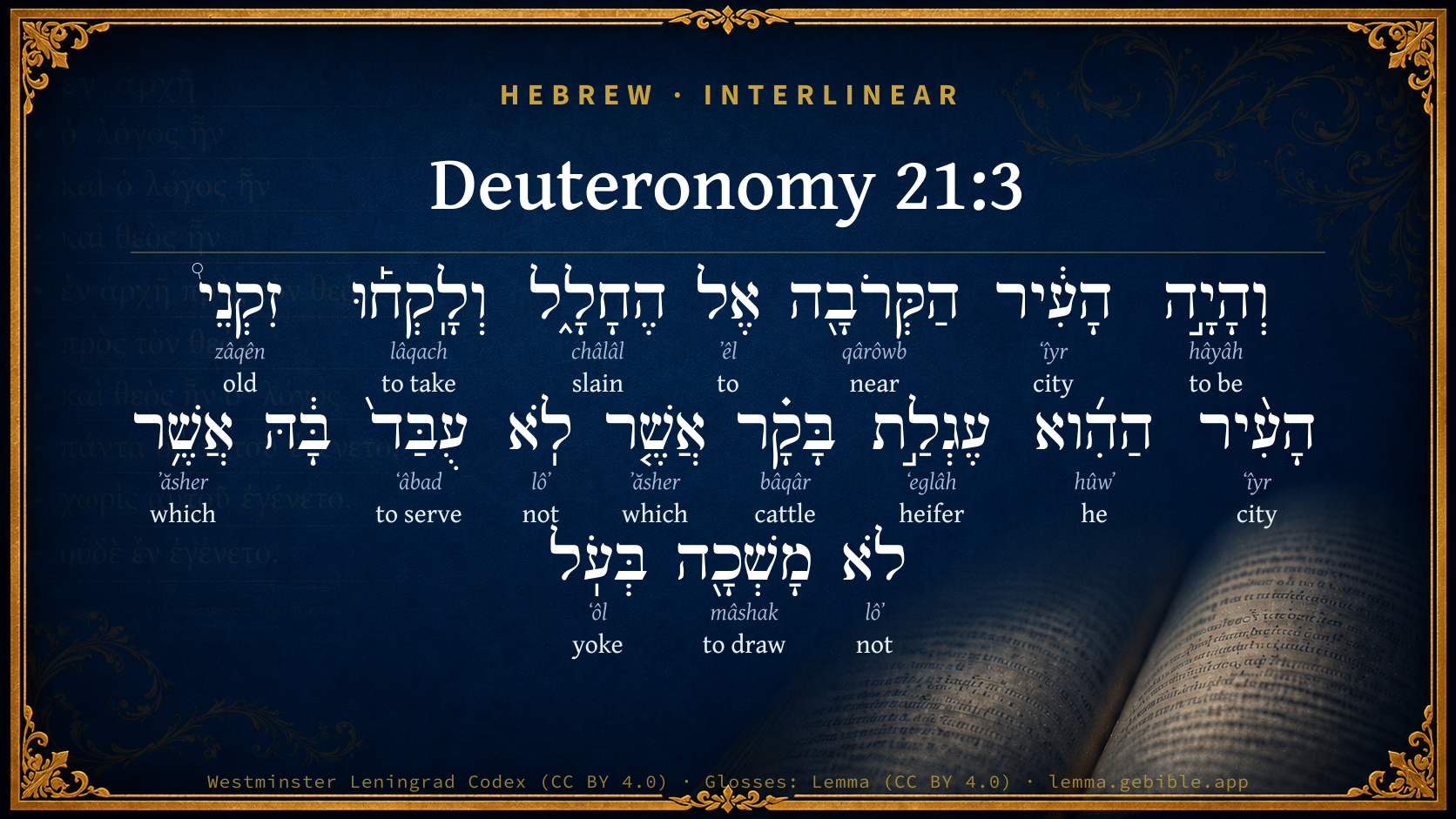
  1. וְהָיָ֣ה hâyâh H1961 “and · to be” Conjunction + Verb, Qal, Sequential Perfect, 3rd Person, Masculine, Singular
  2. הָעִ֔יר ʻîyr H5892 “the · city” Particle, Definite Article + Noun, Common, Feminine, Singular, Absolute
  3. הַקְּרֹבָ֖ה qârôwb H7138 “the · near” Particle, Definite Article + Adjective, Adjective, Feminine, Singular, Absolute
  4. אֶל ʼêl H413 “to” Preposition
  5. הֶחָלָ֑ל châlâl H2491 “the · slain” Particle, Definite Article + Adjective, Adjective, Masculine, Singular, Absolute
  6. וְלָֽקְח֡וּ lâqach H3947 “and · to take” Conjunction + Verb, Qal, Sequential Perfect, 3rd Person, Common, Plural
  7. זִקְנֵי֩ zâqên H2205 “old of” Adjective, Adjective, Masculine, Plural, Construct
  8. הָעִ֨יר ʻîyr H5892 “the · city” Particle, Definite Article + Noun, Common, Feminine, Singular, Absolute
  9. הַהִ֜וא hûwʼ H1931 “the · he” Particle, Definite Article + Pronoun, Personal, 3rd Person, Feminine, Singular
  10. בָּקָ֗ר bâqâr H1241 “cattle” Noun, Common, Both, Singular, Absolute
  11. אֲשֶׁ֤ר ʼăsher H834 “which” Particle, Relative
  12. לֹֽא lôʼ H3808 “not” Particle, Negative
  13. עֻבַּד֙ ʻâbad H5647 “to serve” Verb, Pual, Perfect, 3rd Person, Masculine, Singular
  14. אֲשֶׁ֥ר ʼăsher H834 “which” Particle, Relative
  15. לֹא lôʼ H3808 “not” Particle, Negative
  16. מָשְׁכָ֖ה mâshak H4900 “to draw” Verb, Qal, Perfect, 3rd Person, Feminine, Singular
  17. בְּעֹֽל ʻôl H5923 “in/at · yoke” Preposition + Noun, Common, Masculine, Singular, Absolute

About this verse

These counts appear in no published source. They are computed here, from the morphology-tagged text and Lemma’s own curated glosses. What Lemma adds →

19
words
15
distinct lemmas
Pentateuch
section

Notable vocabulary

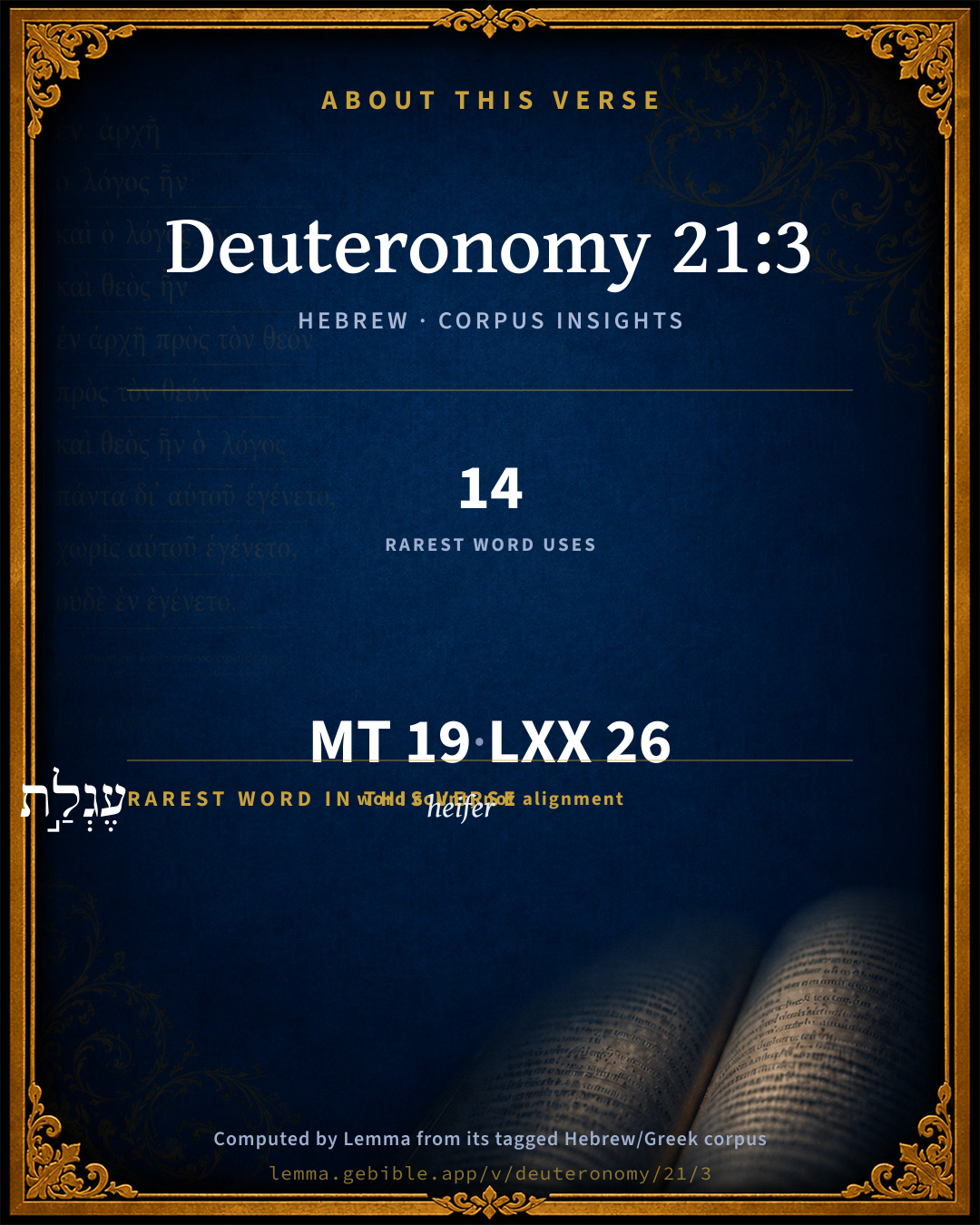
The rarest word here is עֶגְלַ֣ת heifer H5697 — appearing just 14 times in the whole Hebrew Bible.

Shared distinctive vocabulary

עֶגְלַ֣ת heifer H5697 occurs in 13 verses of the Hebrew Bible. Also found in:

Grammatical profile

  • 4 verbs
  • 5 nouns
  • 3 adjectives
  • 1 pronoun
  • 2 prepositions
  • 4 particles

Verb forms

  • וְהָיָ֣ה Qal · Sequential Perfect
  • וְלָֽקְח֡וּ Qal · Sequential Perfect
  • עֻבַּד֙ Pual · Perfect
  • מָשְׁכָ֖ה Qal · Perfect

Repetition

Words recur within this verse — often emphatic in Hebrew:

  • הָעִ֔יר city H5892 ×2
  • אֲשֶׁ֤ר which H834 ×2
  • לֹֽא not H3808 ×2

Hebrew & Septuagint length

In English translation the verse runs 40 words from the Hebrew and 37 from the Septuagint (LXX English) — closely comparable.

A rough comparison of the two English renderings, which tokenize alike — not a word-level alignment.

Word counts can differ between the Hebrew and the Greek without any difference in meaning — e.g. the Hebrew direct-object marker אֵת has no separate Greek word, and Greek often adds the article ὁ.

In the original languages it is 19 Hebrew tokens and 26 Greek tokens — but the two are counted differently (Hebrew bundles its prefixes and suffixes into one token; the Greek is in lemma form), so that isn’t a like-for-like length.

Cross-references

4

Topical passages linked to Deuteronomy 21:3 in the Treasury of Scripture Knowledge — connected by theme and wording, ordered by reader-vote popularity; previews shown in the World English Bible.

  • Numbers 19:2 This is the statute of the law which Yahweh has commanded, saying, Speak to the children of Israel, that they bring you a red heifer without spot, in which is no blemish, [and] on which never came yoke.
  • Jeremiah 31:18 I have surely heard Ephraim bemoaning himself [thus], You have chastised me, and I was chastised, as a calf unaccustomed [to the yoke]: turn you me, and I shall be turned; for you are Yahweh my God.
  • Matthew 11:28–30 "Come to me, all you who labor and are heavily burdened, and I will give you rest.
  • Philippians 2:8 And being found in human form, he humbled himself, becoming obedient to death, yes, the death of the cross.

Cross-references courtesy of OpenBible.info (CC BY 4.0).

Hebrew and Greek witnesses Masoretic Hebrew ↔ Greek Septuagint

The same verse in the two great witnesses to the Old Testament, shown verse-for-verse.

These are two independent witnesses, not word-aligned to each other, and the Septuagint is shown in lemma (dictionary) form.

Hebrew Deuteronomy 21:3 Masoretic · Westminster Leningrad Codex

וְהָיָ֣ה הָעִ֔יר הַקְּרֹבָ֖ה אֶל הֶחָלָ֑ל וְלָֽקְח֡וּ זִקְנֵי֩ הָעִ֨יר הַהִ֜וא עֶגְלַ֣ת בָּקָ֗ר אֲשֶׁ֤ר לֹֽא עֻבַּד֙ בָּ֔הּ אֲשֶׁ֥ר לֹא מָשְׁכָ֖ה בְּעֹֽל

and it shall be, that the city which is nearest to the slain man, even the elders of that city shall take a heifer of the herd, which hasn't been worked with, and which has not drawn in the yoke;

World English Bible · Public Domain

Greek LXX Deuteronomy 21:3 Septuagint · lemma form

καί εἰμί ὁ πόλις ὁ ἐγγίζω ὁ τραυματίας καί λαμβάνω ὁ γερουσία ὁ πόλις ἐκεῖνος δάμαλις ἐκ βοῦς ὅστις οὐ ἐργάζομαι καί ὅστις οὐ ἑλκύω ζυγός

and it shall be that the city which is nearest to the slain man the elders of that city shall take a heifer of the herd, which has not laboured, and which has not borne a yoke.

LXX2012 (modern English Septuagint) · Public Domain

Hebrew: Westminster Leningrad Codex (CC BY 4.0). Greek: Septuagint (public domain); English from LXX2012 (modern English Septuagint) (Public Domain). How the Septuagint differs from the Hebrew →

Targum (Aramaic paraphrase)

2

The Targum is the ancient Jewish Aramaic paraphrase of the Hebrew Scriptures — an interpretive translation, not the Hebrew text itself. Onkelos (literal) and Pseudo-Jonathan (expansive) render the Torah, and Jonathan the Prophets. Coverage is partial: where no permissively-licensed English translation exists for a verse, only the Aramaic is shown. This is verse-level text, not a word-by-word alignment to the Hebrew.

  1. Targum Onkelos Torah (Genesis–Deuteronomy)
    וּתְהֵי קַרְתָּא דִקְרִיבָא לִקְטִילָא וְיִדְבְּרוּן סָבֵי קַרְתָּא הַהִיא עֶגְלַת תּוֹרֵי דִי לָא אִתְפְּלַח בַּהּ דִי לָא נְגִידַת בְּנוּר

    (no public-domain English translation for this verse)

    Targum Onkelos — Aramaic: “Onkelos Genesis” (public domain); “Onkelos Exodus” (public domain); “Onkelos Leviticus” (public domain); “Onkelos Numbers” (public domain); “Onkelos Deuteronomy” (public domain). English: “Sefaria Community Translation” (CC0 1.0 (public-domain dedication)); “J.W. Etheridge. The Targums of Onkelos and Jonathan Ben Uzziel on the Pentateuch. London: Longmans, Green, 1862” (public domain). Text via Sefaria.

  2. Targum Pseudo-Jonathan Torah (Genesis–Deuteronomy)
    וִיהֵי קַרְתָּא דְקָרִיבָא לְקָטִילָא מִתְחַשְׁדָא נַסְבֵי דִינָא רַבָּא מַפְטְרִין וְיִסְבוּן חַכִּימֵי סָבֵי קַרְתָּא הַהִיא עֶגְלַת בְּרַת תּוֹרִין דְּלָא עֵירוֹבִין בְּרַת שַׁתָּא דְּלָא אִתְפְּלַח בָּהּ וְלָא נַגְדַת בְּנִיר

    and the city which is nearest to the dead man, being the suspected one, let the chief court of justice take means for absolution (or disculpation). Let the sages, the elders of that city, take an heifer from the herd, not commixed, an heifer of the year, which hath not been wrought with nor hath drawn in the yoke:

    Targum Pseudo-Jonathan — Aramaic: “Targum Jonathan on Genesis” (public domain); “Targum Jonathan on Exodus” (public domain); “Targum Jonathan on Leviticus” (public domain); “Targum Jonathan on Numbers” (public domain); “Targum Jonathan on Deuteronomy” (public domain). English: “The Targum of Jonathan ben Uzziel, trans. J. W. Etheridge, London, 1862” (public domain). Text via Sefaria.

Commentary

Notes on Deuteronomy 21:3 from classic Christian and Jewish commentators (each source and its license shown beneath its notes). The classic Christian expositions comment on the surrounding passage and are grouped to its opening verse, so a note may address several verses; the Jewish commentaries on the Tanakh (Rashi and others) are per-verse, so they appear only where the commentator wrote on this verse.

Lemma curates 59 commentaries, every one of them public domain or Creative Commons licensed, each selected and text-cleaned for this edition rather than reprinted as found. About our sources →

Trapp's Complete Commentary

John Trapp

Deu 21:3 And it shall be, [that] the city [which is] next unto the slain man, even the elders of that city shall take an heifer, which hath not been wrought with, [and] which hath not drawn in the yoke;

Ver. 3. Shall take a heifer.] Signifying Christ, who is the propitiation for his people’s sins, {1Jn 2:2}

John Trapp, A Commentary or Exposition upon All the Books of the Old and New Testament (1647–1656) — public domain. Text from a community e-Sword module.

Tyndale Open Study Notes

Tyndale Open Resources

21:3-8 An avenger from the victim’s family (19:6-7; Num 35:16-29) could not hold the whole community responsible.

Tyndale Open Study Notes — © Tyndale Open Resources, licensed CC BY-SA 4.0. Text via the HelloAO Bible API.

The Cambridge Bible for Schools and Colleges

gen. ed. J. J. S. Perowne

3. and it shall be, etc.] Lit. and it shall be as regards the city which … that the elders of that city shall take, etc. Similar construction in Deu_12:11, Deu_18:19.

an heifer of the herd] 1Sa_16:2, Gen_15:9 (a three year old) for sacrifice.

which hath not been wrought with] Heifers were used for work, Jdg_14:18, Hos_10:11, Jer_50:11, but this one, destined for a sacred use, must not have been so profaned: cp. Deu_15:19, of firstlings, Num_19:2, of the red heifer.

The Cambridge Bible for Schools and Colleges (gen. ed. J. J. S. Perowne; Cambridge University Press, 1878–1918) — public domain. Text from a community e-Sword module.

John Gill's Exposition

And it shall be, that the city which is next unto the slain man,.... And so suspected, as the Targum of Jonathan, of the murder; or the murderer is in it, or however belonged to it:

even the elders of the city shall take an heifer; of a year old, as the same Targum, and so Jarchi; and in this the Jewish writers agree, that it must be a year old, but not two; though heifers of three years old were sometimes used in sacrifice, Gen 15:9 a type of Christ, in his strength, laboriousness, and patience; see Num 19:2.

which hath not been wrought with; in ploughing land, or treading out corn:

and which hath not drawn in the yoke, which never had any yoke put upon it; or however, if attempted to be put upon it, it would not come under it, and draw with it: no mention is made, as usual, that it should be without blemish: because though in some sense expiatory, yet was not properly a sacrifice, it not being slain and offered where sacrifices were; hence it is said in the Misnah (q), that a blemish in it did not make it rejected, or unlawful for use: nevertheless, this heifer may be a type of Christ, whose sufferings, bloodshed, and death, atone for secret and unknown sins, as well as for open and manifest ones, even for all sin; and its being free from labour, and without a yoke, may signify the freedom of Christ from the yoke of sin, and the service of it, and from human traditions; that he was not obliged to any toil and labour he had been concerned in, or to bear the yoke of the law, had he not voluntarily undertaken it of himself; and that he expiated the sins of such who were sons of Belial, children without a yoke; and for the same reason, this heifer not being required to be without blemish, might be because Christ, though he had no sin of his own, was made sin for his people, and reckoned as if he had been a sinner; though indeed, had this been the design of the type, all the sacrifices which typified Christ would not have required such a qualification, to be without blemish, as they did.

(q) Ut supra, (Sotah, c. 9.) sect. 5.

John Gill's Exposition of the Whole Bible (1746–1763) — public domain (CC PDM 1.0). Text via the HelloAO Bible API.

Albert Barnes' Notes on the Bible

The requirements as regards place and victim are symbolic. The heifer represented the murderer, so far at least as to die in his stead, since he himself could not be found. As hearing his guilt the heifer must therefore be one which was of full growth and strength, and had not yet been ceremonially profaned by human use. The Christian commentators find here a type of Christ and of His sacrifice for man: but the heifer was not strictly a sacrifice or sin-offering. The transaction was rather figurative, and was so ordered as to impress the lesson of Gen 9:5.

Albert Barnes' Notes on the Bible (1834–1885) — public domain. Text from a community e-Sword/MySword module.

Haydock's Catholic Bible Commentary

Heifer, not above three years old, say the Rabbins. The pagans esteemed those victims more agreeable to the gods, which had not been yoked. Chermon observes, that the Egyptians rejected such as had been once "consecrated to labour." (Grotius) --- This circumstance might here indicate, that the murderer was a son of Belial, or "without yoke;" (chap xiii. 13.; Menochius) and the heifer was slain to shew what he deserved, and must expect if he be discovered. (Haydock)

George Leo Haydock (1774–1849), Haydock's Catholic Family Bible and Commentary, 1859 edition — public domain. Excludes Psalms (Douay-Rheims chapter numbering differs from Protestant) and Deuterocanonical books (Catholic canon only).

Matthew Poole's English Annotations

A fit vicegerent and representative of the murderer, in whose stead it was killed, who by this act hath shown himself to be a son of Belial, who would not bear the yoke of God’s law. A type also of Christ, who was obliged to no work, and under no yoke, but what he had voluntarily taken upon himself.

Matthew Poole's English Annotations on the Holy Bible (1683–1685) — public domain. Text from a community e-Sword/MySword module.

Whedon's Commentary on the Bible

Daniel D. Whedon

3. The city which is next unto the slain man — The nearest city was to expiate the bloodguiltiness.

A heifer, which hath not been wrought with — The victim that was to be immolated must be one that had never been applied to common use. Comp. Exo_20:25; Num_19:2. Among the Egyptians, Greeks, and Romans such a victim was deemed more suitable for sacrifice.

Daniel D. Whedon (gen. ed.), Commentary on the Old and New Testaments (1874–1909) — public domain. Text from a community e-Sword module.

The Pulpit Commentary

A heifer, which hath not boon wrought with, and which hath not drawn in the yoke; a young cow which had not been rendered unfit for consecration, nor had its vital force impaired, by being subjected to forced labor. (cf. Num_19:2)

The Pulpit Commentary (1880–1919), ed. H.D.M. Spence-Jones & Joseph S. Exell — public domain. Text from a community e-Sword module.

John Wesley's Explanatory Notes

Which hath not drawn in the yoke - A fit representative of the murderer, in whose stead it was killed, who would not bear the yoke of God's laws. A type also of Christ, who was under the yoke, but what he had voluntarily taken upon himself.

John Wesley, Explanatory Notes Upon the Whole Bible (1754–1765) — public domain. Text via the GEBible commentary corpus.

unfoldingWord translationNotes

Door43 World Missions Community

has not borne the yoke

"has not worn a yoke"

running water

This is an idiom for water that is moving. AT: "a stream" (See: Idiom)

a valley that has been neither plowed nor sown

This can be stated in active form. AT: "a valley where nobody has plowed the ground or planted seeds" (See: Active or Passive)

translationWords

elder

cow

flocks

yoke

water

plow

plant

unfoldingWord translationNotes — © Distant Shores Media and the Door43 World Missions Community, licensed CC BY-SA 4.0. Source: git.door43.org/Door43/en_tn.

Lesson kit

Teaching starters — assembled from the data on this page, not authored interpretation. Every prompt links to the verse data it draws on. Edit before teaching.

Deuteronomy, in the Pentateuch, opens this verse with 19 words (15 distinct Hebrew lemmas). Its most distinctive word is ʻeglâh (“heifer”). A historical commentator’s framing appears above. Read the whole chapter for the surrounding context.

Discussion questions

  1. How does “heifer” (ʻeglâh) shape what this verse is saying?
  2. How does Genesis 15:9, which shares the word «heifer», read alongside this verse?
  3. What does the repetition of “city” (2× in this one verse) do in this verse?
  4. These translations render this verse differently. What is at stake in choosing one wording over another?
  5. «וְהָיָ֣ה» is a Qal Sequential Perfect verb. How does that grammatical form shape the action described?
  6. Compare how Trapp's Complete Commentary and Tyndale Open Study Notes read this verse. Where do they agree or differ?

Things to notice

Reading settings

Reading text

Shown beneath each verse's original-language words.

Old Testament
Old Testament edition

Read the OT as the Masoretic Hebrew (MT) or the Greek Septuagint (LXX).

English shown for the Greek Septuagint (in the Hebrew ↔ Greek comparison).

Comparing translations? Open the Compare panel on any verse page to stack up to four side by side.