
Deuteronomy 14:8

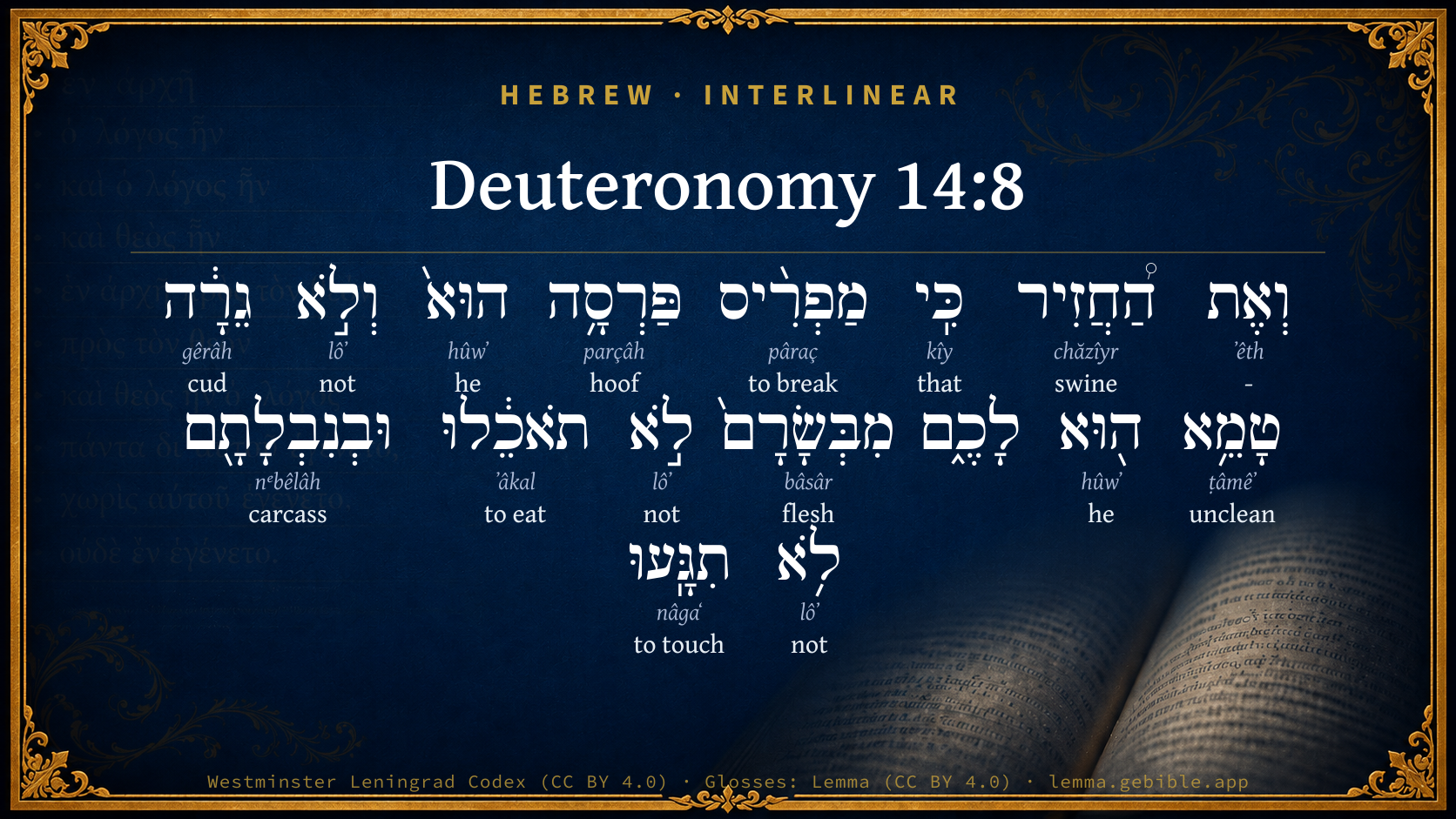
Hebrew (Westminster Leningrad Codex) Deuteronomy 14:8 appears in the Hebrew Old Testament. The text above is from the Westminster Leningrad Codex. Each word links to its Strong’s number, a concise gloss, and parsing drawn from the Open Scriptures Hebrew Bible morphology. Click any word for its full Brown-Driver-Briggs (BDB) entry.
Download image
Cite this verse

Deuteronomy 14:8 (World English Bible). Public Domain. Lemma interlinear Bible study tool, https://lemma.gebible.app/v/deuteronomy/14/8.

Show BibTeX & RIS
BibTeX
RIS
English Translation
The pig, because it has a split hoof but doesn't chew the cud, is unclean to you: of their flesh you shall not eat, and their carcasses you shall not touch.
World English Bible · Public Domain
Download a study sheet

One document with this verse’s original text, its word-by-word gloss line, the meaning frame, cross-references with their text, attributed commentary, and full source and license credits — printable, and it pastes into notes with its structure intact.

This verse Autodidact and up

Study sheet (.html) Plain text (.txt)

A passage Seminary Student

Up to 50 verses in one chapter. A passage sheet keeps up to 6 commentary sources and 12 cross-references per verse, in the order this page ranks them, and says so on the sheet whenever that leaves anything out. Ask for a single verse and you get the Autodidact verse sheet above.

Everything on this page stays free to read, with no account — the sheet is a download of what is already on screen, not access to it.

Want to remove ads? Support Godless Engineer
Compare translations 3

The same verse in 3 English versions, stacked beneath the original-language interlinear above. Click any original word for its lexicon entry.

Each is an independent rendering of the whole verse — the interlinear is not word-aligned to these translations.

Highlighted words mark where these versions differ — a whole-verse word diff, not a word-by-word alignment.

  • World English Bible Public Domain
    The pig, because it has a split hoof but doesn't chew the cud, is unclean to you: of their flesh you shall not eat, and their carcasses you shall not touch.
  • King James Version Public Domain
    And the swine, because it divideth the hoof, yet cheweth not the cud, it is unclean unto you: ye shall not eat of their flesh, nor touch their dead carcass.
  • unfoldingWord Literal Text CC BY-SA 4.0
    And the pig, because he parts the hoof and not the cud, he unclean to you. From their meat do not eat, and do not touch their carcasses.

unfoldingWord Literal Text — © unfoldingWord, licensed CC BY-SA 4.0. Word-aligned USFM3 via Door43 (git.door43.org/unfoldingWord/en_ult).

Versions to compare (up to 4)

3 of 4 selected

Show all 18 translations

Every available English version of this verse, each an independent rendering of the whole verse.

  • World English Bible Public Domain
    The pig, because it has a split hoof but doesn't chew the cud, is unclean to you: of their flesh you shall not eat, and their carcasses you shall not touch.
  • Berean Standard Bible Public Domain
    as well as the pig; though it has a divided hoof, it does not chew the cud. It is unclean for you. You must not eat its meat or touch its carcass.
  • Majority Standard Bible Public Domain
    as well as the pig; though it has a divided hoof, it does not chew the cud. It is unclean for you. You must not eat its meat or touch its carcass.
  • King James Version Public Domain
    And the swine, because it divideth the hoof, yet cheweth not the cud, it is unclean unto you: ye shall not eat of their flesh, nor touch their dead carcass.
  • American Standard Version (1901) Public Domain
    And the swine, because he parteth the hoof but cheweth not the cud, he is unclean unto you: of their flesh ye shall not eat, and their carcasses ye shall not touch.
  • Revised Version (1885) Public Domain
    and the swine, because he parteth the hoof but cheweth not the cud, he is unclean unto you: of their flesh ye shall not eat, and their carcases ye shall not touch.
  • Geneva Bible (1599) Public Domain
    Also the swine, because he deuideth the hoofe, and cheweth not the cud, shalbe vncleane vnto you: ye shall not eate of their flesh, nor touch their dead carkeises.
  • Douay-Rheims (1899) Public Domain
    The swine also, because it divideth the hoof, but cheweth not the cud, shall be unclean, their flesh you shall not eat, and their carcasses you shall not touch.
  • Young's Literal Translation Public Domain
    and the sow, for it is dividing the hoof, and not `bringing' up the cud, unclean it `is' to you; of their flesh ye do not eat, and against their carcase ye do not come.
  • Literal Standard Version CC BY-SA 4.0
    and the sow, for it is dividing the hoof, and not [bringing] up the cud—it [is] unclean to you; you do not eat of their flesh, and you do not come against their carcass.
  • Unlocked Literal Bible CC BY-SA 4.0
    The pig is unclean to you as well because he parts the hoof but does not chew the cud; he is unclean to you. Do not eat pig meat, and do not touch their carcasses.
  • unfoldingWord Literal Text CC BY-SA 4.0
    And the pig, because he parts the hoof and not the cud, he unclean to you. From their meat do not eat, and do not touch their carcasses.
  • Darby Bible Public Domain
    and the swine, for it hath cloven hoofs, yet cheweth not the cud -- it shall be unclean unto you. Of their flesh shall ye not eat, and their carcase shall ye not touch.
  • World Messianic Bible Public Domain
    The pig, because it has a split hoof but doesn’t chew the cud, is unclean to you. You shall not eat their meat. You shall not touch their carcasses.
  • Webster's Bible Public Domain
    And the swine, because it divideth the hoof, yet cheweth not the cud, is unclean to you: ye shall not eat of their flesh, nor touch their dead carcass.
  • Free Bible Version CC BY-SA 4.0
    The same applies to the pig. Even though it has a divided hoof, it does not chew the cud. So you must treat it as unclean. You must not eat its meat or touch its dead body.
  • Bible in Basic English Public Domain
    And the pig is unclean to you, because though it has a division in the horn of its foot, its food does not come back; their flesh may not be used for food or their dead bodies touched by you.
  • JPS Tanakh (1917) Public Domain
    and the swine, because he parteth the hoof but cheweth not the cud, he is unclean unto you; of their flesh ye shall not eat, and their carcasses ye shall not touch.

Literal Standard Version (2020), Covenant Press — licensed CC BY-SA 4.0. Text via the HelloAO Bible API (eBible.org). Unlocked Literal Bible (unfoldingWord) — licensed CC BY-SA 4.0. Text via the HelloAO Bible API (eBible.org). unfoldingWord Literal Text — © unfoldingWord, licensed CC BY-SA 4.0. Word-aligned USFM3 via Door43 (git.door43.org/unfoldingWord/en_ult). Free Bible Version, Dr. Jonathan Gallagher — licensed CC BY-SA 4.0. Text via the HelloAO Bible API (eBible.org).

Word by word

More ways to search: Search by grammar → Find every occurrence → Compare this word →

Practice this passage: Drill this verse → Learn its vocabulary →

הַ֠חֲזִיר
chăzîyr
H2386
“the · swine”
Particle, Definite Article + Noun, Common, Masculine, Singular, Absolute
Part of Speech
Particle + Noun
Type
Common
Gender
Masculine
Number
Singular
State
Absolute
Full BDB Definition

Origin: from an unused root probably meaning to enclose

TWOT: 637a

hog, swine, boar - swine (as forbidden food) - wild boar
  1. וְאֶת ʼêth H853 “and · -” Conjunction + Particle, Direct Object
  2. כִּֽי kîy H3588 “that” Conjunction
  3. מַפְרִ֨יס pâraç H6536 “breaking” Verb, Hiphil, Participle Active, Masculine, Singular, Construct
  4. פַּרְסָ֥ה parçâh H6541 “hoof” Noun, Common, Feminine, Singular, Absolute
  5. הוּא֙ hûwʼ H1931 “he” Pronoun, Personal, 3rd Person, Masculine, Singular
  6. וְלֹ֣א lôʼ H3808 “and · not” Conjunction + Particle, Negative
  7. גֵרָ֔ה gêrâh H1625 “cud” Noun, Common, Feminine, Singular, Absolute
  8. טָמֵ֥א ṭâmêʼ H2931 “unclean” Adjective, Adjective, Masculine, Singular, Absolute
  9. ה֖וּא hûwʼ H1931 “he” Pronoun, Personal, 3rd Person, Masculine, Singular
  10. מִבְּשָׂרָם֙ bâsâr H1320 “from · flesh · their” Preposition + Noun, Common, Masculine, Singular, Construct + Suffix, Personal, 3rd Person, Masculine, Plural
  11. לֹ֣א lôʼ H3808 “not” Particle, Negative
  12. תֹאכֵ֔לוּ ʼâkal H398 “to eat” Verb, Qal, Imperfect, 2nd Person, Masculine, Plural
  13. וּבְנִבְלָתָ֖ם nᵉbêlâh H5038 “and · in/at · carcass · their” Conjunction + Preposition + Noun, Common, Feminine, Singular, Construct + Suffix, Personal, 3rd Person, Masculine, Plural
  14. לֹ֥א lôʼ H3808 “not” Particle, Negative
  15. תִגָּֽעוּ nâgaʻ H5060 “to touch” Verb, Qal, Imperfect, 2nd Person, Masculine, Plural

About this verse

These counts appear in no published source. They are computed here, from the morphology-tagged text and Lemma’s own curated glosses. What Lemma adds →

17
words
13
distinct lemmas
Pentateuch
section

Notable vocabulary

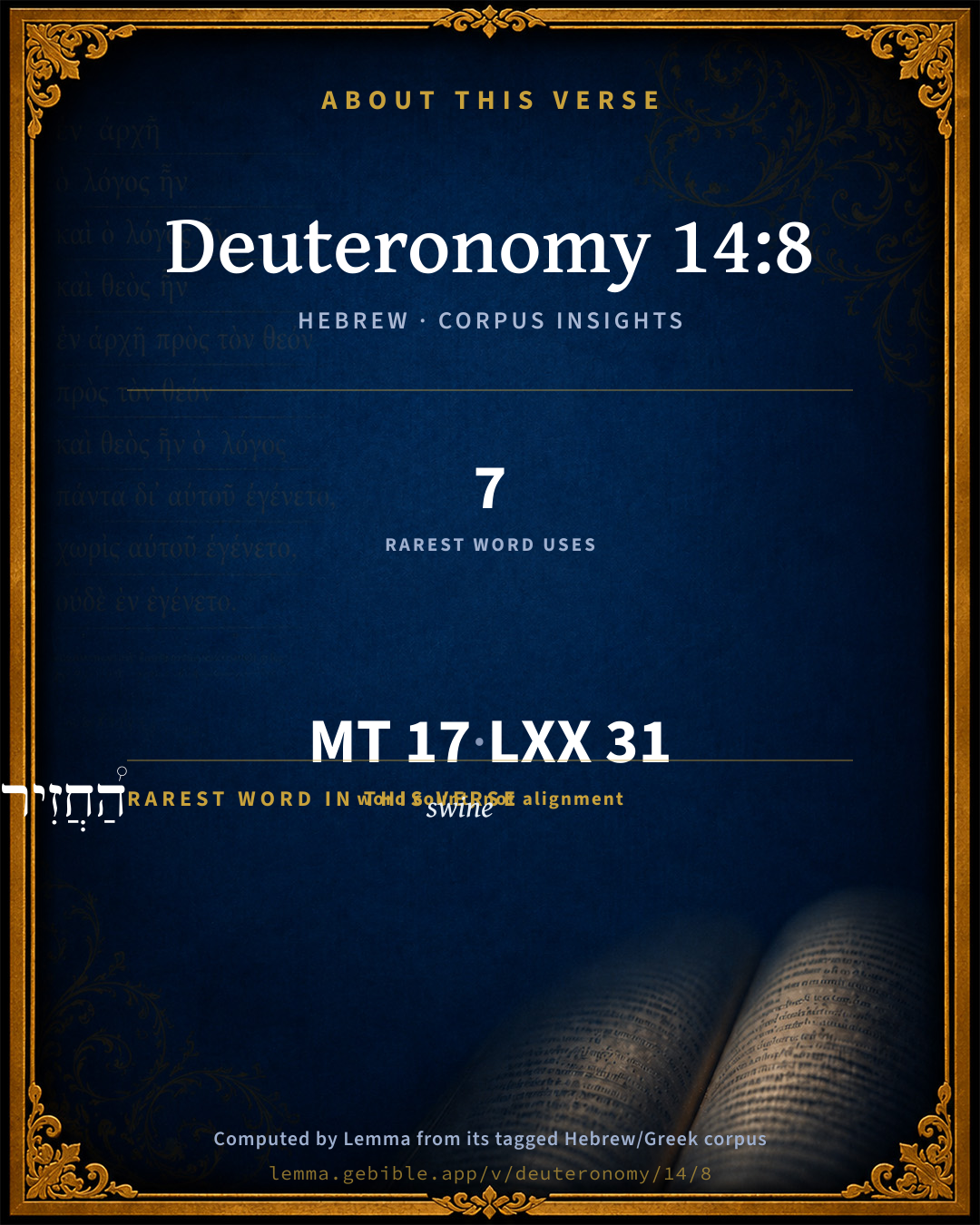
The rarest word here is הַ֠חֲזִיר swine H2386 — appearing just 7 times in the whole Hebrew Bible.

Shared distinctive vocabulary

הַ֠חֲזִיר swine H2386 occurs in 7 verses of the Hebrew Bible. Also found in:

Grammatical profile

  • 3 verbs
  • 5 nouns
  • 1 adjective
  • 2 pronouns
  • 1 preposition
  • 1 conjunction
  • 4 particles

Verb forms

  • מַפְרִ֨יס Hiphil · Participle Active
  • תֹאכֵ֔לוּ Qal · Imperfect
  • תִגָּֽעוּ Qal · Imperfect

Repetition

Words recur within this verse — often emphatic in Hebrew:

  • וְלֹ֣א not H3808 ×3
  • הוּא֙ he H1931 ×2

Hebrew & Septuagint length

In English translation the verse runs 31 words from the Hebrew and 41 from the Septuagint (LXX English) — closely comparable.

A rough comparison of the two English renderings, which tokenize alike — not a word-level alignment.

Word counts can differ between the Hebrew and the Greek without any difference in meaning — e.g. the Hebrew direct-object marker אֵת has no separate Greek word, and Greek often adds the article ὁ.

In the original languages it is 17 Hebrew tokens and 31 Greek tokens — but the two are counted differently (Hebrew bundles its prefixes and suffixes into one token; the Greek is in lemma form), so that isn’t a like-for-like length.

Cross-references

6

Topical passages linked to Deuteronomy 14:8 in the Treasury of Scripture Knowledge — connected by theme and wording, ordered by reader-vote popularity; previews shown in the World English Bible.

  • Leviticus 11:26–27 "'Every animal which parts the hoof, and is not cloven-footed, nor chews the cud, is unclean to you. Everyone who touches them shall be unclean.
  • Isaiah 65:4 who sit among the graves, and lodge in the secret places; who eat pig's flesh, and broth of abominable things is in their vessels;
  • Isaiah 66:3 He who kills an ox is as he who kills a man; he who sacrifices a lamb, as he who breaks a dog's neck; he who offers an offering, [as he who offers] pig's blood; he who burns frankincense, as he who blesses an idol. Yes, they have chosen their own ways, and their soul delights in their abominations:
  • Isaiah 66:17 Those who sanctify themselves and purify themselves [to go] to the gardens, behind one in the midst, eating pig's flesh, and the abomination, and the mouse, they shall come to an end together, says Yahweh.
  • Luke 15:15–16 He went and joined himself to one of the citizens of that country, and he sent him into his fields to feed pigs.
  • 2 Peter 2:22 But it has happened to them according to the true proverb, "The dog turns to his own vomit again," and "the sow that had washed to wallowing in the mire."

Cross-references courtesy of OpenBible.info (CC BY 4.0).

Hebrew and Greek witnesses Masoretic Hebrew ↔ Greek Septuagint

The same verse in the two great witnesses to the Old Testament, shown verse-for-verse.

These are two independent witnesses, not word-aligned to each other, and the Septuagint is shown in lemma (dictionary) form.

Hebrew Deuteronomy 14:8 Masoretic · Westminster Leningrad Codex

וְאֶת הַ֠חֲזִיר כִּֽי מַפְרִ֨יס פַּרְסָ֥ה הוּא֙ וְלֹ֣א גֵרָ֔ה טָמֵ֥א ה֖וּא לָכֶ֑ם מִבְּשָׂרָם֙ לֹ֣א תֹאכֵ֔לוּ וּבְנִבְלָתָ֖ם לֹ֥א תִגָּֽעוּ

The pig, because it has a split hoof but doesn't chew the cud, is unclean to you: of their flesh you shall not eat, and their carcasses you shall not touch.

World English Bible · Public Domain

Greek LXX Deuteronomy 14:8 Septuagint · lemma form

καί ὁ ὗς ὅτι διχηλέω ὁπλή οὗτος καί ὀνυχίζω ὄνυξ ὁπλή καί οὗτος μηρυκισμός οὐ μαρυκάομαι ἀκάθαρτος οὗτος σύ ἀπό ὁ κρέας αὐτός οὐ ἐσθίω καί ὁ θνησιμαῖος αὐτός οὐ ἅπτομαι

And as for the swine, because he divides the hoof, and makes claws of the hoof, yet he chews not the cud, he is unclean to you; you⌃ shall not eat of their flesh, you⌃ shall not touch their dead bodies.

LXX2012 (modern English Septuagint) · Public Domain

On this verse, The Cambridge Bible for Schools and Colleges discusses the Septuagint’s reading. Read the note in Commentary ↓

Hebrew: Westminster Leningrad Codex (CC BY 4.0). Greek: Septuagint (public domain); English from LXX2012 (modern English Septuagint) (Public Domain). How the Septuagint differs from the Hebrew →

Targum (Aramaic paraphrase)

2

The Targum is the ancient Jewish Aramaic paraphrase of the Hebrew Scriptures — an interpretive translation, not the Hebrew text itself. Onkelos (literal) and Pseudo-Jonathan (expansive) render the Torah, and Jonathan the Prophets. Coverage is partial: where no permissively-licensed English translation exists for a verse, only the Aramaic is shown. This is verse-level text, not a word-by-word alignment to the Hebrew.

  1. Targum Onkelos Torah (Genesis–Deuteronomy)
    וְיָת חֲזִירָא אֲרֵי מַסְדִיק פַּרְסָתָא הוּא וְלָא פָשַׁר מְסָאָב הוּא לְכוֹן מִבִּסְרְהוֹן לָא תֵיכְלוּן וּבִנְבֵלְתְּהוֹן לָא תִקְרְבוּן

    (no public-domain English translation for this verse)

    Targum Onkelos — Aramaic: “Onkelos Genesis” (public domain); “Onkelos Exodus” (public domain); “Onkelos Leviticus” (public domain); “Onkelos Numbers” (public domain); “Onkelos Deuteronomy” (public domain). English: “Sefaria Community Translation” (CC0 1.0 (public-domain dedication)); “J.W. Etheridge. The Targums of Onkelos and Jonathan Ben Uzziel on the Pentateuch. London: Longmans, Green, 1862” (public domain). Text via Sefaria.

  2. Targum Pseudo-Jonathan Torah (Genesis–Deuteronomy)
    וְיַת חֲזִירָא אֲרוּם סְדִיק פַּרְסָתָא הוּא וְלֵית כַּנְפֵיק בֵּיהּ דְּסָדִיק וְלָא פָּשַׁר מְסָאַב הוּא לְכוֹן מִבִּסְרֵיהוֹן לָא תֵיכְלוּן וּבִנְבֵילְתְּהוֹן לָא תְקַרְבוּן

    The swine, because, though he hath the hoof divided, and there is none produced that like him divideth (the hoof), and yet cheweth not the cud, is unclean to you; of their flesh you shall not eat, nor touch their dead bodies.

    Targum Pseudo-Jonathan — Aramaic: “Targum Jonathan on Genesis” (public domain); “Targum Jonathan on Exodus” (public domain); “Targum Jonathan on Leviticus” (public domain); “Targum Jonathan on Numbers” (public domain); “Targum Jonathan on Deuteronomy” (public domain). English: “The Targum of Jonathan ben Uzziel, trans. J. W. Etheridge, London, 1862” (public domain). Text via Sefaria.

Commentary

Notes on Deuteronomy 14:8 from classic Christian and Jewish commentators (each source and its license shown beneath its notes). The classic Christian expositions comment on the surrounding passage and are grouped to its opening verse, so a note may address several verses; the Jewish commentaries on the Tanakh (Rashi and others) are per-verse, so they appear only where the commentator wrote on this verse.

Lemma curates 59 commentaries, every one of them public domain or Creative Commons licensed, each selected and text-cleaned for this edition rather than reprinted as found. About our sources →

Tyndale Open Study Notes

Tyndale Open Resources

14:8 The instruction not to touch their carcasses was primarily to maintain ritual purity.

Tyndale Open Study Notes — © Tyndale Open Resources, licensed CC BY-SA 4.0. Text via the HelloAO Bible API.

The Cambridge Bible for Schools and Colleges

gen. ed. J. J. S. Perowne

8. swine] ḥǎzîr, Ar. khanzir; from the animal’s indiscriminate feeding the flesh is liable to become the host of many parasites and therefore without care dangerous especially in warm climates. Used in heathen sacrifices, Isa_65:4 f., 17. Nomad Arabs eat the wild boar: ‘only the fellaḥîn say that they do not eat the wild-boar; their neighbours, however, assert the contrary of them’ (Musil, Ethn. Ber. 151). On the sacredness of the pig among other peoples and the use of it in making charms and amulets see W. R. Smith, Rel. Sem. 272, 429. LXX has here a fuller text as in Lev_11:7. Note that no mention is made of the wilder beasts of prey: lion, panther, bear, wolf, hyaena or jackal. On the use of the hyaena, etc. by the present fellaḥîn see PEFQ, 1905, 120. Wolf-flesh is regarded as medicinal in Arabia (Doughty, i. 337).

The Cambridge Bible for Schools and Colleges (gen. ed. J. J. S. Perowne; Cambridge University Press, 1878–1918) — public domain. Text from a community e-Sword module.

unfoldingWord translationNotes

Door43 World Missions Community

The pig is unclean to you

Something Yahweh says is unfit for his people to eat is spoken of as if it were physically unclean. (See: Metaphor)

translationWords

pig

unfoldingWord translationNotes — © Distant Shores Media and the Door43 World Missions Community, licensed CC BY-SA 4.0. Source: git.door43.org/Door43/en_tn.

Rashi

Rabbi Shlomo Yitzchaki (Rashi)

ובנבלתם לא תגעו YE SHALL NOT TOUCH THEIR CARRION — Our Rabbis explained that this refers only to the festive seasons when every male Israelite was obliged to appear in the Sanctuary and should therefore be in a state of cleanness. One might think that they (the Israelites, i.e. non-priests) are prohibited from touching a carcass during the whole year! It, however, states, (Leviticus 21:1) in reference to the uncleanness of a corpse: “Say unto the priests … [there shall none be defiled by the dead] etc.”. Now you may draw a conclusion a fortiori: How is it in the case of uncleanness caused by a corpse which is a stringent kind of uncleanness? Priests only are prohibited regarding it but ordinary Israelites are not prohibited! Surely in the case of uncleanness caused by a carcass which is less stringent this is all the more so! (Sifra, Shemini, Chapter 4 8-9; cf. Rashi on Leviticus 11:8 and Note thereon).

Rashi on the Tanakh — English translations: “The Judaica Press complete Tanach with Rashi, translated by A. J. Rosenberg” (CC BY 4.0); “Pentateuch with Rashi's commentary by M. Rosenbaum and A.M. Silbermann, 1929-1934” (public domain); “The Metsudah Tanach series, Lakewood, N.J” (CC BY 4.0); and “The Book of Joshua, Metsudah Publications, 1997” (CC BY 4.0). Text via Sefaria.

Lesson kit

Teaching starters — assembled from the data on this page, not authored interpretation. Every prompt links to the verse data it draws on. Edit before teaching.

Deuteronomy, in the Pentateuch, opens this verse with 17 words (13 distinct Hebrew lemmas). Its most distinctive word is chăzîyr (“swine”). A historical commentator’s framing appears above. Read the whole chapter for the surrounding context.

Discussion questions

  1. How does “swine” (chăzîyr) shape what this verse is saying?
  2. Leviticus 11:7 shares the word «swine» with this verse. How do the two illuminate each other?
  3. “not” occurs 3× in this one verse. What is the effect of the repetition?
  4. These translations render this verse differently; the difference is in the English rendering, not the original. What questions does that raise?
  5. The verb «מַפְרִ֨יס» is Hiphil Participle Active. How does its form color the action?
  6. Reading how Tyndale Open Study Notes and The Cambridge Bible for Schools and Colleges read this verse, where do the two commentators agree and where do they part?

Things to notice

Reading settings

Reading text

Shown beneath each verse's original-language words.

Old Testament
Old Testament edition

Read the OT as the Masoretic Hebrew (MT) or the Greek Septuagint (LXX).

English shown for the Greek Septuagint (in the Hebrew ↔ Greek comparison).

Comparing translations? Open the Compare panel on any verse page to stack up to four side by side.