
Deuteronomy 17:10

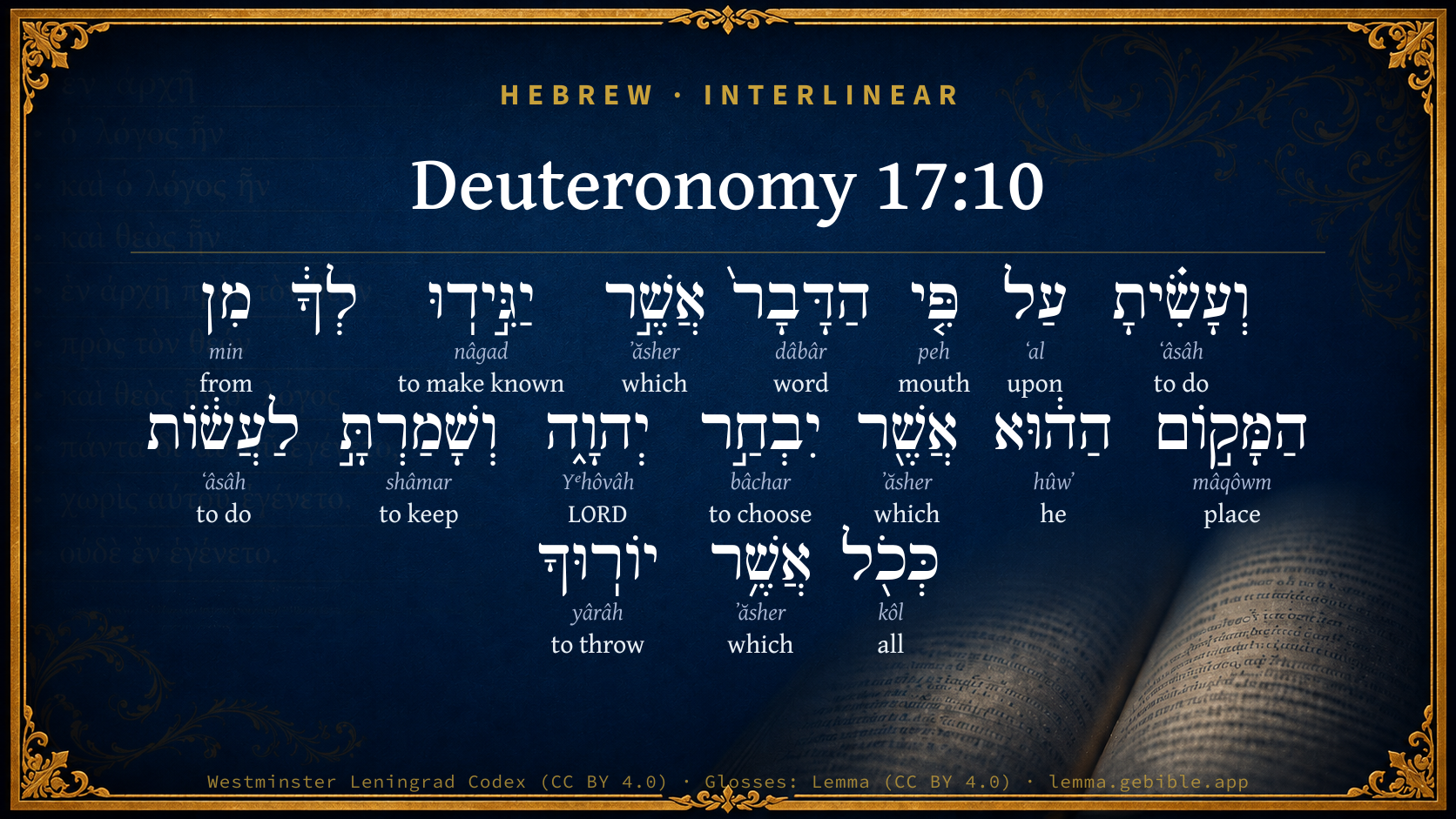
Hebrew (Westminster Leningrad Codex) Deuteronomy 17:10 appears in the Hebrew Old Testament. The text above is from the Westminster Leningrad Codex. Each word links to its Strong’s number, a concise gloss, and parsing drawn from the Open Scriptures Hebrew Bible morphology. Click any word for its full Brown-Driver-Briggs (BDB) entry.
Download image
Cite this verse

Deuteronomy 17:10 (World English Bible). Public Domain. Lemma interlinear Bible study tool, https://lemma.gebible.app/v/deuteronomy/17/10.

Show BibTeX & RIS
BibTeX
RIS
English Translation
You shall do according to the tenor of the sentence which they shall show you from that place which Yahweh shall choose; and you shall observe to do according to all that they shall teach you:
World English Bible · Public Domain
Download a study sheet

One document with this verse’s original text, its word-by-word gloss line, the meaning frame, cross-references with their text, attributed commentary, and full source and license credits — printable, and it pastes into notes with its structure intact.

This verse Autodidact and up

Study sheet (.html) Plain text (.txt)

A passage Seminary Student

Up to 50 verses in one chapter. A passage sheet keeps up to 6 commentary sources and 12 cross-references per verse, in the order this page ranks them, and says so on the sheet whenever that leaves anything out. Ask for a single verse and you get the Autodidact verse sheet above.

Everything on this page stays free to read, with no account — the sheet is a download of what is already on screen, not access to it.

Want to remove ads? Support Godless Engineer
Compare translations 3

The same verse in 3 English versions, stacked beneath the original-language interlinear above. Click any original word for its lexicon entry.

Each is an independent rendering of the whole verse — the interlinear is not word-aligned to these translations.

Highlighted words mark where these versions differ — a whole-verse word diff, not a word-by-word alignment.

  • World English Bible Public Domain
    You shall do according to the tenor of the sentence which they shall show you from that place which Yahweh shall choose; and you shall observe to do according to all that they shall teach you:
  • King James Version Public Domain
    And thou shalt do according to the sentence, which they of that place which the LORD shall choose shall show thee; and thou shalt observe to do according to all that they inform thee:
  • unfoldingWord Literal Text CC BY-SA 4.0
    And you shall do according to the mouth of the word that they tell you, from that place that Yahweh will choose, and keep doing according to all that they teach you.

unfoldingWord Literal Text — © unfoldingWord, licensed CC BY-SA 4.0. Word-aligned USFM3 via Door43 (git.door43.org/unfoldingWord/en_ult).

Versions to compare (up to 4)

3 of 4 selected

Show all 18 translations

Every available English version of this verse, each an independent rendering of the whole verse.

  • World English Bible Public Domain
    You shall do according to the tenor of the sentence which they shall show you from that place which Yahweh shall choose; and you shall observe to do according to all that they shall teach you:
  • Berean Standard Bible Public Domain
    You must abide by the verdict they give you at the place the LORD will choose. Be careful to do everything they instruct you,
  • Majority Standard Bible Public Domain
    You must abide by the verdict they give you at the place the LORD will choose. Be careful to do everything they instruct you,
  • King James Version Public Domain
    And thou shalt do according to the sentence, which they of that place which the LORD shall choose shall show thee; and thou shalt observe to do according to all that they inform thee:
  • American Standard Version (1901) Public Domain
    And thou shalt do according to the tenor of the sentence which they shall show thee from that place which Jehovah shall choose; and thou shalt observe to do according to all that they shall teach thee:
  • Revised Version (1885) Public Domain
    and thou shalt do according to the tenor of the sentence, which they shall shew thee from that place which the LORD shall choose; and thou shalt observe to do according to all that they shall teach thee:
  • Geneva Bible (1599) Public Domain
    And thou shalt do according to that thing which they of that place (which the Lord hath chosen) shewe thee, and thou shalt obserue to doe according to all that they informe thee.
  • Douay-Rheims (1899) Public Domain
    And thou shalt do whatsoever they shall say, that preside in the place, which the Lord shall choose, and what they shall teach thee,
  • Young's Literal Translation Public Domain
    and thou hast done according to the tenor of the word which they declare to thee (`they' of that place which Jehovah doth choose; and thou hast observed to do according to all that they direct thee.
  • Literal Standard Version CC BY-SA 4.0
    and you have done according to the tenor of the word which they declare to you ([they] of that place which YHWH chooses); and you have observed to do according to all that they direct you.
  • Unlocked Literal Bible CC BY-SA 4.0
    You must follow the law given to you at the place Yahweh will choose as his sanctuary. You will be careful to do everything that they direct you to do.
  • unfoldingWord Literal Text CC BY-SA 4.0
    And you shall do according to the mouth of the word that they tell you, from that place that Yahweh will choose, and keep doing according to all that they teach you.
  • Darby Bible Public Domain
    and thou shalt do according to the tenor of the word, which they of that place which Jehovah will choose shall declare unto thee; and thou shalt take heed to do according to all that they instruct thee:
  • World Messianic Bible Public Domain
    You shall do according to the decisions of the verdict which they shall give you from that place which the LORD chooses. You shall observe to do according to all that they shall teach you.
  • Webster's Bible Public Domain
    And thou shalt do according to the sentence, which they of that place which the LORD shall choose shall show thee; and thou shalt observe to do according to all that they inform thee:
  • Free Bible Version CC BY-SA 4.0
    You must abide by the decision they give you there at the place the Lord will choose. Make sure you do everything they tell you to do,
  • Bible in Basic English Public Domain
    And you are to be guided by the decision they give in the place named by the Lord, and do whatever they say:
  • JPS Tanakh (1917) Public Domain
    And thou shalt do according to the tenor of the sentence, which they shall declare unto thee from that place which the LORD shall choose; and thou shalt observe to do according to all that they shall teach thee.

Literal Standard Version (2020), Covenant Press — licensed CC BY-SA 4.0. Text via the HelloAO Bible API (eBible.org). Unlocked Literal Bible (unfoldingWord) — licensed CC BY-SA 4.0. Text via the HelloAO Bible API (eBible.org). unfoldingWord Literal Text — © unfoldingWord, licensed CC BY-SA 4.0. Word-aligned USFM3 via Door43 (git.door43.org/unfoldingWord/en_ult). Free Bible Version, Dr. Jonathan Gallagher — licensed CC BY-SA 4.0. Text via the HelloAO Bible API (eBible.org).

Word by word

More ways to search: Search by grammar → Find every occurrence → Compare this word →

Practice this passage: Drill this verse → Learn its vocabulary →

יוֹרֽוּךָ
yârâh
H3384
“to throw · you”
Verb, Hiphil, Imperfect, 3rd Person, Masculine, Plural + Suffix, Personal, 2nd Person, Masculine, Singular
Part of Speech
Verb
Stem
Hiphil
Form
Imperfect
Person
3rd Person
Gender
Masculine
Number
Plural
Full BDB Definition

Origin: a primitive root

TWOT: 910

to throw, shoot, cast, pour - (Qal) - to throw, cast - to cast, lay, set - to shoot arrows - to throw water, rain - (Niphal) to be shot - (Hiphil) - to throw, cast - to shoot - to point out, show - to direct, teach, instruct - to throw water, rain
  1. וְעָשִׂ֗יתָ ʻâsâh H6213 “and · to do” Conjunction + Verb, Qal, Sequential Perfect, 2nd Person, Masculine, Singular
  2. עַל ʻal H5921 “upon” Preposition
  3. פִּ֤י peh H6310 “mouth of” Noun, Common, Masculine, Singular, Construct
  4. הַדָּבָר֙ dâbâr H1697 “the · word” Particle, Definite Article + Noun, Common, Masculine, Singular, Absolute
  5. אֲשֶׁ֣ר ʼăsher H834 “which” Particle, Relative
  6. יַגִּ֣ידֽוּ nâgad H5046 “to make known” Verb, Hiphil, Imperfect, 3rd Person, Masculine, Plural
  7. מִן min H4480 “from” Preposition
  8. הַמָּק֣וֹם mâqôwm H4725 “the · place” Particle, Definite Article + Noun, Common, Masculine, Singular, Absolute
  9. הַה֔וּא hûwʼ H1931 “the · he” Particle, Definite Article + Pronoun, Personal, 3rd Person, Masculine, Singular
  10. אֲשֶׁ֖ר ʼăsher H834 “which” Particle, Relative
  11. יִבְחַ֣ר bâchar H977 “to choose” Verb, Qal, Imperfect, 3rd Person, Masculine, Singular
  12. יְהוָ֑ה Yᵉhôvâh H3068 “LORD” Noun, Proper
  13. וְשָׁמַרְתָּ֣ shâmar H8104 “and · to keep” Conjunction + Verb, Qal, Sequential Perfect, 2nd Person, Masculine, Singular
  14. לַעֲשׂ֔וֹת ʻâsâh H6213 “to do” Preposition + Verb, Qal, Infinitive Construct
  15. כְּכֹ֖ל kôl H3605 “like/as · all” Preposition + Noun, Common, Masculine, Singular, Absolute
  16. אֲשֶׁ֥ר ʼăsher H834 “which” Particle, Relative

About this verse

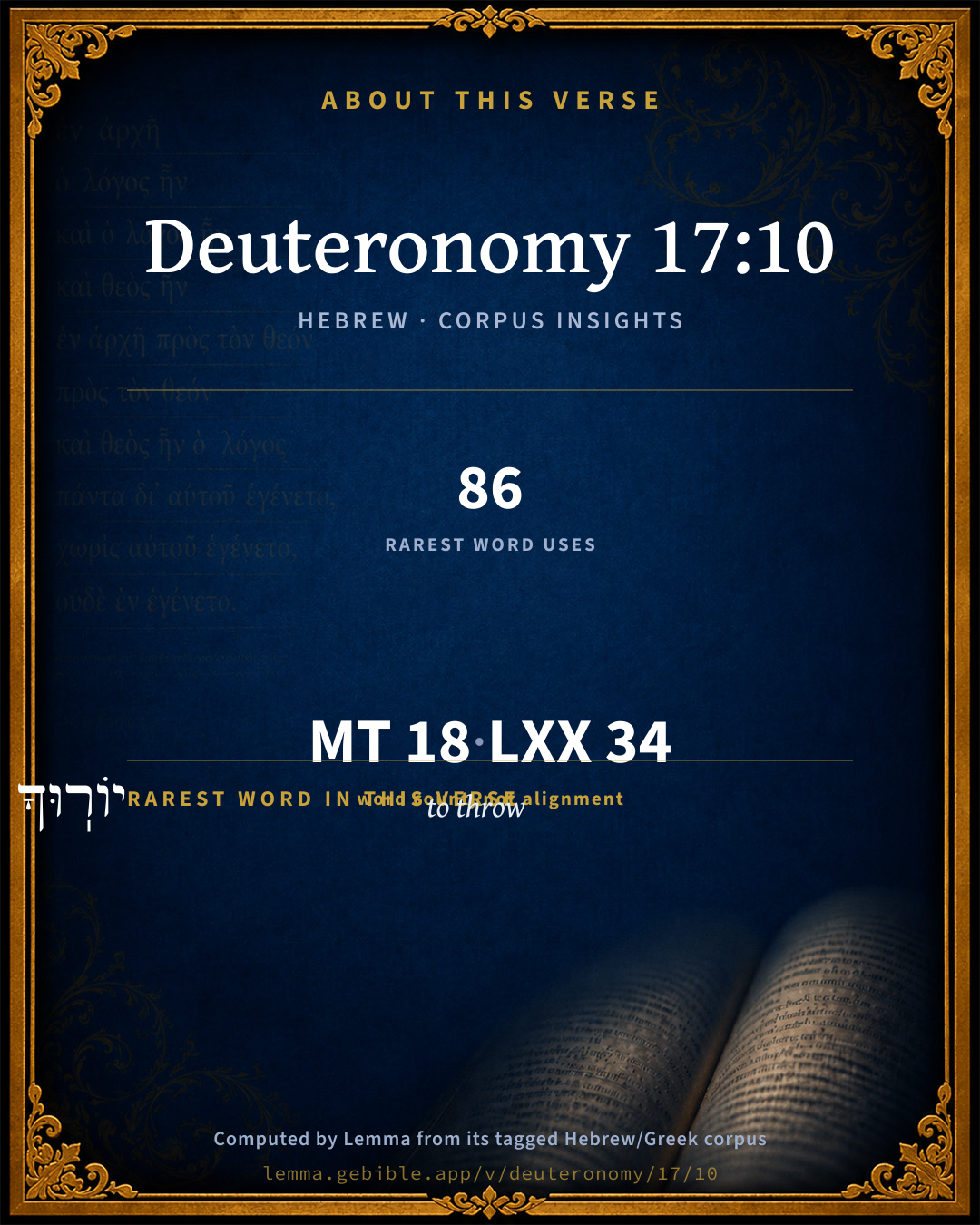
These counts appear in no published source. They are computed here, from the morphology-tagged text and Lemma’s own curated glosses. What Lemma adds →

18
words
14
distinct lemmas
Pentateuch
section

Grammatical profile

  • 6 verbs
  • 5 nouns
  • 1 pronoun
  • 3 prepositions
  • 3 particles

Verb forms

  • וְעָשִׂ֗יתָ Qal · Sequential Perfect
  • יַגִּ֣ידֽוּ Hiphil · Imperfect
  • יִבְחַ֣ר Qal · Imperfect
  • וְשָׁמַרְתָּ֣ Qal · Sequential Perfect
  • לַעֲשׂ֔וֹת Qal · Infinitive Construct
  • יוֹרֽוּךָ Hiphil · Imperfect

Repetition

Words recur within this verse — often emphatic in Hebrew:

  • וְעָשִׂ֗יתָ to do H6213 ×2
  • אֲשֶׁ֣ר which H834 ×3

Hebrew & Septuagint length

In English translation the verse runs 36 words from the Hebrew and 41 from the Septuagint (LXX English) — closely comparable.

A rough comparison of the two English renderings, which tokenize alike — not a word-level alignment.

Word counts can differ between the Hebrew and the Greek without any difference in meaning — e.g. the Hebrew direct-object marker אֵת has no separate Greek word, and Greek often adds the article ὁ.

In the original languages it is 18 Hebrew tokens and 34 Greek tokens — but the two are counted differently (Hebrew bundles its prefixes and suffixes into one token; the Greek is in lemma form), so that isn’t a like-for-like length.

Cross-references

1

Topical passages linked to Deuteronomy 17:10 in the Treasury of Scripture Knowledge — connected by theme and wording, ordered by reader-vote popularity; previews shown in the World English Bible.

  • Matthew 22:2–3 "The Kingdom of Heaven is like a certain king, who made a marriage feast for his son,

Cross-references courtesy of OpenBible.info (CC BY 4.0).

Hebrew and Greek witnesses Masoretic Hebrew ↔ Greek Septuagint

The same verse in the two great witnesses to the Old Testament, shown verse-for-verse.

These are two independent witnesses, not word-aligned to each other, and the Septuagint is shown in lemma (dictionary) form.

Hebrew Deuteronomy 17:10 Masoretic · Westminster Leningrad Codex

וְעָשִׂ֗יתָ עַל פִּ֤י הַדָּבָר֙ אֲשֶׁ֣ר יַגִּ֣ידֽוּ לְךָ֔ מִן הַמָּק֣וֹם הַה֔וּא אֲשֶׁ֖ר יִבְחַ֣ר יְהוָ֑ה וְשָׁמַרְתָּ֣ לַעֲשׂ֔וֹת כְּכֹ֖ל אֲשֶׁ֥ר יוֹרֽוּךָ

You shall do according to the tenor of the sentence which they shall show you from that place which Yahweh shall choose; and you shall observe to do according to all that they shall teach you:

World English Bible · Public Domain

Greek LXX Deuteronomy 17:10 Septuagint · lemma form

καί ποιέω κατά ὁ πρᾶγμα ὅς ἐάν ἀναἀγγέλλω σύ ἐκ ὁ τόπος ὅς ἄν ἐκλέγω κύριος ὁ θεός σύ ἐπικαλέω ὁ ὄνομα αὐτός ἐκεῖ καί φυλάσσω σφόδρα ποιέω κατά πᾶς ὅσος ἐάν νομοθετέω σύ

And you shall act according to the thing which they shall report to you out of the place which the Lord your God shall choose, and you shall observe to do all whatever shall have been by law appointed to you.

LXX2012 (modern English Septuagint) · Public Domain

Hebrew: Westminster Leningrad Codex (CC BY 4.0). Greek: Septuagint (public domain); English from LXX2012 (modern English Septuagint) (Public Domain). How the Septuagint differs from the Hebrew →

Targum (Aramaic paraphrase)

2

The Targum is the ancient Jewish Aramaic paraphrase of the Hebrew Scriptures — an interpretive translation, not the Hebrew text itself. Onkelos (literal) and Pseudo-Jonathan (expansive) render the Torah, and Jonathan the Prophets. Coverage is partial: where no permissively-licensed English translation exists for a verse, only the Aramaic is shown. This is verse-level text, not a word-by-word alignment to the Hebrew.

  1. Targum Onkelos Torah (Genesis–Deuteronomy)
    וְתַעְבֵּד עַל מֵימַר פִּתְגָמָא דִי יְחַוּוּן לָךְ מִן אַתְרָא הַהוּא דִי יִתִּרְעֵי יְיָ וְתִטַר לְמֶעְבַּד כְּכֹל דִי יַלְפֻנָךְ

    (no public-domain English translation for this verse)

    Targum Onkelos — Aramaic: “Onkelos Genesis” (public domain); “Onkelos Exodus” (public domain); “Onkelos Leviticus” (public domain); “Onkelos Numbers” (public domain); “Onkelos Deuteronomy” (public domain). English: “Sefaria Community Translation” (CC0 1.0 (public-domain dedication)); “J.W. Etheridge. The Targums of Onkelos and Jonathan Ben Uzziel on the Pentateuch. London: Longmans, Green, 1862” (public domain). Text via Sefaria.

  2. Targum Pseudo-Jonathan Torah (Genesis–Deuteronomy)
    וְתַעַבְדוּן עַל מֵימַר הִלְכַת אוֹרַיְיתָא דִיחַוּוּן לְכוֹן מִן אַתְרָא הַהוּא דְיִתְרְעֵי יְיָ וְתִטְרוּן לְמֶעֱבַד כְּכָל דְּיַלְפוּנְכוֹן

    Then shall you do according to the word of the custom of the law that they will show you at the place the Lord will choose, and observe to do whatsoever they teach you.

    Targum Pseudo-Jonathan — Aramaic: “Targum Jonathan on Genesis” (public domain); “Targum Jonathan on Exodus” (public domain); “Targum Jonathan on Leviticus” (public domain); “Targum Jonathan on Numbers” (public domain); “Targum Jonathan on Deuteronomy” (public domain). English: “The Targum of Jonathan ben Uzziel, trans. J. W. Etheridge, London, 1862” (public domain). Text via Sefaria.

Commentary

Notes on Deuteronomy 17:10 from classic Christian and Jewish commentators (each source and its license shown beneath its notes). The classic Christian expositions comment on the surrounding passage and are grouped to its opening verse, so a note may address several verses; the Jewish commentaries on the Tanakh (Rashi and others) are per-verse, so they appear only where the commentator wrote on this verse.

Lemma curates 59 commentaries, every one of them public domain or Creative Commons licensed, each selected and text-cleaned for this edition rather than reprinted as found. About our sources →

Joseph Benson's Commentary

Deu 17:10-12. Thou shalt do according to the sentence — He speaks, 1st, To the inferior magistrates, who, in the suits here referred to between man and man, were to give sentence in their lower courts, according to the decision of the great council, or of the supreme judge, and were to take care that that sentence should be carried into execution; and, 2d, To private persons, who, in such cases, are required to acquiesce in the judgment of those whom God had made the supreme interpreters of his law, and to conform themselves to the sentence passed. The man that will do presumptuously — If an inferior judge should presume to contradict the sentence of the higher court, given according to God’s law, and would not execute the orders of it; or if a private person should refuse to conform himself to their sentence, that contumacy was to be punished with death, though the matter were ever so small in which the opposition was made. For unless the parties concerned had been strongly bound to obey the definitive sentence of the judge, priest, or great council, in such matters, there would have been no end of strife. And thou shalt put away the evil —

The evil thing, that scandal, that pernicious example.

Joseph Benson's Commentary on the Old and New Testaments (1811–1818) — public domain. Text from a community e-Sword module.

The Cambridge Bible for Schools and Colleges

gen. ed. J. J. S. Perowne

10. tenor] Heb. mouth; see on Deu_1:26; Deu_1:43, Deu_9:23.

observe to do] See on Deu_5:1.

The Cambridge Bible for Schools and Colleges (gen. ed. J. J. S. Perowne; Cambridge University Press, 1878–1918) — public domain. Text from a community e-Sword module.

John Gill's Exposition

And thou shalt do according to the sentence which they of that place which the Lord shall choose shall show thee,.... The judges of the inferior courts were to return and proceed on the difficult case according to the judgment of the great court at Jerusalem, and follow the directions and instructions they should give them:

and thou shalt observe to do according to all that they inform thee; not only observe and take notice of what they say, but put it in practice, and not in some things and some circumstances only, but in all and everything they should give them information about relating to the case in question.

John Gill's Exposition of the Whole Bible (1746–1763) — public domain (CC PDM 1.0). Text via the HelloAO Bible API.

Haydock's Catholic Bible Commentary

Preside. The high priests who are to succeed each other. (Worthington)

George Leo Haydock (1774–1849), Haydock's Catholic Family Bible and Commentary, 1859 edition — public domain. Excludes Psalms (Douay-Rheims chapter numbering differs from Protestant) and Deuterocanonical books (Catholic canon only).

Matthew Poole's English Annotations

Thou shalt, i.e. thou shalt pass sentence; for he speaks to the inferior magistrates, as was before noted, who were to give sentence, and came hither to be advised about it.

Thou shalt observe to do. It is very observable that this place doth not speak of all controversies of faith, as if they were to believe every thing which they should teach; but only of some particular matters of practice and strife between man and man, to which it is plainly limited, Deu 17:8. And they are not here commanded to believe, but only to

do, which is thrice repeated.

Matthew Poole's English Annotations on the Holy Bible (1683–1685) — public domain. Text from a community e-Sword/MySword module.

The Pulpit Commentary

Vers. 10-12. This sentence, being founded on the Law, the suitors were to accept and implicitly obey. If any through pride or arrogance should refuse to accept the interpretation of the Law given by the priests, or to submit to the sentence pronounced by the judge, he was to be regarded as a rebel against God, and to be put to death, that others might be deterred from the like presumption. (Deu_13:11) The sentence, which they of that place which the Lord shall choose shall show thee; rather, which they shall declare to thee from that place which the Lord shall choose. According to the sentence of the law; literally, according to the mouth of the Law; i.e. according as the Law prescribes, according to the purport of the statute.

The Pulpit Commentary (1880–1919), ed. H.D.M. Spence-Jones & Joseph S. Exell — public domain. Text from a community e-Sword module.

John Wesley's Explanatory Notes

Thou - Thou shalt pass sentence: he speaks to the inferior magistrates; who were to give sentence, and came hither to be advised about it.

John Wesley, Explanatory Notes Upon the Whole Bible (1754–1765) — public domain. Text via the GEBible commentary corpus.

unfoldingWord translationNotes

Door43 World Missions Community

You must follow the law given to you

A person obeying what the priests and judge decide is spoken of as if the person were physically following behind the law. This can be stated in active form. AT: "You must obey what the judge and priests decide about the matter" (See: Metaphor and Active or Passive)

Do not turn aside from what they tell you, to the right hand or to the left

A person not doing exactly what the judge and priests say is spoken of as if he were turning off the correct path. This can be stated in positive form. AT: "Do not disobey anything they tell you" or "Do everything they say" (See: Metaphor)

translationWords

law, laws

sanctuary

turn

unfoldingWord translationNotes — © Distant Shores Media and the Door43 World Missions Community, licensed CC BY-SA 4.0. Source: git.door43.org/Door43/en_tn.

Lesson kit

Teaching starters — assembled from the data on this page, not authored interpretation. Every prompt links to the verse data it draws on. Edit before teaching.

Deuteronomy, in the Pentateuch, opens this verse with 18 words (14 distinct Hebrew lemmas). Its most distinctive word is yârâh (“to throw”). A historical commentator’s framing appears above. Read the whole chapter for the surrounding context.

Discussion questions

  1. What does “to throw” (yârâh) contribute to the verse as a whole?
  2. Matthew 22:2–3 shares this passage’s theme. How do the two illuminate each other?
  3. “to do” occurs 2× in this one verse. What is the effect of the repetition?
  4. These translations render this verse differently. What is at stake in choosing one wording over another?
  5. The verb «וְעָשִׂ֗יתָ» is Qal Sequential Perfect. How does its form color the action?
  6. Reading how Joseph Benson's Commentary and The Cambridge Bible for Schools and Colleges read this verse, where do the two commentators agree and where do they part?

Things to notice

Reading settings

Reading text

Shown beneath each verse's original-language words.

Old Testament
Old Testament edition

Read the OT as the Masoretic Hebrew (MT) or the Greek Septuagint (LXX).

English shown for the Greek Septuagint (in the Hebrew ↔ Greek comparison).

Comparing translations? Open the Compare panel on any verse page to stack up to four side by side.