
Deuteronomy 21:4

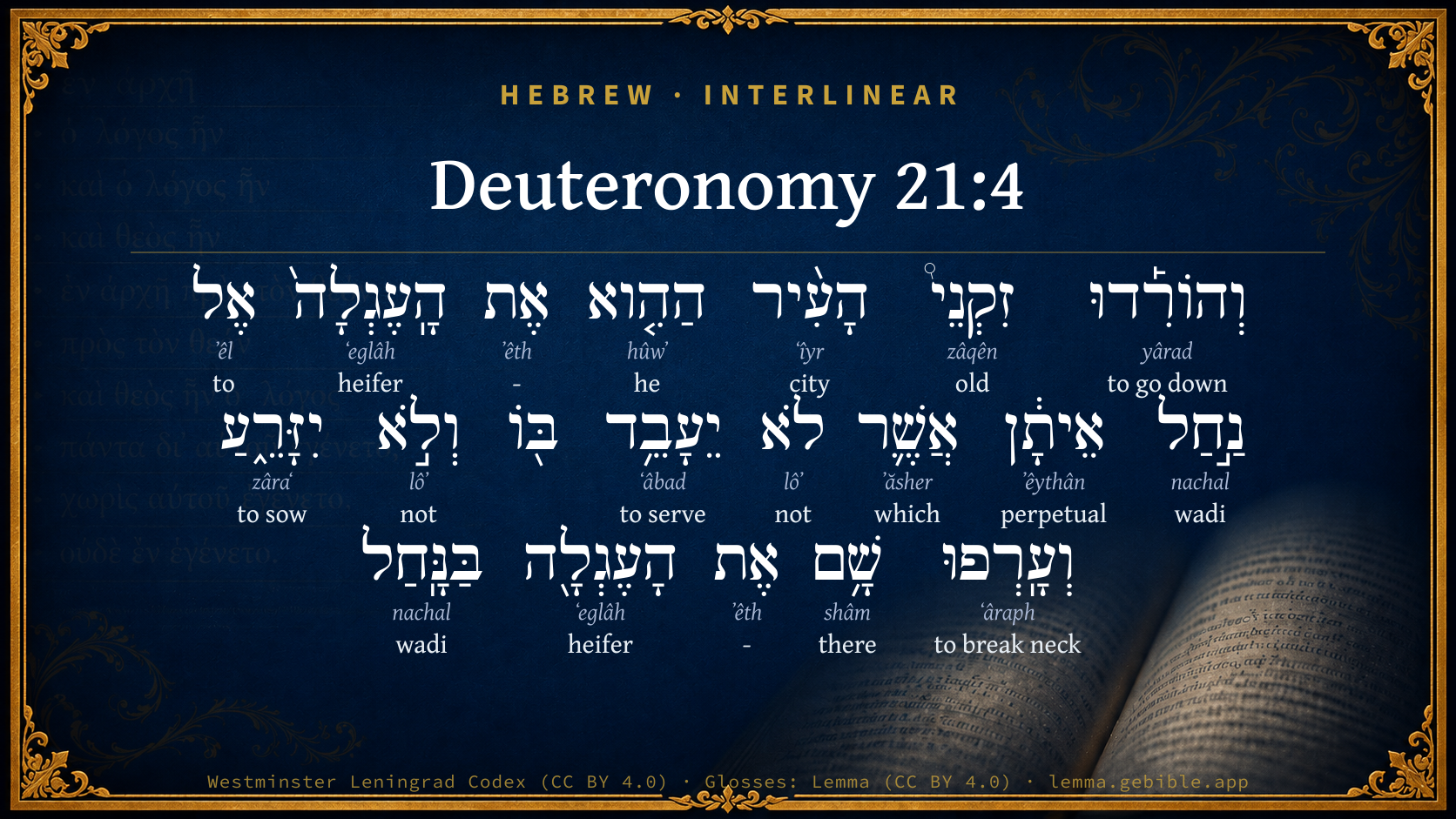
Hebrew (Westminster Leningrad Codex) Deuteronomy 21:4 appears in the Hebrew Old Testament. The text above is from the Westminster Leningrad Codex. Each word links to its Strong’s number, a concise gloss, and parsing drawn from the Open Scriptures Hebrew Bible morphology. Click any word for its full Brown-Driver-Briggs (BDB) entry.
Download image
Cite this verse

Deuteronomy 21:4 (World English Bible). Public Domain. Lemma interlinear Bible study tool, https://lemma.gebible.app/v/deuteronomy/21/4.

Show BibTeX & RIS
BibTeX
RIS
English Translation
and the elders of that city shall bring down the heifer to a valley with running water, which is neither plowed nor sown, and shall break the heifer's neck there in the valley.
World English Bible · Public Domain
Download a study sheet

One document with this verse’s original text, its word-by-word gloss line, the meaning frame, cross-references with their text, attributed commentary, and full source and license credits — printable, and it pastes into notes with its structure intact.

This verse Autodidact and up

Study sheet (.html) Plain text (.txt)

A passage Seminary Student

Up to 50 verses in one chapter. A passage sheet keeps up to 6 commentary sources and 12 cross-references per verse, in the order this page ranks them, and says so on the sheet whenever that leaves anything out. Ask for a single verse and you get the Autodidact verse sheet above.

Everything on this page stays free to read, with no account — the sheet is a download of what is already on screen, not access to it.

Want to remove ads? Support Godless Engineer
Compare translations 3

The same verse in 3 English versions, stacked beneath the original-language interlinear above. Click any original word for its lexicon entry.

Each is an independent rendering of the whole verse — the interlinear is not word-aligned to these translations.

Highlighted words mark where these versions differ — a whole-verse word diff, not a word-by-word alignment.

  • World English Bible Public Domain
    and the elders of that city shall bring down the heifer to a valley with running water, which is neither plowed nor sown, and shall break the heifer's neck there in the valley.
  • King James Version Public Domain
    And the elders of that city shall bring down the heifer unto a rough valley, which is neither eared nor sown, and shall strike off the heifer's neck there in the valley:
  • unfoldingWord Literal Text CC BY-SA 4.0
    And the elders of that city shall cause the heifer to descend to a valley with running water, that has not been worked in, nor sown, and there they shall break the neck of the heifer in the valley.

unfoldingWord Literal Text — © unfoldingWord, licensed CC BY-SA 4.0. Word-aligned USFM3 via Door43 (git.door43.org/unfoldingWord/en_ult).

Versions to compare (up to 4)

3 of 4 selected

Show all 18 translations

Every available English version of this verse, each an independent rendering of the whole verse.

  • World English Bible Public Domain
    and the elders of that city shall bring down the heifer to a valley with running water, which is neither plowed nor sown, and shall break the heifer's neck there in the valley.
  • Berean Standard Bible Public Domain
    bring the heifer to a valley with running water that has not been plowed or sown, and break its neck there by the stream.
  • Majority Standard Bible Public Domain
    bring the heifer to a valley with running water that has not been plowed or sown, and break its neck there by the stream.
  • King James Version Public Domain
    And the elders of that city shall bring down the heifer unto a rough valley, which is neither eared nor sown, and shall strike off the heifer's neck there in the valley:
  • American Standard Version (1901) Public Domain
    and the elders of that city shall bring down the heifer unto a valley with running water, which is neither plowed nor sown, and shall break the heifer's neck there in the valley.
  • Revised Version (1885) Public Domain
    and the elders of that city shall bring down the heifer unto a valley with running water, which is neither plowed nor sown, and shall break the heifer’s neck there in the valley:
  • Geneva Bible (1599) Public Domain
    And let the Elders of that citie bring the heifer vnto a stonie valley, which is neyther eared nor sowen, and strike off the heifers necke there in the valley.
  • Douay-Rheims (1899) Public Domain
    And they shall bring her into a rough and stony valley, that never was ploughed, nor sown: and there they shall strike off the head of the heifer:
  • Young's Literal Translation Public Domain
    and the elders of that city have brought down the heifer unto a hard valley, which is not tilled nor sown, and have beheaded there the heifer in the valley.
  • Literal Standard Version CC BY-SA 4.0
    and [the] elderly of that city have brought down the heifer to a hard valley, which is not tilled nor sown, and have beheaded the heifer there in the valley.
  • Unlocked Literal Bible CC BY-SA 4.0
    Then they must lead the heifer down to a valley with running water, a valley that has been neither plowed nor sown, and there in the valley they must break the heifer's neck.
  • unfoldingWord Literal Text CC BY-SA 4.0
    And the elders of that city shall cause the heifer to descend to a valley with running water, that has not been worked in, nor sown, and there they shall break the neck of the heifer in the valley.
  • Darby Bible Public Domain
    and the elders of that city shall bring down the heifer unto an ever-flowing watercourse, which is not tilled, nor is it sown, and shall break the heifer's neck there in the watercourse;
  • World Messianic Bible Public Domain
    The elders of that city shall bring the heifer down to a valley with running water, which is neither plowed nor sown, and shall break the heifer’s neck there in the valley.
  • Webster's Bible Public Domain
    And the elders of that city shall bring down the heifer to a rough valley, which is neither tilled nor sown, and shall strike off the heifer's neck there in the valley;
  • Free Bible Version CC BY-SA 4.0
    Take the cow to a valley that has a stream running through it and whose ground has never been plowed or sown. Break the cow's neck there beside the stream.
  • Bible in Basic English Public Domain
    And they are to take the cow into a valley where there is flowing water, and which is not ploughed or planted, and there the neck of the cow is to be broken:
  • JPS Tanakh (1917) Public Domain
    And the elders of that city shall bring down the heifer unto a rough valley, which may neither be plowed nor sown, and shall break the heifer's neck there in the valley.

Literal Standard Version (2020), Covenant Press — licensed CC BY-SA 4.0. Text via the HelloAO Bible API (eBible.org). Unlocked Literal Bible (unfoldingWord) — licensed CC BY-SA 4.0. Text via the HelloAO Bible API (eBible.org). unfoldingWord Literal Text — © unfoldingWord, licensed CC BY-SA 4.0. Word-aligned USFM3 via Door43 (git.door43.org/unfoldingWord/en_ult). Free Bible Version, Dr. Jonathan Gallagher — licensed CC BY-SA 4.0. Text via the HelloAO Bible API (eBible.org).

Word by word

More ways to search: Search by grammar → Find every occurrence → Compare this word →

Practice this passage: Drill this verse → Learn its vocabulary →

וְעָֽרְפוּ
ʻâraph
H6202
“and · to break neck”
Conjunction + Verb, Qal, Sequential Perfect, 3rd Person, Common, Plural
Part of Speech
Conjunction + Verb
Stem
Qal
Form
Sequential Perfect
Person
3rd Person
Gender
Common
Number
Plural
Full BDB Definition

Origin: a primitive root [identical with H6201 through the idea of sloping]

TWOT: 1700

(Qal) to break the neck (of an animal)
  1. וְהוֹרִ֡דוּ yârad H3381 “and · to go down” Conjunction + Verb, Hiphil, Sequential Perfect, 3rd Person, Common, Plural
  2. זִקְנֵי֩ zâqên H2205 “old of” Adjective, Adjective, Masculine, Plural, Construct
  3. הָעִ֨יר ʻîyr H5892 “the · city” Particle, Definite Article + Noun, Common, Feminine, Singular, Absolute
  4. הַהִ֤וא hûwʼ H1931 “the · he” Particle, Definite Article + Pronoun, Personal, 3rd Person, Feminine, Singular
  5. אֶת ʼêth H853 “-” Particle, Direct Object
  6. הָֽעֶגְלָה֙ ʻeglâh H5697 “the · heifer” Particle, Definite Article + Noun, Common, Feminine, Singular, Absolute
  7. אֶל ʼêl H413 “to” Preposition
  8. נַ֣חַל nachal H5158 “wadi” Noun, Common, Masculine, Singular, Absolute
  9. אֵיתָ֔ן ʼêythân H386 “perpetual” Adjective, Adjective, Masculine, Singular, Absolute
  10. אֲשֶׁ֛ר ʼăsher H834 “which” Particle, Relative
  11. לֹא lôʼ H3808 “not” Particle, Negative
  12. יֵעָבֵ֥ד ʻâbad H5647 “to serve” Verb, Niphal, Imperfect, 3rd Person, Masculine, Singular
  13. וְלֹ֣א lôʼ H3808 “and · not” Conjunction + Particle, Negative
  14. יִזָּרֵ֑עַ zâraʻ H2232 “to sow” Verb, Niphal, Imperfect, 3rd Person, Masculine, Singular
  15. שָׁ֥ם shâm H8033 “there” Adverb
  16. אֶת ʼêth H853 “-” Particle, Direct Object
  17. הָעֶגְלָ֖ה ʻeglâh H5697 “the · heifer” Particle, Definite Article + Noun, Common, Feminine, Singular, Absolute
  18. בַּנָּֽחַל nachal H5158 “in/at the · wadi” Preposition, Determined + Noun, Common, Masculine, Singular, Absolute

About this verse

These counts appear in no published source. They are computed here, from the morphology-tagged text and Lemma’s own curated glosses. What Lemma adds →

20
words
15
distinct lemmas
Pentateuch
section

Notable vocabulary

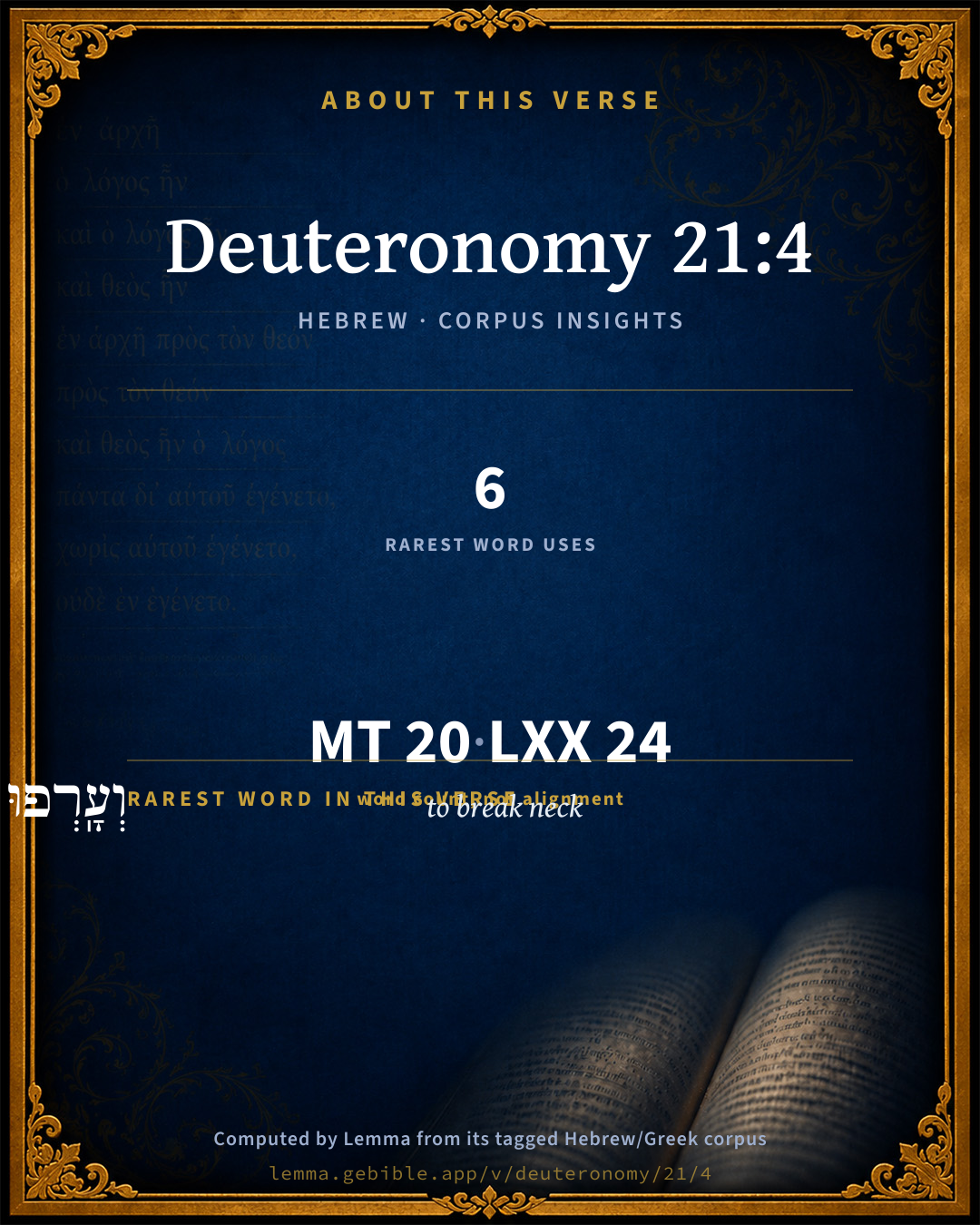
The rarest word here is וְעָֽרְפוּ to break neck H6202 — appearing just 6 times in the whole Hebrew Bible.

Shared distinctive vocabulary

וְעָֽרְפוּ to break neck H6202 occurs in 6 verses of the Hebrew Bible. Also found in:

Grammatical profile

  • 4 verbs
  • 5 nouns
  • 2 adjectives
  • 1 pronoun
  • 2 prepositions
  • 1 adverb
  • 5 particles

Verb forms

  • וְהוֹרִ֡דוּ Hiphil · Sequential Perfect
  • יֵעָבֵ֥ד Niphal · Imperfect
  • יִזָּרֵ֑עַ Niphal · Imperfect
  • וְעָֽרְפוּ Qal · Sequential Perfect

Repetition

Words recur within this verse — often emphatic in Hebrew:

  • הָֽעֶגְלָה֙ heifer H5697 ×2
  • נַ֣חַל wadi H5158 ×2
  • לֹא not H3808 ×2

Hebrew & Septuagint length

In English translation the verse runs 33 words from the Hebrew and 33 from the Septuagint (LXX English) — the same length.

A rough comparison of the two English renderings, which tokenize alike — not a word-level alignment.

Word counts can differ between the Hebrew and the Greek without any difference in meaning — e.g. the Hebrew direct-object marker אֵת has no separate Greek word, and Greek often adds the article ὁ.

In the original languages it is 20 Hebrew tokens and 24 Greek tokens — but the two are counted differently (Hebrew bundles its prefixes and suffixes into one token; the Greek is in lemma form), so that isn’t a like-for-like length.

Cross-references

2

Topical passages linked to Deuteronomy 21:4 in the Treasury of Scripture Knowledge — connected by theme and wording, ordered by reader-vote popularity; previews shown in the World English Bible.

  • 1 Peter 2:21–24 For to this you were called, because Christ also suffered for us, leaving you an example, that you should follow his steps,
  • 1 Peter 3:18 Because Christ also suffered for sins once, the righteous for the unrighteous, that he might bring you to God; being put to death in the flesh, but made alive in the spirit;

Cross-references courtesy of OpenBible.info (CC BY 4.0).

Hebrew and Greek witnesses Masoretic Hebrew ↔ Greek Septuagint

The same verse in the two great witnesses to the Old Testament, shown verse-for-verse.

These are two independent witnesses, not word-aligned to each other, and the Septuagint is shown in lemma (dictionary) form.

Hebrew Deuteronomy 21:4 Masoretic · Westminster Leningrad Codex

וְהוֹרִ֡דוּ זִקְנֵי֩ הָעִ֨יר הַהִ֤וא אֶת הָֽעֶגְלָה֙ אֶל נַ֣חַל אֵיתָ֔ן אֲשֶׁ֛ר לֹא יֵעָבֵ֥ד בּ֖וֹ וְלֹ֣א יִזָּרֵ֑עַ וְעָֽרְפוּ שָׁ֥ם אֶת הָעֶגְלָ֖ה בַּנָּֽחַל

and the elders of that city shall bring down the heifer to a valley with running water, which is neither plowed nor sown, and shall break the heifer's neck there in the valley.

World English Bible · Public Domain

Greek LXX Deuteronomy 21:4 Septuagint · lemma form

καί καταβιβάζω ὁ γερουσία ὁ πόλις ἐκεῖνος ὁ δάμαλις εἰς φάραγξ τραχύς ὅστις οὐ ἐργάζομαι οὐδέ σπείρω καί νευροκοπέω ὁ δάμαλις ἐν ὁ φάραγξ

And the elders of that city shall bring down the heifer into a rough valley, which has not been tilled and is not sown, and they shall kill the heifer in the valley.

LXX2012 (modern English Septuagint) · Public Domain

Hebrew: Westminster Leningrad Codex (CC BY 4.0). Greek: Septuagint (public domain); English from LXX2012 (modern English Septuagint) (Public Domain). How the Septuagint differs from the Hebrew →

Targum (Aramaic paraphrase)

2

The Targum is the ancient Jewish Aramaic paraphrase of the Hebrew Scriptures — an interpretive translation, not the Hebrew text itself. Onkelos (literal) and Pseudo-Jonathan (expansive) render the Torah, and Jonathan the Prophets. Coverage is partial: where no permissively-licensed English translation exists for a verse, only the Aramaic is shown. This is verse-level text, not a word-by-word alignment to the Hebrew.

  1. Targum Onkelos Torah (Genesis–Deuteronomy)
    וְיֶחֱתוּן סָבֵי קַרְתָּא הַהִיא יָת עֲגַלְתָּא לְנַחֲלָא בַיָר דִי לָא יִתְפְּלַח בֵּהּ וְלָא יִזְדְרַע וְיִנְקְפוּן תַּמָן יָת עֲגַלְתָּא בְּנַחֲלָא

    (no public-domain English translation for this verse)

    Targum Onkelos — Aramaic: “Onkelos Genesis” (public domain); “Onkelos Exodus” (public domain); “Onkelos Leviticus” (public domain); “Onkelos Numbers” (public domain); “Onkelos Deuteronomy” (public domain). English: “Sefaria Community Translation” (CC0 1.0 (public-domain dedication)); “J.W. Etheridge. The Targums of Onkelos and Jonathan Ben Uzziel on the Pentateuch. London: Longmans, Green, 1862” (public domain). Text via Sefaria.

  2. Targum Pseudo-Jonathan Torah (Genesis–Deuteronomy)
    וְיִחְתוּן חַכִּימֵי קַרְתָּא הַהוּא יַת עִיגְלְתָא לַחֲקַל בַּיַיר דְּלָא יִתְעֲבֵיד בֵּיהּ פּוּלְחַן אֲרַע וְלָא יִזְדְּרַע וְיִנְקְפוּן תַּמָּן יַת עֶגְלָתָא בְּקוֹפִיץ מִבַּתְרָהָא בִּמְצַע חַקְלָא

    and the sages of that city shall bring the heifer down into an uncultivated field, where the ground hath not been tilled by work, nor sowed; and let them there behead the heifer from behind her with an axe (or knife, dolch) in the midst of the field.

    Targum Pseudo-Jonathan — Aramaic: “Targum Jonathan on Genesis” (public domain); “Targum Jonathan on Exodus” (public domain); “Targum Jonathan on Leviticus” (public domain); “Targum Jonathan on Numbers” (public domain); “Targum Jonathan on Deuteronomy” (public domain). English: “The Targum of Jonathan ben Uzziel, trans. J. W. Etheridge, London, 1862” (public domain). Text via Sefaria.

Commentary

Notes on Deuteronomy 21:4 from classic Christian and Jewish commentators (each source and its license shown beneath its notes). The classic Christian expositions comment on the surrounding passage and are grouped to its opening verse, so a note may address several verses; the Jewish commentaries on the Tanakh (Rashi and others) are per-verse, so they appear only where the commentator wrote on this verse.

Lemma curates 59 commentaries, every one of them public domain or Creative Commons licensed, each selected and text-cleaned for this edition rather than reprinted as found. About our sources →

Trapp's Complete Commentary

John Trapp

Deu 21:4 And the elders of that city shall bring down the heifer unto a rough valley, which is neither eared nor sown, and shall strike off the heifer’s neck there in the valley:

Ver. 4. Which is neither eared nor sown.] That is, that afterwards should neither be tilled nor sown, for horror and hatred of the innocent blood there spilled. So the mountains of Gilboah. {2Sa 1:6}

John Trapp, A Commentary or Exposition upon All the Books of the Old and New Testament (1647–1656) — public domain. Text from a community e-Sword module.

Joseph Benson's Commentary

Deu 21:4. Unto a rough valley — The Hebrew word נחל, nachal, here used, signifies either a valley or a torrent; and most probably is here meant of a valley with a brook running through it. For (Deu 21:6) the elders are required to wash their hands over the heifer, which seems to intimate that there was running water in the place. Which is neither eared nor sown — Rough, uncultivated ground, fitly representing the horribleness of the murder. The Jews say, that unless, after this, the murderer was found, this valley was never to be tilled nor sown, which made the owners of the ground employ their utmost diligence to find out the murderer, that their land might not be waste for ever. But it is more natural to suppose, that such a rough and waste place was chosen partly that the horridness of it might beget a horror of the murder, and of the murderer, and partly because the blood of the victim would have polluted cultivated ground. For, though not slain at the altar, this was a kind of expiatory sacrifice, whereby the land was to be purged from the legal pollution contracted by the murder; and such sacrifices rendered every person or thing unclean that touched them. Shall strike off the heifer’s neck — To show what they should and would have done to the murderer, if they had found him.

Joseph Benson's Commentary on the Old and New Testaments (1811–1818) — public domain. Text from a community e-Sword module.

Tyndale Open Study Notes

Tyndale Open Resources

21:4 The stream would be an ever-flowing (perennial) brook located in an isolated area, free of contaminants.

Tyndale Open Study Notes — © Tyndale Open Resources, licensed CC BY-SA 4.0. Text via the HelloAO Bible API.

Geneva Bible (1599)

Geneva Bible translators

That the blood shed of the innocent beasts in a solitary place, might make them abhor the fact.

Or, rough.

Geneva Bible (1599) marginal notes — public domain. Text via Bolls.life.

Adam Clarke's Commentary

Verse 4. Shall bring down the heifer unto a rough valley] נחל איתן nachal eythan might be translated a rapid stream, probably passing through a piece of uncultivated ground where the elders of the city were to strike off the head of the heifer, and to wash their hands over her in token of their innocence. The spot of ground on which this sacrifice was made must be uncultivated, because it was considered to be a sacrifice to make atonement for the murder, and consequently would pollute the land. This regulation was calculated to keep murder in abhorrence, and to make the magistrates alert in their office, that delinquents might be discovered and punished, and thus public expense saved.

Adam Clarke's Commentary on the Bible (1810–1826) — public domain. Text from a community e-Sword/MySword module.

The Cambridge Bible for Schools and Colleges

gen. ed. J. J. S. Perowne

4. the elders of that city] Luc. omits.

a valley with running water] i.e. with a perennial brook, cp. Amo_5:24 (and see Driver’s note here). The running water is usually explained as meant to carry off the blood, but no blood is mentioned; unless it was so in the original law (see introd. note). The primitive idea was rather the checking of a demon or of the spirit of the slain man. Cp. the belief in the preference of spirits for dry places (Luk_11:24) and their aversion to running water (in modern times that ghosts cannot cross bridges, e.g. Tam o’ Shanter).

neither plowed nor sown] therefore unprofaned by common use, and so meet for a solemn rite. Dillm. (after Ewald): ‘that the soaked-in blood of the beast, vicariously killed, may not hereafter be uncovered by the cultivation of the ground but rather washed away by the brook.’ See however, the previous note. Some object the impossibility of finding an uncultivated valley with a running stream, but there are many such.

shall break the heifer’s neck] The same procedure as J, Exo_13:13; Exo_34:20, enjoins for the firstling of an ass not redeemed; cp. Isa_66:3, of a dog. In these cases there does not appear to have been shedding of the blood such as took place in all sacrifices proper. This is singular if the killing of the heifer was a piaculum. In the original ceremony was it only conceived as a piece of sympathetic magic, symbolic of the execution of the murderer, and did D transform this into an expiation? Or, conversely, was the original ceremony a sacrifice, and did D, on his principle that sacrifice was valid only at the One Altar, reduce it to the level of the treatment of the firstling of an ass? In Lev_4:13-21 (P), the piaculum for an inadvertent sin of the whole congregation, it is also the elders who slay the victim.

The Cambridge Bible for Schools and Colleges (gen. ed. J. J. S. Perowne; Cambridge University Press, 1878–1918) — public domain. Text from a community e-Sword module.

John Gill's Exposition

The elders of that city shall bring down the heifer unto a rough valley,.... Cities being generally built on hills, and so had adjacent valleys, to which there was a descent; but here a rough valley, or the rougher part of it, was selected for this purpose. As a valley is low, and this a rough one, it may be an emblem of Christ's being brought into this lower world, from heaven to earth, to do the will of his Father, which was to work out the salvation of his people; and of his coming into the lower parts of the earth, the womb of the virgin, at his incarnation, and to the grave at his death, Psa 139:15, and of the low estate he came into by the assumption of human nature; through appearing in the form of a servant, being in indigent circumstances, and ministered to by others, and needing the assistance of angels in the wilderness and garden, by which it appeared he was made lower than they; by his being despised of men, and forsaken by his Father; all which are proofs of the low estate he was brought into, fitly signified by a valley, and which was a rough valley to him; in which he was roughly treated, his life being sought after in his infancy by Herod, which obliged the flight of his parents with him into Egypt; and being not received, but rejected by his own, as the King Messiah, whom they would not have to reign over them, and loaded with opprobrious names by them; and who often sought and attempted by various ways to take away his life; and when apprehended and examined before the high priest, and in Pilate's hall, was used in the rudest manner, being spit upon, buffeted, and scourged; and when led out to be crucified, was treated in the most barbarous and scornful manner, and was put to death in the most painful and shameful way; and, above all, was severely handled by the justice of God, being numbered among the transgressors, when the sword of justice was awaked against him, and he was not in the least spared, but wrath came upon him to the uttermost for the sins of his people; so that this world he was brought into proved a rough valley indeed to him. This some take to be an emblem of the hard heart of the murderer who had committed such a barbarous and cruel action as to kill a man; or of the hard heart of a sinner, into which Christ is brought through the ministry of the word; or of the infamous place, Calvary, where Christ was brought to suffer death; but the former is best. Some interpret it, a "strong stream" (q), or "rapid torrent"; so Maimonides (r) and others; and indeed in valleys there are generally streams or brooks of water, but this seems not so well to agree with what follows:

which is neither cared nor sown; that is, neither ploughed nor sown, but quite an uncultivated place; and this the Jews understand not of what it had been, or then was, but what it should be hereafter; that from henceforward it should never be manured, but lie barren and useless; so it is said in the Misnah (s), the place is forbid sowing or tilling, but is free to dress flax in, or to dig stones out of it: so R. Joseph Kimchi (t) interprets this of a fat and fruitful valley, which was not to be tilled nor sown from thenceforward for time to come; the reason of which he thinks was, that they might be the more careful of their countries and borders, and how they encouraged bloody minded men to dwell among them; that no slain person might be found there, and so they lose a choice part of their possessions; and to the same purpose Maimonities (u): and this became true of the fruitful land of Judea and Jerusalem, after the sufferings and death of Christ there, Luk 21:24.

and shall strike off the heifer's neck there in the valley; with an axe, on the back part of it, in the midst of the valley, as the Targum of Jonathan, and the same is said in the Misnah (w): in this it was a type of Christ, who was put to death at the instigation of the elders of the Jewish nation, Mat 27:1 and without the gates of Jerusalem at Golgotha; see Heb 13:11.

(q) "ad torrentem fortem", Montanus. (r) Hilchot Rotzeach, c. 9. sect. 2, so Abarbinel in Muis. & Ben Melech. (s) Ut supra. (Sotah, c. 9. sect. 5.) (t) Apud D. Kimchi, Sepher Shorash, rad. (u) Moreh Nevochim, par. 3. c. 40. (w) Ut supra. (Sotah, c. 9. sect. 5.)

John Gill's Exposition of the Whole Bible (1746–1763) — public domain (CC PDM 1.0). Text via the HelloAO Bible API.

Albert Barnes' Notes on the Bible

Eared - i. e., plowed; compare Gen 45:6 note and references. The word is derived from the Latin, and is in frequent use by English writers of the fifteenth and two following centuries.

Strike off the heifer’s neck - Rather, “break its neck” (compare Exo 13:13). The mode of killing the victim distinguishes this lustration from the sin-offering, in which there would be of course shedding and sprinkling of the blood.

Albert Barnes' Notes on the Bible (1834–1885) — public domain. Text from a community e-Sword/MySword module.

Haydock's Catholic Bible Commentary

Valley. In such places murders are most frequently perpetrated. Hebrew may signify, "a desert," deep or inaccessible torrent, (Haydock) on the side of which the heifer was to be slain, and its body was then, it seems, thrown into the water. The ancients first washed their hands over her. Thus the victim of malediction against those who break a covenant, is buried in a ditch, or cast into the sea. (Homer, Iliad i.) --- Was. Some translate the Hebrew "shall be," as if the place was to be hereafter considered as unclean and accursed. (Calmet) --- The roughness and depth of the valley, denote the hardness of the murderer’s heart, and the depth of his malice. (Menochius) --- Strike off, or cœdent, "cut the neck," (Haydock) at the top, without perhaps separating it entirely from the body. Blood was given for blood, and this was the chief design of the bloody sacrifices. For this reason, the Egyptians impressed a seal upon the horns of the victim, representing a man kneeling, with his hands tied behind his back, as if ready to receive the stroke of death. (Plut.[Plutarch,?] Isis.)

George Leo Haydock (1774–1849), Haydock's Catholic Family Bible and Commentary, 1859 edition — public domain. Excludes Psalms (Douay-Rheims chapter numbering differs from Protestant) and Deuterocanonical books (Catholic canon only).

Matthew Poole's English Annotations

Neither eared nor sown; partly to represent the hard and unprofitable and untutored heart of the murderer; and partly that such a desert and horrid place might beget a horror of murder and of the murderer.

Strike off the heifer’s neck, to show what they would and should have done to the murderer if they had found him.

Matthew Poole's English Annotations on the Holy Bible (1683–1685) — public domain. Text from a community e-Sword/MySword module.

Whedon's Commentary on the Bible

Daniel D. Whedon

4. A rough valley — The Hebrew term which is here rendered valley also means a stream, and many critics have rendered the expression a perennial stream.

Neither eared nor sown — Eared is the old term for ploughed. The heifer was to be brought to a valley through which flowed a perennial stream, a valley that had never been cultivated, and here be slain. This putting to death of the heifer was not, properly speaking, expiatory. It was symbolical, and calculated to impress upon the people the sacredness of human life.

Daniel D. Whedon (gen. ed.), Commentary on the Old and New Testaments (1874–1909) — public domain. Text from a community e-Sword module.

The Pulpit Commentary

A rough valley; literally, a stream of perpetuity, a perennial stream (cf. Psa_74:15, Authorized Version, "mighty rivers;"; Amo_5:24) but here rather the valley or wady through which a stream flowed, as is evident from its being described as neither eared that is, ploughed (literally, wrought, tilled)nor sown; a place which had not been profaned by the hand of man, but was in a state of nature. "This regulation as to the locality in which the act of expiation was to be performed was probably founded on the idea that the water of the brookvalley would suck in the blood and clean it away, and that the blood sucked in by the earth would not be brought to light again by the ploughing and working of the soil" (Keil). Strike off the heifer"s neck there in the valley; rather, break the heifers neck. As this was not an act of sacrifice, for which the shedding of blood would have been required, but simply a symbolical representation of the infliction of death on the undiscovered murderer, the animal was to be killed by breaking its neck. (cf. Exo_13:13)

The Pulpit Commentary (1880–1919), ed. H.D.M. Spence-Jones & Joseph S. Exell — public domain. Text from a community e-Sword module.

John Wesley's Explanatory Notes

A rough valley - That such a desert and horrid place might beget an horror of murder and of the murderer. Strike off the neck - To shew what they would and should have done to the murderer if they had found him.

John Wesley, Explanatory Notes Upon the Whole Bible (1754–1765) — public domain. Text via the GEBible commentary corpus.

Rashi

Rabbi Shlomo Yitzchaki (Rashi)

אל נחל איתן UNTO A VALLEY WHICH IS איתן — which is hard; i.e. one that has never been tilled (Sifrei Devarim 207:2; Sotah 45b).

וערפו AND THEY SHALL STRIKE OFF [THE HEIFER’S] NECK — i.e. one breaks its neck with a hatchet. The Holy One, blessed be He, says, as it were, Let a heifer which is only one year old and which therefore has brought forth no fruits (no offspring) have its neck broken at a spot (the untilled valley) which has not brought forth fruits, to expiate for the murder of him whom they did not permit further to beget children (Sotah 46a).

Rashi on the Tanakh — English translations: “The Judaica Press complete Tanach with Rashi, translated by A. J. Rosenberg” (CC BY 4.0); “Pentateuch with Rashi's commentary by M. Rosenbaum and A.M. Silbermann, 1929-1934” (public domain); “The Metsudah Tanach series, Lakewood, N.J” (CC BY 4.0); and “The Book of Joshua, Metsudah Publications, 1997” (CC BY 4.0). Text via Sefaria.

Ramban (Nachmanides)

Rabbi Moshe ben Nachman (Ramban / Nachmanides)

AND THE ELDERS OF THAT CITY SHALL BRING DOWN THE HEIFER UNTO A VALLEY ‘EITHAN’ — “which is ‘hard,’ one that has never been tilled.” This is Rashi’s language. And our Rabbis have said that the field becomes forbidden from ever being tilled or sown. If so, [the words which is neither tilled nor sown] are admonitions that he who sows or cultivates [a rough valley in which a heifer’s neck has been broken] transgresses this negative commandment. The meaning of the verse is thus that the elders should take forth the heifer to [what will forever become] “a rough valley” because it will never again be tilled or sown. The meaning of the expression And the priests the sons of Levi shall come near is in order to recite Forgive, O Eternal, Thy people Israel, whom Thou hast redeemed etc. And the purport of the verses is as follows: And the priests the sons of Levi shall come near; and all the elders of that city, who are nearest unto the slain man, shall wash their hands; and they shall speak and say: ‘Our hands have not shed this blood.’ The washing of hands is to be done only by some of the [elders] mentioned; so also their speaking [‘Our hands have not shed etc.’] is done by some of them, similar to what is stated, And thou shalt eat before the Eternal thy G-d etc. the tithe of thy corn, of thy wine, and of thine oil, and the firstlings of thy herd etc. [meaning “he who is fit to eat,” for it cannot mean that all are to eat, for the Second Tithe may be eaten by all ritually clean Israelites, while the firstlings are eaten only by the priests; here, too, the washing of hands and speaking are done only by some, but not all, of the elders].Now on the matter of breaking the heifer’s neck Rabbi Abraham ibn Ezra explained that G-d commanded it to be done for the city which is nearest unto the slain man because had they not committed a similar sin, it would not have happened that a man be killed near them, and G-d’s thoughts are infinitely profound to us. But the Rabbi [Moshe ben Maimon] said in the Moreh Nebuchim that the reason for the breaking of the heifer’s neck is to discover the murderer and to cleanse [the guilt for the innocent] blood. In most cases the murderer comes from the place which is round about him that is slain, and when the elders go out and engage in the measuring of the cities, and the elders of the nearest city then bear witness before the Creator that they were not negligent in maintaining and guarding the roads, and that they do not know who killed this man, and as the matter is investigated, the elders gather and bring the heifer, people increasingly speak about it. Then perhaps the matter [of the murderer’s identity] will be solved. The Rabbis have already said that even if a maidservant comes and declares that a certain person committed the murder, the heifer is not killed [despite the fact that such testimony is not sufficient to convict]. And if the murderer is known and they are silent about him, yet call upon the Creator as their witness that they do not know him, this would be a great wickedness, and whoever knows the slightest thing about it will come and tell. Thus it [the murderer’s identity] will become public knowledge, and he will be killed either through the court, or the king, or the avenger of the blood. This law receives added force because the place in which the heifer’s neck is broken may never be tilled or sown. Those who see [the field] recognize it and discuss it. [Thus far are the words of Rabbi Moshe ben Maimon.] Hence according to this reason there is a benefit in this rite. But the act [i.e., the breaking of the heifer’s neck] is not a pleasing one in itself and it would have been more fitting that it be done in a good field fit for sowing that could be recognized by those who see it, for in “a hard valley,” the reason for not being tilled, will not be obvious [because people will assume that it is left barren due to its stony ground]! In my opinion the reason for it is similar to that of the offerings which are done outside [of the Sanctuary Court], such as the goat sent [to Azazel] and the Red Heifer. Therefore the Rabbis have counted the commandment of breaking the heifer’s neck among the chukim [“the statutes” — the class of commandments for which we do not know the reasons].Ki Theitzei

Ramban (Nachmanides) on the Tanakh — English translation: “Commentary on the Torah by Ramban (Nachmanides). Translated and annotated by Charles B. Chavel. New York, Shilo Pub. House, 1971-1976” (CC BY 4.0). Text via Sefaria.

Lesson kit

Teaching starters — assembled from the data on this page, not authored interpretation. Every prompt links to the verse data it draws on. Edit before teaching.

Deuteronomy, in the Pentateuch, opens this verse with 20 words (15 distinct Hebrew lemmas). Its most distinctive word is ʻâraph (“to break neck”). A historical commentator’s framing appears above. Read the whole chapter for the surrounding context.

Discussion questions

  1. How does “to break neck” (ʻâraph) shape what this verse is saying?
  2. Exodus 13:13 shares the word «to break neck» with this verse. How do the two illuminate each other?
  3. “heifer” occurs 2× in this one verse. What is the effect of the repetition?
  4. These translations render this verse differently. What is at stake in choosing one wording over another?
  5. The verb «וְהוֹרִ֡דוּ» is Hiphil Sequential Perfect. How does its form color the action?
  6. Reading how Trapp's Complete Commentary and Joseph Benson's Commentary read this verse, where do the two commentators agree and where do they part?

Things to notice

Reading settings

Reading text

Shown beneath each verse's original-language words.

Old Testament
Old Testament edition

Read the OT as the Masoretic Hebrew (MT) or the Greek Septuagint (LXX).

English shown for the Greek Septuagint (in the Hebrew ↔ Greek comparison).

Comparing translations? Open the Compare panel on any verse page to stack up to four side by side.