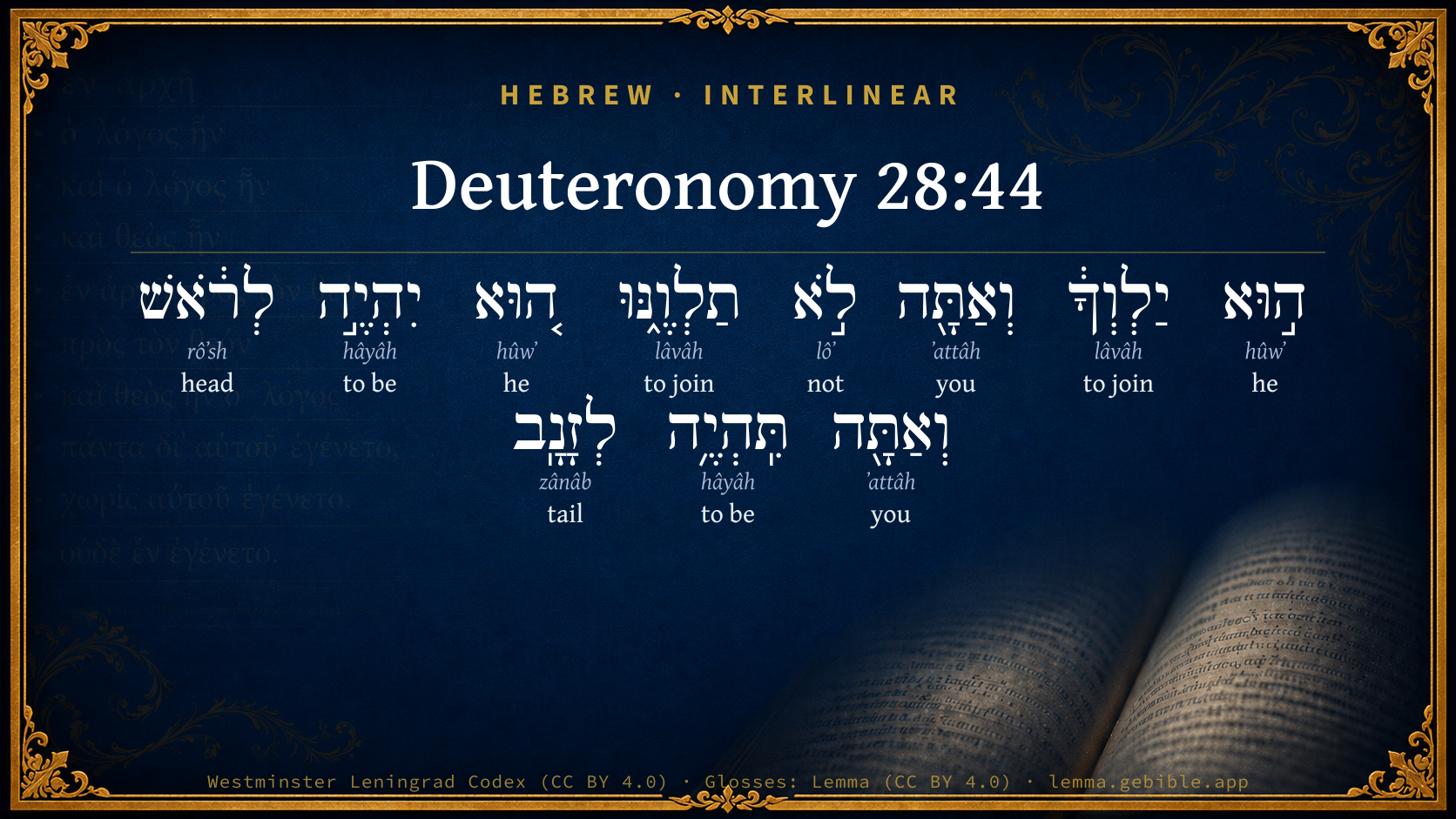
Deuteronomy 28:44

Hebrew (Westminster Leningrad Codex) Deuteronomy 28:44 appears in the Hebrew Old Testament. The text above is from the Westminster Leningrad Codex. Each word links to its Strong’s number, a concise gloss, and parsing drawn from the Open Scriptures Hebrew Bible morphology. Click any word for its full Brown-Driver-Briggs (BDB) entry.
Download image
Cite this verse

Deuteronomy 28:44 (World English Bible). Public Domain. Lemma interlinear Bible study tool, https://lemma.gebible.app/v/deuteronomy/28/44.

Show BibTeX & RIS
BibTeX
RIS
English Translation
He shall lend to you, and you shall not lend to him: he shall be the head, and you shall be the tail.
World English Bible · Public Domain
Download a study sheet

One document with this verse’s original text, its word-by-word gloss line, the meaning frame, cross-references with their text, attributed commentary, and full source and license credits — printable, and it pastes into notes with its structure intact.

This verse Autodidact and up

Study sheet (.html) Plain text (.txt)

A passage Seminary Student

Up to 50 verses in one chapter. A passage sheet keeps up to 6 commentary sources and 12 cross-references per verse, in the order this page ranks them, and says so on the sheet whenever that leaves anything out. Ask for a single verse and you get the Autodidact verse sheet above.

Everything on this page stays free to read, with no account — the sheet is a download of what is already on screen, not access to it.

Want to remove ads? Support Godless Engineer
Compare translations 3

The same verse in 3 English versions, stacked beneath the original-language interlinear above. Click any original word for its lexicon entry.

Each is an independent rendering of the whole verse — the interlinear is not word-aligned to these translations.

Highlighted words mark where these versions differ — a whole-verse word diff, not a word-by-word alignment.

  • World English Bible Public Domain
    He shall lend to you, and you shall not lend to him: he shall be the head, and you shall be the tail.
  • King James Version Public Domain
    He shall lend to thee, and thou shalt not lend to him: he shall be the head, and thou shalt be the tail.
  • unfoldingWord Literal Text CC BY-SA 4.0
    He will lend to you, but you will not lend to him; he will be the head, and you will be the tail.

unfoldingWord Literal Text — © unfoldingWord, licensed CC BY-SA 4.0. Word-aligned USFM3 via Door43 (git.door43.org/unfoldingWord/en_ult).

Versions to compare (up to 4)

3 of 4 selected

Show all 18 translations

Every available English version of this verse, each an independent rendering of the whole verse.

  • World English Bible Public Domain
    He shall lend to you, and you shall not lend to him: he shall be the head, and you shall be the tail.
  • Berean Standard Bible Public Domain
    He will lend to you, but you will not lend to him. He will be the head, and you will be the tail.
  • Majority Standard Bible Public Domain
    He will lend to you, but you will not lend to him. He will be the head, and you will be the tail.
  • King James Version Public Domain
    He shall lend to thee, and thou shalt not lend to him: he shall be the head, and thou shalt be the tail.
  • American Standard Version (1901) Public Domain
    He shall lend to thee, and thou shalt not lend to him: he shall be the head, and thou shalt be the tail.
  • Revised Version (1885) Public Domain
    He shall lend to thee, and thou shalt not lend to him: he shall be the head, and thou shalt be the tail.
  • Geneva Bible (1599) Public Domain
    He shall lend thee, and thou shalt not lend him: he shalbe the head, and thou shalt be ye tayle.
  • Douay-Rheims (1899) Public Domain
    He shall lend to thee, and thou shalt not lend to him. He shall be as the head, and thou shalt be the tail.
  • Young's Literal Translation Public Domain
    he doth lend `to' thee, and thou dost not lend `to' him; he is for head, and thou art for tail.
  • Literal Standard Version CC BY-SA 4.0
    he lends [to] you, and you do not lend [to] him; he is for head and you are for tail.
  • Unlocked Literal Bible CC BY-SA 4.0
    He will lend to you, but you will not lend to him; he will be the head, and you will be the tail.
  • unfoldingWord Literal Text CC BY-SA 4.0
    He will lend to you, but you will not lend to him; he will be the head, and you will be the tail.
  • Darby Bible Public Domain
    He shall lend to thee, but thou shalt not lend to him: he shall be the head, and thou shalt be the tail.
  • World Messianic Bible Public Domain
    He will lend to you, and you won’t lend to him. He will be the head, and you will be the tail.
  • Webster's Bible Public Domain
    He shall lend to thee, and thou shalt not lend to him: he shall be the head, and thou shalt be the tail.
  • Free Bible Version CC BY-SA 4.0
    They will lend to you, but you will not lend to them. They will be the first, and you will be the last.
  • Bible in Basic English Public Domain
    He will let you have his wealth at interest, and will have no need of yours: he will be the head and you the tail.
  • JPS Tanakh (1917) Public Domain
    He shall lend to thee, and thou shalt not lend to him; he shall be the head, and thou shalt be the tail.

Literal Standard Version (2020), Covenant Press — licensed CC BY-SA 4.0. Text via the HelloAO Bible API (eBible.org). Unlocked Literal Bible (unfoldingWord) — licensed CC BY-SA 4.0. Text via the HelloAO Bible API (eBible.org). unfoldingWord Literal Text — © unfoldingWord, licensed CC BY-SA 4.0. Word-aligned USFM3 via Door43 (git.door43.org/unfoldingWord/en_ult). Free Bible Version, Dr. Jonathan Gallagher — licensed CC BY-SA 4.0. Text via the HelloAO Bible API (eBible.org).

Word by word

More ways to search: Search by grammar → Find every occurrence → Compare this word →

Practice this passage: Drill this verse → Learn its vocabulary →

לְזָנָֽב
zânâb
H2180
“to/for · tail”
Preposition + Noun, Common, Masculine, Singular, Absolute
Part of Speech
Preposition + Noun
Type
Common
Gender
Masculine
Number
Singular
State
Absolute
Full BDB Definition

Origin: from H2179 (in the original sense of flapping)

TWOT: 562a

tail, end, stump
  1. ה֣וּא hûwʼ H1931 “he” Pronoun, Personal, 3rd Person, Masculine, Singular
  2. יַלְוְךָ֔ lâvâh H3867 “to join · you” Verb, Hiphil, Imperfect, 3rd Person, Masculine, Singular + Suffix, Personal, 2nd Person, Masculine, Singular
  3. וְאַתָּ֖ה ʼattâh H859 “and · you” Conjunction + Pronoun, Personal, 2nd Person, Masculine, Singular
  4. לֹ֣א lôʼ H3808 “not” Particle, Negative
  5. תַלְוֶ֑נּוּ lâvâh H3867 “to join · him” Verb, Hiphil, Imperfect, 2nd Person, Masculine, Singular + Suffix, Personal, 3rd Person, Masculine, Singular
  6. ה֚וּא hûwʼ H1931 “he” Pronoun, Personal, 3rd Person, Masculine, Singular
  7. יִהְיֶ֣ה hâyâh H1961 “to be” Verb, Qal, Imperfect, 3rd Person, Masculine, Singular
  8. לְרֹ֔אשׁ rôʼsh H7218 “to/for · head” Preposition + Noun, Common, Masculine, Singular, Absolute
  9. וְאַתָּ֖ה ʼattâh H859 “and · you” Conjunction + Pronoun, Personal, 2nd Person, Masculine, Singular
  10. תִּֽהְיֶ֥ה hâyâh H1961 “to be” Verb, Qal, Imperfect, 2nd Person, Masculine, Singular

About this verse

These counts appear in no published source. They are computed here, from the morphology-tagged text and Lemma’s own curated glosses. What Lemma adds →

11
words
7
distinct lemmas
Pentateuch
section

Notable vocabulary

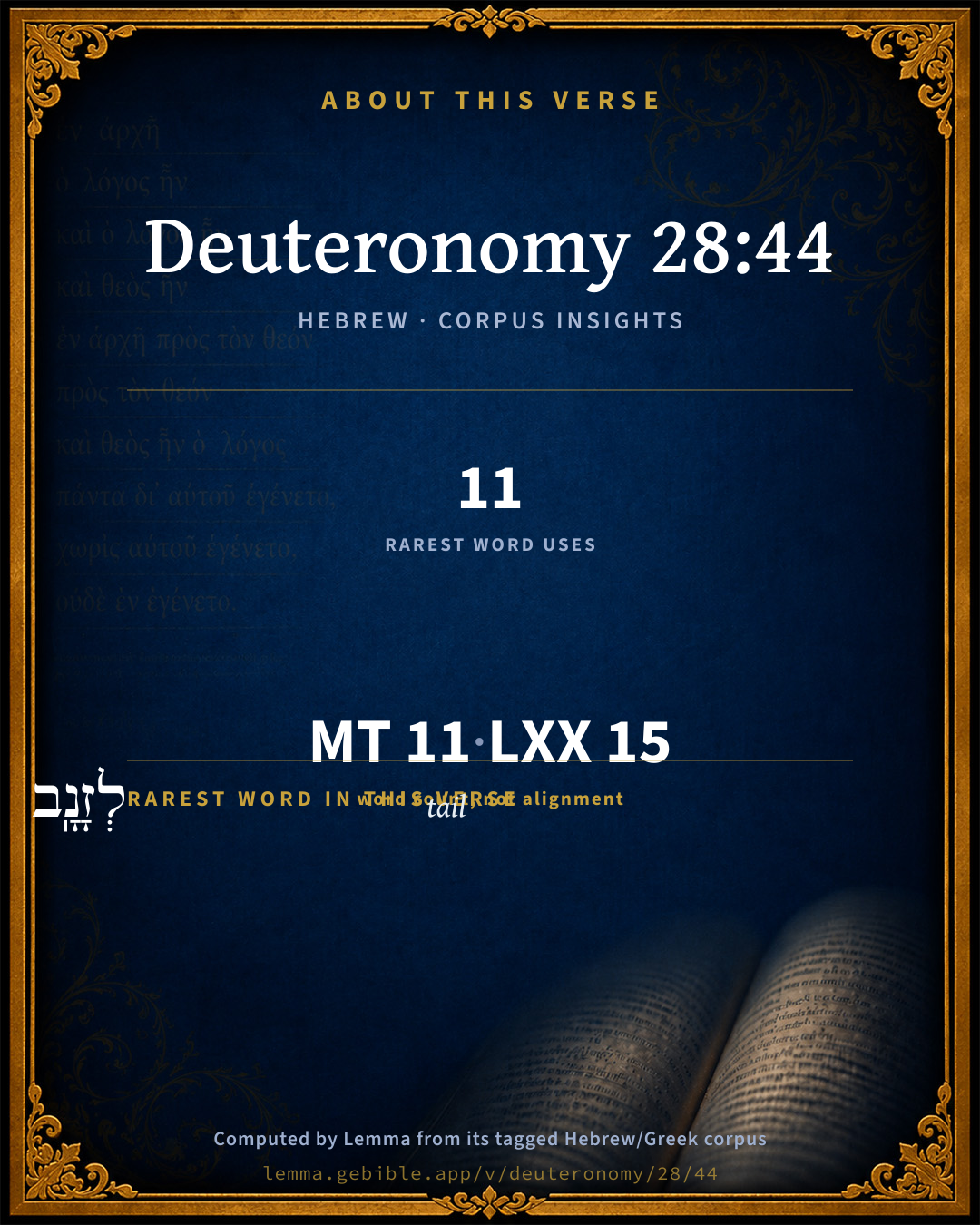
The rarest word here is לְזָנָֽב tail H2180 — appearing just 11 times in the whole Hebrew Bible.

Shared distinctive vocabulary

לְזָנָֽב tail H2180 occurs in 9 verses of the Hebrew Bible. Also found in:

Grammatical profile

  • 4 verbs
  • 2 nouns
  • 4 pronouns
  • 1 particle

Verb forms

  • יַלְוְךָ֔ Hiphil · Imperfect
  • תַלְוֶ֑נּוּ Hiphil · Imperfect
  • יִהְיֶ֣ה Qal · Imperfect
  • תִּֽהְיֶ֥ה Qal · Imperfect

Repetition

Words recur within this verse — often emphatic in Hebrew:

  • יַלְוְךָ֔ to join H3867 ×2
  • יִהְיֶ֣ה to be H1961 ×2
  • ה֣וּא he H1931 ×2
  • וְאַתָּ֖ה you H859 ×2

Hebrew & Septuagint length

In English translation the verse runs 23 words from the Hebrew and 23 from the Septuagint (LXX English) — the same length.

A rough comparison of the two English renderings, which tokenize alike — not a word-level alignment.

Word counts can differ between the Hebrew and the Greek without any difference in meaning — e.g. the Hebrew direct-object marker אֵת has no separate Greek word, and Greek often adds the article ὁ.

In the original languages it is 11 Hebrew tokens and 15 Greek tokens — but the two are counted differently (Hebrew bundles its prefixes and suffixes into one token; the Greek is in lemma form), so that isn’t a like-for-like length.

Cross-references

2

Topical passages linked to Deuteronomy 28:44 in the Treasury of Scripture Knowledge — connected by theme and wording, ordered by reader-vote popularity; previews shown in the World English Bible.

  • Deuteronomy 28:12–13 Yahweh will open to you his good treasure in the sky, to give the rain of your land in its season, and to bless all the work of your hand: and you shall lend to many nations, and you shall not borrow.
  • Lamentations 1:5 Her adversaries are become the head, her enemies prosper; For Yahweh has afflicted her for the multitude of her transgressions: Her young children are gone into captivity before the adversary.

Cross-references courtesy of OpenBible.info (CC BY 4.0).

Hebrew and Greek witnesses Masoretic Hebrew ↔ Greek Septuagint

The same verse in the two great witnesses to the Old Testament, shown verse-for-verse.

These are two independent witnesses, not word-aligned to each other, and the Septuagint is shown in lemma (dictionary) form.

Hebrew Deuteronomy 28:44 Masoretic · Westminster Leningrad Codex

ה֣וּא יַלְוְךָ֔ וְאַתָּ֖ה לֹ֣א תַלְוֶ֑נּוּ ה֚וּא יִהְיֶ֣ה לְרֹ֔אשׁ וְאַתָּ֖ה תִּֽהְיֶ֥ה לְזָנָֽב

He shall lend to you, and you shall not lend to him: he shall be the head, and you shall be the tail.

World English Bible · Public Domain

Greek LXX Deuteronomy 28:44 Septuagint · lemma form

οὗτος δανείζω σύ σύ δέ οὗτος οὐ δανείζω οὗτος εἰμί κεφαλή σύ δέ εἰμί οὐρά

He shall lend to you, and you shall not lend to him: he shall be the head, and you shall be the tail.

LXX2012 (modern English Septuagint) · Public Domain

Hebrew: Westminster Leningrad Codex (CC BY 4.0). Greek: Septuagint (public domain); English from LXX2012 (modern English Septuagint) (Public Domain). How the Septuagint differs from the Hebrew →

Targum (Aramaic paraphrase)

2

The Targum is the ancient Jewish Aramaic paraphrase of the Hebrew Scriptures — an interpretive translation, not the Hebrew text itself. Onkelos (literal) and Pseudo-Jonathan (expansive) render the Torah, and Jonathan the Prophets. Coverage is partial: where no permissively-licensed English translation exists for a verse, only the Aramaic is shown. This is verse-level text, not a word-by-word alignment to the Hebrew.

  1. Targum Onkelos Torah (Genesis–Deuteronomy)
    הוּא יוֹזְפִנָךְ וְאַתְּ לָא תוֹזְפִנֵהּ הוּא יְהֵי לְתַקִיף וְאַתְּ תְּהֵי לְחַלָשׁ

    (no public-domain English translation for this verse)

    Targum Onkelos — Aramaic: “Onkelos Genesis” (public domain); “Onkelos Exodus” (public domain); “Onkelos Leviticus” (public domain); “Onkelos Numbers” (public domain); “Onkelos Deuteronomy” (public domain). English: “Sefaria Community Translation” (CC0 1.0 (public-domain dedication)); “J.W. Etheridge. The Targums of Onkelos and Jonathan Ben Uzziel on the Pentateuch. London: Longmans, Green, 1862” (public domain). Text via Sefaria.

  2. Targum Pseudo-Jonathan Torah (Genesis–Deuteronomy)
    הוּא יַזְפוּנְכוֹן וְאַתּוּן לָא תוֹזְפוּן לְהוֹן הוּא יֶהֱוֵי שַׁלִיט וְאַתּוּן תֶּהֱווֹן הֶדְיוֹטִין

    He will lend to you, but you will not lend to him; he will be the master, and you the servant.

    Targum Pseudo-Jonathan — Aramaic: “Targum Jonathan on Genesis” (public domain); “Targum Jonathan on Exodus” (public domain); “Targum Jonathan on Leviticus” (public domain); “Targum Jonathan on Numbers” (public domain); “Targum Jonathan on Deuteronomy” (public domain). English: “The Targum of Jonathan ben Uzziel, trans. J. W. Etheridge, London, 1862” (public domain). Text via Sefaria.

Commentary

Notes on Deuteronomy 28:44 from classic Christian and Jewish commentators (each source and its license shown beneath its notes). The classic Christian expositions comment on the surrounding passage and are grouped to its opening verse, so a note may address several verses; the Jewish commentaries on the Tanakh (Rashi and others) are per-verse, so they appear only where the commentator wrote on this verse.

Lemma curates 59 commentaries, every one of them public domain or Creative Commons licensed, each selected and text-cleaned for this edition rather than reprinted as found. About our sources →

Tyndale Open Study Notes

Tyndale Open Resources

28:44 the head . . . the tail: Rather than Israel’s leading the nations, the reverse would be true when God punishes his people (see 28:13).

Tyndale Open Study Notes — © Tyndale Open Resources, licensed CC BY-SA 4.0. Text via the HelloAO Bible API.

John Gill's Exposition

Therefore shall thou serve thine enemies, which the Lord shall send against thee,.... Since they would not serve the Lord their God, who was so good a master to them, and supplied them with all good things, and with plenty of them, they should serve other lords, their enemies, whom God would raise up and send against them; not only, the Assyrians, Chaldeans, and Babylonians, but the Romans, after described, whom they should find hard masters, and from whom they; should have very severe usage, and should be

in hunger and in thirst, and in nakedness, and in want of all good things; being destitute of food, and drink and raiment, and the common necessaries of life, and so in famishing and starving circumstances:

and he shall put a yoke of iron upon thy neck; bring them into a state of subjection to their enemies, which would be intolerable to them, and from which they would not be able to free themselves, any more than to break an iron yoke; which, as it agrees with the Babylonish captivity, and their subjection in that state, see Jer 28:13; so more especially with their bondage under the Romans, who are the legs of iron in Nebuchadnezzar's image, and the fourth beast with great iron teeth in Daniel's vision, Dan 2:33, and this yoke was to continue

until he have destroyed thee; the Jews were under the Roman yoke, Roman governors being set over them, and Judea made a Roman province many years before the destruction of their nation, city, and temple, by them.

John Gill's Exposition of the Whole Bible (1746–1763) — public domain (CC PDM 1.0). Text via the HelloAO Bible API.

Lesson kit

Teaching starters — assembled from the data on this page, not authored interpretation. Every prompt links to the verse data it draws on. Edit before teaching.

Deuteronomy, in the Pentateuch, opens this verse with 11 words (7 distinct Hebrew lemmas). Its most distinctive word is zânâb (“tail”). A historical commentator’s framing appears above. Read the whole chapter for the surrounding context.

Discussion questions

  1. The word zânâb carries the sense “tail.” How does it shape the verse?
  2. How does Exodus 4:4, which shares the word «tail», read alongside this verse?
  3. What does the repetition of “to join” (2× in this one verse) do in this verse?
  4. These translations render this verse differently; the difference is in the English rendering, not the original. What questions does that raise?
  5. «יַלְוְךָ֔» is a Hiphil Imperfect verb. How does that grammatical form shape the action described?
  6. Compare how Tyndale Open Study Notes and John Gill's Exposition read this verse. Where do they agree or differ?

Things to notice

Reading settings

Reading text

Shown beneath each verse's original-language words.

Old Testament
Old Testament edition

Read the OT as the Masoretic Hebrew (MT) or the Greek Septuagint (LXX).

English shown for the Greek Septuagint (in the Hebrew ↔ Greek comparison).

Comparing translations? Open the Compare panel on any verse page to stack up to four side by side.