

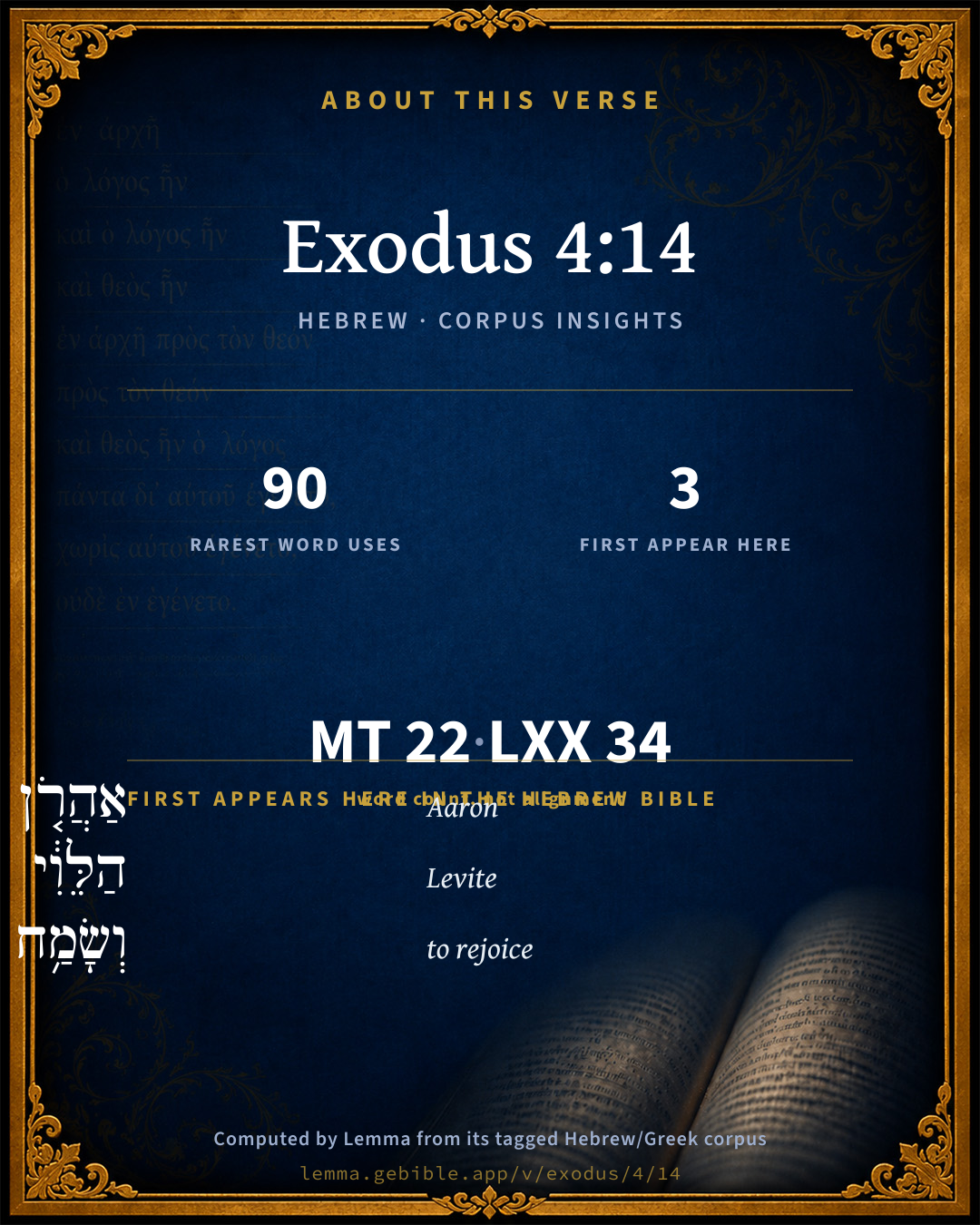
Exodus 4:14

Hebrew (Westminster Leningrad Codex) Exodus 4:14 appears in the Hebrew Old Testament. The text above is from the Westminster Leningrad Codex. Each word links to its Strong’s number, a concise gloss, and parsing drawn from the Open Scriptures Hebrew Bible morphology. Click any word for its full Brown-Driver-Briggs (BDB) entry.
Download image
Cite this verse

Exodus 4:14 (World English Bible). Public Domain. Lemma interlinear Bible study tool, https://lemma.gebible.app/v/exodus/4/14.

Show BibTeX & RIS
BibTeX
RIS
English Translation
The anger of Yahweh was kindled against Moses, and he said, "What about Aaron, your brother, the Levite? I know that he can speak well. Also, behold, he comes forth to meet you. When he sees you, he will be glad in his heart.
World English Bible · Public Domain
Highlights
  • 3 first appearances in the Hebrew Bible
Full analysis ↓
Download a study sheet

One document with this verse’s original text, its word-by-word gloss line, the meaning frame, cross-references with their text, attributed commentary, and full source and license credits — printable, and it pastes into notes with its structure intact.

This verse Autodidact and up

Study sheet (.html) Plain text (.txt)

A passage Seminary Student

Up to 50 verses in one chapter. A passage sheet keeps up to 6 commentary sources and 12 cross-references per verse, in the order this page ranks them, and says so on the sheet whenever that leaves anything out. Ask for a single verse and you get the Autodidact verse sheet above.

Everything on this page stays free to read, with no account — the sheet is a download of what is already on screen, not access to it.

Want to remove ads? Support Godless Engineer
Compare translations 3

The same verse in 3 English versions, stacked beneath the original-language interlinear above. Click any original word for its lexicon entry.

Each is an independent rendering of the whole verse — the interlinear is not word-aligned to these translations.

Highlighted words mark where these versions differ — a whole-verse word diff, not a word-by-word alignment.

  • World English Bible Public Domain
    The anger of Yahweh was kindled against Moses, and he said, "What about Aaron, your brother, the Levite? I know that he can speak well. Also, behold, he comes forth to meet you. When he sees you, he will be glad in his heart.
  • King James Version Public Domain
    And the anger of the LORD was kindled against Moses, and he said, Is not Aaron the Levite thy brother? I know that he can speak well. And also, behold, he cometh forth to meet thee: and when he seeth thee, he will be glad in his heart.
  • unfoldingWord Literal Text CC BY-SA 4.0
    And the nose of Yahweh burned at Moses, and he said, “Is not Aaron, the Levite, your brother? I know that he can speak well. And even more, behold, he is coming to meet you, and he will see you and he will be glad in his heart.

unfoldingWord Literal Text — © unfoldingWord, licensed CC BY-SA 4.0. Word-aligned USFM3 via Door43 (git.door43.org/unfoldingWord/en_ult).

Versions to compare (up to 4)

3 of 4 selected

Show all 18 translations

Every available English version of this verse, each an independent rendering of the whole verse.

  • World English Bible Public Domain
    The anger of Yahweh was kindled against Moses, and he said, "What about Aaron, your brother, the Levite? I know that he can speak well. Also, behold, he comes forth to meet you. When he sees you, he will be glad in his heart.
  • Berean Standard Bible Public Domain
    Then the anger of the LORD burned against Moses, and He said, “Is not Aaron the Levite your brother? I know that he can speak well, and he is now on his way to meet you. When he sees you, he will be glad in his heart.
  • Majority Standard Bible Public Domain
    Then the anger of the LORD burned against Moses, and He said, “Is not Aaron the Levite your brother? I know that he can speak well, and he is now on his way to meet you. When he sees you, he will be glad in his heart.
  • King James Version Public Domain
    And the anger of the LORD was kindled against Moses, and he said, Is not Aaron the Levite thy brother? I know that he can speak well. And also, behold, he cometh forth to meet thee: and when he seeth thee, he will be glad in his heart.
  • American Standard Version (1901) Public Domain
    And the anger of Jehovah was kindled against Moses, and he said, Is there not Aaron thy brother the Levite? I know that he can speak well. And also, behold, he cometh forth to meet thee: and when he seeth thee, he will be glad in his heart.
  • Revised Version (1885) Public Domain
    And the anger of the LORD was kindled against Moses, and he said, Is there not Aaron thy brother the Levite? I know that he can speak well. And also, behold, he cometh forth to meet thee: and when he seeth thee, he will be glad in his heart.
  • Geneva Bible (1599) Public Domain
    Then the Lord was verie angrie with Moses, and said, Doe not I know Aaron thy brother the Leuite, that he himselfe shall speake? for loe, he commeth also foorth to meete thee, and when he seeth thee, he will be glad in his heart.
  • Douay-Rheims (1899) Public Domain
    The Lord being angry at Moses, said Aaron the Levite is thy brother, I know that he is eloquent: behold he cometh forth to meet thee, and seeing thee shall be glad at heart.
  • Young's Literal Translation Public Domain
    And the anger of Jehovah burneth against Moses, and He saith, `Is not Aaron the Levite thy brother? I have known that he speaketh well, and also, lo, he is coming out to meet thee; when he hath seen thee, then he hath rejoiced in his heart,
  • Literal Standard Version CC BY-SA 4.0
    And the anger of YHWH burns against Moses, and He says, “Is Aaron the Levite not your brother? I have known that he speaks well, and also, behold, he is coming out to meet you; when he has seen you, then he has rejoiced in his heart,
  • Unlocked Literal Bible CC BY-SA 4.0
    Then Yahweh became angry with Moses. He said, “What about Aaron, your brother, the Levite? I know that he can speak well. Moreover, he is coming to meet you, and when he sees you, he will be glad in his heart.
  • unfoldingWord Literal Text CC BY-SA 4.0
    And the nose of Yahweh burned at Moses, and he said, “Is not Aaron, the Levite, your brother? I know that he can speak well. And even more, behold, he is coming to meet you, and he will see you and he will be glad in his heart.
  • Darby Bible Public Domain
    Then the anger of Jehovah was kindled against Moses, and he said, Is not Aaron the Levite thy brother? I know that he can speak well. And also behold, he goeth out to meet thee; and when he seeth thee he will be glad in his heart.
  • World Messianic Bible Public Domain
    The LORD’s anger burned against Moses, and he said, “What about Aaron, your brother, the Levite? I know that he can speak well. Also, behold, he is coming out to meet you. When he sees you, he will be glad in his heart.
  • Webster's Bible Public Domain
    And the anger of the LORD was kindled against Moses, and he said, Is not Aaron the Levite thy brother? I know that he can speak well. And also behold, he cometh forth to meet thee: and when he seeth thee, he will be glad in his heart.
  • Free Bible Version CC BY-SA 4.0
    The Lord got angry with Moses, and told him, “There's your brother Aaron, the Levite. I know he speaks well. He's on his way to meet you, and he'll be very happy to see you.
  • Bible in Basic English Public Domain
    And the Lord was angry with Moses, and said, Is there not Aaron, your brother, the Levite? To my knowledge he is good at talking. And now he is coming out to you: and when he sees you he will be glad in his heart.
  • JPS Tanakh (1917) Public Domain
    And the anger of the LORD was kindled against Moses, and He said: 'Is there not Aaron thy brother the Levite? I know that he can speak well. And also, behold, he cometh forth to meet thee; and when he seeth thee, he will be glad in his heart.

Literal Standard Version (2020), Covenant Press — licensed CC BY-SA 4.0. Text via the HelloAO Bible API (eBible.org). Unlocked Literal Bible (unfoldingWord) — licensed CC BY-SA 4.0. Text via the HelloAO Bible API (eBible.org). unfoldingWord Literal Text — © unfoldingWord, licensed CC BY-SA 4.0. Word-aligned USFM3 via Door43 (git.door43.org/unfoldingWord/en_ult). Free Bible Version, Dr. Jonathan Gallagher — licensed CC BY-SA 4.0. Text via the HelloAO Bible API (eBible.org).

Word by word

More ways to search: Search by grammar → Find every occurrence → Compare this word →

Practice this passage: Drill this verse → Learn its vocabulary →

וַיִּֽחַר
chârâh
H2734
“and · to be angry”
Conjunction + Verb, Qal, Sequential Imperfect, 3rd Person, Masculine, Singular
Part of Speech
Conjunction + Verb
Stem
Qal
Form
Sequential Imperfect
Person
3rd Person
Gender
Masculine
Number
Singular
Full BDB Definition

Origin: a primitive root [compare H2787 ]

TWOT: 736

to be hot, furious, burn, become angry, be kindled - (Qal) to burn, kindle (anger) - (Niphal) to be angry with, be incensed - (Hiphil) to burn, kindle - (Hithpael) to heat oneself in vexation
  1. אַ֨ף ʼaph H639 “nose” Particle, Accusative
  2. יְהוָ֜ה Yᵉhôvâh H3068 “LORD” Noun, Proper
  3. בְּמֹשֶׁ֗ה Môsheh H4872 “in/at · Moses” Preposition + Noun, Proper
  4. וַיֹּ֨אמֶר֙ ʼâmar H559 “and · to say” Conjunction + Verb, Qal, Sequential Imperfect, 3rd Person, Masculine, Singular
  5. הֲלֹ֨א lôʼ H3808 “not” Particle, Interrogative + Particle, Negative
  6. אַהֲרֹ֤ן ʼAhărôwn H175 “Aaron” Noun, Proper
  7. אָחִ֨יךָ֙ ʼâch H251 “brother · your” Noun, Common, Masculine, Singular, Construct + Suffix, Personal, 2nd Person, Masculine, Singular
  8. הַלֵּוִ֔י Lêvîyîy H3881 “the · Levite” Particle, Definite Article + Noun, Gentilic, Masculine, Singular, Absolute
  9. יָדַ֕עְתִּי yâdaʻ H3045 “to know” Verb, Qal, Perfect, 1st Person, Common, Singular
  10. כִּֽי kîy H3588 “that” Conjunction
  11. דַבֵּ֥ר dâbar H1696 “to speak” Verb, Piel, Infinitive Absolute
  12. יְדַבֵּ֖ר dâbar H1696 “to speak” Verb, Piel, Imperfect, 3rd Person, Masculine, Singular
  13. ה֑וּא hûwʼ H1931 “he” Pronoun, Personal, 3rd Person, Masculine, Singular
  14. וְגַ֤ם gam H1571 “and · also” Conjunction + Particle, Accusative
  15. הִנֵּה hinnêh H2009 “behold” Particle, Demonstrative
  16. הוּא֙ hûwʼ H1931 “he” Pronoun, Personal, 3rd Person, Masculine, Singular
  17. יֹצֵ֣א yâtsâʼ H3318 “going out” Verb, Qal, Participle Active, Masculine, Singular, Absolute
  18. לִקְרָאתֶ֔ךָ qirʼâh H7125 “to meet · you” Preposition + Verb, Qal, Infinitive Construct + Suffix, Personal, 2nd Person, Masculine, Singular
  19. וְרָאֲךָ֖ râʼâh H7200 “and · to see · you” Conjunction + Verb, Qal, Sequential Perfect, 3rd Person, Masculine, Singular + Suffix, Personal, 2nd Person, Masculine, Singular
  20. וְשָׂמַ֥ח sâmach H8055 “and · to rejoice” Conjunction + Verb, Qal, Sequential Perfect, 3rd Person, Masculine, Singular
  21. בְּלִבּֽוֹ lêb H3820 “in/at · heart · his” Preposition + Noun, Common, Masculine, Singular, Construct + Suffix, Personal, 3rd Person, Masculine, Singular

About this verse

These counts appear in no published source. They are computed here, from the morphology-tagged text and Lemma’s own curated glosses. What Lemma adds →

22
words
20
distinct lemmas
Pentateuch
section

First appearance in Scripture

These words make their first canonical appearance in the Hebrew Bible here:

  • אַהֲרֹ֤ן Aaron H175
  • הַלֵּוִ֔י Levite H3881
  • וְשָׂמַ֥ח to rejoice H8055

Grammatical profile

  • 9 verbs
  • 6 nouns
  • 2 pronouns
  • 1 conjunction
  • 4 particles

Verb forms

  • וַיִּֽחַר Qal · Sequential Imperfect
  • וַיֹּ֨אמֶר֙ Qal · Sequential Imperfect
  • יָדַ֕עְתִּי Qal · Perfect
  • דַבֵּ֥ר Piel · Infinitive Absolute
  • יְדַבֵּ֖ר Piel · Imperfect
  • יֹצֵ֣א Qal · Participle Active
  • לִקְרָאתֶ֔ךָ Qal · Infinitive Construct
  • וְרָאֲךָ֖ Qal · Sequential Perfect
  • וְשָׂמַ֥ח Qal · Sequential Perfect

Repetition

Words recur within this verse — often emphatic in Hebrew:

  • דַבֵּ֥ר to speak H1696 ×2
  • ה֑וּא he H1931 ×2

Hebrew & Septuagint length

In English translation the verse runs 44 words from the Hebrew and 44 from the Septuagint (LXX English) — the same length.

A rough comparison of the two English renderings, which tokenize alike — not a word-level alignment.

Word counts can differ between the Hebrew and the Greek without any difference in meaning — e.g. the Hebrew direct-object marker אֵת has no separate Greek word, and Greek often adds the article ὁ.

In the original languages it is 22 Hebrew tokens and 34 Greek tokens — but the two are counted differently (Hebrew bundles its prefixes and suffixes into one token; the Greek is in lemma form), so that isn’t a like-for-like length.

Cross-references

13

Topical passages linked to Exodus 4:14 in the Treasury of Scripture Knowledge — connected by theme and wording, ordered by reader-vote popularity; previews shown in the World English Bible.

  • Exodus 4:27 Yahweh said to Aaron, "Go into the wilderness to meet Moses." He went, and met him on God's mountain, and kissed him.
  • 1 Chronicles 21:7 God was displeased with this thing; therefore he struck Israel.
  • Mark 14:13–15 He sent two of his disciples, and said to them, "Go into the city, and there you will meet a man carrying a pitcher of water. Follow him,
  • Exodus 4:17 You shall take this rod in your hand, with which you shall do the signs."
  • 1 Samuel 10:1–7 Then Samuel took the vial of oil, and poured it on his head, and kissed him, and said, Isn't it that Yahweh has anointed you to be prince over his inheritance?
  • 2 Samuel 6:7 The anger of Yahweh was kindled against Uzzah; and God struck him there for his error; and there he died by the ark of God.
  • 1 Kings 11:9 Yahweh was angry with Solomon, because his heart was turned away from Yahweh, the God of Israel, who had appeared to him twice,
  • Luke 9:59–60 He said to another, "Follow me!" But he said, "Lord, allow me first to go and bury my father."
  • Acts 15:28 For it seemed good to the Holy Spirit, and to us, to lay no greater burden on you than these necessary things:
  • 2 Corinthians 2:13 I had no relief for my spirit, because I didn't find Titus, my brother, but taking my leave of them, I went out into Macedonia.
  • 2 Corinthians 7:6–7 Nevertheless, he who comforts the lowly, God, comforted us by the coming of Titus;
  • Philippians 2:21 For they all seek their own, not the things of Jesus Christ.
  • 1 Thessalonians 3:6–7 But when Timothy came just now to us from you, and brought us glad news of your faith and love, and that you have good memories of us always, longing to see us, even as we also long to see you;

Cross-references courtesy of OpenBible.info (CC BY 4.0).

Hebrew and Greek witnesses Masoretic Hebrew ↔ Greek Septuagint

The same verse in the two great witnesses to the Old Testament, shown verse-for-verse.

These are two independent witnesses, not word-aligned to each other, and the Septuagint is shown in lemma (dictionary) form.

Hebrew Exodus 4:14 Masoretic · Westminster Leningrad Codex

וַיִּֽחַר אַ֨ף יְהוָ֜ה בְּמֹשֶׁ֗ה וַיֹּ֨אמֶר֙ הֲלֹ֨א אַהֲרֹ֤ן אָחִ֨יךָ֙ הַלֵּוִ֔י יָדַ֕עְתִּי כִּֽי דַבֵּ֥ר יְדַבֵּ֖ר ה֑וּא וְגַ֤ם הִנֵּה הוּא֙ יֹצֵ֣א לִקְרָאתֶ֔ךָ וְרָאֲךָ֖ וְשָׂמַ֥ח בְּלִבּֽוֹ

The anger of Yahweh was kindled against Moses, and he said, "What about Aaron, your brother, the Levite? I know that he can speak well. Also, behold, he comes forth to meet you. When he sees you, he will be glad in his heart.

World English Bible · Public Domain

Greek LXX Exodus 4:14 Septuagint · lemma form

καί θυμόω ὀργή κύριος ἐπί μωυσῆς εἶπον οὐ ἰδού ααρων ὁ ἀδελφός σύ ὁ λευίτης ἐπίσταμαι ὅτι λαλέω λαλέω αὐτός σύ καί ἰδού αὐτός ἐκἔρχομαι εἰς συνάντησις σύ καί ὁράω σύ χαίρω ἐν ἑαυτοῦ

And the Lord was greatly angered against Moses, and said, Behold! is not Aaron the Levite your brother? I know that he will surely speak to you; and, behold, he will come forth to meet you, and beholding you he will rejoice within himself.

LXX2012 (modern English Septuagint) · Public Domain

Hebrew: Westminster Leningrad Codex (CC BY 4.0). Greek: Septuagint (public domain); English from LXX2012 (modern English Septuagint) (Public Domain). How the Septuagint differs from the Hebrew →

Targum (Aramaic paraphrase)

2

The Targum is the ancient Jewish Aramaic paraphrase of the Hebrew Scriptures — an interpretive translation, not the Hebrew text itself. Onkelos (literal) and Pseudo-Jonathan (expansive) render the Torah, and Jonathan the Prophets. Coverage is partial: where no permissively-licensed English translation exists for a verse, only the Aramaic is shown. This is verse-level text, not a word-by-word alignment to the Hebrew.

  1. Targum Onkelos Torah (Genesis–Deuteronomy)
    וּתְקֵיף רוּגְזָא דַיְיָ בְּמשֶׁה וַאֲמַר הֲלָא אַהֲרֹן אָחוּךְ לֵוָאֵי גְלֵי קֳדָמַי אֲרֵי מַלָלָא יְמַלֵל הוּא וְאַף הָא הוּא נָפֵק לְקַדָמוּתָךְ וְיֶחֱזִנָךְ וְיֶחְדֵי בְלִבֵּהּ:

    (no public-domain English translation for this verse)

    Targum Onkelos — Aramaic: “Onkelos Genesis” (public domain); “Onkelos Exodus” (public domain); “Onkelos Leviticus” (public domain); “Onkelos Numbers” (public domain); “Onkelos Deuteronomy” (public domain). English: “Sefaria Community Translation” (CC0 1.0 (public-domain dedication)); “J.W. Etheridge. The Targums of Onkelos and Jonathan Ben Uzziel on the Pentateuch. London: Longmans, Green, 1862” (public domain). Text via Sefaria.

  2. Targum Pseudo-Jonathan Torah (Genesis–Deuteronomy)
    וּתְקֵיף רוּגְזָא דַיְיָ בְּמשֶׁה וַאֲמַר הֲלָא אַהֲרן אָחוּךְ לֵיוָאֵי גְלֵי קֳדָמַי אֲרוּם מַלָלָא יְמַלֵיל הוּא וְאוּף הָא הוּא נָפֵיק לִקְדָמוּתָךְ וְיַחֲמִינָךְ וִיחֲדֵי בְּלִבֵּיהּ

    And the anger of the Lord was kindled against Mosheh, and He said, Is it not manifest before Me that Aharon thy brother speaking can speak? And, behold, also, he cometh forth to meet thee, and will see thee and rejoice in his heart.

    Targum Pseudo-Jonathan — Aramaic: “Targum Jonathan on Genesis” (public domain); “Targum Jonathan on Exodus” (public domain); “Targum Jonathan on Leviticus” (public domain); “Targum Jonathan on Numbers” (public domain); “Targum Jonathan on Deuteronomy” (public domain). English: “The Targum of Jonathan ben Uzziel, trans. J. W. Etheridge, London, 1862” (public domain). Text via Sefaria.

Commentary

Notes on Exodus 4:14 from classic Christian and Jewish commentators (each source and its license shown beneath its notes). The classic Christian expositions comment on the surrounding passage and are grouped to its opening verse, so a note may address several verses; the Jewish commentaries on the Tanakh (Rashi and others) are per-verse, so they appear only where the commentator wrote on this verse.

Lemma curates 59 commentaries, every one of them public domain or Creative Commons licensed, each selected and text-cleaned for this edition rather than reprinted as found. About our sources →

Trapp's Complete Commentary

John Trapp

Exo 4:14 And the anger of the LORD was kindled against Moses, and he said, [Is] not Aaron the Levite thy brother? I know that he can speak well. And also, behold, he cometh forth to meet thee: and when he seeth thee, he will be glad in his heart.

Ver. 14. And the anger of the Lord.] And no wonder: Patientia laesa fit furor. Where God commandeth, there to ask a reason is presumption; but to oppose reason, is a kind of rebellion.

I know that he can speak well.] The gift of utterance is a high favour, a piece of a Christian’s riches. {1Co 1:5} {See Trapp on "1Co 1:5"} Aaron, as Cicero saith of Aristotle, had aureum flumen orationis, a golden gift of speech.

John Trapp, A Commentary or Exposition upon All the Books of the Old and New Testament (1647–1656) — public domain. Text from a community e-Sword module.

The Biblical Illustrator

Joseph S. Exell

Exo_4:14-17

He shall be thy spokesman.

Mutual aid in religious work

I. That sometimes great men are called to undertake a work against the performance of which they imagine themselves to have a natural impediment.

1. Men should be certain that their so-called impediment will be a real hindrance in the service to which they are sent. In these days, when people are called to work, they at once refer to their infirmity and unfitness for it; but their real infirmity is not so much their slowness of speech, as their unbelief, and unwillingness to follow the Divine command. They have not the rectal courage to encounter difficulty.

2. But we admit that sometimes men are called to religious work, against the performance of which they have a true natural impediment. And why this apparent anomaly?

(1) It is because with the command He gives the moral energy necessary for its execution. He gives the timid man the stimulus of the vision. He gives him the inspiration of a miracle.

(2) Its design is to educate man on the side of his weakness.

(3) It is to render the mission all the more triumphant when accomplished. It is the distinguishing glory of Christianity that it makes provision for the victory of the weak, who have within their souls the grace of God.

II. That at such times good men require the aid of others whose talents compensate for their infirmities.

1. This help was adapted to the infirmity of Moses. Is not Aaron the Levite thy brother? I know that he can speak well. So there are a variety of gifts and talents in the Church. The one is the complement of the other.

2. This help was arranged by the Providence of God. And also, behold, he cometh forth to meet thee.

(1) As to the time of meeting.

(2) As to the place of meeting.

(3) As to the purpose of meeting.

3. This help was founded upon, and rendered welcome by, family relationship. Thy brother.

III. That such co-operation renders religious work much more jubilant and successful.

1. It is happy. It is adapted to our weak condition of faith.

2. It is sympathetic.

3. It is hopeful. (J. S. Exell, M. A.)

Moses and Aaron

I. The certificated ambassador. Moses.

1. His hesitation. Caused by

(1) His own meekness. Had not a high opinion of himself.

(2) His knowledge of the people he was sent to deliver, and also of the oppressor. He had not forgotten their rejection of him.

2. His certificate. Power to work sundry miracles is given.

3. His unbelief. Moses seems, at this time, to rely too much on human qualities. His lack of eloquence, he thinks, will be great hindrance.

II. The gracious compensation. Moses and Aaron the complement of each other. The man of words and the man of action. Human qualities are mercifully distributed. No one man perfect. Each needs the help and talents of others. Providence designs that men should not be independent of one another. Two heads better than one. Opposites often found in one family. Moses and Aaron--brothers. Different qualities and talents in a household to be used, and combined, for the service of God. Let none envy the gifts of others, but cultivate his own.

III. The brothers meeting.

1. In the wilderness. Place of brotherly meeting a garden in the desert of life. How great the joy of meeting each other where all around is paradise, and no separation or toll in prospect.

2. Marked by affection. They kissed each other. Mutual respect and love.

3. Their intercourse. Chief matter in hand was Mosess commission. Aaron, the elder, Cheerfully takes the second place. Is indebted for even that to the humility of Moses. They journey on together, and at once address themselves to their work.

Learn--

1. Gods witnesses are witnessed to. Seals to their ministry.

2. Humbly to regard ourselves, but do any work to which Providence calls us.

3. Rejoice in others powers, and cheerfully unite for common ends.

4. Thank God for our meeting on earth, and prepare for the better one.

5. Christ, our elder Brother, meets us in the wilderness, salutes us with the kiss of love, and goes with us to all our holy labours. (J. C. Gray.)

Mutual service

In the valley of Chamounix there stands a very interesting monument; it presents two figures--Saussure, the great scientist, and Balmat, the guide, who was the very first to stand on the summit of Mont Blanc. Saussure on the summit of the mighty mountain could do what the poor guide could not do, he could observe the structure of the rocks, take observations of barometrical variations, note the intensity of the solar rays, the mode of formation of clouds, and he could describe the superb scenery unfolded to his view with the feeling of an artist and the pen of a poet. Balmat could do nothing of all this but had it not been for his skill and daring, Saussure had never scaled the glorious height. So on the monument both are immortalized, the lowly guide, the famous philosopher, for by their mutuality they triumphed and gave mankind a new world of science and poetry. So it ever is in the Church. In Christian fellowship all souls serve one another. (W. L. Watkinson.)

Life and service interdependent

In the great honey industries of South California the bees play a most important and valuable part. But they cannot pierce the skins of the apricots until the lady-bug has made a hole for them. It must have been an accidental thing at the outset, the first bee joining a lady-bug at her feast of apricot, but they have now become necessary to the honey-crop of the district. All life and service is interdependent--Timothy is necessary to Paul; the least essential to the great. (H. O. Mackey.)

The Divine anger

1. Often righteously provoked.

2. Often gentle in its reproof.

3. Truly benevolent in its disposition. (J. S. Exell, M. A.)

I know that he can speak well

I. Then God takes knowledge of the varied talents of men.

II. Then God will hold men responsible for their talents.

III. Then the talents of men cannot be better employed than in the service of the Church. (J. S. Exell, M. A.)

Christian workers more ready to rely on man than on God

We have noted the timidity and hesitation of Moses, notwithstanding the varied promises and assurances with which Divine grace had furnished him. And now, although there was nothing gained in the way of real power, although there was no more virtue or efficacy in one mouth than in another, although it was Moses, after all, who was to speak unto Aaron, yet Moses was quite ready to go when assured of the presence and co-operation of a poor feeble mortal like himself, whereas he could not go when assured again and again that Jehovah would be with him. How his case, like a mirror, reflects our own hearts! We are more ready to trust anything than the living God. How deeply should it humble us before the Lord that, though we move along with bold decision when we possess the countenance and support of a poor frail mortal like ourselves, yet we falter, hesitate, and demur when we have the light of the Masters countenance and the strength of His omnipotent arm to support us. (A. Nevin, D. D.)

The Biblical Illustrator, edited by Joseph S. Exell (c. 1880s–1900s) — public domain. Text from a community e-Sword module.

The Preacher's Complete Homiletical Commentary

Joseph S. Exell (gen. ed.)

MAIN HOMILETICS OF THE PARAGRAPH.—Exo_4:14-17

MUTUAL AID IN RELIGIOUS WORK

I. That sometimes good men are called to undertake a work, against the performance of which they imagine themselves to have a natural impediment. Moses was called to go and achieve the freedom of Israel. But he says that he is a man slow of speech, and that as he is unlikely to succeed in such an undertaking, he asks that God will send another in his stead. Thus Moses was designated to a work, against the performance of which he imagined himself to have a natural infirmity, the lack of ready utterance

1. Men should be certain that their so-called impediment is a real hindrance in the service to which they are sent. Was Moses certain that his lack of speech would prove a real hindrance in the performance of his mission, especially when he considered the preparation he had already received, and the miracles he had been empowered to work? If so, he was mistaken. He looked more on the surface of things than into their depths. He probably regarded his own comfort more than the real bearing of his infirmity upon his mission. He wanted an excuse, and found one in his natural deficiency of language. He probably wanted to appear before Israel as some great one. He wanted to accomplished his mission without encountering difficulty. He looked more at secondary causes than at primary, more at himself than at God and his promised help. And men who do this will be sure to have infirmities, fancied or real. Thus we are not quite so sure that Moses was right in supposing that his lack of speech was a real hindrance to his mission. If he had been gifted in the direction of language, he might have been in danger of betraying his mission by indiscretion. It is a dangerous thing for a man that has moral power and a great mission to have the gift of language, he will almost be sure to talk too much about the honour of his calling, and the power he has to work miracles. Many such enterprises have been wrecked by so-called eloquence. True the public like a man that can talk; he is more likely to become a general favourite; he may win their pleasantry, but will he achieve their moral conviction? Many a minister would have been more successful in his work if he had been more slow of tongue. Thus, before we lament our natural impediment to service, and say that God has called the wrong man for the work, we must look into the reality of things, and see whether our infirmity is a real hindrance or not. In these days when people are called to work, they at once refer to their infirmity and unfitness for it, but their real infirmity is not so much their slowness of speech, as this unbelief and unwillingness to follow the Divine command. They have not the moral courage to encounter difficulty. They think more of Pharaoh and his army than of the Divine companionship that has promised to be with them.

2. But we admit that sometimes men are called to religious service against the performance of which they have a natural impediment. Sometimes men of little courage are sent on errands which require them to be brave; sometimes men of little faith are sent on errands which require them to have strong confidence in the Unseen; sometimes men of slow speech are sent to give the law of God to the assembled multitudes at Sinai. And why this apparent anomaly and invertion of things.

(1.) Is it not an injustice on the part of the Divine requirement. Can God fully expect men of small courage to go to Pharaoh and demand the freedom of a nation. It is just, because with the command He gives the moral energy necessary for its execution. He gives the timid man the stimulus of the vision. He gives him the inspiration of a miracle.

(2.) Its design is to educate man on the side of his weakness. The man lacks courage. The mission requires it. God awakens it. Hence the man who left home a coward, returns a hero. Moses hesitated to undertake the journey to Israel; he did not hesitate to take that still more formidable journey up the mountain of Nebo, into the arms of death. No; the discipline of the mission has been effectual. He has been educated thereby on the side of his weakness. Thus the calling of men to work for which they are antecedently unfitted, is purely educational in its design.

(3.) It is to render the mission all the more triumphant when accomplished. The strong man is familiar with victory, it has ceased to awaken him to enthusiasm as once it did. But for the weak to be the victorious is a new thing, it occasions a new experience, and renders the occasion worthy of more triumphant plaudits. It is the distinguishing glory of Christianity that it makes provision for the victory of the weak who have within their souls the grace of God.

II. That at such time good men require the aid of others whose talents compensate for their infirmity. Sometimes the Divine discipline requires that the weak shall go alone to the mission, for their greater spiritual good and honour, but in the case before us so arduous was the duty, so destitute were the times of religious light, and so vague were the ideas of men on moral service, that God responded to the implied wish of Moses, and gave him the direct help he needed. God does not entirely leave men of natural infirmity alone in their Christian service, but sends them external aid, most helpful and welcome.

1. This help was adapted to the infirmity of Moses. “Is not Aaron, the Levite, thy brother? I know that he can speak well.” Moses was a thinker. So there is a variety of gifts and talent in the Church. Some have the gift of wealth. Others have the gift of originality. Others have the gift of legislation. Others have the gift of great influence. One star differeth from another star in glory. How happy when the whole system of Christian work is revolving in harmony, giving light and hope to the universe. Thus the weak catch the light and impetus of the strong, and the lack of talent in one direction is made up by its supply in another. It is by this combination of Christian talent that all great enterprises will be carried to their successful issue. Let no Christian speaker refuse to aid a Christian thinker. The one is the complement of the other.

2. This help was arranged by the providence of God. “And also, behold He cometh forth to meet thee.”

(1.) As to the time of meeting.

(2.) As to the place of meeting.

(3.) As to the purpose of meeting. Thus the useful combination of talent in the enterprise of human emancipation from moral evil has the Divine sanction, its blending is arranged by the providence of God, and its entire out-working is superintended by Him. “I will be with thy mouth, and with his mouth, and will teach you what ye shall do.”

3. The help was founded upon and rendered welcome by family relationship. “Thy brother.” God did not bring a stranger to the aid of Moses. Moses could not well have communicated his history, his moral experiences to such an one, but he was glad to meet his brother, the sadness of his new mission was removed by the joyful interview, and together, animated by new impulses of hope, they would look over their work and enter into each other’s feelings respecting it. The talents of a family are variously distributed, and when all are consecrated to the Divine service, one may aid another in the great spiritual enterprise of his life.

III. That such co-operation renders religious work much more jubilant and successful.

1. It is happy. It is adapted to our weak conditions of faith. God is unseen and we are liable to think him distant from us in our work. His companionship seems unreal, and communion with Him is, at times, very difficult. Our unbelief robs us of the great repose and hope we ought to experience in His presence. But Aaron was seen by Moses. They could converse one with the other. They could walk together, not by faith, but by sight. And in converse with each other they might rise into higher communion with God. So mutual help in religious service is happy, it links soul to soul, and becomes the inspiration of richer communion with heaven.

2. It is sympathetic.

3. It is hopeful.

SUGGESTIVE COMMENTS ON THE VERSES

Exo_4:14. The literal rendering of the clause is, “Is not Aaron thy brother, the Levite”? which we cannot but understand as implying, that in consequence of Moses’ unbelieving waywardness on this occasion, the distinguishing honour of the priesthood, and of being the official head of the house of Levi, the person in whom the dignity of that name should be especially centred, which would otherwise have been bestowed upon him, should now be conferred upon his brother Aaron, and perpetuated in his family. In this fact the expression of the Lord’s anger consisted. Otherwise, how was Aaron any more the Levite than Moses? We find accordingly the forfeited privilege of Moses thus secured to Aaron (1Ch_23:13). This, we suppose would have been the honour of Moses, had he yielded a ready obedience to the divine mandate. The event teaches us that those who decline the labour and hazard connected with the call of God to a special service, may thereby forfeit and forego a blessing of which they little dream [Bush].

Thus Moses forfeited the dignity of being Jehovah’s sole instrument in that glorious work He was about to accomplish.

No wonder that the anger of the Lord was kindled against Moses. Where God commandeth, there to ask a reason is presumption; but to oppose reason, is a kind of rebellion [Trapp].

Moreover, God condescended so far to the weakness of Moses, as to find him a coadjutor in his mission to the children of Israel and to the King of Egypt. Aaron could speak well. Moses was a thinker; Aaron was a speaker. Aaron was to be to Moses instead of a mouth, and Moses was to be to Aaron instead of God. Thus one man has to be the complement of another. No one man has all gifts and graces. The best and ablest of us cannot do without our brother. There is to be a division of labour in the great work of conquering the world for God. The thinker works; so does the speaker; so does the writer. We are a chain; not merely isolated links; we belong to one another, and only by fraternal and zealous co-operation can we secure the great results possible to faith and labour. Some men are fruitful of suggestion. They have wondrous powers of indication; but there their special power ends. Other men have great gifts of expression; they can put thoughts into the best words; they have the power of music; they can charm and persuade. Such men are not to undervalue one another; they are to co-operate as fellow-labourers in the Kingdom of God [City Temple].

Multiplied oppositions to God’s call may provoke Him to be angry with His servants.

When the Divine promise cannot persuade, God’s anger drives His servants from their excuses.

When one refuseth God’s work in redeeming His Church, He knoweth others to use for it.

God indulgeth the weakness of His servants to give associates, when they decline to go alone.

God’s knowledge of persons, relations, and conditions, puts them in a capacity to do His work.

God moveth the hearts of people sometimes to the same work when they are in remote places.

Some hearts are more ready to move about God’s work than others.

Providence moveth persons to meet, for carrying on His work, when they are at a distance.

God appointeth meetings of friends to enhance the welfare of His Church.

God useth the gladness of some to help on the deadness of others in His work.

THE TWO BROTHERS

I. As educated by different methods. Moses was educated in the palace of Egypt. In the desert. By the vision. By the miracles. Aaron was educated by his parents. Little is known of his early training. He was incidentally called into history. One good natural gift may be fortune and fame to a man. Moses was the greater man, yet Aaron, though of less moral energy, was useful to him. Smaller souls have their mission. Small souls are often gifted with speech. The education of these two brothers had led to different results. It is not the tendency of education to bring all men to one level of talent, but to draw out their distinctive gifts, for the common good of humanity.

II. As meeting after a long separation.

1. The meeting was providential.

2. The meeting had a moral and national significance.

3. The meeting was welcome to the brothers. What is more pleasing than the reunion of the members of a family after a long absence? What narratives each brother would record to the other. Especially would they talk about their new mission, and its likelihood of success. These brothers met in a wilderness. Joy and friendship is independent of locality. The brethren of the Christian Chuch will one day meet again, not in the wilderness, but in the paradise of God.

III. As uniting in a grand enterprise. These two brothers are going to accomplish the freedom of Israel! To the world, a folly; to faith, a victory. Brothers should always join in the enterprises of moral freedom. They should unitedly place themselves in a line with the providence of God.

IV. As entering upon an important future. What will be the issue of this meeting? Who can tell? It will have an influence upon both lives. All the casual meetings of life are important in their bearing upon present work and future destiny.

V. As reflecting commendation upon their family. Was it not a great honour to Amram and Jochebed that two of their sons should be called to be the deliverers of Israel? Sons honour their parents when they undertake an enterprise for the good of men. Brothers cannot be better united than in the cause of God.

The Divine anger:—

1. Often righteously provoked.

2. Often gentle in its reproof.

3. Truly benevolent in its disposition.

“I know that he can speak well.”

I. Then God takes knowledge of the varied talents of men.

II. Then God will hold men responsible for their talents.

III. Then the talents of men cannot be better employed than in the service of the Church.

ILLUSTRATIONS

BY THE

REV. WM. ADAMSON

Exo_4:14-17.

(10)—Moses and Aaron!—The cobbler, writes Smith, could not paint the picture; but he could tell Apelles how to put in the shoe-latchet. Two neighbours—one blind and the other lame—were called to a place at a great distance. It was agreed that the blind man should carry his lame friend, who would help his human house with his eyes;

“The lame man with his crutches rude

Upon the blind man’s shoulders broad;

United thus achieved the pair

What each would have accomplished ne’er.”

—Gellert.

Moses and Aaron had each their defects. Moses and Aaron also had their qualifications. Moses was earnest. Aaron was eloquent. Moses had a bold heart. Aaron had a beautiful voice. Both aided each other. Mutual help.

Exo_4:14-17.

(11)—Gifts!—Well does Salter put it when he points out that flowers, while they captivate us with their beauty, no less astonish us with their variety. Every country has its peculiar species. Some of these love the burning suns of India; some the barren deserts of Africa. America and New Holland are equally distinguished by the variety of its animals, as by the diverse flowers of singular and rare beauty. Then again there are some flowers which are the natives only of temperate climates, and a few are confined to the snowy regions of the north. All these are remarkable for their different qualities; since some have fragrance—others beauty—and others again the properties of medicine. So in the Christian Church. the gifts and graces of its members differ widely.

“And yet what godlike gifts neglected lie

Wasted and marred in the forgotten soul!

The finest workmanship of God is there.”

—Willis.

Guthrie aptly remarks that in Christians there are differences of character, which—springing from constitutional peculiarities or early education—grace will modify, but never altogether eradicate on this side the grave. But there are also differences which imply no defect; just as there are in countenances which are very unlike, and yet, be the complexion dark or fair, are very beautiful. We do not expect all good men to be alike, any more than we would have all the members of a family alike, or all the flowers alike. The Church of Christ—like the meadows below, or the star-spangled heavens above—owes its beauty to that variety in unity which marks the works of God and mars none of them.

“Every where about us they are glowing,

Some like stars, to tell us Spring is born;

Others, their blue eyes with tears o’erflowing,

Stand like Ruth amid the golden corn.”

—Longfellow.

Exo_4:14-17.

(12)—Reward!—There is a beautiful tradition illustrating the blessedness of performing our duty at whatever cost to our inclination. A lovely vision of our Saviour had appeared to a monk. In silent rapture and bliss of ecstasy he was gazing upon it, when the hour arrived at which it was his duty to feed the poor of the convent. He lingered not in his cell to enjoy the vision, but left it to perform his humble duty. On his return, the legend runs that he found the vision still waiting for him to salute him with the words: “Hadst thou staid, I must have fled.” Ancient history (says Pilkington) stories of Dionysius that he caused a band of musicians to play before him on the promise of reward—and that he told them when they came for their reward that they had already had it in their hopes of it. Not so does God fulfil his promise. Moses had respect unto the recompense of the reward, and he now enjoys it.

“So do thy work; it shall succeed

In thine or in another’s day;

And if denied the victor’s meed,

Thou shalt not lack the toiler’s pay.”

—Whittier.

Exo_4:14-17.

(13)—Mutual Help!—Conceive a chain whose uppermost link was surely fixed in the living rock as your only hope of escape; would you not venture your body’s weight upon its strength? But what would be the result if the links were not within one another; but only attached externally by some brittle thing? You would simply be exchanging a slippery place of danger for inevitable death. No; the links must be within each other, and this is done in the fires. They were brought to a white heat ere they could be welded in. Moses and Aaron had thus to be welded together in the furnace of affliction—ere attached to the Eternal Rock—they were safe holding for the imperuled host of Israel.

“Steadfast and sure it cannot fail,

It enters deep within the veil,

It fastens on a land unknown,

And moors me to my Father’s throne.”

Wesley.

The Preacher's Complete Homiletical Commentary (gen. ed. Joseph S. Exell; Funk & Wagnalls, c. 1892) — public domain (pre-1929). A full-Bible homiletical/sermon-outline anthology covering 65 of 66 books (2 John is absent from the source module). Text from a community e-Sword module.

Tyndale Open Study Notes

Tyndale Open Resources

4:14-17 God would not let Moses evade responsibility, but he would accommodate Moses’ concern by allowing Moses’ brother Aaron to become Moses’ mouthpiece (14:16). As the narrative unfolds, the text records fewer and fewer occasions of Aaron serving in this capacity. Moses’ speaking problem was perhaps not as serious as he made it out to be, or the problem began to dissipate as his experience increased.

Tyndale Open Study Notes — © Tyndale Open Resources, licensed CC BY-SA 4.0. Text via the HelloAO Bible API.

Geneva Bible (1599)

Geneva Bible translators

Though we provoke God justly to anger, yet he will never reject his.

Geneva Bible (1599) marginal notes — public domain. Text via Bolls.life.

Jamieson, Fausset & Brown

Robert Jamieson, A. R. Fausset & David Brown

the anger of the Lord was kindled against Moses--The Divine Being is not subject to ebullitions of passion; but His displeasure was manifested by transferring the honor of the priesthood, which would otherwise have been bestowed on Moses, to Aaron, who was from this time destined to be the head of the house of Levi (Ch1 23:13). Marvellous had been His condescension and patience in dealing with Moses; and now every remaining scruple was removed by the unexpected and welcome intelligence that his brother Aaron was to be his colleague. God knew from the beginning what Moses would do, but He reserves this motive to the last as the strongest to rouse his languid heart, and Moses now fully and cordially complied with the call. If we are surprised at his backwardness amidst all the signs and promises that were given him, we must admire his candor and honesty in recording it.

Jamieson, Fausset & Brown — Commentary Critical and Explanatory on the Whole Bible (1871) — public domain (CC PDM 1.0). Text via the HelloAO Bible API.

Adam Clarke's Commentary

Verse 14. And the anger of the Lord was kindled against Moses] Surely this would not have been the case had he only in modesty, and from a deep sense of his own unfitness, desired that the Messiah should be preferred before him. But the whole connection shows that this interpretation is unfounded.

Is not Aaron the Levite thy brother?] Houbigant endeavours to prove from this that Moses, in Ex 4:13, did pray for the immediate mission of the Messiah, and that God gives him here a reason why this could not be, because the Levitical priesthood was to precede the priesthood of our Lord. Is not Aaron the Levite, &c. Must not the ministry of Aaron be first established, before the other can take place? Why then ask for that which is contrary to the Divine counsel? From the opinion of so great a critic as Houbigant no man would wish to dissent, except through necessity: however, I must say that it does appear to me that his view of these verses is fanciful, and the arguments by which he supports it are insufficient to establish his point.

I know that he can speak well.] ידעתי כי דבר ידבר הוא yadati ki dabber yedabber hu, I know that in speaking he will speak. That is, he is apt to talk, and has a ready utterance.

He cometh forth to meet thee] He shall meet thee at my mount, (Ex 4:27), shall rejoice in thy mission, and most heartily co-operate with thee in all things. A necessary assurance, to prevent Moses from suspecting that Aaron, who was his elder brother, would envy his superior call and office.

Adam Clarke's Commentary on the Bible (1810–1826) — public domain. Text from a community e-Sword/MySword module.

Ellicott's Commentary for English Readers

(14) The Levite.—Aben-Ezra and Rosenmüller think that this was the usual designation of the brother of Moses among the Israelites, who thus distinguished him from other Aarons. But as a distinguishing mark, the term would be superfluous here, since “thy brother” prevented the possibility of any other Aaron being thought of. Probably, the term is a title of honour, the priestly character already attaching to the tribe in God’s counsels.

I know that he can speak well.—Heb., I know that speaking he can speak. Facility of utterance, rather than excellence of speech, is intended.

And also, i.e., not only does his ready speech make him a suitable person to appoint, but he is coming to join thee, so that he and thou may arrange your respective parts at once.

A Bible Commentary for English Readers, edited by Charles John Ellicott (1878–1897) — public domain. Text from a community e-Sword module.

The Cambridge Bible for Schools and Colleges

gen. ed. J. J. S. Perowne

14. the Levite] As Moses, equally with Aaron, belonged to the tribe of Levi (Exo_2:1), the term, as applied distinctively to the latter, must denote, not ancestry, but profession. There must have been a period in the history of the ‘Levites,’ when the term was (McNeile) the official title of one who had received the training of a priest, regardless of the tribe of which he was a member by birth’ (cf. Jdg_17:7, where a member of the tribe of Judah is a ‘Levite’). See Moore, Judges, 383; McNeile, lxvi–lxviii. It was the duty of the priest to give tôrâh, or oral ‘direction,’ to the people (p. 79); hence some power of language might be presupposed in him. If the term has here, not a tribal sense, but the official sense just explained, there seed be no anachronism in its use.

that he] unlike Moses. The pron. is emphatic.

when he seeth thee, &c.] he will be glad, not only to meet thee, but also, it is implied, to cooperate with thee.

The Cambridge Bible for Schools and Colleges (gen. ed. J. J. S. Perowne; Cambridge University Press, 1878–1918) — public domain. Text from a community e-Sword module.

John Gill's Exposition

And the anger of the Lord was kindled against Moses,.... For the objections, excuses, and delays he made with respect to his mission. In what way this anger was expressed is not easy to say, whether by not removing the impediment of his speech, or not giving him the priesthood, which Jarchi thinks he otherwise would have had, and Aaron been only a Levite, as he is called in the next clause; or whether it was by joining Aaron to him, and so lessening his honour in this embassy, though that seems to be done to encourage him; or by not suffering him to lead the children of Israel into the land of Canaan, which yet is ascribed to another cause. However, though the Lord was angry with Moses, yet without any change of affection to him, he still retained and expressed a great regard to him; did not reject him from his service as he might have done, but employed him, and preferred him to his elder brother. Moses shows himself to be a faithful historian in recording his own weaknesses, and the displeasure of God at them:

and he said, is not Aaron the Levite thy brother; he was, and his elder brother, he was born three years before him, Exo 7:7 though Justin (w), an Heathen writer, says he was his son, and calls his name Aruas, and speaks of him as an Egyptian priest, and that he was made king after Moses's death; hence, he says, was the custom with the Jews for the same persons to be kings and priests; in all which he is mistaken. But Artapanus (x), another Heathen writer, calls him the brother of Moses, and by his right name, Aaron; and says it was by his advice Moses fled into Arabia, and speaks of his meeting him afterwards, when he was sent to the king of Egypt. Aaron is called the Levite, because he was a descendant of Levi, and yet so was Moses; perhaps this is added here, to distinguish him from others of the same name in other families, as Aben Ezra thinks; for as for what Jarchi suggests, as before, is without any foundation; and it is much more likely that Moses added this title to him, in his account of this affair, because he was the first of the tribe of Levi that was employed in the priestly office:

I know that he can speak well; or "in speaking speak" (y), speak very freely, fluently, in an eloquent manner; in which he was an eminent type of Christ, who is our advocate with the father, and has the tongue of the learned to speak a word in season; and does speak and plead for the conversion of his people, for the comfort of them, for the discoveries of pardoning grace and mercy to them; and for the carrying on the work of grace in them, and their perseverance to the end, and for their eternal glorification. The prayer in Joh 17:1 is a specimen of this:

and also, behold, he cometh forth to meet thee; having had an intimation from God of Moses's call to come into Egypt, and deliver his people from their bondage, he immediately set out to meet him, whereby he showed more faith, zeal, and courage, than Moses did; and this is said to animate him, and was a new sign, and would be a fresh confirmation of his faith, when he should see it accomplished, as he did:

and when he seeth thee, he will be glad in his heart: sincerely glad, and not only secretly so, but would express his cordial joy with his lips; not only because of his having a sight of his brother once more, whom he had not seen for forty years past, but because of his coming on such an errand from God, to deliver the people of Israel; and therefore, as he would express such gladness on this occasion, it became Moses to engage in this work with the utmost pleasure and cheerfulness.

(w) E Trogo, l. 36. c. 2. (x) Apud Euseb. Praepar. Evangel. l. 9. c. 27. p. 433, 434. (y) "loquendo loquetur", Pagninus, Montanus, Vatablus, Drusius.

John Gill's Exposition of the Whole Bible (1746–1763) — public domain (CC PDM 1.0). Text via the HelloAO Bible API.

Albert Barnes' Notes on the Bible

Anger - The words of Moses Exo 4:13 indicated more than a consciousness of infirmity; somewhat of vehemence and stubbornness.

Aaron - This is the first mention of Aaron. The words “he can speak well,” probably imply that Aaron had both the power and will to speak. Aaron is here called “the Levite,” with reference, it may be, to the future consecration of this tribe.

He cometh forth - i. e. is on the eve of setting forth. Not that Aaron was already on the way, but that he had the intention of going to his brother, probably because the enemies of Moses were now dead. See Exo 4:19.

Albert Barnes' Notes on the Bible (1834–1885) — public domain. Text from a community e-Sword/MySword module.

Matthew Poole's English Annotations

He cometh forth to meet thee, by my instigation and direction; which, because I see thou art still diffident, I give thee for a new sign to strengthen thy belief that I will carry thee through this hard work.

Matthew Poole's English Annotations on the Holy Bible (1683–1685) — public domain. Text from a community e-Sword/MySword module.

Whedon's Commentary on the Bible

Daniel D. Whedon

14. Aaron the Levite now first appears, and behind him Moses for the time retires. This is just and natural, for during forty years Aaron had been among his brethren, and living in the atmosphere of the highest civilization of the time, while Moses had been tending sheep for a Bedouin priest in the wilderness; but again we ask, what follower of the Sinai legislator would ever have dreamed of this? Aaron is God’s spokesman to the people; it is Aaron’s rod that buds; Aaron is Jehovah’s high priest; it is his sons that come to honour and wear the splendid vestments of the tabernacle, the chosen servants of Jehovah’s altar, while the children of Moses vanish into obscurity. Yet the slow, stammering, vailed prophet is the soul of Israel.

Behold, he cometh forth to meet thee — Events had been ripening in Egypt also, and the people as well as the leader had been preparing for the critical hour. He will be glad in his heart to see thee, and ready to unite with thee in the work of national deliverance. So we afterwards read that “he met and kissed him in the mount of God.” The Egyptian traditions of the exodus, though broken and confused, are deemed by some historians to show traces of dynastic rivalries and convulsions which favoured the exit of Israel; but this is extremely uncertain. It is certain, however, that Moses, Pharaoh, and Israel, though all freely acting, were all providentially used in this crisis. See on Exo_4:21.

Daniel D. Whedon (gen. ed.), Commentary on the Old and New Testaments (1874–1909) — public domain. Text from a community e-Sword module.

The Pulpit Commentary

The anger of the Lord was kindled against Moses. The expression used is a strong one, but does not perhaps here mean more than that God was displeased. At least, he did not punish the offender in any severer way than by the withholding of a gift that he was ready to bestow, and the partition between two of a position and a dignity which Moses might have had all to himself. Perhaps diffidence and self-distrust, even when out of place, are not altogether abhorrent to One whose creatures are continually offending him by presumption and arrogance. Is not Aaron the Levite thy brother? I know, etc. This translation is wrong. The two clauses form one sentence, and should be rendered, "Do I not know that Aaron the Levite, thy brother, speaks well?" Aaron"s designation as "the Levite" is remarkable, and seems to glance at the future consecration of his tribe to God"s especial service. Behold, he cometh forth to meet thee. It has been conjectured that Aaron designed to visit Moses in Midian, in order to convey to him the intelligence that the king who had sought his (Exo_2:15) was dead. He did not, however, start on the journey till God gave him a special direction (ver. 27).

The love of brothers.

Few things are more lovely than the affection of brothers. James and John, Simon and Andrew, Philip and Bartholomew, James and Jude, were sent out together by our Lord, that they might enjoy this sweet companionship. How touching is the love of Joseph for Benjamin! If there is "a friend that sticketh closer than a brother," the fact is noted for its rarity; and the force of the phrase depends on the known intensity of fraternal affection. Aaron, though so long parted from Moses, perhaps the more because so long parted, would at the sight of him be "glad in his heart." Though not brought up together, though educated so differently, and gifted so differently, though seemingly intended for such different walks in life, the two had a true affection, each for each, which had survived a long and so far as we are told complete separation. Here, and again in verse 27, it is the affection of Aaron which is especially noticed perhaps because it was the more praiseworthy. Aaron, the elder brother, might naturally have felt some jealousy of Moses" advancement above himself, of his superior education, social position, privileges, etc. But he seems to have been entirely free from this feeling. Moses might, for aught that he knew, resume his old princely rank on his return to Egypt, and throw him once more into the shade. Aaron did not disquiet himself about this. God knew that he longed for the simple keen pleasure of seeing his brother ("when he seeth thee, he will be glad," etc.), of pressing him to his heart, and kissing him on the face (ver. 27). Well would it be, if among Christians all brothers were thus minded.

Vers. 14-16. Diversities of gifts a benefit both to individuals and to the Church.

After all, the self-distrust of Moses was turned by God to good. Without it Moses would have been sole leader of the entire enterprise, must have appeared alone before the elders and before the monarch, must have undertaken the entire charge, direction, superintendence of everything, must have had upon his mind an unshared burden which it would have been most trying to bear. God"s strength might indeed have been sufficient for his weakness. But his life could not but have been a weariness to him. He would have lacked the unspeakable solace and comfort of a loved and loving associate, to whom he might open indeed, was bound to open (ver. 15) all his mind, and with whom he could constantly "take sweet counsel together." He would have also lacked the support, so much needed by a shy man, of a companion and coadjutor in crises and times of difficulty, as when he appeared first before the elders (vers. 29, 30), and when he appeared first before Pharaoh. (Exo_5:1) Thus the association of Aaron with himself in the leadership must have been felt by Moses as a benefit. And to Aaron it was an unmixed advantage. The gift with which God had endowed him, and which he had no doubt sedulously cultivated, caused him to be placed almost on a par with his brother enabled him to be of use to him gave him loving companionship and caused him to have a large part in the deliverance of his nation. After forty years of separation, during which he had never ceased to long for the return of his brother, Aaron found himself associated in the closest possible way with Moses, made his "right-hand man," his other self, his constant aider and assister. After a wholly undistinguished life, which had lasted eighty-three years, (Exo_7:7) he found himself brought into a position of the highest dignity and responsibility. And the Church was benefited greatly by the double leadership. Moses, the man of thought, was able to devote himself exclusively to thinking out all the details of the great work entrusted to him. Aaron, the man of words, was able to give all his attention to the framing of addresses whereby he might advance the plans of his brother. So in the Christian Church there have always been, and will always be, "diversities of gifts." At one time they are "gifts of healing, tongues, prophecy, interpretation, discerning of spirits, faith, wisdom, prudence"; (1Co_12:8-10) at another, preaching power, administrative energy, learning, scholarship, influence, and the like. Seldom are even two of these gifts united in the same individual. The Church prospers by utilising the gifts of all, assigning to each man the position suited to him, and taking care that he has a fair field for the employment of his special gift. In this way, "the whole building fitly joined together, and compacted by that which every joint supplieth, according to the effectual working in the measure of every part, maketh increase of the body to the edifying of itself in love". (Eph_4:16)

The Pulpit Commentary (1880–1919), ed. H.D.M. Spence-Jones & Joseph S. Exell — public domain. Text from a community e-Sword module.

John Wesley's Explanatory Notes

And the anger of the Lord was kindled against him - Even self-diffidence when it grows into an extreme, when it either hinders us from duty, or clogs us in duty, is very displeasing to him.

John Wesley, Explanatory Notes Upon the Whole Bible (1754–1765) — public domain. Text via the GEBible commentary corpus.

Scofield Reference Notes

C. I. Scofield

Aaron the Levite

(Cf) Exo 28:1. (See Scofield "Exo 28:1").

The Scofield Reference Bible (1917 edition), notes by C. I. Scofield — public domain. Text from a community e-Sword module.

unfoldingWord translationNotes

Door43 World Missions Community

he will be glad in his heart

Here "heart" refers to inner thoughts and emotions. AT: "he will be very happy" (See: Metonymy)

put the words to say into his mouth

Words here are spoken of as if they were something that can be physically placed in a person's mouth. AT: "give him the message that he is to repeat" (See: Metaphor)

I will be with your mouth

The word "mouth" here represents Moses choice of words. AT: "I will give you the right words to speak" (See: Metonymy)

with his mouth

The word "mouth" here represents Aaron's choice of words. AT: "I will give him the right words to speak" (See: Metonymy)

He will be your mouth

The word "mouth" here represents Aaron repeating what Moses told him. AT: "He will say what you tell him to say" (See: Metonymy)

you will be to him like me, God

The word "like" here means Moses would represent the same authority to Aaron as God did to Moses. AT: "you will speak to Aaron with the same authority with which I spoke to you" (See: Simile)

translationWords

Yahweh

anger

Aaron

Levi

heart

word

God

staff

miracle

unfoldingWord translationNotes — © Distant Shores Media and the Door43 World Missions Community, licensed CC BY-SA 4.0. Source: git.door43.org/Door43/en_tn.

Rashi

Rabbi Shlomo Yitzchaki (Rashi)

ויחר אף AND [THE LORD’S] WRATH GLOWED — Rabbi Joshua the son of Korcha said: wherever the term “and God’s wrath glowed” occurs in the Scriptures it leaves a definite impression (mention of punishment of some kind follows), but here no such result is mentioned, for we do not find that any punishment came upon Moses in consequence of that anger of God. Rabbi José said to him: As a matter of fact here, too, some definite result is mentioned, viz., הלא אהרן אחיך הלוי “Is not Aaron the Levite thy brother?” — which implies, that he was destined to be a Levite (an attendant on the priests) and not a priest, — and I intended that the priesthood should proceed from you. Now, however, this shall not be so, but he will be the Priest and you the Levite, as it is said, (I Chronicles 23:14) “But as for Moses the man of God his sons are named among the tribe of Levi” (Zevachim 102a).

הנה הוא יצא לקראתך HE WILL BE GOING FORTH TOWARDS THEE, when you will be going to Egypt.

וראך ושמח בלבו AND WHEN HE SEETH THEE, HE WILL BE GLAD IN HIS HEART — not as you believe, that he will be angry with you because you have attained a high position. In consequence of this, Aaron was privileged to wear the ornament of the breastplate which was placed over his heart (cf. Exodus 28:29) (Shabbat 139a; Exodus Rabbah 3:17).

Rashi on the Tanakh — English translations: “The Judaica Press complete Tanach with Rashi, translated by A. J. Rosenberg” (CC BY 4.0); “Pentateuch with Rashi's commentary by M. Rosenbaum and A.M. Silbermann, 1929-1934” (public domain); “The Metsudah Tanach series, Lakewood, N.J” (CC BY 4.0); and “The Book of Joshua, Metsudah Publications, 1997” (CC BY 4.0). Text via Sefaria.

Ramban (Nachmanides)

Rabbi Moshe ben Nachman (Ramban / Nachmanides)

I KNOW THAT HE [Aaron] CAN SPEAK WELL. That is to say, “It is revealed before Me that, out of his love for you, Aaron will willingly speak on your behalf even if I were not to command him. And also, behold, he cometh forth of his own bidding to meet thee, and when he seeth thee he will be glad in his heart, and he will not be jealous over your distinction in this honorable mission.” The reason that it was necessary that G-d tell Aaron, Go into the wilderness to meet Moses, was in order to inform him of the road by which Moses was coming. It is possible that Aaron heard of Moses’ departure from Midian, and on his own accord he went out to meet him. Afterwards, when he was already on the way, it was said to him, “Go into the wilderness to meet him, for there you will find him.”

Ramban (Nachmanides) on the Tanakh — English translation: “Commentary on the Torah by Ramban (Nachmanides). Translated and annotated by Charles B. Chavel. New York, Shilo Pub. House, 1971-1976” (CC BY 4.0). Text via Sefaria.

Lesson kit

Teaching starters — assembled from the data on this page, not authored interpretation. Every prompt links to the verse data it draws on. Edit before teaching.

Exodus, in the Pentateuch, opens this verse with 22 words (20 distinct Hebrew lemmas). Its most distinctive word is chârâh (“to be angry”). A historical commentator’s framing appears above. Read the whole chapter for the surrounding context.

Discussion questions

  1. The word chârâh carries the sense “to be angry.” How does it shape the verse?
  2. 3 words make their first appearance in Scripture here. What does this debut establish?
  3. How does Exodus 4:27, which shares this passage’s theme, read alongside this verse?
  4. What does the repetition of “to speak” (2× in this one verse) do in this verse?
  5. The translations on this page render this verse differently — a whole-verse word diff, not a word-by-word alignment. What might account for the different wordings?
  6. «וַיִּֽחַר» is a Qal Sequential Imperfect verb. How does that grammatical form shape the action described?
  7. Compare how Trapp's Complete Commentary and The Biblical Illustrator read this verse. Where do they agree or differ?

Things to notice

Reading settings

Reading text

Shown beneath each verse's original-language words.

Old Testament
Old Testament edition

Read the OT as the Masoretic Hebrew (MT) or the Greek Septuagint (LXX).

English shown for the Greek Septuagint (in the Hebrew ↔ Greek comparison).

Comparing translations? Open the Compare panel on any verse page to stack up to four side by side.