Deuteronomy 23:7

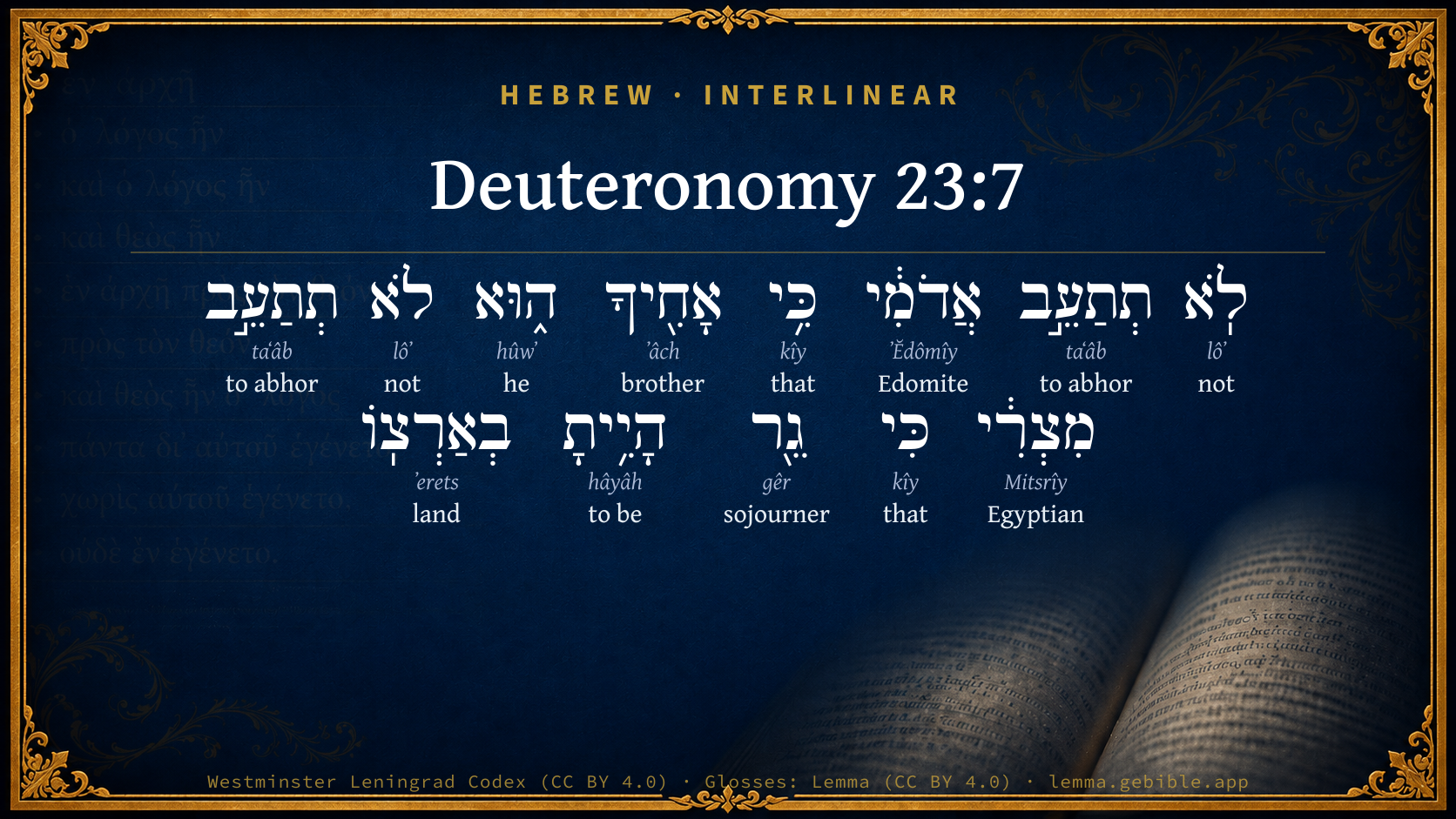
Hebrew (Westminster Leningrad Codex) Deuteronomy 23:7 appears in the Hebrew Old Testament. The text above is from the Westminster Leningrad Codex. Each word links to its Strong’s number, a concise gloss, and parsing drawn from the Open Scriptures Hebrew Bible morphology. Click any word for its full Brown-Driver-Briggs (BDB) entry.
Download image
Cite this verse

Deuteronomy 23:7 (World English Bible). Public Domain. Lemma interlinear Bible study tool, https://lemma.gebible.app/v/deuteronomy/23/7.

Show BibTeX & RIS
BibTeX
RIS
English Translation
You shall not abhor an Edomite; for he is your brother: you shall not abhor an Egyptian, because you lived as a foreigner in his land.
World English Bible · Public Domain
Highlights
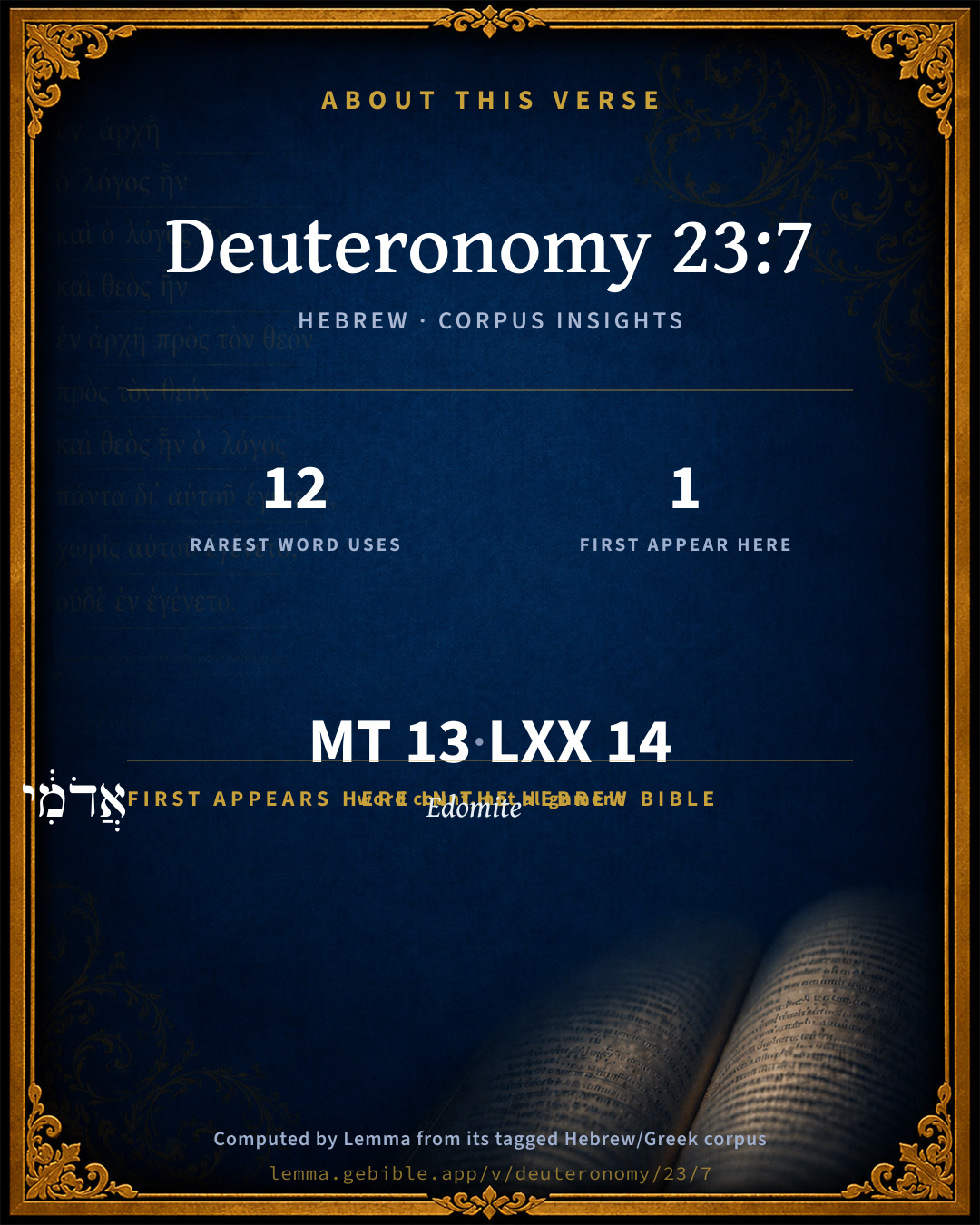
  • 1 first appearance in the Hebrew Bible
Full analysis ↓
Download a study sheet

One document with this verse’s original text, its word-by-word gloss line, the meaning frame, cross-references with their text, attributed commentary, and full source and license credits — printable, and it pastes into notes with its structure intact.

This verse Autodidact and up

Study sheet (.html) Plain text (.txt)

A passage Seminary Student

Up to 50 verses in one chapter. A passage sheet keeps up to 6 commentary sources and 12 cross-references per verse, in the order this page ranks them, and says so on the sheet whenever that leaves anything out. Ask for a single verse and you get the Autodidact verse sheet above.

Everything on this page stays free to read, with no account — the sheet is a download of what is already on screen, not access to it.

Want to remove ads? Support Godless Engineer
Compare translations 3

The same verse in 3 English versions, stacked beneath the original-language interlinear above. Click any original word for its lexicon entry.

Each is an independent rendering of the whole verse — the interlinear is not word-aligned to these translations.

Highlighted words mark where these versions differ — a whole-verse word diff, not a word-by-word alignment.

  • World English Bible Public Domain
    You shall not abhor an Edomite; for he is your brother: you shall not abhor an Egyptian, because you lived as a foreigner in his land.
  • King James Version Public Domain
    Thou shalt not abhor an Edomite; for he is thy brother: thou shalt not abhor an Egyptian; because thou wast a stranger in his land.
  • unfoldingWord Literal Text CC BY-SA 4.0
    You shall not detest an Edomite, for he your brother; you shall not detest an Egyptian, because you were a foreigner in his land.

unfoldingWord Literal Text — © unfoldingWord, licensed CC BY-SA 4.0. Word-aligned USFM3 via Door43 (git.door43.org/unfoldingWord/en_ult).

Versions to compare (up to 4)

3 of 4 selected

Show all 18 translations

Every available English version of this verse, each an independent rendering of the whole verse.

  • World English Bible Public Domain
    You shall not abhor an Edomite; for he is your brother: you shall not abhor an Egyptian, because you lived as a foreigner in his land.
  • Berean Standard Bible Public Domain
    Do not despise an Edomite, for he is your brother. Do not despise an Egyptian, because you lived as a foreigner in his land.
  • Majority Standard Bible Public Domain
    Do not despise an Edomite, for he is your brother. Do not despise an Egyptian, because you lived as a foreigner in his land.
  • King James Version Public Domain
    Thou shalt not abhor an Edomite; for he is thy brother: thou shalt not abhor an Egyptian; because thou wast a stranger in his land.
  • American Standard Version (1901) Public Domain
    Thou shalt not abhor an Edomite; for he is thy brother: thou shalt not abhor an Egyptian, because thou wast a sojourner in his land.
  • Revised Version (1885) Public Domain
    Thou shalt not abhor an Edomite; for he is thy brother: thou shalt not abhor an Egyptian; because thou wast a stranger in his land.
  • Geneva Bible (1599) Public Domain
    Thou shalt not abhorre an Edomite: for he is thy brother, neither shalt thou abhorre an Egyptian, because thou wast a strager in his land.
  • Douay-Rheims (1899) Public Domain
    Thou shalt not abhor the Edomite, because he is thy brother: nor the Egyptian, because thou wast a stranger in his land.
  • Young's Literal Translation Public Domain
    `Thou dost not abominate an Edomite, for thy brother he `is'; thou dost not abominate an Egyptian, for a sojourner thou hast been in his land;
  • Literal Standard Version CC BY-SA 4.0
    You do not detest an Edomite, for he [is] your brother; you do not detest an Egyptian, for you have been a sojourner in his land;
  • Unlocked Literal Bible CC BY-SA 4.0
    You must not detest an Edomite, for he is your brother; you must not abhor an Egyptian, because you were a foreigner in his land.
  • unfoldingWord Literal Text CC BY-SA 4.0
    You shall not detest an Edomite, for he your brother; you shall not detest an Egyptian, because you were a foreigner in his land.
  • Darby Bible Public Domain
    Thou shalt not abhor an Edomite; for he is thy brother. Thou shalt not abhor an Egyptian; because thou wast a sojourner in his land.
  • World Messianic Bible Public Domain
    You shall not abhor an Edomite, for he is your brother. You shall not abhor an Egyptian, because you lived as a foreigner in his land.
  • Webster's Bible Public Domain
    Thou shalt not abhor an Edomite, for he is thy brother: thou shalt not abhor an Egyptian, because thou wast a stranger in his land.
  • Free Bible Version CC BY-SA 4.0
    Don't look down on an Edomite, for they are your relatives. Don't look down on an Egyptian either, because you lived as foreigners in their country.
  • Bible in Basic English Public Domain
    But have no hate for an Edomite, because he is your brother, or for an Egyptian, for you were living in his land.
  • JPS Tanakh (1917) Public Domain
    (23-8) Thou shalt not abhor an Edomite, for he is thy brother; thou shalt not abhor an Egyptian, because thou wast a stranger in his land.

Literal Standard Version (2020), Covenant Press — licensed CC BY-SA 4.0. Text via the HelloAO Bible API (eBible.org). Unlocked Literal Bible (unfoldingWord) — licensed CC BY-SA 4.0. Text via the HelloAO Bible API (eBible.org). unfoldingWord Literal Text — © unfoldingWord, licensed CC BY-SA 4.0. Word-aligned USFM3 via Door43 (git.door43.org/unfoldingWord/en_ult). Free Bible Version, Dr. Jonathan Gallagher — licensed CC BY-SA 4.0. Text via the HelloAO Bible API (eBible.org).

Word by word

More ways to search: Search by grammar → Find every occurrence → Compare this word →

Practice this passage: Drill this verse → Learn its vocabulary →

אֲדֹמִ֔י
ʼĔdômîy
H130
“Edomite”
Noun, Gentilic, Masculine, Singular, Absolute
Part of Speech
Noun
Type
Gentilic
Gender
Masculine
Number
Singular
State
Absolute
Full BDB Definition

Origin: patronymic from H123

TWOT: None

Edomite
  1. לֹֽא lôʼ H3808 “not” Particle, Negative
  2. תְתַעֵ֣ב taʻâb H8581 “to abhor” Verb, Piel, Imperfect, 2nd Person, Masculine, Singular
  3. כִּ֥י kîy H3588 “that” Conjunction
  4. אָחִ֖יךָ ʼâch H251 “brother · your” Noun, Common, Masculine, Singular, Construct + Suffix, Personal, 2nd Person, Masculine, Singular
  5. ה֑וּא hûwʼ H1931 “he” Pronoun, Personal, 3rd Person, Masculine, Singular
  6. לֹא lôʼ H3808 “not” Particle, Negative
  7. תְתַעֵ֣ב taʻâb H8581 “to abhor” Verb, Piel, Imperfect, 2nd Person, Masculine, Singular
  8. מִצְרִ֔י Mitsrîy H4713 “Egyptian” Noun, Gentilic, Masculine, Singular, Absolute
  9. כִּי kîy H3588 “that” Conjunction
  10. גֵ֖ר gêr H1616 “sojourner” Noun, Common, Masculine, Singular, Absolute
  11. הָיִ֥יתָ hâyâh H1961 “to be” Verb, Qal, Perfect, 2nd Person, Masculine, Singular
  12. בְאַרְצֽוֹ ʼerets H776 “in/at · land · his” Preposition + Noun, Common, Both, Singular, Construct + Suffix, Personal, 3rd Person, Masculine, Singular

About this verse

These counts appear in no published source. They are computed here, from the morphology-tagged text and Lemma’s own curated glosses. What Lemma adds →

13
words
10
distinct lemmas
Pentateuch
section

Notable vocabulary

The rarest word here is אֲדֹמִ֔י Edomite H130 — appearing just 12 times in the whole Hebrew Bible.

First appearance in Scripture

This word makes its first canonical appearance in the Hebrew Bible here:

  • אֲדֹמִ֔י Edomite H130

Shared distinctive vocabulary

אֲדֹמִ֔י Edomite H130 occurs in 12 verses of the Hebrew Bible. Also found in:

Grammatical profile

  • 3 verbs
  • 5 nouns
  • 1 pronoun
  • 2 conjunctions
  • 2 particles

Verb forms

  • תְתַעֵ֣ב Piel · Imperfect
  • תְתַעֵ֣ב Piel · Imperfect
  • הָיִ֥יתָ Qal · Perfect

Repetition

Words recur within this verse — often emphatic in Hebrew:

  • תְתַעֵ֣ב to abhor H8581 ×2
  • לֹֽא not H3808 ×2
  • כִּ֥י that H3588 ×2

Hebrew & Septuagint length

In English translation the verse runs 26 words from the Hebrew and 25 from the Septuagint (LXX English) — closely comparable.

A rough comparison of the two English renderings, which tokenize alike — not a word-level alignment.

Word counts can differ between the Hebrew and the Greek without any difference in meaning — e.g. the Hebrew direct-object marker אֵת has no separate Greek word, and Greek often adds the article ὁ.

In the original languages it is 13 Hebrew tokens and 14 Greek tokens — but the two are counted differently (Hebrew bundles its prefixes and suffixes into one token; the Greek is in lemma form), so that isn’t a like-for-like length.

Cross-references

16

Topical passages linked to Deuteronomy 23:7 in the Treasury of Scripture Knowledge — connected by theme and wording, ordered by reader-vote popularity; previews shown in the World English Bible.

  • Exodus 22:21 "You shall not wrong an alien, neither shall you oppress him, for you were aliens in the land of Egypt.
  • Deuteronomy 10:19 Therefore love the foreigner; for you were foreigners in the land of Egypt.
  • Exodus 23:9 "You shall not oppress an alien, for you know the heart of an alien, seeing you were aliens in the land of Egypt.
  • Leviticus 19:34 The stranger who lives as a foreigner with you shall be to you as the native-born among you, and you shall love him as yourself; for you lived as foreigners in the land of Egypt. I am Yahweh your God.
  • Genesis 25:24–26 When her days to be delivered were fulfilled, behold, there were twins in her womb.
  • Genesis 25:30 Esau said to Jacob, "Please feed me with that same red stew, for I am famished." Therefore his name was called Edom.
  • Numbers 20:14 Moses sent messengers from Kadesh to the king of Edom, Thus says your brother Israel, You know all the travail that has happened to us:
  • Genesis 45:17–18 Pharaoh said to Joseph, "Tell your brothers, 'Do this. Load your animals, and go, travel to the land of Canaan.
  • Genesis 46:7 his sons, and his sons' sons with him, his daughters, and his sons' daughters, and he brought all his seed with him into Egypt.
  • Genesis 47:6 The land of Egypt is before you. Make your father and your brothers dwell in the best of the land. Let them dwell in the land of Goshen. If you know any able men among them, then put them in charge of my cattle."
  • Genesis 47:12 Joseph nourished his father, his brothers, and all of his father's household, with bread, according to their families.
  • Genesis 47:27 Israel lived in the land of Egypt, in the land of Goshen; and they got themselves possessions therein, and were fruitful, and multiplied exceedingly.
  • Psalms 105:23 Israel also came into Egypt. Jacob sojourned in the land of Ham.
  • Obadiah 1:10–12 For the violence done to your brother Jacob, shame will cover you, and you will be cut off forever.
  • Malachi 1:2 "I have loved you," says Yahweh. Yet you say, "How have you loved us?" "Wasn't Esau Jacob's brother?" says Yahweh, "Yet I loved Jacob;
  • Acts 7:10–18 and delivered him out of all his afflictions, and gave him favor and wisdom before Pharaoh, king of Egypt. He made him governor over Egypt and all his house.

Cross-references courtesy of OpenBible.info (CC BY 4.0).

Hebrew and Greek witnesses Masoretic Hebrew ↔ Greek Septuagint

The same verse in the two great witnesses to the Old Testament, shown verse-for-verse.

These are two independent witnesses, not word-aligned to each other, and the Septuagint is shown in lemma (dictionary) form.

Hebrew Deuteronomy 23:7 Masoretic · Westminster Leningrad Codex

לֹֽא תְתַעֵ֣ב אֲדֹמִ֔י כִּ֥י אָחִ֖יךָ ה֑וּא לֹא תְתַעֵ֣ב מִצְרִ֔י כִּי גֵ֖ר הָיִ֥יתָ בְאַרְצֽוֹ

You shall not abhor an Edomite; for he is your brother: you shall not abhor an Egyptian, because you lived as a foreigner in his land.

World English Bible · Public Domain

Greek LXX Deuteronomy 23:7 Septuagint · lemma form

οὐ προςἀγορεύω εἰρηνικός αὐτός καί συνφέρω αὐτός πᾶς ὁ ἡμέρα σύ εἰς ὁ αἰών

You shall not abhor an Edomite, because he is your brother; you shall not abhor an Egyptian, because you were a stranger in his land.

LXX2012 (modern English Septuagint) · Public Domain

Hebrew: Westminster Leningrad Codex (CC BY 4.0). Greek: Septuagint (public domain); English from LXX2012 (modern English Septuagint) (Public Domain). How the Septuagint differs from the Hebrew →

Targum (Aramaic paraphrase)

2

The Targum is the ancient Jewish Aramaic paraphrase of the Hebrew Scriptures — an interpretive translation, not the Hebrew text itself. Onkelos (literal) and Pseudo-Jonathan (expansive) render the Torah, and Jonathan the Prophets. Coverage is partial: where no permissively-licensed English translation exists for a verse, only the Aramaic is shown. This is verse-level text, not a word-by-word alignment to the Hebrew.

  1. Targum Onkelos Torah (Genesis–Deuteronomy)
    לָא תִתְבַּע שְׁלָמְהוֹן וְטָבָתְהוֹן כָּל יוֹמָיךְ לְעָלָם

    (no public-domain English translation for this verse)

    Targum Onkelos — Aramaic: “Onkelos Genesis” (public domain); “Onkelos Exodus” (public domain); “Onkelos Leviticus” (public domain); “Onkelos Numbers” (public domain); “Onkelos Deuteronomy” (public domain). English: “Sefaria Community Translation” (CC0 1.0 (public-domain dedication)); “J.W. Etheridge. The Targums of Onkelos and Jonathan Ben Uzziel on the Pentateuch. London: Longmans, Green, 1862” (public domain). Text via Sefaria.

  2. Targum Pseudo-Jonathan Torah (Genesis–Deuteronomy)
    לָא תִתְבְּעוּן שְׁלָמְהוֹן וְטָבְהוֹן כָּל יוֹמֵיכוֹן דַּאֲפִלּוּ מִתְגַיְירִין סְנָא נְטִיר בְּלִבְּהוֹן עַד עַלְמָא

    Ye shall not seek their peace or, their prosperity all your days, because, if even they become proselytes, they will entertain enmity in their hearts for ever.

    Targum Pseudo-Jonathan — Aramaic: “Targum Jonathan on Genesis” (public domain); “Targum Jonathan on Exodus” (public domain); “Targum Jonathan on Leviticus” (public domain); “Targum Jonathan on Numbers” (public domain); “Targum Jonathan on Deuteronomy” (public domain). English: “The Targum of Jonathan ben Uzziel, trans. J. W. Etheridge, London, 1862” (public domain). Text via Sefaria.

Commentary

Notes on Deuteronomy 23:7 from classic Christian and Jewish commentators (each source and its license shown beneath its notes). The classic Christian expositions comment on the surrounding passage and are grouped to its opening verse, so a note may address several verses; the Jewish commentaries on the Tanakh (Rashi and others) are per-verse, so they appear only where the commentator wrote on this verse.

Lemma curates 59 commentaries, every one of them public domain or Creative Commons licensed, each selected and text-cleaned for this edition rather than reprinted as found. About our sources →

Trapp's Complete Commentary

John Trapp

Deu 23:7 Thou shalt not abhor an Edomite; for he [is] thy brother: thou shalt not abhor an Egyptian; because thou wast a stranger in his land.

Ver. 7. For he is thy brother.] And therefore to be borne with, though unkind and injurious. Howbeit, Fratrum concordia rara est: "A brother offended is harder to be won," saith the wise man, "than a strong city, and their contentions are like the bars of a castle." {Pro 18:19} The dissension between England and Scotland consumed more Christian blood, wrought more spoil and destruction, and continued longer than ever quarrel we read of did between any two peoples of the world. {a} The God of Peace prevent the like bloody dissensions again, now mightily endeavoured by the boutefeaus of both nations. Si collidimur, frangimur, If we clash, we perish: dissension is the mother of dissolution, of desolation.

Thou shalt not abhor an Egyptian.] But learn of him to return one good turn for another. Egyptii dicuntur, praeter alias nationes, erga bene meritos de se grati; Existimant enim magnum vitae subsidium esse, gratiae retributionem, saith Diodorus. {b} The Egyptians are said to be, above all others, a thankful people, and to look upon thankfulness as a main support of man’s life.

Because thou wast a stranger in his land.] Where, though thou meetest with much hardship, yet thou hadst kind entertainment at first, and after that a subsistence, such as it was. Our Henry VI is said to have been of that happy memory, that he never forgot anything but injuries. Elisha, by a noble revenge, bade set bread and water before the Syrians that came to surprise him.

{a} Daniel’s Hist., 191.

{b} Diod. Sic., lib. i.

John Trapp, A Commentary or Exposition upon All the Books of the Old and New Testament (1647–1656) — public domain. Text from a community e-Sword module.

Joseph Benson's Commentary

Deu 23:7-8. Thou wast a stranger — And didst receive habitation, protection, and provision from them a long time, which kindness thou must not forget for their following persecution. It is ordinary with men that one injury blots out the remembrance of twenty favours. But God doth not deal so with us, nor will he have us to deal so with others, but commands us to forget injuries, and to remember kindnesses. In the third generation — When they had been proselytes to the true religion for three generations, they might be incorporated with the Jewish community. And, according to the Hebrew masters, the grand-children are the third generation.

Joseph Benson's Commentary on the Old and New Testaments (1811–1818) — public domain. Text from a community e-Sword module.

Tyndale Open Study Notes

Tyndale Open Resources

23:7 The Edomites were descendants of Jacob’s brother, Esau (see 2:8).

Tyndale Open Study Notes — © Tyndale Open Resources, licensed CC BY-SA 4.0. Text via the HelloAO Bible API.

Ellicott's Commentary for English Readers

(7) Thou shalt not abhor an Edomite . . . an Egyptian.—The contrast between these and the Moabite and Ammonite is drawn rather well by Rashi in this passace. “Learn here,” he says, “that he who makes a man to sin, treats him worse than he who kills-him; for he that kills, kills only in this world, but he who causes him to sin, banishes him both from this world and from the world to come. Edom, therefore who met them with the sword (Num_21:18; Num_21:20) they must not abhor; nor, again, Egypt, that would have drowned them (Exo_1:22); but those who made them to sin are to be abhorred of them, because of the counsel wherewith they counselled them to cause them to sin.” The counsel of Balaam and the whoredoms of Moab are referred to; the Midianites who joined in this effort had been chastised already (Numbers 31).

A Bible Commentary for English Readers, edited by Charles John Ellicott (1878–1897) — public domain. Text from a community e-Sword module.

John Gill's Exposition

Thou shall not abhor an Edomite,.... Or an Idumean, the descendants of Esau, whose name was Edom, Gen 25:30 the Targum of Jonathan adds, "that comes to be made a proselyte"; he was not to be rejected with abhorrence, because of the old grudge between Jacob and Esau, and which was become national in their posterity:

for he is thy brother; the Israelites and the Edomites were nearest akin to each other of all the nations; for Jacob and Esau were own brothers by father's and mother's side, yea, were twin brothers; the relation was very near:

thou shall not abhor an Egyptian; that comes to be made a proselyte also, as the same Targum; though the Israelites were so ill used by them, their lives made bitter with hard bondage, and their male infants slain by them, and they for a long time refused their liberty to depart:

because thou wast a stranger in his land: and at first received many favours and kindnesses from them, being supported and supplied with provisions during a long famine; and had one of the richest and most fruitful parts of the country assigned them to dwell in; and old favours were not to be forgotten, though they had been followed with great unkindness and cruelty.

John Gill's Exposition of the Whole Bible (1746–1763) — public domain (CC PDM 1.0). Text via the HelloAO Bible API.

Albert Barnes' Notes on the Bible

The Edomite, as descended from Esau the twin brother of Jacob (compare Deu 2:4), and the Egyptian, as of that nation which had for long shown hospitality to Joseph and his brethren, were not to be objects of abhorrence. The oppression of the Egyptians was perhaps regarded as the act of the Pharaohs rather than the will of the people Exo 11:2-3; and at any rate was not to cancel the memory of preceding hospitality.

Deu 23:8

In their third generation - i. e. the great grandchildren of the Edomite or Egyptian alien: compare the similar phrase in Exo 20:5.

Albert Barnes' Notes on the Bible (1834–1885) — public domain. Text from a community e-Sword/MySword module.

Haydock's Catholic Bible Commentary

Brother. Esau and Jacob were twins. --- Land. The Egyptians had for some time afforded the Hebrews an asylum in their country, and though the kings of late had persecuted them, the people seem not to have entered into the views of their rulers, and spared the male children notwithstanding their cruel edicts. They gave them also very rich presents before their departure, Exodus xii. 35. Gratitude required that these things should be considered, (Haydock) and God orders his people generously to pass over the subsequent ill treatment of these two nations.

George Leo Haydock (1774–1849), Haydock's Catholic Family Bible and Commentary, 1859 edition — public domain. Excludes Psalms (Douay-Rheims chapter numbering differs from Protestant) and Deuterocanonical books (Catholic canon only).

Matthew Poole's English Annotations

An Edomite; the children of Edom; only the Amalekites are excepted by God’s particular order, and upon special reason, Deu 25:17-19.

Thy brother, by Esau, Jacob’s brother.

Thou wast a stranger in his land, and didst receive habitation, protection, and provision from them a long time, which kindness thou must not forget for their following persecution. It is ordinary with great men and others, that one injury or offence blots out the remembrance of twenty courtesies; but God doth not deal so with us, nor will he have us to deal so with others, but commands us to overlook and forget injuries, and to remember kindnesses.

Matthew Poole's English Annotations on the Holy Bible (1683–1685) — public domain. Text from a community e-Sword/MySword module.

Whedon's Commentary on the Bible

Daniel D. Whedon

7. Thou shalt not abhor an Edomite — The Edomites, descendants of Esau, twin brother of Jacob, held closer relations to Israel.

Thou shalt not abhor an Egyptian — The memory of the favours shown to Jacob and his sons in Egypt may have been a reason for this command. The oppression which the nation endured in Egypt may have been ascribed to the Egyptian king.

Daniel D. Whedon (gen. ed.), Commentary on the Old and New Testaments (1874–1909) — public domain. Text from a community e-Sword module.

The Pulpit Commentary

It was to be otherwise with the Edomite and the Egyptian; though the former had refused permission to the Israelites to pass through their land, and the latter had oppressed and wronged the nation, yet as the former were connected with Israel by a bond of kindredfor he is thy brother and the latter had received Israel to sojourn in their land, where, notwithstanding the oppression which clouded the later times of their sojourn, they had reaped many benefits, they were not to abhor these nations or place them under a ban of perpetual exclusion; descendants in the third generation of an Edomite or Egyptian might be naturalized in Israel.

Vers. 7, 8. Terminable chastisements.

The sting in God"s curse is its irreversibleness. The bitter draught is dashed with mercy when we have prospect that it shall cease.

I THE CONDUCT OF SOME MEN IS A STRANGE ADMIXTURE OF GOOD AND BAD. There were some fine traits in Esau"s character commingled with coarse and selfish obstinacy. Light was interfused with darkness. The treatment of Israel by the Edomites was not the most friendly, nor was it decidedly hostile. It was marked by haughty reserve rather than by malignant hostility. So also the Egyptians were not wholly antagonistic to Israel. For more than four hundred years the Hebrews had found sustenance and shelter in Goshen. If the last Pharaoh had oppressed them with bitter bondage, a former Pharaoh had blest them with unusual kindness. From desolating famine, Egypt had shielded them. This shall not be forgotten; it shall temper chastisement. The remoter peoples shall be admitted to God"s kingdom, while those nearer at hand shall be excluded.

II SUCH CONDUCT RECEIVES DUE MEASURE OF CHASTISEMENT. It is impossible to entertain the best feelings of affection towards such persons. Yet we are to be just in our estimate of them. We are not to fasten our eyes only on the dark side of their characters. As far as it is possible we should be generous in feeling. "Thou shalt not abhor them." The present generation of such, and their children, shall be excluded from the privileges of the righteous. But there the ban shall terminate. If children of wisdom, we shall endure such chastisement with patient resignation

For patient suffering is the link That binds us to a glorious morrow.

III THE INHERITANCE OF BLESSING IS IN REVERSION. "Weeping may endure for a night: joy cometh in the morning." The night is temporary; the day will be eternal. However dark be their present lot under the frown of Jehovah, the light of hope shines beyond lights up the future. We live in our children. It alleviates our present burden when we are assured that our children shall be exempt. More often should we stand in awe of sin, if we did but perceive the miseries we were entailing on posterity. The revelations of the future are a valuable guide for the present. D.

The Pulpit Commentary (1880–1919), ed. H.D.M. Spence-Jones & Joseph S. Exell — public domain. Text from a community e-Sword module.

John Wesley's Explanatory Notes

Thou wast a stranger - And didst receive habitation, protection and provision from them a long time, which kindness thou must not forget for their following persecution. It is ordinary with men, that one injury blots out the remembrance of twenty courtesies; but God doth not deal so with us, nor will he have us to deal so with others, but commands us to forget injuries, and to remember kindnesses.

John Wesley, Explanatory Notes Upon the Whole Bible (1754–1765) — public domain. Text via the GEBible commentary corpus.

unfoldingWord translationNotes

Door43 World Missions Community

General Information:

Moses speaks to the Israelites as if they were one man, so the words "you" and "your" here are singular. (See: Forms of You)

You must not detest an Edomite

"Do not hate an Edomite"

for he is your brother

"because he is your relative"

you must not abhor an Egyptian

"do not hate an Egyptian"

The descendants of the third generation that are born to them may belong to the assembly of Yahweh

This "third" is the ordinal number for three. The full meaning of this statement can be made explicit. AT: "If an Edomite or an Egyptian comes to live in the Israelite community, his grandchildren may become full members of that community" (See: Ordinal Numbers and Assumed Knowledge and Implicit Information)

translationWords

Edom

Egypt

alien

descend

generation

assembly

unfoldingWord translationNotes — © Distant Shores Media and the Door43 World Missions Community, licensed CC BY-SA 4.0. Source: git.door43.org/Door43/en_tn.

Rashi

Rabbi Shlomo Yitzchaki (Rashi)

לא תדרש שלמם THOU SHALT NOT SEEK THEIR PEACE [NOR THEIR GOOD] — Since it states, (v. 17) “He (the runaway slave) shall abide with you, even among you, … [where it shall be good for him]” one might think that this (a Moabite or Ammonite runaway slave) should also be treated likewise, therefore Scripture states לא תדרש שלמם THOU SHALT NOT SEEK THEIR PEACE [NOR THEIR GOOD] (Sifrei Devarim 251:2).

Rashi on the Tanakh — English translations: “The Judaica Press complete Tanach with Rashi, translated by A. J. Rosenberg” (CC BY 4.0); “Pentateuch with Rashi's commentary by M. Rosenbaum and A.M. Silbermann, 1929-1934” (public domain); “The Metsudah Tanach series, Lakewood, N.J” (CC BY 4.0); and “The Book of Joshua, Metsudah Publications, 1997” (CC BY 4.0). Text via Sefaria.

Ramban (Nachmanides)

Rabbi Moshe ben Nachman (Ramban / Nachmanides)

THOU SHALT NOT SEEK THEIR PEACE. “Since it is written [with respect to a fugitive slave], He shall dwell with thee, in the midst of thee [where it liketh him best; thou shalt not wrong him], I might think that the rule also applies to this one [an Ammonite or Moabite fugitive slave]. Scripture, therefore, says, Thou shalt not seek their peace.” This is Rashi’s language. Now, this interpretation in the Sifre 251. is deduced from the expression [here] nor their prosperity [Thou shalt not seek their peace ‘nor their prosperity,’ and not as it might appear from the heading in our text of Rashi that it is derived from the expression their peace, for thus is the language of the Sifre]: “Since it is stated there [with respect to the fugitive slave] ‘batov lo’ (where it liketh him best); thou shalt not wrong him — exclude these [the Ammonite and Moabite fugitive slaves] from this tovah (good).” (nor their ‘good’). But the expression Thou shalt not seek their peace is interpreted in the Sifre as follows: “Since it is stated, When thou drawest nigh unto a city to fight against it, then proclaim peace unto it, I might think that the same rule applies to Ammon and Moab. Scripture therefore says, Thou shalt not seek their peace. ” It is also so stated in Tanchuma.. On “Tanchuma” see Vol. IV, p. 158, Note 1.It appears to me that Scripture has forever forbidden war against Ammon and Moab, and the verse stating, neither contend with them was not only a temporary command, but a negative commandment for the generations. It is for this [reason] that He said, because I have given it unto the children of Lot for a possession., Verse 19. Thus their land belongs to them forever because it is the possession that G-d gave them. If so, the verse here stating, Thou shalt not seek their peace commands that if we wage war against them over a city which they captured from other peoples, that we are not to proclaim peace to them. Similarly, if they invaded our Land we are permitted to pursue them and capture cities from them, to smite the inhabitants of those cities who harmed us, as Jephtah did [of whom it is said], And he smote them from Aroer until thou come to Minnith, even twenty cities. David also did so to all the cities of the children of Ammon because they “breached the fence” first and warred against him. In that event we need not to proclaim peace to them and we may smite those fighting us in every city, the men, and the women, and the little ones if we wish. Thus the Rabbis have said in Midrash Rabbah: “And ye shall smite every fortified city, and every choice city, and shall fell every good tree, and stop all fountains of water. They [i.e., Jehoshaphat king of Judah and Jehoram king of Israel] said to him [Elisha]. ‘Scripture states, Thou shalt not destroy the trees thereof, and you say thus [destroy them]!’ He [Elisha] said to them: ‘Scripture commanded this with respect to all peoples, but this one is minor and despised,’ as it is said, And this is but a light thing in the sight of the Eternal, and He will deliver the Moabites into your hand, for it is said, Thou shalt not seek their peace ‘v’tovatham’ (nor their good), this alluding to the ‘good trees.’” Now, all this is to harm them and to vex them, but the land is to remain that family’s for it is the possession which G-d gave them. This subject is mentioned in Agadoth [homilies], Bereshith Rabbah, and in Midrash Tehilim. In line with the plain meaning of Scripture, the purport of the verse Thou shalt not seek their peace nor their prosperity is as if to say, “Although they are members of your family, and your father Abraham loved their father as his brother, that sucked the breasts of his mother, yet you should not act towards them like brothers seeking their peace and prosperity, for it is they who have broken the covenant of brotherhood; let it remain broken forever.” Thus G-d guarded for Lot’s children the merit of their father who accompanied His prophet [Abraham] on the path where G-d sent him. Therefore He gave them an inheritance from Abraham’s possession and He punished his children for their sin that they could not become attached to Israel. Similarly He banned the Egyptians for three generations because of their wickedness in bringing upon us many evils and troubles, but He did not abhor them forever because we were strangers in their land where we found refuge with them in days of famine through the honor they showed our father [Jacob], and they appointed over themselves a chief and ruler from among us. So also did He do with the Edomites. He preserved the merit of the ancestors for them since they were of holy seed, but he banned them for three generations because they came forth against us with the sword and they remembered not the brotherly covenant. Now, the tradition of our Rabbis is that the third generation does not mean “the third generation from the days of Moses” but when one of them [Edomites or Egyptians] becomes a proselyte his third generation [i.e., his grandchild] may enter into the assembly of the Eternal.

Ramban (Nachmanides) on the Tanakh — English translation: “Commentary on the Torah by Ramban (Nachmanides). Translated and annotated by Charles B. Chavel. New York, Shilo Pub. House, 1971-1976” (CC BY 4.0). Text via Sefaria.

Lesson kit

Teaching starters — assembled from the data on this page, not authored interpretation. Every prompt links to the verse data it draws on. Edit before teaching.

Deuteronomy, in the Pentateuch, opens this verse with 13 words (10 distinct Hebrew lemmas). Its most distinctive word is ʼĔdômîy (“Edomite”). A historical commentator’s framing appears above. Read the whole chapter for the surrounding context.

Discussion questions

  1. The word ʼĔdômîy carries the sense “Edomite.” How does it shape the verse?
  2. This is the first place “Edomite” appears in Scripture (first appears here). What does its debut here establish?
  3. How does 1 Samuel 21:7, which shares the word «Edomite», read alongside this verse?
  4. What does the repetition of “to abhor” (2× in this one verse) do in this verse?
  5. The translations on this page render this verse differently — a whole-verse word diff, not a word-by-word alignment. What might account for the different wordings?
  6. «תְתַעֵ֣ב» is a Piel Imperfect verb. How does that grammatical form shape the action described?
  7. Compare how Trapp's Complete Commentary and Joseph Benson's Commentary read this verse. Where do they agree or differ?

Things to notice

Reading settings

Reading text

Shown beneath each verse's original-language words.

Old Testament
Old Testament edition

Read the OT as the Masoretic Hebrew (MT) or the Greek Septuagint (LXX).

English shown for the Greek Septuagint (in the Hebrew ↔ Greek comparison).

Comparing translations? Open the Compare panel on any verse page to stack up to four side by side.