
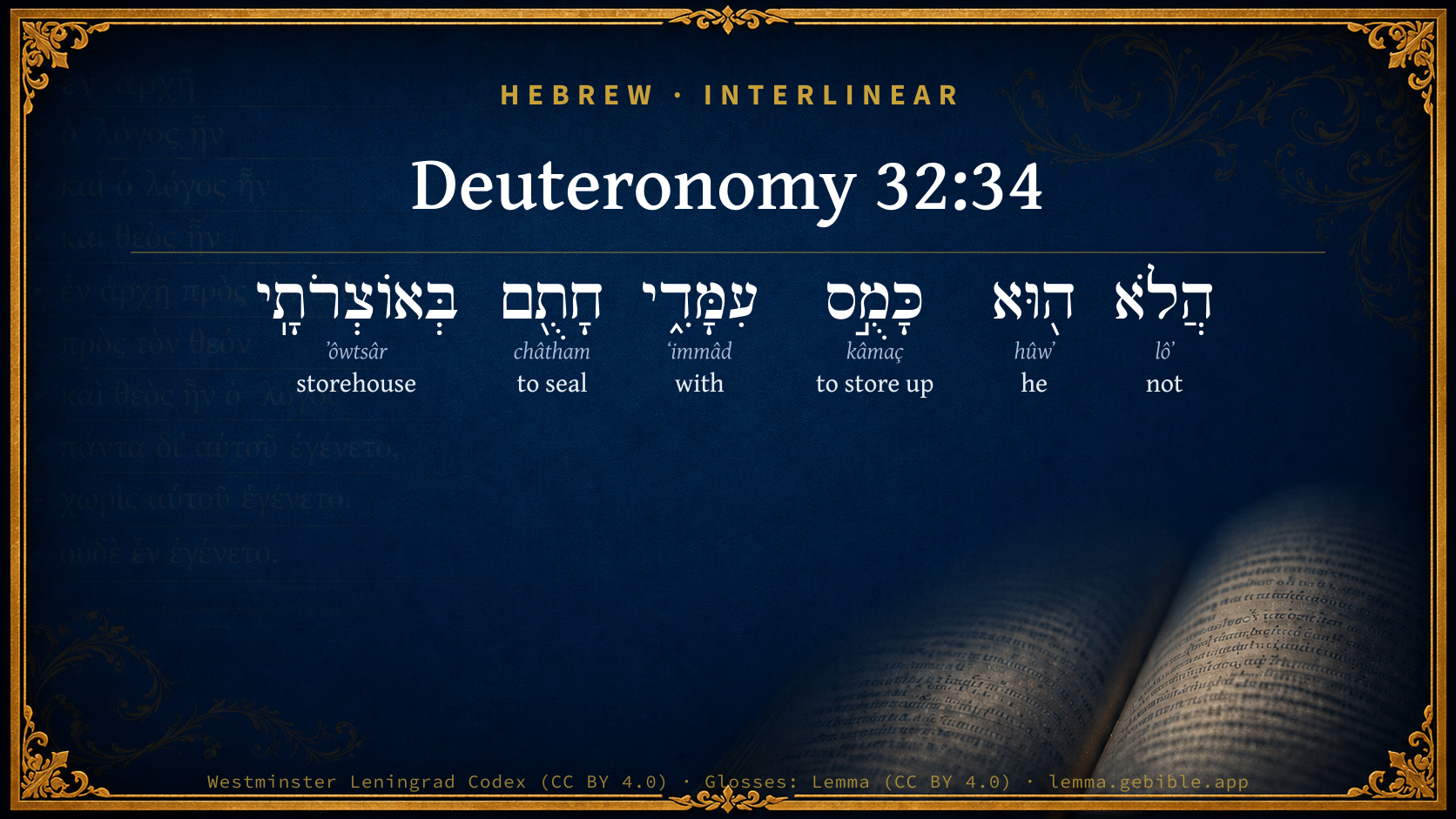
Deuteronomy 32:34

Hebrew (Westminster Leningrad Codex) Deuteronomy 32:34 appears in the Hebrew Old Testament. The text above is from the Westminster Leningrad Codex. Each word links to its Strong’s number, a concise gloss, and parsing drawn from the Open Scriptures Hebrew Bible morphology. Click any word for its full Brown-Driver-Briggs (BDB) entry.
Download image
Cite this verse

Deuteronomy 32:34 (World English Bible). Public Domain. Lemma interlinear Bible study tool, https://lemma.gebible.app/v/deuteronomy/32/34.

Show BibTeX & RIS
BibTeX
RIS
English Translation
Isn't this laid up in store with me, Sealed up among my treasures?
World English Bible · Public Domain
Highlights
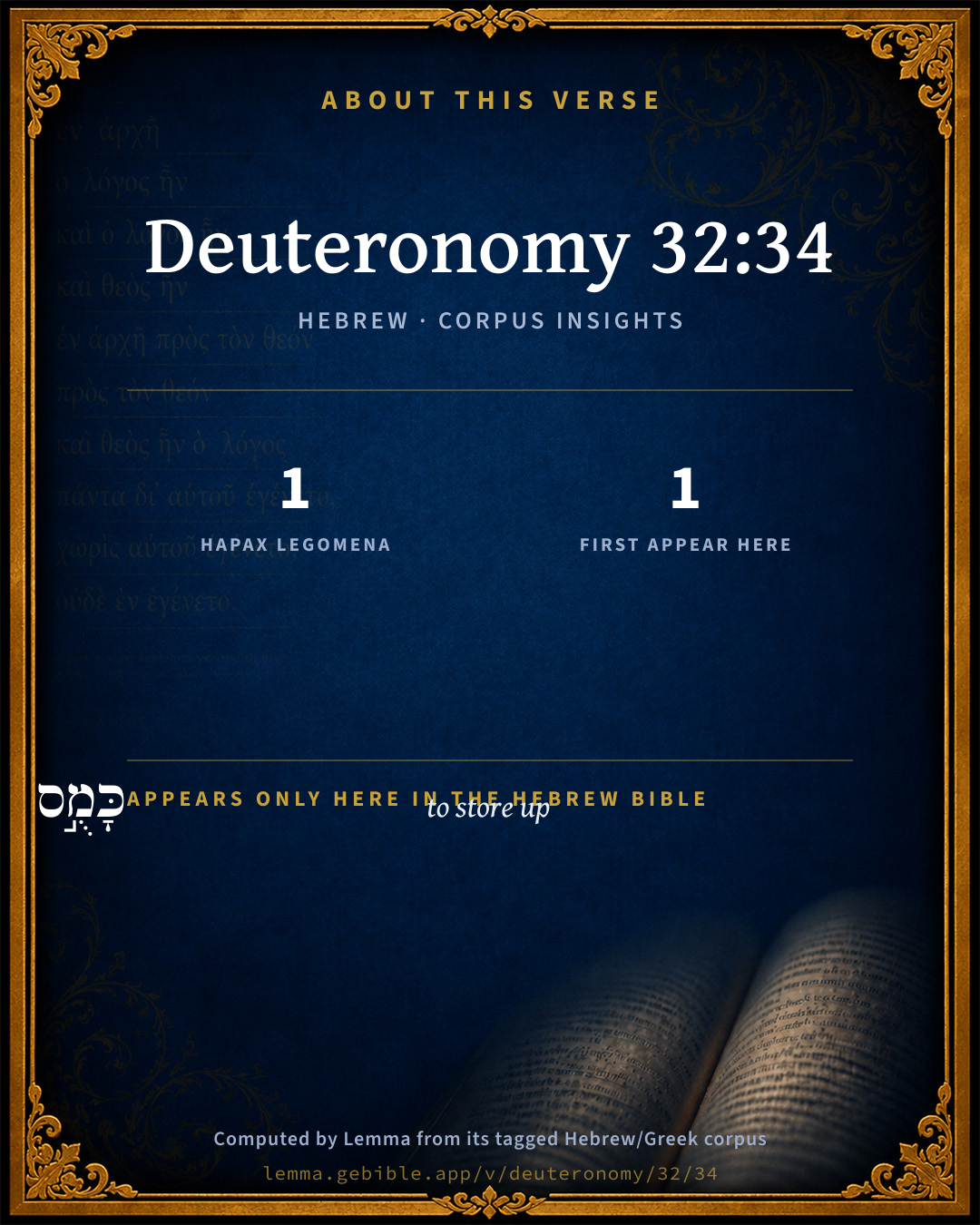
  • 1 hapax legomenon — only here in the Hebrew Bible
  • 1 first appearance in the Hebrew Bible
Full analysis ↓
Download a study sheet

One document with this verse’s original text, its word-by-word gloss line, the meaning frame, cross-references with their text, attributed commentary, and full source and license credits — printable, and it pastes into notes with its structure intact.

This verse Autodidact and up

Study sheet (.html) Plain text (.txt)

A passage Seminary Student

Up to 50 verses in one chapter. A passage sheet keeps up to 6 commentary sources and 12 cross-references per verse, in the order this page ranks them, and says so on the sheet whenever that leaves anything out. Ask for a single verse and you get the Autodidact verse sheet above.

Everything on this page stays free to read, with no account — the sheet is a download of what is already on screen, not access to it.

Want to remove ads? Support Godless Engineer
Compare translations 3

The same verse in 3 English versions, stacked beneath the original-language interlinear above. Click any original word for its lexicon entry.

Each is an independent rendering of the whole verse — the interlinear is not word-aligned to these translations.

Highlighted words mark where these versions differ — a whole-verse word diff, not a word-by-word alignment.

  • World English Bible Public Domain
    Isn't this laid up in store with me, Sealed up among my treasures?
  • King James Version Public Domain
    Is not this laid up in store with me, and sealed up among my treasures?
  • unfoldingWord Literal Text CC BY-SA 4.0
    ‘Is it not concealed with me, sealed up among my treasures?

unfoldingWord Literal Text — © unfoldingWord, licensed CC BY-SA 4.0. Word-aligned USFM3 via Door43 (git.door43.org/unfoldingWord/en_ult).

Versions to compare (up to 4)

3 of 4 selected

Show all 18 translations

Every available English version of this verse, each an independent rendering of the whole verse.

  • World English Bible Public Domain
    Isn't this laid up in store with me, Sealed up among my treasures?
  • Berean Standard Bible Public Domain
    “Have I not stored up these things, sealed up within My vaults?
  • Majority Standard Bible Public Domain
    “Have I not stored up these things, sealed up within My vaults?
  • King James Version Public Domain
    Is not this laid up in store with me, and sealed up among my treasures?
  • American Standard Version (1901) Public Domain
    Is not this laid up in store with me, Sealed up among my treasures?
  • Revised Version (1885) Public Domain
    Is not this laid up in store with me, Sealed up among my treasures?
  • Geneva Bible (1599) Public Domain
    Is not this laide in store with me, and sealed vp among my treasures?
  • Douay-Rheims (1899) Public Domain
    Are not these things stored up with me, and sealed up in my treasures?
  • Young's Literal Translation Public Domain
    Is it not laid up with Me? Sealed among My treasures?
  • Literal Standard Version CC BY-SA 4.0
    Is it not laid up with Me? Sealed among My treasures?
  • Unlocked Literal Bible CC BY-SA 4.0
    Is not this plan secretly kept by me, sealed up among my treasures?
  • unfoldingWord Literal Text CC BY-SA 4.0
    ‘Is it not concealed with me, sealed up among my treasures?
  • Darby Bible Public Domain
    Is not this hidden with me, Sealed up among my treasures?
  • World Messianic Bible Public Domain
    “Isn’t this laid up in store with me, sealed up among my treasures?
  • Webster's Bible Public Domain
    Is not this laid up in store with me, and sealed up among my treasures?
  • Free Bible Version CC BY-SA 4.0
    I've stored this all up; it's sealed in my vaults.
  • Bible in Basic English Public Domain
    Is not this among my secrets, kept safe in my store-house?
  • JPS Tanakh (1917) Public Domain
    'Is not this laid up in store with Me, sealed up in My treasuries?

Literal Standard Version (2020), Covenant Press — licensed CC BY-SA 4.0. Text via the HelloAO Bible API (eBible.org). Unlocked Literal Bible (unfoldingWord) — licensed CC BY-SA 4.0. Text via the HelloAO Bible API (eBible.org). unfoldingWord Literal Text — © unfoldingWord, licensed CC BY-SA 4.0. Word-aligned USFM3 via Door43 (git.door43.org/unfoldingWord/en_ult). Free Bible Version, Dr. Jonathan Gallagher — licensed CC BY-SA 4.0. Text via the HelloAO Bible API (eBible.org).

Word by word

More ways to search: Search by grammar → Find every occurrence → Compare this word →

Practice this passage: Drill this verse → Learn its vocabulary →

About this verse

These counts appear in no published source. They are computed here, from the morphology-tagged text and Lemma’s own curated glosses. What Lemma adds →

6
words
6
distinct lemmas
Pentateuch
section

Notable vocabulary

1 hapax legomenon — a word that appears only here in the entire Hebrew Bible:

  • כָּמֻ֣ס to store up H3647

First appearance in Scripture

This word makes its first canonical appearance in the Hebrew Bible here:

  • כָּמֻ֣ס to store up H3647

Shared distinctive vocabulary

חָתֻ֖ם to seal H2856 occurs in 24 verses of the Hebrew Bible. Also found in:

Grammatical profile

  • 2 verbs
  • 1 noun
  • 1 pronoun
  • 1 preposition
  • 1 particle

Verb forms

  • כָּמֻ֣ס Qal · Participle Passive
  • חָתֻ֖ם Qal · Participle Passive

Hebrew & Septuagint length

In English translation the verse runs 13 words from the Hebrew and 14 from the Septuagint (LXX English) — closely comparable.

A rough comparison of the two English renderings, which tokenize alike — not a word-level alignment.

Word counts can differ between the Hebrew and the Greek without any difference in meaning — e.g. the Hebrew direct-object marker אֵת has no separate Greek word, and Greek often adds the article ὁ.

Cross-references

6

Topical passages linked to Deuteronomy 32:34 in the Treasury of Scripture Knowledge — connected by theme and wording, ordered by reader-vote popularity; previews shown in the World English Bible.

  • Job 14:17 My disobedience is sealed up in a bag. You fasten up my iniquity.
  • Hosea 13:12 The guilt of Ephraim is stored up. His sin is stored up.
  • Jeremiah 2:22 For though you wash yourself with lye, and use much soap, yet your iniquity is marked before me, says the Lord Yahweh.
  • Romans 2:5 But according to your hardness and unrepentant heart you are treasuring up for yourself wrath in the day of wrath, revelation, and of the righteous judgment of God;
  • 1 Corinthians 4:5 Therefore judge nothing before the time, until the Lord comes, who will both bring to light the hidden things of darkness, and reveal the counsels of the hearts. Then each man will get his praise from God.
  • Revelation 20:12–13 I saw the dead, the great and the small, standing before the throne, and they opened books. Another book was opened, which is the book of life. The dead were judged out of the things which were written in the books, according to their works.

Cross-references courtesy of OpenBible.info (CC BY 4.0).

Hebrew and Greek witnesses Masoretic Hebrew ↔ Greek Septuagint

The same verse in the two great witnesses to the Old Testament, shown verse-for-verse.

These are two independent witnesses, not word-aligned to each other, and the Septuagint is shown in lemma (dictionary) form.

Hebrew Deuteronomy 32:34 Masoretic · Westminster Leningrad Codex

הֲלֹא ה֖וּא כָּמֻ֣ס עִמָּדִ֑י חָתֻ֖ם בְּאוֹצְרֹתָֽי

Isn't this laid up in store with me, Sealed up among my treasures?

World English Bible · Public Domain

Greek LXX Deuteronomy 32:34 Septuagint · lemma form

οὐ ἰδού οὗτος συνἄγω παρά ἐγώ καί σφραγίζω ἐν ὁ θησαυρός ἐγώ

Behold! are not these things stored up by me, and sealed among my treasures?

LXX2012 (modern English Septuagint) · Public Domain

On this verse, John Gill's Exposition discusses the Septuagint’s reading. Read the note in Commentary ↓

Hebrew: Westminster Leningrad Codex (CC BY 4.0). Greek: Septuagint (public domain); English from LXX2012 (modern English Septuagint) (Public Domain). How the Septuagint differs from the Hebrew →

Targum (Aramaic paraphrase)

2

The Targum is the ancient Jewish Aramaic paraphrase of the Hebrew Scriptures — an interpretive translation, not the Hebrew text itself. Onkelos (literal) and Pseudo-Jonathan (expansive) render the Torah, and Jonathan the Prophets. Coverage is partial: where no permissively-licensed English translation exists for a verse, only the Aramaic is shown. This is verse-level text, not a word-by-word alignment to the Hebrew.

  1. Targum Onkelos Torah (Genesis–Deuteronomy)
    הֲלָא כָל עוֹבָדֵיהוֹן גְלָן קֳדָמַי גְנִיזִין לְיוֹם דִינָא בְּאוֹצְרָי

    (no public-domain English translation for this verse)

    Targum Onkelos — Aramaic: “Onkelos Genesis” (public domain); “Onkelos Exodus” (public domain); “Onkelos Leviticus” (public domain); “Onkelos Numbers” (public domain); “Onkelos Deuteronomy” (public domain). English: “Sefaria Community Translation” (CC0 1.0 (public-domain dedication)); “J.W. Etheridge. The Targums of Onkelos and Jonathan Ben Uzziel on the Pentateuch. London: Longmans, Green, 1862” (public domain). Text via Sefaria.

  2. Targum Pseudo-Jonathan Torah (Genesis–Deuteronomy)
    הֲלָא עוֹבָדֵיהוֹן דְאִנוּן עַבְדִין בְּטוּמְרָא קֳדָמַי כּוּלְהוֹן גַלְיָין חֲתִימִין וּמְתַקְנֵי בְּאַפּוֹתִיקַיֵי

    Are not their secret works all known before Me? Sealed and laid up Are they in My treasury!

    Targum Pseudo-Jonathan — Aramaic: “Targum Jonathan on Genesis” (public domain); “Targum Jonathan on Exodus” (public domain); “Targum Jonathan on Leviticus” (public domain); “Targum Jonathan on Numbers” (public domain); “Targum Jonathan on Deuteronomy” (public domain). English: “The Targum of Jonathan ben Uzziel, trans. J. W. Etheridge, London, 1862” (public domain). Text via Sefaria.

Commentary

Notes on Deuteronomy 32:34 from classic Christian and Jewish commentators (each source and its license shown beneath its notes). The classic Christian expositions comment on the surrounding passage and are grouped to its opening verse, so a note may address several verses; the Jewish commentaries on the Tanakh (Rashi and others) are per-verse, so they appear only where the commentator wrote on this verse.

Lemma curates 59 commentaries, every one of them public domain or Creative Commons licensed, each selected and text-cleaned for this edition rather than reprinted as found. About our sources →

Trapp's Complete Commentary

John Trapp

Deu 32:34 [Is] not this laid up in store with me, [and] sealed up among my treasures?

Ver. 34. Is not this laid up in store?] To wit, for just punishment, though for a while I forbear them. The wicked man is like a thief, which having stolen a horse, rides away well mounted, till, overtaken by hue and cry, he is apprehended, sentenced, and executed. "Your sin will find you out" as a bloodhound; Et patientia Dei erga impios quo diuturnior, eo minacior. Morae dispendium faenoris duplo pensatur; the longer God forbears, the heavier he punishes. {a}

{a} Jerome, in Jerem,

John Trapp, A Commentary or Exposition upon All the Books of the Old and New Testament (1647–1656) — public domain. Text from a community e-Sword module.

Joseph Benson's Commentary

Deu 32:34. Is not this laid up in store with me? — That is, all their wickedness spoken of before, or the vengeance he is going to mention in the following verses. This, by Le Clerc, and many others, is referred to the vengeance which God would inflict on the enemies of the Jews. But surely the verses with which it is immediately connected, whether preceding or following, render it much more probable that the vengeance which should come on the Jews themselves, is intended, as if he had said, My long- suffering toward them may make them think I have forgotten their sins: but I remember them punctually. They are sealed up as in a bag, (Job 14:17,) and as men seal up their treasures. Or, the allusion may be to deeds signed and sealed, and kept safely in a cabinet, though not presently executed, and in that case the meaning will be that the execution of the vengeance was a thing notified and determined in the mind of God, but that the time was reserved with him as a profound secret, known only to himself.

Joseph Benson's Commentary on the Old and New Testaments (1811–1818) — public domain. Text from a community e-Sword module.

Tyndale Open Study Notes

Tyndale Open Resources

32:34 Metaphorically, my treasury is the place where God, as Divine Warrior, lays up his implements of war and judgment until the time comes for them to be put to use (see 1:30).

Tyndale Open Study Notes — © Tyndale Open Resources, licensed CC BY-SA 4.0. Text via the HelloAO Bible API.

Adam Clarke's Commentary

Verse 34. Sealed up among my treasures?] Deeds or engagements by which persons were bound at a specified time to fulfil certain conditions, were sealed and laid up in places of safety; so here God's justice is pledged to avenge the quarrel of his broken covenant on the disobedient Jews, but the time and manner were sealed in his treasures, and known only to himself. Hence it is said:-

Adam Clarke's Commentary on the Bible (1810–1826) — public domain. Text from a community e-Sword/MySword module.

Ellicott's Commentary for English Readers

(34) Is not this laid up?—“This” is generally taken to refer to what follows, but it is not clear. It may refer to the fact that “He looked for grapes, and the vine brought forth wild grapes.”

A Bible Commentary for English Readers, edited by Charles John Ellicott (1878–1897) — public domain. Text from a community e-Sword module.

The Cambridge Bible for Schools and Colleges

gen. ed. J. J. S. Perowne

34. laid up] Heb. kamus not found elsewhere, and probably misread for kanus, gathered, collected. In next line read treasuries.

34–43. It is Destined for Israel’s Foes

34 Is all that not stored with me,

Sealed in my treasuries,

35 For the day of revenge and requital,

What time their foot shall slip.

Yea, near is their day of disaster,

And destiny rushes upon them.

The Cambridge Bible for Schools and Colleges (gen. ed. J. J. S. Perowne; Cambridge University Press, 1878–1918) — public domain. Text from a community e-Sword module.

John Gill's Exposition

To me belongeth vengeance and recompense,.... Or, I will repay, or recompence, as it is quoted in Rom 12:19; and so all the three Targums, the Septuagint and Vulgate Latin versions, here, and so Jarchi interprets it. Vengeance belongs only to a divine Person, not to an Heathen deity called Dice, or vengeance, Act 28:4; nor to Satan and his spiteful angels, nor to any of the sons of men in a private capacity; though magistrates, being in public office, and representing God, are revengers to execute wrath on them that do evil, Rom 13:4; otherwise it is peculiar to God; and there is a great deal of reason to believe he will recompence it, as it may be concluded from his hatred of sin, his strict justice, and his faithfulness to his threatenings as well as his promises; from the instances of his vengeance on the old world, on Sodom and Gomorrah, and others; and from his taking vengeance on the inventions even of good men, whose sins he pardons, and especially from his sparing his own Son, when standing in the legal place and, stead of sinners: and this is applicable to Christ, who not only in the days of his flesh took vengeance Satan, and his principalities and powers; and, when he came in his kingdom and power, took vengeance on the Jews his enemies, who would not have him to rule over them; but also, at his spiritual coming, he will take vengeance on antichrist, whom he will destroy with the breath of his mouth, and send that son of perdition into the perdition appointed for him; and pour out the vials of his wrath on all the antichristian states, the time of which is next pointed at:

their foot shall slide in due time; there is a time fixed for the reign of antichrist, when it will end, forty two months, or 1260 days; that is, so many years; see Rev 11:2; and a little before the expiration of them, his foot will begin to slide, as the slipping of the foot is just before a fall; and then will the foot of antichrist slip and slide, when the witnesses slain by him shall revive and stand upon their feet, and cause fear to fall on them that are on the earth; and when they shall ascend up into heaven, or rise to superior power and authority, greatness and splendour, than they formerly had, and this in the sight of their enemies; and when there will be earthquakes and revolutions in the several antichristian states; and the tenth part of the great city shall fall, and many persons of renown be slain, and others frightened, and will give glory to the God of heaven; when an angel, or a set of Gospel ministers, shall fly in the midst of heaven, with the everlasting Gospel, to preach to all nations; which will be immediately followed by another, saying, Babylon is fallen, is fallen; when the kings of the earth will dislike and resent various things done by the pope of Rome, and shall hate him, and meditate his ruin, and then may his foot be said to slide; see. Rev 11:11,

for the day of their calamity is at hand; a cloudy day, as the word signifies, when the kingdom of the beast will be full of darkness and confusion, Rev 16:10; and when all those calamities shall come upon Babylon, expressed in Rev 14:8,

and the things that shall come upon them make haste; even all those evil things God has determined in his counsels and purposes, and which are foretold in prophecy, these shall come upon antichrist in haste; for, though his judgment and damnation may seem to linger and slumber, it shall not; God will hasten it in his due time, and all his judgments will come on Babylon in one day, Rev 18:8.

John Gill's Exposition of the Whole Bible (1746–1763) — public domain (CC PDM 1.0). Text via the HelloAO Bible API.

Haydock's Catholic Bible Commentary

Treasures. Whether we refer to the preceding remarks to the faithless Israelites, whose corruption was less pardonable, as they had received so many favours from above, or to their proud and cruel enemies, who exceeded the bounds of moderation in their wars, God keeps an exact account of all, and will shortly punish both according to their deserts. (Haydock)

George Leo Haydock (1774–1849), Haydock's Catholic Family Bible and Commentary, 1859 edition — public domain. Excludes Psalms (Douay-Rheims chapter numbering differs from Protestant) and Deuterocanonical books (Catholic canon only).

Matthew Poole's English Annotations

i.e. All their wickedness mentioned before. My longsuffering towards them may make them and others think that I have forgotten their sins, but I remember them punctually, they are sealed up as in a bag, Job 14:17, and as men seal up their treasures that nothing be lost; and I shall bring them to their remembrance also.

Matthew Poole's English Annotations on the Holy Bible (1683–1685) — public domain. Text from a community e-Sword/MySword module.

Whedon's Commentary on the Bible

Daniel D. Whedon

34. Is not this laid up in store with me — The thought designed to be expressed is, that God’s time for punishment is decided upon, but not yet revealed. It is hidden in his treasure-chambers, for so the words translated treasures in our version might better be rendered.

Daniel D. Whedon (gen. ed.), Commentary on the Old and New Testaments (1874–1909) — public domain. Text from a community e-Sword module.

The Pulpit Commentary

Vers. 34-43. Notwithstanding the iniquity of Israel and the judgments that should come upon them, God would have compassion upon them for his Name"s sake, and would appear for their vindication and defense. The "this" in ver. 34 is by some understood of the sinful doings of the Israelites which God should not forget or overlook. So the Targum of Onkelos: "Are not all their works manifest before me, kept against the day of judgment in my treasures?" So also Calvin, Quanquam de poenis hunc versum quidam exponunt, acsi Deus assereret diversas earum species apud se paratas esse, quas depromat quoties libuerit: rectius tamen est de sceleribus intelligere." But there is a more "comprehensive reference here. Not only the deeds of the transgressors, but the judgments that should come on Israel, and also God"s interposition on their behalf, were laid up in store with him, and sealed up among his treasures. All that had been done had been noted, and all that should happen was decreed, and should certainly come to pass. The "this" has thus both a retrospective and a prospective reference; it includes both the sin of the nation and God"s dealing with them afterwards, as well as his judgments on their enemies.

My treasures. God"s treasures contain not only a store of blessing, but also instruments of punishment, which as he sees meet, he sends forth on men. (cf. Deu_28:12; Job_38:22, Job_38:23; Psa_135:7)

Vers. 34-43. Retribution.

I VENGEANCE A PREROGATIVE OF DEITY. As just Judge of the earth, God must avenge transgression. Vengeance is to be distinguished from personal vindictiveness. Of that God is incapable. But Scripture, supported by reason and conscience, attributes to him a holy and inflexible determination to punish sin to visit on the wrong-doer the consequences of his transgression. The rule for individuals is, "Avenge not yourselves," etc.; but the reason for this is not that vengeance is unnecessary, but that God will avenge. (Rom_12:18) Magistrates, however, bear from God a certain delegated power to punish public offences to "avenge". (Rom_13:4) He who "takes away vengeance from God, at the same time takes it from God"s servant, the magistracy, which carries the sword of vengeance over evil-doers" (Hengstenberg). God has his own time, as well as his own way, of avenging sin, and it is not for man to anticipate this.

II VENGEANCE ASSUREDLY IN STORE FOR GOD"S ENEMIES. However delayed by forbearance. Because judgment is not executed speedily, sinners take confidence. (Ecc_8:11; 2Pe_3:9, 2Pe_3:10) But the sleepless eye of God is all the while upon them, and the stroke falls when they are least expecting it. Sooner or later, every transgression and disobedience will meet with its due recompense of reward.

Note:

1. "Judgment begins at the house of God". (vers. 35, 36; 1Pe_4:17)

2. It will ultimately extend to all who are God"s enemies (vers. 41, 42). We are taught that the Messianic kingdom will be established on earth amidst mighty displays of judgment. (Rev_19:11-21) There will follow the general judgment of quick and dead day of wrath, that dreadful day which will complete the work.

God"s vengeance is:

1. Assured. "As I live," etc. (ver. 40).

2. Terrible. "My glittering sword;" "arrows drunk with blood," etc.

3. No escape from it (ver. 39).

III JUDGMENTS EMPLOYED TO CONVINCE BACKSLIDERS OF THEIR SINS. They tend:

1. To break up false confidences (vers. 37, 38).

2. To create a feeling of the need of God"s help (ver. 39).

3. To convince of the folly of past conduct.

God compassionates even while he punishes (ver. 36). He would fain, through judgment, break a way for mercy. Illustrate this use of judgments from Israel in time of the judges, or from case of Manasseh. (2Ch_33:11-14) This one use of the present exile. May we hope that the day of God"s "repenting himself" toward Israel is drawing near!

IV THE RECOVERY OF ISRAEL THE INAUGURATION OF A TIME OF BLESSING TO THE WORLD. The nations are to share in the joy (ver. 43). God is to be merciful to his land and people. The latter-day glory includes the conversion of the Gentiles. J.O. (Ro 11)

The Pulpit Commentary (1880–1919), ed. H.D.M. Spence-Jones & Joseph S. Exell — public domain. Text from a community e-Sword module.

John Wesley's Explanatory Notes

This - All their wickedness mentioned before. My long suffering towards them may make them think I have forgotten their sins, but I remember them punctually, they are sealed up as in a bag, Job xiv, 17, and as men seal up their treasures.

John Wesley, Explanatory Notes Upon the Whole Bible (1754–1765) — public domain. Text via the GEBible commentary corpus.

Rashi

Rabbi Shlomo Yitzchaki (Rashi)

הלא הוא כמס עמדי IS NOT THIS LAID UP IN STORE WITH ME — Understand this as the Targum has it: (“Are not all their doings open before me?”) — i.e., they believe that I have forgotten their doings, but really they are all stored up and kept with Me.

הלא הוא IS NOT THIS — the fruit of their vine and the produce of their fields (i.e. their doings) כמס עמדי STORED UP WITH ME?

Rashi on the Tanakh — English translations: “The Judaica Press complete Tanach with Rashi, translated by A. J. Rosenberg” (CC BY 4.0); “Pentateuch with Rashi's commentary by M. Rosenbaum and A.M. Silbermann, 1929-1934” (public domain); “The Metsudah Tanach series, Lakewood, N.J” (CC BY 4.0); and “The Book of Joshua, Metsudah Publications, 1997” (CC BY 4.0). Text via Sefaria.

Ramban (Nachmanides)

Rabbi Moshe ben Nachman (Ramban / Nachmanides)

IS NOT THIS LAID UP IN STORE WITH ME — their cruel poison of asps? I have put it in My treasures to feed them from the fruit of their deeds.

Ramban (Nachmanides) on the Tanakh — English translation: “Commentary on the Torah by Ramban (Nachmanides). Translated and annotated by Charles B. Chavel. New York, Shilo Pub. House, 1971-1976” (CC BY 4.0). Text via Sefaria.

Lesson kit

Teaching starters — assembled from the data on this page, not authored interpretation. Every prompt links to the verse data it draws on. Edit before teaching.

Deuteronomy, in the Pentateuch, opens this verse with 6 words (6 distinct Hebrew lemmas). Its most distinctive word is kâmaç (“to store up”). A historical commentator’s framing appears above. Read the whole chapter for the surrounding context.

Discussion questions

  1. What does “to store up” (kâmaç) contribute to the verse as a whole?
  2. 1 word here appears nowhere else in the Hebrew Bible. Why might the author reach for such rare wording?
  3. This is the first place “to store up” appears in Scripture (first appears here). What does its debut here establish?
  4. How does Leviticus 15:3, which shares the word «to seal», read alongside this verse?
  5. These translations render this verse differently; the difference is in the English rendering, not the original. What questions does that raise?
  6. «כָּמֻ֣ס» is a Qal Participle Passive verb. How does that grammatical form shape the action described?
  7. Compare how Trapp's Complete Commentary and Joseph Benson's Commentary read this verse. Where do they agree or differ?

Things to notice

  • 1 word in this verse appears nowhere else in the Hebrew Bible.
  • 1 word makes its first canonical appearance in Scripture here.
  • These translations choose different wording for 4 words in this verse.
  • 6 distinct Hebrew lemmas span 6 words in this verse.

Reading settings

Reading text

Shown beneath each verse's original-language words.

Old Testament
Old Testament edition

Read the OT as the Masoretic Hebrew (MT) or the Greek Septuagint (LXX).

English shown for the Greek Septuagint (in the Hebrew ↔ Greek comparison).

Comparing translations? Open the Compare panel on any verse page to stack up to four side by side.