Amos 7:13

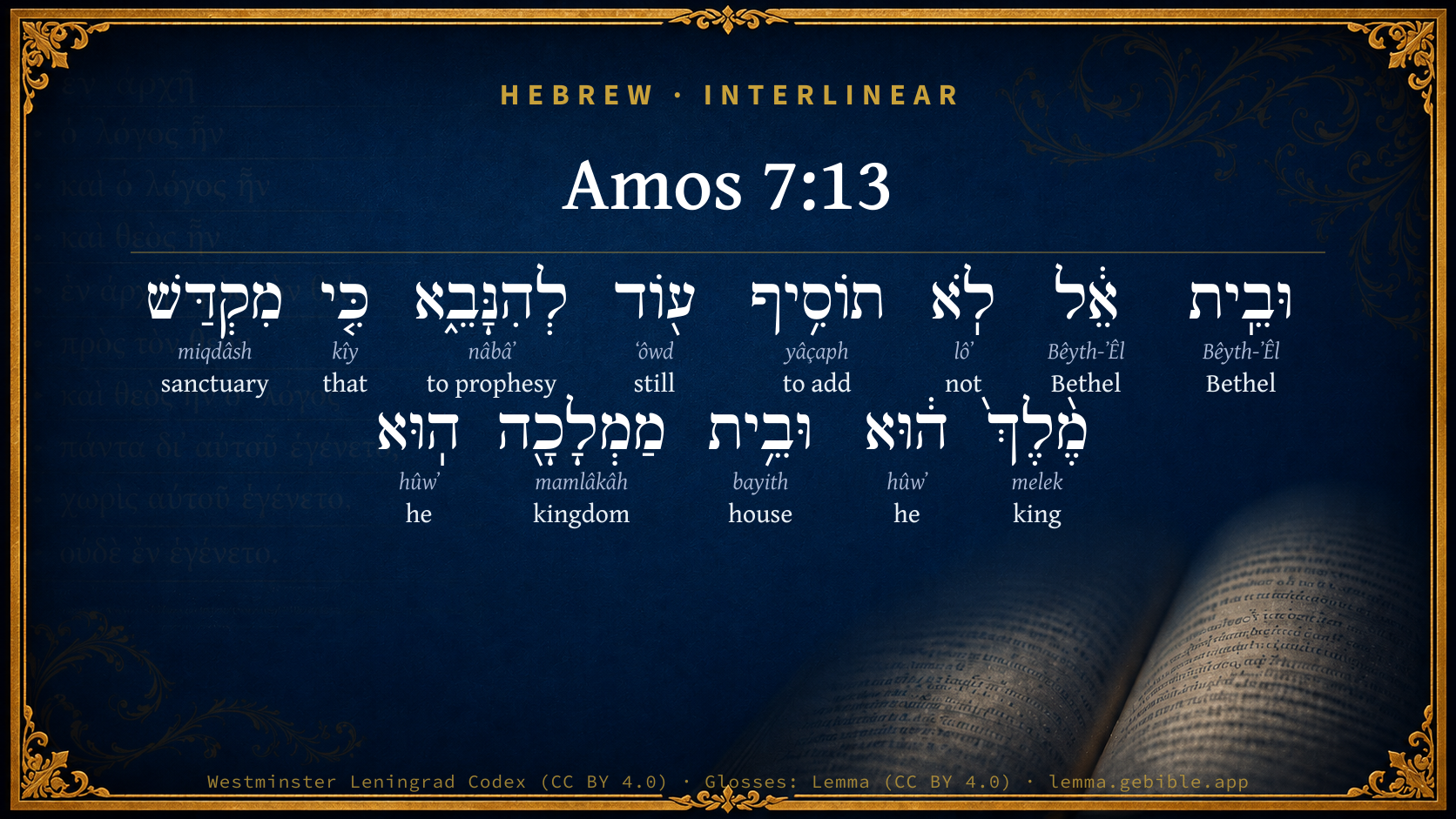
Hebrew (Westminster Leningrad Codex) Amos 7:13 appears in the Hebrew Old Testament. The text above is from the Westminster Leningrad Codex. Each word links to its Strong’s number, a concise gloss, and parsing drawn from the Open Scriptures Hebrew Bible morphology. Click any word for its full Brown-Driver-Briggs (BDB) entry.
Download image
Cite this verse

Amos 7:13 (World English Bible). Public Domain. Lemma interlinear Bible study tool, https://lemma.gebible.app/v/amos/7/13.

Show BibTeX & RIS
BibTeX
RIS
English Translation
but don't prophesy again any more at Bethel; for it is the king's sanctuary, and it is a royal house!"
World English Bible · Public Domain
Download a study sheet

One document with this verse’s original text, its word-by-word gloss line, the meaning frame, cross-references with their text, attributed commentary, and full source and license credits — printable, and it pastes into notes with its structure intact.

This verse Autodidact and up

Study sheet (.html) Plain text (.txt)

A passage Seminary Student

Up to 50 verses in one chapter. A passage sheet keeps up to 6 commentary sources and 12 cross-references per verse, in the order this page ranks them, and says so on the sheet whenever that leaves anything out. Ask for a single verse and you get the Autodidact verse sheet above.

Everything on this page stays free to read, with no account — the sheet is a download of what is already on screen, not access to it.

Want to remove ads? Support Godless Engineer
Compare translations 3

The same verse in 3 English versions, stacked beneath the original-language interlinear above. Click any original word for its lexicon entry.

Each is an independent rendering of the whole verse — the interlinear is not word-aligned to these translations.

Highlighted words mark where these versions differ — a whole-verse word diff, not a word-by-word alignment.

  • World English Bible Public Domain
    but don't prophesy again any more at Bethel; for it is the king's sanctuary, and it is a royal house!"
  • King James Version Public Domain
    But prophesy not again any more at Bethel: for it is the king's chapel, and it is the king's court.
  • unfoldingWord Literal Text CC BY-SA 4.0
    But you must never again prophesy here at Bethel, for it is the king’s sanctuary, and it is a royal house.”

unfoldingWord Literal Text — © unfoldingWord, licensed CC BY-SA 4.0. Word-aligned USFM3 via Door43 (git.door43.org/unfoldingWord/en_ult).

Versions to compare (up to 4)

3 of 4 selected

Show all 18 translations

Every available English version of this verse, each an independent rendering of the whole verse.

  • World English Bible Public Domain
    but don't prophesy again any more at Bethel; for it is the king's sanctuary, and it is a royal house!"
  • Berean Standard Bible Public Domain
    But never prophesy at Bethel again, because it is the sanctuary of the king and the temple of the kingdom.”
  • Majority Standard Bible Public Domain
    But never prophesy at Bethel again, because it is the sanctuary of the king and the temple of the kingdom.”
  • King James Version Public Domain
    But prophesy not again any more at Bethel: for it is the king's chapel, and it is the king's court.
  • American Standard Version (1901) Public Domain
    but prophesy not again any more at Beth-el; for it is the king's sanctuary, and it is a royal house.
  • Revised Version (1885) Public Domain
    but prophesy not again any more at Beth-el: for it is the king’s sanctuary, and it is a royal house.
  • Geneva Bible (1599) Public Domain
    But prophecie no more at Beth-el: for it is the Kings chappel, and it is the Kings court.
  • Douay-Rheims (1899) Public Domain
    But prophesy not again any more in Bethel: because it is the king's sanctuary, and it is the house of the kingdom.
  • Young's Literal Translation Public Domain
    and `at' Beth-El do not add to prophesy any more, for it `is' the king's sanctuary, and it `is' the royal house.'
  • Literal Standard Version CC BY-SA 4.0
    and no longer prophesy [at] Beth-El anymore, for it [is] the king’s sanctuary, and it [is] the royal house.”
  • Unlocked Literal Bible CC BY-SA 4.0
    But do not prophesy anymore here at Bethel, for it is the king's sanctuary and a royal house.”
  • unfoldingWord Literal Text CC BY-SA 4.0
    But you must never again prophesy here at Bethel, for it is the king’s sanctuary, and it is a royal house.”
  • Darby Bible Public Domain
    But prophesy not again any more at Bethel; for it is the king's sanctuary, and it is the house of the kingdom.
  • World Messianic Bible Public Domain
    but don’t prophesy again any more at Bethel; for it is the king’s sanctuary, and it is a royal house!”
  • Webster's Bible Public Domain
    But prophesy not again any more at Beth-el: for it is the king's chapel, and it is the king's court.
  • Free Bible Version CC BY-SA 4.0
    But don't ever prophesy again at Bethel, for this is where the king worships, the national Temple.”
  • Bible in Basic English Public Domain
    But be a prophet no longer at Beth-el: for it is the holy place of the king, and the king's house.
  • JPS Tanakh (1917) Public Domain
    but prophesy not again any more at Beth-el, for it is the king's sanctuary, and it is a royal house.'

Literal Standard Version (2020), Covenant Press — licensed CC BY-SA 4.0. Text via the HelloAO Bible API (eBible.org). Unlocked Literal Bible (unfoldingWord) — licensed CC BY-SA 4.0. Text via the HelloAO Bible API (eBible.org). unfoldingWord Literal Text — © unfoldingWord, licensed CC BY-SA 4.0. Word-aligned USFM3 via Door43 (git.door43.org/unfoldingWord/en_ult). Free Bible Version, Dr. Jonathan Gallagher — licensed CC BY-SA 4.0. Text via the HelloAO Bible API (eBible.org).

Word by word

More ways to search: Search by grammar → Find every occurrence → Compare this word →

Practice this passage: Drill this verse → Learn its vocabulary →

מִקְדַּשׁ
miqdâsh
H4720
“sanctuary of”
Noun, Common, Masculine, Singular, Construct
Part of Speech
Noun
Type
Common
Gender
Masculine
Number
Singular
State
Construct
Full BDB Definition

Origin: from H6942

TWOT: 1990f

sacred place, sanctuary, holy place - sanctuary - of the temple - of the tabernacle - of Ezekiel's temple - of Jehovah
  1. וּבֵֽית Bêyth-ʼÊl H1008 “and · Bethel” Conjunction + Noun, Proper
  2. אֵ֔ל Bêyth-ʼÊl H1008 “Bethel” Noun, Proper
  3. לֹֽא lôʼ H3808 “not” Particle, Negative
  4. תוֹסִ֥יף yâçaph H3254 “to add” Verb, Hiphil, Imperfect, 2nd Person, Masculine, Singular
  5. ע֖וֹד ʻôwd H5750 “still” Adverb
  6. לְהִנָּבֵ֑א nâbâʼ H5012 “to prophesy” Preposition + Verb, Niphal, Infinitive Construct
  7. כִּ֤י kîy H3588 “that” Conjunction
  8. מֶ֨לֶךְ֙ melek H4428 “king” Noun, Common, Masculine, Singular, Absolute
  9. ה֔וּא hûwʼ H1931 “he” Pronoun, Personal, 3rd Person, Masculine, Singular
  10. וּבֵ֥ית bayith H1004 “and · house of” Conjunction + Noun, Common, Masculine, Singular, Construct
  11. מַמְלָכָ֖ה mamlâkâh H4467 “kingdom” Noun, Common, Feminine, Singular, Absolute
  12. הֽוּא hûwʼ H1931 “he” Pronoun, Personal, 3rd Person, Masculine, Singular

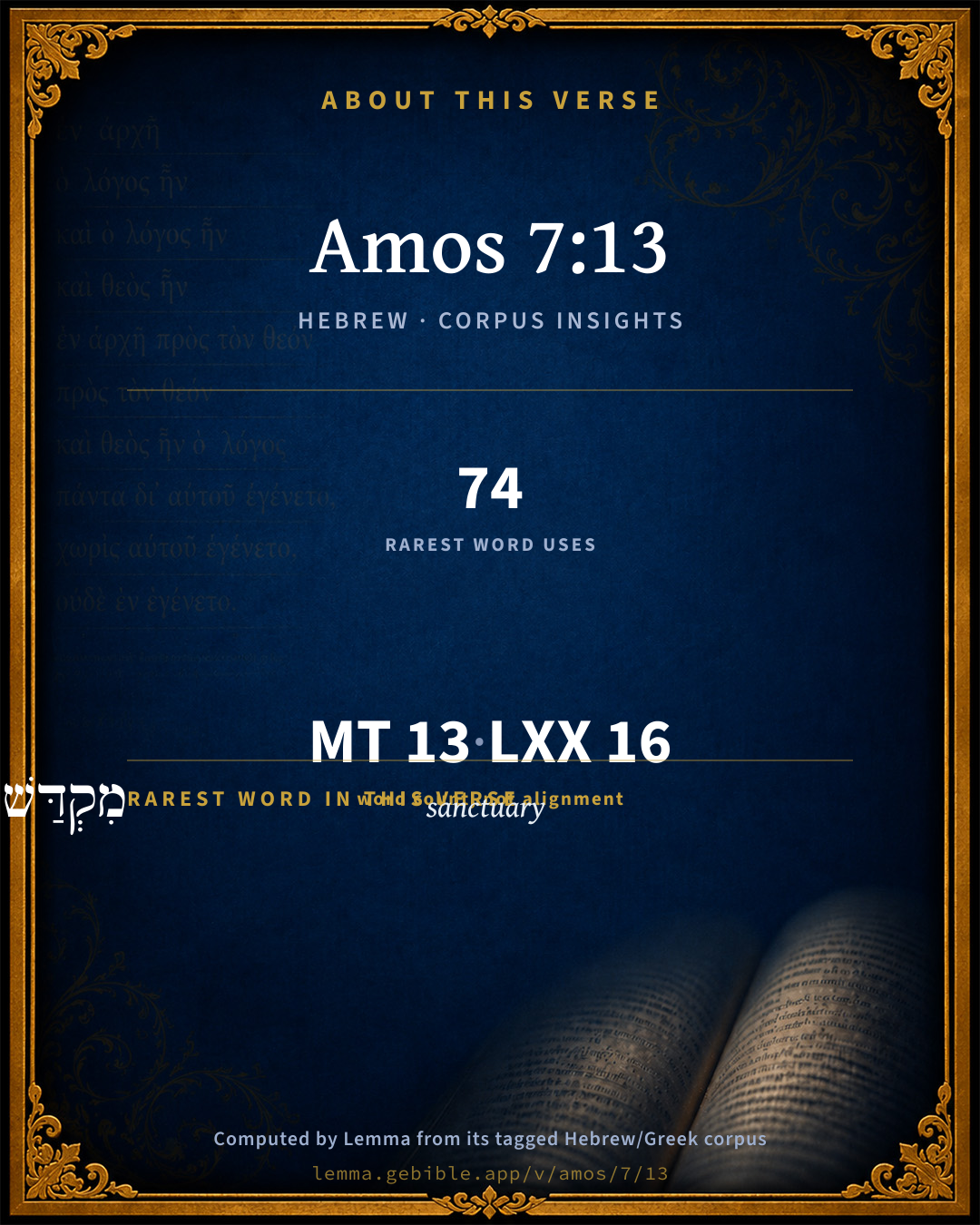
About this verse

These counts appear in no published source. They are computed here, from the morphology-tagged text and Lemma’s own curated glosses. What Lemma adds →

13
words
11
distinct lemmas
Prophets
section

Grammatical profile

  • 2 verbs
  • 6 nouns
  • 2 pronouns
  • 1 conjunction
  • 1 adverb
  • 1 particle

Verb forms

  • תוֹסִ֥יף Hiphil · Imperfect
  • לְהִנָּבֵ֑א Niphal · Infinitive Construct

Repetition

Words recur within this verse — often emphatic in Hebrew:

  • וּבֵֽית Bethel H1008 ×2
  • ה֔וּא he H1931 ×2

Hebrew & Septuagint length

In English translation the verse runs 20 words from the Hebrew and 20 from the Septuagint (LXX English) — the same length.

A rough comparison of the two English renderings, which tokenize alike — not a word-level alignment.

Word counts can differ between the Hebrew and the Greek without any difference in meaning — e.g. the Hebrew direct-object marker אֵת has no separate Greek word, and Greek often adds the article ὁ.

In the original languages it is 13 Hebrew tokens and 16 Greek tokens — but the two are counted differently (Hebrew bundles its prefixes and suffixes into one token; the Greek is in lemma form), so that isn’t a like-for-like length.

Cross-references

7

Topical passages linked to Amos 7:13 in the Treasury of Scripture Knowledge — connected by theme and wording, ordered by reader-vote popularity; previews shown in the World English Bible.

  • 1 Kings 12:32 Jeroboam ordained a feast in the eighth month, on the fifteenth day of the month, like the feast that is in Judah, and he went up to the altar; so did he in Bethel, sacrificing to the calves that he had made: and he placed in Bethel the priests of the high places that he had made.
  • Amos 2:12 "But you gave the Nazirites wine to drink, And commanded the prophets, saying, 'Don't prophesy!'
  • 1 Kings 12:29 He set the one in Bethel, and the other put he in Dan.
  • 1 Kings 13:1 Behold, there came a man of God out of Judah by the word of Yahweh to Beth El: and Jeroboam was standing by the altar to burn incense.
  • Acts 4:17–18 But so that this spreads no further among the people, let's threaten them, that from now on they don't speak to anyone in this name."
  • Acts 5:28 saying, "Didn't we strictly charge you not to teach in this name? Behold, you have filled Jerusalem with your teaching, and intend to bring this man's blood on us."
  • Acts 5:40 They agreed with him. Summoning the apostles, they beat them and charged them not to speak in the name of Jesus, and let them go.

Cross-references courtesy of OpenBible.info (CC BY 4.0).

Hebrew and Greek witnesses Masoretic Hebrew ↔ Greek Septuagint

The same verse in the two great witnesses to the Old Testament, shown verse-for-verse.

These are two independent witnesses, not word-aligned to each other, and the Septuagint is shown in lemma (dictionary) form.

Hebrew Amos 7:13 Masoretic · Westminster Leningrad Codex

וּבֵֽית אֵ֔ל לֹֽא תוֹסִ֥יף ע֖וֹד לְהִנָּבֵ֑א כִּ֤י מִקְדַּשׁ מֶ֨לֶךְ֙ ה֔וּא וּבֵ֥ית מַמְלָכָ֖ה הֽוּא

but don't prophesy again any more at Bethel; for it is the king's sanctuary, and it is a royal house!"

World English Bible · Public Domain

Greek LXX Amos 7:13 Septuagint · lemma form

εἰς δέ βαιθηλ οὐκέτι μή προςτίθημι ὁ προφητεύω ὅτι ἁγίασμα βασιλεύς εἰμί καί οἶκος βασιλεία εἰμί

but you shall no longer prophesy at Bethel: for it is the king's sanctuary, and it is the royal house.

LXX2012 (modern English Septuagint) · Public Domain

Hebrew: Westminster Leningrad Codex (CC BY 4.0). Greek: Septuagint (public domain); English from LXX2012 (modern English Septuagint) (Public Domain). How the Septuagint differs from the Hebrew →

Targum (Aramaic paraphrase)

1

The Targum is the ancient Jewish Aramaic paraphrase of the Hebrew Scriptures — an interpretive translation, not the Hebrew text itself. Onkelos (literal) and Pseudo-Jonathan (expansive) render the Torah, and Jonathan the Prophets. Coverage is partial: where no permissively-licensed English translation exists for a verse, only the Aramaic is shown. This is verse-level text, not a word-by-word alignment to the Hebrew.

  1. Targum Jonathan Prophets (Joshua–Malachi)
    וּבֵית אֵל לָא תוֹסִיף עוֹד לְאִתְנַבָּאָה אֲרֵי מִקְדָשׁ מַלְכָּא הוּא וּבֵית מַלְכוּתָא הוּא:

    (no public-domain English translation for this verse)

    Targum Jonathan — Aramaic: “Mikraot Gedolot” (public domain). English: “Sefaria Community Translation” (CC0 1.0 (public-domain dedication)); “London "Chaldee Paraphrase," 1871” (public domain). Text via Sefaria.

Commentary

Notes on Amos 7:13 from classic Christian and Jewish commentators (each source and its license shown beneath its notes). The classic Christian expositions comment on the surrounding passage and are grouped to its opening verse, so a note may address several verses; the Jewish commentaries on the Tanakh (Rashi and others) are per-verse, so they appear only where the commentator wrote on this verse.

Lemma curates 59 commentaries, every one of them public domain or Creative Commons licensed, each selected and text-cleaned for this edition rather than reprinted as found. About our sources →

Trapp's Complete Commentary

John Trapp

Amo 7:13 But prophesy not again any more at Bethel: for it [is] the king’s chapel, and it [is] the king’s court.

Ver. 13. But prophesy not any more at Bethel] Take heed of that; lest, by diffusing too much light among us, thou mar our markets, and hinder the sale of our false wares. This was the naked truth of the business; though something else was pretended, and the king’s interest pleaded.

For it is the king’s chapel, and the king’s court] Touch these mountains and they wiil smoke. Truth is a good mistress, but such of her servants as follow her too close at heels may hap to have their teeth struck out. Ahab hateth Micaiah, and Herod John Baptist, and the Pope Savonarola, for their plain dealing, laying them fast enough for it. Great ones love it, ηδιστα η ηκιστα, they must hear pleasing things; or if told of their faults, it must be done with silken words, as she said, λογοις βυδινοις. They are usually beset with their Aiones and Negones, as one hath it, that will say as they say: et mirifica est sympathia inter magnates et parasites, and there is a wonderful sympathy between kings and court parasites, as was between Ahab and the false prophets. Few Vespasians are to be found, of whom as it was said, that he was the only one who was made the better man by being made emperor, so Quintilian commendeth him for this, that he was patientissimus veri, most patient of truth, though never so sharp. Jeroboam was none such; or at least Amaziah, the priest of Bethel, would make the prophet so believe, when he tells him it is the king’s court, an ill air for truth to breathe in. Nihil veritate gravius, nihil assentatione suavius.

John Trapp, A Commentary or Exposition upon All the Books of the Old and New Testament (1647–1656) — public domain. Text from a community e-Sword module.

Tyndale Open Study Notes

Tyndale Open Resources

7:13 king’s sanctuary: According to Amaziah, the urbane and sophisticated Israelites did not appreciate the prophet. Amaziah’s loyalties were clearly to the throne; he wanted to keep the king happy in order to keep his job.

Tyndale Open Study Notes — © Tyndale Open Resources, licensed CC BY-SA 4.0. Text via the HelloAO Bible API.

Jamieson, Fausset & Brown

Robert Jamieson, A. R. Fausset & David Brown

prophesy not again-- (Amo 2:12).

at Beth-el--Amaziah wants to be let alone at least in his own residence.

the king's chapel--Beth-el was preferred by the king to Dan, the other seat of the calf-worship, as being nearer Samaria, the capital, and as hallowed by Jacob of old (Gen 28:16, Gen 28:19; Gen 35:6-7). He argues by implication against Amos' presumption, as a private man, in speaking against the worship sanctioned by the king, and that in the very place consecrated to it for the king's own devotions.

king's court--that is, residence: the seat of empire, where the king holds his court, and which thou oughtest to have reverenced. Samaria was the usual king's residence: but for the convenience of attending the calf-worship, a royal palace was at Beth-el also.

Jamieson, Fausset & Brown — Commentary Critical and Explanatory on the Whole Bible (1871) — public domain (CC PDM 1.0). Text via the HelloAO Bible API.

Adam Clarke's Commentary

Verse 13. But prophesy not - at Beth-el] He must not speak against idolatry, because that was the king's religion; and he who speaks against the king's religion must be an enemy to the state. This was the doctrine held in England by popish James II. and his insidious Jesuit hireling priests, till God in his mercy put this pitiful tyrant down, and with him his false prophets, and the degrading superstition which they endeavoured to establish in these lands.

Adam Clarke's Commentary on the Bible (1810–1826) — public domain. Text from a community e-Sword/MySword module.

John Calvin's Commentaries

Now as to the fifth argument, it is especially needful to dwell on it. In Bethel, he says, add no more to prophesy, for it is the king’s sanctuary, and it is the house of the kingdom Here only Amaziah shows what he wished, even to retain possession of his priesthood; which he could not have done without banishing the Prophet: for he could not contend with him in arguments. He consulted then his own advantage by getting rid of the Prophet. Whatever various characters therefore he assumed in the last verse, and notwithstanding the many coverings by which he concealed himself, the ape now, as they say, appears as the ape. Amaziah then shows what he had in views even that he might remain quiet in the possession of his own tyrannical powers and that Amos should no more molest him, and pull up by the roots the prevailing superstitions: for Amaziah was a priest, and Amos could not perform his office without crying out daily against the temple of Bethel; for it was a brothel, inasmuch as God was there robbed of his own honor; and we also know that superstitions are everywhere compared to fornication. Amaziah then now betrays his wicked intention, In Bethel prophesy not; he would retain his quiet state, and wished not the word of God to be heard there. His desire was, as we have already said, to extinguish everywhere the light of heavenly truth; but as he could not do this, he wished to continue at least in his own station without any disputes, as we see the case to be in our time with the Pope and his milted bishops. They became quite mad when they heard that many cities and some princes made commotions in Germany, and departed from their submission to them; but as they could not subdue them by force, they said, “Let us leave to themselves these barbarians; why, more evil than good has hitherto proceeded from them; it is a barren and dry country: provided we have Spain, France, and Italy, secured to us, we have enough; for we have probably lost more than what we have gained by Germany. Let them then have their liberty, or rather licentiousness; they will again some time return, and come under our authority: let us not in the meantime be over-anxious about them. But let not this contagion penetrate into France, for one of our arms has been already cut off; nor let Spain nor Italy be touched by it; for this would be to aim at our life.” Such also was this Amaziah, as it evidently appears, — Prophesy not then in Bethel.

And he spoke cunningly when he said, Add no more to prophecy; for it was the same as though he pardoned him. “See, though thou hast hitherto been offending the king and the common feeling of the people, I will not yet treat you with strict justice, I will forgive thee all, let what thou hast done amiss remain buried, provided thou ‘addest no more’ in future.” We hence see that there is emphasis in the expression, when he says, Proceed not, or, add not; as though he had said, that he would not inquire into the past, nor would accuse Amos of having been seditious: provided he abstained for the future, Amaziah was satisfied, as we may gather from his words, Add then no more to prophesy.

And why? Because it is the king’s sanctuary This was one thing. Amaziah wished here to prove by the king’s authority that the received worship at Bethel was legitimate. How so? “The king has established it; it is not then lawful for any one to say a word to the contrary; the king could do this by his own right; for his majesty is sacred.” We see the object in view. And how many are there at this day under the Papacy, who accumulate on kings all the authority and power they can, in order that no dispute may be made about religion; but power is to be vested in one king to determine according to his own will whatever he pleases, and this is to remain fixed without any dispute. They who at first extolled Henry, King of England, were certainly inconsiderate men; they gave him the supreme power in all things: and this always vexed me grievously; for they were guilty of blasphemy (erant blasphemi) when they called him the chief Head of the Church under Christ. This was certainly too much: but it ought however to remain buried, as they sinned through inconsiderate zeal. But when that impostor, who afterwards became the chancellor of that Proserpina, who, at this day, surpasses all devils in that kingdom — when he was at Ratisbon, he contended not by using any reasons, (I speak of the last chancellor, who was the Bishop of Winchester, ) and as I have just said, he cared not much about the testimonies of Scripture, but said that it was in the power of the king to abrogate statutes and to institute new rites, — that as to fasting, the king could forbid or command the people to eat flesh on this or that days that it was lawful for the king to prohibit priests from marrying, that it was lawful for the king to interdict to the people the use of the cup in the Supper, that it was lawful for the king to appoint this or that thing in his own kingdom. How so? because supreme power is vested in the king. The same was the gloss of this Amaziah of whom the Prophet now speaks: It is the sanctuary of the king.

But he adds afterwards a second thing, It is the house of the kingdom These words of Amaziah ought to be well considered. He says first, It is the king’s sanctuary, and then, It is the house of the kingdom. Hence he ascribes to the king a twofold office, — that it was in his power to change religion in any way he pleased, — and then, that Amos disturbed the peace of the community, and thus did wrong to the king by derogating from his authority. With regard to the first clause, it is indeed certain that kings, when they rightly discharge their duty, become patrons of religion and supporters (nutricios — nursers) of the Church, as Isaiah calls them, (Isaiah 49:23) What then is chiefly required of kings, is this — to use the swords with which they are invested, to render free (asserendum) the worship of God. But still they are inconsiderate men, who give them too much power in spiritual things; (qui faciunt illos nimis spirituales—who make them too spiritual) and this evil is everywhere dominant in Germany; and in these regions it prevails too much. And we now find what fruit is produced by this root, which is this, — that princes, and those who are in power, think themselves so spiritual, that there is no longer any church discipline; and this sacrilege greatly prevails among us; for they limit not their office by fixed and legitimate boundaries, but think that they cannot rule, except they abolish every authority in the Church and become chief judges as well in doctrine as in all spiritual government. The devil then suggested at that time this sentiment to Amaziah, — that the king appointed the temple: hence, since it was the king’s sanctuary, it was not lawful for a private man, it was not even lawful for any one, to deny that religion to be of authority, which had been once approved of, and pleased the king. And princes listen to a sweet song, when impostors lead them astray; and they desire nothing more than that all things without any difference or distinction should be referred to themselves. They then gladly interfere, and at first show some zeal, but mere ambition impels them, as they so carefully appropriate every thing to themselves. Moderation ought then to be observed; for this evil has ever been dominant in princes — to wish to change religion according to their will and fancy, and at the same time for their own advantage; for they regard what is of advantage to themselves, as they are not for the most part guided by the Spirit of God, but impelled by their own ambition. Since then we see that Satan by these hidden arts formerly contended against God’s prophets, we ought to bewail and lament our own courses. But whosoever desires to conduct himself as it behaves him, let him watch against this evil.

It now follows, And it is the house of the kingdom Amaziah contends here no more for the royal prerogative, with regard to spiritual power. “Be it, that the king ought not to have appointed new worship, thou hast yet offended against the peace of the community.” The greater part of the princes at this day seek nothing so much as that they might enjoy their own quietness. They ever declare that they would he courageous enough even to death in the defense of their first confession; but yet what are the teachers they seek for themselves? Even those who avoid the cross and who, to gratify the Papists, or to render them at least somewhat milder, change according to their wishes: for we see at this day that the minds of princes are inflamed by these fanners, not to spare the sacramentarians, nor allow to be called into question what is asserted, not less grossly than foolishly and falsely, respecting the presence of Christ’s body, or his body being included under the bread. “When we show that we contend against them, and that we are separated from them, nay, that we will be their mortal enemies, we in this agree with the Papists; there will then be some access to them, at least their great fury will cease, the Papists will become gentle: they will no more be so incensed against us; we shall hereafter obtain some middle course.” So things are at this day carried on in the world; and nothing is more useful than to compare the state of our time with this example of the Prophet, so that we may go on in our works employing the same weapons with which he contended and not be moved by these diabolical arts; for we have no enemies more hostile and open than these domestic traitors.

It is then the house of the kingdom He now speaks of the secular arm, as they say, and shows that though religion were to perish a hundred times, yet care was to be taken, lest Amos should pull up by the roots the kingdom of Jeroboam, and the customs of the people. It now follows —

John Calvin's Commentaries (1540-1563) — public domain. Text from the Calvin Translation Society English edition (1840s-50s) via the Christian Classics Ethereal Library (ccel.org). Calvin's coverage is partial (roughly two-thirds of the Bible); uncommented books and verses are honest gaps, never fabricated. The 19th-century editor's footnotes and remarks are omitted so the notes are faithfully Calvin's own voice.

The Cambridge Bible for Schools and Colleges

gen. ed. J. J. S. Perowne

13. for it is the king’s sanctuary, and it is a national temple] Lit. the temple of the kingdom. Beth-el was the principal sanctuary of the northern kingdom, under the special patronage and support of the king.

The Cambridge Bible for Schools and Colleges (gen. ed. J. J. S. Perowne; Cambridge University Press, 1878–1918) — public domain. Text from a community e-Sword module.

John Gill's Exposition

But prophesy not again any more at Bethel,.... He might prophesy any where, if he did not there, for what the priest cared, that so his honour and interest were not hurt. The reasons he gave were,

for it is the king's chapel; or "sanctuary" (i); where a temple was built for the idol calf, and where the king worshipped it, and attended all other religious service:

and it is the king's court; or "the house of the kingdom" (k); the seat of it, where the king had a royal palace, and sometimes resided here, and kept his court, as well as at Samaria; often coming hither to worship, it being nearer to him than Dan, where the other calf was placed; intimating hereby that the king would never suffer such a troublesome man as he to be so near him; and by prophesying to interrupt him, either in his religious or civil affairs; and therefore advises him by all means to depart, if he had any regard to his life or peace.

(i) "sanctuarium", Pagninus, Montanus, Vatablus, Mercerus, Junius & Tremellius. Piscator, Drusius, Cocceius. (k) "et domus regni est", V. L. Pagninus, Montanus, Mercerus, Cocceius; "domus regia", Junius & Tremellius, Piscator.

John Gill's Exposition of the Whole Bible (1746–1763) — public domain (CC PDM 1.0). Text via the HelloAO Bible API.

Albert Barnes' Notes on the Bible

It is the king’s chapel - Better, as in the English margin, “sanctuary.” It is the name for “the sanctuary” of God. “Let them make Me a sanctuary, that I may dwell among them” Exo 25:8. “Ye shall reverence My sanctuary: I am the Lord” Lev 19:30; Lev 26:2. It is most often spoken of as, “The sanctuary” ; elsewhere, but always with emphasis, of reverence, sanctity, devotion, protection, it is called “His sanctuary; My sanctuary; Thy sanctuary; the sanctuary of the Lord of God, of his God ; whence God Himself is called “a sanctuary” Isa 8:14; Eze 11:16, as a place of refuge. In three places only, is it called the sanctuary of Israel; “her sanctuary.” God, in His threat to cast them off, says, “I will bring your sanctuaries to desolation” Lev 26:31; Jeremiah laments, “the pagan have entered into her sanctuary” Lam 1:10; he says, “the place of our sanctuary is a glorious high throne from the beginning” Jer 17:12, inasmuch as God was enthroned there.

In this case too it is “the sanctuary for” Israel, not a mere property of Israel. “The sanctuary of God” could not he called the sanctuary of any man. One man could not so appropriate “the sanctuary.” God had ordained it for Himself. His presence had sanctified it. Heresy, in unconsciousness, lets out more truth than it means. A high priest at Jerusalem could not have said this. He knew that “the temple” was the “sanctuary” of God, and could not have called it the “king’s sanctuary.” The sanctuary at Bethel had no other sanction, than what it had from the king. Jeroboam I consecrated it and its priests 1Ki 12:31-33; and from him it and they had their authority. Amaziah wished to use a popular plea to rid himself of Amos. Bethel was “the king’s sanctuary and the house,” not of God, but “of the kingdom,” that is, “the house,” which had the whole royal sanction, which with its Worship was the creature of royal authority, bound up in one with the kingdom, and belonging to it.

Or it may be, “a royal house,” (not a palace, or court, for the king’s palace was at Samaria, but) “a royal temple,” the state-Church. So the Arians betrayed their worldliness by dating one of their Creeds from the Roman Consuls of the year, its month and day” , thereby to show all thinking people, that their faith dates, not of old but now.” Their faith was of yesterday. “They are accustomed to say,” says Jerome, “the Emperor communicates with us, and, if anyone resists them, immediately they calumniate. ‘Actest thou against the Emperor? Despisest thou the Emperor’s mandate?’ And yet we may think, that many Christian kings who have persecuted the Church of God, and essayed to establish the Arian impiety in the whole world, surpass in guilt Jeroboam king of Israel. He despised the message of a false priest, nor would he make any answer to his suggestions. But these, with their many Amaziahpriests, have slain Amos the prophet and the priest of the Lord by hunger and penury, dungeons and exile.”

Albert Barnes' Notes on the Bible (1834–1885) — public domain. Text from a community e-Sword/MySword module.

Haydock's Catholic Bible Commentary

Sanctuary, or "palace." (Kimchi) --- The kings resided commonly in Samaria; but they came hither to practise their religion, and had a palace. (Calmet) --- The king’s choice was all that Amasias regarded, as many seem still to do, without examining whether the religion be true or false! Will the king screen them from the indignation of the just Judge at the hour of death? (Haydock)

George Leo Haydock (1774–1849), Haydock's Catholic Family Bible and Commentary, 1859 edition — public domain. Excludes Psalms (Douay-Rheims chapter numbering differs from Protestant) and Deuterocanonical books (Catholic canon only).

Matthew Poole's English Annotations

Prophesy not again any more at Beth-el; as a friend I advise thou do not, and as having authority from the king, I do declare thou shalt not, prophesy in Beth-el.

For it is the king’s chapel, where I am by the king’s authority empowered to give license, or impose silence, and to see that none but fit persons preach before the king, who doth there pay his devotions.

And it is the king’s court, where all his nobles attend him, and where no ordinary, obscure, and uncourtly doctor may appear: besides, such preaching so near to the king’s court will be speedily punished; therefore, as thou lovest thyself, Amos, follow my advice, and let the king’s court and this country hear no more of thee.

Matthew Poole's English Annotations on the Holy Bible (1683–1685) — public domain. Text from a community e-Sword/MySword module.

The Pulpit Commentary

The king"s chapel; i.e. "a sanctuary" (Exo_25:8 Lev_19:30) founded by the king, (1Ki_12:28) not by God. So in truth it had only an earthly sanction, and the prophet of the Lord was out of place there. The king"s court; literally, house of the kingdom. "National temple" (Kuenen); "a royal temple, the state church" (Pusey). Not the political, but the religious, capital, the chief seat of the religion appertaining to the nation. Amaziah speaks as a thorough Erastian; as if the human authority were everything, and the Lord, of himself, had no claims on the land.

The Pulpit Commentary (1880–1919), ed. H.D.M. Spence-Jones & Joseph S. Exell — public domain. Text from a community e-Sword module.

John Wesley's Explanatory Notes

The king's court - To which therefore thou oughtest to shew more respect, and not thus to affront the king in his own house.

John Wesley, Explanatory Notes Upon the Whole Bible (1754–1765) — public domain. Text via the GEBible commentary corpus.

Rashi

Rabbi Shlomo Yitzchaki (Rashi)

But do not continue to prophesy in Bethel—for here they mention only the name of the idols.

Rashi on the Tanakh — English translations: “The Judaica Press complete Tanach with Rashi, translated by A. J. Rosenberg” (CC BY 4.0); “Pentateuch with Rashi's commentary by M. Rosenbaum and A.M. Silbermann, 1929-1934” (public domain); “The Metsudah Tanach series, Lakewood, N.J” (CC BY 4.0); and “The Book of Joshua, Metsudah Publications, 1997” (CC BY 4.0). Text via Sefaria.

Lesson kit

Teaching starters — assembled from the data on this page, not authored interpretation. Every prompt links to the verse data it draws on. Edit before teaching.

Amos, in the Prophets, opens this verse with 13 words (11 distinct Hebrew lemmas). Its most distinctive word is miqdâsh (“sanctuary”). A historical commentator’s framing appears above. Read the whole chapter for the surrounding context.

Discussion questions

  1. How does “sanctuary” (miqdâsh) shape what this verse is saying?
  2. How does 1 Kings 12:32, which shares this passage’s theme, read alongside this verse?
  3. What does the repetition of “Bethel” (2× in this one verse) do in this verse?
  4. These translations render this verse differently; the difference is in the English rendering, not the original. What questions does that raise?
  5. «תוֹסִ֥יף» is a Hiphil Imperfect verb. How does that grammatical form shape the action described?
  6. Compare how Trapp's Complete Commentary and Tyndale Open Study Notes read this verse. Where do they agree or differ?

Things to notice

Reading settings

Reading text

Shown beneath each verse's original-language words.

Old Testament
Old Testament edition

Read the OT as the Masoretic Hebrew (MT) or the Greek Septuagint (LXX).

English shown for the Greek Septuagint (in the Hebrew ↔ Greek comparison).

Comparing translations? Open the Compare panel on any verse page to stack up to four side by side.