Deuteronomy 2:20

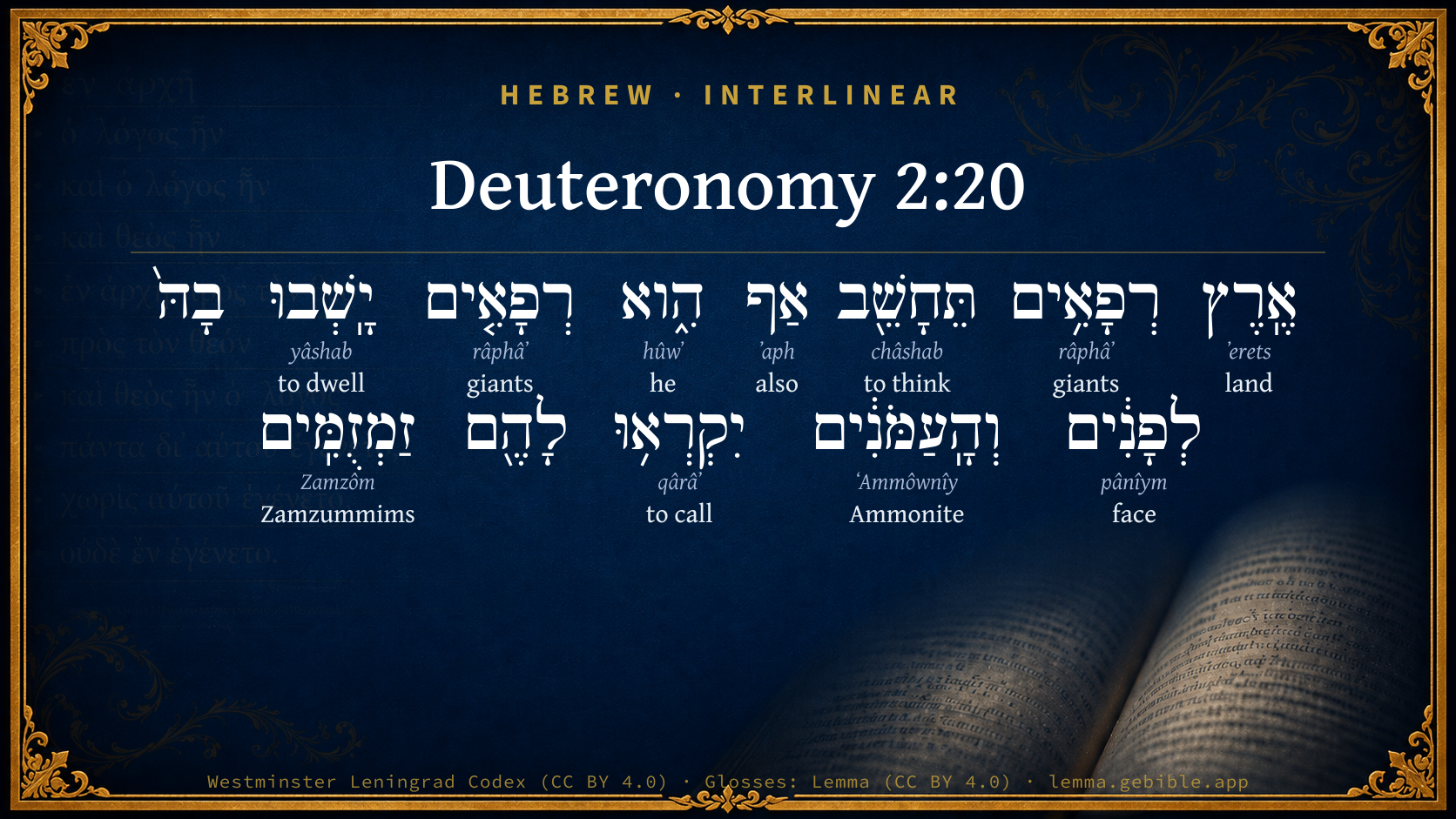
Hebrew (Westminster Leningrad Codex) Deuteronomy 2:20 appears in the Hebrew Old Testament. The text above is from the Westminster Leningrad Codex. Each word links to its Strong’s number, a concise gloss, and parsing drawn from the Open Scriptures Hebrew Bible morphology. Click any word for its full Brown-Driver-Briggs (BDB) entry.
Download image
Cite this verse

Deuteronomy 2:20 (World English Bible). Public Domain. Lemma interlinear Bible study tool, https://lemma.gebible.app/v/deuteronomy/2/20.

Show BibTeX & RIS
BibTeX
RIS
English Translation
(That also is accounted a land of Rephaim: Rephaim lived therein before; but the Ammonites call them Zamzummim,
World English Bible · Public Domain
Highlights
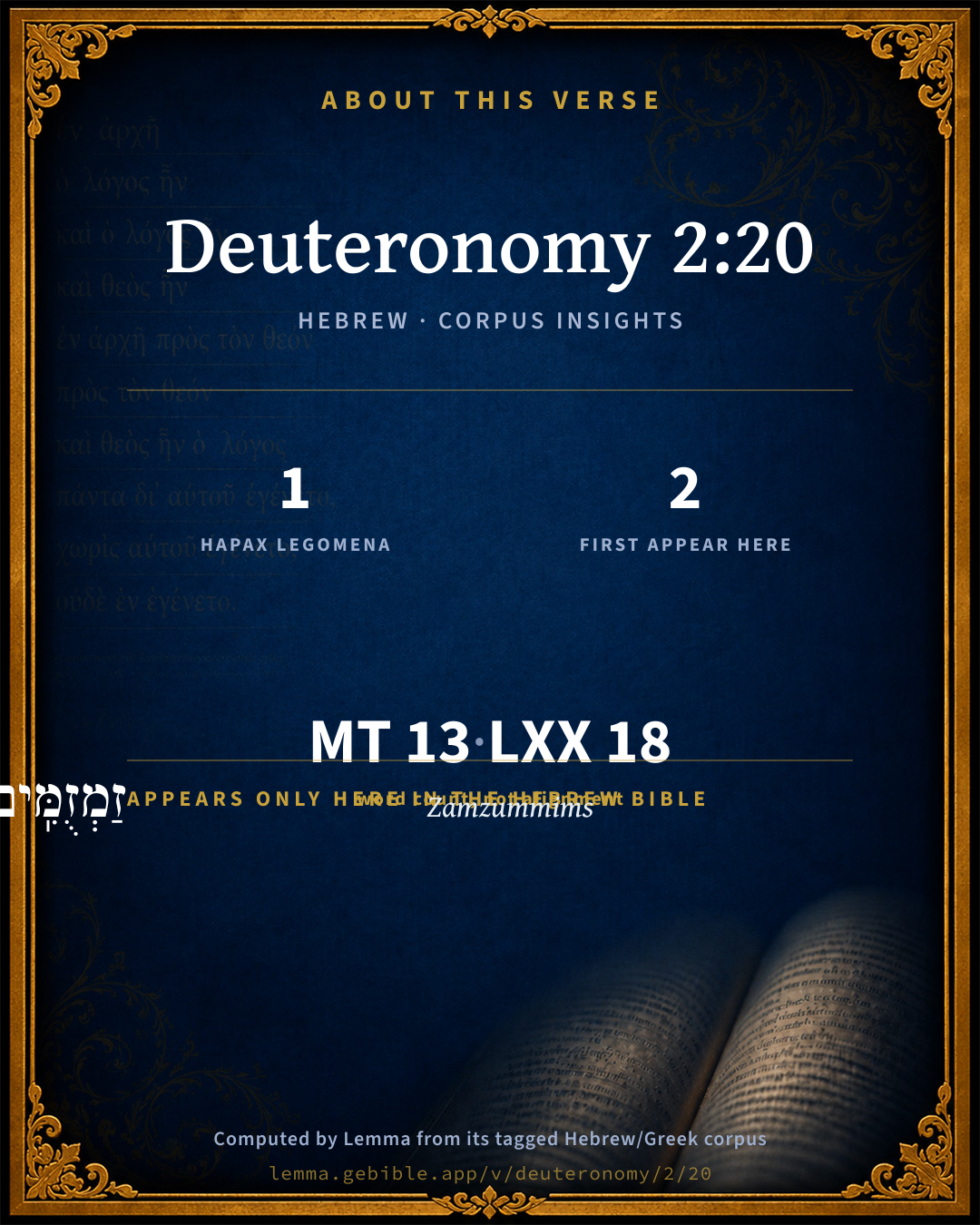
  • 1 hapax legomenon — only here in the Hebrew Bible
  • 2 first appearances in the Hebrew Bible
Full analysis ↓
Download a study sheet

One document with this verse’s original text, its word-by-word gloss line, the meaning frame, cross-references with their text, attributed commentary, and full source and license credits — printable, and it pastes into notes with its structure intact.

This verse Autodidact and up

Study sheet (.html) Plain text (.txt)

A passage Seminary Student

Up to 50 verses in one chapter. A passage sheet keeps up to 6 commentary sources and 12 cross-references per verse, in the order this page ranks them, and says so on the sheet whenever that leaves anything out. Ask for a single verse and you get the Autodidact verse sheet above.

Everything on this page stays free to read, with no account — the sheet is a download of what is already on screen, not access to it.

Want to remove ads? Support Godless Engineer
Compare translations 3

The same verse in 3 English versions, stacked beneath the original-language interlinear above. Click any original word for its lexicon entry.

Each is an independent rendering of the whole verse — the interlinear is not word-aligned to these translations.

Highlighted words mark where these versions differ — a whole-verse word diff, not a word-by-word alignment.

  • World English Bible Public Domain
    (That also is accounted a land of Rephaim: Rephaim lived therein before; but the Ammonites call them Zamzummim,
  • King James Version Public Domain
    (That also was accounted a land of giants: giants dwelt therein in old time; and the Ammonites call them Zamzummims;
  • unfoldingWord Literal Text CC BY-SA 4.0
    (Also, is regarded as a land of the Raphaites. The Raphaites lived there previously, but the Ammonites call them Zamzummites,

unfoldingWord Literal Text — © unfoldingWord, licensed CC BY-SA 4.0. Word-aligned USFM3 via Door43 (git.door43.org/unfoldingWord/en_ult).

Versions to compare (up to 4)

3 of 4 selected

Show all 18 translations

Every available English version of this verse, each an independent rendering of the whole verse.

  • World English Bible Public Domain
    (That also is accounted a land of Rephaim: Rephaim lived therein before; but the Ammonites call them Zamzummim,
  • Berean Standard Bible Public Domain
    (That too was regarded as the land of the Rephaim, who used to live there, though the Ammonites called them Zamzummites.
  • Majority Standard Bible Public Domain
    (That too was regarded as the land of the Rephaim, who used to live there, though the Ammonites called them Zamzummites.
  • King James Version Public Domain
    (That also was accounted a land of giants: giants dwelt therein in old time; and the Ammonites call them Zamzummims;
  • American Standard Version (1901) Public Domain
    (That also is accounted a land of Rephaim: Rephaim dwelt therein aforetime; but the Ammonites call them Zamzummim,
  • Revised Version (1885) Public Domain
    (That also is accounted a land of Rephaim: Rephaim dwelt therein aforetime; but the Ammonites call them Zamzummim;
  • Geneva Bible (1599) Public Domain
    That also was taken for a land of gyants: for gyants dwelt therein afore time, whome the Ammonites called Zamzummims:
  • Douay-Rheims (1899) Public Domain
    It was accounted a land of giants: and giants formerly dwelt in it, whom the Ammonites call Zomzommims,
  • Young's Literal Translation Public Domain
    `A land of Rephaim it is reckoned, even it; Rephaim dwelt in it formerly, and the Ammonites call them Zamzummim;
  • Literal Standard Version CC BY-SA 4.0
    It is reckoned [as] a land of Rephaim, even it; Rephaim formerly dwelt in it, and the Ammonites call them Zamzummim,
  • Unlocked Literal Bible CC BY-SA 4.0
    (That also is considered to be a land of the Rephaim. The Rephaim lived there previously—but the Ammonites call them Zamzummim—
  • unfoldingWord Literal Text CC BY-SA 4.0
    (Also, is regarded as a land of the Raphaites. The Raphaites lived there previously, but the Ammonites call them Zamzummites,
  • Darby Bible Public Domain
    (That also is reckoned a land of giants: giants dwelt therein in time past, and the Ammonites call them Zamzummim;
  • World Messianic Bible Public Domain
    (That also is considered a land of Rephaim. Rephaim lived there in the past, but the Ammonites call them Zamzummim,
  • Webster's Bible Public Domain
    (That also was accounted a land of giants: giants dwelt in it in old time; and the Ammonites call them Zamzummims;
  • Free Bible Version CC BY-SA 4.0
    (This land was previously considered as the country of the Rephaim who used to live there. However, the Ammonites called them Zamzummites.
  • Bible in Basic English Public Domain
    (That land is said to have been a land of the Rephaim, for Rephaim had been living there in earlier times, but they were named Zamzummim by the Ammonites;
  • JPS Tanakh (1917) Public Domain
    That also is accounted a land of Rephaim: Rephaim dwelt therein aforetime; but the Ammonites call them Zamzummim,

Literal Standard Version (2020), Covenant Press — licensed CC BY-SA 4.0. Text via the HelloAO Bible API (eBible.org). Unlocked Literal Bible (unfoldingWord) — licensed CC BY-SA 4.0. Text via the HelloAO Bible API (eBible.org). unfoldingWord Literal Text — © unfoldingWord, licensed CC BY-SA 4.0. Word-aligned USFM3 via Door43 (git.door43.org/unfoldingWord/en_ult). Free Bible Version, Dr. Jonathan Gallagher — licensed CC BY-SA 4.0. Text via the HelloAO Bible API (eBible.org).

Word by word

More ways to search: Search by grammar → Find every occurrence → Compare this word →

Practice this passage: Drill this verse → Learn its vocabulary →

זַמְזֻמִּֽים
Zamzôm
H2157
“Zamzummims”
Noun, Proper
Part of Speech
Noun
Type
Proper
Full BDB Definition

Origin: from H2161

TWOT: None

Zamzummims = "plotters" - the Ammonite name for the people who by others were called Rephaim, and were described as a numerous nation of giants; perhaps the same as 'Zuzim'
  1. אֶֽרֶץ ʼerets H776 “land of” Noun, Common, Both, Singular, Construct
  2. רְפָאִ֥ים râphâʼ H7497 “giants” Noun, Proper
  3. תֵּחָשֵׁ֖ב châshab H2803 “to think” Verb, Niphal, Imperfect, 3rd Person, Feminine, Singular
  4. אַף ʼaph H637 “also” Particle, Accusative
  5. הִ֑וא hûwʼ H1931 “he” Pronoun, Personal, 3rd Person, Feminine, Singular
  6. רְפָאִ֤ים râphâʼ H7497 “giants” Noun, Proper
  7. יָֽשְׁבוּ yâshab H3427 “to dwell” Verb, Qal, Perfect, 3rd Person, Common, Plural
  8. לְפָנִ֔ים pânîym H6440 “to/for · face(s)” Preposition + Noun, Common, Both, Plural, Absolute
  9. וְהָֽעַמֹּנִ֔ים ʻAmmôwnîy H5984 “and · the · Ammonites” Conjunction + Particle, Definite Article + Noun, Gentilic, Masculine, Plural, Absolute
  10. יִקְרְא֥וּ qârâʼ H7121 “to call” Verb, Qal, Imperfect, 3rd Person, Masculine, Plural

About this verse

These counts appear in no published source. They are computed here, from the morphology-tagged text and Lemma’s own curated glosses. What Lemma adds →

13
words
10
distinct lemmas
Pentateuch
section

Notable vocabulary

1 hapax legomenon — a word that appears only here in the entire Hebrew Bible:

  • זַמְזֻמִּֽים Zamzummims H2157

First appearance in Scripture

These words make their first canonical appearance in the Hebrew Bible here:

  • וְהָֽעַמֹּנִ֔ים Ammonite H5984
  • זַמְזֻמִּֽים Zamzummims H2157

Shared distinctive vocabulary

וְהָֽעַמֹּנִ֔ים Ammonite H5984 occurs in 17 verses of the Hebrew Bible. Also found in:

Grammatical profile

  • 3 verbs
  • 6 nouns
  • 1 pronoun
  • 2 prepositions
  • 1 particle

Verb forms

  • תֵּחָשֵׁ֖ב Niphal · Imperfect
  • יָֽשְׁבוּ Qal · Perfect
  • יִקְרְא֥וּ Qal · Imperfect

Repetition

A word recurs within this verse — often emphatic in Hebrew:

  • רְפָאִ֥ים giants H7497 ×2

Hebrew & Septuagint length

In English translation the verse runs 18 words from the Hebrew and 20 from the Septuagint (LXX English) — closely comparable.

A rough comparison of the two English renderings, which tokenize alike — not a word-level alignment.

Word counts can differ between the Hebrew and the Greek without any difference in meaning — e.g. the Hebrew direct-object marker אֵת has no separate Greek word, and Greek often adds the article ὁ.

In the original languages it is 13 Hebrew tokens and 18 Greek tokens — but the two are counted differently (Hebrew bundles its prefixes and suffixes into one token; the Greek is in lemma form), so that isn’t a like-for-like length.

Cross-references

1

Topical passages linked to Deuteronomy 2:20 in the Treasury of Scripture Knowledge — connected by theme and wording, ordered by reader-vote popularity; previews shown in the World English Bible.

  • Genesis 14:5 In the fourteenth year Chedorlaomer came, and the kings who were with him, and struck the Rephaim in Ashteroth Karnaim, and the Zuzim in Ham, and the Emim in Shaveh-kiriathaim,

Cross-references courtesy of OpenBible.info (CC BY 4.0).

Hebrew and Greek witnesses Masoretic Hebrew ↔ Greek Septuagint

The same verse in the two great witnesses to the Old Testament, shown verse-for-verse.

These are two independent witnesses, not word-aligned to each other, and the Septuagint is shown in lemma (dictionary) form.

Hebrew Deuteronomy 2:20 Masoretic · Westminster Leningrad Codex

אֶֽרֶץ רְפָאִ֥ים תֵּחָשֵׁ֖ב אַף הִ֑וא רְפָאִ֤ים יָֽשְׁבוּ בָהּ֙ לְפָנִ֔ים וְהָֽעַמֹּנִ֔ים יִקְרְא֥וּ לָהֶ֖ם זַמְזֻמִּֽים

(That also is accounted a land of Rephaim: Rephaim lived therein before; but the Ammonites call them Zamzummim,

World English Bible · Public Domain

Greek LXX Deuteronomy 2:20 Septuagint · lemma form

γῆ ραφαϊν λογίζομαι καί γάρ ἐπί αὐτός καταοἰκέω ὁ ραφαϊν ὁ πρότερος καί ὁ αμμανῖται ὀνομάζω αὐτός ζομζομμιν

It shall be accounted a land of Raphain, for the Raphain lived there before, and the Ammanites call them Zochommin.

LXX2012 (modern English Septuagint) · Public Domain

On this verse, The Pulpit Commentary discusses the Septuagint’s reading. Read the note in Commentary ↓

Hebrew: Westminster Leningrad Codex (CC BY 4.0). Greek: Septuagint (public domain); English from LXX2012 (modern English Septuagint) (Public Domain). How the Septuagint differs from the Hebrew →

Targum (Aramaic paraphrase)

2

The Targum is the ancient Jewish Aramaic paraphrase of the Hebrew Scriptures — an interpretive translation, not the Hebrew text itself. Onkelos (literal) and Pseudo-Jonathan (expansive) render the Torah, and Jonathan the Prophets. Coverage is partial: where no permissively-licensed English translation exists for a verse, only the Aramaic is shown. This is verse-level text, not a word-by-word alignment to the Hebrew.

  1. Targum Onkelos Torah (Genesis–Deuteronomy)
    אַרְעָא גִבָּרַיָא מִתְחַשְׁבָא אַף הִיא גִבָּרִין יָתִיבוּ בַהּ מִלְקַדְמִין וְעַמוֹנָאֵי קְרַן לְהוֹן חֻשְׁבָּנֵי

    (no public-domain English translation for this verse)

    Targum Onkelos — Aramaic: “Onkelos Genesis” (public domain); “Onkelos Exodus” (public domain); “Onkelos Leviticus” (public domain); “Onkelos Numbers” (public domain); “Onkelos Deuteronomy” (public domain). English: “Sefaria Community Translation” (CC0 1.0 (public-domain dedication)); “J.W. Etheridge. The Targums of Onkelos and Jonathan Ben Uzziel on the Pentateuch. London: Longmans, Green, 1862” (public domain). Text via Sefaria.

  2. Targum Pseudo-Jonathan Torah (Genesis–Deuteronomy)
    אֲרַע גּוּבָּרַיָא מִתְחַשְׁבָא לְחוֹד הִיא גִיבָּרַיָא יְתִיבָן בָּהּ מִן לְקַדְמִין וְעַמּוֹנָאֵי קְרַן לְהוֹן זֵימְתָנֵי

    That also was accounted a land of giants; in old time the giants dwelt in it, and the Ammonites called them Zimthanee,

    Targum Pseudo-Jonathan — Aramaic: “Targum Jonathan on Genesis” (public domain); “Targum Jonathan on Exodus” (public domain); “Targum Jonathan on Leviticus” (public domain); “Targum Jonathan on Numbers” (public domain); “Targum Jonathan on Deuteronomy” (public domain). English: “The Targum of Jonathan ben Uzziel, trans. J. W. Etheridge, London, 1862” (public domain). Text via Sefaria.

Commentary

Notes on Deuteronomy 2:20 from classic Christian and Jewish commentators (each source and its license shown beneath its notes). The classic Christian expositions comment on the surrounding passage and are grouped to its opening verse, so a note may address several verses; the Jewish commentaries on the Tanakh (Rashi and others) are per-verse, so they appear only where the commentator wrote on this verse.

Lemma curates 59 commentaries, every one of them public domain or Creative Commons licensed, each selected and text-cleaned for this edition rather than reprinted as found. About our sources →

Trapp's Complete Commentary

John Trapp

Deu 2:20 (That also was accounted a land of giants: giants dwelt therein in old time; and the Ammonites call them Zamzummims;

Ver. 20. Zamzummims.] Big and boisterous, bearing down all before them; presumptuous wicked ones they were, and yet they called themselves Rephaims, that is, physicians or preservers: such, indeed, rulers ought to be. {Isa 3:7} The Greeks, therefore, call a king Aναξ, ab ακος, medela, because he is to be ligator vulnerum, chirurgus, et Reip. medicus - the commonwealth’s surgeon and physician. {a} But such were not these Zamzummims, more than in name: το μεν ονομα βιος, &c., as he said of his bow, Thy name is life, but thy use is present death.

{a} Cornel. a Lapid., in Isa 3:7.

John Trapp, A Commentary or Exposition upon All the Books of the Old and New Testament (1647–1656) — public domain. Text from a community e-Sword module.

Albert Barnes' Notes on the Bible

These verses, like Deu 2:10-12, are in all likelihood an addition made by a later reviser.

Deu 2:20

Zamzummims - A giant race usually identified with the Zuzims of Gen 14:5.

Deu 2:23

The Avims which dwelt in Hazerim, even unto Azzah - Read (Gaza, of which Azzah is the Hebrew form. “Hazerim” is not strictly a proper name, but means “villages,” or “enclosures,” probably such as are still common in the East. The Avims are no doubt identical with the Avites of Jos 13:3, and were doubtless a scattered remnant of a people conquered by the Caphtorim (Gen 10:14 note) and living in their “enclosures” in the neighborhood of Gerar. The word, which means “ruins,” seems itself expressive of their fallen state.

Albert Barnes' Notes on the Bible (1834–1885) — public domain. Text from a community e-Sword/MySword module.

Tyndale Open Study Notes

Tyndale Open Resources

2:20-21 The Zamzummites are probably the same as the Zuzites (Gen 14:5). The Lord had removed them from the land in the past so that the Ammonites could occupy their lands. The God of Israel is also the God of all the earth; he is mindful of all nations and has a place and purpose for each.

Tyndale Open Study Notes — © Tyndale Open Resources, licensed CC BY-SA 4.0. Text via the HelloAO Bible API.

Geneva Bible (1599)

Geneva Bible translators

Who called themselves Rephaims: that is, preservers, or physicians to heal and reform vices: but were indeed Zamzummims, that is, wicked and abominable.

Geneva Bible (1599) marginal notes — public domain. Text via Bolls.life.

Adam Clarke's Commentary

Verse 20. That also was accounted a land of giants] That was accounted the land or territory of the Rephaim.

Zamzummims] Supposed to be the same as the Zuzim, Ge 14:5. Of these ancient people we know very little; they were probably inconsiderable tribes or clans, "pursuing and pursued, each other's prey," till at length a stronger totally destroyed or subdued them, and their name became either extinct or absorbed in that of their conquerors. From the 10th to the 12th, and from the 20th to the 23d verse inclusive, we have certain historical remarks introduced which do not seem to have been made by Moses, but rather by Joshua or Ezra. By the introduction of these verses the thread of the narrative suffers considerable interruption. Dr. Kennicott considers both these passages to be interpolations. That they could not have made a part of the speech of Moses originally, needs little proof.

Adam Clarke's Commentary on the Bible (1810–1826) — public domain. Text from a community e-Sword/MySword module.

Ellicott's Commentary for English Readers

(20) In old time.—See Genesis 14

Zamzummims = Zuzims (Gen_14:5).

A Bible Commentary for English Readers, edited by Charles John Ellicott (1878–1897) — public domain. Text from a community e-Sword module.

The Cambridge Bible for Schools and Colleges

gen. ed. J. J. S. Perowne

20–23. Another Archaeological Note. On the Repha’im, see Deu_1:28. Zamzummim, a name held by some to be formed on the analogy of the Gk ‘Barbaroi,’ as of a people whose speech sounded uncouth; Ar. zamzamah is a distant, confused sound. Others suggest identification with the Zuzîm of Gen_14:5, of which Musil (Moab, i. 275, 318, etc.) is reminded by the present Zîzâ, Ptolemy’s Ziza on the N.E. frontier of Mo’ab. But the Ar. zizim is applied to rustling sounds in the desert by night, supposed to be the noise of the Jinn (see Driver’s note, with communication from W. R. Smith, and Schwally, D. Leben nach d. Tode, 64 f., 137 ff.). The name would thus be another of those mythological terms for pre-historic races given above on Deu_1:28. On the Ḥorites, see Deu_2:12. On the ‘Avvîm or ‘Awwîm cp. Jos_13:3 f.; whether the name be ethnic or indicative of a stage of culture is uncertain. They dwelt in villages, Heb. ḥaṣerîm (mostly in P and Levit. writers), used both in parallel to circles of tents, Gen_25:16, and to collections of houses without surrounding walls, Lev_25:31, and the dependencies of cities, Jos_15:46 etc. Kaphtôr is most probably Crete, see HGHL 135, 170 f.

The Cambridge Bible for Schools and Colleges (gen. ed. J. J. S. Perowne; Cambridge University Press, 1878–1918) — public domain. Text from a community e-Sword module.

John Gill's Exposition

That also was accounted a land of giants,.... Ammon was so reckoned as well as Moab, Deu 2:10.

giants dwelt therein in old time; the Rephaim dwelt there, as they did also in Ashteroth Karnaim, Gen 14:5.

and the Ammonites call them Zamzummims; they are thought to be the same with the Zuzims in Gen 14:5 who had their name, as Hillerus (c) thinks, from Mezuzah, a door post, from their tall stature, being as high as one; and for a like reason Saph the giant might have his name, Sa2 21:18. The word Zamzummims, according to him (d), signifies contrivers of evil and terrible things; they were inventors of wickedness, crafty and subtle in forming wicked and mischievous designs, which struck terror into people, and made them formidable to them.

(c) Onomastic. Sacr. p. 158, 288, 289. (d) Onomastic. Sacr. p. 161, 310, 428.

John Gill's Exposition of the Whole Bible (1746–1763) — public domain (CC PDM 1.0). Text via the HelloAO Bible API.

Haydock's Catholic Bible Commentary

Zomzommim, means "wicked wretches," famous for their stature, &c. (Menochius) --- They are probably the same nation as the Zuzim, Genesis xiv. 5.

George Leo Haydock (1774–1849), Haydock's Catholic Family Bible and Commentary, 1859 edition — public domain. Excludes Psalms (Douay-Rheims chapter numbering differs from Protestant) and Deuterocanonical books (Catholic canon only).

Matthew Poole's English Annotations

Which signifies men most wicked and abominable, or most presumptuous, or most crafty.

Matthew Poole's English Annotations on the Holy Bible (1683–1685) — public domain. Text from a community e-Sword/MySword module.

Whedon's Commentary on the Bible

Daniel D. Whedon

20. Zamzummim — The name is supposed to be derived from a root meaning to hum: the noisy people; probably the same as the Zuzim of Gen_14:5.

Daniel D. Whedon (gen. ed.), Commentary on the Old and New Testaments (1874–1909) — public domain. Text from a community e-Sword module.

The Pulpit Commentary

Vers. 20-23. Another parenthetical insertion, containing some ethnographical notices, intended, probably, to confirm the assertion that to the children of Ammon God had given their land for a possession. There is no sufficient reason for supposing that this paragraph is an interpolation, or gloss, inserted by some later writer. It lay as much in the way of Moses to introduce such ethnographical notices as in that of any writer of a later age.

Before the Ammonites, the laud was occupied by a gigantic race, called by them, Zamzummim (probably noisy ones, from to hum, mutter; or, as the verb also signifies, to muse or meditate, perhaps moody ones ; whether the same as the Zuzim of Gen_14:5 LXX, qnh e ijscura, as if from zWz, to overflow, to abound is uncertain). The colossal stone monuments, resembling what in Europe are known by the Celtic names of dolmen, menhir, and cromlech , still to be found in the land of Moab, are supposed to be the work of these aboriginal inhabitants of the country, the gigantic Emim and Zamzummim. This giant tribe the Lord had destroyed before the Ammonites, just as he had destroyed the Horim before the children of Esau in Seir.

The Pulpit Commentary (1880–1919), ed. H.D.M. Spence-Jones & Joseph S. Exell — public domain. Text from a community e-Sword module.

unfoldingWord translationNotes

Door43 World Missions Community

General Information:

These verses begin to give background information about the people groups who lived in the land. If your language has a way of showing that what follows is background information, you should use it here. (See: Background Information)

That also is considered

This can be stated in active form. AT: "People also consider that" (See: Active or Passive)

Rephaim

This is the name of a people group. See how you translated this in Deuteronomy 2:11. (See: How to Translate Names)

Zamzummim

This is another name for the Rephaim people group. (See: How to Translate Names)

Anakim

This is the name of a people group. See how you translated this in Deuteronomy 1:28. (See: How to Translate Names)

destroyed them before the Ammonites

"allowed the Ammonites to defeat them" or "allowed the Ammonites to kill them all"

they succeeded them and lived in their place

"the Ammonites took over everything the Rephaim had owned and have lived where the Rephaim had lived"

Horites

This is the name of a people group. See how you translated this in Deuteronomy 2:12. (See: How to Translate Names)

succeeded them and have lived in their place

"took over everything the Horites had owned and have lived where the Horites had lived"

translationWords

Ammon

Yahweh

Esau

descend

unfoldingWord translationNotes — © Distant Shores Media and the Door43 World Missions Community, licensed CC BY-SA 4.0. Source: git.door43.org/Door43/en_tn.

Rashi

Rabbi Shlomo Yitzchaki (Rashi)

ארץ רפאים תחשב IT (AMMON) ALSO WAS ACCOUNTED A LAND OF REPHAIM. — It also is accounted a land of Rephaim because the Rephaim formerly dwelt in it, but yet it is not that land which I gave to Abraham.

Rashi on the Tanakh — English translations: “The Judaica Press complete Tanach with Rashi, translated by A. J. Rosenberg” (CC BY 4.0); “Pentateuch with Rashi's commentary by M. Rosenbaum and A.M. Silbermann, 1929-1934” (public domain); “The Metsudah Tanach series, Lakewood, N.J” (CC BY 4.0); and “The Book of Joshua, Metsudah Publications, 1997” (CC BY 4.0). Text via Sefaria.

Ramban (Nachmanides)

Rabbi Moshe ben Nachman (Ramban / Nachmanides)

TEICHASHEIV’ (ACCOUNTED). The land of Ammon, too, is considered part of the land of Rephaim; in other words, it is included within it. Similarly, from the Shihor, which is before Egypt, even unto the border of Ekron northward ‘teichasheiv’ (is accounted) to the Canaanites. So also, the sons of Rimmon the Beerothite, of the children of Benjamin; for Beeroth also ‘teichasheiv’ (is accounted) to Benjamin. It is possible that such is also the meaning of the expression written above [with reference to Moab], these also are ‘yeichashvu’ Rephaim, Scripture stating that the Emim who formerly dwelled there, Verse 10. are also “accounted” as an expression of importance and esteem. Here Ramban explains it as “accounted” [to the Rephaim]. Rephaim since they were part of them, and they were as the Anakim, and therefore they [the Moabites] called them ‘Emim’ [because their “dread,” like that of the Anakim (giants) lay upon the people]. This is the correct interpretation.Thus the land of Rephaim was very large, and from it, Moab and Ammon took their lands. The balance remained for the Rephaim themselves, for Og, who dwelled in Ashtaroth, was of them, as is stated, and they smote the Rephaim in Ashteroth-karnaim., Verse 5. And in the Book of Joshua it is written, and cut down a space for thyself there in the land of the Perizzites and of the Rephaim. Therefore, Scripture says of the border of Moab and Ammon that it is “accounted to the Rephaim,” [still calling them “Rephaim,” the name by which they were originally known]. The Moabites and the Ammonites were the ones that changed [the name of the Rephaim] to other names: [the Moabites calling them] Emim and [the Ammonites calling them] Zamzummim.

Ramban (Nachmanides) on the Tanakh — English translation: “Commentary on the Torah by Ramban (Nachmanides). Translated and annotated by Charles B. Chavel. New York, Shilo Pub. House, 1971-1976” (CC BY 4.0). Text via Sefaria.

Lesson kit

Teaching starters — assembled from the data on this page, not authored interpretation. Every prompt links to the verse data it draws on. Edit before teaching.

Deuteronomy, in the Pentateuch, opens this verse with 13 words (10 distinct Hebrew lemmas). Its most distinctive word is Zamzôm (“Zamzummims”). A historical commentator’s framing appears above. Read the whole chapter for the surrounding context.

Discussion questions

  1. What does “Zamzummims” (Zamzôm) contribute to the verse as a whole?
  2. 1 word here appears nowhere else in the Hebrew Bible. Why might the author reach for such rare wording?
  3. 2 words make their first appearance in Scripture here. What does this debut establish?
  4. How does Deuteronomy 23:3, which shares the word «Ammonite», read alongside this verse?
  5. What does the repetition of “giants” (2× in this one verse) do in this verse?
  6. The translations on this page render this verse differently — a whole-verse word diff, not a word-by-word alignment. What might account for the different wordings?
  7. «תֵּחָשֵׁ֖ב» is a Niphal Imperfect verb. How does that grammatical form shape the action described?
  8. Compare how Trapp's Complete Commentary and Albert Barnes' Notes on the Bible read this verse. Where do they agree or differ?

Things to notice

  • 1 word in this verse appears nowhere else in the Hebrew Bible.
  • 2 words make their first canonical appearance in Scripture here.
  • This verse counts 13 Hebrew ↔ 18 Greek words.
  • These translations choose different wording for 16 words in this verse.
  • “giants” occurs 2× in this single verse.

Reading settings

Reading text

Shown beneath each verse's original-language words.

Old Testament
Old Testament edition

Read the OT as the Masoretic Hebrew (MT) or the Greek Septuagint (LXX).

English shown for the Greek Septuagint (in the Hebrew ↔ Greek comparison).

Comparing translations? Open the Compare panel on any verse page to stack up to four side by side.