
Deuteronomy 1:44

Hebrew (Westminster Leningrad Codex) Deuteronomy 1:44 appears in the Hebrew Old Testament. The text above is from the Westminster Leningrad Codex. Each word links to its Strong’s number, a concise gloss, and parsing drawn from the Open Scriptures Hebrew Bible morphology. Click any word for its full Brown-Driver-Briggs (BDB) entry.
Download image
Cite this verse

Deuteronomy 1:44 (World English Bible). Public Domain. Lemma interlinear Bible study tool, https://lemma.gebible.app/v/deuteronomy/1/44.

Show BibTeX & RIS
BibTeX
RIS
English Translation
The Amorites, who lived in that hill-country, came out against you, and chased you, as bees do, and beat you down in Seir, even to Hormah.
World English Bible · Public Domain
Highlights
  • 1 first appearance in the Hebrew Bible
Full analysis ↓
Download a study sheet

One document with this verse’s original text, its word-by-word gloss line, the meaning frame, cross-references with their text, attributed commentary, and full source and license credits — printable, and it pastes into notes with its structure intact.

This verse Autodidact and up

Study sheet (.html) Plain text (.txt)

A passage Seminary Student

Up to 50 verses in one chapter. A passage sheet keeps up to 6 commentary sources and 12 cross-references per verse, in the order this page ranks them, and says so on the sheet whenever that leaves anything out. Ask for a single verse and you get the Autodidact verse sheet above.

Everything on this page stays free to read, with no account — the sheet is a download of what is already on screen, not access to it.

Want to remove ads? Support Godless Engineer
Compare translations 3

The same verse in 3 English versions, stacked beneath the original-language interlinear above. Click any original word for its lexicon entry.

Each is an independent rendering of the whole verse — the interlinear is not word-aligned to these translations.

Highlighted words mark where these versions differ — a whole-verse word diff, not a word-by-word alignment.

  • World English Bible Public Domain
    The Amorites, who lived in that hill-country, came out against you, and chased you, as bees do, and beat you down in Seir, even to Hormah.
  • King James Version Public Domain
    And the Amorites, which dwelt in that mountain, came out against you, and chased you, as bees do, and destroyed you in Seir, even unto Hormah.
  • unfoldingWord Literal Text CC BY-SA 4.0
    And the Amorites, who lived in that hill, came out against you and chased you like the bees do and caused you to scatter in Seir as far as Hormah.

unfoldingWord Literal Text — © unfoldingWord, licensed CC BY-SA 4.0. Word-aligned USFM3 via Door43 (git.door43.org/unfoldingWord/en_ult).

Versions to compare (up to 4)

3 of 4 selected

Show all 18 translations

Every available English version of this verse, each an independent rendering of the whole verse.

  • World English Bible Public Domain
    The Amorites, who lived in that hill-country, came out against you, and chased you, as bees do, and beat you down in Seir, even to Hormah.
  • Berean Standard Bible Public Domain
    Then the Amorites who lived in the hills came out against you and chased you like a swarm of bees. They routed you from Seir all the way to Hormah.
  • Majority Standard Bible Public Domain
    Then the Amorites who lived in the hills came out against you and chased you like a swarm of bees. They routed you from Seir all the way to Hormah.
  • King James Version Public Domain
    And the Amorites, which dwelt in that mountain, came out against you, and chased you, as bees do, and destroyed you in Seir, even unto Hormah.
  • American Standard Version (1901) Public Domain
    And the Amorites, that dwelt in that hill-country, came out against you, and chased you, as bees do, and beat you down in Seir, even unto Hormah.
  • Revised Version (1885) Public Domain
    And the Amorites, which dwelt in that mountain, came out against you, and chased you, as bees do, and beat you down in Seir, even unto Hormah.
  • Geneva Bible (1599) Public Domain
    Then the Amorites which dwelt in that mountaine came out against you, and chased you (as bees vse to doe) and destroied you in Seir, euen vnto Hormah.
  • Douay-Rheims (1899) Public Domain
    The Lord said to me: Say to them: Go not up, and fight not, for I am not with you: lest you fall before your enemies.
  • Young's Literal Translation Public Domain
    and the Amorite who is dwelling in that hill-country cometh out to meet you, and they pursue you as the bees do, and smite you in Seir -- unto Hormah.
  • Literal Standard Version CC BY-SA 4.0
    and the Amorite who is dwelling in that hill-country comes out to meet you, and they pursue you as the bees do, and strike you in Seir, even to Hormah.
  • Unlocked Literal Bible CC BY-SA 4.0
    But the Amorites, who lived in that hill country, came out against you and chased you like bees, and struck you down in Seir, as far as Hormah.
  • unfoldingWord Literal Text CC BY-SA 4.0
    And the Amorites, who lived in that hill, came out against you and chased you like the bees do and caused you to scatter in Seir as far as Hormah.
  • Darby Bible Public Domain
    And the Amorite that dwelt on that hill came out against you, and chased you, like as bees do, and cut you in pieces in Seir, as far as Hormah.
  • World Messianic Bible Public Domain
    The Amorites, who lived in that hill country, came out against you and chased you as bees do, and beat you down in Seir, even to Hormah.
  • Webster's Bible Public Domain
    And the Amorites, who dwelt on that mountain, came out against you, and chased you, as bees do, and destroyed you in Seir, even to Hormah.
  • Free Bible Version CC BY-SA 4.0
    Then the Amorites living there in the hills came and attacked you. They chased after you like a swarm of bees, killing you all the way from Seir to Hormah.
  • Bible in Basic English Public Domain
    And the Amorites who were in the hill-country came out against you and put you to flight, rushing after you like bees, and overcame you in Seir, driving you even as far as Hormah.
  • JPS Tanakh (1917) Public Domain
    And the Amorites, that dwell in that hill-country, came out against you, and chased you, as bees do, and beat you down in Seir, even unto Hormah.

Literal Standard Version (2020), Covenant Press — licensed CC BY-SA 4.0. Text via the HelloAO Bible API (eBible.org). Unlocked Literal Bible (unfoldingWord) — licensed CC BY-SA 4.0. Text via the HelloAO Bible API (eBible.org). unfoldingWord Literal Text — © unfoldingWord, licensed CC BY-SA 4.0. Word-aligned USFM3 via Door43 (git.door43.org/unfoldingWord/en_ult). Free Bible Version, Dr. Jonathan Gallagher — licensed CC BY-SA 4.0. Text via the HelloAO Bible API (eBible.org).

Word by word

More ways to search: Search by grammar → Find every occurrence → Compare this word →

Practice this passage: Drill this verse → Learn its vocabulary →

הַדְּבֹרִ֑ים
dᵉbôwrâh
H1682
“the · bees”
Particle, Definite Article + Noun, Common, Feminine, Plural, Absolute
Part of Speech
Particle + Noun
Type
Common
Gender
Feminine
Number
Plural
State
Absolute
Full BDB Definition

Origin: from H1696 (in the sense of orderly motion)

TWOT: 399f

bee
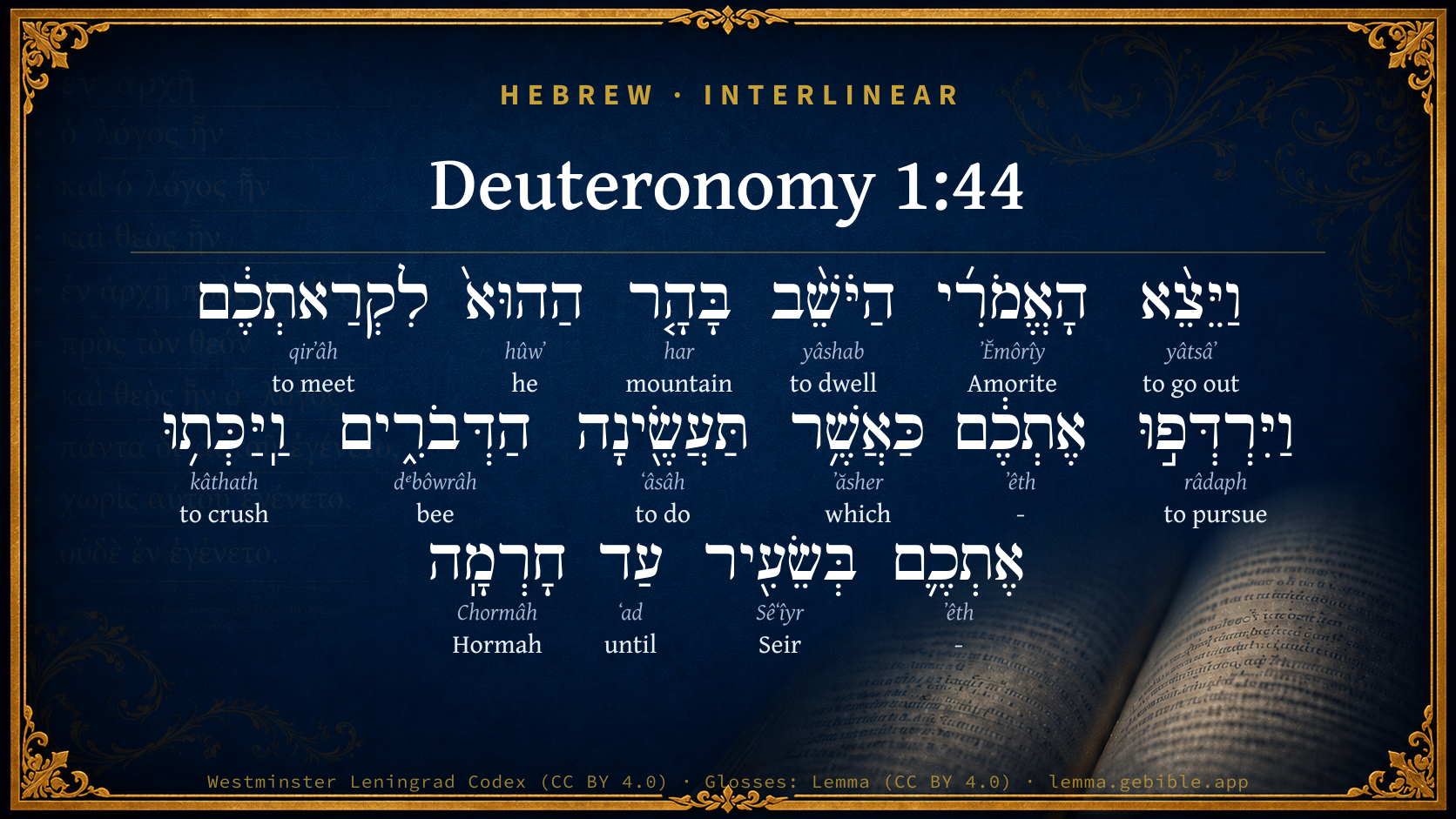
  1. וַיֵּצֵ֨א yâtsâʼ H3318 “and · to go out” Conjunction + Verb, Qal, Sequential Imperfect, 3rd Person, Masculine, Singular
  2. הָאֱמֹרִ֜י ʼĔmôrîy H567 “the · Amorite” Particle, Definite Article + Noun, Gentilic, Masculine, Singular, Absolute
  3. הַיֹּשֵׁ֨ב yâshab H3427 “the · dwelling” Particle, Definite Article + Verb, Qal, Participle Active, Masculine, Singular, Absolute
  4. בָּהָ֤ר har H2022 “in/at the · mountain” Preposition, Determined + Noun, Common, Masculine, Singular, Absolute
  5. הַהוּא֙ hûwʼ H1931 “the · he” Particle, Definite Article + Pronoun, Personal, 3rd Person, Masculine, Singular
  6. לִקְרַאתְכֶ֔ם qirʼâh H7125 “to meet · you” Preposition + Verb, Qal, Infinitive Construct + Suffix, Personal, 2nd Person, Masculine, Plural
  7. וַיִּרְדְּפ֣וּ râdaph H7291 “and · to pursue” Conjunction + Verb, Qal, Sequential Imperfect, 3rd Person, Masculine, Plural
  8. אֶתְכֶ֔ם ʼêth H853 “- · you” Particle, Direct Object + Suffix, Personal, 2nd Person, Masculine, Plural
  9. כַּאֲשֶׁ֥ר ʼăsher H834 “like/as · which” Preposition + Particle, Relative
  10. תַּעֲשֶׂ֖ינָה ʻâsâh H6213 “to do” Verb, Qal, Imperfect, 3rd Person, Feminine, Plural
  11. וַֽיַּכְּת֥וּ kâthath H3807 “and · to crush” Conjunction + Verb, Hiphil, Sequential Imperfect, 3rd Person, Masculine, Plural
  12. אֶתְכֶ֛ם ʼêth H853 “- · you” Particle, Direct Object + Suffix, Personal, 2nd Person, Masculine, Plural
  13. בְּשֵׂעִ֖יר Sêʻîyr H8165 “in/at · Seir” Preposition + Noun, Proper
  14. עַד ʻad H5704 “until” Preposition
  15. חָרְמָֽה Chormâh H2767 “Hormah” Noun, Proper

About this verse

These counts appear in no published source. They are computed here, from the morphology-tagged text and Lemma’s own curated glosses. What Lemma adds →

16
words
15
distinct lemmas
Pentateuch
section

Notable vocabulary

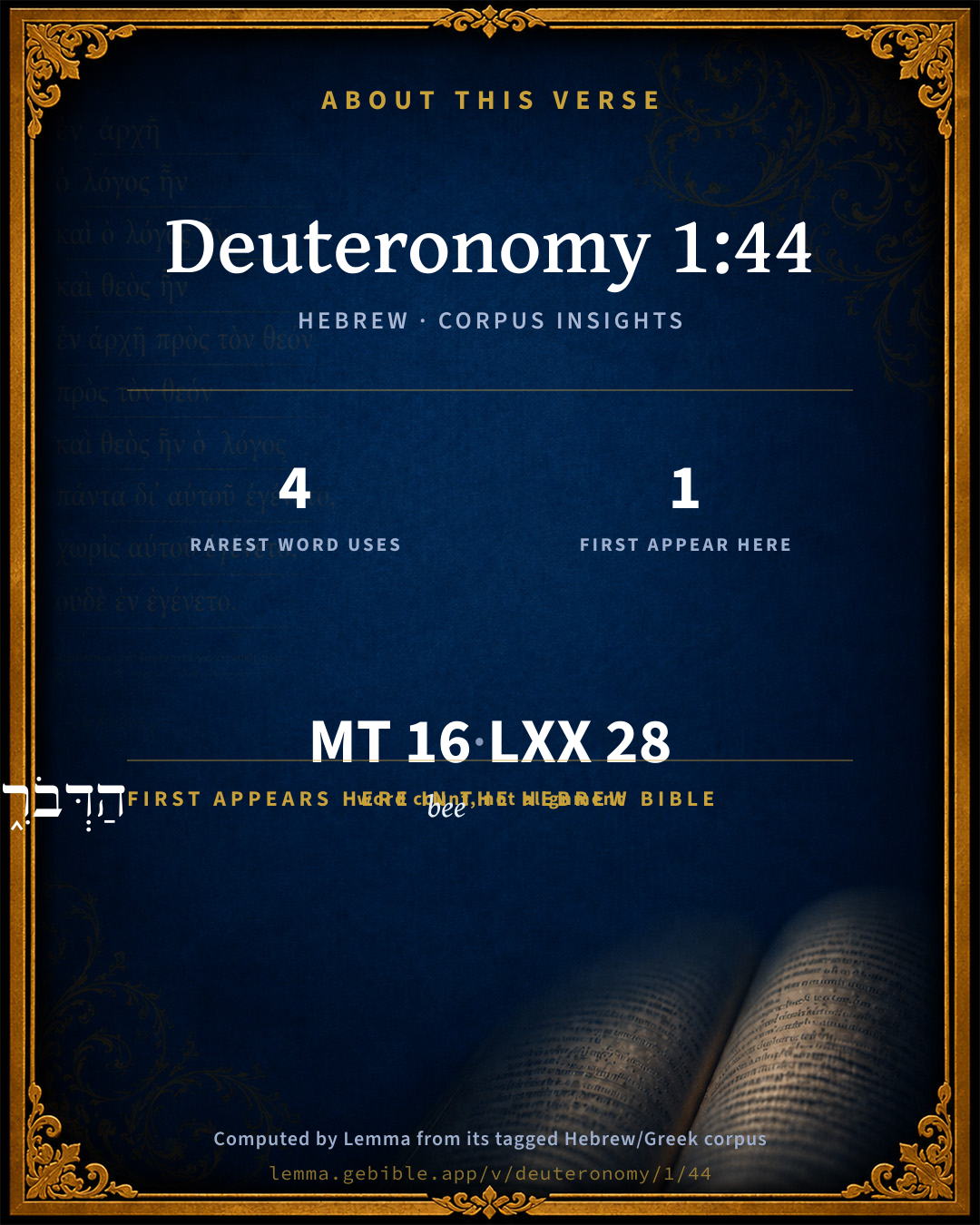
The rarest word here is הַדְּבֹרִ֑ים bee H1682 — appearing just 4 times in the whole Hebrew Bible.

First appearance in Scripture

This word makes its first canonical appearance in the Hebrew Bible here:

  • הַדְּבֹרִ֑ים bee H1682

Shared distinctive vocabulary

הַדְּבֹרִ֑ים bee H1682 occurs in 4 verses of the Hebrew Bible. Also found in:

Grammatical profile

  • 6 verbs
  • 5 nouns
  • 1 pronoun
  • 1 preposition
  • 3 particles

Verb forms

  • וַיֵּצֵ֨א Qal · Sequential Imperfect
  • הַיֹּשֵׁ֨ב Qal · Participle Active
  • לִקְרַאתְכֶ֔ם Qal · Infinitive Construct
  • וַיִּרְדְּפ֣וּ Qal · Sequential Imperfect
  • תַּעֲשֶׂ֖ינָה Qal · Imperfect
  • וַֽיַּכְּת֥וּ Hiphil · Sequential Imperfect

Hebrew & Septuagint length

In English translation the verse runs 26 words from the Hebrew and 26 from the Septuagint (LXX English) — the same length.

A rough comparison of the two English renderings, which tokenize alike — not a word-level alignment.

Word counts can differ between the Hebrew and the Greek without any difference in meaning — e.g. the Hebrew direct-object marker אֵת has no separate Greek word, and Greek often adds the article ὁ.

In the original languages it is 16 Hebrew tokens and 28 Greek tokens — but the two are counted differently (Hebrew bundles its prefixes and suffixes into one token; the Greek is in lemma form), so that isn’t a like-for-like length.

Cross-references

6

Topical passages linked to Deuteronomy 1:44 in the Treasury of Scripture Knowledge — connected by theme and wording, ordered by reader-vote popularity; previews shown in the World English Bible.

  • Psalms 118:12 They surrounded me like bees. They are quenched like the burning thorns. In the name of Yahweh I cut them off.
  • Numbers 14:45 Then the Amalekite came down, and the Canaanite who lived in that mountain, and struck them and beat them down, even to Hormah.
  • Numbers 21:3 Yahweh listened to the voice of Israel, and delivered up the Canaanites; and they utterly destroyed them and their cities: and the name of the place was called Hormah.
  • Isaiah 7:18 It will happen in that day that Yahweh will whistle for the fly that is in the uttermost part of the rivers of Egypt, and for the bee that is in the land of Assyria.
  • Deuteronomy 28:25 Yahweh will cause you to be struck before your enemies; you shall go out one way against them, and shall flee seven ways before them: and you shall be tossed back and forth among all the kingdoms of the earth.
  • Deuteronomy 32:30 How should one chase a thousand, Two put ten thousand to flight, Except their Rock had sold them, Yahweh had delivered them up?

Cross-references courtesy of OpenBible.info (CC BY 4.0).

Hebrew and Greek witnesses Masoretic Hebrew ↔ Greek Septuagint

The same verse in the two great witnesses to the Old Testament, shown verse-for-verse.

These are two independent witnesses, not word-aligned to each other, and the Septuagint is shown in lemma (dictionary) form.

Hebrew Deuteronomy 1:44 Masoretic · Westminster Leningrad Codex

וַיֵּצֵ֨א הָאֱמֹרִ֜י הַיֹּשֵׁ֨ב בָּהָ֤ר הַהוּא֙ לִקְרַאתְכֶ֔ם וַיִּרְדְּפ֣וּ אֶתְכֶ֔ם כַּאֲשֶׁ֥ר תַּעֲשֶׂ֖ינָה הַדְּבֹרִ֑ים וַֽיַּכְּת֥וּ אֶתְכֶ֛ם בְּשֵׂעִ֖יר עַד חָרְמָֽה

The Amorites, who lived in that hill-country, came out against you, and chased you, as bees do, and beat you down in Seir, even to Hormah.

World English Bible · Public Domain

Greek LXX Deuteronomy 1:44 Septuagint · lemma form

καί ἐκἔρχομαι ὁ ἀμορραῖος ὁ καταοἰκέω ἐν ὁ ὄρος ἐκεῖνος εἰς συνάντησις σύ καί καταδιώκω σύ ὡς εἰ ποιέω ὁ μέλισσα καί τιτρώσκω σύ ἀπό σηιρ ἕως ερμα

And the Amorite who lived in that mountain came out to meet you, and pursued you as bees do, and wounded you from Seir to Herma.

LXX2012 (modern English Septuagint) · Public Domain

On this verse, The Cambridge Bible for Schools and Colleges discusses the Septuagint’s reading. Read the note in Commentary ↓

Hebrew: Westminster Leningrad Codex (CC BY 4.0). Greek: Septuagint (public domain); English from LXX2012 (modern English Septuagint) (Public Domain). How the Septuagint differs from the Hebrew →

Targum (Aramaic paraphrase)

2

The Targum is the ancient Jewish Aramaic paraphrase of the Hebrew Scriptures — an interpretive translation, not the Hebrew text itself. Onkelos (literal) and Pseudo-Jonathan (expansive) render the Torah, and Jonathan the Prophets. Coverage is partial: where no permissively-licensed English translation exists for a verse, only the Aramaic is shown. This is verse-level text, not a word-by-word alignment to the Hebrew.

  1. Targum Onkelos Torah (Genesis–Deuteronomy)
    וּנְפַק אֱמֹרָאָה דְיָתֵב בְּטוּרָא הַהוּא לְקַדָמוּתְכוֹן וּרְדָפוּ יָתְכוֹן כְּמָא דִי נַתְּזָן דַבַּרְיָתָא וּטְרָדוּ יָתְכוֹן בְּשֵׂעִיר עַד חָרְמָה

    (no public-domain English translation for this verse)

    Targum Onkelos — Aramaic: “Onkelos Genesis” (public domain); “Onkelos Exodus” (public domain); “Onkelos Leviticus” (public domain); “Onkelos Numbers” (public domain); “Onkelos Deuteronomy” (public domain). English: “Sefaria Community Translation” (CC0 1.0 (public-domain dedication)); “J.W. Etheridge. The Targums of Onkelos and Jonathan Ben Uzziel on the Pentateuch. London: Longmans, Green, 1862” (public domain). Text via Sefaria.

  2. Targum Pseudo-Jonathan Torah (Genesis–Deuteronomy)
    וּנְפַק אֱמוֹרָאָה דְיָתִיב בְּטַוְורָא הַהוּא לִקְדָמוּתְכוֹן וּרְדָפוּ יַתְכוֹן הֵיכְמָא דְחַדִדַן וְחַיְישַׁן אוּרְעֲיָיתָא וּמְחוֹ יַתְכוֹן בְּגַבְלָא עַד חָרְמָה

    And the Amoraah who dwelt in that mountain came out to meet you, and pursued you, as they drive away and destroy hornets, and smote you from Gebal unto Hormah.

    Targum Pseudo-Jonathan — Aramaic: “Targum Jonathan on Genesis” (public domain); “Targum Jonathan on Exodus” (public domain); “Targum Jonathan on Leviticus” (public domain); “Targum Jonathan on Numbers” (public domain); “Targum Jonathan on Deuteronomy” (public domain). English: “The Targum of Jonathan ben Uzziel, trans. J. W. Etheridge, London, 1862” (public domain). Text via Sefaria.

Commentary

Notes on Deuteronomy 1:44 from classic Christian and Jewish commentators (each source and its license shown beneath its notes). The classic Christian expositions comment on the surrounding passage and are grouped to its opening verse, so a note may address several verses; the Jewish commentaries on the Tanakh (Rashi and others) are per-verse, so they appear only where the commentator wrote on this verse.

Lemma curates 59 commentaries, every one of them public domain or Creative Commons licensed, each selected and text-cleaned for this edition rather than reprinted as found. About our sources →

Joseph Benson's Commentary

Deu 1:44. As bees — As bees, which, being provoked, come out of their hives in great numbers, and with great fury pursue their adversary and disturber.

Joseph Benson's Commentary on the Old and New Testaments (1811–1818) — public domain. Text from a community e-Sword module.

Tyndale Open Study Notes

Tyndale Open Resources

1:44 Hormah is perhaps modern Khirbet el-Meshash, a site seven miles southeast of Beersheba. The ancient name is derived from the verb kharam, which means to “devastate” or “annihilate.” The Israelites indeed devastated Hormah (Num 14:45; 21:3).

Tyndale Open Study Notes — © Tyndale Open Resources, licensed CC BY-SA 4.0. Text via the HelloAO Bible API.

Adam Clarke's Commentary

Verse 44. The Amorites - chased you] See Clarke on Nu 14:40: as bees do - by irresistible numbers.

Adam Clarke's Commentary on the Bible (1810–1826) — public domain. Text from a community e-Sword/MySword module.

Ellicott's Commentary for English Readers

(44) As bees do.—This should be observed as illustrating what is said of the hornet in Exo_23:28-30, and further on in Deu_7:20; Jos_24:12. The incidental mention of the bees in this place shows that the writer of Deuteronomy was familiar with the spectacle of a company of men pursued by bees.

In Seir, even unto Hormah.—Conder (Bible Handbook, p. 250) understands this Seir as the range of hills round Petra. There is another Seir in the territory of Judah (Jos_15:10). As to Hormah, the Jewish commentator Aben Ezra says, “the name of a place or the verb,” i.e., either unto Hormah, or unto utter destruction. But in our version the word Hormah is always taken as a proper name. The situation of Hormah is unknown.

A Bible Commentary for English Readers, edited by Charles John Ellicott (1878–1897) — public domain. Text from a community e-Sword module.

The Cambridge Bible for Schools and Colleges

gen. ed. J. J. S. Perowne

44. the Amorites] So D characteristically (see above on Deu_1:7) names the peoples whom J, Num_14:45, calls Amalekites and Canaanites.

as bees do] Swarming in their multitudes; cp. Isa_7:18; Psa_118:12; Iliad, ii. 87 ff., ‘As when the tribes of thronging bees issue from some hollow rock.’

in Seir] Se‘îr, the frequent name of the territory of Edom, extended to the W. as well as to the E. of the ‘Arabah; and if that be here intended Israel’s defeat took place on Edomite soil; Sam. ‘in Gebala’ (Gebal being a late post-exilic name for the N. part of Edom’s territory on the E. of the ‘Arabah, Psa_83:8 : see ‘Land of Edom’ by the present writer in Expositor, seventh series, vol. vi. pp. 331, 515). LXX and other versions read from Se‘îr, which on such a reading would be a definite district in the N. whence Israel were driven southward to Ḥormah. And as Se‘îr, rough or shaggy, appears as the name of other localities than the land of Edom (cp. Jos_15:10; Jdg_3:26; Tell-el-Amarna Letters, Winckler’s ed. No. 181, line 26) it is possible that this is but another application of it to some place on the S. border of Palestine. But in that case one must not think of it as the plain of Seer, S.E. of Be’er-sheba‘, which Trumbull (K. B. 93) identifies with the Edomite Se‘îr (cf. Driver); for the spelling of that, first correctly given by J. Wilson (Lands of the Bible, i. 345) and. confirmed by Palmer (Des. of the Exod. ii. 404) and Musil (Edom, i. 9, etc.), as Sirr, is radically different from Se‘îr.

unto Hormah] Not now to be identified. Musil’s lists and maps discover no such place-name. The tradition of the origin of the name is double. According to JE, Num_21:3, it was so called because Israel devoted to the ḥerem or ban the Canaanites whom they defeated there; but in Jdg_1:17 because Judah and Simeon did the same upon their victory. The place lay in Judah in the Negeb on the border of Edom, Jos_12:14; Jos_15:30; cp. 1Sa_30:30; but it was Simeon’s according to Jos_19:4, 1Ch_4:30. In Jdg_1:17 the ancient name is given as Ṣephath; and es-Sbaita (Musil, Edom, ii. 37 ff.) has been suggested as its mod. equivalent, but the radicals of the name are not the same. The situation, however, is suitable; some 25 miles N.N.E. of ‘Ain-Ḳudeis.

The Cambridge Bible for Schools and Colleges (gen. ed. J. J. S. Perowne; Cambridge University Press, 1878–1918) — public domain. Text from a community e-Sword module.

John Gill's Exposition

And the Amorites which dwelt in the mountain,.... Elsewhere called Canaanites, being one, and a principal one of the seven nations of Canaan, and who were joined and assisted in the attack by the Amalekites, Num 14:45.

came out against you, and chased you, as bees do; which being disturbed in their hives come out in great numbers, and with great fury and ardour (for, though a small creature, it has a great deal of spirit); and pursue the aggressor, and leave him not till they have stung him, though thereby they lose their stings, and quickly their lives, at least their usefulness; so these Amorites, being irritated at the approach of the Israelites on their borders, came out in great numbers and with great wrath, and fell upon them and smote them, and pursued them a long way, as is after expressed, though these in the issue were destroyed themselves. The Syriac version renders it, "as bees that are smoked": or irritated by smoke; which is a method that has been used, and was anciently: to dispossess them of their hives, and get their honey, as Bochart (p) from various writers has shown, as from Virgil (q), Ovid (r), and others; and when they are too much smoked become exceeding angry as Aristotle (s) and Pliny (t) observe; and which same writers take notice of the strength and force of their stings, as that they will kill with them the largest animals, even horses have been killed by them; and, though such small feeble creatures, are not afraid to attack men and beasts; yea, sometimes people have been obliged to leave their habitations, and have been driven out of their country by them, of which Aelianus (u) gives an instance; all which shows the aptness and propriety of this simile; see Psa 118:12 and destroyed you in Seir, even unto Hormah; pursued them as far as Mount Seir, even to another place on the borders of Edom, which was called Hormah, either from the destruction now or afterwards made here; See Gill on Num 14:45, though some take it not to be the proper name of a place, but an appellative, and render it, "even unto destruction"; so the Jerusalem Targum; that is, destroyed them with an utter destruction.

(p) Hierozoic, par. 2. l. 4. c. 10. col. 507. (q) "-----Fumosque manu", &c. Virgil. Georgic. l. 4. v. 230. (r) "Quid, cum suppositos", &c. Ovid. de Remed. Amor. l. 1. v. 185. (s) Hist. Animal. l. 9. c. 40. (t) Nat Hist. l. 11. c. 16, 18. (u) De Animal. l. 17. c. 35.

John Gill's Exposition of the Whole Bible (1746–1763) — public domain (CC PDM 1.0). Text via the HelloAO Bible API.

Albert Barnes' Notes on the Bible

The Amorites - In Num 14:45, it is “the Amalekites and the Canaanites” who are said to have discomfited them. The Amorites, as the most powerful nation of Canaan, lend their name here, as in other passages (eg. Deu 1:7) to the Canaanite tribes generally.

Albert Barnes' Notes on the Bible (1834–1885) — public domain. Text from a community e-Sword/MySword module.

Haydock's Catholic Bible Commentary

Bees do. This similitude shews the vivacity, courage, and numbers of those who pursued the Hebrews from Seir to Horma. See Numbers xxi. 3., Psalm cvii. 12., and Isaias vii. 18.

George Leo Haydock (1774–1849), Haydock's Catholic Family Bible and Commentary, 1859 edition — public domain. Excludes Psalms (Douay-Rheims chapter numbering differs from Protestant) and Deuterocanonical books (Catholic canon only).

Matthew Poole's English Annotations

As bees do; as bees which being provoked come out of their hives in great numbers, and with great fury pursue and sting their adversary and disturber, Psa 118:12.

Matthew Poole's English Annotations on the Holy Bible (1683–1685) — public domain. Text from a community e-Sword/MySword module.

Whedon's Commentary on the Bible

Daniel D. Whedon

44. The Amorites — Called also the Canaanites, in Num_14:43.

Hormah — Comp. Num_14:45. See note on Num_26:3.

Daniel D. Whedon (gen. ed.), Commentary on the Old and New Testaments (1874–1909) — public domain. Text from a community e-Sword module.

The Pulpit Commentary

The Amorites, for the Canaanites generally; in Numbers, the Amalekites are specially mentioned as joining with the Amorites in chastising the Israelites. These tribes came down from the higher mountain range to the lower height which the Israelites had gained, and drove them with great slaughter as far as Hormah, in Seir, chasing them as bees do, which pursue with keen ferocity those who disturb them. Hormah (Banplace), the earlier name of which was Zephath, (Jud_1:17) was a royal city of the Canaanites, taken by the Israelites towards the close of their wanderings, and placed by them under a ban, (Num_21:1, etc.) which ban was fully executed only in the time of the Judges. It is here and elsewhere called Hormah by anticipation. The old name Zephath seems to have survived that given to it by the Israelites in the name Sebaita or Sepata, the Arabic form of Zephath, the name of a heap of ruins on the western slope of the rocky mountain-plateau Rakhmah, about two hours and a half south-west of Khalasa (Ritter, "Geography of Palestine," 1:431; Palmer, "Desert of Et-Tih," p. 289, etc.). This is a more probable identification than that of Robinson ("Res.," 2:18), who finds Hormah in the rocky defile of Es-Sufah, an unlikely place for a city of the importance of Zephath to be in.

The Pulpit Commentary (1880–1919), ed. H.D.M. Spence-Jones & Joseph S. Exell — public domain. Text from a community e-Sword module.

John Wesley's Explanatory Notes

As bees - As bees which being provoked come out of their hives in great numbers, and with great fury pursue their adversary and disturber.

John Wesley, Explanatory Notes Upon the Whole Bible (1754–1765) — public domain. Text via the GEBible commentary corpus.

Rashi

Rabbi Shlomo Yitzchaki (Rashi)

כאשר תעשינה הדברים [AND THEY PURSUED YOU] AS BEES DO — Just as a bee when it stings a person it dies immediately, similarly they (the Amorites): when they attacked you they died immediately (Numbers Rabbah 17:3).

Rashi on the Tanakh — English translations: “The Judaica Press complete Tanach with Rashi, translated by A. J. Rosenberg” (CC BY 4.0); “Pentateuch with Rashi's commentary by M. Rosenbaum and A.M. Silbermann, 1929-1934” (public domain); “The Metsudah Tanach series, Lakewood, N.J” (CC BY 4.0); and “The Book of Joshua, Metsudah Publications, 1997” (CC BY 4.0). Text via Sefaria.

Lesson kit

Teaching starters — assembled from the data on this page, not authored interpretation. Every prompt links to the verse data it draws on. Edit before teaching.

Deuteronomy, in the Pentateuch, opens this verse with 16 words (15 distinct Hebrew lemmas). Its most distinctive word is dᵉbôwrâh (“bee”). A historical commentator’s framing appears above. Read the whole chapter for the surrounding context.

Discussion questions

  1. The word dᵉbôwrâh carries the sense “bee.” How does it shape the verse?
  2. The word “bee” first appears here in Scripture. What is being introduced at this debut?
  3. Judges 14:8 shares the word «bee» with this verse. How do the two illuminate each other?
  4. These translations render this verse differently. What is at stake in choosing one wording over another?
  5. The verb «וַיֵּצֵ֨א» is Qal Sequential Imperfect. How does its form color the action?
  6. Reading how Joseph Benson's Commentary and Tyndale Open Study Notes read this verse, where do the two commentators agree and where do they part?

Things to notice

Reading settings

Reading text

Shown beneath each verse's original-language words.

Old Testament
Old Testament edition

Read the OT as the Masoretic Hebrew (MT) or the Greek Septuagint (LXX).

English shown for the Greek Septuagint (in the Hebrew ↔ Greek comparison).

Comparing translations? Open the Compare panel on any verse page to stack up to four side by side.