Deuteronomy 21:6

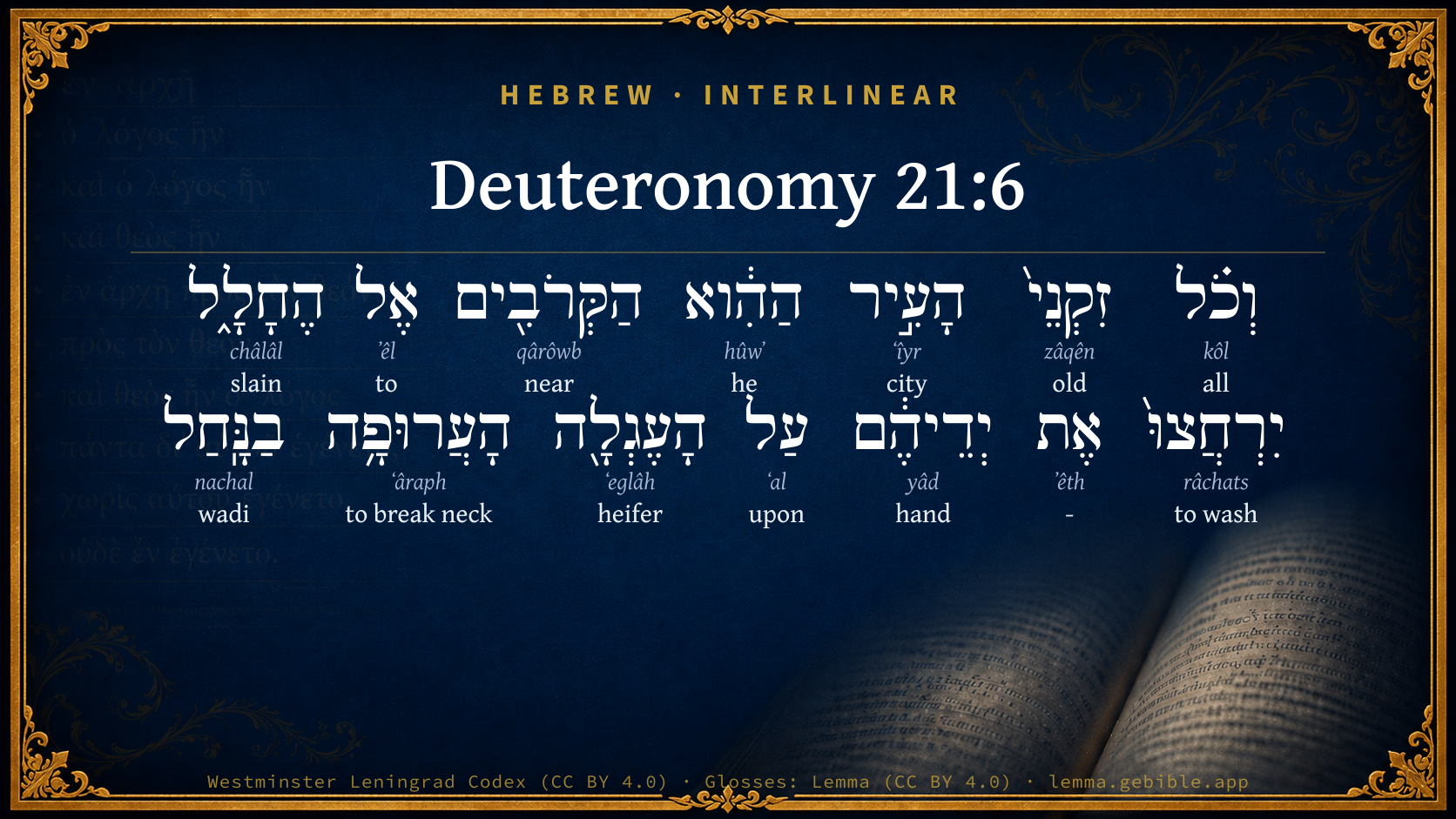
Hebrew (Westminster Leningrad Codex) Deuteronomy 21:6 appears in the Hebrew Old Testament. The text above is from the Westminster Leningrad Codex. Each word links to its Strong’s number, a concise gloss, and parsing drawn from the Open Scriptures Hebrew Bible morphology. Click any word for its full Brown-Driver-Briggs (BDB) entry.
Download image
Cite this verse

Deuteronomy 21:6 (World English Bible). Public Domain. Lemma interlinear Bible study tool, https://lemma.gebible.app/v/deuteronomy/21/6.

Show BibTeX & RIS
BibTeX
RIS
English Translation
All the elders of that city, who are nearest to the slain man, shall wash their hands over the heifer whose neck was broken in the valley;
World English Bible · Public Domain
Download a study sheet

One document with this verse’s original text, its word-by-word gloss line, the meaning frame, cross-references with their text, attributed commentary, and full source and license credits — printable, and it pastes into notes with its structure intact.

This verse Autodidact and up

Study sheet (.html) Plain text (.txt)

A passage Seminary Student

Up to 50 verses in one chapter. A passage sheet keeps up to 6 commentary sources and 12 cross-references per verse, in the order this page ranks them, and says so on the sheet whenever that leaves anything out. Ask for a single verse and you get the Autodidact verse sheet above.

Everything on this page stays free to read, with no account — the sheet is a download of what is already on screen, not access to it.

Want to remove ads? Support Godless Engineer
Compare translations 3

The same verse in 3 English versions, stacked beneath the original-language interlinear above. Click any original word for its lexicon entry.

Each is an independent rendering of the whole verse — the interlinear is not word-aligned to these translations.

Highlighted words mark where these versions differ — a whole-verse word diff, not a word-by-word alignment.

  • World English Bible Public Domain
    All the elders of that city, who are nearest to the slain man, shall wash their hands over the heifer whose neck was broken in the valley;
  • King James Version Public Domain
    And all the elders of that city, that are next unto the slain man, shall wash their hands over the heifer that is beheaded in the valley:
  • unfoldingWord Literal Text CC BY-SA 4.0
    And all the elders of that city, the nearest one to the slain, shall wash their hands over the heifer whose neck was broken in the valley,

unfoldingWord Literal Text — © unfoldingWord, licensed CC BY-SA 4.0. Word-aligned USFM3 via Door43 (git.door43.org/unfoldingWord/en_ult).

Versions to compare (up to 4)

3 of 4 selected

Show all 18 translations

Every available English version of this verse, each an independent rendering of the whole verse.

  • World English Bible Public Domain
    All the elders of that city, who are nearest to the slain man, shall wash their hands over the heifer whose neck was broken in the valley;
  • Berean Standard Bible Public Domain
    Then all the elders of the city nearest the victim shall wash their hands by the stream over the heifer whose neck has been broken,
  • Majority Standard Bible Public Domain
    Then all the elders of the city nearest the victim shall wash their hands by the stream over the heifer whose neck has been broken,
  • King James Version Public Domain
    And all the elders of that city, that are next unto the slain man, shall wash their hands over the heifer that is beheaded in the valley:
  • American Standard Version (1901) Public Domain
    And all the elders of that city, who are nearest unto the slain man, shall wash their hands over the heifer whose neck was broken in the valley;
  • Revised Version (1885) Public Domain
    and all the elders of that city, who are nearest unto the slain man, shall wash their hands over the heifer whose neck was broken in the valley:
  • Geneva Bible (1599) Public Domain
    And all the Elders of that citie that came neere to the slayne man, shall wash their hands ouer the heifer that is beheaded in the valley:
  • Douay-Rheims (1899) Public Domain
    And the ancients of that city shall come to the person slain, and shall wash their hands over the heifer that was killed in the valley,
  • Young's Literal Translation Public Domain
    and all the elders of that city, who are near unto the slain one, do wash their hands over the heifer which is beheaded in the valley,
  • Literal Standard Version CC BY-SA 4.0
    and all [the] elderly of that city, who are near to the slain one, wash their hands over the heifer which is beheaded in the valley,
  • Unlocked Literal Bible CC BY-SA 4.0
    All the elders of the city that is the nearest to the killed man must wash their hands over the heifer whose neck was broken in the valley;
  • unfoldingWord Literal Text CC BY-SA 4.0
    And all the elders of that city, the nearest one to the slain, shall wash their hands over the heifer whose neck was broken in the valley,
  • Darby Bible Public Domain
    And all the elders of that city, that are nearest unto him that is slain, shall wash their hands over the heifer whose neck is broken in the watercourse,
  • World Messianic Bible Public Domain
    All the elders of that city which is nearest to the slain man shall wash their hands over the heifer whose neck was broken in the valley.
  • Webster's Bible Public Domain
    And all the elders of that city that are next to the slain man, shall wash their hands over the heifer that is beheaded in the valley:
  • Free Bible Version CC BY-SA 4.0
    Then all the elders of the town nearest the body are to wash their hands in the stream over the dead cow, saying,
  • Bible in Basic English Public Domain
    And all the responsible men of that town which is nearest to the dead man, washing their hands over the cow whose neck was broken in the valley,
  • JPS Tanakh (1917) Public Domain
    And all the elders of that city, who are nearest unto the slain man, shall wash their hands over the heifer whose neck was broken in the valley.

Literal Standard Version (2020), Covenant Press — licensed CC BY-SA 4.0. Text via the HelloAO Bible API (eBible.org). Unlocked Literal Bible (unfoldingWord) — licensed CC BY-SA 4.0. Text via the HelloAO Bible API (eBible.org). unfoldingWord Literal Text — © unfoldingWord, licensed CC BY-SA 4.0. Word-aligned USFM3 via Door43 (git.door43.org/unfoldingWord/en_ult). Free Bible Version, Dr. Jonathan Gallagher — licensed CC BY-SA 4.0. Text via the HelloAO Bible API (eBible.org).

Word by word

More ways to search: Search by grammar → Find every occurrence → Compare this word →

Practice this passage: Drill this verse → Learn its vocabulary →

הָעֲרוּפָ֥ה
ʻâraph
H6202
“the · broken neck”
Particle, Definite Article + Verb, Qal, Participle Passive, Feminine, Singular, Absolute
Part of Speech
Particle + Verb
Stem
Qal
Form
Participle Passive
Gender
Feminine
Number
Singular
State
Absolute
Full BDB Definition

Origin: a primitive root [identical with H6201 through the idea of sloping]

TWOT: 1700

(Qal) to break the neck (of an animal)
  1. וְכֹ֗ל kôl H3605 “and · all of” Conjunction + Noun, Common, Masculine, Singular, Construct
  2. זִקְנֵי֙ zâqên H2205 “old of” Adjective, Adjective, Masculine, Plural, Construct
  3. הָעִ֣יר ʻîyr H5892 “the · city” Particle, Definite Article + Noun, Common, Feminine, Singular, Absolute
  4. הַהִ֔וא hûwʼ H1931 “the · he” Particle, Definite Article + Pronoun, Personal, 3rd Person, Feminine, Singular
  5. הַקְּרֹבִ֖ים qârôwb H7138 “the · near” Particle, Definite Article + Adjective, Adjective, Masculine, Plural, Absolute
  6. אֶל ʼêl H413 “to” Preposition
  7. הֶחָלָ֑ל châlâl H2491 “the · slain” Particle, Definite Article + Adjective, Adjective, Masculine, Singular, Absolute
  8. יִרְחֲצוּ֙ râchats H7364 “to wash” Verb, Qal, Imperfect, 3rd Person, Masculine, Plural
  9. אֶת ʼêth H853 “-” Particle, Direct Object
  10. יְדֵיהֶ֔ם yâd H3027 “hands · their” Noun, Common, Both, Dual, Construct + Suffix, Personal, 3rd Person, Masculine, Plural
  11. עַל ʻal H5921 “upon” Preposition
  12. הָעֶגְלָ֖ה ʻeglâh H5697 “the · heifer” Particle, Definite Article + Noun, Common, Feminine, Singular, Absolute
  13. בַנָּֽחַל nachal H5158 “in/at the · wadi” Preposition, Determined + Noun, Common, Masculine, Singular, Absolute

About this verse

These counts appear in no published source. They are computed here, from the morphology-tagged text and Lemma’s own curated glosses. What Lemma adds →

14
words
14
distinct lemmas
Pentateuch
section

Notable vocabulary

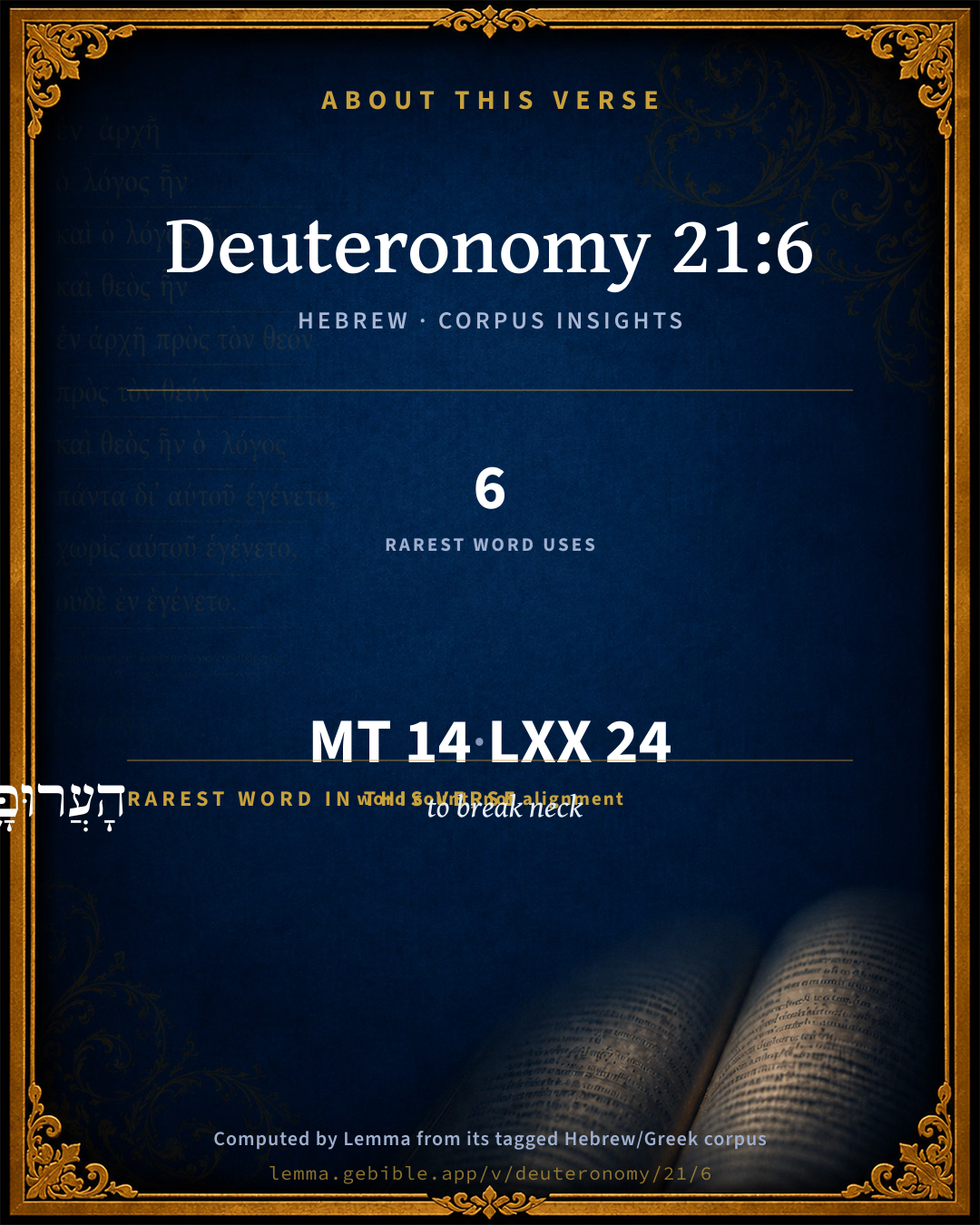
The rarest word here is הָעֲרוּפָ֥ה to break neck H6202 — appearing just 6 times in the whole Hebrew Bible.

Shared distinctive vocabulary

הָעֲרוּפָ֥ה to break neck H6202 occurs in 6 verses of the Hebrew Bible. Also found in:

Grammatical profile

  • 2 verbs
  • 5 nouns
  • 3 adjectives
  • 1 pronoun
  • 2 prepositions
  • 1 particle

Verb forms

  • יִרְחֲצוּ֙ Qal · Imperfect
  • הָעֲרוּפָ֥ה Qal · Participle Passive

Hebrew & Septuagint length

In English translation the verse runs 27 words from the Hebrew and 30 from the Septuagint (LXX English) — closely comparable.

A rough comparison of the two English renderings, which tokenize alike — not a word-level alignment.

Word counts can differ between the Hebrew and the Greek without any difference in meaning — e.g. the Hebrew direct-object marker אֵת has no separate Greek word, and Greek often adds the article ὁ.

In the original languages it is 14 Hebrew tokens and 24 Greek tokens — but the two are counted differently (Hebrew bundles its prefixes and suffixes into one token; the Greek is in lemma form), so that isn’t a like-for-like length.

Cross-references

10

Topical passages linked to Deuteronomy 21:6 in the Treasury of Scripture Knowledge — connected by theme and wording, ordered by reader-vote popularity; previews shown in the World English Bible.

  • Psalms 26:6 I will wash my hands in innocence, So I will go about your altar, Yahweh;
  • Psalms 73:13 Surely in vain I have cleansed my heart, And washed my hands in innocence,
  • Job 9:30 If I wash myself with snow, And cleanse my hands with lye,
  • Psalms 19:12 Who can discern his errors? Forgive me from hidden errors.
  • Psalms 51:2 Wash me thoroughly from my iniquity. Cleanse me from my sin.
  • Psalms 51:7 Purify me with hyssop, and I will be clean. Wash me, and I will be whiter than snow.
  • Psalms 51:14 Deliver me from bloodguiltiness, O God, the God of my salvation. My tongue shall sing aloud of your righteousness.
  • Jeremiah 2:22 For though you wash yourself with lye, and use much soap, yet your iniquity is marked before me, says the Lord Yahweh.
  • Matthew 27:24–25 So when Pilate saw that nothing was being gained, but rather that a disturbance was starting, he took water, and washed his hands before the multitude, saying, "I am innocent of the blood of this righteous person. You see to it."
  • Hebrews 9:10 being only (with meats and drinks and various washings) fleshly ordinances, imposed until a time of reformation.

Cross-references courtesy of OpenBible.info (CC BY 4.0).

Hebrew and Greek witnesses Masoretic Hebrew ↔ Greek Septuagint

The same verse in the two great witnesses to the Old Testament, shown verse-for-verse.

These are two independent witnesses, not word-aligned to each other, and the Septuagint is shown in lemma (dictionary) form.

Hebrew Deuteronomy 21:6 Masoretic · Westminster Leningrad Codex

וְכֹ֗ל זִקְנֵי֙ הָעִ֣יר הַהִ֔וא הַקְּרֹבִ֖ים אֶל הֶחָלָ֑ל יִרְחֲצוּ֙ אֶת יְדֵיהֶ֔ם עַל הָעֶגְלָ֖ה הָעֲרוּפָ֥ה בַנָּֽחַל

All the elders of that city, who are nearest to the slain man, shall wash their hands over the heifer whose neck was broken in the valley;

World English Bible · Public Domain

Greek LXX Deuteronomy 21:6 Septuagint · lemma form

καί πᾶς ὁ γερουσία ὁ πόλις ἐκεῖνος ὁ ἐγγίζω ὁ τραυματίας νίπτω ὁ χείρ ἐπί ὁ κεφαλή ὁ δάμαλις ὁ νευροκοπέω ἐν ὁ φάραγξ

And all the elders of that city who draw near to the slain man shall wash their hands over the head of the heifer which was slain in the valley;

LXX2012 (modern English Septuagint) · Public Domain

Hebrew: Westminster Leningrad Codex (CC BY 4.0). Greek: Septuagint (public domain); English from LXX2012 (modern English Septuagint) (Public Domain). How the Septuagint differs from the Hebrew →

Targum (Aramaic paraphrase)

2

The Targum is the ancient Jewish Aramaic paraphrase of the Hebrew Scriptures — an interpretive translation, not the Hebrew text itself. Onkelos (literal) and Pseudo-Jonathan (expansive) render the Torah, and Jonathan the Prophets. Coverage is partial: where no permissively-licensed English translation exists for a verse, only the Aramaic is shown. This is verse-level text, not a word-by-word alignment to the Hebrew.

  1. Targum Onkelos Torah (Genesis–Deuteronomy)
    וְכֹל סָבֵי קַרְתָּא הַהִיא דִקְרִיבִין לִקְטִילָא יַסְחוּן יָת יְדֵיהוֹן עַל עֲגַלְתָּא דִנְקֶפְתָּא בְנַחֲלָא

    (no public-domain English translation for this verse)

    Targum Onkelos — Aramaic: “Onkelos Genesis” (public domain); “Onkelos Exodus” (public domain); “Onkelos Leviticus” (public domain); “Onkelos Numbers” (public domain); “Onkelos Deuteronomy” (public domain). English: “Sefaria Community Translation” (CC0 1.0 (public-domain dedication)); “J.W. Etheridge. The Targums of Onkelos and Jonathan Ben Uzziel on the Pentateuch. London: Longmans, Green, 1862” (public domain). Text via Sefaria.

  2. Targum Pseudo-Jonathan Torah (Genesis–Deuteronomy)
    וְכָל חַכִּימֵי קַרְתָּא הַהוּא דְקָרִיבִין לְקָטִילָה יְשַׁזְגוּן יַת יְדֵיהוֹן עַל עֶגְלְתָא דִנְקִיפָא בְּחַקְלָא

    and all the elders of the city lying nearest to the dead man shall wash their hands over the heifer which hath been cut off in the field,

    Targum Pseudo-Jonathan — Aramaic: “Targum Jonathan on Genesis” (public domain); “Targum Jonathan on Exodus” (public domain); “Targum Jonathan on Leviticus” (public domain); “Targum Jonathan on Numbers” (public domain); “Targum Jonathan on Deuteronomy” (public domain). English: “The Targum of Jonathan ben Uzziel, trans. J. W. Etheridge, London, 1862” (public domain). Text via Sefaria.

Commentary

Notes on Deuteronomy 21:6 from classic Christian and Jewish commentators (each source and its license shown beneath its notes). The classic Christian expositions comment on the surrounding passage and are grouped to its opening verse, so a note may address several verses; the Jewish commentaries on the Tanakh (Rashi and others) are per-verse, so they appear only where the commentator wrote on this verse.

Lemma curates 59 commentaries, every one of them public domain or Creative Commons licensed, each selected and text-cleaned for this edition rather than reprinted as found. About our sources →

Trapp's Complete Commentary

John Trapp

Deu 21:6 And all the elders of that city, [that are] next unto the slain [man], shall wash their hands over the heifer that is beheaded in the valley:

Ver. 6. Shall wash their hands.] An old ceremony, used in this case by the Gentiles also, as the Scholiast upon Sophocles showeth. {See Trapp on "Mat 27:24"}

John Trapp, A Commentary or Exposition upon All the Books of the Old and New Testament (1647–1656) — public domain. Text from a community e-Sword module.

Tyndale Open Study Notes

Tyndale Open Resources

21:6 wash their hands: This ancient practice asserted innocence (cp. Matt 27:24); by it the community would declare that it was not responsible for a crime committed in its vicinity.

Tyndale Open Study Notes — © Tyndale Open Resources, licensed CC BY-SA 4.0. Text via the HelloAO Bible API.

Adam Clarke's Commentary

Verse 6. Shall wash their hands over the heifer] Washing the hands, in reference to such a subject as this, was a rite anciently used to signify that the persons thus washing were innocent of the crime in question. It was probably from the Jews that Pilate learned this symbolical method of expressing his innocence.

Adam Clarke's Commentary on the Bible (1810–1826) — public domain. Text from a community e-Sword/MySword module.

The Cambridge Bible for Schools and Colleges

gen. ed. J. J. S. Perowne

6. wash their hands] thus disowning their own and their community’s guilt. Psa_26:6; Psa_73:13, Mat_27:24.

over the heifer] As representing the murderer or the murder?

The Cambridge Bible for Schools and Colleges (gen. ed. J. J. S. Perowne; Cambridge University Press, 1878–1918) — public domain. Text from a community e-Sword module.

John Gill's Exposition

And all the elders of that city that are next unto the slain man,.... The whole court of judicature belonging to it, all the magistracy of it; even though there were an hundred of them, Maimonides (x) says:

shall wash their hands over the heifer that is beheaded in the valley: in token of their innocence, and this they did not only for themselves, but for the whole city, being the representatives of it; see Psa 26:6. Some think that this is a confirmation of the sense embraced by some, that it was a strong stream to which the heifer was brought; and there might be a stream of water here, and a valley also; though it would be no great difficulty to get from the city, which was near, a sufficient quantity of water to wash the hands of the elders with. This may denote the purification of sin by the blood of Christ, when it is confessed over him; and shows that priests and elders, ministers of the word, as well as others, stand in need of it; and that even those concerned in the death of Christ shared in the benefits of it.

(x) Hilchot Rotzeach, c. 9. sect. 3.

John Gill's Exposition of the Whole Bible (1746–1763) — public domain (CC PDM 1.0). Text via the HelloAO Bible API.

Haydock's Catholic Bible Commentary

Wash. This was intended to testify that they were not guilty of the blood which had been shed, and that they wished to remove the punishment of it from themselves upon the head of the heifer, (Calmet) the representative of the unknown murderer. So Pilate conformed to this custom, when he condemned Christ on the bare accusation of the Jews; (Matthew xxvii. 24) and the priest, at mass, washes his hands, as an emblem of that innocence, with which he ought to approach the holy of holies. (Haydock) --- Asterius was stricken with lightning, for touching the altar of Jupiter without having washed his hands. (Natal. Myth. i. 10. 14.) The pagans generally purified themselves with fumigations, or by sprinkling sea water upon their bodies. Achilles ordered the things which had been used to purify the Greeks, at the siege of Troy, to be thrown into the sea, as being unclean. (Iliad i.)

George Leo Haydock (1774–1849), Haydock's Catholic Family Bible and Commentary, 1859 edition — public domain. Excludes Psalms (Douay-Rheims chapter numbering differs from Protestant) and Deuterocanonical books (Catholic canon only).

Matthew Poole's English Annotations

In testimony of their innocency. See Poole "Mat 27:24".

Matthew Poole's English Annotations on the Holy Bible (1683–1685) — public domain. Text from a community e-Sword/MySword module.

Whedon's Commentary on the Bible

Daniel D. Whedon

6-8. The elders… shall wash their hands — The elders were to wash their hands over the slain heifer, to indicate that the guilt of the blood of the murdered man was not to rest upon the place they represented.

Daniel D. Whedon (gen. ed.), Commentary on the Old and New Testaments (1874–1909) — public domain. Text from a community e-Sword module.

The Pulpit Commentary

The elders of that city. The elders, by the significant act of washing their hands, indicated that they threw off from them, utterly repudiated, the charge of blood-guiltiness on the part of the town which they represented. (cf. Psa_26:6 Psa_73:13; Mat_27:24)

The Pulpit Commentary (1880–1919), ed. H.D.M. Spence-Jones & Joseph S. Exell — public domain. Text from a community e-Sword module.

unfoldingWord translationNotes

Door43 World Missions Community

General Information:

Moses continues speaking to the people of Israel.

the heifer whose neck was broken

This can be stated in active form. AT: "the heifer whose neck the priests broke" (See: Active or Passive)

they must answer to the case

"they must testify to Yahweh about this case"

Our hands have not shed this blood

Here "hands" are a synecdoche for the whole person and "shed this blood" is a metonym for killing an innocent person. AT: "We did not kill this innocent person" (See: Synecdoche and Metonymy)

neither have our eyes seen it

Here "eyes" refers to the whole person. AT: "and we did not see anyone kill this person" (See: Synecdoche)

translationWords

elder

cow

blood

unfoldingWord translationNotes — © Distant Shores Media and the Door43 World Missions Community, licensed CC BY-SA 4.0. Source: git.door43.org/Door43/en_tn.

Lesson kit

Teaching starters — assembled from the data on this page, not authored interpretation. Every prompt links to the verse data it draws on. Edit before teaching.

Deuteronomy, in the Pentateuch, opens this verse with 14 words (14 distinct Hebrew lemmas). Its most distinctive word is ʻâraph (“to break neck”). A historical commentator’s framing appears above. Read the whole chapter for the surrounding context.

Discussion questions

  1. How does “to break neck” (ʻâraph) shape what this verse is saying?
  2. Exodus 13:13 shares the word «to break neck» with this verse. How do the two illuminate each other?
  3. These translations render this verse differently. What is at stake in choosing one wording over another?
  4. The verb «יִרְחֲצוּ֙» is Qal Imperfect. How does its form color the action?
  5. Reading how Trapp's Complete Commentary and Tyndale Open Study Notes read this verse, where do the two commentators agree and where do they part?

Things to notice

Reading settings

Reading text

Shown beneath each verse's original-language words.

Old Testament
Old Testament edition

Read the OT as the Masoretic Hebrew (MT) or the Greek Septuagint (LXX).

English shown for the Greek Septuagint (in the Hebrew ↔ Greek comparison).

Comparing translations? Open the Compare panel on any verse page to stack up to four side by side.