
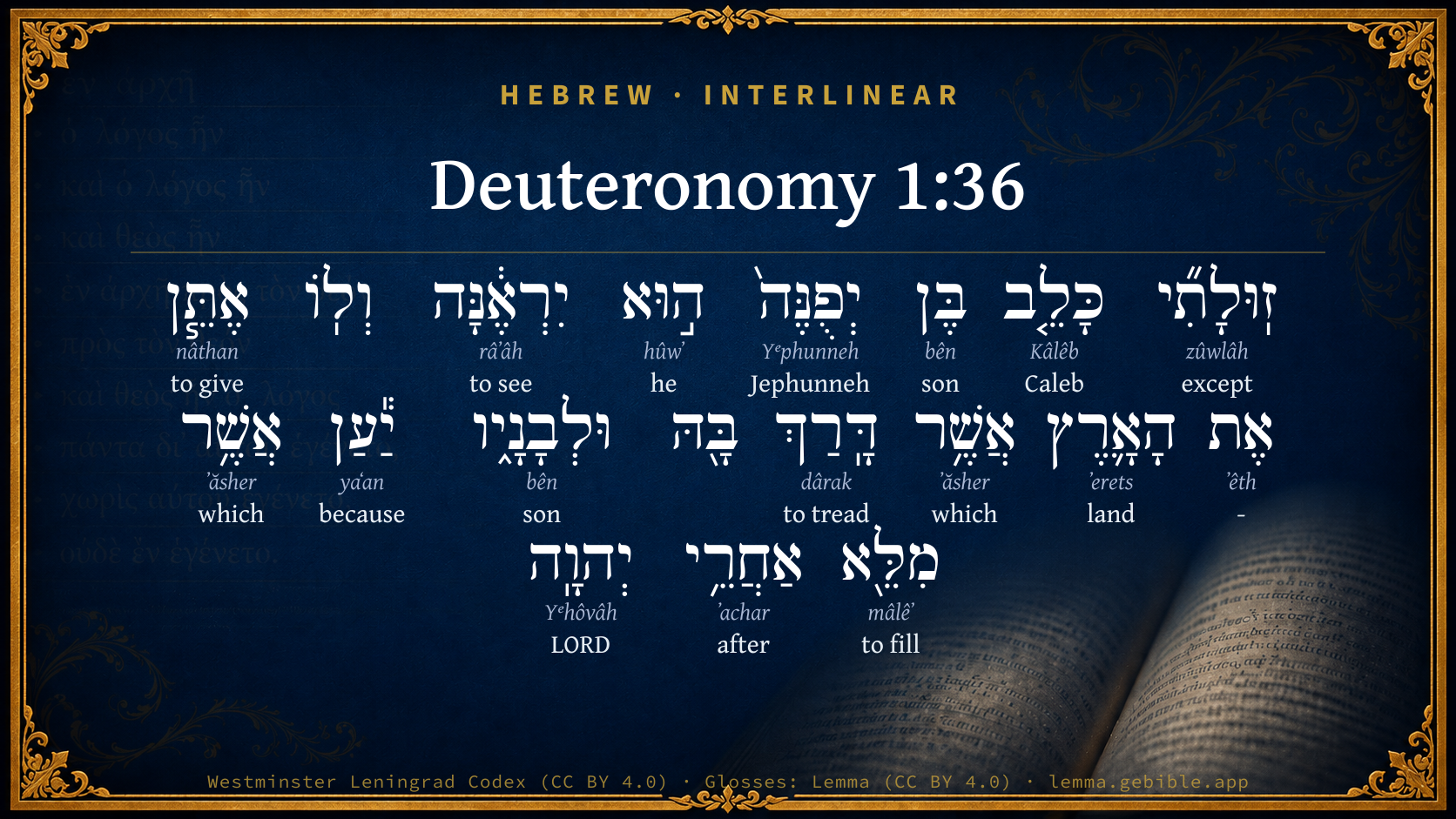
Deuteronomy 1:36

Hebrew (Westminster Leningrad Codex) Deuteronomy 1:36 appears in the Hebrew Old Testament. The text above is from the Westminster Leningrad Codex. Each word links to its Strong’s number, a concise gloss, and parsing drawn from the Open Scriptures Hebrew Bible morphology. Click any word for its full Brown-Driver-Briggs (BDB) entry.
Download image
Cite this verse

Deuteronomy 1:36 (World English Bible). Public Domain. Lemma interlinear Bible study tool, https://lemma.gebible.app/v/deuteronomy/1/36.

Show BibTeX & RIS
BibTeX
RIS
English Translation
save Caleb the son of Jephunneh: he shall see it; and to him will I give the land that he has trodden on, and to his children, because he has wholly followed Yahweh.
World English Bible · Public Domain
Highlights
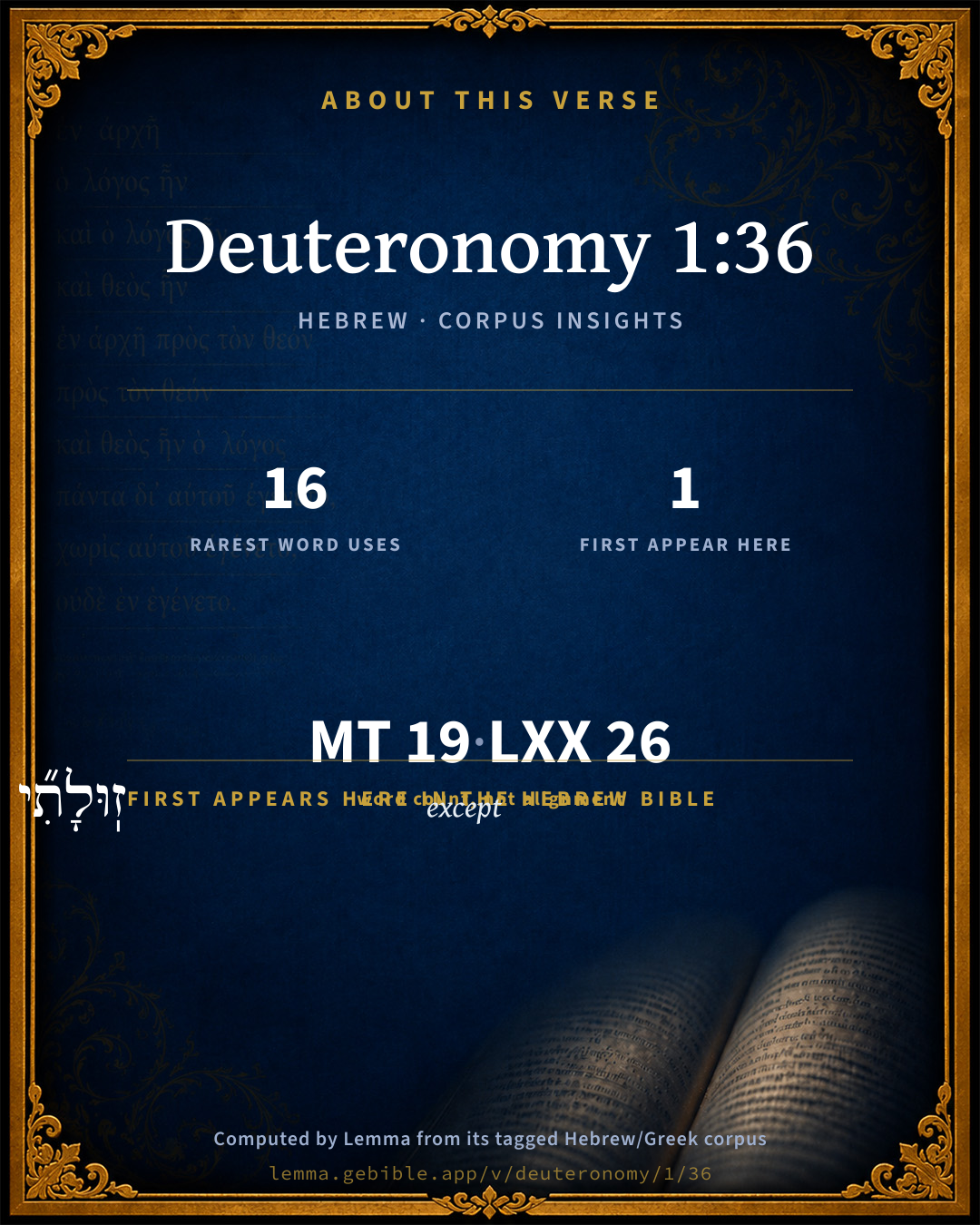
  • 1 first appearance in the Hebrew Bible
Full analysis ↓
Download a study sheet

One document with this verse’s original text, its word-by-word gloss line, the meaning frame, cross-references with their text, attributed commentary, and full source and license credits — printable, and it pastes into notes with its structure intact.

This verse Autodidact and up

Study sheet (.html) Plain text (.txt)

A passage Seminary Student

Up to 50 verses in one chapter. A passage sheet keeps up to 6 commentary sources and 12 cross-references per verse, in the order this page ranks them, and says so on the sheet whenever that leaves anything out. Ask for a single verse and you get the Autodidact verse sheet above.

Everything on this page stays free to read, with no account — the sheet is a download of what is already on screen, not access to it.

Want to remove ads? Support Godless Engineer
Compare translations 3

The same verse in 3 English versions, stacked beneath the original-language interlinear above. Click any original word for its lexicon entry.

Each is an independent rendering of the whole verse — the interlinear is not word-aligned to these translations.

Highlighted words mark where these versions differ — a whole-verse word diff, not a word-by-word alignment.

  • World English Bible Public Domain
    save Caleb the son of Jephunneh: he shall see it; and to him will I give the land that he has trodden on, and to his children, because he has wholly followed Yahweh.
  • King James Version Public Domain
    Save Caleb the son of Jephunneh; he shall see it, and to him will I give the land that he hath trodden upon, and to his children, because he hath wholly followed the LORD.
  • unfoldingWord Literal Text CC BY-SA 4.0
    except Caleb, the son of Jephunneh; he, he shall see it. And to him I will give the land that he has stepped on, and to his sons, because wholly after Yahweh.’

unfoldingWord Literal Text — © unfoldingWord, licensed CC BY-SA 4.0. Word-aligned USFM3 via Door43 (git.door43.org/unfoldingWord/en_ult).

Versions to compare (up to 4)

3 of 4 selected

Show all 18 translations

Every available English version of this verse, each an independent rendering of the whole verse.

  • World English Bible Public Domain
    save Caleb the son of Jephunneh: he shall see it; and to him will I give the land that he has trodden on, and to his children, because he has wholly followed Yahweh.
  • Berean Standard Bible Public Domain
    except Caleb son of Jephunneh. He will see it, and I will give him and his descendants the land on which he has set foot, because he followed the LORD wholeheartedly.”
  • Majority Standard Bible Public Domain
    except Caleb son of Jephunneh. He will see it, and I will give him and his descendants the land on which he has set foot, because he followed the LORD wholeheartedly.”
  • King James Version Public Domain
    Save Caleb the son of Jephunneh; he shall see it, and to him will I give the land that he hath trodden upon, and to his children, because he hath wholly followed the LORD.
  • American Standard Version (1901) Public Domain
    save Caleb the son of Jephunneh: he shall see it; and to him will I give the land that he hath trodden upon, and to his children, because he hath wholly followed Jehovah.
  • Revised Version (1885) Public Domain
    save Caleb the son of Jephunneh, he shall see it; and to him will I give the land that he hath trodden upon, and to his children: because he hath wholly followed the LORD.
  • Geneva Bible (1599) Public Domain
    Saue Caleb the sonne of Iephunneh: he shall see it, and to him will I giue the land that he hath troden vpon, and to his children, because he hath constantly followed the Lord.
  • Douay-Rheims (1899) Public Domain
    And when the Lord had heard the voice of your words, he was angry and swore, and said:
  • Young's Literal Translation Public Domain
    save Caleb son of Jephunneh -- he doth see it, and to him I give the land on which he hath trodden, and to his sons, because that he hath been fully after Jehovah.
  • Literal Standard Version CC BY-SA 4.0
    except Caleb son of Jephunneh—he sees it, and to him I give the land on which he has trodden, and to his sons, because that he has been fully after YHWH.
  • Unlocked Literal Bible CC BY-SA 4.0
    save Caleb son of Jephunneh; he will see it. To him I will give the land that he has stepped on, and to his children, because he has wholly followed Yahweh.'
  • unfoldingWord Literal Text CC BY-SA 4.0
    except Caleb, the son of Jephunneh; he, he shall see it. And to him I will give the land that he has stepped on, and to his sons, because wholly after Yahweh.’
  • Darby Bible Public Domain
    Except Caleb the son of Jephunneh, he shall see it, and to him will I give the land that he hath trodden upon, and to his children, because he hath wholly followed Jehovah.
  • World Messianic Bible Public Domain
    except Caleb the son of Jephunneh. He shall see it. I will give the land that he has trodden on to him and to his children, because he has wholly followed the LORD.”
  • Webster's Bible Public Domain
    Save Caleb the son of Jephunneh; he shall see it, and to him will I give the land that he hath trod upon, and to his children, because he hath wholly followed the LORD.
  • Free Bible Version CC BY-SA 4.0
    except Caleb, son of Jephunneh. He will see it, and I will give him and his descendants the land he explored, because he was completely committed to the Lord.”
  • Bible in Basic English Public Domain
    But only Caleb, the son of Jephunneh, he will see it; and to him and to his children I will give the land over which his feet have gone, because he has been true to the Lord with all his heart.
  • JPS Tanakh (1917) Public Domain
    save Caleb the son of Jephunneh, he shall see it; and to him will I give the land that he hath trodden upon, and to his children; because he hath wholly followed the LORD.'

Literal Standard Version (2020), Covenant Press — licensed CC BY-SA 4.0. Text via the HelloAO Bible API (eBible.org). Unlocked Literal Bible (unfoldingWord) — licensed CC BY-SA 4.0. Text via the HelloAO Bible API (eBible.org). unfoldingWord Literal Text — © unfoldingWord, licensed CC BY-SA 4.0. Word-aligned USFM3 via Door43 (git.door43.org/unfoldingWord/en_ult). Free Bible Version, Dr. Jonathan Gallagher — licensed CC BY-SA 4.0. Text via the HelloAO Bible API (eBible.org).

Word by word

More ways to search: Search by grammar → Find every occurrence → Compare this word →

Practice this passage: Drill this verse → Learn its vocabulary →

זֽוּלָתִ֞י
zûwlâh
H2108
“except”
Preposition
Part of Speech
Preposition
Full BDB Definition

Origin: from H2107

TWOT: 537a

a removal, a putting away (noun feminine) - except, besides, with the exception of, with removal of (preposition) - except that (conjunction)
  1. כָּלֵ֤ב Kâlêb H3612 “Caleb” Noun, Proper
  2. בֶּן bên H1121 “son of” Noun, Common, Masculine, Singular, Construct
  3. יְפֻנֶּה֙ Yᵉphunneh H3312 “Jephunneh” Noun, Proper
  4. ה֣וּא hûwʼ H1931 “he” Pronoun, Personal, 3rd Person, Masculine, Singular
  5. יִרְאֶ֔נָּה râʼâh H7200 “to see · her” Verb, Qal, Imperfect, 3rd Person, Masculine, Singular + Suffix, Personal, 3rd Person, Feminine, Singular
  6. אֶתֵּ֧ן nâthan H5414 “to give” Verb, Qal, Imperfect, 1st Person, Common, Singular
  7. אֶת ʼêth H853 “-” Particle, Direct Object
  8. הָאָ֛רֶץ ʼerets H776 “the · land” Particle, Definite Article + Noun, Common, Both, Singular, Absolute
  9. אֲשֶׁ֥ר ʼăsher H834 “which” Particle, Relative
  10. דָּֽרַךְ dârak H1869 “to tread” Verb, Qal, Perfect, 3rd Person, Masculine, Singular
  11. וּלְבָנָ֑יו bên H1121 “and · to/for · sons · his” Conjunction + Preposition + Noun, Common, Masculine, Plural, Construct + Suffix, Personal, 3rd Person, Masculine, Singular
  12. יַ֕עַן yaʻan H3282 “because” Conjunction
  13. אֲשֶׁ֥ר ʼăsher H834 “which” Particle, Relative
  14. מִלֵּ֖א mâlêʼ H4390 “to fill” Verb, Piel, Perfect, 3rd Person, Masculine, Singular
  15. אַחֲרֵ֥י ʼachar H310 “after” Preposition
  16. יְהוָֽה Yᵉhôvâh H3068 “LORD” Noun, Proper

About this verse

These counts appear in no published source. They are computed here, from the morphology-tagged text and Lemma’s own curated glosses. What Lemma adds →

19
words
15
distinct lemmas
Pentateuch
section

Notable vocabulary

The rarest word here is זֽוּלָתִ֞י except H2108 — appearing just 16 times in the whole Hebrew Bible.

First appearance in Scripture

This word makes its first canonical appearance in the Hebrew Bible here:

  • זֽוּלָתִ֞י except H2108

Shared distinctive vocabulary

זֽוּלָתִ֞י except H2108 occurs in 16 verses of the Hebrew Bible. Also found in:

Grammatical profile

  • 4 verbs
  • 6 nouns
  • 1 pronoun
  • 4 prepositions
  • 1 conjunction
  • 3 particles

Verb forms

  • יִרְאֶ֔נָּה Qal · Imperfect
  • אֶתֵּ֧ן Qal · Imperfect
  • דָּֽרַךְ Qal · Perfect
  • מִלֵּ֖א Piel · Perfect

Repetition

Words recur within this verse — often emphatic in Hebrew:

  • בֶּן son H1121 ×2
  • אֲשֶׁ֥ר which H834 ×2

Hebrew & Septuagint length

In English translation the verse runs 33 words from the Hebrew and 36 from the Septuagint (LXX English) — closely comparable.

A rough comparison of the two English renderings, which tokenize alike — not a word-level alignment.

Word counts can differ between the Hebrew and the Greek without any difference in meaning — e.g. the Hebrew direct-object marker אֵת has no separate Greek word, and Greek often adds the article ὁ.

In the original languages it is 19 Hebrew tokens and 26 Greek tokens — but the two are counted differently (Hebrew bundles its prefixes and suffixes into one token; the Greek is in lemma form), so that isn’t a like-for-like length.

Cross-references

8

Topical passages linked to Deuteronomy 1:36 in the Treasury of Scripture Knowledge — connected by theme and wording, ordered by reader-vote popularity; previews shown in the World English Bible.

  • Numbers 14:24 but my servant Caleb, because he had another spirit with him, and has followed me fully, him will I bring into the land into which he went; and his seed shall possess it.
  • Numbers 32:12 save Caleb the son of Jephunneh the Kenizzite, and Joshua the son of Nun; because they have wholly followed Yahweh.
  • Joshua 14:6–14 Then the children of Judah drew near to Joshua in Gilgal: and Caleb the son of Jephunneh the Kenizzite said to him, You know the thing that Yahweh spoke to Moses the man of God concerning me and concerning you in Kadesh-barnea.
  • Numbers 13:6 Of the tribe of Judah, Caleb the son of Jephunneh.
  • Numbers 13:30 Caleb stilled the people before Moses, and said, Let us go up at once, and possess it; for we are well able to overcome it.
  • Numbers 26:65 For Yahweh had said of them, They shall surely die in the wilderness. There was not left a man of them, save Caleb the son of Jephunneh, and Joshua the son of Nun.
  • Numbers 34:19 These are the names of the men: Of the tribe of Judah, Caleb the son of Jephunneh.
  • Judges 1:12–15 Caleb said, He who strikes Kiriath Sepher, and takes it, to him will I give Achsah my daughter as wife.

Cross-references courtesy of OpenBible.info (CC BY 4.0).

Hebrew and Greek witnesses Masoretic Hebrew ↔ Greek Septuagint

The same verse in the two great witnesses to the Old Testament, shown verse-for-verse.

These are two independent witnesses, not word-aligned to each other, and the Septuagint is shown in lemma (dictionary) form.

Hebrew Deuteronomy 1:36 Masoretic · Westminster Leningrad Codex

זֽוּלָתִ֞י כָּלֵ֤ב בֶּן יְפֻנֶּה֙ ה֣וּא יִרְאֶ֔נָּה וְלֽוֹ אֶתֵּ֧ן אֶת הָאָ֛רֶץ אֲשֶׁ֥ר דָּֽרַךְ בָּ֖הּ וּלְבָנָ֑יו יַ֕עַן אֲשֶׁ֥ר מִלֵּ֖א אַחֲרֵ֥י יְהוָֽה

save Caleb the son of Jephunneh: he shall see it; and to him will I give the land that he has trodden on, and to his children, because he has wholly followed Yahweh.

World English Bible · Public Domain

Greek LXX Deuteronomy 1:36 Septuagint · lemma form

πλήν χαλεβ υἱός ιεφοννη οὗτος ὁράω αὐτός καί οὗτος δίδωμι ὁ γῆ ἐπί ὅς ἐπιβαίνω καί ὁ υἱός αὐτός διά ὁ προςκεῖμαι αὐτός ὁ πρός κύριος

except Chaleb the son of Jephonne, he shall see it; and to him I will give the land on which he went up, and to his sons, because he attended to the things of the Lord.

LXX2012 (modern English Septuagint) · Public Domain

On this verse, The Cambridge Bible for Schools and Colleges discusses the Septuagint’s reading. Read the note in Commentary ↓

Hebrew: Westminster Leningrad Codex (CC BY 4.0). Greek: Septuagint (public domain); English from LXX2012 (modern English Septuagint) (Public Domain). How the Septuagint differs from the Hebrew →

Targum (Aramaic paraphrase)

2

The Targum is the ancient Jewish Aramaic paraphrase of the Hebrew Scriptures — an interpretive translation, not the Hebrew text itself. Onkelos (literal) and Pseudo-Jonathan (expansive) render the Torah, and Jonathan the Prophets. Coverage is partial: where no permissively-licensed English translation exists for a verse, only the Aramaic is shown. This is verse-level text, not a word-by-word alignment to the Hebrew.

  1. Targum Onkelos Torah (Genesis–Deuteronomy)
    אֱלָהֵן כָּלֵב בַּר יְפֻנֶה הוּא יֶחְזִנַהּ וְלֵהּ אֶתֵּן יָת אַרְעָא דִי דְרַךְ בַּהּ וְלִבְנוֹהִי חֲלַף דִי אַשְׁלִים בָּתַר דַחַלְתָּא דַיְיָ

    (no public-domain English translation for this verse)

    Targum Onkelos — Aramaic: “Onkelos Genesis” (public domain); “Onkelos Exodus” (public domain); “Onkelos Leviticus” (public domain); “Onkelos Numbers” (public domain); “Onkelos Deuteronomy” (public domain). English: “Sefaria Community Translation” (CC0 1.0 (public-domain dedication)); “J.W. Etheridge. The Targums of Onkelos and Jonathan Ben Uzziel on the Pentateuch. London: Longmans, Green, 1862” (public domain). Text via Sefaria.

  2. Targum Pseudo-Jonathan Torah (Genesis–Deuteronomy)
    אֱלָהֵן כָּלֵב בַּר יְפוּנֶה הוּא יֶחֱמִינָהּ וְלֵיהּ אִיתֵּן יַת אַרְעָא טַבְתָא אַרְעָא דְחֶבְרוֹן דִּמְטַיֵּיל בָּהּ וְלִבְנוֹי חוֹלַף דְּאַשְׁלִים בָּתַר דַּחַלְתָּא דַיְיָ

    except Kaleb bar Jephunneh, who shall see it, and to whom I will give the good land, the land of Hebron through which he walked, and to his children, because he hath followed with integrity the fear of the Lord.

    Targum Pseudo-Jonathan — Aramaic: “Targum Jonathan on Genesis” (public domain); “Targum Jonathan on Exodus” (public domain); “Targum Jonathan on Leviticus” (public domain); “Targum Jonathan on Numbers” (public domain); “Targum Jonathan on Deuteronomy” (public domain). English: “The Targum of Jonathan ben Uzziel, trans. J. W. Etheridge, London, 1862” (public domain). Text via Sefaria.

Commentary

Notes on Deuteronomy 1:36 from classic Christian and Jewish commentators (each source and its license shown beneath its notes). The classic Christian expositions comment on the surrounding passage and are grouped to its opening verse, so a note may address several verses; the Jewish commentaries on the Tanakh (Rashi and others) are per-verse, so they appear only where the commentator wrote on this verse.

Lemma curates 59 commentaries, every one of them public domain or Creative Commons licensed, each selected and text-cleaned for this edition rather than reprinted as found. About our sources →

The Cambridge Bible for Schools and Colleges

gen. ed. J. J. S. Perowne

36. save] Heb. zûlathî, in the Hex. only here, Deu_4:12 and Jos_11:13.

Caleb the son of Jephunneh] In the O. T. Kaleb—probably meaning dog (as from a tribal totem, W. R. Smith, Kinship, 200, 219), though other meanings have been suggested1[110]—is the name both of an individual and of a tribe, as among other Semites; Nabatean Kalba (Cooke, N. Sem. Inscr. 237); Arab. Kilâb (Wellh. Reste, 176 f., 217) and el-Kleib, a small tribe, (Musil, Ar. Petr. iii. 120 f.). In JE frequently Kaleb alone (Num_13:30; Num_14:24; Jos_15:14; Jos_15:16 f.); those passages in JE in which he is called son of Yephunneh2[111] are usually regarded as editorial, but it would be rash to say that the name of his father was not already found in JE by the deuteronomists. In D and P Kaleb the son of Yephunneh (Num_13:6; Num_14:6; Num_32:12; Num_34:19). According to J, Jos_15:17 (= Jdg_1:13) Kaleb was the brother of Ḳçnaz (the sons of Ḳçnaz were Edomite, Gen_36:11; Gen_36:15; Gen_36:42) and is called the Kenizzite in secondary passages of JE, Jos_14:6; Jos_14:13 f., which also explain along with Jos_15:13 how Joshua gave him Ḥebron in fulfilment of Moses’ promise to him. In David’s time the clan was still distinct from Judah or at least the memory of its original distinction was then preserved, 1Sa_30:14. Yet according to P, Num_13:6; Num_14:6; Num_34:19, Kaleb the spy was already of the tribe of Judah, and so the tribe or its ancestor is reckoned by the genealogies, 1Ch_2:9, 1Ch_2:18 ff., 1Ch_2:42 ff., 1Ch_4:15. This history of the name proves that the tradition held Kaleb the spy and Kaleb the ancestor of the tribe to have been the same. Yet it is possible that there was more than one possessor of so general a name; in connection with which, notice that neither in E, Numbers 13 f., nor in D is Kaleb described as a Kenizzite or indeed as anything but an Israelite.

[110] Sayce (Early Hist. of Hebr. 265) points out that in the Tell-el-Amarna letters awl later Assyr. despatches kalbu, ‘dog,’ is used of the king’s officers; but surely this is a term of humility; Hommel (Geogr. u. Gesch. d. alt. Orients) identifies Kaleb with Kalabu (Kalibu) ‘priests.’

[111] He (God?) is turned: cp. Palmyrene Ithpani, Cooke, p. 276.

to him will I give the land … and to his children] J E Num_14:24, his seed shall possess it.

that he hath trodden upon] JE, Num_14:24, whereinto he went. ‘D in harmony with its more elevated style uses the choicer and more expressive word, Deu_11:24 f.; Jos_1:3; Jos_14:9’ (Driver).

because] Heb. ya‘an asher, JE. in consequence of, ‘eḳeb.

hath wholly followed the Lord] Heb. hath fulfilled after Jehovah. Jehovah, being the speaker, we expect rather after me, as in Num_14:24; and so doubtless it was originally here ’aḥarai, the last letter of which has been mistaken by a scribe for the initial of Jehovah. Sam. and LXX, after Jehovah.

Further Note to Deu_1:36-38. Because Moses has just been described as seeking to turn the people from their sin, 29 ff., and it is therefore unreasonable to include him in their punishment; because Deu_1:37-38 needlessly anticipate Deu_3:26; Deu_3:28 and Deu_4:21; and because Deu_1:39 in whole or part follows suitably on Deu_1:36; therefore Deu_1:37-38 are taken by many (Dillm., W. R. Smith, Steuern., Berth, etc.) as a later addition to the text. And indeed the beginning of Deu_1:39 shows that the original has been disturbed by an editorial hand (see below). Steuern. would also omit Deu_1:36 on the ground that Kaleb has not been previously mentioned in this survey. But Kaleb is mentioned in JE on which this survey otherwise depends. In whatever way these textual questions may be decided, the parallel passages Deu_3:26 ff. and Deu_4:21 confirm the fact of a D tradition or statement that Jehovah was angry with Moses for the people’s sake. This can only mean, their guilt was great enough to include the very leader who had done his best to dissuade them from their disaffection! Now neither JE nor P gives any hint of so remarkable a judgement. On the contrary, P accounts for the exclusion of Moses by his own sin in striking the rock at Ḳadesh 37 years after this disaffection of Israel, Num_21:10 ff; Num_27:13 f.; Deu_32:50 f. The most reasonable explanation of such discrepancies is that they are discrepancies not of fact but or opinion. The earliest tradition, JE, merely held the facts that Kaleb survived and that Moses died on the eve of the possession of the Promised Land. The problem, which arose from this contrast of fortune, the deuteronomic writers solved by the statement that Moses was included in the guilt of the people when, startled by the report of the spies, they refused to invade Canaan from the S. in the second year of the wandering; and this agrees with the deuteronomic principle of the ethical solidarity of Israel. But the later priestly writer or writers, under the influence of the idea, first emphasized in the time of Jeremiah and Ezekiel (Jer_31:29 f., Ezekiel 18), that every man died because of his own sin, found a solution for the problem in Moses’ own guilt in presumptuously striking the rock at Ḳadesh, 37 years later. In this double engagement, from two different standpoints, with so difficult a problem, note the strong evidence that the survival of Kaleb and the death of Moses before Israel’s entrance to the Land were regarded as irremoveable elements of the early tradition.

The Cambridge Bible for Schools and Colleges (gen. ed. J. J. S. Perowne; Cambridge University Press, 1878–1918) — public domain. Text from a community e-Sword module.

The Biblical Illustrator

Joseph S. Exell

Deu_1:36

Because he hath wholly followed the Lord.

Following the Lord fully

You want to be a Christian, meanwhile your heart is set upon getting riches. You would store your mind with the learning and wisdom of the world, you wish to gain repute as a good talker in company, and a convivial guest at the social hoard. Ambition prompts you to seek fame among your fellows. Well, I shall not denounce any of these things, but I would use every persuasion to induce you who are believers in Christ to renounce the world. If Christ has redeemed you He has henceforth a claim on you as His servant, and it is at your peril that you take up any pursuits that are inconsistent with a full surrender of yourself to Him. Why many Christians never attain to any eminence in the Divine life is because they let the floods of their life run away in a dozen little rivulets, whereas if they cooped them up in one channel and sent that one stream rolling on to the glory of God, there would be such a force and power about their character that they would live while they lived. (C. H. Spurgeon.)

Following the Lord fully

It ought to be the great care of every one of us to follow the Lord fully. We must follow Him universally, without dividing; uprightly, without dissembling: cheerfully, without disputing; constantly, without declining; and this is following Him fully. (Matthew Henry.)

Self-concentration on God

No man makes progress in any branch of human thought or science without this first condition--the habit of pinning himself down wholly to the subject in band, and rigidly restraining all other thoughts. You must bring your instrument to a point before it will penetrate, to an edge that it may cut; and only firm concentration of oneself on the matter before us will do that. Alas! how little of this patient prolonged concentration of interested thought on our dear Lord do even the best and devoutest of us employ! And as for the ordinary Christian life of this day, what a sad contrast does it present to such an ideal. (A. Maclaren, D. D.)

The Biblical Illustrator, edited by Joseph S. Exell (c. 1880s–1900s) — public domain. Text from a community e-Sword module.

Joseph Benson's Commentary

Deu 1:36-37. Save Caleb — Under whom Joshua is comprehended, though not here expressed, because he was not now to be one of the people, but to be set over them as a chief governor: we are also to except Eleazar and some other Levites. For your sakes — Upon occasion of your wickedness and perverseness, by which you provoked me to speak unadvisedly.

Joseph Benson's Commentary on the Old and New Testaments (1811–1818) — public domain. Text from a community e-Sword module.

Tyndale Open Study Notes

Tyndale Open Resources

1:36 Caleb was one of the twelve spies whom Moses sent to discern the political and military situation in Canaan. Caleb and Joshua alone brought back the report that God would give Israel success in conquering Canaan (Num 13:6, 8, 16, 30). Caleb later became the father-in-law of Othniel, Israel’s first judge (Judg 1:13). For his faithfulness, Caleb was given the vicinity of Hebron as his inheritance, and he expelled the Anakites (see Josh 14:12-15; Judg 1:20).

Tyndale Open Study Notes — © Tyndale Open Resources, licensed CC BY-SA 4.0. Text via the HelloAO Bible API.

Adam Clarke's Commentary

Verse 36. Caleb - wholly followed the Lord.] See Clarke on Nu 14:24.

Adam Clarke's Commentary on the Bible (1810–1826) — public domain. Text from a community e-Sword/MySword module.

Ellicott's Commentary for English Readers

(36) Save Caleb.—Caleb is here placed by himself, as the one exception among the people. Joshua, as Moses’ substitute, the exception among the recognised leaders, is named separately.

A Bible Commentary for English Readers, edited by Charles John Ellicott (1878–1897) — public domain. Text from a community e-Sword module.

John Gill's Exposition

Save Caleb, the son of Jephunneh, he shall see it,.... Enter into it, and enjoy it:

and Joshua also; who was the other spy with him, that brought a good report of the land; see Deu 1:38,

and to him will I give the land that he hath trodden upon, and to his children: not the whole land of Canaan, but that part of it which he particularly came to and searched; and where the giants were, and he saw them, and notwithstanding was not intimidated by them, but encouraged the people to go up and possess it; and the part he came to particularly, and trod on, was Hebron, Num 13:22 and which the Targum of Jonathan, Jarchi, and Aben Ezra, interpret of that; and this was what was given to him and his at the division of the land, Jos 14:13,

because he hath wholly followed the Lord; see Num 14:24.

John Gill's Exposition of the Whole Bible (1746–1763) — public domain (CC PDM 1.0). Text via the HelloAO Bible API.

Matthew Poole's English Annotations

Caleb, under whom Joshua is comprehended, as is manifest from Deu 1:38; Num 14:30, though not here expressed, because he was not now to be one of the people, but to be set over them as chief governor. The land; that particular part of the land: compare Jos 14:9.

Matthew Poole's English Annotations on the Holy Bible (1683–1685) — public domain. Text from a community e-Sword/MySword module.

John Wesley's Explanatory Notes

Save Caleb - Under whom Josh. is comprehended, though not here expressed, because he was not now to be one of the people, but to be set over them as a chief governor.

John Wesley, Explanatory Notes Upon the Whole Bible (1754–1765) — public domain. Text via the GEBible commentary corpus.

Rashi

Rabbi Shlomo Yitzchaki (Rashi)

אשר דרך בה [AND TO HIM WILL I GIVE THE LAND] THAT HE TROD UPON — viz., Hebron, as it is said, (Numbers 13:22) “And he (Caleb) came to Hebron”.

Rashi on the Tanakh — English translations: “The Judaica Press complete Tanach with Rashi, translated by A. J. Rosenberg” (CC BY 4.0); “Pentateuch with Rashi's commentary by M. Rosenbaum and A.M. Silbermann, 1929-1934” (public domain); “The Metsudah Tanach series, Lakewood, N.J” (CC BY 4.0); and “The Book of Joshua, Metsudah Publications, 1997” (CC BY 4.0). Text via Sefaria.

Lesson kit

Teaching starters — assembled from the data on this page, not authored interpretation. Every prompt links to the verse data it draws on. Edit before teaching.

Deuteronomy, in the Pentateuch, opens this verse with 19 words (15 distinct Hebrew lemmas). Its most distinctive word is zûwlâh (“except”). A historical commentator’s framing appears above. Read the whole chapter for the surrounding context.

Discussion questions

  1. The word zûwlâh carries the sense “except.” How does it shape the verse?
  2. This is the first place “except” appears in Scripture (first appears here). What does its debut here establish?
  3. How does Deuteronomy 4:12, which shares the word «except», read alongside this verse?
  4. What does the repetition of “son” (2× in this one verse) do in this verse?
  5. These translations render this verse differently. What is at stake in choosing one wording over another?
  6. «יִרְאֶ֔נָּה» is a Qal Imperfect verb. How does that grammatical form shape the action described?
  7. Compare how The Cambridge Bible for Schools and Colleges and The Biblical Illustrator read this verse. Where do they agree or differ?

Things to notice

Reading settings

Reading text

Shown beneath each verse's original-language words.

Old Testament
Old Testament edition

Read the OT as the Masoretic Hebrew (MT) or the Greek Septuagint (LXX).

English shown for the Greek Septuagint (in the Hebrew ↔ Greek comparison).

Comparing translations? Open the Compare panel on any verse page to stack up to four side by side.