
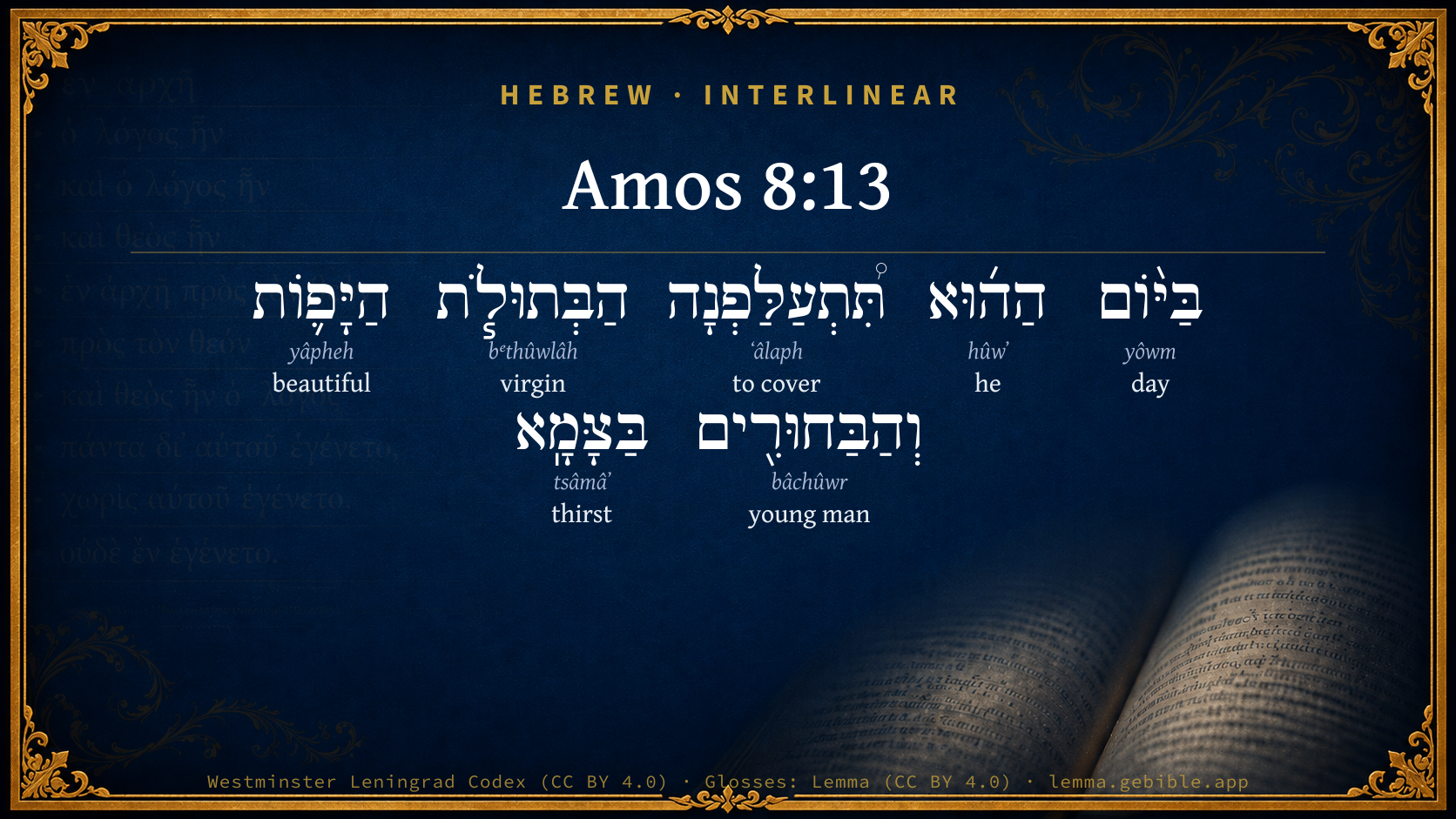
Amos 8:13

Hebrew (Westminster Leningrad Codex) Amos 8:13 appears in the Hebrew Old Testament. The text above is from the Westminster Leningrad Codex. Each word links to its Strong’s number, a concise gloss, and parsing drawn from the Open Scriptures Hebrew Bible morphology. Click any word for its full Brown-Driver-Briggs (BDB) entry.
Download image
Cite this verse

Amos 8:13 (World English Bible). Public Domain. Lemma interlinear Bible study tool, https://lemma.gebible.app/v/amos/8/13.

Show BibTeX & RIS
BibTeX
RIS
English Translation
In that day the beautiful virgins And the young men will faint for thirst.
World English Bible · Public Domain
Download a study sheet

One document with this verse’s original text, its word-by-word gloss line, the meaning frame, cross-references with their text, attributed commentary, and full source and license credits — printable, and it pastes into notes with its structure intact.

This verse Autodidact and up

Study sheet (.html) Plain text (.txt)

A passage Seminary Student

Up to 50 verses in one chapter. A passage sheet keeps up to 6 commentary sources and 12 cross-references per verse, in the order this page ranks them, and says so on the sheet whenever that leaves anything out. Ask for a single verse and you get the Autodidact verse sheet above.

Everything on this page stays free to read, with no account — the sheet is a download of what is already on screen, not access to it.

Want to remove ads? Support Godless Engineer
Compare translations 3

The same verse in 3 English versions, stacked beneath the original-language interlinear above. Click any original word for its lexicon entry.

Each is an independent rendering of the whole verse — the interlinear is not word-aligned to these translations.

Highlighted words mark where these versions differ — a whole-verse word diff, not a word-by-word alignment.

  • World English Bible Public Domain
    In that day the beautiful virgins And the young men will faint for thirst.
  • King James Version Public Domain
    In that day shall the fair virgins and young men faint for thirst.
  • unfoldingWord Literal Text CC BY-SA 4.0
    In that day the beautiful virgins and the young men will faint from thirst.

unfoldingWord Literal Text — © unfoldingWord, licensed CC BY-SA 4.0. Word-aligned USFM3 via Door43 (git.door43.org/unfoldingWord/en_ult).

Versions to compare (up to 4)

3 of 4 selected

Show all 18 translations

Every available English version of this verse, each an independent rendering of the whole verse.

  • World English Bible Public Domain
    In that day the beautiful virgins And the young men will faint for thirst.
  • Berean Standard Bible Public Domain
    In that day the lovely young women—the young men as well—will faint from thirst.
  • Majority Standard Bible Public Domain
    In that day the lovely young women—the young men as well—will faint from thirst.
  • King James Version Public Domain
    In that day shall the fair virgins and young men faint for thirst.
  • American Standard Version (1901) Public Domain
    In that day shall the fair virgins and the young men faint for thirst.
  • Revised Version (1885) Public Domain
    In that day shall the fair virgins and the young men faint for thirst.
  • Geneva Bible (1599) Public Domain
    In that day shall the faire virgines and the yong men perish for thirst.
  • Douay-Rheims (1899) Public Domain
    In that day the fair virgins, and the young men shall faint for thirst.
  • Young's Literal Translation Public Domain
    In that day faint do the fair virgins, And the young men, with thirst.
  • Literal Standard Version CC BY-SA 4.0
    In that day the beautiful virgins, || And the young men, faint with thirst.
  • Unlocked Literal Bible CC BY-SA 4.0
    In that day the beautiful virgins and the young men will faint from thirst.
  • unfoldingWord Literal Text CC BY-SA 4.0
    In that day the beautiful virgins and the young men will faint from thirst.
  • Darby Bible Public Domain
    In that day shall the fair virgins and the young men faint for thirst;
  • World Messianic Bible Public Domain
    In that day the beautiful virgins and the young men will faint for thirst.
  • Webster's Bible Public Domain
    In that day shall the fair virgins and young men faint for thirst.
  • Free Bible Version CC BY-SA 4.0
    On that day, even the beautiful girls and healthy young men will collapse from thirst.
  • Bible in Basic English Public Domain
    In that day the fair virgins and the young men will be feeble from need of water.
  • JPS Tanakh (1917) Public Domain
    In that day shall the fair virgins and the young men faint for thirst.

Literal Standard Version (2020), Covenant Press — licensed CC BY-SA 4.0. Text via the HelloAO Bible API (eBible.org). Unlocked Literal Bible (unfoldingWord) — licensed CC BY-SA 4.0. Text via the HelloAO Bible API (eBible.org). unfoldingWord Literal Text — © unfoldingWord, licensed CC BY-SA 4.0. Word-aligned USFM3 via Door43 (git.door43.org/unfoldingWord/en_ult). Free Bible Version, Dr. Jonathan Gallagher — licensed CC BY-SA 4.0. Text via the HelloAO Bible API (eBible.org).

Word by word

More ways to search: Search by grammar → Find every occurrence → Compare this word →

Practice this passage: Drill this verse → Learn its vocabulary →

תִּ֠תְעַלַּפְנָה
ʻâlaph
H5968
“to cover”
Verb, Hithpael, Imperfect, 3rd Person, Feminine, Plural
Part of Speech
Verb
Stem
Hithpael
Form
Imperfect
Person
3rd Person
Gender
Feminine
Number
Plural
Full BDB Definition

Origin: a primitive root

TWOT: 1634

to cover - (Pual) covered, encrusted (participle) - (Hithpael) to enwrap oneself, disguise oneself, faint
  1. בַּיּ֨וֹם yôwm H3117 “in/at the · day” Preposition, Determined + Noun, Common, Masculine, Singular, Absolute
  2. הַה֜וּא hûwʼ H1931 “the · he” Particle, Definite Article + Pronoun, Personal, 3rd Person, Masculine, Singular
  3. הַבְּתוּלֹ֧ת bᵉthûwlâh H1330 “the · virgins” Particle, Definite Article + Noun, Common, Feminine, Plural, Absolute
  4. הַיָּפ֛וֹת yâpheh H3303 “the · beautiful” Particle, Definite Article + Adjective, Adjective, Feminine, Plural, Absolute
  5. וְהַבַּחוּרִ֖ים bâchûwr H970 “and · the · young men” Conjunction + Particle, Definite Article + Noun, Common, Masculine, Plural, Absolute
  6. בַּצָּמָֽא tsâmâʼ H6772 “in/at the · thirst” Preposition, Determined + Noun, Common, Masculine, Singular, Absolute

About this verse

These counts appear in no published source. They are computed here, from the morphology-tagged text and Lemma’s own curated glosses. What Lemma adds →

7
words
7
distinct lemmas
Prophets
section

Notable vocabulary

The rarest word here is תִּ֠תְעַלַּפְנָה to cover H5968 — appearing just 5 times in the whole Hebrew Bible.

Shared distinctive vocabulary

תִּ֠תְעַלַּפְנָה to cover H5968 occurs in 5 verses of the Hebrew Bible. Also found in:

Grammatical profile

  • 1 verb
  • 4 nouns
  • 1 adjective
  • 1 pronoun

Verb forms

  • תִּ֠תְעַלַּפְנָה Hithpael · Imperfect

Hebrew & Septuagint length

In English translation the verse runs 14 words from the Hebrew and 14 from the Septuagint (LXX English) — the same length.

A rough comparison of the two English renderings, which tokenize alike — not a word-level alignment.

Word counts can differ between the Hebrew and the Greek without any difference in meaning — e.g. the Hebrew direct-object marker אֵת has no separate Greek word, and Greek often adds the article ὁ.

Cross-references

11

Topical passages linked to Amos 8:13 in the Treasury of Scripture Knowledge — connected by theme and wording, ordered by reader-vote popularity; previews shown in the World English Bible.

  • Hosea 2:3 Lest I strip her naked, And make her bare as in the day that she was born, And make her like a wilderness, And set her like a dry land, And kill her with thirst.
  • Lamentations 1:18 Yahweh is righteous; for I have rebelled against his commandment: Please hear all you peoples, and see my sorrow: My virgins and my young men are gone into captivity.
  • Lamentations 2:21 The youth and the old man lie on the ground in the streets; My virgins and my young men are fallen by the sword: You have killed them in the day of your anger; you have slaughtered, [and] not pitied.
  • Deuteronomy 32:25 Outside shall the sword bereave, In the chambers terror; [It shall destroy] both young man and virgin, The suckling with the man of gray hairs.
  • Psalms 63:1 God, you are my God. I will earnestly seek you. My soul thirsts for you, My flesh longs for you, In a dry and weary land, where there is no water.
  • Isaiah 40:30 Even the youths shall faint and be weary, and the young men shall utterly fall:
  • Isaiah 41:17–20 The poor and needy seek water, and there is none, and their tongue fails for thirst; I, Yahweh, will answer them, I, the God of Israel, will not forsake them.
  • Jeremiah 48:18 You daughter who dwells in Dibon, come down from your glory, and sit in thirst; for the destroyer of Moab is come up against you, he has destroyed your strongholds.
  • Lamentations 2:10 The elders of the daughter of Zion sit on the ground, they keep silence; They have cast up dust on their heads; they have girded themselves with sackcloth: The virgins of Jerusalem hang down their heads to the ground.
  • Zechariah 9:17 For how great is his goodness, And how great is his beauty! Grain will make the young men flourish, And new wine the virgins.
  • Psalms 144:12–15 Then our sons will be like well-nurtured plants, Our daughters like pillars carved to adorn a palace.

Cross-references courtesy of OpenBible.info (CC BY 4.0).

Hebrew and Greek witnesses Masoretic Hebrew ↔ Greek Septuagint

The same verse in the two great witnesses to the Old Testament, shown verse-for-verse.

These are two independent witnesses, not word-aligned to each other, and the Septuagint is shown in lemma (dictionary) form.

Hebrew Amos 8:13 Masoretic · Westminster Leningrad Codex

בַּיּ֨וֹם הַה֜וּא תִּ֠תְעַלַּפְנָה הַבְּתוּלֹ֧ת הַיָּפ֛וֹת וְהַבַּחוּרִ֖ים בַּצָּמָֽא

In that day the beautiful virgins And the young men will faint for thirst.

World English Bible · Public Domain

Greek LXX Amos 8:13 Septuagint · lemma form

ἐν ὁ ἡμέρα ἐκεῖνος ἐκλείπω ὁ παρθένος ὁ καλός καί ὁ νεανίσκος ἐν δίψος

In that day shall the fair virgins and the young men faint for thirst;

LXX2012 (modern English Septuagint) · Public Domain

Hebrew: Westminster Leningrad Codex (CC BY 4.0). Greek: Septuagint (public domain); English from LXX2012 (modern English Septuagint) (Public Domain). How the Septuagint differs from the Hebrew →

Targum (Aramaic paraphrase)

1

The Targum is the ancient Jewish Aramaic paraphrase of the Hebrew Scriptures — an interpretive translation, not the Hebrew text itself. Onkelos (literal) and Pseudo-Jonathan (expansive) render the Torah, and Jonathan the Prophets. Coverage is partial: where no permissively-licensed English translation exists for a verse, only the Aramaic is shown. This is verse-level text, not a word-by-word alignment to the Hebrew.

  1. Targum Jonathan Prophets (Joshua–Malachi)
    בְּיוֹמָא הַהוּא יִשְׁתַּלְהַיָן כְּנִישָׁתָא דְיִשְׂרָאֵל דְאִינוּן דַמְיָן לִבְתוּלָן שַׁפִּירָן דְטָעָאָה בְּשִׁפְרְהָן עִם עוּלֵימִין חַיָבִין וִיהוֹן מְטָרְפִין וּרְמָן בִּצְחוּתָא:

    (no public-domain English translation for this verse)

    Targum Jonathan — Aramaic: “Mikraot Gedolot” (public domain). English: “Sefaria Community Translation” (CC0 1.0 (public-domain dedication)); “London "Chaldee Paraphrase," 1871” (public domain). Text via Sefaria.

Commentary

Notes on Amos 8:13 from classic Christian and Jewish commentators (each source and its license shown beneath its notes). The classic Christian expositions comment on the surrounding passage and are grouped to its opening verse, so a note may address several verses; the Jewish commentaries on the Tanakh (Rashi and others) are per-verse, so they appear only where the commentator wrote on this verse.

Lemma curates 59 commentaries, every one of them public domain or Creative Commons licensed, each selected and text-cleaned for this edition rather than reprinted as found. About our sources →

Trapp's Complete Commentary

John Trapp

Amo 8:13 In that day shall the fair virgins and young men faint for thirst.

Ver. 13. In that day shall the fair virgins and young men faint for thirst] When God depriveth a People of his ordinances, and so withdraweth his gracious presence from them, what wonder though temporal judgments come rushing in as by a sluice? "Persecute and take him" (said David’s enemies), "for God hath forsaken him, and there is none to deliver him," Psa 71:11. "The Philistines are upon me," saith Saul, "for God hath forsaken me." "Behold, I am cast out from thy presence," said Cain (that is, from my father’s house where thine ordinances are administered), "and therefore every one that findeth me shall slay me," Gen 4:14. In that day of the want of the word, in the day of spiritual famine and thirst, behold, aliud ex alio malum, another thirst shall seize upon the choicest and fairest; as flies settle upon the sweetest perfumes, when they are cold, and corrupt them.

Shall the fair virgins] Whom all men favour for their comeliness, οτι καλον φιλον εστι. Beauty is of itself lovely and attractive, it needeth no letters of commendations: but God is no respecter of persons, and beauty abused is like a fair house with an ill inhabitant, said Diogenes; like a jewel of gold in a swine’s snout, said Solomon, Pro 11:22. Some are Helenas without, but Hecubas within, painted sepulchres, Egyptian temples; like Aurelia Orestilla, of whom Sallust saith, that she had nothing in her praise worthy but her beauty: fair she was and foolish, not καλη και σοφη, beautiful and wise, as it is reported of Aspasia, Cyrus’s concubine (Athenaeus). Now these fair maids, together with the choice young men, best able to endure thirst a long season,

Shall faint for thirst] Heb. shall be overcovered with grief, shall be troubled and perplexed, shall faint and swoon, shall find by experience that all flesh is grass, and the glory thereof as the flower of the field, that "even the youths shall faint and be weary, and the young men shall utterly fall. But they that wait upon the Lord shall renew their strength; they shall mount up with wings as eagles; they shall run and not be weary; and they shall walk and not faint," Isa 40:30-31.

John Trapp, A Commentary or Exposition upon All the Books of the Old and New Testament (1647–1656) — public domain. Text from a community e-Sword module.

Jamieson, Fausset & Brown

Robert Jamieson, A. R. Fausset & David Brown

faint for thirst--namely, thirst for hearing the words of the Lord, being destitute of all other comfort. If even the young and strong faint, how much more the infirm (Isa 40:30-31)!

Jamieson, Fausset & Brown — Commentary Critical and Explanatory on the Whole Bible (1871) — public domain (CC PDM 1.0). Text via the HelloAO Bible API.

John Calvin's Commentaries

The Prophet, having threatened spiritual famine, now adds, that the people would in every respect be barren and destitute of every good: for I take not thirst here in the same sense as before; but that they should be dried up through the want of all things. It is indeed the worst deprivation when men are parched up with thirst; and this is what the Prophet threatens here. A country may suffer from want of provision, while there is water enough to drink; but when not even this remains, it is an evidence of a heavier and of almost the extreme curse of God. We now perceive what the Prophet meant, which was this, — that when God should take away his word, by which the souls of men are nourished up to eternal life, the Israelites would be then in want also of all blessings, so that they would not only be without bread, but also without water; and he mentions a circumstance which would greatly aggravate the evil, Faint, he says, shall the fair virgins and the youth in their vigor It seems unnatural, that those who are vigorous, and can run to get supply for their wants, should faint: but the Prophet, as I have said, wished to show that there would be no escape, but that God would distress the strongest, when he sent such a famine, and with it the want also of drink.

John Calvin's Commentaries (1540-1563) — public domain. Text from the Calvin Translation Society English edition (1840s-50s) via the Christian Classics Ethereal Library (ccel.org). Calvin's coverage is partial (roughly two-thirds of the Bible); uncommented books and verses are honest gaps, never fabricated. The 19th-century editor's footnotes and remarks are omitted so the notes are faithfully Calvin's own voice.

Ellicott's Commentary for English Readers

(13) Faint.—That fair virgins and strong brave youths should faint by reason of their raging thirst suggests that the less vigorous would suffer even more keenly. It is sad when old men stumble into the darkness of unbelief amid the shining of the noon-day sun, seeing that they can remember the brightness of their morning, but there is always hope that their child-like spirit may return to them, and that at the evening time it may be light; but if fair virgins and strong youths are covered with the inward veil, what will become of them in their westering days? and where will the elders be if they have had no youth?

A Bible Commentary for English Readers, edited by Charles John Ellicott (1878–1897) — public domain. Text from a community e-Sword module.

The Cambridge Bible for Schools and Colleges

gen. ed. J. J. S. Perowne

13. In the day of agony and distress then coming upon Israel, the young men and fair maidens, the strength and pride of the population, will faint for thirsty, exhausted by the privations of a siege, or the sufferings involved in the sack of a city by the foe (cf. especially Lam_2:11-12; Lam_2:19; Isa_51:20).

The Cambridge Bible for Schools and Colleges (gen. ed. J. J. S. Perowne; Cambridge University Press, 1878–1918) — public domain. Text from a community e-Sword module.

John Gill's Exposition

In that day shall the fair virgins and young men faint for thirst. After the word, for want of that grain and wine, which make young men and maids cheerful, Zac 9:17; but, being destitute of them, should be covered with sorrow, overwhelmed with grief, and ready to sink and die away. These, according to some, design the congregation of Israel; who are like to beautiful virgins, as the Targum paraphrases it; and the principal men of it, the masters of the assemblies: or, as others, such who were trusting to their own righteousness, and seeking after that which they could never attain justification by, and did not hunger and thirst after the righteousness of Christ, and so perished.

Amos 8:14

John Gill's Exposition of the Whole Bible (1746–1763) — public domain (CC PDM 1.0). Text via the HelloAO Bible API.

Albert Barnes' Notes on the Bible

In this hopelessness as to all relief, those too shall fail and sink under their sufferings, in whom life is freshest and strongest and hope most buoyant. Hope mitigates any sufferings. When hope is gone, the powers of life, which it sustains, give way. “They shall faint for thirst,” literally, “shall be mantled over, covered” , as, in fact, one fainting seems to feel as if a veil came over his brow and eyes. “Thirst,” as it is an intenser suffering than bodily hunger, includes sufferings of body and mind. If even over those, whose life was firmest, a veil came, and they fainted for thirst, what of the rest?

Albert Barnes' Notes on the Bible (1834–1885) — public domain. Text from a community e-Sword/MySword module.

Matthew Poole's English Annotations

It is probable these in their strength and rigour would seek earnestly to know what end they might expect, whether they should outlive this famine of the word, and the famine of bread and water, but both should faint with thirst and hunger; neither finding the word of the Lord for their comfort, they should faint with despair, nor finding bread and water, should faint and die with weakness: so Israel should be extinguished.

Matthew Poole's English Annotations on the Holy Bible (1683–1685) — public domain. Text from a community e-Sword/MySword module.

The Pulpit Commentary

This verse is parallel to the preceding. The thirst, spiritual and physical, shall affect the fair virgins and young men those in all the freshness, beauty, and vigour of youth. Shall faint; literally, shall be veiled, covered, expressive of the feeling of faintness, when the sight grows dim and a mantle of darkness drops over one. (Jon_4:8) If the strongest thus fail, much more will the rest succumb to the threatened calamity.

The Pulpit Commentary (1880–1919), ed. H.D.M. Spence-Jones & Joseph S. Exell — public domain. Text from a community e-Sword module.

Keil & Delitzsch

C. F. Keil & F. Delitzsch

"In that day will the fair virgins and the young men faint for thirst. Amo 8:14. They who swear by the guilt of Samaria, and say, By the life of thy God, O Dan! and by the life of the way to Beersheba; and will fall, and not rise again." Those who now stand in all the fullest and freshest vigour of life, will succumb to this hunger and thirst. The virgins and young men are individualized, as comprising that portion of the nation which possessed the vigorous fulness of youth. עלף, to be enveloped in night, to sink into a swoon, hithp. to hide one's self, to faint away. הנּשׁבּעים refers to the young men and virgins; and inasmuch as they represent the most vigorous portion of the nation, to the nation as a whole. If the strongest succumb to the thirst, how much more the weak! 'Ashmath Shōmerōn, the guilt of Samaria, is the golden calf at Bethel, the principal idol of the kingdom of Israel, which is named after the capital Samaria (compare Deu 9:21, "the sin of Israel"), not the Asherah which was still standing in Samaria in the reign of Jehoahaz (Kg2 13:6); for apart from the question whether it was there in the time of Jeroboam, this is at variance with the second clause, in which the manner of their swearing is given, - namely, by the life of the god at Dan, that is to say, the golden calf that was there; so that the guilt of Samaria can only have been the golden calf at Bethel, the national sanctuary of the ten tribes (cf. Amo 4:4; Amo 5:5). The way to Beersheba is mentioned, instead of the worship, for the sake of which the pilgrimage to Beersheba was made. This worship, again, was not a purely heathen worship, but an idolatrous worship of Jehovah (see Amo 5:5). The fulfilment of these threats commenced with the destruction of the kingdom of Israel, and the carrying away of the ten tribes into exile in Assyria, and continues to this day in the case of that portion of the Israelitish nation which is still looking for the Messiah, the prophet promised by Moses, and looking in vain, because they will not hearken to the preaching of the gospel concerning the Messiah, who appeared as Jesus.

Keil & Delitzsch — Biblical Commentary on the Old Testament (1861–1891) — public domain (CC PDM 1.0). Text via the HelloAO Bible API. (Old Testament only.)

unfoldingWord translationNotes

Door43 World Missions Community

In that day

"At that time"

faint

to lose all strength

by the sin of Samaria

Here "sin" represents the false god the people worship in Samaria. AT: "by the false god of Samaria" (See: Metonymy)

As your god lives, Dan

This is a way of making a solemn oath. The people declare that they believe the god of Dan is certainly alive to emphasize that they will certainly do what they promise to do.

As the way to Beersheba exists

This is probably a reference to the roads that pilgrims would take to Beersheba in order to worship idols there. Again, this is a way of making a solemn oath. They state that the way to Beersheba certainly exists in order to emphasize that they will certainly do what they promise to do.

they will fall

This is an idiom. AT: "they will die" (See: Idiom)

translationWords

virgin

oath

sin

Samaria

life

Dan

Beersheba

unfoldingWord translationNotes — © Distant Shores Media and the Door43 World Missions Community, licensed CC BY-SA 4.0. Source: git.door43.org/Door43/en_tn.

Rashi

Rabbi Shlomo Yitzchaki (Rashi)

shall faint Heb. תִּתְעַלַּפְנָה. Their spirit shall fly out. Cf. (Jonah 4:8) “And he fainted (וַיִּתְעַלָּף).” And so, (Ezekiel 31:15) “The trees of the field fainted (עֻלְפֶּה) for him.” And so in the language of the Mishnah (Chullin 3b): “He may faint (נִתְעַלְּפָה),” pasmer, (pamer) in French. [from Dunash p.84]

Rashi on the Tanakh — English translations: “The Judaica Press complete Tanach with Rashi, translated by A. J. Rosenberg” (CC BY 4.0); “Pentateuch with Rashi's commentary by M. Rosenbaum and A.M. Silbermann, 1929-1934” (public domain); “The Metsudah Tanach series, Lakewood, N.J” (CC BY 4.0); and “The Book of Joshua, Metsudah Publications, 1997” (CC BY 4.0). Text via Sefaria.

Lesson kit

Teaching starters — assembled from the data on this page, not authored interpretation. Every prompt links to the verse data it draws on. Edit before teaching.

Amos, in the Prophets, opens this verse with 7 words (7 distinct Hebrew lemmas). Its most distinctive word is ʻâlaph (“to cover”). A historical commentator’s framing appears above. Read the whole chapter for the surrounding context.

Discussion questions

  1. How does “to cover” (ʻâlaph) shape what this verse is saying?
  2. Genesis 38:14 shares the word «to cover» with this verse. How do the two illuminate each other?
  3. These translations render this verse differently; the difference is in the English rendering, not the original. What questions does that raise?
  4. The verb «תִּ֠תְעַלַּפְנָה» is Hithpael Imperfect. How does its form color the action?
  5. Reading how Trapp's Complete Commentary and Jamieson, Fausset & Brown read this verse, where do the two commentators agree and where do they part?

Things to notice

Reading settings

Reading text

Shown beneath each verse's original-language words.

Old Testament
Old Testament edition

Read the OT as the Masoretic Hebrew (MT) or the Greek Septuagint (LXX).

English shown for the Greek Septuagint (in the Hebrew ↔ Greek comparison).

Comparing translations? Open the Compare panel on any verse page to stack up to four side by side.