
Deuteronomy 22:17

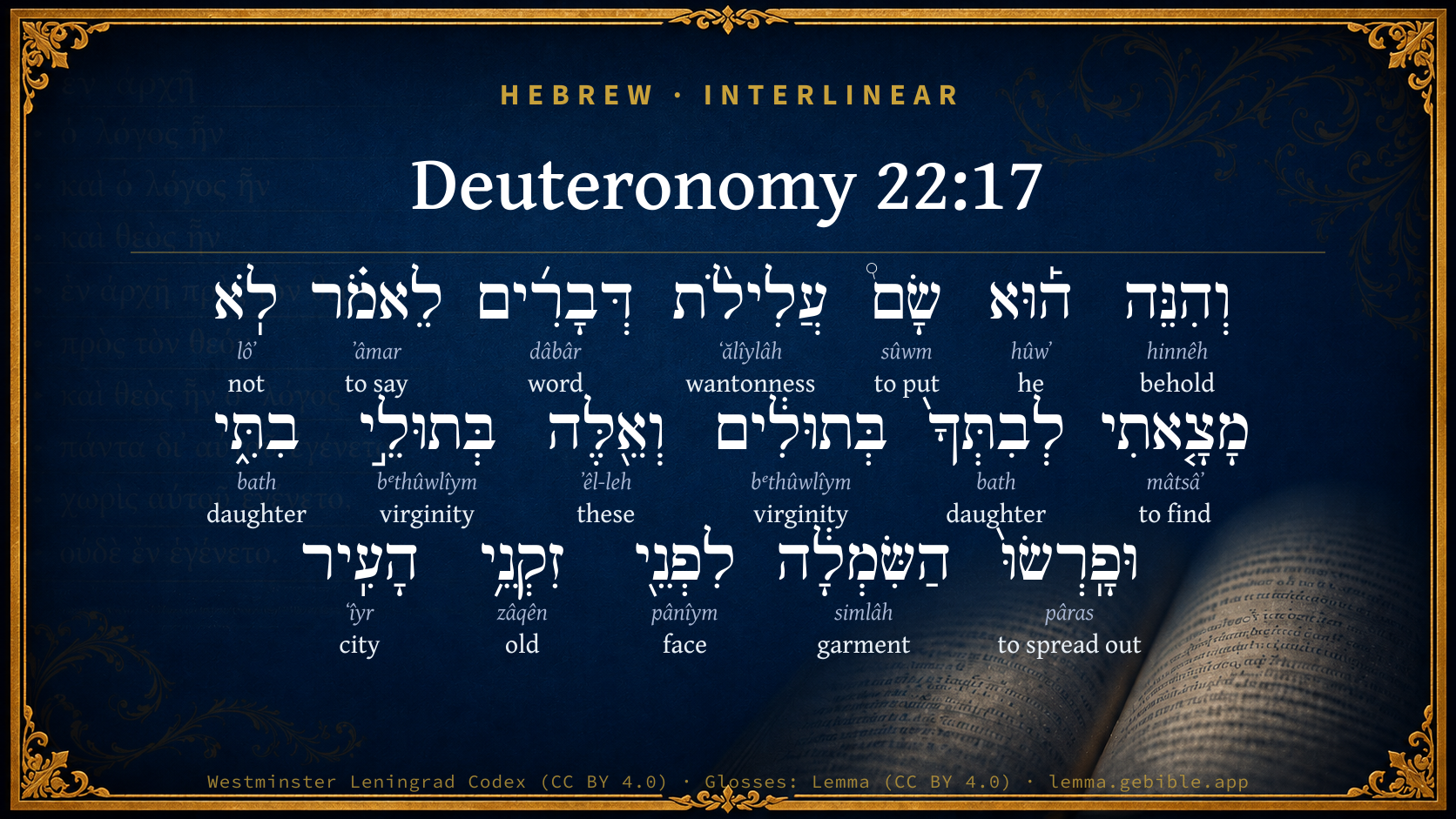
Hebrew (Westminster Leningrad Codex) Deuteronomy 22:17 appears in the Hebrew Old Testament. The text above is from the Westminster Leningrad Codex. Each word links to its Strong’s number, a concise gloss, and parsing drawn from the Open Scriptures Hebrew Bible morphology. Click any word for its full Brown-Driver-Briggs (BDB) entry.
Download image
Cite this verse

Deuteronomy 22:17 (World English Bible). Public Domain. Lemma interlinear Bible study tool, https://lemma.gebible.app/v/deuteronomy/22/17.

Show BibTeX & RIS
BibTeX
RIS
English Translation
and, behold, he has laid shameful things [to her charge], saying, I didn't find in your daughter the tokens of virginity; and yet these are the tokens of my daughter's virginity. They shall spread the garment before the elders of the city.
World English Bible · Public Domain
Download a study sheet

One document with this verse’s original text, its word-by-word gloss line, the meaning frame, cross-references with their text, attributed commentary, and full source and license credits — printable, and it pastes into notes with its structure intact.

This verse Autodidact and up

Study sheet (.html) Plain text (.txt)

A passage Seminary Student

Up to 50 verses in one chapter. A passage sheet keeps up to 6 commentary sources and 12 cross-references per verse, in the order this page ranks them, and says so on the sheet whenever that leaves anything out. Ask for a single verse and you get the Autodidact verse sheet above.

Everything on this page stays free to read, with no account — the sheet is a download of what is already on screen, not access to it.

Want to remove ads? Support Godless Engineer
Compare translations 3

The same verse in 3 English versions, stacked beneath the original-language interlinear above. Click any original word for its lexicon entry.

Each is an independent rendering of the whole verse — the interlinear is not word-aligned to these translations.

Highlighted words mark where these versions differ — a whole-verse word diff, not a word-by-word alignment.

  • World English Bible Public Domain
    and, behold, he has laid shameful things [to her charge], saying, I didn't find in your daughter the tokens of virginity; and yet these are the tokens of my daughter's virginity. They shall spread the garment before the elders of the city.
  • King James Version Public Domain
    And, lo, he hath given occasions of speech against her, saying, I found not thy daughter a maid; and yet these are the tokens of my daughter's virginity. And they shall spread the cloth before the elders of the city.
  • unfoldingWord Literal Text CC BY-SA 4.0
    And behold, he has set forth shameful things, saying, “I did not find virginity in your daughter.” But these the virginity of my daughter.’ And they shall spread the garment out to the faces of the elders of the city.

unfoldingWord Literal Text — © unfoldingWord, licensed CC BY-SA 4.0. Word-aligned USFM3 via Door43 (git.door43.org/unfoldingWord/en_ult).

Versions to compare (up to 4)

3 of 4 selected

Show all 18 translations

Every available English version of this verse, each an independent rendering of the whole verse.

  • World English Bible Public Domain
    and, behold, he has laid shameful things [to her charge], saying, I didn't find in your daughter the tokens of virginity; and yet these are the tokens of my daughter's virginity. They shall spread the garment before the elders of the city.
  • Berean Standard Bible Public Domain
    And now he has accused her of shameful conduct, saying, ‘I discovered that your daughter was not a virgin.’ But here is the proof of her virginity.” And they shall spread out the cloth before the city elders.
  • Majority Standard Bible Public Domain
    And now he has accused her of shameful conduct, saying, ‘I discovered that your daughter was not a virgin.’ But here is the proof of her virginity.” And they shall spread out the cloth before the city elders.
  • King James Version Public Domain
    And, lo, he hath given occasions of speech against her, saying, I found not thy daughter a maid; and yet these are the tokens of my daughter's virginity. And they shall spread the cloth before the elders of the city.
  • American Standard Version (1901) Public Domain
    and, lo, he hath laid shameful things `to her charge', saying, I found not in thy daughter the tokens of virginity; and yet these are the tokens of my daughter's virginity. And they shall spread the garment before the elders of the city.
  • Revised Version (1885) Public Domain
    and, lo, he hath laid shameful things to her charge, saying, I found not in thy daughter the tokens of virginity; and yet these are the tokens of my daughter’s virginity. And they shall spread the garment before the elders of the city.
  • Geneva Bible (1599) Public Domain
    And lo, he layeth slaunderous things vnto her charge, saying, I founde not thy daughter a mayde: loe, these are the tokens of my daughters virginitie: and they shall spreade the vesture before the Elders of the citie.
  • Douay-Rheims (1899) Public Domain
    He layeth to her charge a very ill name, so as to say: I found not thy daughter a virgin: and behold these are the tokens of my daughter's virginity. And they shall spread the cloth before the ancients of the city:
  • Young's Literal Translation Public Domain
    and lo, he hath laid actions of words, saying, I have not found to thy daughter tokens of virginity -- and these `are' the tokens of the virginity of my daughter! and they have spread out the garment before the elders of the city.
  • Literal Standard Version CC BY-SA 4.0
    and behold, he has laid evil deeds of words, saying, I have not found proofs of virginity for your daughter—and these [are] the proofs of virginity of my daughter! And they have spread out the garment before [the] elderly of the city.
  • Unlocked Literal Bible CC BY-SA 4.0
    See, he has accused her of shameful things and said, “I did not find in your daughter the proof of virginity.” But here is the proof of my daughter's virginity.' Then they will spread the garment out before the elders of the city.
  • unfoldingWord Literal Text CC BY-SA 4.0
    And behold, he has set forth shameful things, saying, “I did not find virginity in your daughter.” But these the virginity of my daughter.’ And they shall spread the garment out to the faces of the elders of the city.
  • Darby Bible Public Domain
    and behold, he charges her with things for scandalous talk, saying, I found not thy daughter a virgin; and here are the tokens of my daughter's virginity. And they shall spread the cloth before the elders of the city.
  • World Messianic Bible Public Domain
    Behold, he has accused her of shameful things, saying, ‘I didn’t find in your daughter the tokens of virginity;’ and yet these are the tokens of my daughter’s virginity.” They shall spread the cloth before the elders of the city.
  • Webster's Bible Public Domain
    And lo, he hath given occasions of speech against her, saying, I found not thy daughter a maid; and yet these are the tokens of my daughter's virginity. And they shall spread the cloth before the elders of the city.
  • Free Bible Version CC BY-SA 4.0
    Now he has accused her of being immoral, saying, ‘I found out that your daughter wasn't a virgin.’ But here's the proof of her virginity.” The parents shall spread out the sheet in front of the town elders.
  • Bible in Basic English Public Domain
    And now he has put shame on her, saying that she is not a virgin; but here is the sign that she is a virgin. Then they are to put her clothing before the responsible men of the town.
  • JPS Tanakh (1917) Public Domain
    and, lo, he hath laid wanton charges, saying: I found not in thy daughter the tokens of virginity; and yet these are the tokens of my daughter's virginity.' And they shall spread the garment before the elders of the city.

Literal Standard Version (2020), Covenant Press — licensed CC BY-SA 4.0. Text via the HelloAO Bible API (eBible.org). Unlocked Literal Bible (unfoldingWord) — licensed CC BY-SA 4.0. Text via the HelloAO Bible API (eBible.org). unfoldingWord Literal Text — © unfoldingWord, licensed CC BY-SA 4.0. Word-aligned USFM3 via Door43 (git.door43.org/unfoldingWord/en_ult). Free Bible Version, Dr. Jonathan Gallagher — licensed CC BY-SA 4.0. Text via the HelloAO Bible API (eBible.org).

Word by word

More ways to search: Search by grammar → Find every occurrence → Compare this word →

Practice this passage: Drill this verse → Learn its vocabulary →

בְּתוּלִ֔ים
bᵉthûwlîym
H1331
“virginity”
Noun, Common, Both, Plural, Absolute
Part of Speech
Noun
Type
Common
Gender
Both
Number
Plural
State
Absolute
Full BDB Definition

Origin: masculine plural of the same as H1330

TWOT: 295b

virginity
  1. וְהִנֵּה hinnêh H2009 “and · behold” Conjunction + Particle, Demonstrative
  2. ה֡וּא hûwʼ H1931 “he” Pronoun, Personal, 3rd Person, Masculine, Singular
  3. שָׂם֩ sûwm H7760 “to put” Verb, Qal, Perfect, 3rd Person, Masculine, Singular
  4. עֲלִילֹ֨ת ʻălîylâh H5949 “deeds of” Noun, Common, Feminine, Plural, Construct
  5. דְּבָרִ֜ים dâbâr H1697 “words” Noun, Common, Masculine, Plural, Absolute
  6. לֵאמֹ֗ר ʼâmar H559 “to say” Preposition + Verb, Qal, Infinitive Construct
  7. לֹֽא lôʼ H3808 “not” Particle, Negative
  8. מָצָ֤אתִי mâtsâʼ H4672 “to find” Verb, Qal, Perfect, 1st Person, Common, Singular
  9. לְבִתְּךָ֙ bath H1323 “to/for · daughter · your” Preposition + Noun, Common, Feminine, Singular, Construct + Suffix, Personal, 2nd Person, Masculine, Singular
  10. וְאֵ֖לֶּה ʼêl-leh H428 “and · these” Conjunction + Pronoun, Demonstrative, Common, Plural
  11. בְּתוּלֵ֣י bᵉthûwlîym H1331 “virginity of” Noun, Common, Both, Plural, Construct
  12. בִתִּ֑י bath H1323 “daughter · my” Noun, Common, Feminine, Singular, Construct + Suffix, Personal, 1st Person, Common, Singular
  13. וּפָֽרְשׂוּ֙ pâras H6566 “and · to spread out” Conjunction + Verb, Qal, Sequential Perfect, 3rd Person, Common, Plural
  14. הַשִּׂמְלָ֔ה simlâh H8071 “the · garment” Particle, Definite Article + Noun, Common, Feminine, Singular, Absolute
  15. לִפְנֵ֖י pânîym H6440 “to/for · face(s) of” Preposition + Noun, Common, Both, Plural, Construct
  16. זִקְנֵ֥י zâqên H2205 “old of” Adjective, Adjective, Masculine, Plural, Construct
  17. הָעִֽיר ʻîyr H5892 “the · city” Particle, Definite Article + Noun, Common, Feminine, Singular, Absolute

About this verse

These counts appear in no published source. They are computed here, from the morphology-tagged text and Lemma’s own curated glosses. What Lemma adds →

18
words
16
distinct lemmas
Pentateuch
section

Notable vocabulary

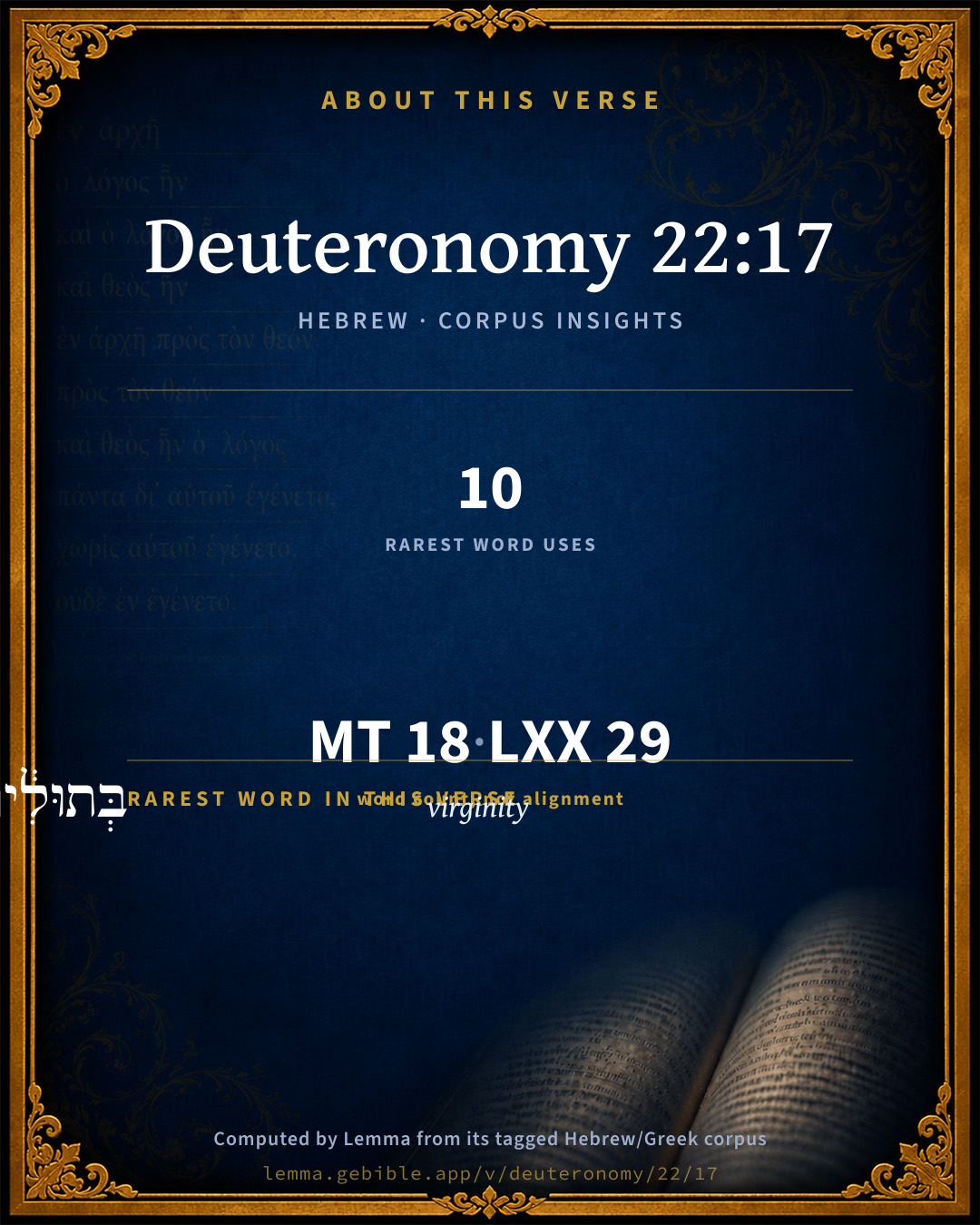
The rarest word here is בְּתוּלִ֔ים virginity H1331 — appearing just 10 times in the whole Hebrew Bible.

Shared distinctive vocabulary

בְּתוּלִ֔ים virginity H1331 occurs in 9 verses of the Hebrew Bible. Also found in:

Grammatical profile

  • 4 verbs
  • 9 nouns
  • 1 adjective
  • 2 pronouns
  • 2 particles

Verb forms

  • שָׂם֩ Qal · Perfect
  • לֵאמֹ֗ר Qal · Infinitive Construct
  • מָצָ֤אתִי Qal · Perfect
  • וּפָֽרְשׂוּ֙ Qal · Sequential Perfect

Repetition

Words recur within this verse — often emphatic in Hebrew:

  • לְבִתְּךָ֙ daughter H1323 ×2
  • בְּתוּלִ֔ים virginity H1331 ×2

Hebrew & Septuagint length

In English translation the verse runs 42 words from the Hebrew and 44 from the Septuagint (LXX English) — closely comparable.

A rough comparison of the two English renderings, which tokenize alike — not a word-level alignment.

Word counts can differ between the Hebrew and the Greek without any difference in meaning — e.g. the Hebrew direct-object marker אֵת has no separate Greek word, and Greek often adds the article ὁ.

In the original languages it is 18 Hebrew tokens and 29 Greek tokens — but the two are counted differently (Hebrew bundles its prefixes and suffixes into one token; the Greek is in lemma form), so that isn’t a like-for-like length.

Hebrew and Greek witnesses Masoretic Hebrew ↔ Greek Septuagint

The same verse in the two great witnesses to the Old Testament, shown verse-for-verse.

These are two independent witnesses, not word-aligned to each other, and the Septuagint is shown in lemma (dictionary) form.

Hebrew Deuteronomy 22:17 Masoretic · Westminster Leningrad Codex

וְהִנֵּה ה֡וּא שָׂם֩ עֲלִילֹ֨ת דְּבָרִ֜ים לֵאמֹ֗ר לֹֽא מָצָ֤אתִי לְבִתְּךָ֙ בְּתוּלִ֔ים וְאֵ֖לֶּה בְּתוּלֵ֣י בִתִּ֑י וּפָֽרְשׂוּ֙ הַשִּׂמְלָ֔ה לִפְנֵ֖י זִקְנֵ֥י הָעִֽיר

and, behold, he has laid shameful things [to her charge], saying, I didn't find in your daughter the tokens of virginity; and yet these are the tokens of my daughter's virginity. They shall spread the garment before the elders of the city.

World English Bible · Public Domain

Greek LXX Deuteronomy 22:17 Septuagint · lemma form

αὐτός νῦν ἐπιτίθημι αὐτός προφασιστικός λόγος λέγω οὐ εὑρίσκω ὁ θυγάτηρ σύ παρθένεια καί οὗτος ὁ παρθένεια ὁ θυγάτηρ ἐγώ καί ἀναπτύσσω ὁ ἱμάτιον ἐναντίον ὁ γερουσία ὁ πόλις

and now he has hated her, and attaches reproachful words to her, saying, I have not found tokens of virginity with your daughter; and these are the tokens of my daughter's virginity. And they shall unfold the garment before the elders of the city.

LXX2012 (modern English Septuagint) · Public Domain

On this verse, The Cambridge Bible for Schools and Colleges discusses the Septuagint’s reading. Read the note in Commentary ↓

Hebrew: Westminster Leningrad Codex (CC BY 4.0). Greek: Septuagint (public domain); English from LXX2012 (modern English Septuagint) (Public Domain). How the Septuagint differs from the Hebrew →

Targum (Aramaic paraphrase)

2

The Targum is the ancient Jewish Aramaic paraphrase of the Hebrew Scriptures — an interpretive translation, not the Hebrew text itself. Onkelos (literal) and Pseudo-Jonathan (expansive) render the Torah, and Jonathan the Prophets. Coverage is partial: where no permissively-licensed English translation exists for a verse, only the Aramaic is shown. This is verse-level text, not a word-by-word alignment to the Hebrew.

  1. Targum Onkelos Torah (Genesis–Deuteronomy)
    וְהָא הוּא שַׁוִי תַּסְקוֹפֵי מִלִין לְמֵימַר לָא אַשְׁכָּחִית לִבְרַתָּךְ בְּתוּלִין וְאִלֵין בְּתוּלֵי בְרַתִּי וְיִפְרְסוּן שׁוֹשִׁיפָא קֳדָם סָבֵי קַרְתָּא

    (no public-domain English translation for this verse)

    Targum Onkelos — Aramaic: “Onkelos Genesis” (public domain); “Onkelos Exodus” (public domain); “Onkelos Leviticus” (public domain); “Onkelos Numbers” (public domain); “Onkelos Deuteronomy” (public domain). English: “Sefaria Community Translation” (CC0 1.0 (public-domain dedication)); “J.W. Etheridge. The Targums of Onkelos and Jonathan Ben Uzziel on the Pentateuch. London: Longmans, Green, 1862” (public domain). Text via Sefaria.

  2. Targum Pseudo-Jonathan Torah (Genesis–Deuteronomy)
    וְהָא הוּא שַׁוֵי עֲרַד דְּמִילִין לְמֵימָר לָא אַשְׁכָּחִית לִבְרַתָּךְ סְהִידַווֹן וְאִילֵין סְהִידוֹי בְּרַתִּי וְיִפְרְסוּן שׁוֹשִׁיפָא קֳדָם חַכִּימֵי קַרְתָּא

    and, behold, he hath thrown upon her occasion of words, saying: I have not found the witnesses of thy daughter’s (virginity) but these are my daughter’s witnesses; and they shall spread the linen before the sages of the city;

    Targum Pseudo-Jonathan — Aramaic: “Targum Jonathan on Genesis” (public domain); “Targum Jonathan on Exodus” (public domain); “Targum Jonathan on Leviticus” (public domain); “Targum Jonathan on Numbers” (public domain); “Targum Jonathan on Deuteronomy” (public domain). English: “The Targum of Jonathan ben Uzziel, trans. J. W. Etheridge, London, 1862” (public domain). Text via Sefaria.

Commentary

Notes on Deuteronomy 22:17 from classic Christian and Jewish commentators (each source and its license shown beneath its notes). The classic Christian expositions comment on the surrounding passage and are grouped to its opening verse, so a note may address several verses; the Jewish commentaries on the Tanakh (Rashi and others) are per-verse, so they appear only where the commentator wrote on this verse.

Lemma curates 59 commentaries, every one of them public domain or Creative Commons licensed, each selected and text-cleaned for this edition rather than reprinted as found. About our sources →

Trapp's Complete Commentary

John Trapp

Deu 22:17 And, lo, he hath given occasions of speech [against her], saying, I found not thy daughter a maid; and yet these [are the tokens of] my daughter’s virginity. And they shall spread the cloth before the elders of the city.

Ver. 17. These are the tokens.] Which in those countries seldom or never failed.

John Trapp, A Commentary or Exposition upon All the Books of the Old and New Testament (1647–1656) — public domain. Text from a community e-Sword module.

Tyndale Open Study Notes

Tyndale Open Resources

22:17 The bed sheet (literally covering) might also have been a garment of some kind, such as a nightgown.

Tyndale Open Study Notes — © Tyndale Open Resources, licensed CC BY-SA 4.0. Text via the HelloAO Bible API.

Geneva Bible (1599)

Geneva Bible translators

Meaning, the sheet, wherein the signs of her virginity were.

Geneva Bible (1599) marginal notes — public domain. Text via Bolls.life.

Adam Clarke's Commentary

Verse 17. They shall spread the cloth, c.] A usage of this kind argues a roughness of manners which would ill comport with the refinement of European ideas on so delicate a subject. Attempts have been made to show that the law here is to be understood metaphorically but they so perfectly fail to establish any thing like probability, that it would be wasting my own and my reader's time to detail them. A custom similar to that above is observed among the Mohammedans to the present day.

Adam Clarke's Commentary on the Bible (1810–1826) — public domain. Text from a community e-Sword/MySword module.

The Cambridge Bible for Schools and Colleges

gen. ed. J. J. S. Perowne

17. to her charge] So Sam. LXX; omitted by Heb.

The Cambridge Bible for Schools and Colleges (gen. ed. J. J. S. Perowne; Cambridge University Press, 1878–1918) — public domain. Text from a community e-Sword module.

John Gill's Exposition

And the elders of that city shall take the man, and chastise him. Not with words, but blows. Jarchi interprets it of beating, and so does the Talmud (x); and both the Targums of Onkelos and Jonathan render it,"shall beat him;''

that is, with the beating or scourging of forty stripes, save one.

(x) T. Bab. Cetubot, fol. 46. 1.

John Gill's Exposition of the Whole Bible (1746–1763) — public domain (CC PDM 1.0). Text via the HelloAO Bible API.

Rashi

Rabbi Shlomo Yitzchaki (Rashi)

ופרשו השמלה AND THEY SHALL SPREAD THE CLOTH [BEFORE THE ELDERS OF THE CITY] — This is a figurative expression: they must make the matter as white (as clear) as a sheet (Sifrei Devarim 237:1; Ketubot 46a).

Rashi on the Tanakh — English translations: “The Judaica Press complete Tanach with Rashi, translated by A. J. Rosenberg” (CC BY 4.0); “Pentateuch with Rashi's commentary by M. Rosenbaum and A.M. Silbermann, 1929-1934” (public domain); “The Metsudah Tanach series, Lakewood, N.J” (CC BY 4.0); and “The Book of Joshua, Metsudah Publications, 1997” (CC BY 4.0). Text via Sefaria.

Ramban (Nachmanides)

Rabbi Moshe ben Nachman (Ramban / Nachmanides)

AND THEY SHALL SPREAD THE CLOTH. “This is a figurative expression meaning, the matter is as white [i.e., as clear] as a sheet.” This is Rashi’s language, which is the interpretation of Rabbi Yishmael found in the Sifre 237. and Mechilta. 13. But there is no need for it. For this was the custom in former time in Israel: they would bring the groom and bride into the bridal chamber and examine them, and the witnesses would guard them outside — these being termed shoshbinin (friends) (friends) as guards, one appointed by the groom’s family, and one by the bride’s.” by the Sages. When they separated, the witnesses would enter and take the cloth on which he laid with her and see the proof of her virginity. This [procedure] is known in the Talmud and in books of Agadah [homily], and they would call this cloth sudor. (cloth).” Therefore, Scripture states that her father and mother should spread the cloth which they took from the hands of the witnesses and say, These are the tokens of my daughter’s virginity. Now surely there is still a need to clarify matters with respect to many items about which Scripture spoke briefly. But the intent of [the Sifre and Mechilta in] stating “This is a figurative expression,” is only in accordance with the opinion which holds that the law concerning a man who defames his wife applies even if he has had no sexual relations with her. [It is according to this opinion that the phrase and they shall spread the cloth cannot be literal, for if no cohabitation took place, there can be no evidence in the sheet. Hence, the phrase is figurative, meaning that they are to prove their complaint “as clear as a sheet.”] But the plain meaning of Scripture is in accordance with the Sage that this law applies only after he has had conjugal relations with her [and in that case the phrase and they shall spread the cloth is to be understood literally]. And thus the Rabbis said in the Gemara: “Rabbi Eleazar ): “Eliezer.” ben Yaakov says, The term cloth is literal, and the law is in accordance with his words.” And such indeed is the sense of the section [of the Torah]. For Scripture stated first, Then the father of the maiden, and her mother, shall take and bring forth the tokens of the maiden’s virginity. Thus the verse is speaking of both [the father and mother]. Afterwards it reverts to the father alone: And the maiden’s father shall say etc. It then reverts and states, and ‘they’ shall spread the cloth — the two of them. Now, the reason [for these changes] is that [basically] the claim concerns only the father for [if the husband’s accusation is proven false,] the fine [of a hundred silver shekels, imposed upon the husband] belongs to the father. Scripture, however, made the mother a partner in this affair because women occupy themselves with the subject of the sheet, for it is they who are knowledgeable and expert in blood, and it is proper for the mother to take hold and bring it [the cloth] to court. But the claim, I gave my daughter unto this man to wife is that of the father, for the mother is not the adversary of her daughter’s husband. Or it may be that after the father presents his arguments in court, he takes hold of the cloth which his wife had brought under the corners of her garment and they both spread it before the court. Thus the mother is not mentioned in the section and did not appear in court at all except for the matter of “the cloth,” which is to be understood in its literal sense, as I have explained.

Ramban (Nachmanides) on the Tanakh — English translation: “Commentary on the Torah by Ramban (Nachmanides). Translated and annotated by Charles B. Chavel. New York, Shilo Pub. House, 1971-1976” (CC BY 4.0). Text via Sefaria.

Lesson kit

Teaching starters — assembled from the data on this page, not authored interpretation. Every prompt links to the verse data it draws on. Edit before teaching.

Deuteronomy, in the Pentateuch, opens this verse with 18 words (16 distinct Hebrew lemmas). Its most distinctive word is bᵉthûwlîym (“virginity”). A historical commentator’s framing appears above. Read the whole chapter for the surrounding context.

Discussion questions

  1. What does “virginity” (bᵉthûwlîym) contribute to the verse as a whole?
  2. How does Leviticus 21:13, which shares the word «virginity», read alongside this verse?
  3. What does the repetition of “daughter” (2× in this one verse) do in this verse?
  4. These translations render this verse differently; the difference is in the English rendering, not the original. What questions does that raise?
  5. «שָׂם֩» is a Qal Perfect verb. How does that grammatical form shape the action described?
  6. Compare how Trapp's Complete Commentary and Tyndale Open Study Notes read this verse. Where do they agree or differ?

Things to notice

Reading settings

Reading text

Shown beneath each verse's original-language words.

Old Testament
Old Testament edition

Read the OT as the Masoretic Hebrew (MT) or the Greek Septuagint (LXX).

English shown for the Greek Septuagint (in the Hebrew ↔ Greek comparison).

Comparing translations? Open the Compare panel on any verse page to stack up to four side by side.