
Exodus 12:42

Hebrew (Westminster Leningrad Codex) Exodus 12:42 appears in the Hebrew Old Testament. The text above is from the Westminster Leningrad Codex. Each word links to its Strong’s number, a concise gloss, and parsing drawn from the Open Scriptures Hebrew Bible morphology. Click any word for its full Brown-Driver-Briggs (BDB) entry.
Download image
Cite this verse

Exodus 12:42 (World English Bible). Public Domain. Lemma interlinear Bible study tool, https://lemma.gebible.app/v/exodus/12/42.

Show BibTeX & RIS
BibTeX
RIS
English Translation
It is a night to be much observed to Yahweh for bringing them out from the land of Egypt. This is that night of Yahweh, to be much observed of all the children of Israel throughout their generations.
World English Bible · Public Domain
Highlights
  • 1 first appearance in the Hebrew Bible
Full analysis ↓
Download a study sheet

One document with this verse’s original text, its word-by-word gloss line, the meaning frame, cross-references with their text, attributed commentary, and full source and license credits — printable, and it pastes into notes with its structure intact.

This verse Autodidact and up

Study sheet (.html) Plain text (.txt)

A passage Seminary Student

Up to 50 verses in one chapter. A passage sheet keeps up to 6 commentary sources and 12 cross-references per verse, in the order this page ranks them, and says so on the sheet whenever that leaves anything out. Ask for a single verse and you get the Autodidact verse sheet above.

Everything on this page stays free to read, with no account — the sheet is a download of what is already on screen, not access to it.

Want to remove ads? Support Godless Engineer
Compare translations 3

The same verse in 3 English versions, stacked beneath the original-language interlinear above. Click any original word for its lexicon entry.

Each is an independent rendering of the whole verse — the interlinear is not word-aligned to these translations.

Highlighted words mark where these versions differ — a whole-verse word diff, not a word-by-word alignment.

  • World English Bible Public Domain
    It is a night to be much observed to Yahweh for bringing them out from the land of Egypt. This is that night of Yahweh, to be much observed of all the children of Israel throughout their generations.
  • King James Version Public Domain
    It is a night to be much observed unto the LORD for bringing them out from the land of Egypt: this is that night of the LORD to be observed of all the children of Israel in their generations.
  • unfoldingWord Literal Text CC BY-SA 4.0
    It was a night of observing for Yahweh to bring them out from the land of Egypt. This night, it is for all the sons of Israel to observe for Yahweh throughout their generations.

unfoldingWord Literal Text — © unfoldingWord, licensed CC BY-SA 4.0. Word-aligned USFM3 via Door43 (git.door43.org/unfoldingWord/en_ult).

Versions to compare (up to 4)

3 of 4 selected

Show all 18 translations

Every available English version of this verse, each an independent rendering of the whole verse.

  • World English Bible Public Domain
    It is a night to be much observed to Yahweh for bringing them out from the land of Egypt. This is that night of Yahweh, to be much observed of all the children of Israel throughout their generations.
  • Berean Standard Bible Public Domain
    Because the LORD kept a vigil that night to bring them out of the land of Egypt, this same night is to be a vigil to the LORD, to be observed by all the Israelites for the generations to come.
  • Majority Standard Bible Public Domain
    Because the LORD kept a vigil that night to bring them out of the land of Egypt, this same night is to be a vigil to the LORD, to be observed by all the Israelites for the generations to come.
  • King James Version Public Domain
    It is a night to be much observed unto the LORD for bringing them out from the land of Egypt: this is that night of the LORD to be observed of all the children of Israel in their generations.
  • American Standard Version (1901) Public Domain
    It is a night to be much observed unto Jehovah for bringing them out from the land of Egypt: this is that night of Jehovah, to be much observed of all the children of Israel throughout their generations.
  • Revised Version (1885) Public Domain
    It is a night to be much observed unto the LORD for bringing them out from the land of Egypt: this is that night of the LORD, to be much observed of all the children of Israel throughout their generations.
  • Geneva Bible (1599) Public Domain
    It is a night to be kept holie to the Lord, because he brought them out of the lande of Egypt: this is that night of the Lord, which all the children of Israel must keepe throughout their generations.
  • Douay-Rheims (1899) Public Domain
    This is the observable night of the Lord, when he brought them forth out of the land of Egypt: this night all the children of Israel must observe in their generations.
  • Young's Literal Translation Public Domain
    A night of watchings it `is' to Jehovah, to bring them out from the land of Egypt; it `is' this night to Jehovah of watchings to all the sons of Israel to their generations.
  • Literal Standard Version CC BY-SA 4.0
    It [is] a night of watchings to YHWH, to bring them out from the land of Egypt; it [is] this night of watchings to YHWH to all the sons of Israel throughout their generations.
  • Unlocked Literal Bible CC BY-SA 4.0
    This was a night to stay awake, for Yahweh to bring them out from the land of Egypt. This was Yahweh's night to be observed by all the Israelites throughout their people's generations.
  • unfoldingWord Literal Text CC BY-SA 4.0
    It was a night of observing for Yahweh to bring them out from the land of Egypt. This night, it is for all the sons of Israel to observe for Yahweh throughout their generations.
  • Darby Bible Public Domain
    It is a night of observance to Jehovah, because of their being brought out from the land of Egypt: that same night is an observance to Jehovah for all the children of Israel in their generations.
  • World Messianic Bible Public Domain
    It is a night to be much observed to the LORD for bringing them out from the land of Egypt. This is that night of the LORD, to be much observed by all the children of Israel throughout their generations.
  • Webster's Bible Public Domain
    It is a night to be much observed to the LORD, for bringing them out from the land of Egypt: this is that night of the LORD to be observed by all the children of Israel in their generations.
  • Free Bible Version CC BY-SA 4.0
    Because the Lord kept watch that night to lead them out of the land of Egypt, this same night you are to keep watch as an observance to honor the Lord, and this to be kept by all Israelites for generations to come.
  • Bible in Basic English Public Domain
    It is a watch-night before the Lord who took them out of the land of Egypt: this same night is a watch-night to the Lord for all the children of Israel, through all their generations.
  • JPS Tanakh (1917) Public Domain
    It was a night of watching unto the LORD for bringing them out from the land of Egypt; this same night is a night of watching unto the LORD for all the children of Israel throughout their generations.

Literal Standard Version (2020), Covenant Press — licensed CC BY-SA 4.0. Text via the HelloAO Bible API (eBible.org). Unlocked Literal Bible (unfoldingWord) — licensed CC BY-SA 4.0. Text via the HelloAO Bible API (eBible.org). unfoldingWord Literal Text — © unfoldingWord, licensed CC BY-SA 4.0. Word-aligned USFM3 via Door43 (git.door43.org/unfoldingWord/en_ult). Free Bible Version, Dr. Jonathan Gallagher — licensed CC BY-SA 4.0. Text via the HelloAO Bible API (eBible.org).

Word by word

More ways to search: Search by grammar → Find every occurrence → Compare this word →

Practice this passage: Drill this verse → Learn its vocabulary →

שִׁמֻּרִ֥ים
shimmur
H8107
“night watches”
Noun, Common, Masculine, Plural, Absolute
Part of Speech
Noun
Type
Common
Gender
Masculine
Number
Plural
State
Absolute
Full BDB Definition

Origin: from H8104

TWOT: 2414c

night watch, watching, vigil
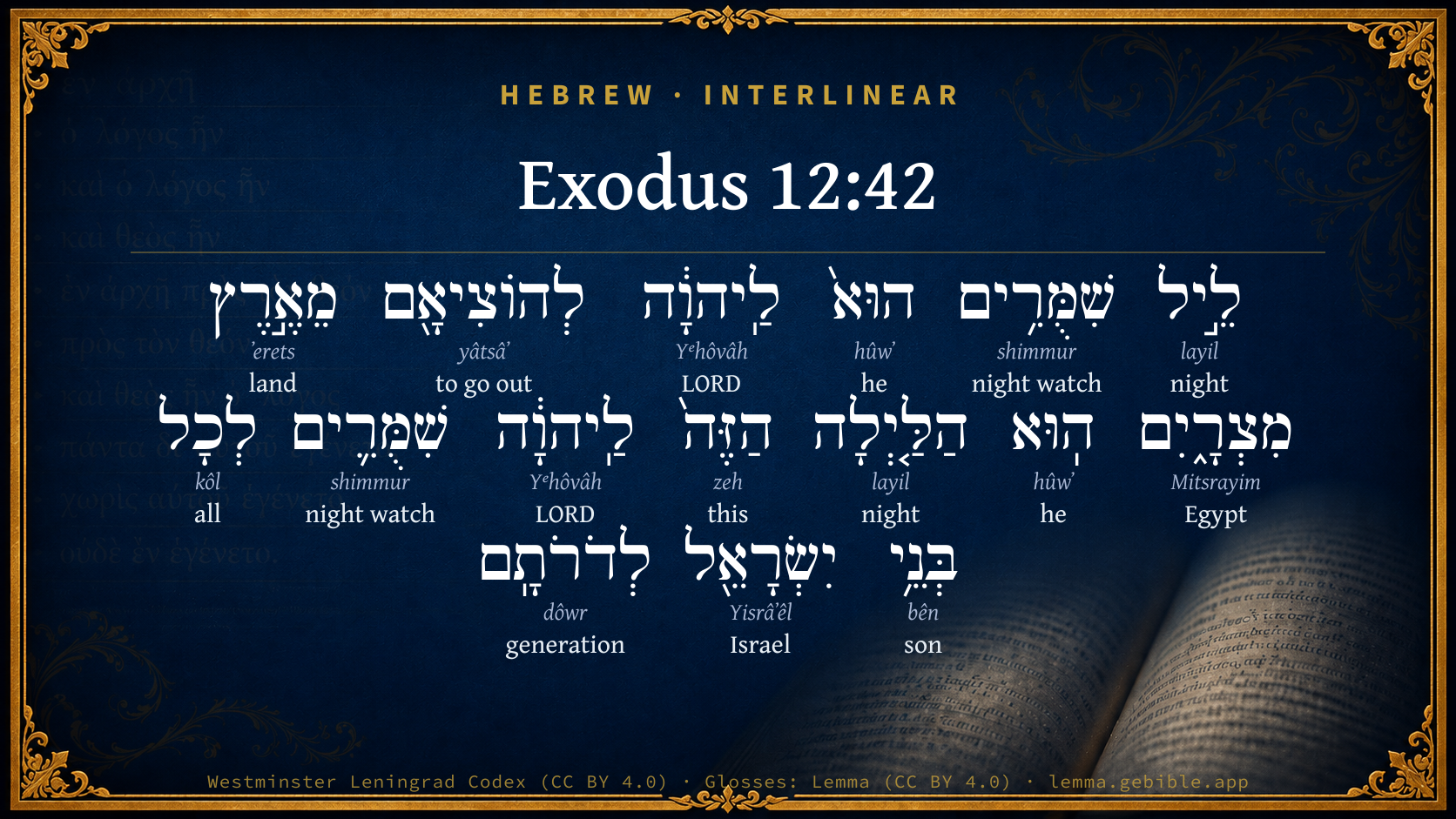
  1. לֵ֣יל layil H3915 “night of” Noun, Common, Masculine, Singular, Construct
  2. הוּא֙ hûwʼ H1931 “he” Pronoun, Personal, 3rd Person, Masculine, Singular
  3. לַֽיהוָ֔ה Yᵉhôvâh H3068 “to/for · LORD” Preposition + Noun, Proper
  4. לְהוֹצִיאָ֖ם yâtsâʼ H3318 “to go out · them” Preposition + Verb, Hiphil, Infinitive Construct + Suffix, Personal, 3rd Person, Masculine, Plural
  5. מֵאֶ֣רֶץ ʼerets H776 “from · land of” Preposition + Noun, Common, Both, Singular, Construct
  6. מִצְרָ֑יִם Mitsrayim H4714 “Egypt” Noun, Proper
  7. הֽוּא hûwʼ H1931 “he” Pronoun, Personal, 3rd Person, Masculine, Singular
  8. הַלַּ֤יְלָה layil H3915 “the · night” Particle, Definite Article + Noun, Common, Masculine, Singular, Absolute
  9. הַזֶּה֙ zeh H2088 “the · this” Particle, Definite Article + Pronoun, Demonstrative, Masculine, Singular
  10. לַֽיהוָ֔ה Yᵉhôvâh H3068 “to/for · LORD” Preposition + Noun, Proper
  11. שִׁמֻּרִ֛ים shimmur H8107 “night watches” Noun, Common, Masculine, Plural, Absolute
  12. לְכָל kôl H3605 “to/for · all of” Preposition + Noun, Common, Masculine, Singular, Construct
  13. בְּנֵ֥י bên H1121 “sons of” Noun, Common, Masculine, Plural, Construct
  14. יִשְׂרָאֵ֖ל Yisrâʼêl H3478 “Israel” Noun, Proper
  15. לְדֹרֹתָֽם dôwr H1755 “to/for · generations · their” Preposition + Noun, Common, Masculine, Plural, Construct + Suffix, Personal, 3rd Person, Masculine, Plural

About this verse

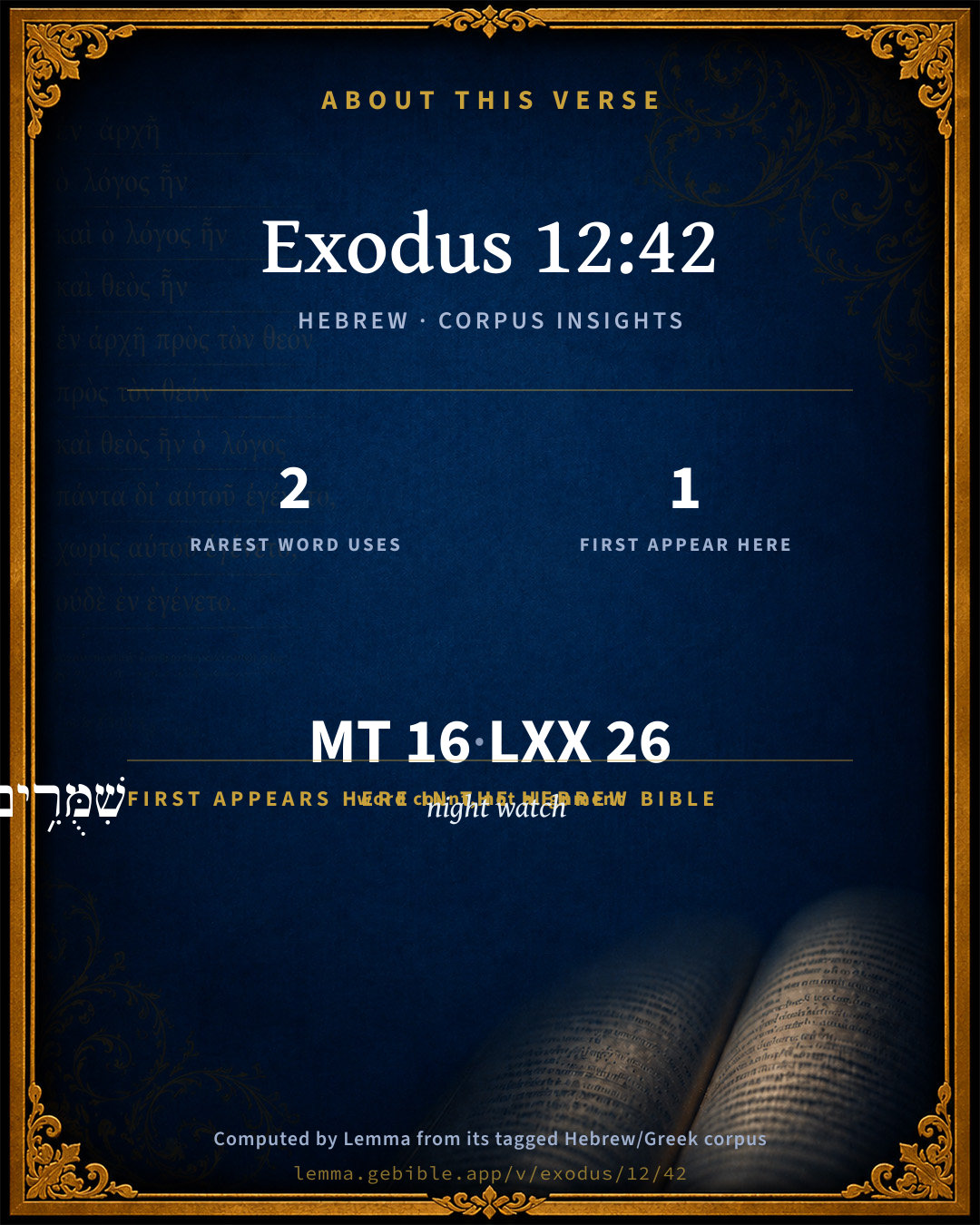
These counts appear in no published source. They are computed here, from the morphology-tagged text and Lemma’s own curated glosses. What Lemma adds →

16
words
12
distinct lemmas
Pentateuch
section

Notable vocabulary

The rarest word here is שִׁמֻּרִ֥ים night watch H8107 — appearing just 2 times in the whole Hebrew Bible.

First appearance in Scripture

This word makes its first canonical appearance in the Hebrew Bible here:

  • שִׁמֻּרִ֥ים night watch H8107

Grammatical profile

  • 1 verb
  • 12 nouns
  • 3 pronouns

Verb forms

  • לְהוֹצִיאָ֖ם Hiphil · Infinitive Construct

Repetition

Words recur within this verse — often emphatic in Hebrew:

  • לֵ֣יל night H3915 ×2
  • שִׁמֻּרִ֥ים night watch H8107 ×2
  • לַֽיהוָ֔ה LORD H3068 ×2
  • הוּא֙ he H1931 ×2

Hebrew & Septuagint length

In English translation the verse runs 38 words from the Hebrew and 44 from the Septuagint (LXX English) — closely comparable.

A rough comparison of the two English renderings, which tokenize alike — not a word-level alignment.

Word counts can differ between the Hebrew and the Greek without any difference in meaning — e.g. the Hebrew direct-object marker אֵת has no separate Greek word, and Greek often adds the article ὁ.

In the original languages it is 16 Hebrew tokens and 26 Greek tokens — but the two are counted differently (Hebrew bundles its prefixes and suffixes into one token; the Greek is in lemma form), so that isn’t a like-for-like length.

Cross-references

3

Topical passages linked to Exodus 12:42 in the Treasury of Scripture Knowledge — connected by theme and wording, ordered by reader-vote popularity; previews shown in the World English Bible.

  • Exodus 12:14 This day shall be to you for a memorial, and you shall keep it a feast to Yahweh: throughout your generations you shall keep it a feast by an ordinance forever.
  • Deuteronomy 16:1–6 Observe the month of Abib, and keep the Passover to Yahweh your God; for in the month of Abib Yahweh your God brought you forth out of Egypt by night.
  • Exodus 13:10 You shall therefore keep this ordinance in its season from year to year.

Cross-references courtesy of OpenBible.info (CC BY 4.0).

Hebrew and Greek witnesses Masoretic Hebrew ↔ Greek Septuagint

The same verse in the two great witnesses to the Old Testament, shown verse-for-verse.

These are two independent witnesses, not word-aligned to each other, and the Septuagint is shown in lemma (dictionary) form.

Hebrew Exodus 12:42 Masoretic · Westminster Leningrad Codex

לֵ֣יל שִׁמֻּרִ֥ים הוּא֙ לַֽיהוָ֔ה לְהוֹצִיאָ֖ם מֵאֶ֣רֶץ מִצְרָ֑יִם הֽוּא הַלַּ֤יְלָה הַזֶּה֙ לַֽיהוָ֔ה שִׁמֻּרִ֛ים לְכָל בְּנֵ֥י יִשְׂרָאֵ֖ל לְדֹרֹתָֽם

It is a night to be much observed to Yahweh for bringing them out from the land of Egypt. This is that night of Yahweh, to be much observed of all the children of Israel throughout their generations.

World English Bible · Public Domain

Greek LXX Exodus 12:42 Septuagint · lemma form

νύξ προφυλακή εἰμί ὁ κύριος ὥστε ἐκἄγω αὐτός ἐκ γῆ αἴγυπτος ἐκεῖνος ὁ νύξ οὗτος προφυλακή κύριος ὥστε πᾶς ὁ υἱός ἰσραήλ εἰμί εἰς γενεά αὐτός

It is a watch kept to the Lord, so that he should bring them out of the land of Egypt; that very night is a watch kept to the Lord, so that it should be to all the children of Israel to their generations.

LXX2012 (modern English Septuagint) · Public Domain

Hebrew: Westminster Leningrad Codex (CC BY 4.0). Greek: Septuagint (public domain); English from LXX2012 (modern English Septuagint) (Public Domain). How the Septuagint differs from the Hebrew →

Targum (Aramaic paraphrase)

2

The Targum is the ancient Jewish Aramaic paraphrase of the Hebrew Scriptures — an interpretive translation, not the Hebrew text itself. Onkelos (literal) and Pseudo-Jonathan (expansive) render the Torah, and Jonathan the Prophets. Coverage is partial: where no permissively-licensed English translation exists for a verse, only the Aramaic is shown. This is verse-level text, not a word-by-word alignment to the Hebrew.

  1. Targum Onkelos Torah (Genesis–Deuteronomy)
    לֵילֵי נְטִּיר הוּא קֳדָם יְיָ לְאַפָּקוּתְהוֹן מֵאַרְעָא דְמִצְרַיִם הוּא לֵילְיָא הָדֵין קֳדָם יְיָ נְטִירִין לְכָל בְּנֵי יִשְׂרָאֵל לְדָרֵיהוֹן:

    (no public-domain English translation for this verse)

    Targum Onkelos — Aramaic: “Onkelos Genesis” (public domain); “Onkelos Exodus” (public domain); “Onkelos Leviticus” (public domain); “Onkelos Numbers” (public domain); “Onkelos Deuteronomy” (public domain). English: “Sefaria Community Translation” (CC0 1.0 (public-domain dedication)); “J.W. Etheridge. The Targums of Onkelos and Jonathan Ben Uzziel on the Pentateuch. London: Longmans, Green, 1862” (public domain). Text via Sefaria.

  2. Targum Pseudo-Jonathan Torah (Genesis–Deuteronomy)
    אַרְבָּעָה לֵילְוָון כְּתִיבִין בְּסֵפֶר דּוּכְרָנַיָיא קֳדָם רִבּוֹן עַלְמָא לֵילְיָא קַדְמָאָה כַּד אִיתְגְּלֵי לְמִבְרֵי עַלְמָא תִּנְיָינָא כַּד אִיתְגְּלֵי עַל אַבְרָהָם תְּלִיתָאָה כַּד אִיתְגְּלֵי בְּמִצְרַיִם וַהֲוָת יְדֵיהּ מְקַטְלָא כָּל בּוּכְרָא דְמִצְרַיִם וִימִינֵיהּ מְשֵׁיזְבָא בְּכוֹרֵיהֶן דְּיִשְרָאֵל רְבִיעָאָה כַּד אִתְגְּלֵי לְמִפְרוֹק עַמָּא בֵּית יִשְרָאֵל מִבֵּינֵי עַמְמַיָא וְכוּלְהוֹן קָרָא לֵילֵי נְטִיר בְּגִין כֵּן פָּרִישׁ משֶׁה וַאֲמַר לֵיל נְטִיר לְפוּרְקַן הוּא מִן קֳדָם יְיָ לְמַפְקָא יַת עַמָּא בְּנֵי יִשְרָאֵל מֵאַרְעָא דְמִצְרַיִם הוּא לֵילְיָא הָדֵין נְטִיר מִמַּלְאָכָה מְחַבְּלָא לְכָל בְּנֵי יִשְרָאֵל דִּבְמִצְרַיִם וְכֵן לְמִיפְרַקְהוֹן מִגַּלְוַותְהוֹן לְדָרֵיהוֹן:

    Four nights are there written in the Book of Memorials before the Lord of the world. Night the first,--when He was revealed in creating the world; the second,--when He was revealed to Abraham; the third,--when He was revealed in Mizraim, His hand killing all the firstborn of Mizraim, and His right hand saving the firstborn of Israel; the fourth,--when He will yet be revealed to liberate the people of the house of Israel from among the nations. And all these are called Nights to be observed; for so explained Mosheh, and said thereof, It is to be observed on account of the liberation which is from the Lord, to lead forth the people of the sons of Israel from the land of Mizraim. This is that Night of preservation from the destroying angel for all the sons of Israel who were in Mizraim, and of redemption of their generations from their captivity.

    Targum Pseudo-Jonathan — Aramaic: “Targum Jonathan on Genesis” (public domain); “Targum Jonathan on Exodus” (public domain); “Targum Jonathan on Leviticus” (public domain); “Targum Jonathan on Numbers” (public domain); “Targum Jonathan on Deuteronomy” (public domain). English: “The Targum of Jonathan ben Uzziel, trans. J. W. Etheridge, London, 1862” (public domain). Text via Sefaria.

Commentary

Notes on Exodus 12:42 from classic Christian and Jewish commentators (each source and its license shown beneath its notes). The classic Christian expositions comment on the surrounding passage and are grouped to its opening verse, so a note may address several verses; the Jewish commentaries on the Tanakh (Rashi and others) are per-verse, so they appear only where the commentator wrote on this verse.

Lemma curates 59 commentaries, every one of them public domain or Creative Commons licensed, each selected and text-cleaned for this edition rather than reprinted as found. About our sources →

Trapp's Complete Commentary

John Trapp

Exo 12:42 It [is] a night to be much observed unto the LORD for bringing them out from the land of Egypt: this [is] that night of the LORD to be observed of all the children of Israel in their generations.

Ver. 42. This is that night.] That, with an accent. God expects our returns should be answerable to our receipts. God’s blessings are binders; and of all things he can least abide to be forgotten.

John Trapp, A Commentary or Exposition upon All the Books of the Old and New Testament (1647–1656) — public domain. Text from a community e-Sword module.

The Biblical Illustrator

Joseph S. Exell

Exo_12:42

A night to be much observed unto the Lord.

The Passover

I. The Passover the appointed means of a great deliverance. The destruction of the firstborn secured Israels freedom; the rite itself saved Israels firstborn.

1. Wrath was averted.

2. Individual faith and action were required.

3. Perfect safety was thus obtained.

II. The Passover as ordained feast of remembrance.

1. Not a formal service, but gratefully rendered, and intelligently observed; the father instructing the child as to its meaning (Exo_12:26-27).

2. To be kept by all the people (Exo_12:4). The redemption to be celebrated by all the redeemed.

3. In each successive generation. A perpetual witness of Jehovahs delivering mercy; an unfailing type; a constant test and measure of religious life. Kept by Moses (Num_9:1-23.); by Joshua (chap. 5.); revived by Josiah; in Nehemiahs time (Ezr_6:1-22.); in our Lords time widely observed.

4. Every detail was divinely ordered.

5. The lamb was eaten with special accompaniments Bitter herbs denoted penitence; unleavened bread, sincerity. Godly sorrow chastens Christian joy. True consecration marks the believers praise.

6. In a pilgrim spirit. Loins girded, shoes on feet, staff in hand. Christs service here is not the Christians rest. His eye is fixed on heaven; and, while he works and praises, his true cry ever is, Come, Lord Jesus. (W. S. Bruce, M. A.)

Freedom and discipline

I. Scholars have said that the old Greeks were the fathers of freedom; and there have been other people in the worlds history who have made glorious and successful struggles to throw off their tyrants and be free. But liberty is of a far older and nobler house. It was born on the first Easter night, when God Himself stooped from heaven to set the oppressed free.

II. The history of the Jews is the history of the whole Church and of every nation in Christendom. The Jews had to wander forty years in the wilderness, and Christendom has had to wander too, in strange and bloodstained paths, for eighteen hundred years and more. For as the Israelites were not worthy to enter at once into rest, no more have the nation of Christs Church been worthy. As the new generation sprang up in the wilderness, trained under Moses stern law, to the fear of God, so for eighteen hundred years have the generations of Christendom, by the training of the Church and the light of the gospel, been growing in wisdom and knowledge, growing in morality and humanity, in that true discipline and loyalty which are the yokefellows of freedom and independence. (C. Kingsley, M. A.)

A holy celebration

It is the night of our regeneration; it is the night of our conversion (night or day, it matters not which); the time in which we actually received salvation, and were made partakers of this Passover, that we would just now admonish you to remember. At that particular time important events transpired for us. The most important events, to us, that ever occurred in our history, happened on that occasion. There was a point in our life up to which we were dead: then we were made alive. There was a point up to which we were condemned: then, in an instant, we were acquitted. Now, what events transpired on that occasion?

1. Well, the first was, it pleased God then to show us the blood of Jesus, and to apply it to our souls. That night, too, or that day, whichever it may have been, we do remember that we enjoyed a feast upon our Saviour. The blood was sprinkled, and so we were saved; and then we sat down at the table, and began at once to feast upon the precious things stored up in the person of Christ.

2. And then it was that for the first time in your life you felt that you were free. You were free; but finding yourself free, you also discovered, for the first time, that you were a pilgrim; for the Israelites, as they ate that paschal supper, had to do so with their loins girl and staves in their hands, like men that were to leave that country. You found that now you were a stranger. If you had an unconverted parent, you could not talk to him or her about your soul. If you had old companions, you felt you must bid them farewell, for they would not understand you; if you did not know you were a pilgrim before, you found it out the very next day, when you began to talk with them. O! it was a time to be remembered, and I want you to remember it now--those blessed days when we began to live!

3. Important results will flow to you from the preservation of this memorial. It will humble you and foster the grace of humility. Have you become an old experienced Christian, my brother? Go back to the hole of the pit whence you were digged. (C. H. Spurgeon.)

The Biblical Illustrator, edited by Joseph S. Exell (c. 1880s–1900s) — public domain. Text from a community e-Sword module.

Joseph Benson's Commentary

Exo 12:42. This first passover night was a night of the Lord, much to be observed; but the last passover night, in which Christ was betrayed, was a night of the Lord, much more to be observed, when a yoke heavier than that of Egypt was broken from off our necks, and a land better than that of Canaan set before us. That was a temporal deliverance, to be celebrated in their generations; this an eternal redemption, to be celebrated world without end!

Joseph Benson's Commentary on the Old and New Testaments (1811–1818) — public domain. Text from a community e-Sword module.

Adam Clarke's Commentary

Verse 42. A night to be much observed] A night to be held in everlasting remembrance, because of the peculiar display of the power and goodness of God, the observance of which annually was to be considered a religious precept while the Jewish nation should continue.

Adam Clarke's Commentary on the Bible (1810–1826) — public domain. Text from a community e-Sword/MySword module.

The Cambridge Bible for Schools and Colleges

gen. ed. J. J. S. Perowne

42. The night is to be observed in perpetuity as a night of watching, or of vigil, unto Jehovah; cf. Isa_30:29. Both the margins are preferable to the text. ל, however, cannot mean for (i.e., apparently, in return for), though it might mean with regard to; but its natural meaning here would be in order to; hence Bu. Bä. may be right in rendering, A night of watching was it for Yahweh to bring them out, &c.; Jehovah Himself was on the watch that night to protect His people from the destroyer, and to bring them safely out of Egypt: v. 41b will then be a later addition, transforming the night of vigil kept by Jehovah, into a night of vigil kept to Him (cf. Nowack, Arch. ii. 149).

throughout your generations. See on v. 14.

43–51 (P). Regulations respecting the Passover, supplementary to those in vv. 1–13, and intended principally to define what persons were or were not authorised to eat it. No foreigner, temporary ‘settler,’ or (foreign) hired servant is to eat of it: a slave, and a ‘sojourner,’ i.e. a protected foreigner, when they have been circumcised, may eat of it (vv. 43–45, 48 f.).

The Cambridge Bible for Schools and Colleges (gen. ed. J. J. S. Perowne; Cambridge University Press, 1878–1918) — public domain. Text from a community e-Sword module.

John Gill's Exposition

But every man's servant that is bought for money,.... And so his own property:

when thou hast circumcised him; as such an one ought to be, according to the covenant of circumcision given to Abraham, Gen 17:13, though one should think not without his consent; wherefore care was to be taken to purchase such servants as would be willing to conform to that rite, and pains were to be taken with them to instruct them in it, and persuade them to it; to which, when they had submitted, they had a right to eat the passover, but if they did not, it was not allowed:

then shall he eat thereof; but not otherwise.

John Gill's Exposition of the Whole Bible (1746–1763) — public domain (CC PDM 1.0). Text via the HelloAO Bible API.

Haydock's Catholic Bible Commentary

Observable, in which the Lord has been our sentinel and preserver. (Vatable)

George Leo Haydock (1774–1849), Haydock's Catholic Family Bible and Commentary, 1859 edition — public domain. Excludes Psalms (Douay-Rheims chapter numbering differs from Protestant) and Deuterocanonical books (Catholic canon only).

Whedon's Commentary on the Bible

Daniel D. Whedon

42. Observed of all the children of Israel in their generations — Israel was long ago scattered among the Gentiles; all the Levitical sacrifices have for centuries “ceased to be offered;” tabernacle and temple vanished ages ago; yet wherever in his wanderings a Jew retains to-day one shred of his ancestral religion he keeps the passover.

Daniel D. Whedon (gen. ed.), Commentary on the Old and New Testaments (1874–1909) — public domain. Text from a community e-Sword module.

The Pulpit Commentary

It is a night to be much observed. We must suppose that some of the Israelites actually commenced their march before the night was over, being "hastened" by the Egyptians (ver. 33), and having all things in readiness; but the bulk of the people can scarcely have started before daybreak. This is that night of the Lordi.e. , the night concerning which directions had been already given (vers. 6-11) the only "night" for which any observances were appointed. In their generations. To all time so long as they continue to be a people. On the bindingness of this commandment, see the comment on ver. 14 of this chapter.

The Pulpit Commentary (1880–1919), ed. H.D.M. Spence-Jones & Joseph S. Exell — public domain. Text from a community e-Sword module.

John Wesley's Explanatory Notes

This first passover night was a night of the Lord, much to be observed; but the last passover night, in which Christ was betrayed, was a night of the Lord, much more to be observed, when a yoke heavier than that of Egypt was broke from off our necks, and a land better than that of Canaan set before us. That was a temporal deliverance, to be celebrated in their generations; this an eternal redemption to be celebrated world without end.

John Wesley, Explanatory Notes Upon the Whole Bible (1754–1765) — public domain. Text via the GEBible commentary corpus.

Rashi

Rabbi Shlomo Yitzchaki (Rashi)

ליל שמרים IT WAS NIGHT OF WATCHING [UNTO THE LORD] — a night which the Holy One, blessed be He, was watching for and looking forward to, that He might fulfill His promise להוציאם מארץ מצרים TO BRING THEM OUT FROM THE LAND OF EGYPT.

הוא הלילה הזה לה IT IS THIS NIGHT OF THE LORD — it is the night of which He said to Abraham, “On this night will I redeem your children” (Mekhilta; cf. Rashi on Genesis 39:11).

שמרים לכל בני ישראל לדרתם [IT IS A NIGHT] OF PROTECTION FOR ALL THE CHILDREN OF ISRAEL THROUGHOUT THEIR GENERATIONS — this night is protected, and comes as such from ages past, against all destructive forces, as it is said, (v. 33) “And He will not permit the destroyer [to enter your houses]” (Pesachim 109b; Rosh Hashanah 11b).

Rashi on the Tanakh — English translations: “The Judaica Press complete Tanach with Rashi, translated by A. J. Rosenberg” (CC BY 4.0); “Pentateuch with Rashi's commentary by M. Rosenbaum and A.M. Silbermann, 1929-1934” (public domain); “The Metsudah Tanach series, Lakewood, N.J” (CC BY 4.0); and “The Book of Joshua, Metsudah Publications, 1997” (CC BY 4.0). Text via Sefaria.

Ramban (Nachmanides)

Rabbi Moshe ben Nachman (Ramban / Nachmanides)

IT WAS A NIGHT OF WATCHING UNTO THE ETERNAL FOR BRINGING THEM OUT FROM THE LAND OF EGYPT. The verse is stating that from the time He decreed the exile upon them, He observed the matter that He bring them out on that night once the end had come, for I will hasten it in its time. It may be that the verse, It was a night of watching unto the Eternal, means that He was watching and looking forward to the night when He would bring them out from the land of Egypt, for the Holy One, blessed be He, looked forward to the time when they would merit to be brought out therefrom.Now if we are to say [as Rashi did, quoted in the commentary on Verse 40], that the [period referred to in] the verse, that thy seed shall be a stranger in a land that is not theirs,. begins from the time that Abraham had seed, and that the reckoning [of the four hundred and thirty years] begins from the birth of Isaac, you will find that they stayed in Egypt two hundred and forty years, according to the explanation we mentioned., 47:9). We thus have one hundred and ninety years since the birth of Isaac. Deduct them from the sum of four hundred and thirty, and you have two hundred and forty years remaining for the stay in Egypt. But this too in my opinion is not correct according to the plain meaning of Scripture, since all the days of Abraham cannot be counted as exile with respect to his seed.The correct interpretation is that He was saying to Abraham “that thy seed shall be a stranger in a land that is not theirs … four hundred years. from this day on.” The purport thereof was to tell him: “your children will not immediately inherit this land which I give them, but instead they will be strangers like you were, in a land not theirs [for a period of] four hundred years and more. They will not return here till the fourth generation when four hundred and thirty years will be completed.” But if so, then their stay in Egypt lasted about two hundred and twenty years or thereabouts. Now if the numerical value of the word ‘r’du’ (get you down) thither, (go you), but r’du (get you down), because the numerical value of the word r’du is two hundred and ten. There was thus an allusion here to the time the Israelites would stay in Egypt. [which is two hundred and ten], be an established tradition in Israel, it is possible that [Jacob, by using the word r’du], alluded to those who arrived in Egypt that after Jacob’s death they would stay there two hundred and ten years. With the seventeen years that Jacob lived in the land of Egypt, their stay altogether totalled two hundred and twenty-seven years.And I have already mentioned, 15:13 (in Vol. I, Seder Lech Lecha, p. 203). the explanation of Rabbi Abraham ibn Ezra that the expression, that thy seed shall be a stranger, means “in servitude and affliction until the end of a four-hundred year period commencing from this day of the covenant.” And Ibn Ezra further said that the thirty additional years [mentioned here in Verses 40-41] represent the time that elapsed between Abraham’s departure from his country [and the day of the covenant]. Accordingly, the explanation of the verse here is as follows: “Now the time that the children of Israel dwelt in Egypt until the end of the period when they and their ancestors were strangers in a land not theirs, was four hundred and thirty years.”I maintain further that the most lucid explanation of all is that we say that the decree of the four-hundred year period, [as mentioned in Genesis 15:13], is to be reckoned from that day [of the “covenant between the parts],” as we have mentioned, and these thirty additional years — [in Verses 40-41 here] — were due to the sin of that generation. If exile and affliction are decreed upon a person for a year or two because of his sin and he will fully continue to add to his transgressions, exile and visitation of seven times the original magnitude will be his lot; his first punishment is no guarantee against his being punished for the additional sin he committed. Now it had been decreed upon Abraham that his children would be strangers in a land not their own [for a period of] four hundred years, and that they will not return until the fourth generation, for the iniquity of the Amorite is not yet full. Abraham was given no assurance [concerning the precise ending of the exile], except in the promise, And afterward they will come out with great substance, and that [“afterward”] could be immediately [after the four-hundred year period] or some subsequent time. Even that promise was given conditionally, as He said, And also that nation, whom they shall serve, will I judge; and afterward shall they come out with great substance, meaning that He will bring them to judgment to determine whether they did to Israel in accordance with their deeds and as was decreed upon them. Besides, no assurance is immune to annulment because of subsequent sin unless it is accompanied by an oath. And it is a known fact that the Israelites in Egypt were wicked and exceeding sinners, having also done away with circumcision, as it is written, And they rebelled against Me, and would not hearken unto Me; they did not every man cast away the detestable things of their eyes, neither did they forsake the idols of Egypt; then I said I would pour out My fury upon them in the midst of the land of Egypt. Again it says, And put away the gods which your fathers served beyond the River, and in Egypt, and serve ye the Eternal. It was for this reason that He prolonged their exile for thirty years.In fact, it should have been prolonged even more, but on account of their cries and many prayers, [it was shortened to thirty years]. This is the sense of the verses: And the children of Israel sighed by reason of the bondage, and they cried, and their cry came up unto G-d; And G-d heard their groaning, Verse 24. And now, behold, the cry of the children of Israel is come unto Me., 3:9. And it further states, And we cried unto the Eternal, the G-d of our fathers, and the Eternal heard our voice, and saw our affliction, and our toil, and our oppression, since they did not deserve to be redeemed on account of the end [of the four-hundred year period], but only because He accepted their cry and their groaning on account of the great agony they were in, as I have explained in Seder V’eileh Shemoth. Why should the earlier scholars — [i.e., Rashi and Ibn Ezra] — find it difficult to explain that their exile was prolonged after the end [of the four-hundred year period] by thirty years, when on account of the sin of the spies their stay in the wilderness was later prolonged forty years! Those forty years were indeed an affliction to them, as Scripture states, And thou shalt remember all the way which the Eternal thy G-d hath led thee these forty years in the wilderness, that He might afflict thee. And it further says, And He afflicted thee, and suffered thee to hunger., Verse 4. Thus they were subject [in the wilderness] to complete exile in a land given over to serpents, fiery serpents, and scorpions, Verse 15. and the promise, And in the fourth generation they shall come back hither, was not fulfilled in them, since during those forty years, that generation surely passed away after the [fifth] generation was already born. Thus the sins caused all delays.It is possible that this [delay of the thirty years] was on account of the children of Ephraim who went out [from the land of Egypt] thirty years before the coming of Moses our teacher, and as our Rabbis have mentioned. They reckoned [the end of the four-hundred year period from the time it was declared to Abraham], and they made no error, but his own iniquities shall ensnare the wicked. And may the Holy One, blessed be He, forgive us all sin and error.

THIS SAME NIGHT IS A NIGHT OF WATCHING UNTO THE ETERNAL FOR ALL THE CHILDREN OF ISRAEL THROUGHOUT THEIR GENERATIONS. The intent of this is “that this night set aside by G-d to bring Israel out of Egypt is unto the Eternal. That is to say, it is to be sanctified to His Name. [It is] a night of watching for all the children of Israel throughout their generations, meaning that they are to observe it by worshipping Him through the eating of the Passover-offering, the remembering of the miracles, and the reciting of praise and thanksgiving to His Name,” just as He said, And thou shalt keep this ordinance. (and thou shalt keep) is of the same root as shimurim (watching) here. And He further said, Observe the month of Aviv, and keep the Passover. (observe) is of the same root as shimurim in the verse before us. It thus proves that leil shimurim (a night of watching) means “a night of observance of the Passover service.”Rabbi Abraham ibn Ezra explained that the intent of the expression, It was a night of watching unto the Eternal, is that G-d watched the Israelites and did not suffer the destroyer to come into their homes. This is not correct, since Scripture continues to state, It was a night of watching… for bringing them out from the land of Egypt.

Ramban (Nachmanides) on the Tanakh — English translation: “Commentary on the Torah by Ramban (Nachmanides). Translated and annotated by Charles B. Chavel. New York, Shilo Pub. House, 1971-1976” (CC BY 4.0). Text via Sefaria.

Lesson kit

Teaching starters — assembled from the data on this page, not authored interpretation. Every prompt links to the verse data it draws on. Edit before teaching.

Exodus, in the Pentateuch, opens this verse with 16 words (12 distinct Hebrew lemmas). Its most distinctive word is shimmur (“night watch”). A historical commentator’s framing appears above. Read the whole chapter for the surrounding context.

Discussion questions

  1. How does “night watch” (shimmur) shape what this verse is saying?
  2. This is the first place “night watch” appears in Scripture (first appears here). What does its debut here establish?
  3. How does Exodus 12:14, which shares this passage’s theme, read alongside this verse?
  4. What does the repetition of “night” (2× in this one verse) do in this verse?
  5. These translations render this verse differently. What is at stake in choosing one wording over another?
  6. «לְהוֹצִיאָ֖ם» is a Hiphil Infinitive Construct verb. How does that grammatical form shape the action described?
  7. Compare how Trapp's Complete Commentary and The Biblical Illustrator read this verse. Where do they agree or differ?

Things to notice

Reading settings

Reading text

Shown beneath each verse's original-language words.

Old Testament
Old Testament edition

Read the OT as the Masoretic Hebrew (MT) or the Greek Septuagint (LXX).

English shown for the Greek Septuagint (in the Hebrew ↔ Greek comparison).

Comparing translations? Open the Compare panel on any verse page to stack up to four side by side.