
Deuteronomy 3:13

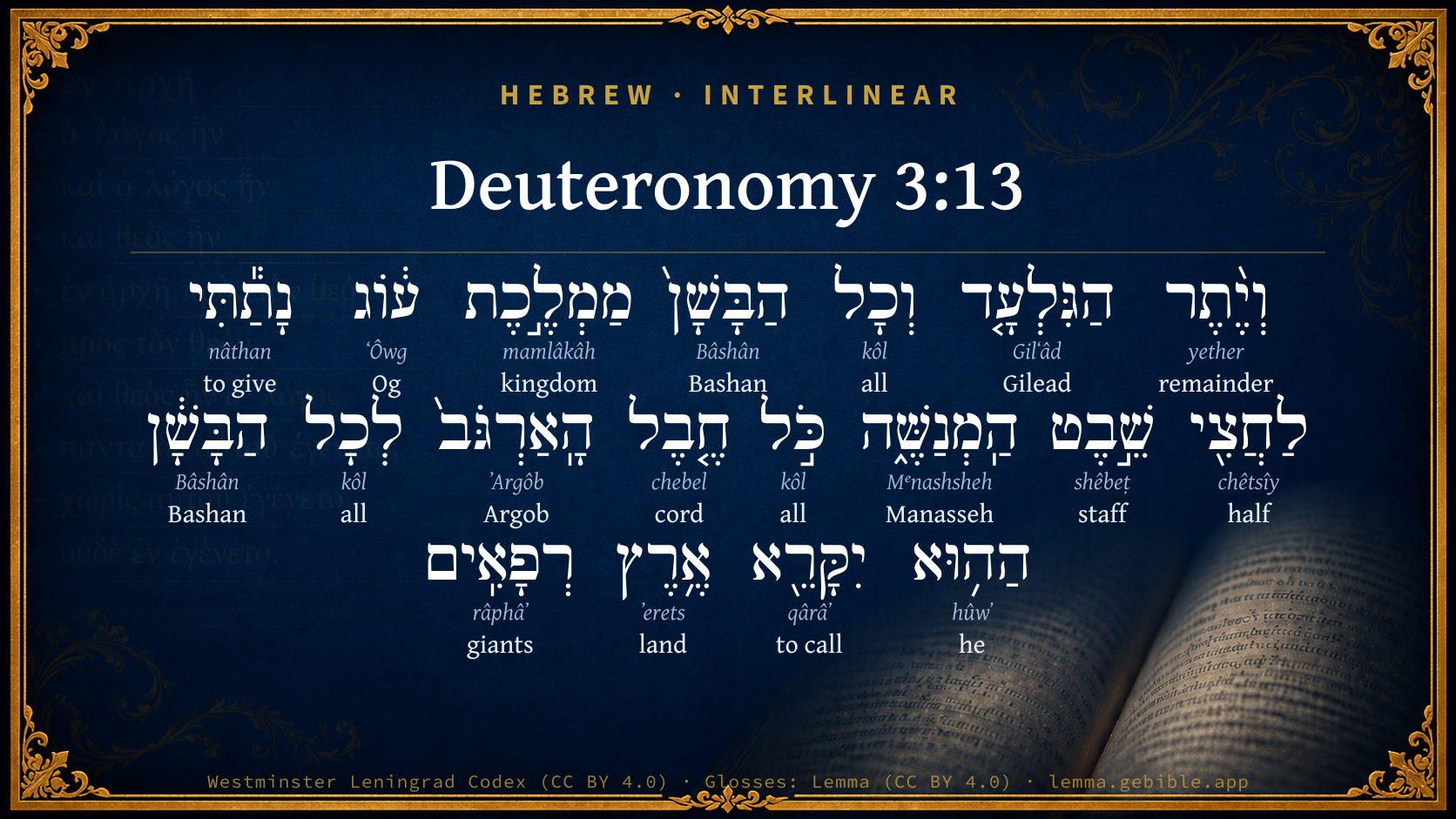
Hebrew (Westminster Leningrad Codex) Deuteronomy 3:13 appears in the Hebrew Old Testament. The text above is from the Westminster Leningrad Codex. Each word links to its Strong’s number, a concise gloss, and parsing drawn from the Open Scriptures Hebrew Bible morphology. Click any word for its full Brown-Driver-Briggs (BDB) entry.
Download image
Cite this verse

Deuteronomy 3:13 (World English Bible). Public Domain. Lemma interlinear Bible study tool, https://lemma.gebible.app/v/deuteronomy/3/13.

Show BibTeX & RIS
BibTeX
RIS
English Translation
and the rest of Gilead, and all Bashan, the kingdom of Og, gave I to the half-tribe of Manasseh; all the region of Argob, even all Bashan. (The same is called the land of Rephaim.
World English Bible · Public Domain
Download a study sheet

One document with this verse’s original text, its word-by-word gloss line, the meaning frame, cross-references with their text, attributed commentary, and full source and license credits — printable, and it pastes into notes with its structure intact.

This verse Autodidact and up

Study sheet (.html) Plain text (.txt)

A passage Seminary Student

Up to 50 verses in one chapter. A passage sheet keeps up to 6 commentary sources and 12 cross-references per verse, in the order this page ranks them, and says so on the sheet whenever that leaves anything out. Ask for a single verse and you get the Autodidact verse sheet above.

Everything on this page stays free to read, with no account — the sheet is a download of what is already on screen, not access to it.

Want to remove ads? Support Godless Engineer
Compare translations 3

The same verse in 3 English versions, stacked beneath the original-language interlinear above. Click any original word for its lexicon entry.

Each is an independent rendering of the whole verse — the interlinear is not word-aligned to these translations.

Highlighted words mark where these versions differ — a whole-verse word diff, not a word-by-word alignment.

  • World English Bible Public Domain
    and the rest of Gilead, and all Bashan, the kingdom of Og, gave I to the half-tribe of Manasseh; all the region of Argob, even all Bashan. (The same is called the land of Rephaim.
  • King James Version Public Domain
    And the rest of Gilead, and all Bashan, being the kingdom of Og, gave I unto the half tribe of Manasseh; all the region of Argob, with all Bashan, which was called the land of giants.
  • unfoldingWord Literal Text CC BY-SA 4.0
    And the rest of Gilead and all Bashan, the kingdom of Og, I gave to half of the tribe of Manasseh.” (All the region of Argob, to all Bashan. The same is called the land of the Raphaites.

unfoldingWord Literal Text — © unfoldingWord, licensed CC BY-SA 4.0. Word-aligned USFM3 via Door43 (git.door43.org/unfoldingWord/en_ult).

Versions to compare (up to 4)

3 of 4 selected

Show all 18 translations

Every available English version of this verse, each an independent rendering of the whole verse.

  • World English Bible Public Domain
    and the rest of Gilead, and all Bashan, the kingdom of Og, gave I to the half-tribe of Manasseh; all the region of Argob, even all Bashan. (The same is called the land of Rephaim.
  • Berean Standard Bible Public Domain
    To the half-tribe of Manasseh I gave the rest of Gilead and all of Bashan, the kingdom of Og. (The entire region of Argob, the whole territory of Bashan, used to be called the land of the Rephaim.)
  • Majority Standard Bible Public Domain
    To the half-tribe of Manasseh I gave the rest of Gilead and all of Bashan, the kingdom of Og. (The entire region of Argob, the whole territory of Bashan, used to be called the land of the Rephaim.)
  • King James Version Public Domain
    And the rest of Gilead, and all Bashan, being the kingdom of Og, gave I unto the half tribe of Manasseh; all the region of Argob, with all Bashan, which was called the land of giants.
  • American Standard Version (1901) Public Domain
    and the rest of Gilead, and all Bashan, the kingdom of Og, gave I unto the half-tribe of Manasseh; all the region of Argob, even all Bashan. (The same is called the land of Rephaim.
  • Revised Version (1885) Public Domain
    and the rest of Gilead, and all Bashan, the kingdom of Og, gave I unto the half tribe of Manasseh; all the region of Argob, even all Bashan. (The same is called the land of Rephaim.
  • Geneva Bible (1599) Public Domain
    And the rest of Gilead, and all Bashan, the kingdome of Og, gaue I vnto the halfe tribe of Manasseh: euen all the countrey of Argob with all Bashan, which is called, The land of gyants.
  • Douay-Rheims (1899) Public Domain
    And I delivered the other part of Galaad, and all Basan the kingdom of Og to the half tribe of Manasses, all the country of Argob: and all Basan is called the Land of giants.
  • Young's Literal Translation Public Domain
    and the rest of Gilead and all Bashan, the kingdom of Og, I have given to the half tribe of Manasseh; all the region of Argob, to all that Bashan, called the land of Rephaim.
  • Literal Standard Version CC BY-SA 4.0
    and the rest of Gilead and all Bashan, the kingdom of Og, I have given to the half tribe of Manasseh; all the region of Argob, with all Bashan—it is called the land of [the] Rephaim.
  • Unlocked Literal Bible CC BY-SA 4.0
    The rest of Gilead and all Bashan, the kingdom of Og, I gave to the half tribe of Manasseh. (All the region of Argob, and all Bashan. The same territory is called the land of Rephaim.
  • unfoldingWord Literal Text CC BY-SA 4.0
    And the rest of Gilead and all Bashan, the kingdom of Og, I gave to half of the tribe of Manasseh.” (All the region of Argob, to all Bashan. The same is called the land of the Raphaites.
  • Darby Bible Public Domain
    and the rest of Gilead, and all Bashan, the kingdom of Og, I gave to half the tribe of Manasseh. (The whole region of Argob, even all Bashan, is called a land of giants.
  • World Messianic Bible Public Domain
    and the rest of Gilead, and all Bashan, the kingdom of Og, I gave to the half-tribe of Manasseh—all the region of Argob, even all Bashan. (The same is called the land of Rephaim.
  • Webster's Bible Public Domain
    And the rest of Gilead, and all Bashan, being the kingdom of Og, I gave to the half-tribe of Manasseh; all the region of Argob, with all Bashan, which was called the land of giants.
  • Free Bible Version CC BY-SA 4.0
    I assigned to the half-tribe of Manasseh the rest of Gilead, and all of Bashan, the kingdom of Og. (The whole region of Argob, all the territory of Bashan, was formerly called the land of the Rephaim.)
  • Bible in Basic English Public Domain
    The rest of Gilead and all Bashan, the kingdom of Og, all the land of Argob, together with Bashan, I gave to the half-tribe of Manasseh. (This land is named the land of the Rephaim.
  • JPS Tanakh (1917) Public Domain
    and the rest of Gilead, and all Bashan, the kingdom of Og, gave I unto the half-tribe of Manasseh; all the region of Argob — all that Bashan is called the land of Rephaim.

Literal Standard Version (2020), Covenant Press — licensed CC BY-SA 4.0. Text via the HelloAO Bible API (eBible.org). Unlocked Literal Bible (unfoldingWord) — licensed CC BY-SA 4.0. Text via the HelloAO Bible API (eBible.org). unfoldingWord Literal Text — © unfoldingWord, licensed CC BY-SA 4.0. Word-aligned USFM3 via Door43 (git.door43.org/unfoldingWord/en_ult). Free Bible Version, Dr. Jonathan Gallagher — licensed CC BY-SA 4.0. Text via the HelloAO Bible API (eBible.org).

Word by word

More ways to search: Search by grammar → Find every occurrence → Compare this word →

Practice this passage: Drill this verse → Learn its vocabulary →

הָֽאַרְגֹּב֙
ʼArgôb
H709
“the · Argob”
Particle, Definite Article + Noun, Proper
Part of Speech
Particle + Noun
Type
Proper
Full BDB Definition

Origin: from the same as H7263

TWOT: None

Argob = "heap of clods" - a district or area in Bashan (noun proper locative) - one of king Pekah's officers (noun proper masculine)
  1. וְיֶ֨תֶר yether H3499 “and · remainder of” Conjunction + Noun, Common, Masculine, Singular, Construct
  2. הַגִּלְעָ֤ד Gilʻâd H1568 “the · Gilead” Particle, Definite Article + Noun, Proper
  3. וְכָל kôl H3605 “and · all of” Conjunction + Noun, Common, Masculine, Singular, Construct
  4. הַבָּשָׁן֙ Bâshân H1316 “the · Bashan” Particle, Definite Article + Noun, Proper
  5. מַמְלֶ֣כֶת mamlâkâh H4467 “kingdom of” Noun, Common, Feminine, Singular, Construct
  6. ע֔וֹג ʻÔwg H5747 “Og” Noun, Proper
  7. נָתַ֕תִּי nâthan H5414 “to give” Verb, Qal, Perfect, 1st Person, Common, Singular
  8. לַחֲצִ֖י chêtsîy H2677 “to/for · half of” Preposition + Noun, Common, Masculine, Singular, Construct
  9. שֵׁ֣בֶט shêbeṭ H7626 “staff of” Noun, Common, Masculine, Singular, Construct
  10. הַֽמְנַשֶּׁ֑ה Mᵉnashsheh H4519 “the · Manasseh” Particle, Definite Article + Noun, Proper
  11. כֹּ֣ל kôl H3605 “all of” Noun, Common, Masculine, Singular, Construct
  12. חֶ֤בֶל chebel H2256 “cord of” Noun, Common, Both, Singular, Construct
  13. לְכָל kôl H3605 “to/for · all of” Preposition + Noun, Common, Masculine, Singular, Construct
  14. הַבָּשָׁ֔ן Bâshân H1316 “the · Bashan” Particle, Definite Article + Noun, Proper
  15. הַה֥וּא hûwʼ H1931 “the · he” Particle, Definite Article + Pronoun, Personal, 3rd Person, Masculine, Singular
  16. יִקָּרֵ֖א qârâʼ H7121 “to call” Verb, Niphal, Imperfect, 3rd Person, Masculine, Singular
  17. אֶ֥רֶץ ʼerets H776 “land of” Noun, Common, Both, Singular, Construct
  18. רְפָאִֽים râphâʼ H7497 “giants” Noun, Proper

About this verse

These counts appear in no published source. They are computed here, from the morphology-tagged text and Lemma’s own curated glosses. What Lemma adds →

19
words
16
distinct lemmas
Pentateuch
section

Notable vocabulary

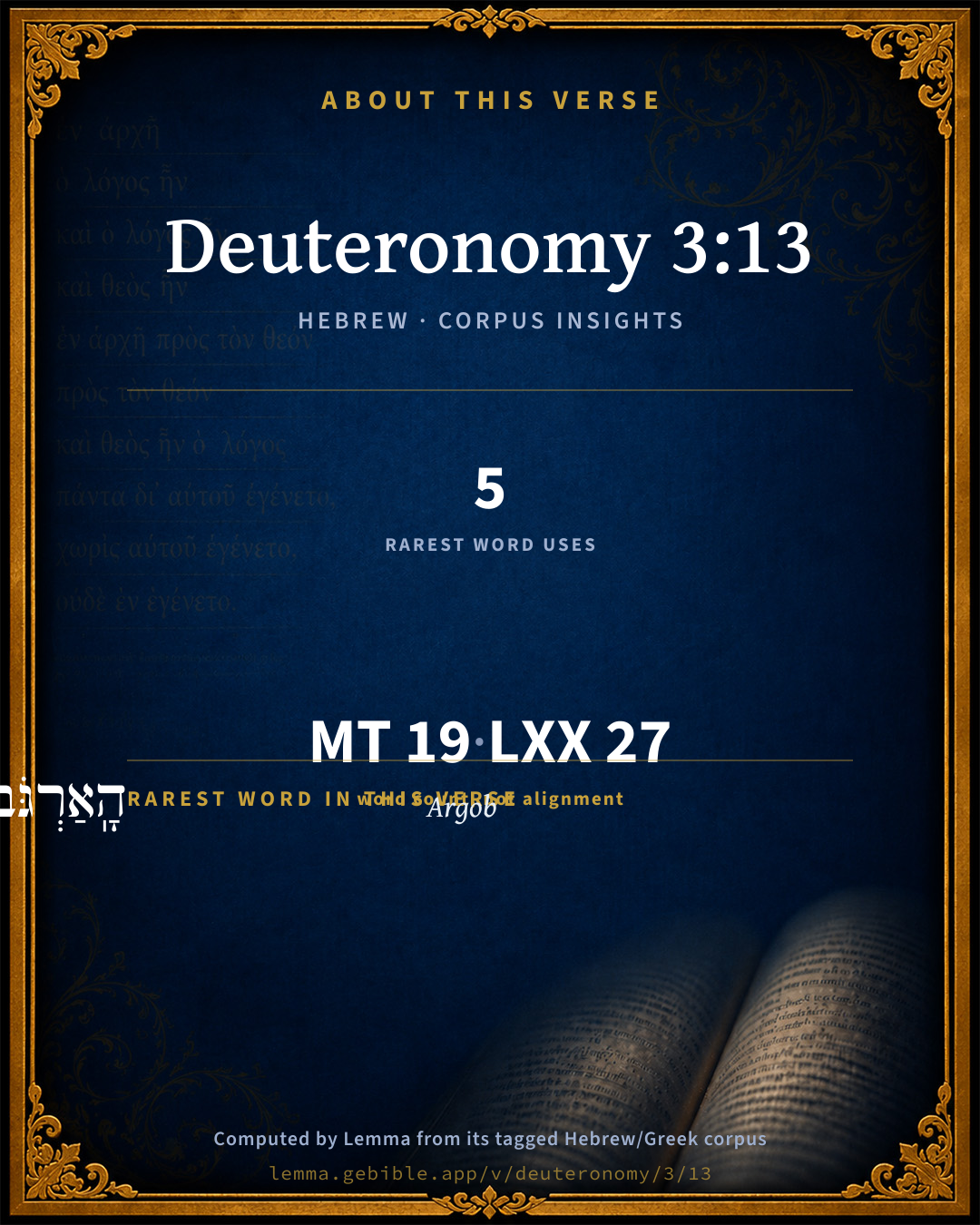
The rarest word here is הָֽאַרְגֹּב֙ Argob H709 — appearing just 5 times in the whole Hebrew Bible.

Shared distinctive vocabulary

הָֽאַרְגֹּב֙ Argob H709 occurs in 5 verses of the Hebrew Bible. Also found in:

Grammatical profile

  • 2 verbs
  • 16 nouns
  • 1 pronoun

Verb forms

  • נָתַ֕תִּי Qal · Perfect
  • יִקָּרֵ֖א Niphal · Imperfect

Repetition

Words recur within this verse — often emphatic in Hebrew:

  • וְכָל all H3605 ×3
  • הַבָּשָׁן֙ Bashan H1316 ×2

Hebrew & Septuagint length

In English translation the verse runs 35 words from the Hebrew and 37 from the Septuagint (LXX English) — closely comparable.

A rough comparison of the two English renderings, which tokenize alike — not a word-level alignment.

Word counts can differ between the Hebrew and the Greek without any difference in meaning — e.g. the Hebrew direct-object marker אֵת has no separate Greek word, and Greek often adds the article ὁ.

In the original languages it is 19 Hebrew tokens and 27 Greek tokens — but the two are counted differently (Hebrew bundles its prefixes and suffixes into one token; the Greek is in lemma form), so that isn’t a like-for-like length.

Cross-references

3

Topical passages linked to Deuteronomy 3:13 in the Treasury of Scripture Knowledge — connected by theme and wording, ordered by reader-vote popularity; previews shown in the World English Bible.

  • Numbers 32:39–42 The children of Machir the son of Manasseh went to Gilead, and took it, and dispossessed the Amorites who were therein.
  • Joshua 13:29–32 Moses gave [inheritance] to the half-tribe of Manasseh: and it was for the half-tribe of the children of Manasseh according to their families.
  • 1 Chronicles 5:23–26 The children of the half-tribe of Manasseh lived in the land: they increased from Bashan to Baal Hermon and Senir and Mount Hermon.

Cross-references courtesy of OpenBible.info (CC BY 4.0).

Hebrew and Greek witnesses Masoretic Hebrew ↔ Greek Septuagint

The same verse in the two great witnesses to the Old Testament, shown verse-for-verse.

These are two independent witnesses, not word-aligned to each other, and the Septuagint is shown in lemma (dictionary) form.

Hebrew Deuteronomy 3:13 Masoretic · Westminster Leningrad Codex

וְיֶ֨תֶר הַגִּלְעָ֤ד וְכָל הַבָּשָׁן֙ מַמְלֶ֣כֶת ע֔וֹג נָתַ֕תִּי לַחֲצִ֖י שֵׁ֣בֶט הַֽמְנַשֶּׁ֑ה כֹּ֣ל חֶ֤בֶל הָֽאַרְגֹּב֙ לְכָל הַבָּשָׁ֔ן הַה֥וּא יִקָּרֵ֖א אֶ֥רֶץ רְפָאִֽים

and the rest of Gilead, and all Bashan, the kingdom of Og, gave I to the half-tribe of Manasseh; all the region of Argob, even all Bashan. (The same is called the land of Rephaim.

World English Bible · Public Domain

Greek LXX Deuteronomy 3:13 Septuagint · lemma form

καί ὁ κατάλοιπος ὁ γαλαάδ καί πᾶς ὁ βασαν βασιλεία ωγ δίδωμι ὁ ἥμισυς φυλή μανασσή καί πᾶς περίχωρος αργοβ πᾶς ὁ βασαν ἐκεῖνος γῆ ραφαϊν λογίζομαι

And the rest of Galaad, and all Basan the kingdom of Og I gave to the half-tribe of Manasse, and all the country round about Argob, all that Basan; it shall be accounted the land of Raphain.

LXX2012 (modern English Septuagint) · Public Domain

On this verse, The Pulpit Commentary discusses the Septuagint’s reading. Read the note in Commentary ↓

Hebrew: Westminster Leningrad Codex (CC BY 4.0). Greek: Septuagint (public domain); English from LXX2012 (modern English Septuagint) (Public Domain). How the Septuagint differs from the Hebrew →

Targum (Aramaic paraphrase)

2

The Targum is the ancient Jewish Aramaic paraphrase of the Hebrew Scriptures — an interpretive translation, not the Hebrew text itself. Onkelos (literal) and Pseudo-Jonathan (expansive) render the Torah, and Jonathan the Prophets. Coverage is partial: where no permissively-licensed English translation exists for a verse, only the Aramaic is shown. This is verse-level text, not a word-by-word alignment to the Hebrew.

  1. Targum Onkelos Torah (Genesis–Deuteronomy)
    וּשְׁאָר גִלְעָד וְכָל מַתְנָן מַלְכוּתָא דְעוֹג יְהָבִית לְפַלְגוּת שִׁבְטָא דִמְנַשֶׁה כֹּל בֵּית פָּלַךְ טְרָכוֹנָא לְכָל מַתְנָן הַהוּא מִתְקְרֵי אַרְעָא גִבָּרַיָא

    (no public-domain English translation for this verse)

    Targum Onkelos — Aramaic: “Onkelos Genesis” (public domain); “Onkelos Exodus” (public domain); “Onkelos Leviticus” (public domain); “Onkelos Numbers” (public domain); “Onkelos Deuteronomy” (public domain). English: “Sefaria Community Translation” (CC0 1.0 (public-domain dedication)); “J.W. Etheridge. The Targums of Onkelos and Jonathan Ben Uzziel on the Pentateuch. London: Longmans, Green, 1862” (public domain). Text via Sefaria.

  2. Targum Pseudo-Jonathan Torah (Genesis–Deuteronomy)
    וּשְׁאָר גִּלְעָד וְכָל מַתְנָן מַלְכוּתֵיהּ דְּעוֹג יְהָבִית לַחֲצִי שֵׁבֶט מְנַשֶּׁה כָּל תְּחוּם בֵּית פְּלַךְ טַרְגוֹנָא וְכָל מַתְנָן הַהוּא מִתְקְרֵי אֲרַע גִּבָּרַיָא

    but the remaining part of Gilead, and all Mathnan, the kingdom of Og, I have given to the half tribe of Menasheh; all the limit of the region of Targona, and all Mathnan, which is called the land of the giants.

    Targum Pseudo-Jonathan — Aramaic: “Targum Jonathan on Genesis” (public domain); “Targum Jonathan on Exodus” (public domain); “Targum Jonathan on Leviticus” (public domain); “Targum Jonathan on Numbers” (public domain); “Targum Jonathan on Deuteronomy” (public domain). English: “The Targum of Jonathan ben Uzziel, trans. J. W. Etheridge, London, 1862” (public domain). Text via Sefaria.

Commentary

Notes on Deuteronomy 3:13 from classic Christian and Jewish commentators (each source and its license shown beneath its notes). The classic Christian expositions comment on the surrounding passage and are grouped to its opening verse, so a note may address several verses; the Jewish commentaries on the Tanakh (Rashi and others) are per-verse, so they appear only where the commentator wrote on this verse.

Lemma curates 59 commentaries, every one of them public domain or Creative Commons licensed, each selected and text-cleaned for this edition rather than reprinted as found. About our sources →

Trapp's Complete Commentary

John Trapp

Deu 3:13 And the rest of Gilead, and all Bashan, [being] the kingdom of Og, gave I unto the half tribe of Manasseh; all the region of Argob, with all Bashan, which was called the land of giants.

Ver. 13. Land of giants.] Such as are said to be in another land, in another life. For "he knoweth not that the giants are there, and that her guests are in the depths of hell." {Pro 9:18}

John Trapp, A Commentary or Exposition upon All the Books of the Old and New Testament (1647–1656) — public domain. Text from a community e-Sword module.

Tyndale Open Study Notes

Tyndale Open Resources

3:13 The half-tribe of Manasseh made the same request as Reuben and Gad (3:12), and Moses accepted their request. Gad and Reuben settled between the Arnon (see 2:24) and the middle of Gilead (see 2:36), and Manasseh took everything north of that, including Bashan (see 3:1). • The Rephaites, a giant people related to the Anakites (see 2:11), are noted here as being indigenous to Bashan.

Tyndale Open Study Notes — © Tyndale Open Resources, licensed CC BY-SA 4.0. Text via the HelloAO Bible API.

Ellicott's Commentary for English Readers

(13) The land of giants—i.e., of Rephaim.

(13-17) Comp. Num_32:33-42, and Notes thereon,

A Bible Commentary for English Readers, edited by Charles John Ellicott (1878–1897) — public domain. Text from a community e-Sword module.

The Cambridge Bible for Schools and Colleges

gen. ed. J. J. S. Perowne

13. the rest of Gilead] From the Jabboḳ to the Yarmûḳ. This, with all Bashan, the kingdom of ‘Ôg, fell to the half-tribe of Manasseh, and is further defined as all the region of Argob (see Deu_3:4). R.V. following the Heb. punctuation adds even all Bashan, but as Rev. Marg. suggests, this phrase is part of the next note: all that Bashan is called a land of Repha‘îm. In Num_32:1-32; Num_32:34-38 (a section with obvious marks of P but containing earlier elements) only Re’uben and Gad are assigned land E. of Jordan. Moses’ allotment there to the half-tribe of Manasseh is recorded in deuteronomic passages, as here and Num_33:33 (editorial); while Deborah’s song, Jdg_5:14, takes Machir as a W. clan, but J, Num_33:39; Num_33:41, assigns the conquest of Gile‘ad to Machir, son of Manasseh, and the capture of its towns to Ya’îr, son of Manasseh; Num_33:40, adding that Moses gave Gile‘ad; to Manasseh, is regarded as a later insertion both because of the statement just cited from Deborah and because Judges 10 assigns the Ḥawwôth-Ya’îr to Ya’îr, a Gileadite in the days of the Judges. There thus appear to have been two traditions of the occupation of Gile‘ad by part of Manasseh, one as early as J (Num_33:39; Num_33:41) followed by D, which dates it under Moses; and one, which records the conquering clan as settled first in W. Palestine, and thence invading Gile‘ad under the Judges. This second tradition is preferred by many, e.g. Wellh. Gesch. (2) 33, and Budde, who points out that the Bnê Yoseph could not have complained to Joshua, Jos_17:14-18, that they had only one lot if, besides this western territory which he gave them, part of them had already received from Moses land E. of Jordan. He proposes to insert Gile‘ad in Jos_17:18, so as to make it the new lot granted by Joshua. But in that case some allusion to the crossing of Jordan would have been natural, nor would the occupation of Gile‘ad have helped the Joseph tribe against the Canaanites of W. Palestine. Moreover, Gile‘ad is said to have been the father of Abi‘ezer and Shechem (JE, Jos_17:2; P, Num_26:29 ff.) and therefore older in Manasseh’s line than these W. septs of the tribe. So there is something to be said for the occupation of Gile‘ad by Manasseh under Moses. But the whole matter is obscure. See further Hastings, D.B. iii. 230 f., HGHL, 577. Cp. the next notes.

The Cambridge Bible for Schools and Colleges (gen. ed. J. J. S. Perowne; Cambridge University Press, 1878–1918) — public domain. Text from a community e-Sword module.

John Gill's Exposition

And the rest of Gilead,.... The other half of the mount, with the cities belonging to it:

and all Bashan, being the kingdom of Og, gave I unto the half tribe of Manasseh; see Num 32:33.

all the region of Argob, with all Bashan; the region of Trachonitis, in Bashan; see Deu 3:4,

which was called the land of giants; or of Rephaim; this Jarchi says is the country of the Rephaim given to Abraham, Gen 15:20.

John Gill's Exposition of the Whole Bible (1746–1763) — public domain (CC PDM 1.0). Text via the HelloAO Bible API.

The Pulpit Commentary

The last part of this verse is differently construed and rendered by different translators. By some the clause all the region of Argob is connected with what precedes, while others regard this clause as in apposition with what follows. Targum: "All the region of Trachona, and all that province was called the land of giants;" LXX "And all the region of Argob, all that Bashan: the land of the Rephaim it was reckoned:" Vulgate: "The whole region of Argob, and all Bashan is called the land of giants." Modern interpreters for the most part adopt the order of the Targum. The clause may be rendered thus: The whole region of Argob as respects all Bashan i.e. in so far as it formed part of the kingdom of Bashan under Og was reputed the land of the Rephaim.

The Pulpit Commentary (1880–1919), ed. H.D.M. Spence-Jones & Joseph S. Exell — public domain. Text from a community e-Sword module.

Rashi

Rabbi Shlomo Yitzchaki (Rashi)

ההוא יקרא ארץ רפאים IT IS THAT WHICH IS CALLED THE LAND OF REPHAIM — it is that which I gave to Abraham (cf. Rashi on 2:20).

Rashi on the Tanakh — English translations: “The Judaica Press complete Tanach with Rashi, translated by A. J. Rosenberg” (CC BY 4.0); “Pentateuch with Rashi's commentary by M. Rosenbaum and A.M. Silbermann, 1929-1934” (public domain); “The Metsudah Tanach series, Lakewood, N.J” (CC BY 4.0); and “The Book of Joshua, Metsudah Publications, 1997” (CC BY 4.0). Text via Sefaria.

Ramban (Nachmanides)

Rabbi Moshe ben Nachman (Ramban / Nachmanides)

ALL THE REGION OF THE ARGOB — ALL ‘HAHU’ (THAT) BASHAN IS CALLED THE LAND OF REPHAIM. The meaning thereof is: “and all the region of the Argob — all ‘the’ Bashan ‘asher’ (which) in hahu [habashan ‘hahu’ — “that” Bashan] as meaning asher (which): “the Bashan ‘which’” is called the land of Rephaim. is called the land of Rephaim” [I also gave to the half-tribe of Menasheh]. This usage [a letter hei meaning asher (which) or (who)] is also found in the following verses: And all ‘hahikdish’ Samuel the Seer, and Saul the son of Kish, in hahikdish means asher hikdish (“which” he dedicated). [meaning: asher hikdish — “‘which’ he dedicated”]; ‘hahoshivu’ foreign women [meaning: asher hoshivu — “‘who’ had married”]. In all these cases the letter hei is in the place of asher (which or who). There are many similar examples. Now [Argob] was considered part of the land of Rephaim because of Og who ruled over it, or because it originally belonged to the Rephaim and was left to Og because he and the people that dwelled in it were of the remnant of the Rephaim. Va’ethchanan

Ramban (Nachmanides) on the Tanakh — English translation: “Commentary on the Torah by Ramban (Nachmanides). Translated and annotated by Charles B. Chavel. New York, Shilo Pub. House, 1971-1976” (CC BY 4.0). Text via Sefaria.

Lesson kit

Teaching starters — assembled from the data on this page, not authored interpretation. Every prompt links to the verse data it draws on. Edit before teaching.

Deuteronomy, in the Pentateuch, opens this verse with 19 words (16 distinct Hebrew lemmas). Its most distinctive word is ʼArgôb (“Argob”). A historical commentator’s framing appears above. Read the whole chapter for the surrounding context.

Discussion questions

  1. How does “Argob” (ʼArgôb) shape what this verse is saying?
  2. Deuteronomy 3:4 shares the word «Argob» with this verse. How do the two illuminate each other?
  3. “all” occurs 3× in this one verse. What is the effect of the repetition?
  4. These translations render this verse differently. What is at stake in choosing one wording over another?
  5. The verb «נָתַ֕תִּי» is Qal Perfect. How does its form color the action?
  6. Reading how Trapp's Complete Commentary and Tyndale Open Study Notes read this verse, where do the two commentators agree and where do they part?

Things to notice

Reading settings

Reading text

Shown beneath each verse's original-language words.

Old Testament
Old Testament edition

Read the OT as the Masoretic Hebrew (MT) or the Greek Septuagint (LXX).

English shown for the Greek Septuagint (in the Hebrew ↔ Greek comparison).

Comparing translations? Open the Compare panel on any verse page to stack up to four side by side.