
Deuteronomy 4:42

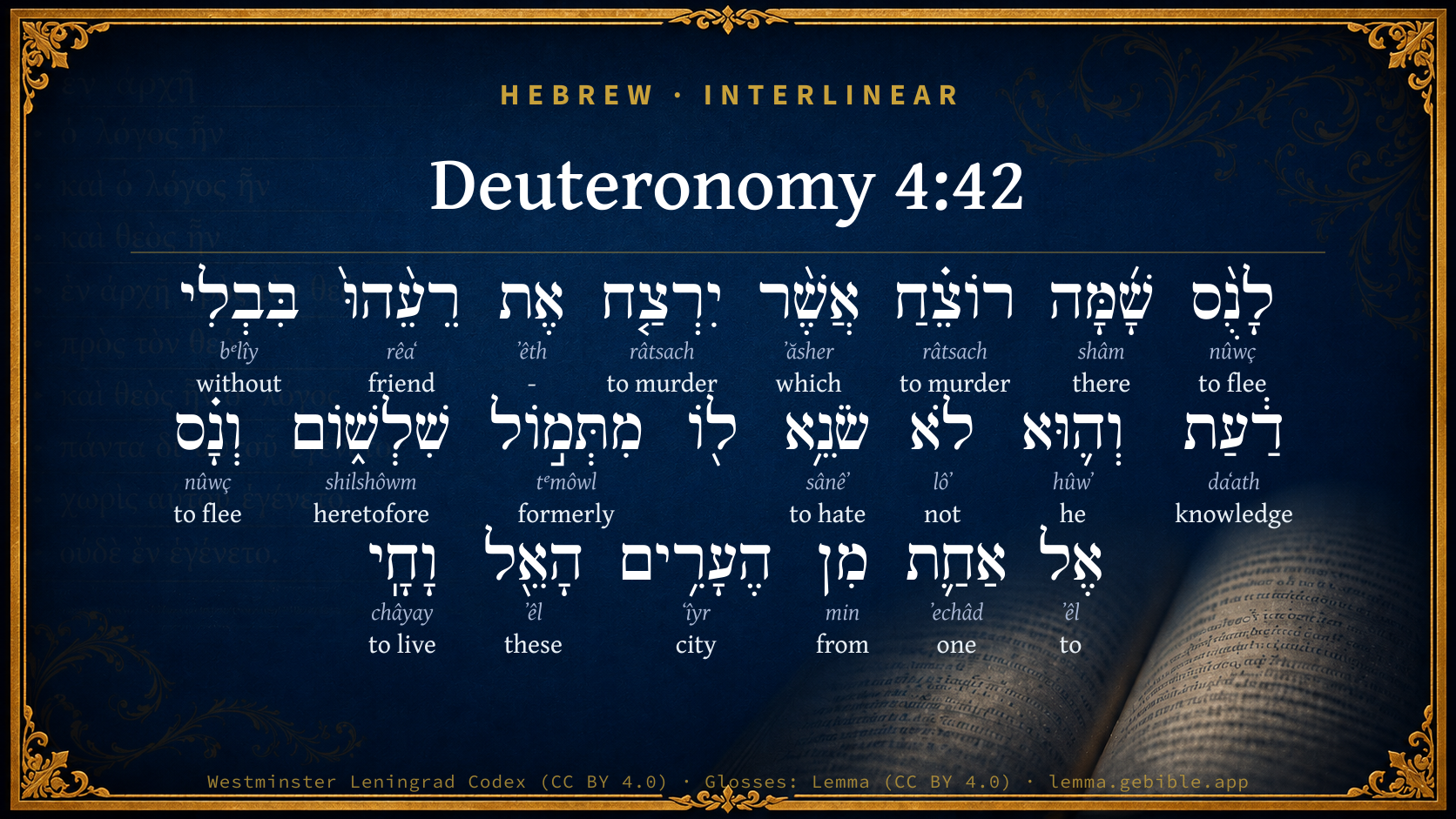
Hebrew (Westminster Leningrad Codex) Deuteronomy 4:42 appears in the Hebrew Old Testament. The text above is from the Westminster Leningrad Codex. Each word links to its Strong’s number, a concise gloss, and parsing drawn from the Open Scriptures Hebrew Bible morphology. Click any word for its full Brown-Driver-Briggs (BDB) entry.
Download image
Cite this verse

Deuteronomy 4:42 (World English Bible). Public Domain. Lemma interlinear Bible study tool, https://lemma.gebible.app/v/deuteronomy/4/42.

Show BibTeX & RIS
BibTeX
RIS
English Translation
that the manslayer might flee there, who kills his neighbor unawares, and didn't hate him in time past; and that fleeing to one of these cities he might live:
World English Bible · Public Domain
Download a study sheet

One document with this verse’s original text, its word-by-word gloss line, the meaning frame, cross-references with their text, attributed commentary, and full source and license credits — printable, and it pastes into notes with its structure intact.

This verse Autodidact and up

Study sheet (.html) Plain text (.txt)

A passage Seminary Student

Up to 50 verses in one chapter. A passage sheet keeps up to 6 commentary sources and 12 cross-references per verse, in the order this page ranks them, and says so on the sheet whenever that leaves anything out. Ask for a single verse and you get the Autodidact verse sheet above.

Everything on this page stays free to read, with no account — the sheet is a download of what is already on screen, not access to it.

Want to remove ads? Support Godless Engineer
Compare translations 3

The same verse in 3 English versions, stacked beneath the original-language interlinear above. Click any original word for its lexicon entry.

Each is an independent rendering of the whole verse — the interlinear is not word-aligned to these translations.

Highlighted words mark where these versions differ — a whole-verse word diff, not a word-by-word alignment.

  • World English Bible Public Domain
    that the manslayer might flee there, who kills his neighbor unawares, and didn't hate him in time past; and that fleeing to one of these cities he might live:
  • King James Version Public Domain
    That the slayer might flee thither, which should kill his neighbor unawares, and hated him not in times past; and that fleeing unto one of these cities he might live:
  • unfoldingWord Literal Text CC BY-SA 4.0
    for a manslayer to flee there, who killed his neighbor without knowing and he did not hate him previously before; and he shall flee to one of these cities, and he shall live:

unfoldingWord Literal Text — © unfoldingWord, licensed CC BY-SA 4.0. Word-aligned USFM3 via Door43 (git.door43.org/unfoldingWord/en_ult).

Versions to compare (up to 4)

3 of 4 selected

Show all 18 translations

Every available English version of this verse, each an independent rendering of the whole verse.

  • World English Bible Public Domain
    that the manslayer might flee there, who kills his neighbor unawares, and didn't hate him in time past; and that fleeing to one of these cities he might live:
  • Berean Standard Bible Public Domain
    to which a manslayer could flee after killing his neighbor unintentionally without prior malice. To save one’s own life, he could flee to one of these cities:
  • Majority Standard Bible Public Domain
    to which a manslayer could flee after killing his neighbor unintentionally without prior malice. To save one’s own life, he could flee to one of these cities:
  • King James Version Public Domain
    That the slayer might flee thither, which should kill his neighbor unawares, and hated him not in times past; and that fleeing unto one of these cities he might live:
  • American Standard Version (1901) Public Domain
    that the manslayer might flee thither, that slayeth his neighbor unawares, and hated him not in time past; and that fleeing unto one of these cities he might live:
  • Revised Version (1885) Public Domain
    that the manslayer might flee thither, which slayeth his neighbour unawares, and hated him not in time past; and that fleeing unto one of these cities he might live:
  • Geneva Bible (1599) Public Domain
    That the slayer should flee thither, which had killed his neighbour at vnwares, and hated him not in time past, might flee, I say, vnto one of those cities, and liue:
  • Douay-Rheims (1899) Public Domain
    That any one might flee to them who should kill his neighbour unwillingly, and was not his enemy a day or two before, and that he might escape to some one of these cities:
  • Young's Literal Translation Public Domain
    for the fleeing thither of the man-slayer, who slayeth his neighbour unknowingly, and he is not hating him heretofore, and he hath fled unto one of these cities, and he hath lived:
  • Literal Standard Version CC BY-SA 4.0
    for the fleeing there of the manslayer who slays his neighbor unknowingly, and he is not hating him before, and he has fled to one of these cities and he has lived:
  • Unlocked Literal Bible CC BY-SA 4.0
    so that anyone might flee to one of them if he killed another person accidentally, without being his enemy previously. By fleeing to one of these cities, he might survive.
  • unfoldingWord Literal Text CC BY-SA 4.0
    for a manslayer to flee there, who killed his neighbor without knowing and he did not hate him previously before; and he shall flee to one of these cities, and he shall live:
  • Darby Bible Public Domain
    that the manslayer might flee thither, who should kill his neighbour unawares, and hated him not previously, that fleeing to one of these cities, he might live:
  • World Messianic Bible Public Domain
    that the man slayer might flee there, who kills his neighbor unintentionally and didn’t hate him in time past, and that fleeing to one of these cities he might live:
  • Webster's Bible Public Domain
    That the slayer might flee thither, who should kill his neighbor unawares, and when he had not hated him in times past; and that fleeing to one of these cities he might live:
  • Free Bible Version CC BY-SA 4.0
    where a person could run to after accidentally killing someone without deliberate hatred. To save their life they could run to one of these towns:
  • Bible in Basic English Public Domain
    To which anyone causing the death of his neighbour in error and not through hate, might go in flight; so that in one of these towns he might be kept from death:
  • JPS Tanakh (1917) Public Domain
    that the manslayer might flee thither, that slayeth his neighbour unawares, and hated him not in time past; and that fleeing unto one of these cities he might live:

Literal Standard Version (2020), Covenant Press — licensed CC BY-SA 4.0. Text via the HelloAO Bible API (eBible.org). Unlocked Literal Bible (unfoldingWord) — licensed CC BY-SA 4.0. Text via the HelloAO Bible API (eBible.org). unfoldingWord Literal Text — © unfoldingWord, licensed CC BY-SA 4.0. Word-aligned USFM3 via Door43 (git.door43.org/unfoldingWord/en_ult). Free Bible Version, Dr. Jonathan Gallagher — licensed CC BY-SA 4.0. Text via the HelloAO Bible API (eBible.org).

Word by word

More ways to search: Search by grammar → Find every occurrence → Compare this word →

Practice this passage: Drill this verse → Learn its vocabulary →

הָאֵ֖ל
ʼêl
H411
“the · these”
Particle, Definite Article + Pronoun, Demonstrative, Common, Plural
Part of Speech
Particle + Pronoun
Type
Demonstrative
Gender
Common
Number
Plural
Full BDB Definition

Origin: a demonstrative particle (only in a plural sense)

TWOT: 92

these, those
  1. לָנֻ֨ס nûwç H5127 “to flee” Preposition + Verb, Qal, Infinitive Construct
  2. שָׁ֜מָּה shâm H8033 “there · toward” Adverb + Suffix, Demonstrative
  3. רוֹצֵ֗חַ râtsach H7523 “murdering” Verb, Qal, Participle Active, Masculine, Singular, Absolute
  4. אֲשֶׁ֨ר ʼăsher H834 “which” Particle, Relative
  5. יִרְצַ֤ח râtsach H7523 “to murder” Verb, Qal, Imperfect, 3rd Person, Masculine, Singular
  6. אֶת ʼêth H853 “-” Particle, Direct Object
  7. רֵעֵ֨הוּ֙ rêaʻ H7453 “friend · his” Noun, Common, Masculine, Singular, Construct + Suffix, Personal, 3rd Person, Masculine, Singular
  8. בִּבְלִי bᵉlîy H1097 “in/at · without of” Preposition + Noun, Common, Masculine, Singular, Construct
  9. דַ֔עַת daʻath H1847 “knowledge” Noun, Common, Feminine, Singular, Absolute
  10. וְה֛וּא hûwʼ H1931 “and · he” Conjunction + Pronoun, Personal, 3rd Person, Masculine, Singular
  11. לֹא lôʼ H3808 “not” Particle, Negative
  12. שֹׂנֵ֥א sânêʼ H8130 “hating” Verb, Qal, Participle Active, Masculine, Singular, Absolute
  13. מִתְּמ֣וֹל tᵉmôwl H8543 “from · formerly” Preposition + Adverb
  14. שִׁלְשׁ֑וֹם shilshôwm H8032 “heretofore” Noun, Common, Masculine, Singular, Absolute
  15. וְנָ֗ס nûwç H5127 “and · to flee” Conjunction + Verb, Qal, Sequential Perfect, 3rd Person, Masculine, Singular
  16. אֶל ʼêl H413 “to” Preposition
  17. אַחַ֛ת ʼechâd H259 “one” Adjective, Cardinal number, Feminine, Singular, Absolute
  18. מִן min H4480 “from” Preposition
  19. הֶעָרִ֥ים ʻîyr H5892 “the · cities” Particle, Definite Article + Noun, Common, Feminine, Plural, Absolute
  20. וָחָֽי châyay H2425 “and · to live” Conjunction + Verb, Qal, Sequential Perfect, 3rd Person, Masculine, Singular

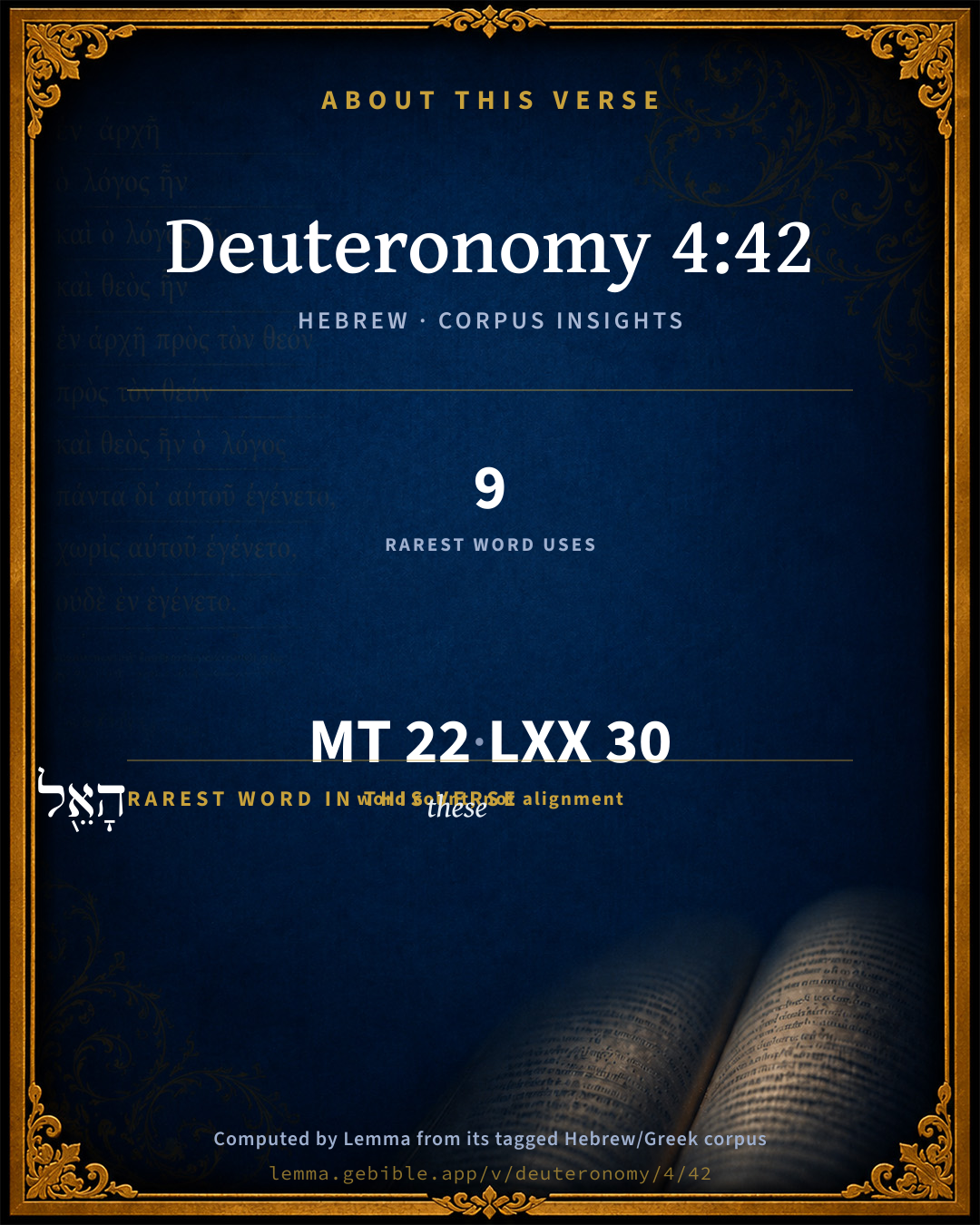
About this verse

These counts appear in no published source. They are computed here, from the morphology-tagged text and Lemma’s own curated glosses. What Lemma adds →

22
words
19
distinct lemmas
Pentateuch
section

Notable vocabulary

The rarest word here is הָאֵ֖ל these H411 — appearing just 9 times in the whole Hebrew Bible.

Shared distinctive vocabulary

הָאֵ֖ל these H411 occurs in 9 verses of the Hebrew Bible. Also found in:

Grammatical profile

  • 6 verbs
  • 5 nouns
  • 1 adjective
  • 2 pronouns
  • 3 prepositions
  • 2 adverbs
  • 3 particles

Verb forms

  • לָנֻ֨ס Qal · Infinitive Construct
  • רוֹצֵ֗חַ Qal · Participle Active
  • יִרְצַ֤ח Qal · Imperfect
  • שֹׂנֵ֥א Qal · Participle Active
  • וְנָ֗ס Qal · Sequential Perfect
  • וָחָֽי Qal · Sequential Perfect

Repetition

Words recur within this verse — often emphatic in Hebrew:

  • לָנֻ֨ס to flee H5127 ×2
  • רוֹצֵ֗חַ to murder H7523 ×2

Hebrew & Septuagint length

In English translation the verse runs 29 words from the Hebrew and 33 from the Septuagint (LXX English) — closely comparable.

A rough comparison of the two English renderings, which tokenize alike — not a word-level alignment.

Word counts can differ between the Hebrew and the Greek without any difference in meaning — e.g. the Hebrew direct-object marker אֵת has no separate Greek word, and Greek often adds the article ὁ.

In the original languages it is 22 Hebrew tokens and 30 Greek tokens — but the two are counted differently (Hebrew bundles its prefixes and suffixes into one token; the Greek is in lemma form), so that isn’t a like-for-like length.

Cross-references

5

Topical passages linked to Deuteronomy 4:42 in the Treasury of Scripture Knowledge — connected by theme and wording, ordered by reader-vote popularity; previews shown in the World English Bible.

  • Numbers 35:6 The cities which you shall give to the Levites, they shall be the six cities of refuge, which you shall give for the manslayer to flee to: and besides them you shall give forty-two cities.
  • Numbers 35:11–12 then you shall appoint you cities to be cities of refuge for you, that the manslayer who kills any person unwittingly may flee there.
  • Numbers 35:15–28 For the children of Israel, and for the stranger and for the foreigner living among them, shall these six cities be for refuge; that everyone who kills any person unwittingly may flee there.
  • Deuteronomy 19:1–10 When Yahweh your God shall cut off the nations, whose land Yahweh your God gives you, and you succeed them, and dwell in their cities, and in their houses;
  • Hebrews 6:18 that by two immutable things, in which it is impossible for God to lie, we may have a strong encouragement, who have fled for refuge to take hold of the hope set before us.

Cross-references courtesy of OpenBible.info (CC BY 4.0).

Hebrew and Greek witnesses Masoretic Hebrew ↔ Greek Septuagint

The same verse in the two great witnesses to the Old Testament, shown verse-for-verse.

These are two independent witnesses, not word-aligned to each other, and the Septuagint is shown in lemma (dictionary) form.

Hebrew Deuteronomy 4:42 Masoretic · Westminster Leningrad Codex

לָנֻ֨ס שָׁ֜מָּה רוֹצֵ֗חַ אֲשֶׁ֨ר יִרְצַ֤ח אֶת רֵעֵ֨הוּ֙ בִּבְלִי דַ֔עַת וְה֛וּא לֹא שֹׂנֵ֥א ל֖וֹ מִתְּמ֣וֹל שִׁלְשׁ֑וֹם וְנָ֗ס אֶל אַחַ֛ת מִן הֶעָרִ֥ים הָאֵ֖ל וָחָֽי

that the manslayer might flee there, who kills his neighbor unawares, and didn't hate him in time past; and that fleeing to one of these cities he might live:

World English Bible · Public Domain

Greek LXX Deuteronomy 4:42 Septuagint · lemma form

φεύγω ἐκεῖ ὁ φονευτής ὅς ἄν φονεύω ὁ πλησίον οὐ οἶδα καί οὗτος οὐ μισέω αὐτός πρό ὁ χθές καί τρίτος καί καταφεύγω εἰς εἷς ὁ πόλις οὗτος καί ζάω

that the slayer might flee there, who should have slain his neighbor unintentionally, and should not have hated him in times past, and he shall flee to one of these cities and live:

LXX2012 (modern English Septuagint) · Public Domain

On this verse, John Gill's Exposition discusses the Septuagint’s reading. Read the note in Commentary ↓

Hebrew: Westminster Leningrad Codex (CC BY 4.0). Greek: Septuagint (public domain); English from LXX2012 (modern English Septuagint) (Public Domain). How the Septuagint differs from the Hebrew →

Targum (Aramaic paraphrase)

2

The Targum is the ancient Jewish Aramaic paraphrase of the Hebrew Scriptures — an interpretive translation, not the Hebrew text itself. Onkelos (literal) and Pseudo-Jonathan (expansive) render the Torah, and Jonathan the Prophets. Coverage is partial: where no permissively-licensed English translation exists for a verse, only the Aramaic is shown. This is verse-level text, not a word-by-word alignment to the Hebrew.

  1. Targum Onkelos Torah (Genesis–Deuteronomy)
    לְמֵעִירוֹק תַּמָן קָטוֹלָא דִי יִקְטוֹל יָת חַבְרֵהּ בְּלָא מַנְדְעֵי וְהוּא לָא סָנֵי לֵהּ מֵאִתְמַלֵי וּמִדְקַמוֹהִי וְיֵעִרוֹק לְחַד מִן קִרְוַיָא הָאִלֵין וְיִתְקַיָם

    (no public-domain English translation for this verse)

    Targum Onkelos — Aramaic: “Onkelos Genesis” (public domain); “Onkelos Exodus” (public domain); “Onkelos Leviticus” (public domain); “Onkelos Numbers” (public domain); “Onkelos Deuteronomy” (public domain). English: “Sefaria Community Translation” (CC0 1.0 (public-domain dedication)); “J.W. Etheridge. The Targums of Onkelos and Jonathan Ben Uzziel on the Pentateuch. London: Longmans, Green, 1862” (public domain). Text via Sefaria.

  2. Targum Pseudo-Jonathan Torah (Genesis–Deuteronomy)
    לְמֵעֲרוֹק לְתַמָּן קָטוֹלָא דְיִקְטוֹל יַת חַבְרֵיהּ וְלָא אִתְכְּוַון וְהוּא לָא שָנֵי לֵיהּ מֵאִיתְמְלֵי וּמִדְקָמוֹהִי וְיֵעִירוֹק לַחֲדָא מִקִּרְוַויָא הָאִלֵין וְיִתְקַיָּים

    that the manslayer who had killed his neighbour without intention, not having hated him yesterday or before, may flee, and escape into one of those cities, and be spared alive.

    Targum Pseudo-Jonathan — Aramaic: “Targum Jonathan on Genesis” (public domain); “Targum Jonathan on Exodus” (public domain); “Targum Jonathan on Leviticus” (public domain); “Targum Jonathan on Numbers” (public domain); “Targum Jonathan on Deuteronomy” (public domain). English: “The Targum of Jonathan ben Uzziel, trans. J. W. Etheridge, London, 1862” (public domain). Text via Sefaria.

Commentary

Notes on Deuteronomy 4:42 from classic Christian and Jewish commentators (each source and its license shown beneath its notes). The classic Christian expositions comment on the surrounding passage and are grouped to its opening verse, so a note may address several verses; the Jewish commentaries on the Tanakh (Rashi and others) are per-verse, so they appear only where the commentator wrote on this verse.

Lemma curates 59 commentaries, every one of them public domain or Creative Commons licensed, each selected and text-cleaned for this edition rather than reprinted as found. About our sources →

Trapp's Complete Commentary

John Trapp

Deu 4:42 That the slayer might flee thither, which should kill his neighbour unawares, and hated him not in times past; and that fleeing unto one of these cities he might live:

Ver. 42. That thou mayest prolong thy days.] Hence some Lutherans {a} have gathered that God hath not determined the set period of man’s days, but that it is in men’s power to lengthen or shorten them. But this is against Job 7:1; Job 14:14 Ecc 2:3 Isa 38:5; Isa 38:15. Stat sua cuique dies. Our hairs are numbered, much more our days.

That the slayer.] {See Trapp on "Num 35:6"} {See Trapp on "Num 35:7"} &c.

{a} Heming et alii.

John Trapp, A Commentary or Exposition upon All the Books of the Old and New Testament (1647–1656) — public domain. Text from a community e-Sword module.

The Cambridge Bible for Schools and Colleges

gen. ed. J. J. S. Perowne

42. unawares, and hated him not in time past] The same terminology as in Deu_19:1 ff. For this E has lies not in wait but God delivers him into his hand (in contrast with wilfully), Exo_21:12-14; but P gives another term, in error or inadvertence, Num_35:11; Num_35:15. Joshua 20 combines both phrases Deu_4:3; Deu_4:5; Deu_4:9.

The Cambridge Bible for Schools and Colleges (gen. ed. J. J. S. Perowne; Cambridge University Press, 1878–1918) — public domain. Text from a community e-Sword module.

John Gill's Exposition

That the slayer might flee thither,.... For refuge; the slayer of a man, but not any slayer, but

which should kill his neighbour unawares; by accident to him, without any design and intention to kill him; ignorantly, as the Septuagint version; and so Onkelos:

and hated him not in times past; it having never appeared that there had been a quarrel between them, and that the slayer had shown any enmity to the man slain any time before the fact, or bore a grudge against him, or spite unto him:

and that, fleeing unto one of these cities, he might live; in peace and safety unto his own death, or unto the death of the high priest, when he was released from his confinement to the city of his refuge, and might return to his tribe, house, family, and possessions.

John Gill's Exposition of the Whole Bible (1746–1763) — public domain (CC PDM 1.0). Text via the HelloAO Bible API.

Haydock's Catholic Bible Commentary

Before. The Rabbins say, when two people had refused to speak to one another for three days, it was a sufficient indication of their enmity. (Selden, Jur. iv. 2.)

George Leo Haydock (1774–1849), Haydock's Catholic Family Bible and Commentary, 1859 edition — public domain. Excludes Psalms (Douay-Rheims chapter numbering differs from Protestant) and Deuterocanonical books (Catholic canon only).

The Pulpit Commentary

Unawares; literally, in lack or want of knowing (tdAylibB), i.e. unconsciously, unintentionally; in Num_35:31, Num_35:15, another word (hggv by mistake) is used, rendered in the Authorized Version by "unwittingly;" in Jos_20:3, both words are used. In times past; literally, yesterday, three days since, i.e. formerly, heretofore (cf. Gen_31:2; Exo_5:8)

The Pulpit Commentary (1880–1919), ed. H.D.M. Spence-Jones & Joseph S. Exell — public domain. Text from a community e-Sword module.

Lesson kit

Teaching starters — assembled from the data on this page, not authored interpretation. Every prompt links to the verse data it draws on. Edit before teaching.

Deuteronomy, in the Pentateuch, opens this verse with 22 words (19 distinct Hebrew lemmas). Its most distinctive word is ʼêl (“these”). A historical commentator’s framing appears above. Read the whole chapter for the surrounding context.

Discussion questions

  1. What does “these” (ʼêl) contribute to the verse as a whole?
  2. How does Genesis 19:8, which shares the word «these», read alongside this verse?
  3. What does the repetition of “to flee” (2× in this one verse) do in this verse?
  4. The translations on this page render this verse differently — a whole-verse word diff, not a word-by-word alignment. What might account for the different wordings?
  5. «לָנֻ֨ס» is a Qal Infinitive Construct verb. How does that grammatical form shape the action described?
  6. Compare how Trapp's Complete Commentary and The Cambridge Bible for Schools and Colleges read this verse. Where do they agree or differ?

Things to notice

Reading settings

Reading text

Shown beneath each verse's original-language words.

Old Testament
Old Testament edition

Read the OT as the Masoretic Hebrew (MT) or the Greek Septuagint (LXX).

English shown for the Greek Septuagint (in the Hebrew ↔ Greek comparison).

Comparing translations? Open the Compare panel on any verse page to stack up to four side by side.