Deuteronomy 31:18

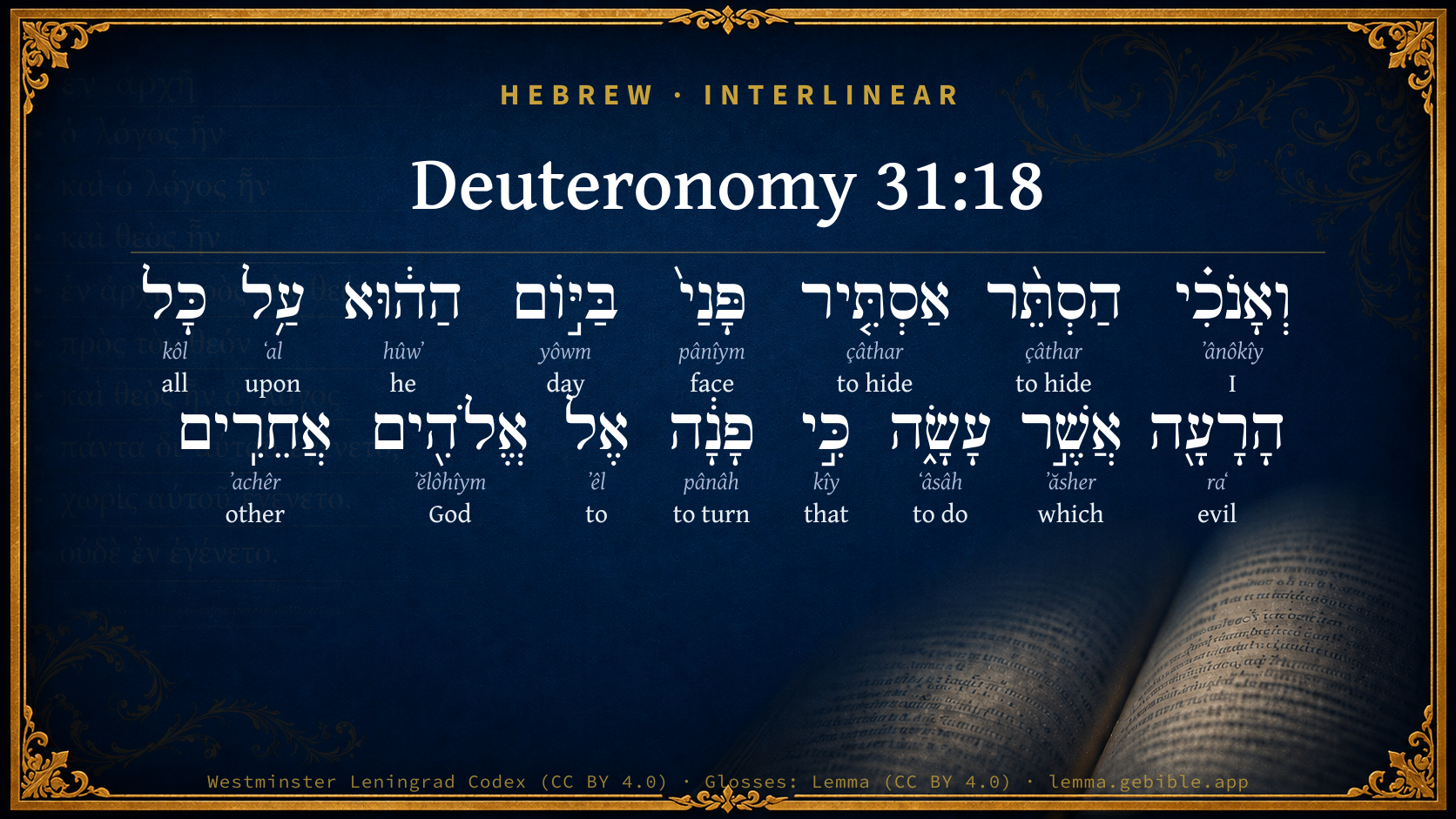
Hebrew (Westminster Leningrad Codex) Deuteronomy 31:18 appears in the Hebrew Old Testament. The text above is from the Westminster Leningrad Codex. Each word links to its Strong’s number, a concise gloss, and parsing drawn from the Open Scriptures Hebrew Bible morphology. Click any word for its full Brown-Driver-Briggs (BDB) entry.
Download image
Cite this verse

Deuteronomy 31:18 (World English Bible). Public Domain. Lemma interlinear Bible study tool, https://lemma.gebible.app/v/deuteronomy/31/18.

Show BibTeX & RIS
BibTeX
RIS
English Translation
I will surely hide my face in that day for all the evil which they shall have worked, in that they are turned to other gods.
World English Bible · Public Domain
Download a study sheet

One document with this verse’s original text, its word-by-word gloss line, the meaning frame, cross-references with their text, attributed commentary, and full source and license credits — printable, and it pastes into notes with its structure intact.

This verse Autodidact and up

Study sheet (.html) Plain text (.txt)

A passage Seminary Student

Up to 50 verses in one chapter. A passage sheet keeps up to 6 commentary sources and 12 cross-references per verse, in the order this page ranks them, and says so on the sheet whenever that leaves anything out. Ask for a single verse and you get the Autodidact verse sheet above.

Everything on this page stays free to read, with no account — the sheet is a download of what is already on screen, not access to it.

Want to remove ads? Support Godless Engineer
Compare translations 3

The same verse in 3 English versions, stacked beneath the original-language interlinear above. Click any original word for its lexicon entry.

Each is an independent rendering of the whole verse — the interlinear is not word-aligned to these translations.

Highlighted words mark where these versions differ — a whole-verse word diff, not a word-by-word alignment.

  • World English Bible Public Domain
    I will surely hide my face in that day for all the evil which they shall have worked, in that they are turned to other gods.
  • King James Version Public Domain
    And I will surely hide my face in that day for all the evils which they shall have wrought, in that they are turned unto other gods.
  • unfoldingWord Literal Text CC BY-SA 4.0
    And hiding, I will hide my face on that day because of all the evil that he will have done, because he will have turned to other gods.

unfoldingWord Literal Text — © unfoldingWord, licensed CC BY-SA 4.0. Word-aligned USFM3 via Door43 (git.door43.org/unfoldingWord/en_ult).

Versions to compare (up to 4)

3 of 4 selected

Show all 18 translations

Every available English version of this verse, each an independent rendering of the whole verse.

  • World English Bible Public Domain
    I will surely hide my face in that day for all the evil which they shall have worked, in that they are turned to other gods.
  • Berean Standard Bible Public Domain
    And on that day I will surely hide My face because of all the evil they have done by turning to other gods.
  • Majority Standard Bible Public Domain
    And on that day I will surely hide My face because of all the evil they have done by turning to other gods.
  • King James Version Public Domain
    And I will surely hide my face in that day for all the evils which they shall have wrought, in that they are turned unto other gods.
  • American Standard Version (1901) Public Domain
    And I will surely hide my face in that day for all the evil which they shall have wrought, in that they are turned unto other gods.
  • Revised Version (1885) Public Domain
    And I will surely hide my face in that day for all the evil which they shall have wrought, in that they are turned unto other gods.
  • Geneva Bible (1599) Public Domain
    But I will surely hide my face in that day, because of all the euill, which they shall commit, in that they are turned vnto other gods.
  • Douay-Rheims (1899) Public Domain
    But I will hide, and cover my face in that day, for all the evils which they have done, because they have followed strange gods..
  • Young's Literal Translation Public Domain
    and I certainly hide My face in that day for all the evil which it hath done, for it hath turned unto other gods.
  • Literal Standard Version CC BY-SA 4.0
    And I certainly hide My face in that day for all the evil which it has done, for it has turned to other gods.
  • Unlocked Literal Bible CC BY-SA 4.0
    I will surely hide my face from them on that day because of all the evil that they will have done, because they has turned to other gods.
  • unfoldingWord Literal Text CC BY-SA 4.0
    And hiding, I will hide my face on that day because of all the evil that he will have done, because he will have turned to other gods.
  • Darby Bible Public Domain
    And I will entirely hide my face in that day for all the evils that they have wrought, because they turned unto other gods.
  • World Messianic Bible Public Domain
    I will surely hide my face in that day for all the evil which they have done, in that they have turned to other gods.
  • Webster's Bible Public Domain
    And I will surely hide my face in that day for all the evils which they shall have wrought, in that they are turned to other gods.
  • Free Bible Version CC BY-SA 4.0
    Then I will definitely ignore them because of all the evil they have done by worshiping other gods.
  • Bible in Basic English Public Domain
    Truly, my face will be turned away from them in that day, because of all the evil they have done in going after other gods.
  • JPS Tanakh (1917) Public Domain
    And I will surely hide My face in that day for all the evil which they shall have wrought, in that they are turned unto other gods.

Literal Standard Version (2020), Covenant Press — licensed CC BY-SA 4.0. Text via the HelloAO Bible API (eBible.org). Unlocked Literal Bible (unfoldingWord) — licensed CC BY-SA 4.0. Text via the HelloAO Bible API (eBible.org). unfoldingWord Literal Text — © unfoldingWord, licensed CC BY-SA 4.0. Word-aligned USFM3 via Door43 (git.door43.org/unfoldingWord/en_ult). Free Bible Version, Dr. Jonathan Gallagher — licensed CC BY-SA 4.0. Text via the HelloAO Bible API (eBible.org).

Word by word

More ways to search: Search by grammar → Find every occurrence → Compare this word →

Practice this passage: Drill this verse → Learn its vocabulary →

הַסְתֵּ֨ר
çâthar
H5641
“to hide”
Verb, Hiphil, Infinitive Absolute
Part of Speech
Verb
Stem
Hiphil
Form
Infinitive Absolute
Full BDB Definition

Origin: a primitive root

TWOT: 1551

to hide, conceal - (Niphal) - to hide oneself - to be hidden, be concealed - (Piel) to hide carefully - (Pual) to be hidden carefully, be concealed - (Hiphil) to conceal, hide - (Hithpael) to hide oneself carefully
  1. וְאָנֹכִ֗י ʼânôkîy H595 “and · I” Conjunction + Pronoun, Personal, 1st Person, Common, Singular
  2. אַסְתִּ֤יר çâthar H5641 “to hide” Verb, Hiphil, Imperfect, 1st Person, Common, Singular
  3. פָּנַי֙ pânîym H6440 “face(s) · my” Noun, Common, Both, Plural, Construct + Suffix, Personal, 1st Person, Common, Singular
  4. בַּיּ֣וֹם yôwm H3117 “in/at the · day” Preposition, Determined + Noun, Common, Masculine, Singular, Absolute
  5. הַה֔וּא hûwʼ H1931 “the · he” Particle, Definite Article + Pronoun, Personal, 3rd Person, Masculine, Singular
  6. עַ֥ל ʻal H5921 “upon” Preposition
  7. כָּל kôl H3605 “all of” Noun, Common, Masculine, Singular, Construct
  8. הָרָעָ֖ה raʻ H7451 “the · evil” Particle, Definite Article + Noun, Common, Feminine, Singular, Absolute
  9. אֲשֶׁ֣ר ʼăsher H834 “which” Particle, Relative
  10. עָשָׂ֑ה ʻâsâh H6213 “to do” Verb, Qal, Perfect, 3rd Person, Masculine, Singular
  11. כִּ֣י kîy H3588 “that” Conjunction
  12. פָנָ֔ה pânâh H6437 “to turn” Verb, Qal, Perfect, 3rd Person, Masculine, Singular
  13. אֶל ʼêl H413 “to” Preposition
  14. אֱלֹהִ֖ים ʼĕlôhîym H430 “God(s)” Noun, Common, Masculine, Plural, Absolute
  15. אֲחֵרִֽים ʼachêr H312 “other” Adjective, Adjective, Masculine, Plural, Absolute

About this verse

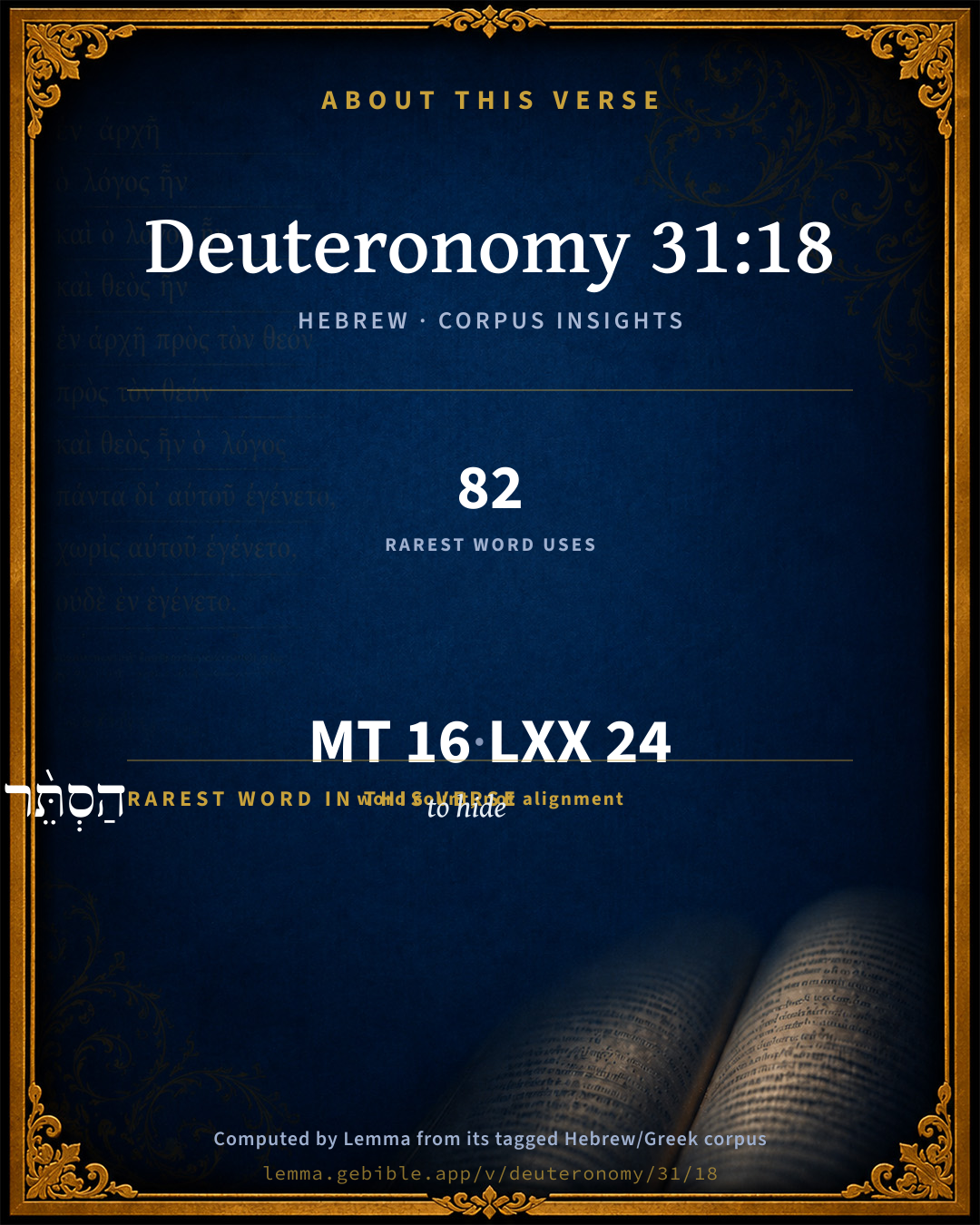
These counts appear in no published source. They are computed here, from the morphology-tagged text and Lemma’s own curated glosses. What Lemma adds →

16
words
15
distinct lemmas
Pentateuch
section

Grammatical profile

  • 4 verbs
  • 5 nouns
  • 1 adjective
  • 2 pronouns
  • 2 prepositions
  • 1 conjunction
  • 1 particle

Verb forms

  • הַסְתֵּ֨ר Hiphil · Infinitive Absolute
  • אַסְתִּ֤יר Hiphil · Imperfect
  • עָשָׂ֑ה Qal · Perfect
  • פָנָ֔ה Qal · Perfect

Repetition

A word recurs within this verse — often emphatic in Hebrew:

  • הַסְתֵּ֨ר to hide H5641 ×2

Hebrew & Septuagint length

In English translation the verse runs 26 words from the Hebrew and 30 from the Septuagint (LXX English) — closely comparable.

A rough comparison of the two English renderings, which tokenize alike — not a word-level alignment.

Word counts can differ between the Hebrew and the Greek without any difference in meaning — e.g. the Hebrew direct-object marker אֵת has no separate Greek word, and Greek often adds the article ὁ.

In the original languages it is 16 Hebrew tokens and 24 Greek tokens — but the two are counted differently (Hebrew bundles its prefixes and suffixes into one token; the Greek is in lemma form), so that isn’t a like-for-like length.

Cross-references

1

Topical passages linked to Deuteronomy 31:18 in the Treasury of Scripture Knowledge — connected by theme and wording, ordered by reader-vote popularity; previews shown in the World English Bible.

  • Deuteronomy 31:16–17 Yahweh said to Moses, Behold, you shall sleep with your fathers; and this people will rise up, and play the prostitute after the strange gods of the land, where they go to be among them, and will forsake me, and break my covenant which I have made with them.

Cross-references courtesy of OpenBible.info (CC BY 4.0).

Hebrew and Greek witnesses Masoretic Hebrew ↔ Greek Septuagint

The same verse in the two great witnesses to the Old Testament, shown verse-for-verse.

These are two independent witnesses, not word-aligned to each other, and the Septuagint is shown in lemma (dictionary) form.

Hebrew Deuteronomy 31:18 Masoretic · Westminster Leningrad Codex

וְאָנֹכִ֗י הַסְתֵּ֨ר אַסְתִּ֤יר פָּנַי֙ בַּיּ֣וֹם הַה֔וּא עַ֥ל כָּל הָרָעָ֖ה אֲשֶׁ֣ר עָשָׂ֑ה כִּ֣י פָנָ֔ה אֶל אֱלֹהִ֖ים אֲחֵרִֽים

I will surely hide my face in that day for all the evil which they shall have worked, in that they are turned to other gods.

World English Bible · Public Domain

Greek LXX Deuteronomy 31:18 Septuagint · lemma form

ἐγώ δέ ἀποστροφή ἀποστρέφω ὁ πρόσωπον ἐγώ ἀπό αὐτός ἐν ὁ ἡμέρα ἐκεῖνος διά πᾶς ὁ κακία ὅς ποιέω ὅτι ἐπιστρέφω ἐπί θεός ἀλλότριος

And I will surely turn away my face from them in that day, because of all their evil doings which they have done, because they turned aside after strange gods.

LXX2012 (modern English Septuagint) · Public Domain

On this verse, The Cambridge Bible for Schools and Colleges discusses the Septuagint’s reading. Read the note in Commentary ↓

Hebrew: Westminster Leningrad Codex (CC BY 4.0). Greek: Septuagint (public domain); English from LXX2012 (modern English Septuagint) (Public Domain). How the Septuagint differs from the Hebrew →

Targum (Aramaic paraphrase)

2

The Targum is the ancient Jewish Aramaic paraphrase of the Hebrew Scriptures — an interpretive translation, not the Hebrew text itself. Onkelos (literal) and Pseudo-Jonathan (expansive) render the Torah, and Jonathan the Prophets. Coverage is partial: where no permissively-licensed English translation exists for a verse, only the Aramaic is shown. This is verse-level text, not a word-by-word alignment to the Hebrew.

  1. Targum Onkelos Torah (Genesis–Deuteronomy)
    וַאֲנָא סַלָקָא אֶסַלֵק שְׁכִנְתִּי מִנְהוֹן בְּיוֹמָא הַהוּא עַל כָּל בִּישָׁא דִי עֲבָדוּ אֲרֵי אִתְפְּנִיוּ לְטַעֲוַת עַמְמַיָא

    (no public-domain English translation for this verse)

    Targum Onkelos — Aramaic: “Onkelos Genesis” (public domain); “Onkelos Exodus” (public domain); “Onkelos Leviticus” (public domain); “Onkelos Numbers” (public domain); “Onkelos Deuteronomy” (public domain). English: “Sefaria Community Translation” (CC0 1.0 (public-domain dedication)); “J.W. Etheridge. The Targums of Onkelos and Jonathan Ben Uzziel on the Pentateuch. London: Longmans, Green, 1862” (public domain). Text via Sefaria.

  2. Targum Pseudo-Jonathan Torah (Genesis–Deuteronomy)
    וַאֲנָא מְסַלְקָא אֲסַלֵק שְׁכִינְתִּי מִנְהוֹן בְּעִידָנָא הַהִיא עַד דְיִתְמַקְמְקוּן וִיקַבְּלוּן פּוּרְעָנוּת חוֹבֵיהוֹן עַל כָּל בִּישָׁתָא דְעָבָדוּ אֲרוּם אִתְפְּנִיוּ בָּתַר טַעֲוַות עַמְמַיָא

    But I will indeed remove My Shekinah from them at that time, until they have dwindled away, to receive the punishment of their sins for all the evil they have wrought, because they turned themselves after the idols of the nations.

    Targum Pseudo-Jonathan — Aramaic: “Targum Jonathan on Genesis” (public domain); “Targum Jonathan on Exodus” (public domain); “Targum Jonathan on Leviticus” (public domain); “Targum Jonathan on Numbers” (public domain); “Targum Jonathan on Deuteronomy” (public domain). English: “The Targum of Jonathan ben Uzziel, trans. J. W. Etheridge, London, 1862” (public domain). Text via Sefaria.

Commentary

Notes on Deuteronomy 31:18 from classic Christian and Jewish commentators (each source and its license shown beneath its notes). The classic Christian expositions comment on the surrounding passage and are grouped to its opening verse, so a note may address several verses; the Jewish commentaries on the Tanakh (Rashi and others) are per-verse, so they appear only where the commentator wrote on this verse.

Lemma curates 59 commentaries, every one of them public domain or Creative Commons licensed, each selected and text-cleaned for this edition rather than reprinted as found. About our sources →

Trapp's Complete Commentary

John Trapp

Deu 31:18 And I will surely hide my face in that day for all the evils which they shall have wrought, in that they are turned unto other gods.

Ver. 18. Hide my face,] i.e., Withdraw my favour, and therewith all good.

John Trapp, A Commentary or Exposition upon All the Books of the Old and New Testament (1647–1656) — public domain. Text from a community e-Sword module.

Tyndale Open Study Notes

Tyndale Open Resources

31:18 I will hide my face: The invisible God used this figure of speech (see study note on 8:2) to communicate the breaking of fellowship between himself and his people. He turned away to indicate his rejection and repudiation.

Tyndale Open Study Notes — © Tyndale Open Resources, licensed CC BY-SA 4.0. Text via the HelloAO Bible API.

Adam Clarke's Commentary

Verse 18. I will surely hide my face] Withdraw my approbation and my protection. This is a general meaning of the word in Scripture.

Adam Clarke's Commentary on the Bible (1810–1826) — public domain. Text from a community e-Sword/MySword module.

Ellicott's Commentary for English Readers

(18) I will surely hide my face.—“As though I did not see (them) in their distress” (Rashi).

A Bible Commentary for English Readers, edited by Charles John Ellicott (1878–1897) — public domain. Text from a community e-Sword module.

The Cambridge Bible for Schools and Colleges

gen. ed. J. J. S. Perowne

18. hide my face] Some Heb. MSS, Sam., LXX, etc., add from them; but the Heb. has the next vbs. in Sg. evil which it has wrought, and it turned to other gods (Sam. they and they). The Heb. vb. is panah, not used exactly so elsewhere in Deut., but cp. Deu_29:18 (17), Deu_30:17, and below Deu_31:20.

The Cambridge Bible for Schools and Colleges (gen. ed. J. J. S. Perowne; Cambridge University Press, 1878–1918) — public domain. Text from a community e-Sword module.

John Gill's Exposition

Now, therefore, write ye this song for you,.... Which was now dictated by the Lord, and given to Moses and Joshua to write, which is recorded in Deu 32:1,

and teach it the children of Israel; teach them by it, instructing them in the meaning of it: thus it was usual in ancient times to write things in verses, that they might be the more pleasingly attended to and regarded, and be longer retained in memory; and especially this practice was used with children, and still is:

put it in their mouths; oblige them to get it by heart, or lay it up in their memories, and repeat it frequently, that it may be familiar to them, and not be forgotten by them:

that this song may be a witness for me against the children of Israel; when in times to come they shall call to mind how in this song they were cautioned against such and such sins, and what they were threatened with should befall them on account of them, and how all things have come to pass exactly as foretold in it; which would be a testimony for God of his goodness to them, of his tender care of them, and concern for them, in the previous cautions he gave them; and of his foreknowledge of future events; and a testimony against them for their ingratitude and other sins.

John Gill's Exposition of the Whole Bible (1746–1763) — public domain (CC PDM 1.0). Text via the HelloAO Bible API.

Ramban (Nachmanides)

Rabbi Moshe ben Nachman (Ramban / Nachmanides)

AND I WILL SURELY HIDE MY FACE IN THAT DAY. The meaning thereof is that [He will hide His face] on a different occasion [for it was already stated in Verse 17, and I will hide My face from them]. Since the Israelites already reflected in their hearts that they sinned against G-d, and that these evils came upon them because their G-d was not among them, it would have been fitting — according to the exceeding mercies of G-d — that He help them and rescue them because they had already denied the idols. This is similar to what is stated, Behold, I will enter into judgment with thee, because thou sayest: ‘I have not sinned,’ [indicating that the very denial of wrongdoing is a grievous sin, but here the admission of sin should have caused G-d to help them]. Therefore he [Moses] states that, because of the great evil that they did in trusting idols, He will again hide His face from them — not like the first hiding of His face when He hid the face of His mercies and many evils and troubles came upon them — but that only the face of redemption will be hidden and they will abide by the promise of the face of His mercies. [This is the promise of] And yet for all that, when they are in the land of their enemies, I will not reject them, neither will I abhor them etc. [They will not be shown the face of redemption] until they add to the aforementioned regret real confession and perfect repentance, as is stated above, and thou shalt return unto the Eternal thy G-d etc.

Ramban (Nachmanides) on the Tanakh — English translation: “Commentary on the Torah by Ramban (Nachmanides). Translated and annotated by Charles B. Chavel. New York, Shilo Pub. House, 1971-1976” (CC BY 4.0). Text via Sefaria.

Lesson kit

Teaching starters — assembled from the data on this page, not authored interpretation. Every prompt links to the verse data it draws on. Edit before teaching.

Deuteronomy, in the Pentateuch, opens this verse with 16 words (15 distinct Hebrew lemmas). Its most distinctive word is çâthar (“to hide”). A historical commentator’s framing appears above. Read the whole chapter for the surrounding context.

Discussion questions

  1. What does “to hide” (çâthar) contribute to the verse as a whole?
  2. Deuteronomy 31:16–17 shares this passage’s theme. How do the two illuminate each other?
  3. “to hide” occurs 2× in this one verse. What is the effect of the repetition?
  4. These translations render this verse differently. What is at stake in choosing one wording over another?
  5. The verb «הַסְתֵּ֨ר» is Hiphil Infinitive Absolute. How does its form color the action?
  6. Reading how Trapp's Complete Commentary and Tyndale Open Study Notes read this verse, where do the two commentators agree and where do they part?

Things to notice

Reading settings

Reading text

Shown beneath each verse's original-language words.

Old Testament
Old Testament edition

Read the OT as the Masoretic Hebrew (MT) or the Greek Septuagint (LXX).

English shown for the Greek Septuagint (in the Hebrew ↔ Greek comparison).

Comparing translations? Open the Compare panel on any verse page to stack up to four side by side.