Deuteronomy 18:5

Hebrew (Westminster Leningrad Codex) Deuteronomy 18:5 appears in the Hebrew Old Testament. The text above is from the Westminster Leningrad Codex. Each word links to its Strong’s number, a concise gloss, and parsing drawn from the Open Scriptures Hebrew Bible morphology. Click any word for its full Brown-Driver-Briggs (BDB) entry.
Download image
Cite this verse

Deuteronomy 18:5 (World English Bible). Public Domain. Lemma interlinear Bible study tool, https://lemma.gebible.app/v/deuteronomy/18/5.

Show BibTeX & RIS
BibTeX
RIS
English Translation
For Yahweh your God has chosen him out of all your tribes, to stand to minister in the name of Yahweh, him and his sons for ever.
World English Bible · Public Domain
Download a study sheet

One document with this verse’s original text, its word-by-word gloss line, the meaning frame, cross-references with their text, attributed commentary, and full source and license credits — printable, and it pastes into notes with its structure intact.

This verse Autodidact and up

Study sheet (.html) Plain text (.txt)

A passage Seminary Student

Up to 50 verses in one chapter. A passage sheet keeps up to 6 commentary sources and 12 cross-references per verse, in the order this page ranks them, and says so on the sheet whenever that leaves anything out. Ask for a single verse and you get the Autodidact verse sheet above.

Everything on this page stays free to read, with no account — the sheet is a download of what is already on screen, not access to it.

Want to remove ads? Support Godless Engineer
Compare translations 3

The same verse in 3 English versions, stacked beneath the original-language interlinear above. Click any original word for its lexicon entry.

Each is an independent rendering of the whole verse — the interlinear is not word-aligned to these translations.

Highlighted words mark where these versions differ — a whole-verse word diff, not a word-by-word alignment.

  • World English Bible Public Domain
    For Yahweh your God has chosen him out of all your tribes, to stand to minister in the name of Yahweh, him and his sons for ever.
  • King James Version Public Domain
    For the LORD thy God hath chosen him out of all thy tribes, to stand to minister in the name of the LORD, him and his sons for ever.
  • unfoldingWord Literal Text CC BY-SA 4.0
    For Yahweh your God has chosen him out of all your tribes to stand to serve in the name of Yahweh, him and his sons, all of the days.

unfoldingWord Literal Text — © unfoldingWord, licensed CC BY-SA 4.0. Word-aligned USFM3 via Door43 (git.door43.org/unfoldingWord/en_ult).

Versions to compare (up to 4)

3 of 4 selected

Show all 18 translations

Every available English version of this verse, each an independent rendering of the whole verse.

  • World English Bible Public Domain
    For Yahweh your God has chosen him out of all your tribes, to stand to minister in the name of Yahweh, him and his sons for ever.
  • Berean Standard Bible Public Domain
    For the LORD your God has chosen Levi and his sons out of all your tribes to stand and minister in His name for all time.
  • Majority Standard Bible Public Domain
    For the LORD your God has chosen Levi and his sons out of all your tribes to stand and minister in His name for all time.
  • King James Version Public Domain
    For the LORD thy God hath chosen him out of all thy tribes, to stand to minister in the name of the LORD, him and his sons for ever.
  • American Standard Version (1901) Public Domain
    For Jehovah thy God hath chosen him out of all thy tribes, to stand to minister in the name of Jehovah, him and his sons for ever.
  • Revised Version (1885) Public Domain
    For the LORD thy God hath chosen him out of all thy tribes, to stand to minister in the name of the LORD, him and his sons for ever.
  • Geneva Bible (1599) Public Domain
    For the Lord thy God hath chosen him out of all thy tribes, to stande and minister in the Name of the Lord, him, and his sonnes for euer.
  • Douay-Rheims (1899) Public Domain
    For the Lord thy God hath chosen him of all thy tribes, to stand and to minister to the name of the Lord, him and his sons for ever.
  • Young's Literal Translation Public Domain
    for on him hath Jehovah thy God fixed, out of all thy tribes, to stand to serve in the name of Jehovah, He and his sons continually.
  • Literal Standard Version CC BY-SA 4.0
    for your God YHWH has fixed on him, out of all your tribes, to stand to serve in the Name of YHWH—him and his sons continually.
  • Unlocked Literal Bible CC BY-SA 4.0
    For Yahweh your God has chosen him out of all your tribes to stand to serve in the name of Yahweh, him and his sons forever.
  • unfoldingWord Literal Text CC BY-SA 4.0
    For Yahweh your God has chosen him out of all your tribes to stand to serve in the name of Yahweh, him and his sons, all of the days.
  • Darby Bible Public Domain
    for Jehovah thy God hath chosen him out of all thy tribes, that he may stand to serve in the name of Jehovah, he and his sons continually.
  • World Messianic Bible Public Domain
    For the LORD your God has chosen him out of all your tribes to stand to minister in the LORD’s name, him and his sons forever.
  • Webster's Bible Public Domain
    For the LORD thy God hath chosen him out of all thy tribes, to stand to minister in the name of the LORD, him and his sons for ever.
  • Free Bible Version CC BY-SA 4.0
    For the Lord your God has chosen Levi and his descendants from all your tribes to stand before him and serve in his name forever.
  • Bible in Basic English Public Domain
    For he, and his sons after him for ever, have been marked out by the Lord your God from all your tribes, to do the work of priests in the name of the Lord.
  • JPS Tanakh (1917) Public Domain
    For the LORD thy God hath chosen him out of all thy tribes, to stand to minister in the name of the LORD, him and his sons for ever.

Literal Standard Version (2020), Covenant Press — licensed CC BY-SA 4.0. Text via the HelloAO Bible API (eBible.org). Unlocked Literal Bible (unfoldingWord) — licensed CC BY-SA 4.0. Text via the HelloAO Bible API (eBible.org). unfoldingWord Literal Text — © unfoldingWord, licensed CC BY-SA 4.0. Word-aligned USFM3 via Door43 (git.door43.org/unfoldingWord/en_ult). Free Bible Version, Dr. Jonathan Gallagher — licensed CC BY-SA 4.0. Text via the HelloAO Bible API (eBible.org).

Word by word

More ways to search: Search by grammar → Find every occurrence → Compare this word →

Practice this passage: Drill this verse → Learn its vocabulary →

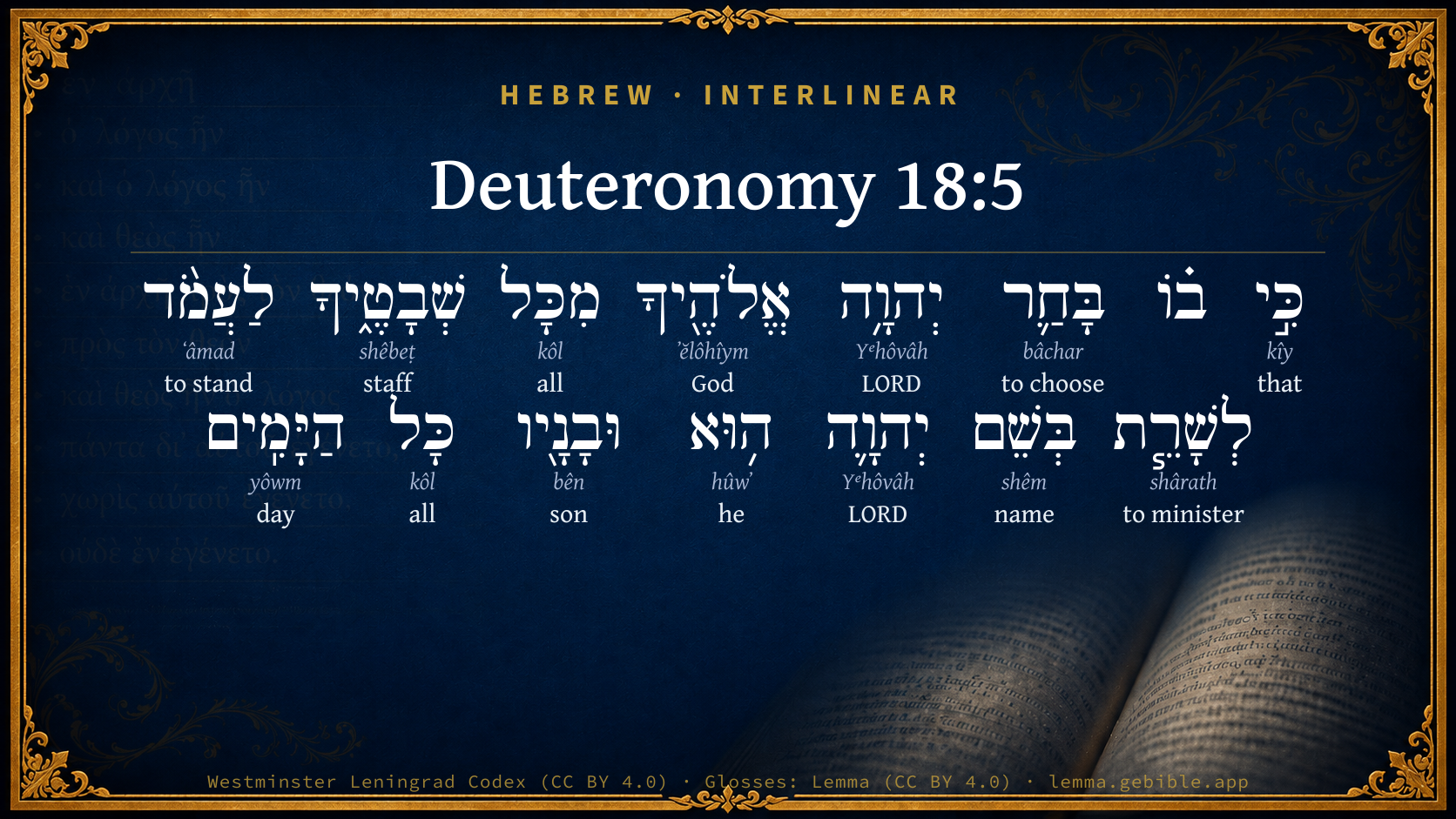
לְשָׁרֵ֧ת
shârath
H8334
“to minister”
Preposition + Verb, Piel, Infinitive Construct
Part of Speech
Preposition + Verb
Stem
Piel
Form
Infinitive Construct
Full BDB Definition

Origin: a primitive root

TWOT: 2472

(Piel) to minister, serve, minister to
  1. כִּ֣י kîy H3588 “that” Conjunction
  2. בָּחַ֛ר bâchar H977 “to choose” Verb, Qal, Perfect, 3rd Person, Masculine, Singular
  3. יְהוָ֥ה Yᵉhôvâh H3068 “LORD” Noun, Proper
  4. אֱלֹהֶ֖יךָ ʼĕlôhîym H430 “God(s) · your” Noun, Common, Masculine, Plural, Construct + Suffix, Personal, 2nd Person, Masculine, Singular
  5. מִכָּל kôl H3605 “from · all of” Preposition + Noun, Common, Masculine, Singular, Construct
  6. שְׁבָטֶ֑יךָ shêbeṭ H7626 “staffs · your” Noun, Common, Masculine, Plural, Construct + Suffix, Personal, 2nd Person, Masculine, Singular
  7. לַעֲמֹ֨ד ʻâmad H5975 “to stand” Preposition + Verb, Qal, Infinitive Construct
  8. בְּשֵׁם shêm H8034 “in/at · name of” Preposition + Noun, Common, Masculine, Singular, Construct
  9. יְהוָ֛ה Yᵉhôvâh H3068 “LORD” Noun, Proper
  10. ה֥וּא hûwʼ H1931 “he” Pronoun, Personal, 3rd Person, Masculine, Singular
  11. וּבָנָ֖יו bên H1121 “and · sons · his” Conjunction + Noun, Common, Masculine, Plural, Construct + Suffix, Personal, 3rd Person, Masculine, Singular
  12. כָּל kôl H3605 “all of” Noun, Common, Masculine, Singular, Construct
  13. הַיָּמִֽים yôwm H3117 “the · days” Particle, Definite Article + Noun, Common, Masculine, Plural, Absolute

About this verse

These counts appear in no published source. They are computed here, from the morphology-tagged text and Lemma’s own curated glosses. What Lemma adds →

15
words
12
distinct lemmas
Pentateuch
section

Grammatical profile

  • 3 verbs
  • 9 nouns
  • 1 pronoun
  • 1 preposition
  • 1 conjunction

Verb forms

  • בָּחַ֛ר Qal · Perfect
  • לַעֲמֹ֨ד Qal · Infinitive Construct
  • לְשָׁרֵ֧ת Piel · Infinitive Construct

Repetition

Words recur within this verse — often emphatic in Hebrew:

  • יְהוָ֥ה LORD H3068 ×2
  • מִכָּל all H3605 ×2

Hebrew & Septuagint length

In English translation the verse runs 27 words from the Hebrew and 34 from the Septuagint (LXX English) — closely comparable.

A rough comparison of the two English renderings, which tokenize alike — not a word-level alignment.

Word counts can differ between the Hebrew and the Greek without any difference in meaning — e.g. the Hebrew direct-object marker אֵת has no separate Greek word, and Greek often adds the article ὁ.

Cross-references

8

Topical passages linked to Deuteronomy 18:5 in the Treasury of Scripture Knowledge — connected by theme and wording, ordered by reader-vote popularity; previews shown in the World English Bible.

  • Deuteronomy 10:8 At that time Yahweh set apart the tribe of Levi, to bear the ark of the covenant of Yahweh, to stand before Yahweh to minister to him, and to bless in his name, to this day.
  • Numbers 3:10 You shall appoint Aaron and his sons, and they shall keep their priesthood. The stranger who comes near shall be put to death."
  • Exodus 28:1–14 "Bring Aaron your brother, and his sons with him, near to you from among the children of Israel, that he may minister to me in the priest's office, even Aaron, Nadab and Abihu, Eleazar and Ithamar, Aaron's sons.
  • Numbers 16:5 and he spoke to Korah and to all his company, saying, In the morning Yahweh will show who are his, and who is holy, and will cause him to come near to him: even him whom he shall choose will he cause to come near to him.
  • Numbers 16:9–10 [seems it but] a small thing to you, that the God of Israel has separated you from the congregation of Israel, to bring you near to himself, to do the service of the tent of Yahweh, and to stand before the congregation to minister to them;
  • Numbers 17:5–9 It shall happen, that the rod of the man whom I shall choose shall bud: and I will make to cease from me the murmurings of the children of Israel, which they murmur against you.
  • Deuteronomy 17:12 The man who does presumptuously, in not listening to the priest who stands to minister there before Yahweh your God, or to the judge, even that man shall die: and you shall put away the evil from Israel.
  • Numbers 25:13 and it shall be to him, and to his seed after him, the covenant of an everlasting priesthood; because he was jealous for his God, and made atonement for the children of Israel.

Cross-references courtesy of OpenBible.info (CC BY 4.0).

Hebrew and Greek witnesses Masoretic Hebrew ↔ Greek Septuagint

The same verse in the two great witnesses to the Old Testament, shown verse-for-verse.

These are two independent witnesses, not word-aligned to each other, and the Septuagint is shown in lemma (dictionary) form.

Hebrew Deuteronomy 18:5 Masoretic · Westminster Leningrad Codex

כִּ֣י ב֗וֹ בָּחַ֛ר יְהוָ֥ה אֱלֹהֶ֖יךָ מִכָּל שְׁבָטֶ֑יךָ לַעֲמֹ֨ד לְשָׁרֵ֧ת בְּשֵׁם יְהוָ֛ה ה֥וּא וּבָנָ֖יו כָּל הַיָּמִֽים

For Yahweh your God has chosen him out of all your tribes, to stand to minister in the name of Yahweh, him and his sons for ever.

World English Bible · Public Domain

Greek LXX Deuteronomy 18:5 Septuagint · lemma form

ὅτι αὐτός ἐκλέγω κύριος ὁ θεός σύ ἐκ πᾶς ὁ φυλή σύ παραἵστημι ἔναντι κύριος ὁ θεός σύ λειτουργέω καί εὐλογέω ἐπί ὁ ὄνομα αὐτός αὐτός καί ὁ υἱός αὐτός ἐν ὁ υἱός ἰσραήλ

because the Lord has chosen him out of all your tribes, to stand before the Lord your God, to minister and bless in his name, himself and his sons among the children of Israel.

LXX2012 (modern English Septuagint) · Public Domain

On this verse, The Cambridge Bible for Schools and Colleges discusses the Septuagint’s reading. Read the note in Commentary ↓

Hebrew: Westminster Leningrad Codex (CC BY 4.0). Greek: Septuagint (public domain); English from LXX2012 (modern English Septuagint) (Public Domain). How the Septuagint differs from the Hebrew →

Targum (Aramaic paraphrase)

2

The Targum is the ancient Jewish Aramaic paraphrase of the Hebrew Scriptures — an interpretive translation, not the Hebrew text itself. Onkelos (literal) and Pseudo-Jonathan (expansive) render the Torah, and Jonathan the Prophets. Coverage is partial: where no permissively-licensed English translation exists for a verse, only the Aramaic is shown. This is verse-level text, not a word-by-word alignment to the Hebrew.

  1. Targum Onkelos Torah (Genesis–Deuteronomy)
    אֲרֵי בֵהּ יִתִּרְעֵי יְיָ אֱלָהָךְ מִכָּל שִׁבְטָיךְ לְמֵקַם לְשַׁמָשָׁא בִשְׁמָא דַיְיָ הוּא וּבְנוֹהִי כָּל יוֹמַיָא

    (no public-domain English translation for this verse)

    Targum Onkelos — Aramaic: “Onkelos Genesis” (public domain); “Onkelos Exodus” (public domain); “Onkelos Leviticus” (public domain); “Onkelos Numbers” (public domain); “Onkelos Deuteronomy” (public domain). English: “Sefaria Community Translation” (CC0 1.0 (public-domain dedication)); “J.W. Etheridge. The Targums of Onkelos and Jonathan Ben Uzziel on the Pentateuch. London: Longmans, Green, 1862” (public domain). Text via Sefaria.

  2. Targum Pseudo-Jonathan Torah (Genesis–Deuteronomy)
    מְטוּל דְּבֵיהּ אִתְרְעֵי יְיָ אֱלָהָכוֹן מִכָּל שִׁבְטֵיכוֹן לְמֵיקוּם לְשַׁמָּשָׁא בִּשְׁמָא דַיְיָ הוּא וּבְנוֹי כָּל יוֹמַיָא

    because the Lord thy God hath chosen him out of all thy tribes to stand and minister in the Name of the Lord, him, and his sons, all the days.

    Targum Pseudo-Jonathan — Aramaic: “Targum Jonathan on Genesis” (public domain); “Targum Jonathan on Exodus” (public domain); “Targum Jonathan on Leviticus” (public domain); “Targum Jonathan on Numbers” (public domain); “Targum Jonathan on Deuteronomy” (public domain). English: “The Targum of Jonathan ben Uzziel, trans. J. W. Etheridge, London, 1862” (public domain). Text via Sefaria.

Commentary

Notes on Deuteronomy 18:5 from classic Christian and Jewish commentators (each source and its license shown beneath its notes). The classic Christian expositions comment on the surrounding passage and are grouped to its opening verse, so a note may address several verses; the Jewish commentaries on the Tanakh (Rashi and others) are per-verse, so they appear only where the commentator wrote on this verse.

Lemma curates 59 commentaries, every one of them public domain or Creative Commons licensed, each selected and text-cleaned for this edition rather than reprinted as found. About our sources →

The Cambridge Bible for Schools and Colleges

gen. ed. J. J. S. Perowne

5. Sam. and some Codd. of LXX read: to stand before the Lord [thy God] to minister [unto him] and to bless in his name, as in Deu_10:8 (q.v.); and for the unto this day of that v. some have all the days; others read, he and his sons among the sons of Israel.

The Cambridge Bible for Schools and Colleges (gen. ed. J. J. S. Perowne; Cambridge University Press, 1878–1918) — public domain. Text from a community e-Sword module.

John Gill's Exposition

For the Lord thy God hath chosen him out of all thy tribes,.... That is, has chosen the tribe of Levi out of all the other tribes of Israel:

to stand to minister in the name of the Lord; the priests to minister to the Lord by offering sacrifices, and the Levites to minister to the priests in assisting them in their service; and both their ministry were in the name of the Lord, and for his glory, and done standing; for there was no sitting in the sanctuary (w); the priestly ministry was only performed standing (x), whatever was done sitting was rejected (y); see Heb 10:11,

him and his sons for ever; Levi and his posterity, or the posterity of the tribe of Levi, were chosen by the Lord to this service, to be employed in it as long as the ceremonial law continued, on which stood the Levitical priesthood; but both are now abolished by Christ, having their accomplishment in him, Heb 7:11.

(w) Maimon. in Misn. Zebachim, c. 2. sect. 1. (x) Bartenora in ib. (y) Misn. ib.

John Gill's Exposition of the Whole Bible (1746–1763) — public domain (CC PDM 1.0). Text via the HelloAO Bible API.

Haydock's Catholic Bible Commentary

Stand. This was the usual posture of the priests ministering in the temple, as well as of people praying. --- Minister. Samaritan and Septuagint add, "and to bless in," &c.

George Leo Haydock (1774–1849), Haydock's Catholic Family Bible and Commentary, 1859 edition — public domain. Excludes Psalms (Douay-Rheims chapter numbering differs from Protestant) and Deuterocanonical books (Catholic canon only).

Matthew Poole's English Annotations

To minister in the name of the Lord, i.e. either by authority and commission from him, or for his honour, worship, or service.

Matthew Poole's English Annotations on the Holy Bible (1683–1685) — public domain. Text from a community e-Sword/MySword module.

The Pulpit Commentary

The reason assigned for the enactment is that God had chosen the priest to stand and minister in the Name of Jehovah, i.e. not only by his appointment and authority, but with full power to act as mediator between the people and God. Him and his sons forever; referring to the establishment of the priesthood in the family of Aaron.

The priesthood.

Israel, as a holy nation, consecrated to God"s service, was a kingdom of priests". (Exo_19:6) This priestly character of the nation was represented formally in the tribe of Levi. The distinctive duties of the priesthood were discharged by the sons of Aaron, who were thus the priests strictly so called.

I THE PRIESTHOOD IN ITSELF.

1. Chosen and set apart by God. "Chosen him out of all thy tribes.

2. Holy, indicated by bodily perfection, (Lev_21:16-24) holy garments, (Ex 39) rites of dedication, (Le 8) ceremonial regulations and restrictions. (Le 21, etc.)

3. Represented the people before God. (Exo_28:12)

4. Made propitiation for sins. (Heb_5:1)

5. Gave forth oracles. (Num_27:21)

6. Had for these purposes the right of approach to God.

II THE PRIESTHOOD AS TYPICAL.

1. Of Christ. The high priest, in particular, was typical of Christ as

(1) the One Medium of approach to God (Joh_14:6; 1Ti_2:5)

(2) Inherently holy, absolutely without sin. (2Co_5:21)

(3) Representing the Church before God in his person, work, and intercession. (Heb_4:14)

(4) In his having made reconciliation for the sins of the people himself both Priest and Sacrifice. (Heb_2:17 Heb_10:12)

(5) In being the organ of Divine revelations. (Mat_11:27)

(6) For this priestly work to which he was divinely ordained (Heb_5:5) Christ has free and immediate access to the holiest of all, and has gained admission to the same for his people. (Heb_9:12 Heb_10:19)

2. Of believers.

(1) Chosen. (Psa_65:4)

(2) Consecrated. (1Co_1:2)

(3) Having freedom of approach to God. (Heb_10:19)

(4) Offering spiritual sacrifices. (1Pe_2:5)

(5) Interceding for the world. J.O.

The Pulpit Commentary (1880–1919), ed. H.D.M. Spence-Jones & Joseph S. Exell — public domain. Text from a community e-Sword module.

Rashi

Rabbi Shlomo Yitzchaki (Rashi)

לעמד לשרת TO STAND TO MINISTER — From here we may derive the law that the sacrificial service must be performed standing (Sifrei Devarim 167:1; Sota 38a).

Rashi on the Tanakh — English translations: “The Judaica Press complete Tanach with Rashi, translated by A. J. Rosenberg” (CC BY 4.0); “Pentateuch with Rashi's commentary by M. Rosenbaum and A.M. Silbermann, 1929-1934” (public domain); “The Metsudah Tanach series, Lakewood, N.J” (CC BY 4.0); and “The Book of Joshua, Metsudah Publications, 1997” (CC BY 4.0). Text via Sefaria.

Lesson kit

Teaching starters — assembled from the data on this page, not authored interpretation. Every prompt links to the verse data it draws on. Edit before teaching.

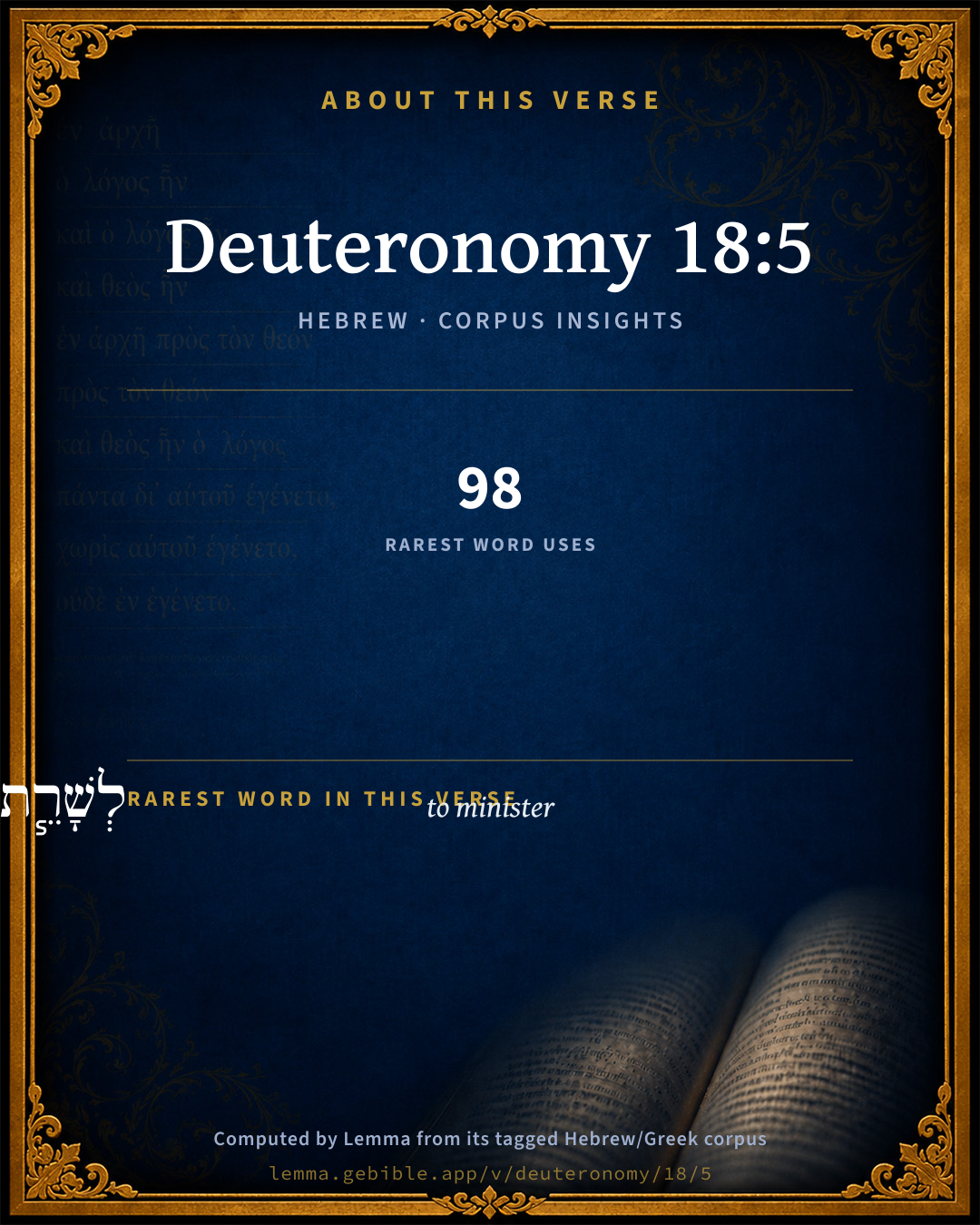
Deuteronomy, in the Pentateuch, opens this verse with 15 words (12 distinct Hebrew lemmas). Its most distinctive word is shârath (“to minister”). A historical commentator’s framing appears above. Read the whole chapter for the surrounding context.

Discussion questions

  1. How does “to minister” (shârath) shape what this verse is saying?
  2. How does Deuteronomy 10:8, which shares this passage’s theme, read alongside this verse?
  3. What does the repetition of “LORD” (2× in this one verse) do in this verse?
  4. These translations render this verse differently; the difference is in the English rendering, not the original. What questions does that raise?
  5. «בָּחַ֛ר» is a Qal Perfect verb. How does that grammatical form shape the action described?
  6. Compare how The Cambridge Bible for Schools and Colleges and John Gill's Exposition read this verse. Where do they agree or differ?

Things to notice

Reading settings

Reading text

Shown beneath each verse's original-language words.

Old Testament
Old Testament edition

Read the OT as the Masoretic Hebrew (MT) or the Greek Septuagint (LXX).

English shown for the Greek Septuagint (in the Hebrew ↔ Greek comparison).

Comparing translations? Open the Compare panel on any verse page to stack up to four side by side.