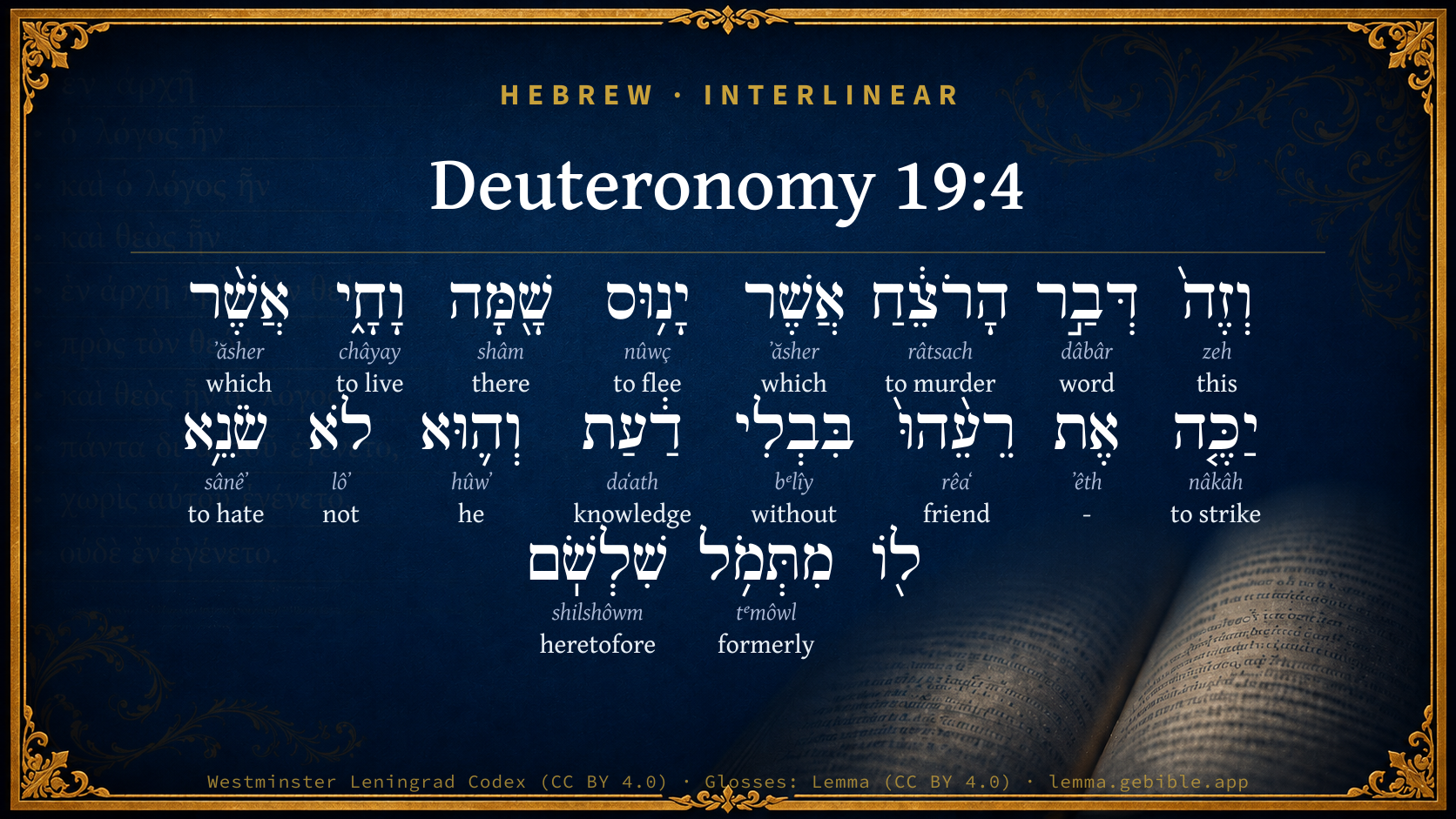
Deuteronomy 19:4

Hebrew (Westminster Leningrad Codex) Deuteronomy 19:4 appears in the Hebrew Old Testament. The text above is from the Westminster Leningrad Codex. Each word links to its Strong’s number, a concise gloss, and parsing drawn from the Open Scriptures Hebrew Bible morphology. Click any word for its full Brown-Driver-Briggs (BDB) entry.
Download image
Cite this verse

Deuteronomy 19:4 (World English Bible). Public Domain. Lemma interlinear Bible study tool, https://lemma.gebible.app/v/deuteronomy/19/4.

Show BibTeX & RIS
BibTeX
RIS
English Translation
This is the case of the manslayer, that shall flee there and live: whoever kills his neighbor unawares, and didn't hate him in time past;
World English Bible · Public Domain
Download a study sheet

One document with this verse’s original text, its word-by-word gloss line, the meaning frame, cross-references with their text, attributed commentary, and full source and license credits — printable, and it pastes into notes with its structure intact.

This verse Autodidact and up

Study sheet (.html) Plain text (.txt)

A passage Seminary Student

Up to 50 verses in one chapter. A passage sheet keeps up to 6 commentary sources and 12 cross-references per verse, in the order this page ranks them, and says so on the sheet whenever that leaves anything out. Ask for a single verse and you get the Autodidact verse sheet above.

Everything on this page stays free to read, with no account — the sheet is a download of what is already on screen, not access to it.

Want to remove ads? Support Godless Engineer
Compare translations 3

The same verse in 3 English versions, stacked beneath the original-language interlinear above. Click any original word for its lexicon entry.

Each is an independent rendering of the whole verse — the interlinear is not word-aligned to these translations.

Highlighted words mark where these versions differ — a whole-verse word diff, not a word-by-word alignment.

  • World English Bible Public Domain
    This is the case of the manslayer, that shall flee there and live: whoever kills his neighbor unawares, and didn't hate him in time past;
  • King James Version Public Domain
    And this is the case of the slayer, which shall flee thither, that he may live: Whoso killeth his neighbor ignorantly, whom he hated not in time past;
  • unfoldingWord Literal Text CC BY-SA 4.0
    And this the matter of the killer who flees there and lives (who strikes his neighbor without knowledge, and he did not hate him from previous times,

unfoldingWord Literal Text — © unfoldingWord, licensed CC BY-SA 4.0. Word-aligned USFM3 via Door43 (git.door43.org/unfoldingWord/en_ult).

Versions to compare (up to 4)

3 of 4 selected

Show all 18 translations

Every available English version of this verse, each an independent rendering of the whole verse.

  • World English Bible Public Domain
    This is the case of the manslayer, that shall flee there and live: whoever kills his neighbor unawares, and didn't hate him in time past;
  • Berean Standard Bible Public Domain
    Now this is the situation regarding the manslayer who flees to one of these cities to save his life, having killed his neighbor accidentally, without intending to harm him:
  • Majority Standard Bible Public Domain
    Now this is the situation regarding the manslayer who flees to one of these cities to save his life, having killed his neighbor accidentally, without intending to harm him:
  • King James Version Public Domain
    And this is the case of the slayer, which shall flee thither, that he may live: Whoso killeth his neighbor ignorantly, whom he hated not in time past;
  • American Standard Version (1901) Public Domain
    And this is the case of the manslayer, that shall flee thither and live: whoso killeth his neighbor unawares, and hated him not in time past;
  • Revised Version (1885) Public Domain
    And this is the case of the manslayer, which shall flee thither and live: whoso killeth his neighbour unawares, and hated him not in time past;
  • Geneva Bible (1599) Public Domain
    This also is ye cause wherfore the manslayer shall flee thither, and liue: who so killeth his neighbor ignorantly, and hated him not in time passed:
  • Douay-Rheims (1899) Public Domain
    This shall be the law of the slayer that fleeth, whose life is to be saved: He that killeth his neighbour ignorantly, and who is proved to have had no hatred against him yesterday and the day before:
  • Young's Literal Translation Public Domain
    `And this `is' the matter of the man-slayer who fleeth thither, and hath lived: He who smiteth his neighbour unknowingly, and is not hating him heretofore,
  • Literal Standard Version CC BY-SA 4.0
    And this [is] the matter of the manslayer who flees there, and has lived: he who strikes his neighbor unknowingly, and is not hating him before—
  • Unlocked Literal Bible CC BY-SA 4.0
    This is the law for the one who kills another and who flees there to live—anyone who kills his neighbor unintentionally, and did not previously hate him.
  • unfoldingWord Literal Text CC BY-SA 4.0
    And this the matter of the killer who flees there and lives (who strikes his neighbor without knowledge, and he did not hate him from previous times,
  • Darby Bible Public Domain
    And this is the case of the slayer who shall flee thither that he may live: he that smiteth his neighbour unwittingly, whom he hated not previously;
  • World Messianic Bible Public Domain
    This is the case of the man slayer who shall flee there and live: Whoever kills his neighbor unintentionally, and didn’t hate him in time past—
  • Webster's Bible Public Domain
    And this is the case of the slayer, who shall flee thither, that he may live: Whoever killeth his neighbor ignorantly, whom he hated not in time past;
  • Free Bible Version CC BY-SA 4.0
    This is what is to happen when a person accidentally kills someone else without meaning to, and runs to one of these sanctuary towns to save their life.
  • Bible in Basic English Public Domain
    This is to be the rule for anyone who goes in flight there, after causing the death of his neighbour in error and not through hate;
  • JPS Tanakh (1917) Public Domain
    And this is the case of the manslayer, that shall flee thither and live: whoso killeth his neighbour unawares, and hated him not in time past;

Literal Standard Version (2020), Covenant Press — licensed CC BY-SA 4.0. Text via the HelloAO Bible API (eBible.org). Unlocked Literal Bible (unfoldingWord) — licensed CC BY-SA 4.0. Text via the HelloAO Bible API (eBible.org). unfoldingWord Literal Text — © unfoldingWord, licensed CC BY-SA 4.0. Word-aligned USFM3 via Door43 (git.door43.org/unfoldingWord/en_ult). Free Bible Version, Dr. Jonathan Gallagher — licensed CC BY-SA 4.0. Text via the HelloAO Bible API (eBible.org).

Word by word

More ways to search: Search by grammar → Find every occurrence → Compare this word →

Practice this passage: Drill this verse → Learn its vocabulary →

וָחָ֑י
châyay
H2425
“and · to live”
Conjunction + Verb, Qal, Sequential Perfect, 3rd Person, Masculine, Singular
Part of Speech
Conjunction + Verb
Stem
Qal
Form
Sequential Perfect
Person
3rd Person
Gender
Masculine
Number
Singular
Full BDB Definition

Origin: a primitive root [compare H2421 ]

TWOT: 644

to live, have life, remain alive, sustain life, live prosperously, live for ever, be quickened, be alive, be restored to life or health - (Qal) - to live - to have life - to continue in life, remain alive - to sustain life, to live on or upon - to live (prosperously) - to revive, be quickened - from sickness - from discouragement - from faintness - from death - (Piel) - to preserve alive, let live - to give life - to quicken, revive, refresh - to restore to life - to cause to grow - to restore - to revive - (Hiphil) - to preserve alive, let live - to quicken, revive - to restore (to health) - to revive - to restore to life

  1. וְזֶה֙ zeh H2088 “and · this” Conjunction + Pronoun, Demonstrative, Masculine, Singular
  2. דְּבַ֣ר dâbâr H1697 “word of” Noun, Common, Masculine, Singular, Construct
  3. הָרֹצֵ֔חַ râtsach H7523 “the · murdering” Particle, Definite Article + Verb, Qal, Participle Active, Masculine, Singular, Absolute
  4. אֲשֶׁר ʼăsher H834 “which” Particle, Relative
  5. יָנ֥וּס nûwç H5127 “to flee” Verb, Qal, Imperfect, 3rd Person, Masculine, Singular
  6. שָׁ֖מָּה shâm H8033 “there · toward” Adverb + Suffix, Demonstrative
  7. אֲשֶׁ֨ר ʼăsher H834 “which” Particle, Relative
  8. יַכֶּ֤ה nâkâh H5221 “to strike” Verb, Hiphil, Imperfect, 3rd Person, Masculine, Singular
  9. אֶת ʼêth H853 “-” Particle, Direct Object
  10. רֵעֵ֨הוּ֙ rêaʻ H7453 “friend · his” Noun, Common, Masculine, Singular, Construct + Suffix, Personal, 3rd Person, Masculine, Singular
  11. בִּבְלִי bᵉlîy H1097 “in/at · without of” Preposition + Noun, Common, Masculine, Singular, Construct
  12. דַ֔עַת daʻath H1847 “knowledge” Noun, Common, Feminine, Singular, Absolute
  13. וְה֛וּא hûwʼ H1931 “and · he” Conjunction + Pronoun, Personal, 3rd Person, Masculine, Singular
  14. לֹא lôʼ H3808 “not” Particle, Negative
  15. שֹׂנֵ֥א sânêʼ H8130 “hating” Verb, Qal, Participle Active, Masculine, Singular, Absolute
  16. מִתְּמֹ֥ל tᵉmôwl H8543 “from · formerly” Preposition + Adverb
  17. שִׁלְשֹֽׁם shilshôwm H8032 “heretofore” Noun, Common, Masculine, Singular, Absolute

About this verse

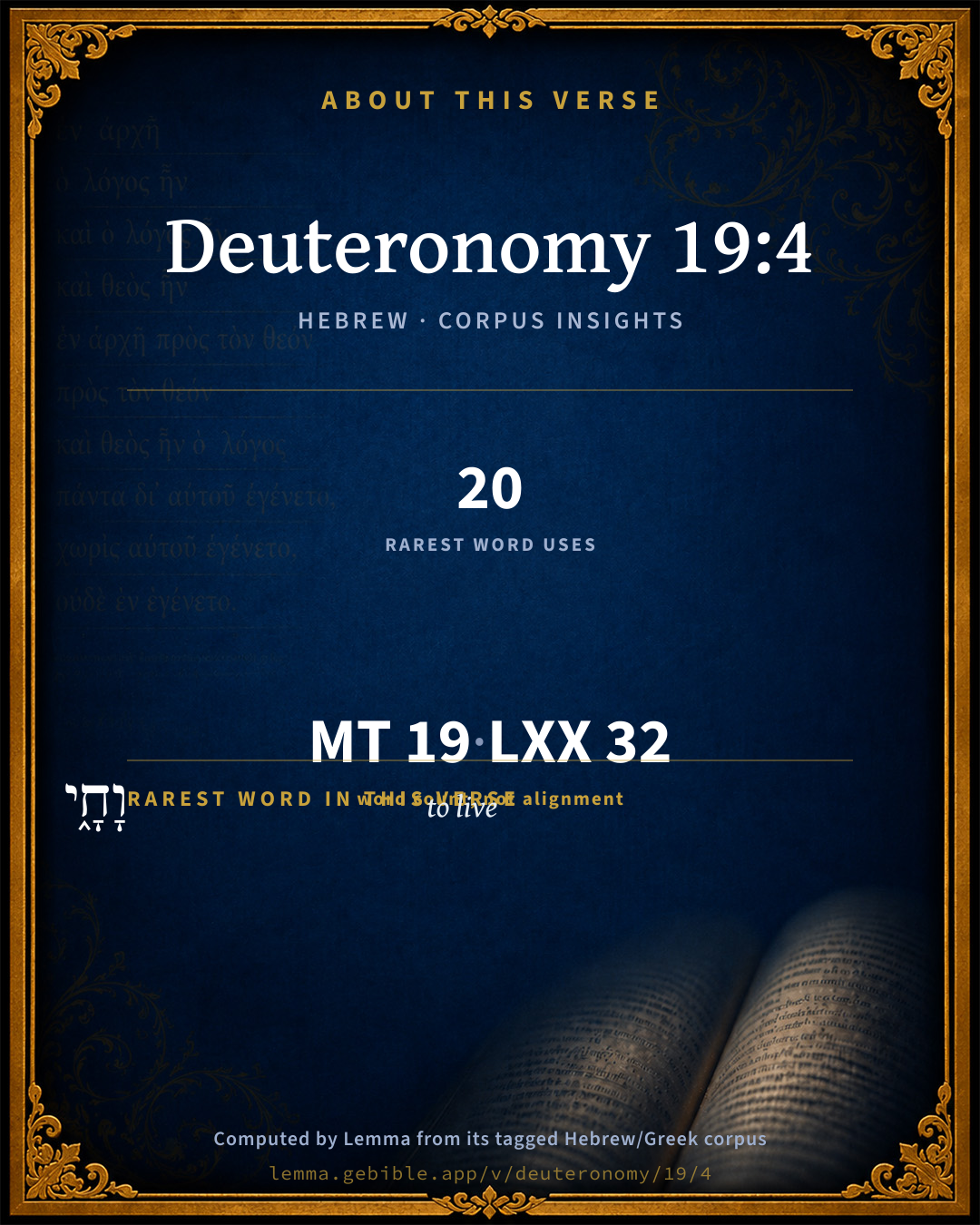
These counts appear in no published source. They are computed here, from the morphology-tagged text and Lemma’s own curated glosses. What Lemma adds →

19
words
17
distinct lemmas
Pentateuch
section

Notable vocabulary

The rarest word here is וָחָ֑י to live H2425 — appearing just 20 times in the whole Hebrew Bible.

Shared distinctive vocabulary

וָחָ֑י to live H2425 occurs in 20 verses of the Hebrew Bible. Also found in:

Grammatical profile

  • 5 verbs
  • 5 nouns
  • 2 pronouns
  • 1 preposition
  • 2 adverbs
  • 4 particles

Verb forms

  • הָרֹצֵ֔חַ Qal · Participle Active
  • יָנ֥וּס Qal · Imperfect
  • וָחָ֑י Qal · Sequential Perfect
  • יַכֶּ֤ה Hiphil · Imperfect
  • שֹׂנֵ֥א Qal · Participle Active

Repetition

A word recurs within this verse — often emphatic in Hebrew:

  • אֲשֶׁר which H834 ×2

Hebrew & Septuagint length

In English translation the verse runs 25 words from the Hebrew and 31 from the Septuagint (LXX English) — closely comparable.

A rough comparison of the two English renderings, which tokenize alike — not a word-level alignment.

Word counts can differ between the Hebrew and the Greek without any difference in meaning — e.g. the Hebrew direct-object marker אֵת has no separate Greek word, and Greek often adds the article ὁ.

In the original languages it is 19 Hebrew tokens and 32 Greek tokens — but the two are counted differently (Hebrew bundles its prefixes and suffixes into one token; the Greek is in lemma form), so that isn’t a like-for-like length.

Cross-references

7

Topical passages linked to Deuteronomy 19:4 in the Treasury of Scripture Knowledge — connected by theme and wording, ordered by reader-vote popularity; previews shown in the World English Bible.

  • Numbers 35:15–24 For the children of Israel, and for the stranger and for the foreigner living among them, shall these six cities be for refuge; that everyone who kills any person unwittingly may flee there.
  • Deuteronomy 4:42 that the manslayer might flee there, who kills his neighbor unawares, and didn't hate him in time past; and that fleeing to one of these cities he might live:
  • Genesis 31:2 Jacob saw the expression on Laban's face, and, behold, it was not toward him as before.
  • Deuteronomy 19:6 lest the avenger of blood pursue the manslayer, while his heart is hot, and overtake him, because the way is long, and strike him mortally; whereas he was not worthy of death, inasmuch as he didn't hate him in time past.
  • Joshua 3:4 Yet there shall be a space between you and it, about two thousand cubits by measure: don't come near to it, that you may know the way by which you must go; for you have not passed this way heretofore.
  • 1 Chronicles 11:2 In times past, even when Saul was king, it was you who led out and brought in Israel: and Yahweh your God said to you, You shall be shepherd of my people Israel, and you shall be prince over my people Israel.
  • Isaiah 30:33 For a Topheth is prepared of old; yes, for the king it is made ready; he has made it deep and large; the pile of it is fire and much wood; the breath of Yahweh, like a stream of sulfur, does kindle it.

Cross-references courtesy of OpenBible.info (CC BY 4.0).

Hebrew and Greek witnesses Masoretic Hebrew ↔ Greek Septuagint

The same verse in the two great witnesses to the Old Testament, shown verse-for-verse.

These are two independent witnesses, not word-aligned to each other, and the Septuagint is shown in lemma (dictionary) form.

Hebrew Deuteronomy 19:4 Masoretic · Westminster Leningrad Codex

וְזֶה֙ דְּבַ֣ר הָרֹצֵ֔חַ אֲשֶׁר יָנ֥וּס שָׁ֖מָּה וָחָ֑י אֲשֶׁ֨ר יַכֶּ֤ה אֶת רֵעֵ֨הוּ֙ בִּבְלִי דַ֔עַת וְה֛וּא לֹא שֹׂנֵ֥א ל֖וֹ מִתְּמֹ֥ל שִׁלְשֹֽׁם

This is the case of the manslayer, that shall flee there and live: whoever kills his neighbor unawares, and didn't hate him in time past;

World English Bible · Public Domain

Greek LXX Deuteronomy 19:4 Septuagint · lemma form

οὗτος δέ εἰμί ὁ πρόσταγμα ὁ φονευτής ὅς ἄν φεύγω ἐκεῖ καί ζάω ὅς ἄν πατάσσω ὁ πλησίον αὐτός ἀκουσίως καί οὗτος οὐ μισέω αὐτός πρό ὁ χθές καί πρό ὁ τρίτος

And this shall be the ordinance of the manslayer, who shall flee there, and shall live, whoever shall have struck his neighbor ignorantly, whereas he hated him not in times past.

LXX2012 (modern English Septuagint) · Public Domain

Hebrew: Westminster Leningrad Codex (CC BY 4.0). Greek: Septuagint (public domain); English from LXX2012 (modern English Septuagint) (Public Domain). How the Septuagint differs from the Hebrew →

Targum (Aramaic paraphrase)

2

The Targum is the ancient Jewish Aramaic paraphrase of the Hebrew Scriptures — an interpretive translation, not the Hebrew text itself. Onkelos (literal) and Pseudo-Jonathan (expansive) render the Torah, and Jonathan the Prophets. Coverage is partial: where no permissively-licensed English translation exists for a verse, only the Aramaic is shown. This is verse-level text, not a word-by-word alignment to the Hebrew.

  1. Targum Onkelos Torah (Genesis–Deuteronomy)
    וְדֵין פִּתְגַם קָטוֹלָא דְיֵעִרוֹק תַּמָן וְיִתְקַיַם דִי יִקְטוֹל יָת חַבְרֵהּ בְּלָא מַנְדְעֵהּ וְהוּא לָא סָנֵי לֵהּ מֵאִתְמַלֵי וּמִדְקָמוֹהִי

    (no public-domain English translation for this verse)

    Targum Onkelos — Aramaic: “Onkelos Genesis” (public domain); “Onkelos Exodus” (public domain); “Onkelos Leviticus” (public domain); “Onkelos Numbers” (public domain); “Onkelos Deuteronomy” (public domain). English: “Sefaria Community Translation” (CC0 1.0 (public-domain dedication)); “J.W. Etheridge. The Targums of Onkelos and Jonathan Ben Uzziel on the Pentateuch. London: Longmans, Green, 1862” (public domain). Text via Sefaria.

  2. Targum Pseudo-Jonathan Torah (Genesis–Deuteronomy)
    וְדֵין הִילְכַת קָטוֹלָא דְיַעֲרוֹק לְתַמָּן וְיֵיחֵי דְּיִקְטוֹל יַת אָחֵיהּ בְּלָא מִתְכַוִין לֵיהּ וְהוּא לָא נְטַר לֵיהּ סְנָא מֵאִתְמְלֵי וּמִדְקֳדָמוֹי

    And this is the regulation for the manslayer who fleeth thither that he may live: Whoever shall have killed his brother without intention, he not having kept enmity against him yesterday, or the day before,

    Targum Pseudo-Jonathan — Aramaic: “Targum Jonathan on Genesis” (public domain); “Targum Jonathan on Exodus” (public domain); “Targum Jonathan on Leviticus” (public domain); “Targum Jonathan on Numbers” (public domain); “Targum Jonathan on Deuteronomy” (public domain). English: “The Targum of Jonathan ben Uzziel, trans. J. W. Etheridge, London, 1862” (public domain). Text via Sefaria.

Commentary

Notes on Deuteronomy 19:4 from classic Christian and Jewish commentators (each source and its license shown beneath its notes). The classic Christian expositions comment on the surrounding passage and are grouped to its opening verse, so a note may address several verses; the Jewish commentaries on the Tanakh (Rashi and others) are per-verse, so they appear only where the commentator wrote on this verse.

Lemma curates 59 commentaries, every one of them public domain or Creative Commons licensed, each selected and text-cleaned for this edition rather than reprinted as found. About our sources →

Trapp's Complete Commentary

John Trapp

Deu 19:4 And this [is] the case of the slayer, which shall flee thither, that he may live: Whoso killeth his neighbour ignorantly, whom he hated not in time past;

Ver. 4. Whom he hated not in time past.] There is, first, a passion of hatred. This is a kind of averse ness and rising of the heart against a man, when one sees him, so that he cannot away with him, nor speak to him, nor look courteously or peaceably upon him, and by his goodwill he would have nothing to do with him. Secondly, there is a habit of hatred, when the heart is so settled in this alienation and estrangement, that it grows to wish, and desire, and seek his hurt. Both these must be mortified.

John Trapp, A Commentary or Exposition upon All the Books of the Old and New Testament (1647–1656) — public domain. Text from a community e-Sword module.

Tyndale Open Study Notes

Tyndale Open Resources

19:4 A slayer who kills . . . unintentionally does not plan ahead of time to commit the act (see 17:8).

Tyndale Open Study Notes — © Tyndale Open Resources, licensed CC BY-SA 4.0. Text via the HelloAO Bible API.

The Cambridge Bible for Schools and Colleges

gen. ed. J. J. S. Perowne

4. And this is the case of] See note on Deu_15:2, and the introd. to this law.

whoso smiteth his neighbour unawares … time past] See Deu_4:42, which has slayeth for smiteth.

The Cambridge Bible for Schools and Colleges (gen. ed. J. J. S. Perowne; Cambridge University Press, 1878–1918) — public domain. Text from a community e-Sword module.

John Gill's Exposition

And this is the case of the slayer, which shall flee thither, that he may live,.... It was not any slayer that might have protection in these cities, but such who were thus and thus circumstanced, or whose case was as follows:

whoso killeth his neighbour ignorantly; without intention, as the Targum of Jonathan, did not design it, but was done by him unawares:

whom he hated not in time past; had never shown by words or deeds that he had any hatred of him or enmity to him three days ago; so that if there were no marks of hatred, or proofs of it three days before this happened, it was reckoned an accidental thing, and not done on purpose, as this phrase is usually interpreted; see Exo 21:29.

John Gill's Exposition of the Whole Bible (1746–1763) — public domain (CC PDM 1.0). Text via the HelloAO Bible API.

The Pulpit Commentary

Vers. 4-7. (cf. Num_35:11, etc.)

The Pulpit Commentary (1880–1919), ed. H.D.M. Spence-Jones & Joseph S. Exell — public domain. Text from a community e-Sword module.

unfoldingWord translationNotes

Door43 World Missions Community

This is the law

"These are the instructions" or "These are the directions"

for the one who kills another

The word "person" is understood. AT: "for a person who kills another person" (See: Ellipsis)

who flees there

"and who escapes to one of these cities" or "who runs to one of these cities"

to live

"to save his own life." The full meaning of this statement can be made explicit. AT: "so the family of the man who died does not kill him to get revenge" (See: Assumed Knowledge and Implicit Information)

anyone who kills his neighbor unintentionally

Here "neighbor" means any person in general. AT: "any person who kills another person by accident"

and did not previously hate him

"but did not hate his neighbor before he killed him." This implies there was no cause for him to kill his neighbor purposely. (See: Assumed Knowledge and Implicit Information)

For example, if a man goes into the forest ... to cut wood

The author gives a hypothetical situation where a person accidentally kills another person. (See: Hypothetical Situations)

the ax head slips off of the handle

The iron part of the ax comes off the wooden handle.

strikes his neighbor and kills him

This means the head of the ax hits and kills the neighbor.

to one of these cities and save his life

It is implied that the family of the dead man may try to get revenge. The man who killed him can flee to one of these cities, and the people there would protect him. (See: Assumed Knowledge and Implicit Information)

translationWords

law, laws

life

neighbor

ax

die

unfoldingWord translationNotes — © Distant Shores Media and the Door43 World Missions Community, licensed CC BY-SA 4.0. Source: git.door43.org/Door43/en_tn.

Lesson kit

Teaching starters — assembled from the data on this page, not authored interpretation. Every prompt links to the verse data it draws on. Edit before teaching.

Deuteronomy, in the Pentateuch, opens this verse with 19 words (17 distinct Hebrew lemmas). Its most distinctive word is châyay (“to live”). A historical commentator’s framing appears above. Read the whole chapter for the surrounding context.

Discussion questions

  1. How does “to live” (châyay) shape what this verse is saying?
  2. How does Genesis 3:22, which shares the word «to live», read alongside this verse?
  3. What does the repetition of “which” (2× in this one verse) do in this verse?
  4. The translations on this page render this verse differently — a whole-verse word diff, not a word-by-word alignment. What might account for the different wordings?
  5. «הָרֹצֵ֔חַ» is a Qal Participle Active verb. How does that grammatical form shape the action described?
  6. Compare how Trapp's Complete Commentary and Tyndale Open Study Notes read this verse. Where do they agree or differ?

Things to notice

Reading settings

Reading text

Shown beneath each verse's original-language words.

Old Testament
Old Testament edition

Read the OT as the Masoretic Hebrew (MT) or the Greek Septuagint (LXX).

English shown for the Greek Septuagint (in the Hebrew ↔ Greek comparison).

Comparing translations? Open the Compare panel on any verse page to stack up to four side by side.