2 Kings 1:8

Hebrew (Westminster Leningrad Codex) 2 Kings 1:8 appears in the Hebrew Old Testament. The text above is from the Westminster Leningrad Codex. Each word links to its Strong’s number, a concise gloss, and parsing drawn from the Open Scriptures Hebrew Bible morphology. Click any word for its full Brown-Driver-Briggs (BDB) entry.
Download image
Cite this verse

2 Kings 1:8 (World English Bible). Public Domain. Lemma interlinear Bible study tool, https://lemma.gebible.app/v/2-kings/1/8.

Show BibTeX & RIS
BibTeX
RIS
English Translation
They answered him, He was a hairy man, and girt with a belt of leather about his loins. He said, It is Elijah the Tishbite.
World English Bible · Public Domain
Highlights
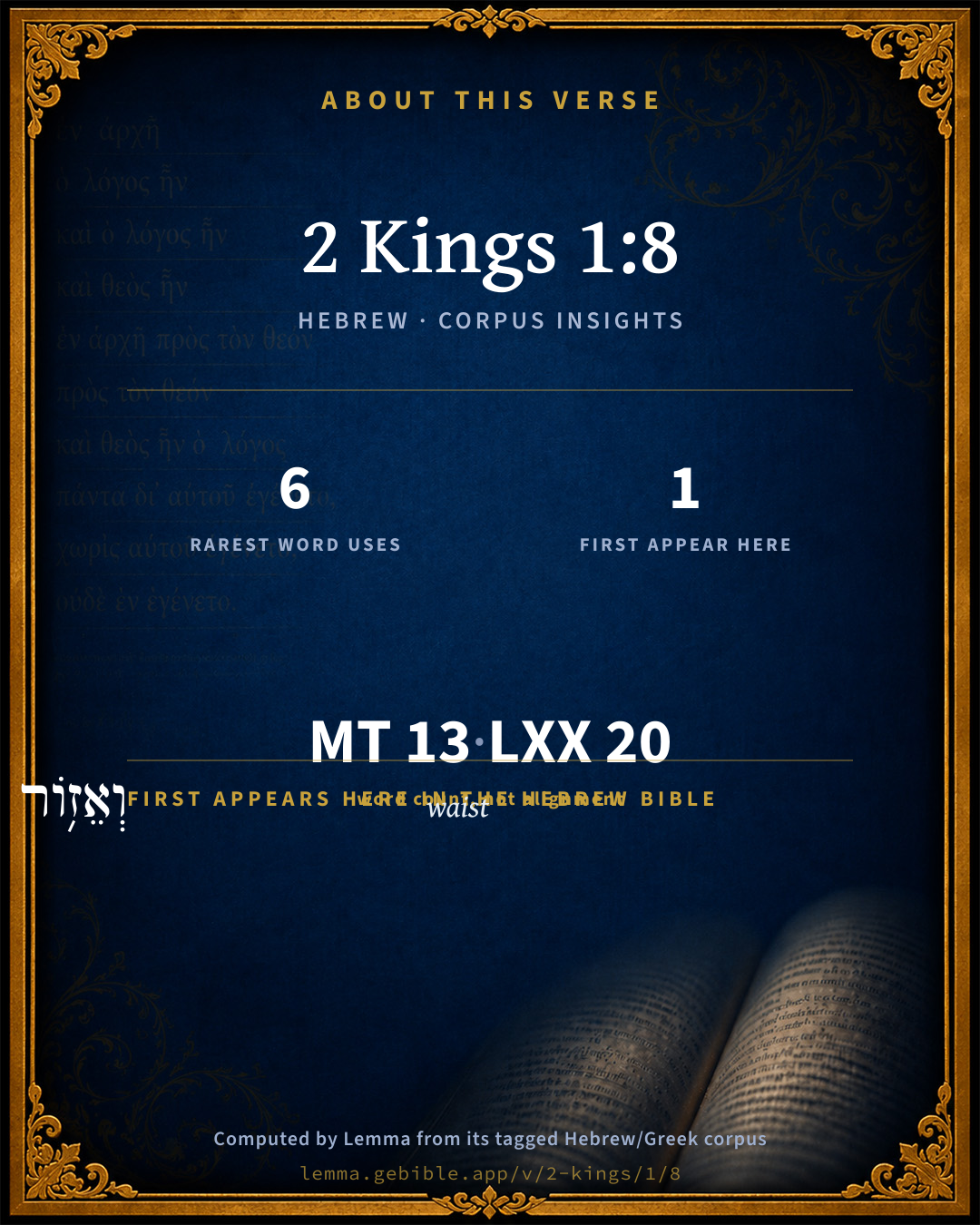
  • 1 first appearance in the Hebrew Bible
Full analysis ↓
Download a study sheet

One document with this verse’s original text, its word-by-word gloss line, the meaning frame, cross-references with their text, attributed commentary, and full source and license credits — printable, and it pastes into notes with its structure intact.

This verse Autodidact and up

Study sheet (.html) Plain text (.txt)

A passage Seminary Student

Up to 50 verses in one chapter. A passage sheet keeps up to 6 commentary sources and 12 cross-references per verse, in the order this page ranks them, and says so on the sheet whenever that leaves anything out. Ask for a single verse and you get the Autodidact verse sheet above.

Everything on this page stays free to read, with no account — the sheet is a download of what is already on screen, not access to it.

Want to remove ads? Support Godless Engineer
Compare translations 3

The same verse in 3 English versions, stacked beneath the original-language interlinear above. Click any original word for its lexicon entry.

Each is an independent rendering of the whole verse — the interlinear is not word-aligned to these translations.

Highlighted words mark where these versions differ — a whole-verse word diff, not a word-by-word alignment.

  • World English Bible Public Domain
    They answered him, He was a hairy man, and girt with a belt of leather about his loins. He said, It is Elijah the Tishbite.
  • King James Version Public Domain
    And they answered him, He was an hairy man, and girt with a girdle of leather about his loins. And he said, It is Elijah the Tishbite.
  • unfoldingWord Literal Text CC BY-SA 4.0
    And they said to him, “A man, a master of hair, and a belt of skin was tied around his waist.” And he said, “He Elijah the Tishbite.”

unfoldingWord Literal Text — © unfoldingWord, licensed CC BY-SA 4.0. Word-aligned USFM3 via Door43 (git.door43.org/unfoldingWord/en_ult).

Versions to compare (up to 4)

3 of 4 selected

Show all 18 translations

Every available English version of this verse, each an independent rendering of the whole verse.

  • World English Bible Public Domain
    They answered him, He was a hairy man, and girt with a belt of leather about his loins. He said, It is Elijah the Tishbite.
  • Berean Standard Bible Public Domain
    “He was a hairy man,” they answered, “with a leather belt around his waist.” “It was Elijah the Tishbite,” said the king.
  • Majority Standard Bible Public Domain
    “He was a hairy man,” they answered, “with a leather belt around his waist.” “It was Elijah the Tishbite,” said the king.
  • King James Version Public Domain
    And they answered him, He was an hairy man, and girt with a girdle of leather about his loins. And he said, It is Elijah the Tishbite.
  • American Standard Version (1901) Public Domain
    And they answered him, He was a hairy man, and girt with a girdle of leather about his loins. And he said, It is Elijah the Tishbite.
  • Revised Version (1885) Public Domain
    And they answered him, He was an hairy man, and girt with a girdle of leather about his loins. And he said, It is Elijah the Tishbite.
  • Geneva Bible (1599) Public Domain
    And they said vnto him, He was an hearie man, and girded with a girdle of lether about his loynes. Then sayde he, It is Eliiah the Tishbite.
  • Douay-Rheims (1899) Public Domain
    But they said: A hairy man with a girdle of leather about his loins. And he said: It is Elias the Thesbite.
  • Young's Literal Translation Public Domain
    And they say unto him, `A man -- hairy, and a girdle of skin girt about his loins;' and he saith, `He `is' Elijah the Tishbite.'
  • Literal Standard Version CC BY-SA 4.0
    And they say to him, “A hairy man, and a girdle of skin girt around his loins”; and he says, “He [is] Elijah the Tishbite.”
  • Unlocked Literal Bible CC BY-SA 4.0
    They answered him, “He wore a garment made of hair and had a leather belt wrapped around his waist.” So the king replied, “That is Elijah the Tishbite.”
  • unfoldingWord Literal Text CC BY-SA 4.0
    And they said to him, “A man, a master of hair, and a belt of skin was tied around his waist.” And he said, “He Elijah the Tishbite.”
  • Darby Bible Public Domain
    And they said to him, He was a man in a hairy [garment], and girt with a girdle of leather about his loins. And he said, It is Elijah the Tishbite.
  • World Messianic Bible Public Domain
    They answered him, “He was a hairy man, and wearing a leather belt around his waist.” He said, “It’s Elijah the Tishbite.”
  • Webster's Bible Public Domain
    And they answered him, He was a hairy man, and girt with a girdle of leather about his loins. And he said, It is Elijah the Tishbite.
  • Free Bible Version CC BY-SA 4.0
    “He was a hairy man wearing a leather belt around his waist,” they replied. “It's Elijah the Tishbite,” said the king.
  • Bible in Basic English Public Domain
    And they said in answer, He was a man clothed in a coat of hair, with a leather band about his body. Then he said, It is Elijah the Tishbite.
  • JPS Tanakh (1917) Public Domain
    And they answered him: 'He was a hairy man, and girt with a girdle of leather about his loins.' And he said: 'It is Elijah the Tishbite.'

Literal Standard Version (2020), Covenant Press — licensed CC BY-SA 4.0. Text via the HelloAO Bible API (eBible.org). Unlocked Literal Bible (unfoldingWord) — licensed CC BY-SA 4.0. Text via the HelloAO Bible API (eBible.org). unfoldingWord Literal Text — © unfoldingWord, licensed CC BY-SA 4.0. Word-aligned USFM3 via Door43 (git.door43.org/unfoldingWord/en_ult). Free Bible Version, Dr. Jonathan Gallagher — licensed CC BY-SA 4.0. Text via the HelloAO Bible API (eBible.org).

Word by word

More ways to search: Search by grammar → Find every occurrence → Compare this word →

Practice this passage: Drill this verse → Learn its vocabulary →

הַתִּשְׁבִּ֖י
Tishbîy
H8664
“the · Tishbite”
Particle, Definite Article + Noun, Gentilic, Masculine, Singular, Absolute
Part of Speech
Particle + Noun
Type
Gentilic
Gender
Masculine
Number
Singular
State
Absolute
Full BDB Definition

Origin: patrial from an unused name meaning recourse

TWOT: None

Tishbite = "captivity" - the home of Elijah - site unknown but maybe the town of Tishbe - an inhabitant of Tishbe or Tishbi or Tesheb - site unknown and name uncertain
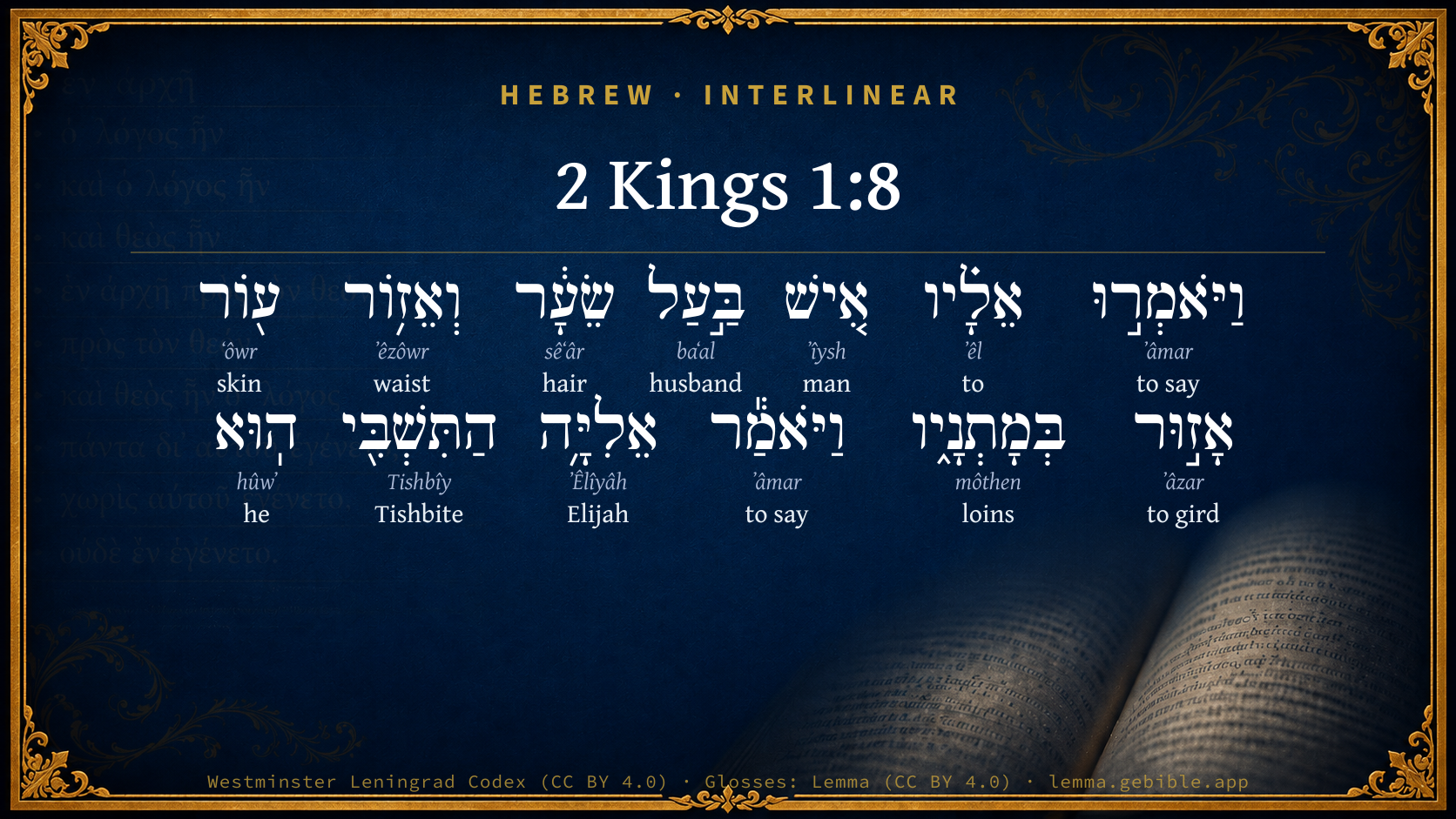
  1. וַיֹּאמְר֣וּ ʼâmar H559 “and · to say” Conjunction + Verb, Qal, Sequential Imperfect, 3rd Person, Masculine, Plural
  2. אֵלָ֗יו ʼêl H413 “to · him” Preposition + Suffix, Personal, 3rd Person, Masculine, Singular
  3. אִ֚ישׁ ʼîysh H376 “man of” Noun, Common, Masculine, Singular, Construct
  4. בַּ֣עַל baʻal H1167 “husband of” Noun, Common, Masculine, Singular, Construct
  5. שֵׂעָ֔ר sêʻâr H8181 “hair” Noun, Common, Masculine, Singular, Absolute
  6. וְאֵז֥וֹר ʼêzôwr H232 “and · waist of” Conjunction + Noun, Common, Masculine, Singular, Construct
  7. ע֖וֹר ʻôwr H5785 “skin” Noun, Common, Masculine, Singular, Absolute
  8. אָז֣וּר ʼâzar H247 “girded” Verb, Qal, Participle Passive, Masculine, Singular, Absolute
  9. בְּמָתְנָ֑יו môthen H4975 “in/at · loins · his” Preposition + Noun, Common, Masculine, Dual, Construct + Suffix, Personal, 3rd Person, Masculine, Singular
  10. וַיֹּאמַ֕ר ʼâmar H559 “and · to say” Conjunction + Verb, Qal, Sequential Imperfect, 3rd Person, Masculine, Singular
  11. אֵלִיָּ֥ה ʼÊlîyâh H452 “Elijah” Noun, Proper
  12. הֽוּא hûwʼ H1931 “he” Pronoun, Personal, 3rd Person, Masculine, Singular

About this verse

These counts appear in no published source. They are computed here, from the morphology-tagged text and Lemma’s own curated glosses. What Lemma adds →

13
words
12
distinct lemmas
Historical
section

Notable vocabulary

The rarest word here is הַתִּשְׁבִּ֖י Tishbite H8664 — appearing just 6 times in the whole Hebrew Bible.

First appearance in Scripture

This word makes its first canonical appearance in the Hebrew Bible here:

  • וְאֵז֥וֹר waist H232

Shared distinctive vocabulary

הַתִּשְׁבִּ֖י Tishbite H8664 occurs in 6 verses of the Hebrew Bible. Also found in:

Grammatical profile

  • 3 verbs
  • 8 nouns
  • 1 pronoun
  • 1 preposition

Verb forms

  • וַיֹּאמְר֣וּ Qal · Sequential Imperfect
  • אָז֣וּר Qal · Participle Passive
  • וַיֹּאמַ֕ר Qal · Sequential Imperfect

Repetition

A word recurs within this verse — often emphatic in Hebrew:

  • וַיֹּאמְר֣וּ to say H559 ×2

Hebrew & Septuagint length

In English translation the verse runs 25 words from the Hebrew and 27 from the Septuagint (LXX English) — closely comparable.

A rough comparison of the two English renderings, which tokenize alike — not a word-level alignment.

Word counts can differ between the Hebrew and the Greek without any difference in meaning — e.g. the Hebrew direct-object marker אֵת has no separate Greek word, and Greek often adds the article ὁ.

In the original languages it is 13 Hebrew tokens and 20 Greek tokens — but the two are counted differently (Hebrew bundles its prefixes and suffixes into one token; the Greek is in lemma form), so that isn’t a like-for-like length.

Cross-references

7

Topical passages linked to 2 Kings 1:8 in the Treasury of Scripture Knowledge — connected by theme and wording, ordered by reader-vote popularity; previews shown in the World English Bible.

  • Matthew 3:4 Now John himself wore clothing made of camel's hair, with a leather belt around his waist. His food was locusts and wild honey.
  • Zechariah 13:4 It will happen in that day, that the prophets will each be ashamed of his vision, when he prophesies; neither will they wear a hairy mantle to deceive:
  • Mark 1:6 John was clothed with camel's hair and a leather belt around his loins. He ate locusts and wild honey.
  • Isaiah 20:2 at that time Yahweh spoke by Isaiah the son of Amoz, saying, Go, and loose the sackcloth from off your loins, and put your shoe from off your foot. He did so, walking naked and barefoot.
  • Matthew 11:8 But what did you go out to see? A man in soft clothing? Behold, those who wear soft clothing are in king's houses.
  • Luke 1:17 He will go before him in the spirit and power of Elijah, 'to turn the hearts of the fathers to the children,' and the disobedient to the wisdom of the just; to make ready a people prepared for the Lord."
  • Revelation 11:3 I will give power to my two witnesses, and they will prophesy one thousand two hundred sixty days, clothed in sackcloth."

Cross-references courtesy of OpenBible.info (CC BY 4.0).

Hebrew and Greek witnesses Masoretic Hebrew ↔ Greek Septuagint

The same verse in the two great witnesses to the Old Testament, shown verse-for-verse.

These are two independent witnesses, not word-aligned to each other, and the Septuagint is shown in lemma (dictionary) form.

Hebrew 2 Kings 1:8 Masoretic · Westminster Leningrad Codex

וַיֹּאמְר֣וּ אֵלָ֗יו אִ֚ישׁ בַּ֣עַל שֵׂעָ֔ר וְאֵז֥וֹר ע֖וֹר אָז֣וּר בְּמָתְנָ֑יו וַיֹּאמַ֕ר אֵלִיָּ֥ה הַתִּשְׁבִּ֖י הֽוּא

They answered him, He was a hairy man, and girt with a belt of leather about his loins. He said, It is Elijah the Tishbite.

World English Bible · Public Domain

Greek LXX 2 Kings 1:8 Septuagint · lemma form

καί εἶπον πρός αὐτός ἀνήρ δασύς καί ζωνή δερμάτινος περιζώννυμι ὁ ὀσφύς αὐτός καί εἶπον ηλιου ὁ θεσβίτης οὗτος εἰμί

And they said to him, He was a hairy man, and girded with a leather girdle about his loins. And he said, This is Eliu the Thesbite.

LXX2012 (modern English Septuagint) · Public Domain

On this verse, Ellicott's Commentary for English Readers discusses the Septuagint’s reading. Read the note in Commentary ↓

Hebrew: Westminster Leningrad Codex (CC BY 4.0). Greek: Septuagint (public domain); English from LXX2012 (modern English Septuagint) (Public Domain). How the Septuagint differs from the Hebrew →

Targum (Aramaic paraphrase)

1

The Targum is the ancient Jewish Aramaic paraphrase of the Hebrew Scriptures — an interpretive translation, not the Hebrew text itself. Onkelos (literal) and Pseudo-Jonathan (expansive) render the Torah, and Jonathan the Prophets. Coverage is partial: where no permissively-licensed English translation exists for a verse, only the Aramaic is shown. This is verse-level text, not a word-by-word alignment to the Hebrew.

  1. Targum Jonathan Prophets (Joshua–Malachi)
    וַאֲמַרוּ לֵיהּ גְבַר בְּעֵיל סַעֲרָן וְזַרְזָא דְמַשְׁכָא אַסִיר בְּחַרְצֵיהּ וַאֲמַר אֵלִיָה דְמִן תּוֹשָׁב הוּא:

    (no public-domain English translation for this verse)

    Targum Jonathan — Aramaic: “Mikraot Gedolot” (public domain). English: “Sefaria Community Translation” (CC0 1.0 (public-domain dedication)); “London "Chaldee Paraphrase," 1871” (public domain). Text via Sefaria.

Commentary

Notes on 2 Kings 1:8 from classic Christian and Jewish commentators (each source and its license shown beneath its notes). The classic Christian expositions comment on the surrounding passage and are grouped to its opening verse, so a note may address several verses; the Jewish commentaries on the Tanakh (Rashi and others) are per-verse, so they appear only where the commentator wrote on this verse.

Lemma curates 59 commentaries, every one of them public domain or Creative Commons licensed, each selected and text-cleaned for this edition rather than reprinted as found. About our sources →

Trapp's Complete Commentary

John Trapp

2Ki 1:8 And they answered him, [He was] an hairy man, and girt with a girdle of leather about his loins. And he said, It [is] Elijah the Tishbite.

Ver. 8. He was a hairy man.] Hispidus et hirsutus. Either because Elijah had much hair on his head and face, or because, as a prophet, he wore a rough garment, {Zec 13:4} as a pattern of repentance.

And girt with a girdle of leather.] So was John Baptist, that second Elijah. That this girdle here mentioned was made of the pelt of that ram which Abraham offered up instead of his son Isaac, is a Jewish fable, scarce worth relating.

John Trapp, A Commentary or Exposition upon All the Books of the Old and New Testament (1647–1656) — public domain. Text from a community e-Sword module.

Joseph Benson's Commentary

2Ki 1:8. They answered, He was a hairy man — This may either denote his wearing long hair on his head and beard, according to the manner of the ancient Greek philosophers, or it may signify that he was clad with a hairy garment, that is, with a skin that had not been dressed, such as the prophets were wont to wear, (Isa 20:2; Zec 13:4; Mat 3:4,) and eminent persons in Greece in ancient times; and such clothing the poorer Arabians use at this day. The prophets, doubtless, used this habit to show their utter contempt of a luxurious, effeminate life. And girt with a girdle of leather — As John the Baptist also was, that by his very outward appearance he might represent Elijah, in whose power and spirit he came. And he said, It is Elijah the Tishbite — This conclusion he draws from their description of him, having seen him in this dress in his fathers court.

Joseph Benson's Commentary on the Old and New Testaments (1811–1818) — public domain. Text from a community e-Sword module.

Geneva Bible (1599)

Geneva Bible translators

Some think that this is meant of his garments, which were rough and made of hair.

Geneva Bible (1599) marginal notes — public domain. Text via Bolls.life.

Jamieson, Fausset & Brown

Robert Jamieson, A. R. Fausset & David Brown

an hairy man--This was the description not of his person, as in the case of Esau, but of his dress, which consisted either of unwrought sheep or goatskins (Heb 11:37), or of camel's haircloth--the coarser manufacture of this material like our rough haircloth. The Dervishes and Bedouins are attired in this wild, uncouth manner, while their hair flows loose on the head, their shaggy cloak is thrown over their shoulders and tied in front on the breast, naked, except at the waist, round which is a skin girdle--a broad, rough leathern belt. Similar to this was the girdle of the prophets, as in keeping with their coarse garments and their stern, uncompromising office.

Jamieson, Fausset & Brown — Commentary Critical and Explanatory on the Whole Bible (1871) — public domain (CC PDM 1.0). Text via the HelloAO Bible API.

Adam Clarke's Commentary

Verse 8. He was a hairy man] That is, he wore a rough garment, either made of camels' hair, as his successor John Baptist's was, or he wore a skin dressed with the hair on. Some think that the meaning is, he had very long hair and a long beard. The ancient prophets all wore rough garments, or upper coats made of the skins of beasts: They wandered about in sheep-skins and goat-skins, says the apostle, Heb 11:37.

Adam Clarke's Commentary on the Bible (1810–1826) — public domain. Text from a community e-Sword/MySword module.

Ellicott's Commentary for English Readers

(8) Answered.—Said unto.

An hairy man.—Literally, a lord of hair. This might refer to length of hair and beard (so LXX., δασὺς, “hirsute,” “shaggy”); or to a hairy cloak or mantle. The second alternative is right, because a hairy mantle was a mark of the prophetic office from Elijah downwards. (Comp. Zec_13:4, “a rough garment;” and Mat_3:4, where it is said of John Baptist—the second Elias—that “he was clad in camel’s hair,” and had “a leather girdle about his loins.”) The girdle, as Thenius remarks, would not be mentioned alone. The common dress of the Bedawis is a sheep or goat’s skin with the hair left on.

Girt with a girdle of leather.—Such as only the poorest would wear. The girdle was ordinarily of linen or cotton, and often costly. The prophet’s dress was a sign of contempt for earthly display, and of sorrow for the national sins and their consequences, which it was his function to proclaim. (Comp. Isa_20:2.)

A Bible Commentary for English Readers, edited by Charles John Ellicott (1878–1897) — public domain. Text from a community e-Sword module.

The Cambridge Bible for Schools and Colleges

gen. ed. J. J. S. Perowne

8. He was a hairy man] Literally, ‘lord, i.e. possessor, of hair’. This might equally be used of the long hair of the head and beard, or of the shaggy cloak of hair worn as a garment. But when we know of him who came ‘in the spirit and power of Elijah’ that ‘his raiment was of camel’s hair and a leathern girdle about his loins’, it seems better to accept the expression as a description of Elijah’s dress. We know too that the prophets (Zec_13:4) did wear a mantle of hair, probably adopted from the garb of this greatest among them, Elijah.

It is Elijah the Tishbite] Though the messengers might not know the prophet, the king, from his father’s experience, must have heard a great deal about Elijah, and of his appearance and dress.

The Cambridge Bible for Schools and Colleges (gen. ed. J. J. S. Perowne; Cambridge University Press, 1878–1918) — public domain. Text from a community e-Sword module.

John Gill's Exposition

And they answered him, he was an hairy man,.... Either the hair of his head and beard were grown very long, having been much neglected for a great while; or he had an hairy garment on, either of goats' hair, such as the Chinese wear (f), whose women spin it, see Exo 35:26 and of which garments are made; or of camels' hair, such as John the Baptist wore, who came in his spirit and power, and imitated him in his dress, being also, as Elijah here:

girt with a girdle of leather about his loins: for more expeditious travelling, not for warmth, the climate being hot:

and he said, it is Elijah the Tishbite; for he had seen him formerly in his father's court in this dress.

(f) Semedo's History of China, part 1. ch. 3.

John Gill's Exposition of the Whole Bible (1746–1763) — public domain (CC PDM 1.0). Text via the HelloAO Bible API.

Albert Barnes' Notes on the Bible

An hairy man - Either in allusion to his shaggy cloak of untanned skin; or, more probably, an expression descriptive of the prophet’s person, of his long flowing locks, abundant beard, and general profusion of hair. His costume was that of a thorough ascetic. Generally the Jews wore girdles of linen or cotton stuff, soft and comfortable. Under the girdle they wore one or two long linen gowns or shirts, and over these they had sometimes a large shawl. Elijah had only his leather girdle and his sheepskin cape or “mantle.”

Albert Barnes' Notes on the Bible (1834–1885) — public domain. Text from a community e-Sword/MySword module.

Haydock's Catholic Bible Commentary

Man. Hebrew ish bahal sehar, "a man lord of hair," or all covered with it, having a long beard, like the ancient sages, (St. Jerome, in Ezechiel xxxv.) and clothed with a skin, (Bochart) as the first inhabitants of the earth, the heroes, prophets and St. John the Baptist, are described, Hebrews xi. 37., and Matthew iii. 4. So Statius (ii., and iv.) says: Tiresiæ vultus, voces et vellera nota

Induitur.

The monks imitated this poverty and simplicity of clothing; and it is still common among Arabs, who wear a sheep’s skin, with the shorn side inwards in hot weather. (Calmet) --- Elias. He was known by his long hair and distinct garment, from ordinary men. (Worthington) --- Hence none ought to blame priests and monks, for wearing clothing which may designate their profession. (Haydock)

George Leo Haydock (1774–1849), Haydock's Catholic Family Bible and Commentary, 1859 edition — public domain. Excludes Psalms (Douay-Rheims chapter numbering differs from Protestant) and Deuterocanonical books (Catholic canon only).

Matthew Poole's English Annotations

An hairy man; either,

1. As to his body; the hair of his head and beard being through neglect grown long, and spread over much of his time. Or rather,

2. As to his outward garment, which was rough and hairy, such as were sometimes worn by eminent persons in Greece in ancient times, and were the proper habit of the prophets. See Isa 20:2; Zec 13:4; Mat 3:4; Heb 11:37.

With a girdle of leather about his loins; as John the Baptist also had, Mat 3:4, that by his very outward habit he might represent Elias, in whose spirit and power he came.

Matthew Poole's English Annotations on the Holy Bible (1683–1685) — public domain. Text from a community e-Sword/MySword module.

Whedon's Commentary on the Bible

Daniel D. Whedon

8. A hairy man — Literally, a man, a lord, of hair; lord of the hairy mantle. A rough garment, woven of goats’ hair, and fastened with a leather strap about his loins, formed, apparently, the sole dress of Elijah. “Inaccurately as the word mantle represents such a garment, it has yet become so identified with Elijah that it is impossible now to alter it. It is desirable therefore, to substitute “mantle” for “garment” in Zec_13:4, a passage from which it would appear that since the time of Elijah his garb had become the recognised sign of a prophet of Jehovah.” — Grove. The prophets were wont to wear a distinctive dress, expressive, in some way, of the nature of their work. Isaiah wore a garment of sackcloth, as a mark of sorrow and self-abasement for the sins of the people. Isa_20:2. John the Baptist attired himself like Elijah, (in whose spirit and power he came, Mat_3:4;) and the outer garb was a representative of his inner character and spirit.

Daniel D. Whedon (gen. ed.), Commentary on the Old and New Testaments (1874–1909) — public domain. Text from a community e-Sword module.

The Pulpit Commentary

A hairy man; literally, a lord of hair (rc lB). Some take the meaning to be that he was rough and unkempt, with his hair and beard long; and so the LXX, who give ajnhv. But the more usual explanation is that he wore a shaggy coat of untanned skin, with the hair outward. Such a garment seems certainly to have been worn by the later prophets (Zec_13:4; Mat_3:4) and to have been regarded as a sign of their profession. But there is no positive evidence that the dress had been adopted by Isaiah"s time. Girt with a girdle of leather. Generally the Israelites wore girdles of a soft material, as linen or cotton. The "curious girdle" of the high priest"s ephod was of "fine twined linen," embroidered with gold, and blue, and purple, and scarlet. (Exo_28:8) Girdles of leather, rough and uncomfortable, would only be worn by the very poor and by the ascetic. Elijah may have adopted his rough and coarse costume, either to show contempt for things earthly, as Hengstenberg thinks; or as a penitential garb indicating sorrow for the sins of the people, as Keil supposes; or simple to chastise and subdue the flesh, as other ascetics. It is Elijah the Tishbite. The description given is enough. The king has no longer any doubt. His suspicion is turned into certainty. There is no living person hut Elijah who would at once have the boldness to prophesy the death of the king, and would wear such a costume as described. Elijah is, of course, his enemy, as he had been his father"s "enemy", (1Ki_21:20) and will wish him ill, and prophesy accordingly, the wish being "father to the thought." It is not improbable that Elijah had withdrawn himself into obscurity on the accession of Ahaziah, or at any rate on his exhibition of strong idolatrous proclivities (Ewald), as he had done on more than one occasion from Ahab. (1Ki_17:10 1Ki_19:8-8) Ahaziah may have been long wishing to arrest and imprison him, and now thought he saw his opportunity.

The Pulpit Commentary (1880–1919), ed. H.D.M. Spence-Jones & Joseph S. Exell — public domain. Text from a community e-Sword module.

John Wesley's Explanatory Notes

An hairy man - His garment was rough and hairy, such as were worn by eminent persons in Greece, in ancient times; and were the proper habit of the prophets. Girdle - As John the baptist also had. That by his very outward habit, he might represent Elijah, in whose spirit and power he came.

John Wesley, Explanatory Notes Upon the Whole Bible (1754–1765) — public domain. Text via the GEBible commentary corpus.

Lesson kit

Teaching starters — assembled from the data on this page, not authored interpretation. Every prompt links to the verse data it draws on. Edit before teaching.

2 Kings, in the Historical, opens this verse with 13 words (12 distinct Hebrew lemmas). Its most distinctive word is Tishbîy (“Tishbite”). A historical commentator’s framing appears above. Read the whole chapter for the surrounding context.

Discussion questions

  1. The word Tishbîy carries the sense “Tishbite.” How does it shape the verse?
  2. This is the first place “waist” appears in Scripture (first appears here). What does its debut here establish?
  3. How does 1 Kings 17:1, which shares the word «Tishbite», read alongside this verse?
  4. What does the repetition of “to say” (2× in this one verse) do in this verse?
  5. These translations render this verse differently. What is at stake in choosing one wording over another?
  6. «וַיֹּאמְר֣וּ» is a Qal Sequential Imperfect verb. How does that grammatical form shape the action described?
  7. Compare how Trapp's Complete Commentary and Joseph Benson's Commentary read this verse. Where do they agree or differ?

Things to notice

Reading settings

Reading text

Shown beneath each verse's original-language words.

Old Testament
Old Testament edition

Read the OT as the Masoretic Hebrew (MT) or the Greek Septuagint (LXX).

English shown for the Greek Septuagint (in the Hebrew ↔ Greek comparison).

Comparing translations? Open the Compare panel on any verse page to stack up to four side by side.