Deuteronomy 10:9

Hebrew (Westminster Leningrad Codex) Deuteronomy 10:9 appears in the Hebrew Old Testament. The text above is from the Westminster Leningrad Codex. Each word links to its Strong’s number, a concise gloss, and parsing drawn from the Open Scriptures Hebrew Bible morphology. Click any word for its full Brown-Driver-Briggs (BDB) entry.
Download image
Cite this verse

Deuteronomy 10:9 (World English Bible). Public Domain. Lemma interlinear Bible study tool, https://lemma.gebible.app/v/deuteronomy/10/9.

Show BibTeX & RIS
BibTeX
RIS
English Translation
Therefore Levi has no portion nor inheritance with his brothers; Yahweh is his inheritance, according as Yahweh your God spoke to him.)
World English Bible · Public Domain
Download a study sheet

One document with this verse’s original text, its word-by-word gloss line, the meaning frame, cross-references with their text, attributed commentary, and full source and license credits — printable, and it pastes into notes with its structure intact.

This verse Autodidact and up

Study sheet (.html) Plain text (.txt)

A passage Seminary Student

Up to 50 verses in one chapter. A passage sheet keeps up to 6 commentary sources and 12 cross-references per verse, in the order this page ranks them, and says so on the sheet whenever that leaves anything out. Ask for a single verse and you get the Autodidact verse sheet above.

Everything on this page stays free to read, with no account — the sheet is a download of what is already on screen, not access to it.

Want to remove ads? Support Godless Engineer
Compare translations 3

The same verse in 3 English versions, stacked beneath the original-language interlinear above. Click any original word for its lexicon entry.

Each is an independent rendering of the whole verse — the interlinear is not word-aligned to these translations.

Highlighted words mark where these versions differ — a whole-verse word diff, not a word-by-word alignment.

  • World English Bible Public Domain
    Therefore Levi has no portion nor inheritance with his brothers; Yahweh is his inheritance, according as Yahweh your God spoke to him.)
  • King James Version Public Domain
    Wherefore Levi hath no part nor inheritance with his brethren; the LORD is his inheritance, according as the LORD thy God promised him.
  • unfoldingWord Literal Text CC BY-SA 4.0
    Therefore, Levi has no portion nor inheritance with his brothers. Yahweh, he is his inheritance, as Yahweh your God spoke to him.)

unfoldingWord Literal Text — © unfoldingWord, licensed CC BY-SA 4.0. Word-aligned USFM3 via Door43 (git.door43.org/unfoldingWord/en_ult).

Versions to compare (up to 4)

3 of 4 selected

Show all 18 translations

Every available English version of this verse, each an independent rendering of the whole verse.

  • World English Bible Public Domain
    Therefore Levi has no portion nor inheritance with his brothers; Yahweh is his inheritance, according as Yahweh your God spoke to him.)
  • Berean Standard Bible Public Domain
    That is why Levi has no portion or inheritance among his brothers; the LORD is his inheritance, as the LORD your God promised him.
  • Majority Standard Bible Public Domain
    That is why Levi has no portion or inheritance among his brothers; the LORD is his inheritance, as the LORD your God promised him.
  • King James Version Public Domain
    Wherefore Levi hath no part nor inheritance with his brethren; the LORD is his inheritance, according as the LORD thy God promised him.
  • American Standard Version (1901) Public Domain
    Wherefore Levi hath no portion nor inheritance with his brethren; Jehovah is his inheritance, according as Jehovah thy God spake unto him.)
  • Revised Version (1885) Public Domain
    Wherefore Levi hath no portion nor inheritance with his brethren; the LORD is his inheritance, according as the LORD thy God spake unto him.)
  • Geneva Bible (1599) Public Domain
    Wherefore Leui hath no part nor inheritance with his brethren: for the Lord is his inheritance, as the Lord thy God hath promised him.
  • Douay-Rheims (1899) Public Domain
    Wherefore Levi hath no part nor possession with his brethren: because the Lord himself is his possession, as the Lord thy God promised him.
  • Young's Literal Translation Public Domain
    therefore there hath not been to Levi a portion and inheritance with his brethren; Jehovah Himself `is' his inheritance, as Jehovah thy God hath spoken to him.
  • Literal Standard Version CC BY-SA 4.0
    therefore there has not been a portion and inheritance for Levi with his brothers; YHWH Himself [is] his inheritance, as your God YHWH has spoken to him.
  • Unlocked Literal Bible CC BY-SA 4.0
    Therefore Levi has no portion nor inheritance of land with his brothers; Yahweh is his inheritance, as Yahweh your God spoke to him.)
  • unfoldingWord Literal Text CC BY-SA 4.0
    Therefore, Levi has no portion nor inheritance with his brothers. Yahweh, he is his inheritance, as Yahweh your God spoke to him.)
  • Darby Bible Public Domain
    Therefore Levi has no portion nor inheritance with his brethren; Jehovah is his inheritance, according as Jehovah thy God told him.
  • World Messianic Bible Public Domain
    Therefore Levi has no portion nor inheritance with his brothers; the LORD is his inheritance, according as the LORD your God spoke to him.)
  • Webster's Bible Public Domain
    Wherefore Levi hath no part nor inheritance with his brethren; the LORD is his inheritance, according as the LORD thy God promised him.
  • Free Bible Version CC BY-SA 4.0
    That's why the tribe of Levi has no land allowance or share among the other tribes. The Lord provides what they need, just as the Lord your God promised.
  • Bible in Basic English Public Domain
    For this reason Levi has no part or heritage for himself among his brothers: the Lord is his heritage, as the Lord your God said to him.)
  • JPS Tanakh (1917) Public Domain
    Wherefore Levi hath no portion nor inheritance with his brethren; the LORD is his inheritance, according as the LORD thy God spoke unto him. —

Literal Standard Version (2020), Covenant Press — licensed CC BY-SA 4.0. Text via the HelloAO Bible API (eBible.org). Unlocked Literal Bible (unfoldingWord) — licensed CC BY-SA 4.0. Text via the HelloAO Bible API (eBible.org). unfoldingWord Literal Text — © unfoldingWord, licensed CC BY-SA 4.0. Word-aligned USFM3 via Door43 (git.door43.org/unfoldingWord/en_ult). Free Bible Version, Dr. Jonathan Gallagher — licensed CC BY-SA 4.0. Text via the HelloAO Bible API (eBible.org).

Word by word

More ways to search: Search by grammar → Find every occurrence → Compare this word →

Practice this passage: Drill this verse → Learn its vocabulary →

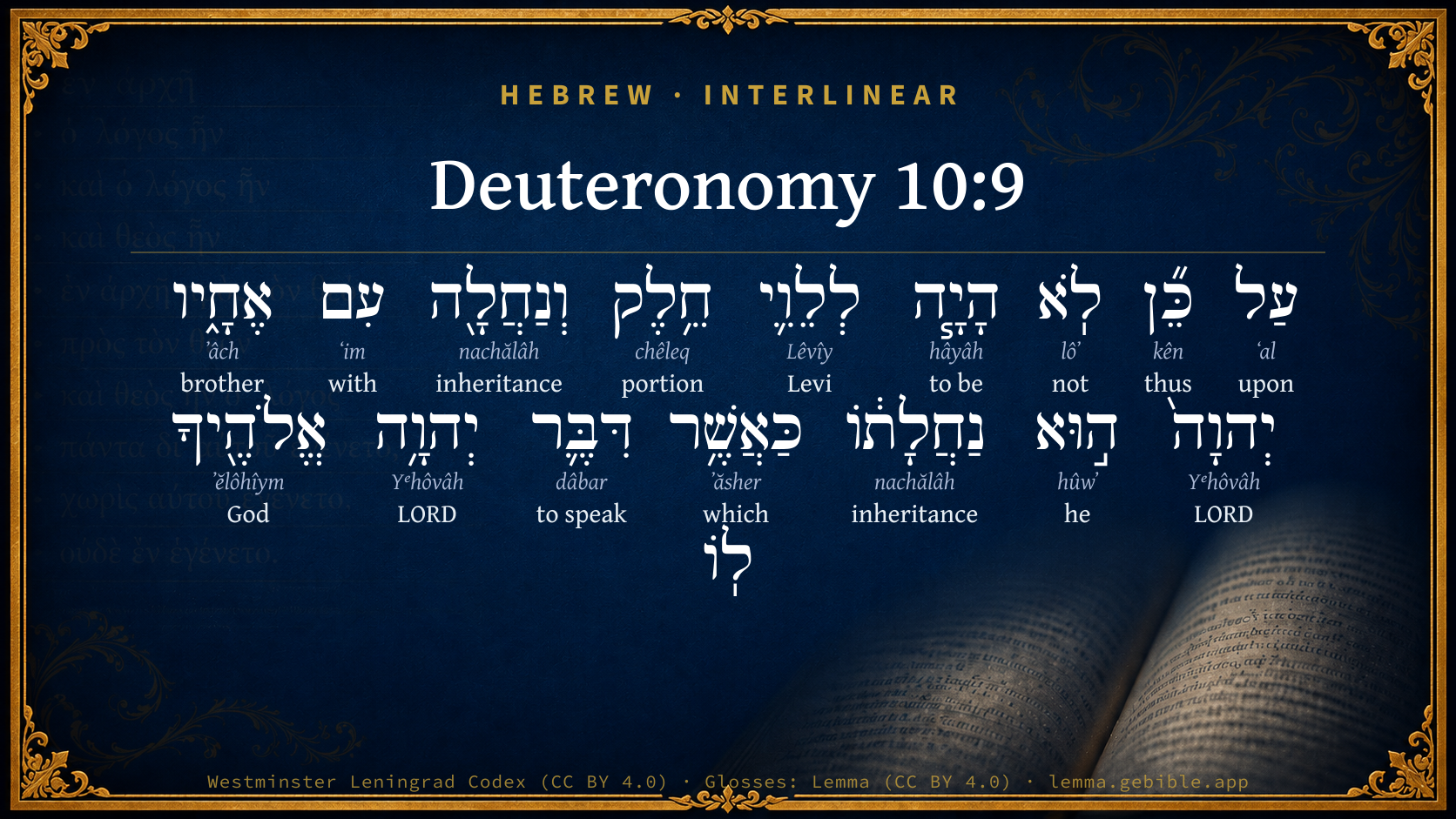
לְלֵוִ֛י
Lêvîy
H3878
“to/for · Levi”
Preposition + Noun, Proper
Part of Speech
Preposition + Noun
Type
Proper
Full BDB Definition

Origin: from H3867

TWOT: 1093

Levi = "joined to" - the 3rd son of Jacob by Leah and progenitor of tribe of Levites
  1. עַל ʻal H5921 “upon” Preposition
  2. כֵּ֞ן kên H3651 “thus” Particle, Demonstrative
  3. לֹֽא lôʼ H3808 “not” Particle, Negative
  4. הָיָ֧ה hâyâh H1961 “to be” Verb, Qal, Perfect, 3rd Person, Masculine, Singular
  5. חֵ֥לֶק chêleq H2506 “portion” Noun, Common, Masculine, Singular, Absolute
  6. וְנַחֲלָ֖ה nachălâh H5159 “and · inheritance” Conjunction + Noun, Common, Feminine, Singular, Absolute
  7. עִם ʻim H5973 “with” Preposition
  8. אֶחָ֑יו ʼâch H251 “brothers · his” Noun, Common, Masculine, Plural, Construct + Suffix, Personal, 3rd Person, Masculine, Singular
  9. יְהוָה֙ Yᵉhôvâh H3068 “LORD” Noun, Proper
  10. ה֣וּא hûwʼ H1931 “he” Pronoun, Personal, 3rd Person, Masculine, Singular
  11. נַחֲלָת֔וֹ nachălâh H5159 “inheritance · his” Noun, Common, Feminine, Singular, Construct + Suffix, Personal, 3rd Person, Masculine, Singular
  12. כַּאֲשֶׁ֥ר ʼăsher H834 “like/as · which” Preposition + Particle, Relative
  13. דִּבֶּ֛ר dâbar H1696 “to speak” Verb, Piel, Perfect, 3rd Person, Masculine, Singular
  14. יְהוָ֥ה Yᵉhôvâh H3068 “LORD” Noun, Proper
  15. אֱלֹהֶ֖יךָ ʼĕlôhîym H430 “God(s) · your” Noun, Common, Masculine, Plural, Construct + Suffix, Personal, 2nd Person, Masculine, Singular

About this verse

These counts appear in no published source. They are computed here, from the morphology-tagged text and Lemma’s own curated glosses. What Lemma adds →

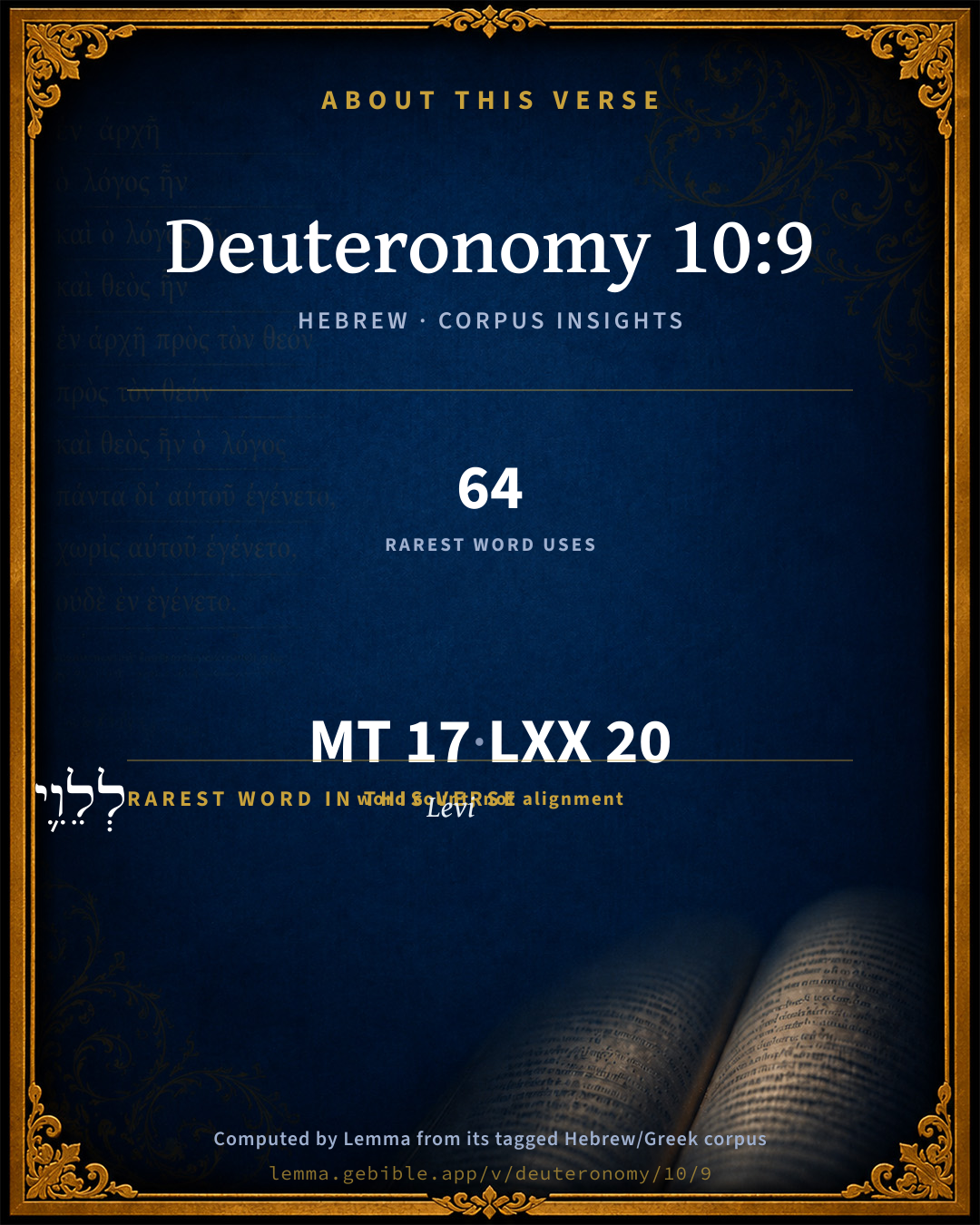
17
words
14
distinct lemmas
Pentateuch
section

Grammatical profile

  • 2 verbs
  • 8 nouns
  • 1 pronoun
  • 3 prepositions
  • 3 particles

Verb forms

  • הָיָ֧ה Qal · Perfect
  • דִּבֶּ֛ר Piel · Perfect

Repetition

Words recur within this verse — often emphatic in Hebrew:

  • וְנַחֲלָ֖ה inheritance H5159 ×2
  • יְהוָה֙ LORD H3068 ×2

Hebrew & Septuagint length

In English translation the verse runs 22 words from the Hebrew and 22 from the Septuagint (LXX English) — the same length.

A rough comparison of the two English renderings, which tokenize alike — not a word-level alignment.

Word counts can differ between the Hebrew and the Greek without any difference in meaning — e.g. the Hebrew direct-object marker אֵת has no separate Greek word, and Greek often adds the article ὁ.

In the original languages it is 17 Hebrew tokens and 20 Greek tokens — but the two are counted differently (Hebrew bundles its prefixes and suffixes into one token; the Greek is in lemma form), so that isn’t a like-for-like length.

Cross-references

5

Topical passages linked to Deuteronomy 10:9 in the Treasury of Scripture Knowledge — connected by theme and wording, ordered by reader-vote popularity; previews shown in the World English Bible.

  • Ezekiel 44:28 They shall have an inheritance: I am their inheritance; and you shall give them no possession in Israel; I am their possession.
  • Numbers 18:20–24 Yahweh said to Aaron, You shall have no inheritance in their land, neither shall you have any portion among them: I am your portion and your inheritance among the children of Israel.
  • Deuteronomy 18:1–2 The priests the Levites, [even] all the tribe of Levi, shall have no portion nor inheritance with Israel: they shall eat the offerings of Yahweh made by fire, and his inheritance.
  • Numbers 26:62 Those who were numbered of them were twenty-three thousand, every male from a month old and upward: for they were not numbered among the children of Israel, because there was no inheritance given them among the children of Israel.
  • Joshua 14:3 For Moses had given the inheritance of the two tribes and the half-tribe beyond the Jordan: but to the Levites he gave no inheritance among them.

Cross-references courtesy of OpenBible.info (CC BY 4.0).

Hebrew and Greek witnesses Masoretic Hebrew ↔ Greek Septuagint

The same verse in the two great witnesses to the Old Testament, shown verse-for-verse.

These are two independent witnesses, not word-aligned to each other, and the Septuagint is shown in lemma (dictionary) form.

Hebrew Deuteronomy 10:9 Masoretic · Westminster Leningrad Codex

עַל כֵּ֞ן לֹֽא הָיָ֧ה לְלֵוִ֛י חֵ֥לֶק וְנַחֲלָ֖ה עִם אֶחָ֑יו יְהוָה֙ ה֣וּא נַחֲלָת֔וֹ כַּאֲשֶׁ֥ר דִּבֶּ֛ר יְהוָ֥ה אֱלֹהֶ֖יךָ לֽוֹ

Therefore Levi has no portion nor inheritance with his brothers; Yahweh is his inheritance, according as Yahweh your God spoke to him.)

World English Bible · Public Domain

Greek LXX Deuteronomy 10:9 Septuagint · lemma form

διά οὗτος οὐ εἰμί ὁ λευίτης μερίς καί κλῆρος ἐν ὁ ἀδελφός αὐτός κύριος αὐτός κλῆρος αὐτός καθά εἶπον αὐτός

Therefore the Levites have no part nor inheritance among their brethren; the Lord himself is their inheritance, as he said to them.

LXX2012 (modern English Septuagint) · Public Domain

On this verse, The Cambridge Bible for Schools and Colleges discusses the Septuagint’s reading. Read the note in Commentary ↓

Hebrew: Westminster Leningrad Codex (CC BY 4.0). Greek: Septuagint (public domain); English from LXX2012 (modern English Septuagint) (Public Domain). How the Septuagint differs from the Hebrew →

Targum (Aramaic paraphrase)

2

The Targum is the ancient Jewish Aramaic paraphrase of the Hebrew Scriptures — an interpretive translation, not the Hebrew text itself. Onkelos (literal) and Pseudo-Jonathan (expansive) render the Torah, and Jonathan the Prophets. Coverage is partial: where no permissively-licensed English translation exists for a verse, only the Aramaic is shown. This is verse-level text, not a word-by-word alignment to the Hebrew.

  1. Targum Onkelos Torah (Genesis–Deuteronomy)
    עַל כֵּן לָא הֲּוָה לְלֵוִי חֳלָק וְאַחֲסָנָא עִם אֲחוֹהִי מַתְּנָן דִיהַב לֵהּ יְיָ אִנוּן אַחֲסַנְתֵּהּ כְּמָא דִי מַלִיל יְיָ אֱלָהָךְ לֵהּ

    (no public-domain English translation for this verse)

    Targum Onkelos — Aramaic: “Onkelos Genesis” (public domain); “Onkelos Exodus” (public domain); “Onkelos Leviticus” (public domain); “Onkelos Numbers” (public domain); “Onkelos Deuteronomy” (public domain). English: “Sefaria Community Translation” (CC0 1.0 (public-domain dedication)); “J.W. Etheridge. The Targums of Onkelos and Jonathan Ben Uzziel on the Pentateuch. London: Longmans, Green, 1862” (public domain). Text via Sefaria.

  2. Targum Pseudo-Jonathan Torah (Genesis–Deuteronomy)
    בְּגִין כֵּן לָא הֲוָה לְשִׁבְטָא דְלֵוִי חוּלַק וְאַחְסָנָא עִם אֲחוֹהִי מַתְּנָן דִּיהַב לֵיהּ יְיָ הִינוּן אַחֲסַנְתֵּיהּ הֵיכְמָא דְמַלֵּיל יְיָ אֱלָהָכוֹן לֵיהּ

    Therefore the tribe of Levi hath not a portion or inheritance with his brethren; the gifts which the Lord giveth him are his inheritance, as the Lord your God hath spoken to him.

    Targum Pseudo-Jonathan — Aramaic: “Targum Jonathan on Genesis” (public domain); “Targum Jonathan on Exodus” (public domain); “Targum Jonathan on Leviticus” (public domain); “Targum Jonathan on Numbers” (public domain); “Targum Jonathan on Deuteronomy” (public domain). English: “The Targum of Jonathan ben Uzziel, trans. J. W. Etheridge, London, 1862” (public domain). Text via Sefaria.

Commentary

Notes on Deuteronomy 10:9 from classic Christian and Jewish commentators (each source and its license shown beneath its notes). The classic Christian expositions comment on the surrounding passage and are grouped to its opening verse, so a note may address several verses; the Jewish commentaries on the Tanakh (Rashi and others) are per-verse, so they appear only where the commentator wrote on this verse.

Lemma curates 59 commentaries, every one of them public domain or Creative Commons licensed, each selected and text-cleaned for this edition rather than reprinted as found. About our sources →

The Biblical Illustrator

Joseph S. Exell

Deu_10:9

The Lord is his inheritance.

The Lord the Christians inheritance

The obvious meaning of having the Lord for our inheritance is, that we have dedicated ourselves to His service, that we have surrendered ourselves altogether to Him, the energies of the body and the faculties of the mind, to do His will and advance His kingdom and glory; again, that we have secured Him as our own forever, that we are attached to Him as a man to a possession which he cannot alienate; further, that we have, as it were, the use of the Lord God Almighty, that His perfections and His grace are guaranteed to us to be employed for our personal advantage; and, lastly, that we are in the actual enjoyment of those blessings which belong to living in a state of favour with the righteous Governor of the universe.

I. In life the true believer realises the promise, and has the Lord for his inheritance.

1. Because he deliberately chooses Him in preference to the charms and allurements of the world. In proportion as he is separated from the world, does the Lord become his inheritance; he is more closely united to Him, and more exclusively employed in His service; he perceives the wisdom of his choice, tastes of the blessings that are at Gods right hand, and finds a supply of all his wants from the fulness that is in Christ Jesus; that the Lord is his portion and his sole inheritance, he has taken Him for his own, and every other less perfect and substantial he has absolutely and utterly renounced.

2. The Christian has the Lord for his inheritance, in that all things are working together for his final salvation.

3. The true believer has the Lord for his inheritance, because he has the peace of God shed abroad in his heart. The voice of Christian experience is unanimous. God does not hide Himself from those whom He has given to His beloved Son.

4. The true believer has surrendered to him the Lord Christ Himself as his inheritance; he has Him for his own. It is the assurance of St. John that he that hath the Son hath life, and he that hath not the Son hath not life.

II. But not only in this life, but also after death--not only in time, but also in eternity, has the Christian the Lord for his inheritance. He is not deprived of his portion by the separation of soul and body, by the change of scene, nor the commencement of a spiritual existence. Not only is it his own now, but also in the world to come.

1. For, first, He is eternally with him. Wherever is the heaven where Christ lives and reigns, there is the habitation of His chosen people. They are with Him where He is, they see Him as He is, they walk in the light of His countenance.

2. But the great truth stands out in all its excellency when we find it is the presence of the Lord that constitutes the believers happiness and joy. Every joy and blessing of those blessed places originates in the fact, that we are to dwell in the presence of the Lord. His presence is the fountain and spring of happiness to every individual of His glorified Church.

Conclusion: Let us bear in mind--

1. That whether we have made the Lord our inheritance must be the criterion of our hopes. To have no part in Him is to be an outcast from the promises, to live with the Divine wrath upon our heads.

2. Let us also seriously inquire, what will be the state of those in the next world who have not made the Lord their inheritance? Can their souls be conceived in any way capable of participating in heavenly joy? Is there anything in the circumstances or employments of redeemed spirits which can fill up the measure of their cup, and make them perfectly and forever blessed? (H. Hughes, M. A.)

The Biblical Illustrator, edited by Joseph S. Exell (c. 1880s–1900s) — public domain. Text from a community e-Sword module.

Joseph Benson's Commentary

Deu 10:9. Levi hath no inheritance with his brethren — That they might attend only on the duties of their sacred office, provision was made for their maintenance, without their being obliged to plough, or sow, or entangle themselves in other worldly affairs. And is not provision made for the clergy of this and other countries professing Christianity, for a similar reason, namely, that, being under no necessity of entangling themselves in the affairs of this life, they may war a good warfare, and please Him that hath chosen them to be his soldiers? 2Ti 2:4. The Lord is his inheritance — They are to be maintained out of such tithes and revenues as are appropriated to them by the special appointment of God.

Joseph Benson's Commentary on the Old and New Testaments (1811–1818) — public domain. Text from a community e-Sword module.

Geneva Bible (1599)

Geneva Bible translators

So God turned the curse of Jacob, Gen. 49:7, unto blessing.

Geneva Bible (1599) marginal notes — public domain. Text via Bolls.life.

Ellicott's Commentary for English Readers

(9) The Lord is his inheritance.—As He was the inheritance of Aaron, Moses’ brother, whom he had recently taken to Himself, and to whose death Moses had just referred.

A Bible Commentary for English Readers, edited by Charles John Ellicott (1878–1897) — public domain. Text from a community e-Sword module.

The Cambridge Bible for Schools and Colleges

gen. ed. J. J. S. Perowne

9. Wherefore] i.e. because of God’s separation of the tribe to Himself.

Levi hath no portion nor inheritance] Deu_12:12, Deu_14:27; Deu_14:29, Deu_18:1 f. In P of Aaron Num_18:20.

the Lord is his inheritance] What this means is defined in Deu_18:1, they shall eat the offerings of Jehovah made by fire, and his inheritance; details follow in 3 f.

according as … spake unto him] This is not recorded in the Pent., but may have been found in the original form of JE; see on Deu_10:8. LXX om. the Lord thy God, and so relieves the text from one of the two instances of the Sg. address in this section.

The Cambridge Bible for Schools and Colleges (gen. ed. J. J. S. Perowne; Cambridge University Press, 1878–1918) — public domain. Text from a community e-Sword module.

John Gill's Exposition

Wherefore Levi hath no part nor inheritance with his brethren,.... In the division of the land of Canaan, because being separated to the service of the sanctuary, he had no leisure to plough and sow, as Jarchi observes:

the Lord is his inheritance, as the Lord thy God promised him; not in a spiritual sense, for so the Lord was an inheritance and portion of other Israelites; though these being taken off of worldly employments, and devoted to sanctuary service, might have more communion with God than others; but in a temporal sense, provision being made particularly by tithes, which were the Lord's, for their maintenance; and so the Targums of Onkelos and Jonathan paraphrase the words;"gifts which the Lord gave him are his inheritance;''see Num 18:20.

John Gill's Exposition of the Whole Bible (1746–1763) — public domain (CC PDM 1.0). Text via the HelloAO Bible API.

Matthew Poole's English Annotations

The Lord is his inheritance, i.e. the Lord’s portion, to wit, tithes and offerings, which belong to God, are given by him to the Levites for their subsistence from generation to generation, as inheritances run.

Matthew Poole's English Annotations on the Holy Bible (1683–1685) — public domain. Text from a community e-Sword/MySword module.

The Pulpit Commentary

cf. Num_18:20-24

The Pulpit Commentary (1880–1919), ed. H.D.M. Spence-Jones & Joseph S. Exell — public domain. Text from a community e-Sword module.

John Wesley's Explanatory Notes

The Lord is his inheritance - That is, the Lord's portion, namely, tithes and offerings, which belong to God, are given by him to the Levites for their subsistence, from generation to generation.

John Wesley, Explanatory Notes Upon the Whole Bible (1754–1765) — public domain. Text via the GEBible commentary corpus.

Rashi

Rabbi Shlomo Yitzchaki (Rashi)

על כן לא היה ללוי חלק WHEREFORE LEVI HATH NO PORTION — because they have been singled out for the service of the altar (v. 8), and therefore were not free to plough and sow.

ה' הוא נחלתו THE LORD IS HIS INHERITANCE — he receives his daily fare ready for him from the King’s house (from the Temple; the dues from the sacrifices, etc.).

Rashi on the Tanakh — English translations: “The Judaica Press complete Tanach with Rashi, translated by A. J. Rosenberg” (CC BY 4.0); “Pentateuch with Rashi's commentary by M. Rosenbaum and A.M. Silbermann, 1929-1934” (public domain); “The Metsudah Tanach series, Lakewood, N.J” (CC BY 4.0); and “The Book of Joshua, Metsudah Publications, 1997” (CC BY 4.0). Text via Sefaria.

Ramban (Nachmanides)

Rabbi Moshe ben Nachman (Ramban / Nachmanides)

WHEREFORE LEVI HATH NO PORTION. The purport thereof is have no portion in the Land, when only the priests were discussed in this section? Ramban answers, “The purport thereof is etc.” that because they all [i.e., the Levites] minister to and assist the priests in their [Divine] Service, since every part of the Sanctuary pertained to the offerings, [therefore, the whole tribe of Levi was not free to devote itself to the cultivation and development of the Land; therefore they received no portion therein]. And so He said [to Aaron], And thy brethren also of the tribe of Levi, the tribe of thy father, bring thou near with thee, that they may be joined unto thee, and minister unto thee.

Ramban (Nachmanides) on the Tanakh — English translation: “Commentary on the Torah by Ramban (Nachmanides). Translated and annotated by Charles B. Chavel. New York, Shilo Pub. House, 1971-1976” (CC BY 4.0). Text via Sefaria.

Lesson kit

Teaching starters — assembled from the data on this page, not authored interpretation. Every prompt links to the verse data it draws on. Edit before teaching.

Deuteronomy, in the Pentateuch, opens this verse with 17 words (14 distinct Hebrew lemmas). Its most distinctive word is Lêvîy (“Levi”). A historical commentator’s framing appears above. Read the whole chapter for the surrounding context.

Discussion questions

  1. How does “Levi” (Lêvîy) shape what this verse is saying?
  2. How does Ezekiel 44:28, which shares this passage’s theme, read alongside this verse?
  3. What does the repetition of “inheritance” (2× in this one verse) do in this verse?
  4. These translations render this verse differently. What is at stake in choosing one wording over another?
  5. «הָיָ֧ה» is a Qal Perfect verb. How does that grammatical form shape the action described?
  6. Compare how The Biblical Illustrator and Joseph Benson's Commentary read this verse. Where do they agree or differ?

Things to notice

Reading settings

Reading text

Shown beneath each verse's original-language words.

Old Testament
Old Testament edition

Read the OT as the Masoretic Hebrew (MT) or the Greek Septuagint (LXX).

English shown for the Greek Septuagint (in the Hebrew ↔ Greek comparison).

Comparing translations? Open the Compare panel on any verse page to stack up to four side by side.