Jeremiah 5:12

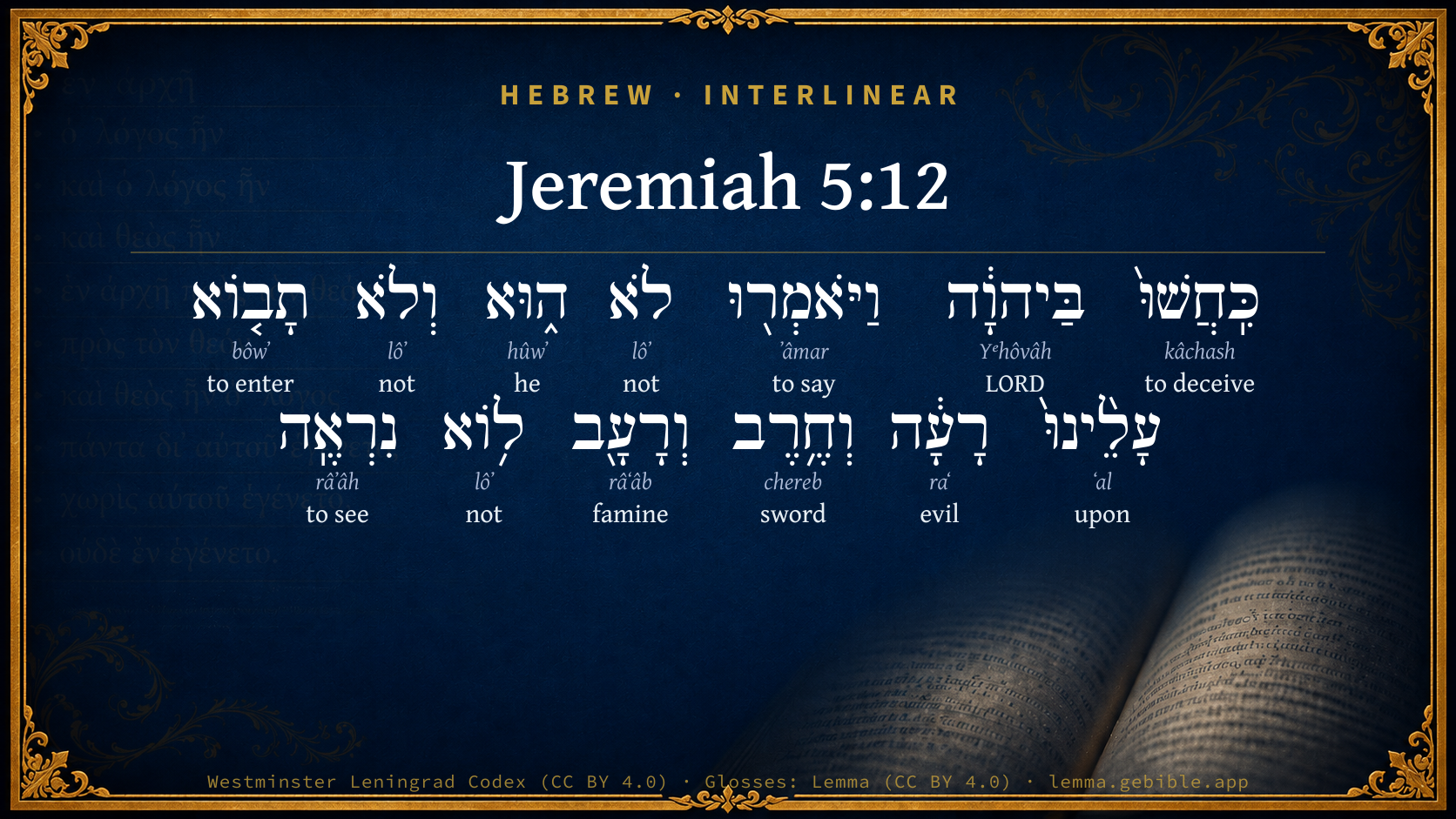
Hebrew (Westminster Leningrad Codex) Jeremiah 5:12 appears in the Hebrew Old Testament. The text above is from the Westminster Leningrad Codex. Each word links to its Strong’s number, a concise gloss, and parsing drawn from the Open Scriptures Hebrew Bible morphology. Click any word for its full Brown-Driver-Briggs (BDB) entry.
Download image
Cite this verse

Jeremiah 5:12 (World English Bible). Public Domain. Lemma interlinear Bible study tool, https://lemma.gebible.app/v/jeremiah/5/12.

Show BibTeX & RIS
BibTeX
RIS
English Translation
They have denied Yahweh, and said, It is not he; neither shall evil come on us; neither shall we see sword nor famine:
World English Bible · Public Domain
Download a study sheet

One document with this verse’s original text, its word-by-word gloss line, the meaning frame, cross-references with their text, attributed commentary, and full source and license credits — printable, and it pastes into notes with its structure intact.

This verse Autodidact and up

Study sheet (.html) Plain text (.txt)

A passage Seminary Student

Up to 50 verses in one chapter. A passage sheet keeps up to 6 commentary sources and 12 cross-references per verse, in the order this page ranks them, and says so on the sheet whenever that leaves anything out. Ask for a single verse and you get the Autodidact verse sheet above.

Everything on this page stays free to read, with no account — the sheet is a download of what is already on screen, not access to it.

Want to remove ads? Support Godless Engineer
Compare translations 3

The same verse in 3 English versions, stacked beneath the original-language interlinear above. Click any original word for its lexicon entry.

Each is an independent rendering of the whole verse — the interlinear is not word-aligned to these translations.

Highlighted words mark where these versions differ — a whole-verse word diff, not a word-by-word alignment.

  • World English Bible Public Domain
    They have denied Yahweh, and said, It is not he; neither shall evil come on us; neither shall we see sword nor famine:
  • King James Version Public Domain
    They have belied the LORD, and said, It is not he; neither shall evil come upon us; neither shall we see sword nor famine:
  • unfoldingWord Literal Text CC BY-SA 4.0
    They have deceived about Yahweh, and they said, “He not, and no evil will come upon us, and we will not see sword or famine.

unfoldingWord Literal Text — © unfoldingWord, licensed CC BY-SA 4.0. Word-aligned USFM3 via Door43 (git.door43.org/unfoldingWord/en_ult).

Versions to compare (up to 4)

3 of 4 selected

Show all 18 translations

Every available English version of this verse, each an independent rendering of the whole verse.

  • World English Bible Public Domain
    They have denied Yahweh, and said, It is not he; neither shall evil come on us; neither shall we see sword nor famine:
  • Berean Standard Bible Public Domain
    They have lied about the LORD and said: “He will not do anything; harm will not come to us; we will not see sword or famine.
  • Majority Standard Bible Public Domain
    They have lied about the LORD and said: “He will not do anything; harm will not come to us; we will not see sword or famine.
  • King James Version Public Domain
    They have belied the LORD, and said, It is not he; neither shall evil come upon us; neither shall we see sword nor famine:
  • American Standard Version (1901) Public Domain
    They have denied Jehovah, and said, It is not he; neither shall evil come upon us; neither shall we see sword nor famine:
  • Revised Version (1885) Public Domain
    They have denied the LORD, and said, It is not he; neither shall evil come upon us; neither shall we see sword nor famine:
  • Geneva Bible (1599) Public Domain
    They haue denied the Lord, and saide, It is not he, neither shall the plague come vpon vs, neither shall we see sworde nor famine.
  • Douay-Rheims (1899) Public Domain
    They have denied the Lord, and said, It is not he: and the evil shall not come upon us: we shall not see the sword and famine.
  • Young's Literal Translation Public Domain
    They have lied against Jehovah, And they say, ``It is' not He, Nor come in against us doth evil, Yea, sword and famine we do not see.
  • Literal Standard Version CC BY-SA 4.0
    They have lied against YHWH, || And they say, “[It is] not He, || Nor does evil come in against us, || Indeed, we do not see sword and famine.
  • Unlocked Literal Bible CC BY-SA 4.0
    They have spoken falsely about Yahweh and they said, “He will do nothing; no harm will come upon us, and we will not see sword or famine.
  • unfoldingWord Literal Text CC BY-SA 4.0
    They have deceived about Yahweh, and they said, “He not, and no evil will come upon us, and we will not see sword or famine.
  • Darby Bible Public Domain
    They have denied Jehovah, and say, He is not; and evil shall not come upon us, nor shall we see sword nor famine;
  • World Messianic Bible Public Domain
    They have denied the LORD, and said, “It is not he. Evil won’t come on us. We won’t see sword or famine.
  • Webster's Bible Public Domain
    They have belied the LORD, and said, It is not he; neither shall evil come upon us; neither shall we see sword nor famine:
  • Free Bible Version CC BY-SA 4.0
    They have lied about the Lord, saying, “He won't do anything. Nothing bad will happen to us. We won't have war or famine.
  • Bible in Basic English Public Domain
    They would have nothing to do with the Lord, saying, He will do nothing, and no evil will come to us; we will not see the sword or be short of food:
  • JPS Tanakh (1917) Public Domain
    They have belied the LORD, and said: 'It is not He, neither shall evil come upon us; neither shall we see sword nor famine;

Literal Standard Version (2020), Covenant Press — licensed CC BY-SA 4.0. Text via the HelloAO Bible API (eBible.org). Unlocked Literal Bible (unfoldingWord) — licensed CC BY-SA 4.0. Text via the HelloAO Bible API (eBible.org). unfoldingWord Literal Text — © unfoldingWord, licensed CC BY-SA 4.0. Word-aligned USFM3 via Door43 (git.door43.org/unfoldingWord/en_ult). Free Bible Version, Dr. Jonathan Gallagher — licensed CC BY-SA 4.0. Text via the HelloAO Bible API (eBible.org).

Word by word

More ways to search: Search by grammar → Find every occurrence → Compare this word →

Practice this passage: Drill this verse → Learn its vocabulary →

כִּֽחֲשׁוּ֙
kâchash
H3584
“to deceive”
Verb, Piel, Perfect, 3rd Person, Common, Plural
Part of Speech
Verb
Stem
Piel
Form
Perfect
Person
3rd Person
Gender
Common
Number
Plural
Full BDB Definition

Origin: a primitive root

TWOT: 975

to deceive, lie, fail, grow lean, be disappointing, be untrue, be insufficient, be found liars, belie, deny, dissemble, deal falsely - (Qal) to become lean - (Niphal) to cringe, feign obedience - (Piel) - to deceive, deny falsely - to act deceptively - to cringe - to disappoint, fail - (Hithpael) to cringe, feign obedience
  1. בַּיהוָ֔ה Yᵉhôvâh H3068 “in/at · LORD” Preposition + Noun, Proper
  2. וַיֹּאמְר֖וּ ʼâmar H559 “and · to say” Conjunction + Verb, Qal, Sequential Imperfect, 3rd Person, Masculine, Plural
  3. לֹא lôʼ H3808 “not” Particle, Negative
  4. ה֑וּא hûwʼ H1931 “he” Pronoun, Personal, 3rd Person, Masculine, Singular
  5. וְלֹא lôʼ H3808 “and · not” Conjunction + Particle, Negative
  6. תָב֤וֹא bôwʼ H935 “to enter” Verb, Qal, Imperfect, 3rd Person, Feminine, Singular
  7. עָלֵ֨ינוּ֙ ʻal H5921 “upon · us” Preposition + Suffix, Personal, 1st Person, Common, Plural
  8. רָעָ֔ה raʻ H7451 “evil” Noun, Common, Feminine, Singular, Absolute
  9. וְחֶ֥רֶב chereb H2719 “and · sword” Conjunction + Noun, Common, Feminine, Singular, Absolute
  10. וְרָעָ֖ב râʻâb H7458 “and · famine” Conjunction + Noun, Common, Masculine, Singular, Absolute
  11. ל֥וֹא lôʼ H3808 “not” Particle, Negative
  12. נִרְאֶֽה râʼâh H7200 “to see” Verb, Qal, Imperfect, 1st Person, Common, Plural

About this verse

These counts appear in no published source. They are computed here, from the morphology-tagged text and Lemma’s own curated glosses. What Lemma adds →

13
words
11
distinct lemmas
Prophets
section

Notable vocabulary

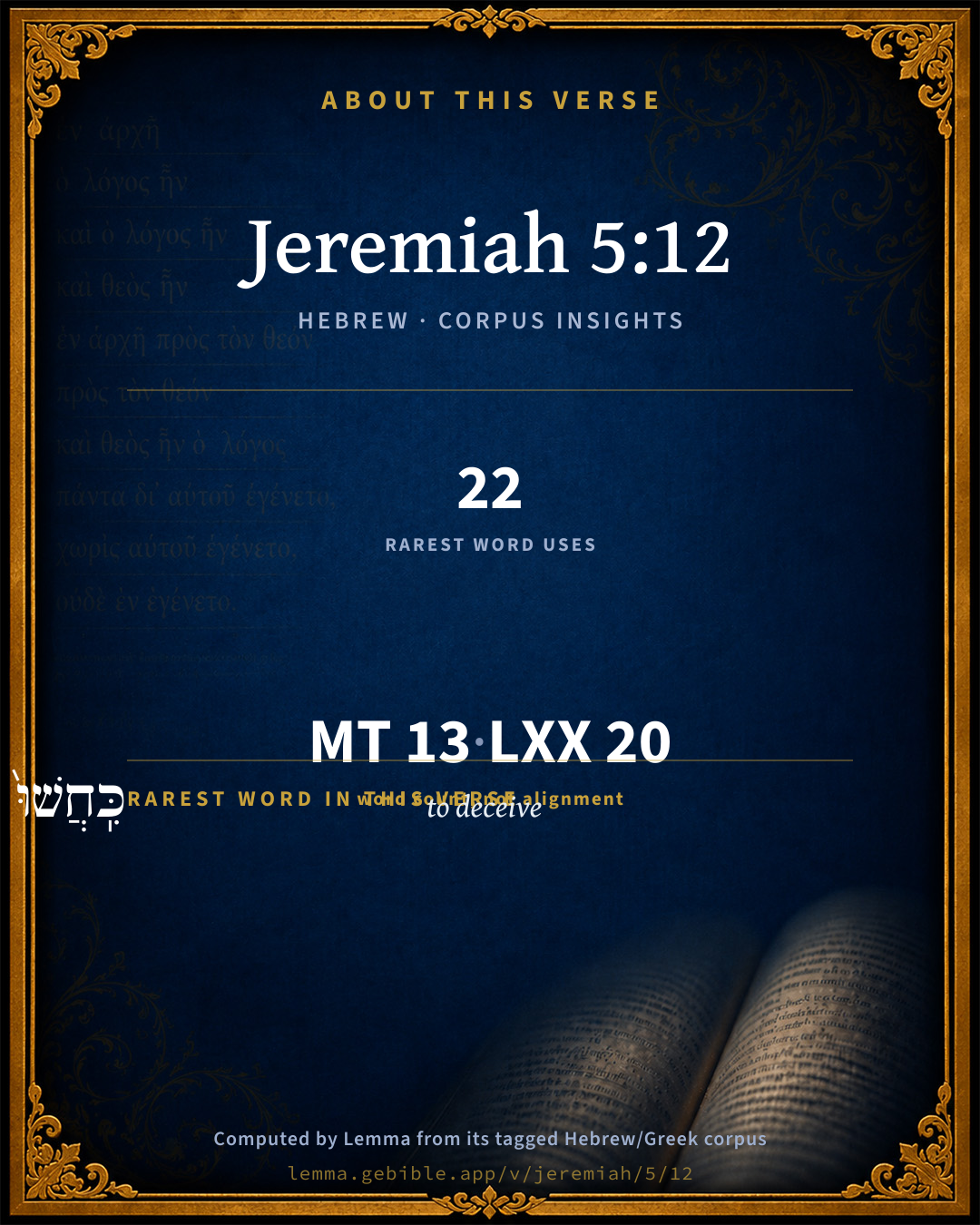
The rarest word here is כִּֽחֲשׁוּ֙ to deceive H3584 — appearing just 22 times in the whole Hebrew Bible.

Shared distinctive vocabulary

כִּֽחֲשׁוּ֙ to deceive H3584 occurs in 22 verses of the Hebrew Bible. Also found in:

Grammatical profile

  • 4 verbs
  • 4 nouns
  • 1 pronoun
  • 1 preposition
  • 3 particles

Verb forms

  • כִּֽחֲשׁוּ֙ Piel · Perfect
  • וַיֹּאמְר֖וּ Qal · Sequential Imperfect
  • תָב֤וֹא Qal · Imperfect
  • נִרְאֶֽה Qal · Imperfect

Repetition

A word recurs within this verse — often emphatic in Hebrew:

Hebrew & Septuagint length

In the original languages it is 13 Hebrew tokens and 20 Greek tokens — but the two are counted differently (Hebrew bundles its prefixes and suffixes into one token; the Greek is in lemma form), so that isn’t a like-for-like length.

Cross-references

19

Topical passages linked to Jeremiah 5:12 in the Treasury of Scripture Knowledge — connected by theme and wording, ordered by reader-vote popularity; previews shown in the World English Bible.

  • 2 Chronicles 36:16 but they mocked the messengers of God, and despised his words, and scoffed at his prophets, until the wrath of Yahweh arose against his people, until there was no remedy.
  • Deuteronomy 29:19 and it happen, when he hears the words of this curse, that he bless himself in his heart, saying, I shall have peace, though I walk in the stubbornness of my heart, to destroy the moist with the dry.
  • 1 Samuel 6:9 Behold; if it goes up by the way of its own border to Beth-shemesh, then he has done us this great evil: but if not, then we shall know that it is not his hand that struck us; it was a chance that happened to us."
  • Psalms 10:6 He says in his heart, "I shall not be shaken; For generations I shall have no trouble."
  • Isaiah 28:14–15 Why hear the word of Yahweh, you scoffers, that rule this people that is in Jerusalem:
  • Jeremiah 5:31 the prophets prophesy falsely, and the priests bear rule by their means; and my people love to have it so: and what will you do in the end of it?
  • Jeremiah 14:13–14 Then said I, Ah, Lord Yahweh! behold, the prophets tell them, You shall not see the sword, neither shall you have famine; but I will give you assured peace in this place.
  • Jeremiah 23:14–17 In the prophets of Jerusalem also I have seen a horrible thing: they commit adultery, and walk in lies; and they strengthen the hands of evil-doers, so that none does return from his wickedness: they are all of them become to me as Sodom, and the inhabitants of it as Gomorrah.
  • Jeremiah 28:4 and I will bring again to this place Jeconiah the son of Jehoiakim, king of Judah, with all the captives of Judah, who went to Babylon, says Yahweh; for I will break the yoke of the king of Babylon.
  • Jeremiah 28:15–17 Then said the prophet Jeremiah to Hananiah the prophet, Hear now, Hananiah: Yahweh has not sent you; but you make this people to trust in a lie.
  • Jeremiah 43:2–3 then spoke Azariah the son of Hoshaiah, and Johanan the son of Kareah, and all the proud men, saying to Jeremiah, You speak falsely: Yahweh our God has not sent you to say, You shall not go into Egypt to sojourn there;
  • Ezekiel 12:22–28 Son of man, what is this proverb that you have in the land of Israel, saying, The days are prolonged, and every vision fails?
  • Ezekiel 13:6 They have seen falsehood and lying divination, who say, Yahweh says; but Yahweh has not sent them: and they have made men to hope that the word would be confirmed.
  • Micah 2:11 If a man walking in a spirit of falsehood lies: 'I will prophesy to you of wine and of strong drink;' He would be the prophet of this people.
  • Micah 3:11 Her leaders judge for bribes, And her priests teach for a price, And her prophets of it tell forturnes for money: Yet they lean on Yahweh, and say, Isn't Yahweh in the midst of us? No disaster will come on us.
  • Habakkuk 1:5–6 "Look among the nations, watch, and wonder marvelously; for I am working a work in your days, which you will not believe though it is told you.
  • 1 Thessalonians 5:2–3 For you yourselves know well that the day of the Lord comes like a thief in the night.
  • 1 John 5:10 He who believes in the Son of God has the testimony in himself. He who doesn't believe God has made him a liar, because he has not believed in the testimony that God has given concerning his Son.
  • Jeremiah 4:10 Then said I, Ah, Lord Yahweh! surely you have greatly deceived this people and Jerusalem, saying, You shall have peace; whereas the sword reaches to the life.

Cross-references courtesy of OpenBible.info (CC BY 4.0).

Hebrew and Greek witnesses Masoretic Hebrew ↔ Greek Septuagint

The same verse in the two great witnesses to the Old Testament, shown verse-for-verse.

These are two independent witnesses, not word-aligned to each other, and the Septuagint is shown in lemma (dictionary) form.

Hebrew Jeremiah 5:12 Masoretic · Westminster Leningrad Codex

כִּֽחֲשׁוּ֙ בַּיהוָ֔ה וַיֹּאמְר֖וּ לֹא ה֑וּא וְלֹא תָב֤וֹא עָלֵ֨ינוּ֙ רָעָ֔ה וְחֶ֥רֶב וְרָעָ֖ב ל֥וֹא נִרְאֶֽה

They have denied Yahweh, and said, It is not he; neither shall evil come on us; neither shall we see sword nor famine:

World English Bible · Public Domain

Greek LXX Structure differs

In the Septuagint, Jeremiah is about an eighth shorter than the Hebrew and arranges its material differently — the Oracles Against the Nations (Hebrew chapters 46–51) appear in the middle of the Greek book, after 25:13. Because the chapter and verse boundaries do not line up, a verse-for-verse comparison with the Hebrew is not shown.

A verse-for-verse comparison isn’t shown here because the chapters and verses don’t line up. Switch to the LXX edition with the MT / LXX toggle above to read the Greek directly.

Hebrew: Westminster Leningrad Codex (CC BY 4.0). Greek: Septuagint (public domain); English from a public-domain English Septuagint. How the Septuagint differs from the Hebrew →

Targum (Aramaic paraphrase)

1

The Targum is the ancient Jewish Aramaic paraphrase of the Hebrew Scriptures — an interpretive translation, not the Hebrew text itself. Onkelos (literal) and Pseudo-Jonathan (expansive) render the Torah, and Jonathan the Prophets. Coverage is partial: where no permissively-licensed English translation exists for a verse, only the Aramaic is shown. This is verse-level text, not a word-by-word alignment to the Hebrew.

  1. Targum Jonathan Prophets (Joshua–Malachi)
    כַּדִיבוּ בְּמֵימְרָא דַייָ וַאֲמַרוּ לָא מִן קֳדָמוֹהִי אַתְיָא עֲלָנָא טַבְתָא וְאַף לָא תֵיתֵי עֲלָנָא בִּישְׁתָא וּדְקַטְלִין בְּחַרְבָּא וּבְכַפְנָא לָא נֶחֱזֵי:

    (no public-domain English translation for this verse)

    Targum Jonathan — Aramaic: “Mikraot Gedolot” (public domain). English: “Sefaria Community Translation” (CC0 1.0 (public-domain dedication)); “London "Chaldee Paraphrase," 1871” (public domain). Text via Sefaria.

Commentary

Notes on Jeremiah 5:12 from classic Christian and Jewish commentators (each source and its license shown beneath its notes). The classic Christian expositions comment on the surrounding passage and are grouped to its opening verse, so a note may address several verses; the Jewish commentaries on the Tanakh (Rashi and others) are per-verse, so they appear only where the commentator wrote on this verse.

Lemma curates 59 commentaries, every one of them public domain or Creative Commons licensed, each selected and text-cleaned for this edition rather than reprinted as found. About our sources →

Trapp's Complete Commentary

John Trapp

Jer 5:12 They have belied the LORD, and said, [It is] not he; neither shall evil come upon us; neither shall we see sword nor famine:

Ver. 12. They have belied the Lord.] Or, They give the Lord the lie - as Montfort, Earl of Leicester, gave his sovereign, Henry III, {a} the lie. Every unbeliever doth as much, upon the matter; {1Jn 5:10} see the note there, Nam etiamsi non semper ore obloquitur, factis tamen obluctatur, {b}

And said, It is not he,] scil., That speaketh, but the prophets speak their own dreams and fancies. Or, as some render the text, He is not; there is no God to reward us if we do well, or to punish us if we do worse. See my Commonplace of Atheism.

{a} Daniel’s Hist., 172.

{b} Oecolamp.

John Trapp, A Commentary or Exposition upon All the Books of the Old and New Testament (1647–1656) — public domain. Text from a community e-Sword module.

Tyndale Open Study Notes

Tyndale Open Resources

5:12-13 Even with the enemy looming on the northern horizon, the people thought that nothing bad would happen to them (14:13; Isa 47:8). They did not respect God’s prophets (literally the prophets) either. • Some interpreters end the people’s quote with Jer 5:12 and attribute 5:13 to the Lord. The windbags would then refer to false prophets.

Tyndale Open Study Notes — © Tyndale Open Resources, licensed CC BY-SA 4.0. Text via the HelloAO Bible API.

Geneva Bible (1599)

Geneva Bible translators

Because they gave no credit to the words of his Prophets, as Isa. 28:15.

Geneva Bible (1599) marginal notes — public domain. Text via Bolls.life.

Jamieson, Fausset & Brown

Robert Jamieson, A. R. Fausset & David Brown

belied--denied.

It is not he--rather, "(Jehovah) is not HE," that is, the true and only God (Jer 14:22; Deu 32:39; Isa 43:10, Isa 43:13). By their idolatry they virtually denied Him. Or, referring to what follows, and to Jer 5:9, "(Jehovah) is not," namely, about to be the punisher of our sins (Jer 14:13; Isa 28:15).

Jamieson, Fausset & Brown — Commentary Critical and Explanatory on the Whole Bible (1871) — public domain (CC PDM 1.0). Text via the HelloAO Bible API.

Adam Clarke's Commentary

Verse 12. They have belied the Lord] כחשו kichashu. They have denied or disavowed the Lord.

It is not he] לוא הוא lo hu, he is not; there is no such being; therefore this evil shall not come upon us. On their premises, this conclusion was just. There is no judge; therefore there shall be no judgment. Thus they denied the Lord. They were atheists at heart.

Adam Clarke's Commentary on the Bible (1810–1826) — public domain. Text from a community e-Sword/MySword module.

John Calvin's Commentaries

He expresses more clearly and fully what he had previously said. Their perfidy was, that they had denied God I do not wholly reject what others have said, that they lied to God: but as ב is here used after כחש, I cannot see that it means to lie. It ought to have been in that case, כחשו, ליהוהcacheshu La-Jeve: but as it is ביהוה, Be-Jeve, I doubt not but that he simply declares that they denied God; and the context seems to require this meaning; for he immediately adds, that they said there was no God This certainly was not to lie to God, but to reject him as one who did not exist. As then the sense would be less significant, were we to say, that they lied to God, I am inclined to take the other meaning, that they denied God; that is, that they wholly disregarded him or sought to erase the remembrance of him.

The reason which follow requires special notice: They have said, He is not To render this more clear, he says, that they boasted of impunity. It seemed, no doubt, to exceed credibility, when the Prophet said that God was denied by the Jews; but that they might not evade the charge, he continued it, they have said, He is not We are further to consider why he brought against them so grievous and so atrocious a charge: it was, because they boasted that they should be free from the punishments which the prophets had threatened.

We then see what Jeremiah alleges against them, even their contempt and also their perverseness. They felt themselves safe notwithstanding the prophetic threatenings. The Prophet says, this is nothing less than wholly to deny God. Were we judges, this declaration might appear too severe: but let us pause, and acquiesce in what the Holy Spirit has pronounced.

And this is a remarkable passage, whence we may learn how abhorred by God is their indifference, who harden themselves against his threatenings, and wholly disregard his judgment. For if we acknowledge him as God, his power as a judge ought not to be taken away. What does God’s name mean? Doubtless they who imagine that God remains quiet in heaven and enjoys his leisure and his rest, though they may not in words deny God, yet treat him with mockery: there is in them at the same time no religion and no thought of a divine being. Let us then carefully notice this passage, in which the Prophet testifies that God is denied by us, except we be moved by his threatenings; for the torpidity in which we indulge ourselves, when God denounces his judgment on us, is the same as the denial of him; nor is there anything by which they can extenuate their sin who thus despise the vengeance of God. For the Holy Spirit has once for all declared, that all who trifle with the prophets do in their hearts say, that there is no God, inasmuch as they deprive him of his power and of his office, and leave him only a naked essence; nay, they make him only a creature of the imagination or a mere phantom.

We now then understand the meaning of the Prophet: he more fully explains the perfidy with which he had charged the Jews; for he says that they denied God, and said, He is not; and they proved that they did all this, for they did not believe the evil to be at hand which the prophets had announced. It afterwards follows —

John Calvin's Commentaries (1540-1563) — public domain. Text from the Calvin Translation Society English edition (1840s-50s) via the Christian Classics Ethereal Library (ccel.org). Calvin's coverage is partial (roughly two-thirds of the Bible); uncommented books and verses are honest gaps, never fabricated. The 19th-century editor's footnotes and remarks are omitted so the notes are faithfully Calvin's own voice.

Ellicott's Commentary for English Readers

(12) It is not he.—i.e., It is not Jehovah who speaks. They listened to the prophet’s warnings as if they came from himself only, and brought with them no certainty of the “sword” or “famine” which they foretold. Perhaps, however, the words refer also to the denial that Jehovah was working in the sufferings that fell upon the people, or even to a more entire denial, like that of the fool in Psa_14:1.

A Bible Commentary for English Readers, edited by Charles John Ellicott (1878–1897) — public domain. Text from a community e-Sword module.

The Cambridge Bible for Schools and Colleges

gen. ed. J. J. S. Perowne

12. It is not he] lit. not he! probably corresponding to our own colloquial expression, and used as a rejoinder by those who refused to credit prophetic warnings of disaster. Cp. Zep_1:12.

The Cambridge Bible for Schools and Colleges (gen. ed. J. J. S. Perowne; Cambridge University Press, 1878–1918) — public domain. Text from a community e-Sword module.

John Gill's Exposition

They have belied the Lord, and said, it is not he,.... Or, "denied the Lord" (x), as some render the words, saying that there was no God; which, though they might not deliver in express words, yet inasmuch as they denied his providence, and disbelieved his word by his prophets, it was tacitly denying that there was a God, or that the Lord was God. The meaning of the phrase "not he" may be, he takes no notice of what is done by us; he does not concern himself with our affairs; nor has he given any such orders to our enemies, as above; nor said these things by the prophets which are pretended:

neither shall evil come upon us; they speak of:

neither shall we see sword nor famine; war and sieges, and famine, the consequence of them.

(x) "egaverunt Dominum", V. L. Pagninus; "abnegant", Piscator; "abnegarunt Jehovam", Cocceius, Schmidt.

John Gill's Exposition of the Whole Bible (1746–1763) — public domain (CC PDM 1.0). Text via the HelloAO Bible API.

Albert Barnes' Notes on the Bible

It is not he - i. e., Who speaks by the prophets.

Albert Barnes' Notes on the Bible (1834–1885) — public domain. Text from a community e-Sword/MySword module.

Matthew Poole's English Annotations

They have belied the Lord: this may signify either a denying, viz. a renouncing, making little or nothing of him, as some; or a denying, i.e. not believing, that these words of the prophet were God’s words, or God did not say so; he gave not the prophet, nor any other, any such commission; and possibly their atheism might grow to so high a degree as to deny his providence, power, and justice, &c.: so it agrees with the following words,

It is not he, or, God did not speak as he meant; but he would only fright us, it shall not be thus.

Neither shall we see sword nor famine this siege or famine, or any other such dreadful judgments, as Jeremiah speaks of, shall not befall us. Seeing is used here for feeling, as it is in Job 7:7.

Matthew Poole's English Annotations on the Holy Bible (1683–1685) — public domain. Text from a community e-Sword/MySword module.

Whedon's Commentary on the Bible

Daniel D. Whedon

GOD’S WORD BY HIS PROPHETS WILL BE FULFILLED IN PUNISHMENT, vv.11-18.

12, 13. Belied the Lord — Either by stating that he does not exist, or, more probably, that it is not he who speaks by the prophets threatening these calamities. The thirteenth verse is a continuation of the same denial. The prophets who predict our ruin shall come to naught, because he that speaketh (not the word) is not in them. Some understand this as the language of God with reference to the false prophets, but that view is not to be preferred.

Daniel D. Whedon (gen. ed.), Commentary on the Old and New Testaments (1874–1909) — public domain. Text from a community e-Sword module.

The Pulpit Commentary

It is not he. Understand "who speaks by the prophets" (Payne Smith). It is hardly conceivable that any of the Jews absolutely denied the existence of Jehovah. They were practical, not speculative unbelievers, like men of the world in general.

Vers. 12, 13. Culpable unbelief.

The Jews are accused of unbelief as a sin. It is therefore sometimes to be regarded in this light (e.g. Hebrews 4). Let us consider the characteristics of a culpable unbelief and its origin.

I UNBELIEF IS MORALLY CULPABLE WHEN IT ARISES FROM AN EVIL HEART.

1. This unbelief must be distinguished

(1.) from that of ignorance;

(2.) from that of prejudice, bad education, etc.;

(3.) from that of honest doubt.

2. It is recognized

(1) as residing in the will rather than in the intellect a result of wishing a thing not to be true; and

(2) as colored by custom, worldly proclivities, base passions, ill feeling against all that the highest truth is concerned with. It is practically equivalent to the willful rejection of truth. He who is blamed for this is not blamed for his opinions, but for the moral determining causes of them. We are not responsible for our beliefs, in so far as they are purely intellectual, but we are responsible for them in so far as they are formed under moral influences.

II THE EVIL TENDENCIES TOWARDS A CULPABLE UNBELIEF ARE ABUNDANT AND POWERFUL. These are not to be found in a simple proneness to err, a natural weakness of faith, nor in the dangers accompanying daring speculation. They are to be traced in conduct and practical affairs.

1. Untruthful habits. Israel had dealt treacherously with God (ver. 11). We must be true to discern truth. If the eye is evil, the whole body is full of darkness. There is a close connection between those two evil things which go under the name of infidelity treachery and unbelief, lack of faithfulness and lack of faith.

2. Resistance to the will of God. The language of the people betrays an animus, a spirit of enmity to God. "They have belied the Lord." Nothing blinds like hatred.

3. Love of ease. The words of Jeremiah were not pleasant; be threatened terrible things. Therefore his hearers refused to accept his message. Their conduct was most illogical, since truth is not affected by our liking for it are there not many unpleasant truths? and most injurious to themselves, since it was for their own interest to give heed to the warning of approaching calamity, that foresight might mitigate the force, if it could not now prevent the falling, of the blow. Yet this conduct was most natural. It is constantly to be observed that people listen to the teachers whom they like rather than to those whom they believe to be speaking the most important truths, and accept the opinions which suit their inclinations rather than those possibly less agreeable ideas which stand on the surest foundation of fact.

4. Spiritual deadness. The Jews deny the inspiration of the prophets. To them weighty words such as those of Jeremiah are mere "wind." So there were those who derided him who spake with the weightiest authority and "as never man spake." Sin deadens the soul to the perception of God"s voice in nature, in the Bible, in Christ, in conscience.

The Pulpit Commentary (1880–1919), ed. H.D.M. Spence-Jones & Joseph S. Exell — public domain. Text from a community e-Sword module.

John Wesley's Explanatory Notes

Belied - Not believing that these words of the prophet were God's word.

John Wesley, Explanatory Notes Upon the Whole Bible (1754–1765) — public domain. Text via the GEBible commentary corpus.

Rashi

Rabbi Shlomo Yitzchaki (Rashi)

And [they] said, “It is not He” [The Targum renders:] Our good fortune does not come before Him.

Rashi on the Tanakh — English translations: “The Judaica Press complete Tanach with Rashi, translated by A. J. Rosenberg” (CC BY 4.0); “Pentateuch with Rashi's commentary by M. Rosenbaum and A.M. Silbermann, 1929-1934” (public domain); “The Metsudah Tanach series, Lakewood, N.J” (CC BY 4.0); and “The Book of Joshua, Metsudah Publications, 1997” (CC BY 4.0). Text via Sefaria.

Lesson kit

Teaching starters — assembled from the data on this page, not authored interpretation. Every prompt links to the verse data it draws on. Edit before teaching.

Jeremiah, in the Prophets, opens this verse with 13 words (11 distinct Hebrew lemmas). Its most distinctive word is kâchash (“to deceive”). A historical commentator’s framing appears above. Read the whole chapter for the surrounding context.

Discussion questions

  1. The word kâchash carries the sense “to deceive.” How does it shape the verse?
  2. How does Genesis 18:15, which shares the word «to deceive», read alongside this verse?
  3. What does the repetition of “not” (3× in this one verse) do in this verse?
  4. These translations render this verse differently; the difference is in the English rendering, not the original. What questions does that raise?
  5. «כִּֽחֲשׁוּ֙» is a Piel Perfect verb. How does that grammatical form shape the action described?
  6. Compare how Trapp's Complete Commentary and Tyndale Open Study Notes read this verse. Where do they agree or differ?

Things to notice

Reading settings

Reading text

Shown beneath each verse's original-language words.

Old Testament
Old Testament edition

Read the OT as the Masoretic Hebrew (MT) or the Greek Septuagint (LXX).

English shown for the Greek Septuagint (in the Hebrew ↔ Greek comparison).

Comparing translations? Open the Compare panel on any verse page to stack up to four side by side.